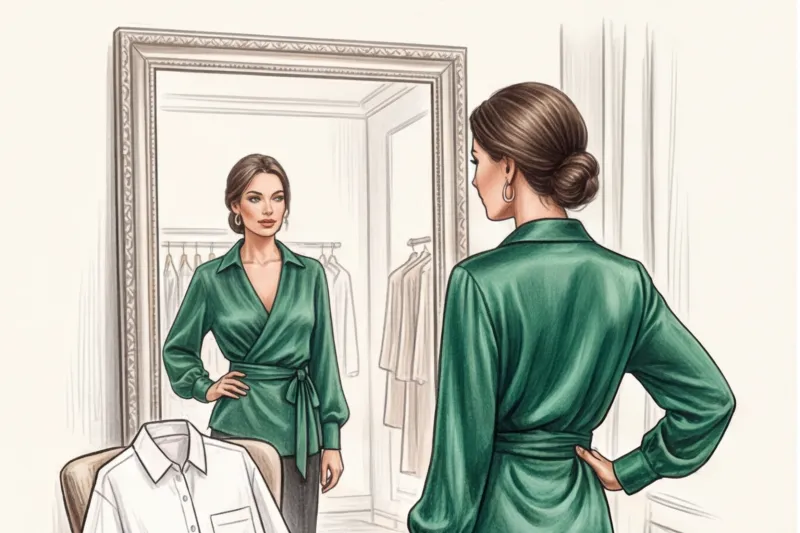
Let's be honest: if I see another article advising curvy women to "just cinch their waists with a wide elastic belt," I think I'll sue the author for fashion crime. This 2010s technique is not only hopelessly outdated, but it also physically "cuts" the torso in half, shortening the height and adding unnecessary bulk.
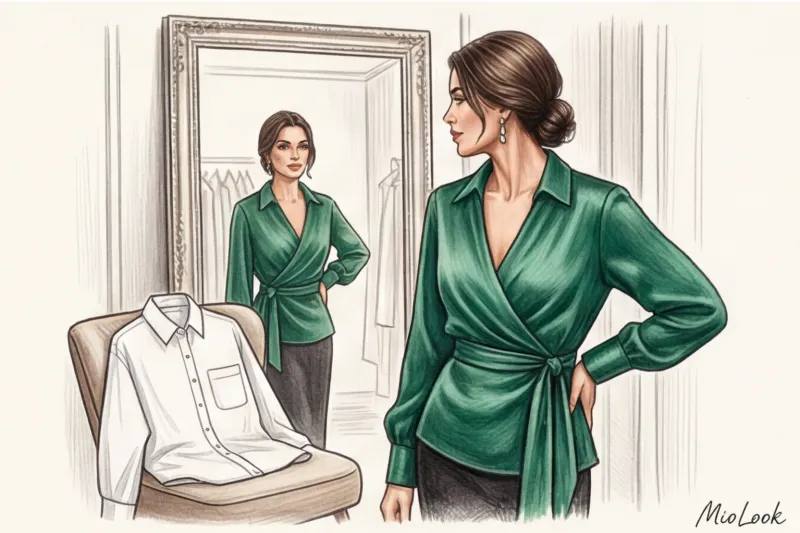
Hi, I'm Isabella Garcia. And as a stylist who adores the Mediterranean aesthetic, I offer a completely different approach. Your silhouette isn't a problem to be cinched with corsets. It's a luxurious architecture that requires the right materials. As we discussed in detail in our A complete guide to creating a capsule wardrobe for different body types , the secret lies not in rigid frameworks, but in flexibility.
Today we will assemble the perfect Basic wardrobe for an hourglass figure We'll use fluid fabrics, strategic darts, and the right proportions to allow you to wear even today's oversized trends while maintaining that effortless elegance.
Why a Rigid Base Doesn't Work: The Connection Between Body Architecture and Tissue
Over 12 years of practice, I've discovered one absolute rule: standard lists of "universal basics" are a lie. A classic, stiff white shirt made of thick cotton is the main enemy of expressive curves.
One of my clients, a top manager with a 35 cm waist-to-hip difference, hated business attire for years. In standard mass-market shirts (cut to straight patterns), her luxurious 11-inch bust visually transformed her entire torso into a solid 18-inch rectangle, completely concealing her graceful waist. Why is this happening?
Most brands tailor clothes for a "linear" body shape. But an hourglass figure is characterized by an "arc" shape. Stiff poplin or dense, pure linen will sit rigidly, ignoring your curves and creating a tent-like effect.
My main advice: clothes should fit, not cling. Instead of trying to squeeze your curves into the rigid architecture of a straight jacket, opt for soft tailoring, where the shape is determined by darts rather than the density of the cardigan.
The Anatomy of a Perfect Fit: Golden Rules for Expressive Curves
If dense tissues are not our friends, then who are our allies? The answer lies in the word fluidity (Fluidity). Silk, viscose with a density of 120 g/m² or more, Tencel, cupra, and fine merino wool. These materials are heavy enough to fall gracefully without creating excess bulk on the hips.
According to a report from the analytical agency WGSN (2024), the trend for "enveloping silhouettes" is currently dominating the runways, which is playing to our advantage. But there's one technique that only insiders know about— bias cut.
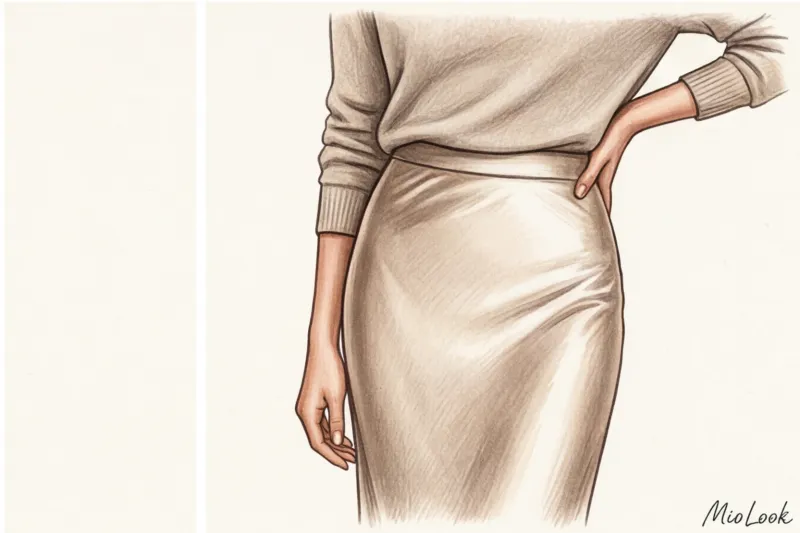
Invented by the legendary Madeleine Vionnet in the 1920s, this method involves cutting the fabric at a 45-degree angle to the warp and weft threads. The result? The fabric acquires natural elasticity. A bias-cut skirt will gently hug your hips and naturally narrow at the waist, requiring no elastic or belt.
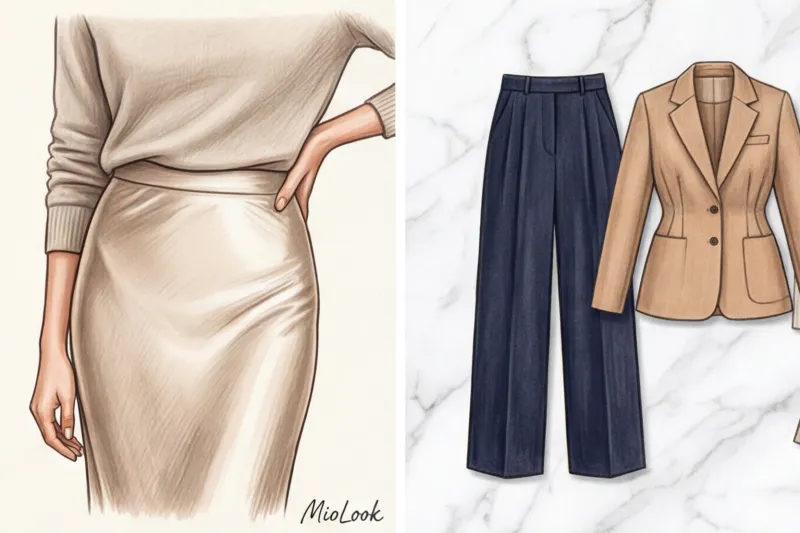
Always adhere to the "air rule." There should be 1-2 centimeters of space between your body and the fabric. This airiness creates a feeling of luxury and slimness.
The Myth of the Obligatory Belt: How to Accentuate Your Waist in a Modern Way
Now let's debunk the biggest myth. A belt isn't the only way to create a slimmer waist, and it's far from the best way.
Modern alternatives work much more subtly:
- Smell (wrap style): A diagonal line crossing the torso automatically visually narrows the waist.
- Color block: Contrasting color transition between the top and trousers right at the waistline.
- French tuck (half-tucked edge): Tuck in only the front of a blouse or thin sweater. This defines the waistline but leaves room for relaxed volume at the back.
Fair Limit: The French tuck technique does NOT work with chunky knit sweaters. They will create an unnecessary roll on your stomach.
Your perfect look starts here
Join thousands of users who look flawless every day with MioLook. Our AI stylist will help you create a capsule wardrobe tailored to your body type.
Get access — €0.99 onceA Basic Wardrobe for an Hourglass Figure: 12 Capsule Pieces
So, what does a modern, functional one look like? Basic wardrobe for an hourglass figure Here are 12 elements that will form the backbone of your new capsule. Please pay attention to the composition requirements.
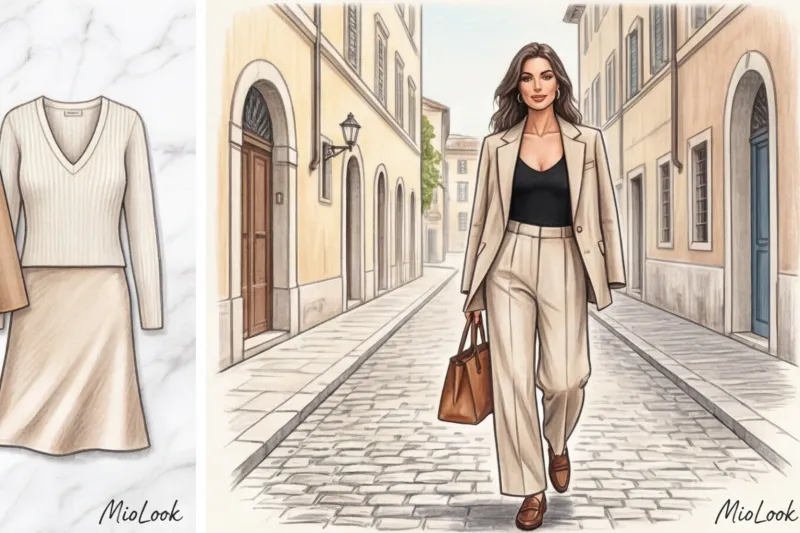
- Ribbed top with V-neck. The vertical texture elongates the silhouette, and the V-neckline lightens the décolleté. Look for a fabric with 2-5% elastane.
- Silk or viscose wrap blouse. Matte texture is preferable to glossy.
- Bodysuit with a square neckline. The perfect base that will never slip out of your pants.
- Single-breasted jacket with a fitted silhouette. Look for styles with pronounced darts under the bust.
- Thin cardigan with small buttons. Wear it as a standalone top on your bare body, unbuttoning a couple of buttons at the top and bottom.
- High waist palazzo pants. The fabric should be flowing (wool with added silk or viscose).
- Bias cut midi skirt. In shades of champagne, emerald or deep blue.
- Straight jeans made of soft denim. Be sure to add 1-2% elastane. 100% hard cotton won't shrink around your curves.
- Slip dress. Cut on the bias.
- Wrap dress. Made of dense matte viscose.
- Thin turtleneck-noodle. Made from merino wool (no squeaky acrylic).
- A short trench coat or robe coat. With a soft belt made of the same fabric.
Waist-Emphasis Looks from a Stylist
The things in your closet are just fabric. The magic begins when we arrange them into formulas. I adore these three combinations for their impeccable geometry.
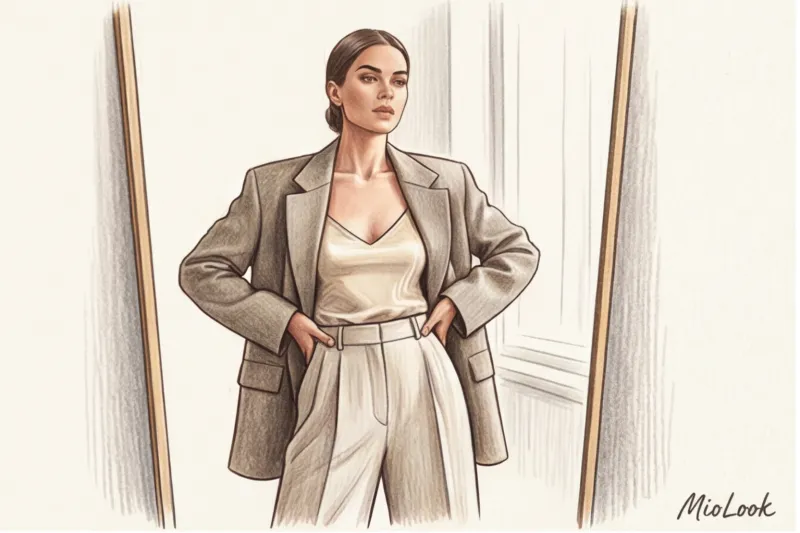
Formula 1 (Office): Palazzo pants + bodysuit + fitted open jacket
This style creates a powerful optical illusion. The two flaps of the unbuttoned jacket form a narrow vertical column in the center (where the bodysuit is visible). Your waist appears to be equal to the distance between the flaps. It looks incredibly elegant and formal.
Formula 2 (Mediterranean Chic): Bias-cut midi skirt + thin cardigan + loafers
Wear the cardigan barefoot. Fasten only the middle buttons, leaving the top and bottom unbuttoned. The unbuttoned bottom creates an inverted V just above your belly—the most flattering style for a figure with hips.
Formula 3 (Casual): Straight jeans + silk blouse + accent belt (2-3 cm wide)
Use the French tuck technique on your blouse. The belt here serves not as a cinching device, but as a piece of jewelry—it creates a focal point. Choose a belt with a beautiful metal buckle in the €50–€100 range—it'll instantly elevate the look.
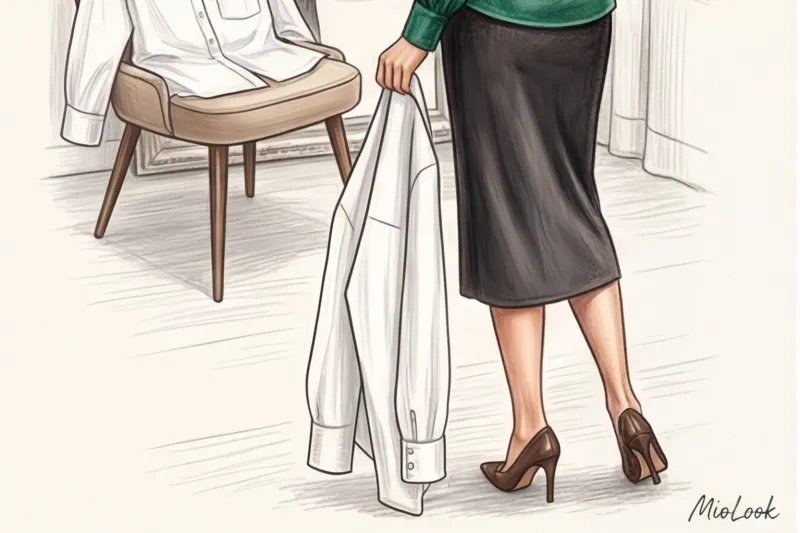
If you are unsure how these formulas will look from your specific items, take a photo of them and add them to MioLook app Its smart algorithms will help you assemble images with the correct proportions right on your phone screen.
The Biggest Mistake: How to Wear Oversized Dresses with an Hourglass Shape
There's a harmful stereotype: curvy women shouldn't wear oversized clothes, otherwise they'll look like "nightstands." Nonsense! It's allowed, but there are strict architectural rules.
One day, a client named Elena came to see me. She adored cozy, oversized sweaters but was afraid they would make her look heavy. She was wearing a sweater that ended at the widest part of her hips. I simply folded the hem up 5 centimeters—right down to her waist. Elena looked in the mirror and gasped: she'd visually dropped two sizes in a second.
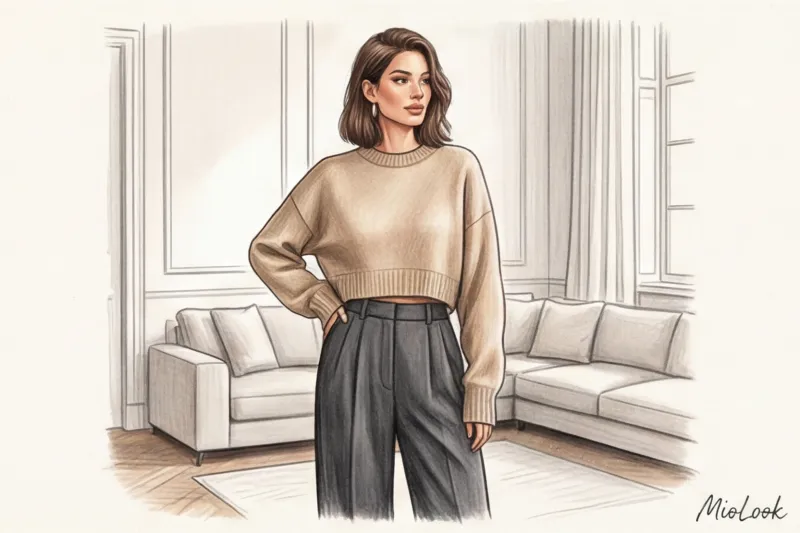
The one-zone rule: If you choose an oversized top, it should end right at the narrowest point of your torso—your waistline.
Wear cropped, oversized sweaters with high-waisted trousers.
If you want to wear an oversized men's shirt, try the "pinch" trick. Roll up the sleeves to show off your slender wrists (the most graceful part of your hand), and tuck only one half of the shirt into the front of your trousers. Let the other half hang loose. You'll maintain a relaxed vibe while defining your waist.
Access to MioLook for €0.99 — one-time payment
A smart AI stylist will select the perfect outfit from your clothes based on your body type. Forget about the "nothing to wear" problem.
Get access — €0.99 onceInvesting in Planting: Why a Studio is Your Best Friend
Ever notice that telltale waist gap when you put on jeans? They fit perfectly through your hips, and you can fit your fist through the back of your waist.
According to statistics, approximately 70% of women with pronounced curves regularly face this problem. Mass-market brands standardize their patterns. They are physically unable to produce a style that will perfectly match your unique curves.
Stop trying to squeeze into a smaller size for the sake of your waist (this will only create folds on your hips). Buy pants and skirts. strictly according to the hip size. And then take them to the studio.
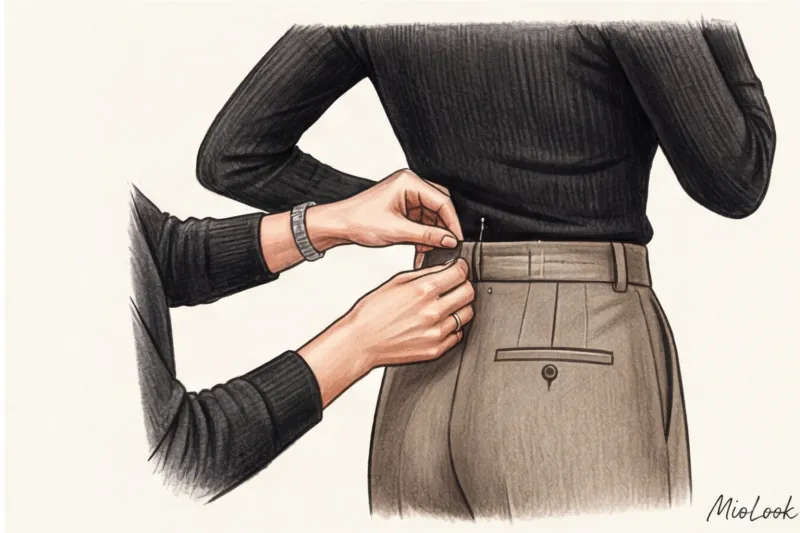
In Europe, having a trouser waist taken in costs between €15 and €30 on average. For this small amount, you get a bespoke tailored fit. A pair of €40 trousers from Zara, tailored to your waist in a tailor's shop, will look like a pair of luxury trousers for €400.
Checklist: Reviewing Your Wardrobe
It's time to get practical. This evening, open your closet and do a quick three-step inventory:
- Hardness test. Get out all those straight jackets, stiff polyester sheath dresses, and thick turtlenecks that are too stiff. Put them away. They don't enhance your beauty.
- Search for verticals. Leave behind V-necks, bias-cut skirts, soft cardigans and full-length trousers.
- Shopping list. If you need to start updating your wardrobe from scratch, buy just three items: the perfect palazzo pants (take them to a tailor immediately!), a silk wrap blouse, and a top with the perfect square neckline.
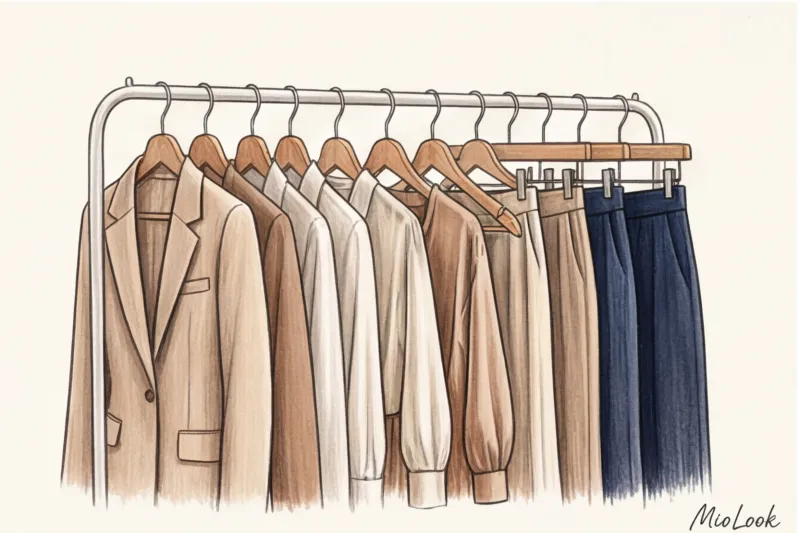
Remember the most important thing: your figure is flawless right now. If a garment doesn't fit you well, it's not a problem with you—it's a problem with the designer's patterns. Clothes should complement your curves, highlighting your natural femininity and curves. Choose fabrics that dance with your body, and you'll always look stunning.