Imagine a familiar situation: you've read a glossy article, calculated with a tape measure that you're pear-shaped, and obediently go looking for the recommended A-line dress. In the fitting room, you try on a stiff cotton number that, by all rights, should have concealed your hips, but instead, it stiffens up, transforming you into a monumental statue and visually adding 10 kilograms. Sound familiar?
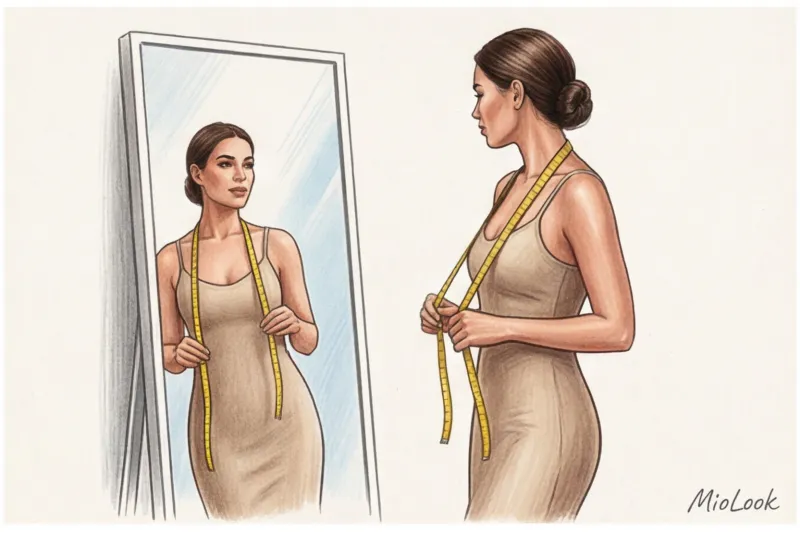
In 12 years of working with patterns and fabrics, I see this mistake every week. The problem isn't your figure. The problem is that traditional stylist advice ignores the most important thing: there is no such thing as a one-size-fits-all cut. The ideal basis is an equation that takes into account not only the geometry of your body but also the physical behavior of textiles in motion. That's why properly selected dress styles by body type depend on the density of the fabric no less than on the darts.
We talked about the systemic approach to the capsule in more detail in our A complete guide to a basic wardrobe based on your body type , and today we'll look at the most complex and most important piece of clothing in a woman's wardrobe—the basic dress.
Forget about "apples" and "pears": a new approach to body analysis
Let's be honest: the fruit typology is hopelessly outdated. Not only does it stigmatize women (who likes to associate themselves with a round apple?), but it also completely ignores the dynamics of the body. When choosing dress styles based on body type, we should look not at the circumference in centimeters, but at vectoriality your lines.
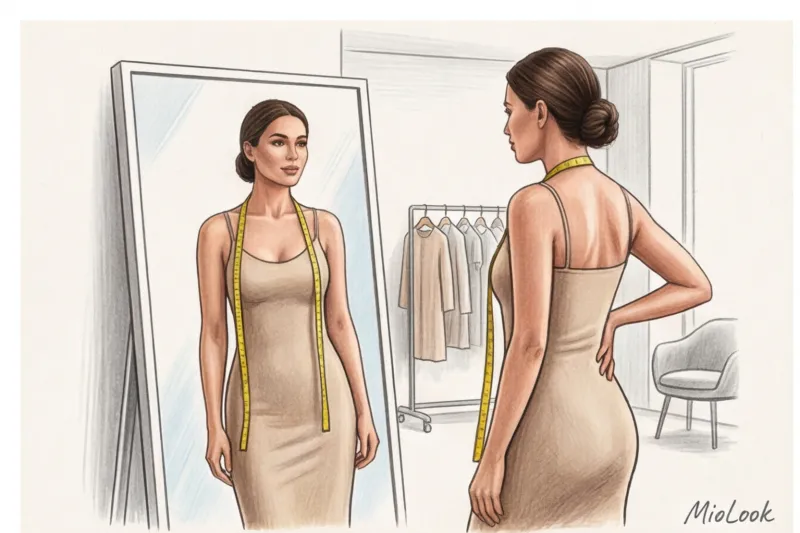
My experience analyzing over 1,000 wardrobes shows that women know their sizes, but they can't see their body shape. I divide body shapes into two main vectors:
- Linear vector: a predominance of right angles, sharp shoulders, flat or athletic buttocks, and prominent collarbones (what used to be called a rectangle or inverted triangle).
- Round vector: smooth transitions, defined hips, full bust, sloping shoulders (hourglass, pear, oval).
A pattern on paper is just a drawing. But fabric is a building material. You can't build an elegant bridge from soft clay, just as you can't sew a fluid, seductive dress from stiff canvas.
Access to MioLook for €0.99 — one-time payment
A smart AI stylist will select the perfect look based on your body structure.
Get access — €0.99 onceHow Fabric Controls Silhouette: The Hidden Physics of Clothing
Differences in fabric density dramatically alter the fit of the same pattern. Let's take the GSM (grams per square meter) parameter. A shirtdress made of lightweight viscose (120 GSM) will flow along the body, delicately outlining curves. The same dress made of dense poplin (250 GSM) will create a rigid frame around the body.
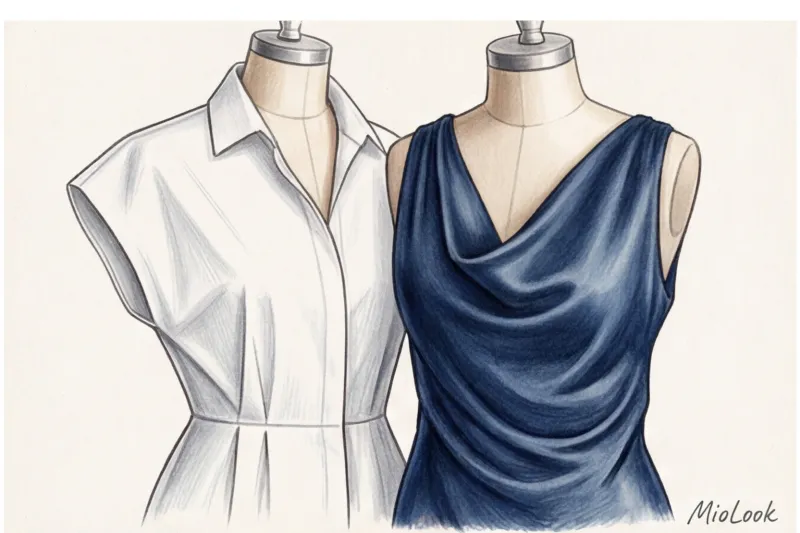
"Fit is a dialogue between gravity, the direction of the thread, and the curves of the human body. One cannot work without the other," according to the Fashion Institute of Technology (FIT) principles of garment design.
The rule of balance is as follows: rounded shapes require flexible fabrics (viscose, heavy silk, crepe marocain, Tencel) that will curve around the volumes without creating a tent-like effect. Linear shapes, on the other hand, require form-building materials (heavy cotton, coated linen, taffeta, suiting wool) that will complete the architecture where it's lacking.
A separate secret of the designers is the bias cut, where the fabric is cut at a 45-degree angle to the grain. Research by specialized design institutes confirms that this technique gives non-elastic fabrics (such as 100% silk) micro-stretch properties. This dress literally adapts to your weight fluctuations of just a few kilograms.
Dress Styles by Body Type: Finding Your Architectural "Base"
Now let's put this physics into practice. As a stylist, I'm categorically against blindly copying trends. Your base should serve you, not you serve it.
For a linear vector
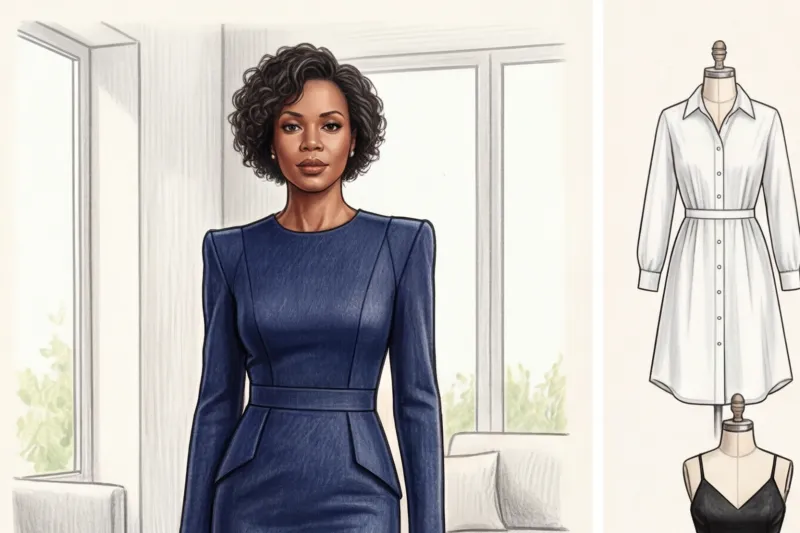
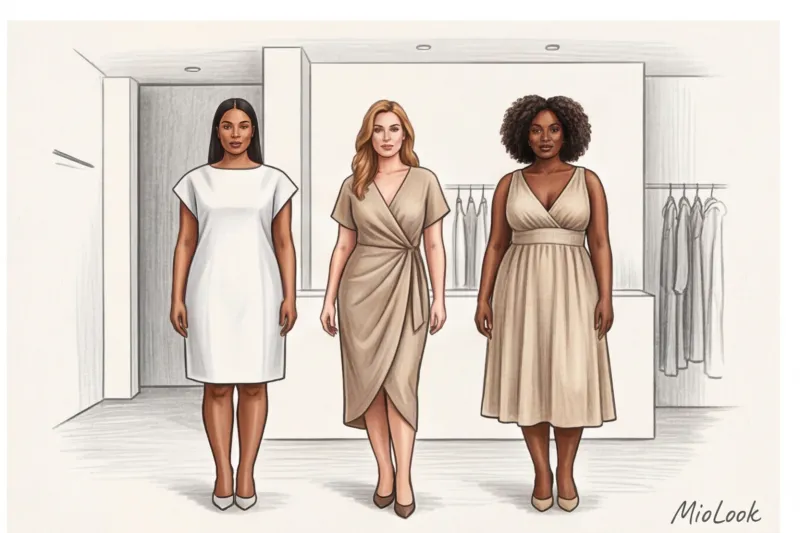
If your figure is dominated by straight lines, your ideal base is an architectural one. Shirt dresses made of thick cotton (look for at least 180 g/m²), jacket dresses, and straight cuts with dropped shoulders are recommended. These styles create a clean, luxurious silhouette. Brands like COS or Massimo Dutti (in the €100-€150 range) rely on this type of base.
For a round vector
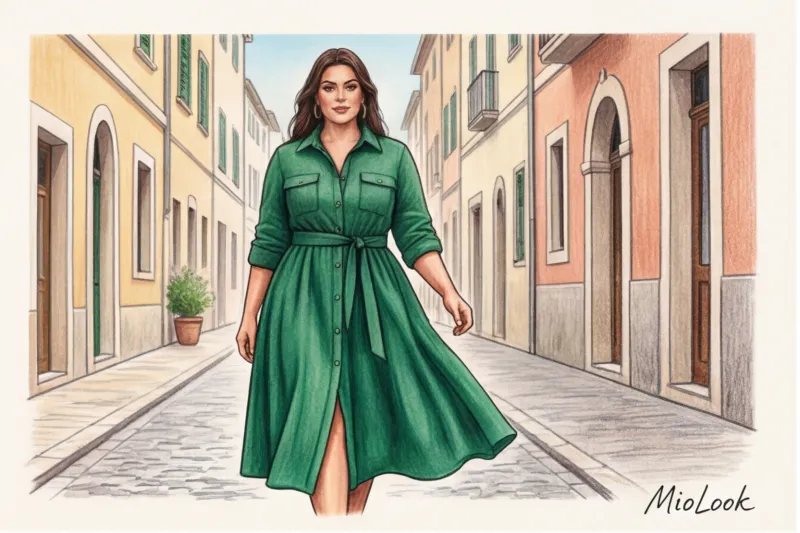
Here, extreme oversize is contraindicated. One of my clients, who has a luscious 4D bust, constantly wore thick, cocoon-like dresses, believing they "hidden" her excess. In reality, the thick fabric puffed out at the chest and fell at a right angle, adding visual bulk to her back and stomach. We replaced this with bias-cut slip dresses and wrap dresses made of heavy viscose. The result? A visual reduction of two sizes.
For the dominant center (emphasis on the stomach)
If your volume is concentrated in the center (previously known as the "apple" shape), you'll want cocoon dresses made of soft, flexible wool or empire-style dresses (with a slightly high waistline). The key here is a deep V-neckline, which breaks up the horizontal volume of the chest and elongates the neck.
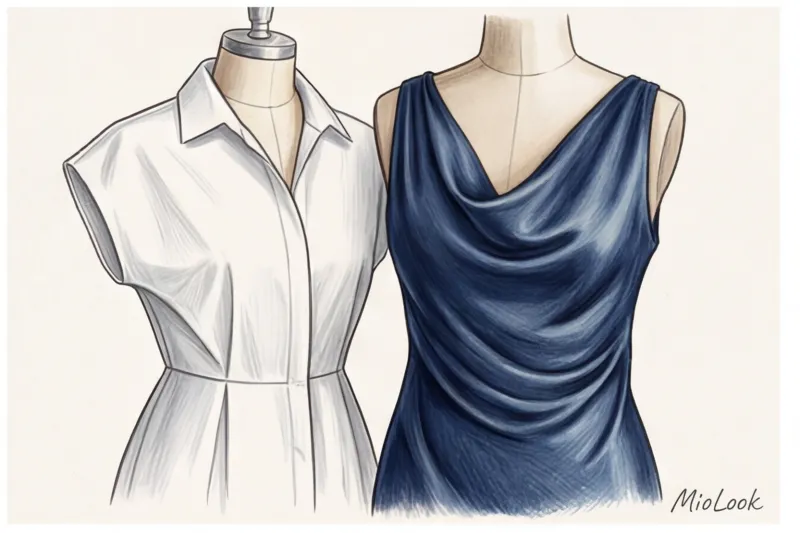
When this advice does NOT work: A flowy cut won't flatter a curvy figure if you've chosen cheap 100% polyester. This fabric will attract static, cling to your tights, and highlight even the slightest unevenness. Look for blended fabrics or add a high-quality antistatic agent.
The Biggest Fashion Myth: Why the Little Black Dress Isn't for Everyone
It's time to dispel one of the most persistent misconceptions that glossy magazines have been hammering into us for decades: "Every woman should have a classic little black sheath dress in her wardrobe."
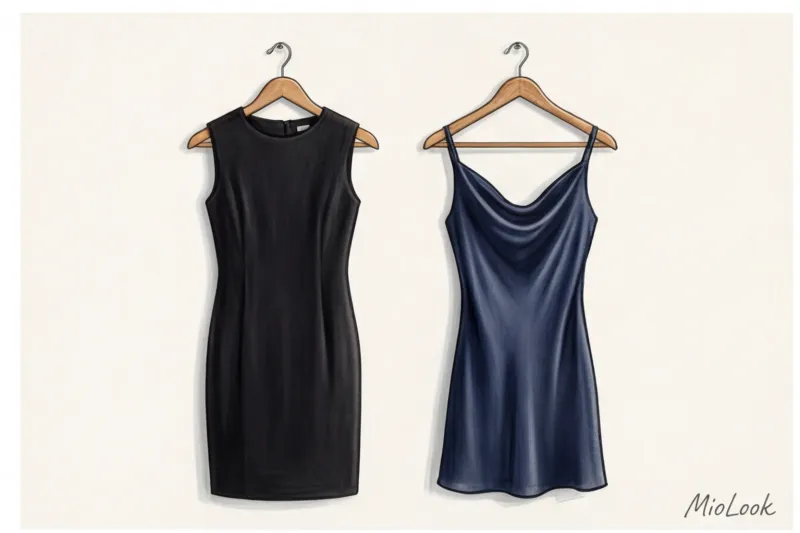
As a practitioner, I can tell you: a stiff sheath dress is unattractive for 60% of women. It demands perfect proportions, absolute symmetry of shoulders and hips, but in everyday life (especially if you're sitting in an office for eight hours), it only causes discomfort, gathering in folds on your stomach.
Moreover, black is a tricky color. According to the laws of color theory, black absorbs light. If your dress is made from budget fabric (under €50), black will immediately highlight the cheapness of the texture, quickly fade after three washes, and make the look flat.
What to choose instead?
Opt for a fluid, semi-fitted dress in complex, deep shades: dark chocolate, navy (deep blue), graphite, or emerald. These colors work as a base palette, but reflect light much more elegantly than black. To create a status evening look This dress will work a hundred times more effectively than a hard sheath.
Your perfect look starts here
Join thousands of users who look flawless every day with an AI stylist.
Get access — €0.99 onceSustainable Fashion Checklist: How to Evaluate a Dress Before Buying
A basic dress is an investment. According to a 2022 report by the Ellen MacArthur Foundation, poorly fitting clothes are thrown away three times more often, which catastrophically worsens the environmental crisis. The strict Cost-per-Wear formula applies: a €150 dress only breaks even if you wear it more than 30 times.
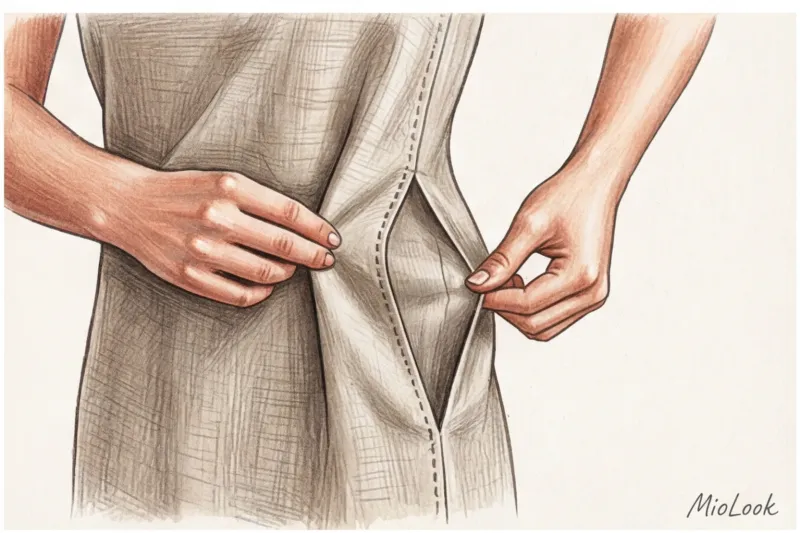
To ensure your item lasts for years in your closet, perform three essential tests right in the store:
- Seam tension test. Gently tug the side seam of the dress in different directions. If you see any gaps or loose threads, the stitching will break at the first awkward bend. A quality garment should have a stitch density of at least 3-4 stitches per centimeter.
- Tactile crash test. Squeeze the hem in your fist for 10 seconds. If the fabric is very wrinkled, this dress will make you look unkempt on the way to work. A good blended fabric (for example, 70% cotton, 25% polyamide, 5% elastane) will quickly return to its shape.
- Breathing test. Place the fabric against your lips and try to exhale air through it. If no air passes through, you'll sweat in this dress like a greenhouse.
Wardrobe integration: from everyday to status look
A true foundation is never boring because it acts as a blank canvas. One well-chosen dress should cover at least five life scenarios. This is especially important if you're collecting comfortable capsule or getting ready for a busy week.
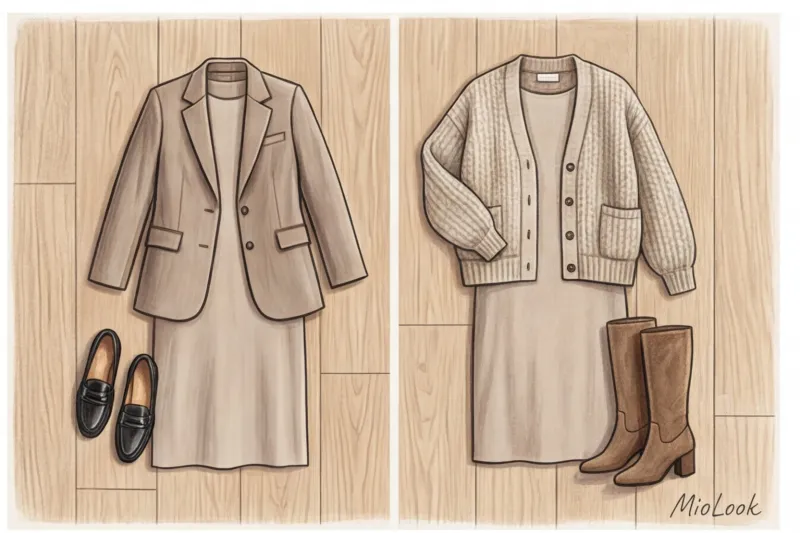
The secret to versatility lies in the length. Midi (a hand's breadth below the knee or mid-calf) is the safest and most adaptable length. It looks elegant with tall tube boots in winter (when the hem overlaps the shaft without cutting into the leg), pairs perfectly with classic pumps, and looks absolutely natural with white city sneakers.
For an office with a strict dress code, layer a structured double-breasted jacket over a basic slip dress—the contrast of flowing and stiff fabric always looks expensive. And if you're thinking, How to dress confidently and without mistakes for a date , it is enough to change the jacket for a voluminous, chunky knit cardigan, dropped on one shoulder.
Let's sum it up: the formula for your perfect basic dress
We're used to thinking that style is an innate talent. In reality, it's applied geometry and a little materials science. Stop squeezing yourself into the rigid confines of other people's must-have lists.
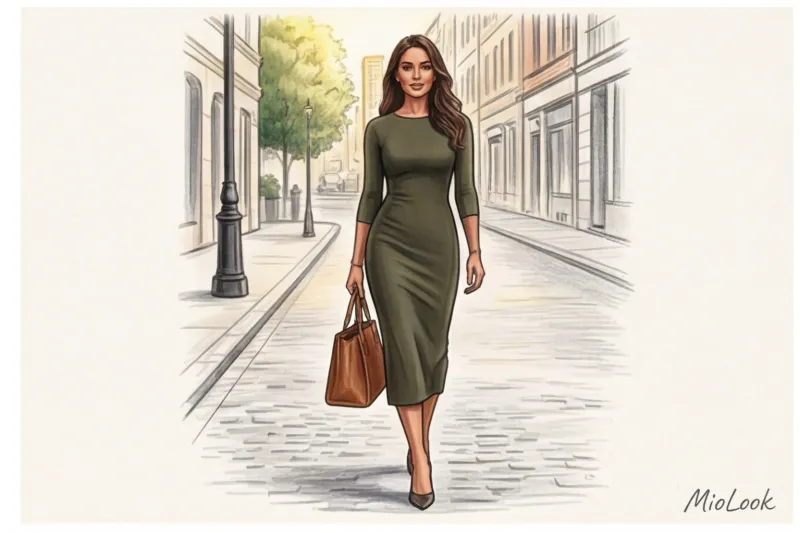
Your personal formula looks like this: Your line vector (sharp/smooth) + The right fabric density (holds shape/drapes) + Impeccable seam quality = The perfect basic dress.
As homework, I suggest you go through your dresses this evening. Put aside any that make you feel uncomfortable and analyze their composition and stiffness. You'll be surprised, but most likely, all the "unsatisfactory" items will be made of fabrics that clash with your natural structure. A conscious wardrobe begins with this understanding: clothes should serve a woman, not the other way around.