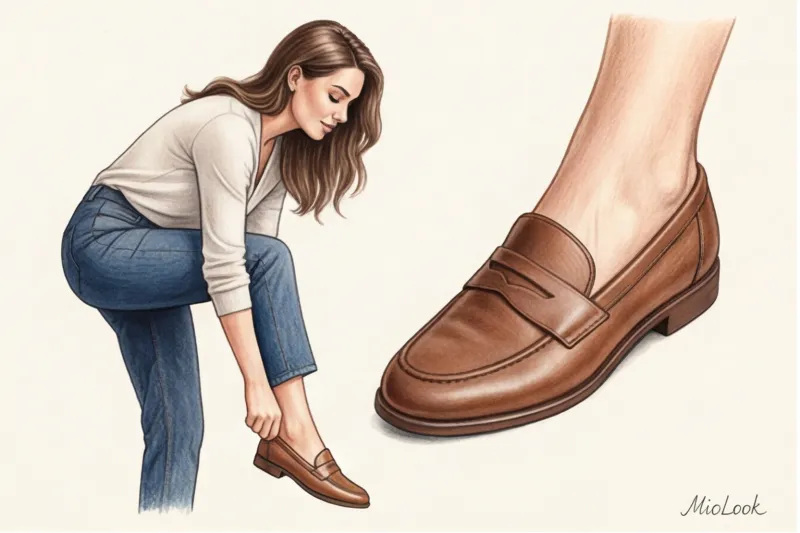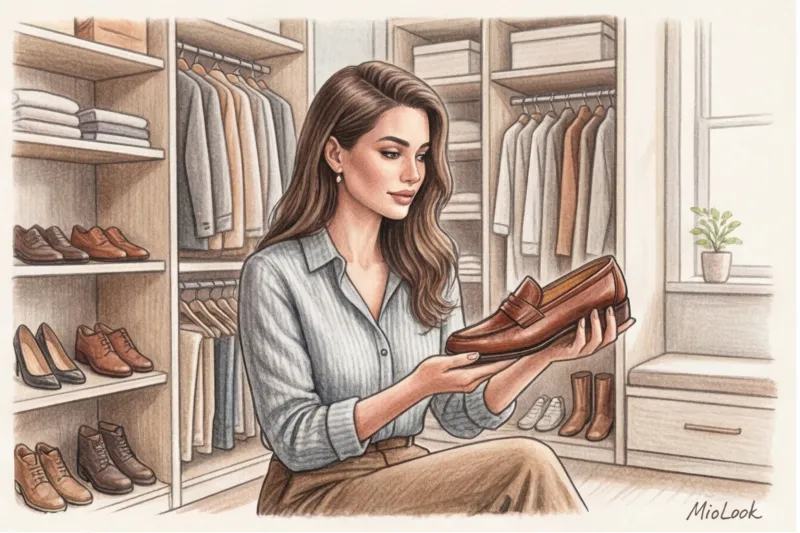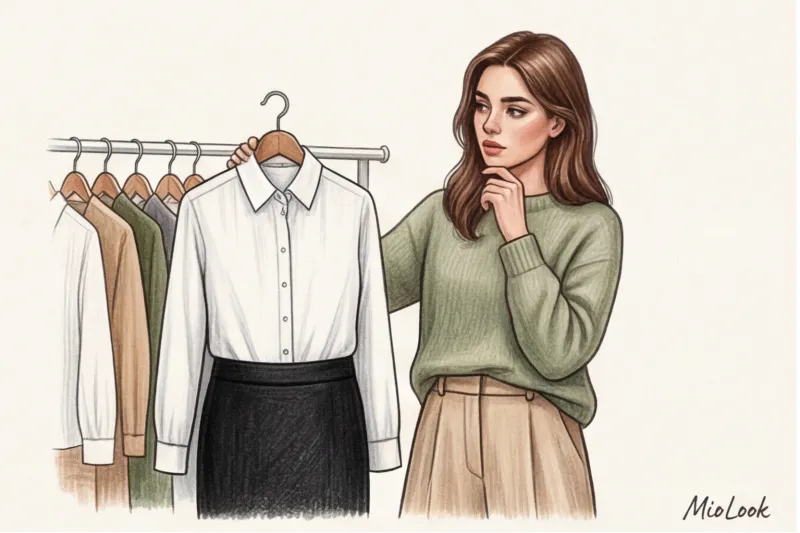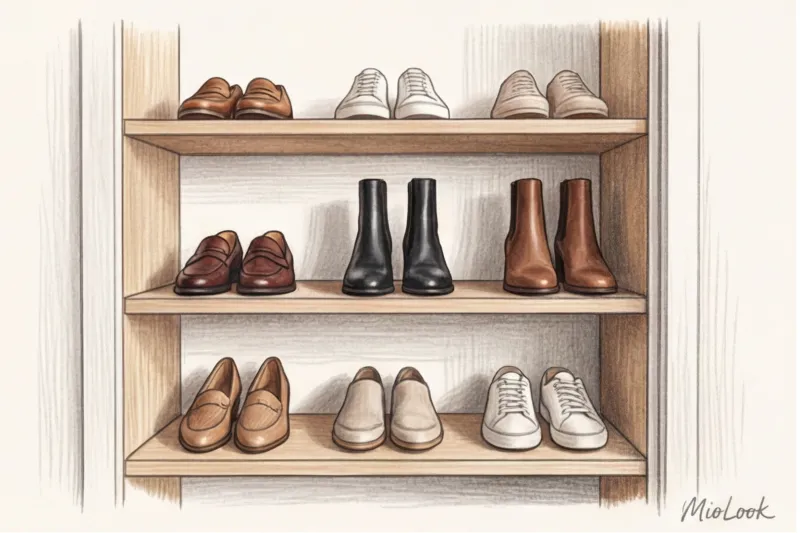
What is a modern basic shoe wardrobe?
Take a look at your closet. How many pairs of shoes are there right now? Based on internal statistics from our app users. MioLook Women regularly wear only 20% of the shoes they buy. The remaining 80% simply take up space, gather dust in boxes, and wait for that mythical "special occasion." A properly composed basic shoe wardrobe solves this problem forever, turning the morning chaos into a logical and manageable system.
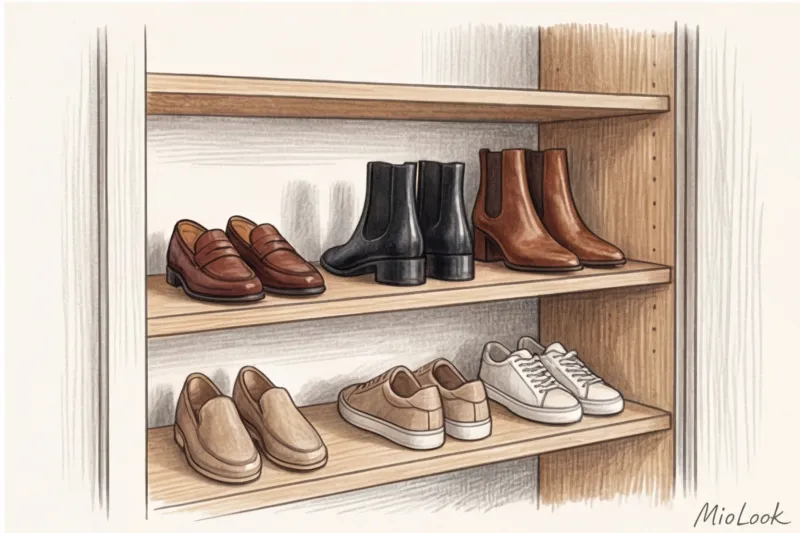
Glossy magazines used to convince us that every dress required its own unique pair of shoes. Today, the concept has changed dramatically. The modern shoe capsule is an uncompromising shift in focus from mindless quantity to functionality and 100% synergy with clothing. The perfect base doesn't steal the show, but rather functions as an architectural foundation: seamlessly tying together an outfit, whether it's a formal business suit or relaxed straight-leg jeans. I discussed the principles of building such systems in more detail in The Complete Guide to Creating a Capsule Wardrobe.
In my practice, I often encounter illustrative stories. Recently, I conducted a wardrobe audit with a client, Anna. On the shelves, we discovered 15 pairs of striking, but terribly uncomfortable, high-heeled shoes meant for going out. Meanwhile, her daily reality is managing an IT team, a hybrid work environment, and long commutes out of town. She was critically short of comfortable, stylish shoes. smart casual We removed 15 pairs from sight and assembled a working capsule of just 4 high-quality pairs that covered 100% of her real needs.
To avoid repeating the mistakes of others, calculate your personal "lifestyle index" before purchasing. Your baseline directly depends on how many steps you take per day and on what type of surface. If your usual route involves 10,000 steps on city cobblestones or hard asphalt, a classic thin leather sole will destroy both your feet and the shoes themselves within a month. In this case, the core of your shoe capsule should be models with shock-absorbing soles made of microporous rubber or thermoplastic elastomer, ensuring an anatomically correct foot roll.
And here we come to the main rule of conscious consumption—the Cost Per Wear (CPW) formula. Why do expensive basic boots end up being significantly cheaper than mass-market ones? Let's do the math. A cheap $50 pair of polyurethane boots will last a maximum of one active season (about 30 wears). The cost per wear is $1.60. Moreover, polyurethane doesn't breathe, creating a greenhouse effect, and the last quickly deforms beyond repair.
Now let's take a pair of high-quality leather Chelsea boots with durable welt stitching for $250. With proper care, they'll last you at least 5 years (approximately 300 wears during the off-season). The bottom line: just $0.80 per wear. A quality pair of basic shoes isn't a waste of money, but a smart investment in comfort, foot health, and the status of your look for years to come.
The Anatomy of a Quality Basic Pair: A Textile Expert's View
When someone brings me a €400 "investment" pair of boots that's irreversibly lost its shape after just one season, the problem almost never lies with the brand or improper wear. The error lies much deeper—in the architecture of the shoe itself. Over 12 years of studying textile technologies and shoe design, I've developed an automatic professional reflex: when I walk into a boutique, I immediately ignore the design and price tag. I begin to physically "feel" the shoe.
You can conduct this audit right now with your favorite pair. Invisible signs of quality always reveal themselves through tactile contact. First, check density of the back Grasp the heel of the shoe with your thumb and index finger and press firmly. In high-quality basic shoes, the heel counter is reinforced with thermoplastic or layers of stiff leather—it shouldn't give under your toes. A soft, pliable heel will inevitably cause the shoe to wear inward or outward, causing your foot to collapse, and causing an uneven gait.
Secondly, be sure to test flexibility of the heel A shank is a metal, wooden, or thick leather plate hidden inside the sole between the heel and the ball of the foot. Grasp the shoe by the toe and heel and try to bend it in half. If the sole easily folds right down the center (like a V), put the shoe back on the shelf immediately. According to the strict standards of the American Podiatric Medical Association (APMA), proper shoes should bend exclusively at the toe, exactly where your toes naturally bend as you walk. A lack of a rigid shank puts strain on the plantar fascia, leading to rapid foot fatigue and, in the long term, can lead to knee problems.
And finally, pay attention to quality of the insole Mass-market manufacturers love to skimp on this invisible area by lining the inside with pressed shoe cardboard (texon) covered with a thin layer of foam. With daily wear, the cardboard absorbs sweat, deforms, crumbles, and begins to emit an unpleasant odor. Real basic shoes, designed to last for years, always have a vegetable-tanned leather insole. It effectively wicks away moisture, has natural antibacterial properties, and over time, conforms to the unique anatomical contours of your foot.
Materials: genuine leather, vegan alternatives and eco-friendly
The foundation of any quality base is raw material that can age beautifully. In the footwear industry, there's a huge gap between full-grain (grain) leather and split leather, although both boxes can legally say “100% genuine leather”.
Full-grain leather preserves the outermost, most durable layer of the animal's epidermis, with its natural porous structure. It breathes, adapts to outdoor temperatures, and develops a luxurious patina over time. Good full-grain leather loafers in the $150 to $300 price range, with proper care, will last you for a decade. How can you tell them apart in a store? Look for the exposed leather cut at the edges. Full-grain leather will reveal a dense, top layer. Split leather, on the other hand, is the loose, lower layer of the hide that remains after the grain is removed. To give it a marketable appearance, the surface is coated with a thick layer of polyurethane and stamped with an artificial texture. Such a pair doesn't breathe, and after a year, the polymer film inevitably begins to crack and peel off in unsightly patches at the folds.
Let's be completely honest: the hidden truth about today's popular "vegan leather" is that 90% of the time, what the mass market is selling you is regular polyurethane (PU) or polyvinyl chloride (PVC).
From a textile chemistry perspective, it's pure plastic with a petrochemical base. Polyurethane isn't an environmentally friendly material. It takes centuries to decompose in landfills, creates a greenhouse effect on feet, and—most critical for a capsule wardrobe—is completely irreparable. If you deeply scratch genuine leather, a specialist can easily restore it with wax and coloring pigment. A scratch or scuff on a PU shoe means the item is destined for the trash.
When it comes to truly innovative materials—apple leather (AppleSkin), textiles made from pineapple leaves (Piñatex), or mushroom mycelium (Mylo)—the industry is making incredible strides. I've personally tested several pairs made from apple leather. They look great, but most plant-based alternatives still require the addition of synthetic resins and a polyurethane coating to stabilize the material. They're ready to become part of a statement summer wardrobe, but for heavy-duty everyday essentials (like autumn Chelsea boots that need to withstand puddles, road chemicals, and temperature fluctuations), dense vegetable-tanned leather remains the unrivaled leader in terms of sustainability through wearability.
Outsole construction and stitching: markers of durability
No matter how premium the upper material, the ultimate lifespan of a shoe is determined by the method of sole attachment. Three assembly methods dominate the modern industry, and your task as a conscious consumer is to learn to visually distinguish between them.
The most common method is - adhesive (cemented) The upper is simply glued to the sole. This is quick to produce and inexpensive, but completely short-lived. The glue dries out from moisture and temperature fluctuations, and once the sole wears out, it's impossible to replace. This is the technological norm for running shoes, but for classic basic shoes, it's a definite no-no.
Blake Stitch — This is the golden mean for elegant city shoes. The sole is stitched to the insole and upper with a single seam (you can feel this seam with your fingers inside the shoe). This type of shoe is incredibly flexible and elegant, perfect for loafers, minimalist oxfords, and summer brogues. A good shoemaker can replace the sole on a pair of Blakes, although this will require finding a workshop with the necessary equipment.
But the absolute standard of durability for a demi-season and winter base is welt stitching (Goodyear Welt) This is a complex engineering process: first, the upper and insole are sewn to a narrow strip of leather (the welt), and then the solid outer sole is stitched to this welt. The space between the insole and the sole is filled with natural cork chips, which over time form a perfect orthopedic mold of your foot.
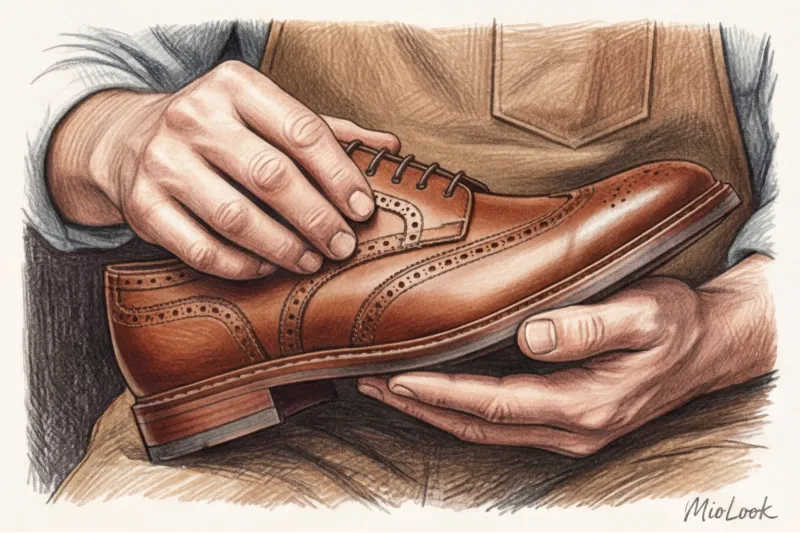
Why is resoleability so crucial for basic shoes? It's the pure mathematics of conscious consumption and smart wardrobe management. High-quality welted boots can last 15 years. During that time, you might wear the rubber soles down two or three times on the pavement. Instead of throwing away a perfectly fitting, worn-in pair, you take them to a shoe repair shop. There, the old sole is carefully ripped from the welt and a new one is sewn on. The upper remains completely intact. This is how you build a truly sustainable basic shoe wardrobe that lasts for years, rather than requiring a fresh pair every November.
Digitize your shoe capsule
Upload a photo of your high-quality basic shoes to MioLook, and a smart AI stylist will show you how to pair them to create dozens of new looks for any weather.
Create a smart wardrobeBreaking Stereotypes: Why Universal Lists Don't Exist
Remember those glossy articles from the 2000s with the uncompromising title "10 Pairs of Shoes Every Woman Must Own"? Spoiler: you owe them absolutely nothing. Trying to fit your routine into a template created by a fashion magazine editor ten years ago is the biggest mistake I see in new clients.
As a practicing stylist, I officially declare: the imposed "universal basics" only lead to you buying things for an imaginary, not a real life. A large-scale study of consumer behavior by McKinsey (2023) clearly shows the trend: the globalization of styles is giving way to micro-lifestyles. Therefore, I strongly suggest completely abandoning abstract checklists in favor of a concept. "personal uniforms".
A personal uniform is your own, tried-and-true formula for a look that perfectly suits your specific schedule, climate, and anatomy. For example, if your reality involves remote work, commuting, and long walks, your base would be technical sneakers and insulated Chelsea boots. To determine your true needs, I recommend recording your daily combinations through smart wardrobe feature in the MioLook app You'll be surprised how quickly the true shoe matrix will emerge, and how many "must-have" items you'll find completely unnecessary.
Counterintuitive insight: The more the industry insists on selling you a "classic must-have," the more likely it is to become dead weight on the top shelf. A quality essential is deeply selfish—it should serve only your comfort.
Let's dissect the most persistent myth: black stiletto pumps. For decades, we've been told they're the pinnacle of elegance and a ticket to any office. However, the reality is that a classic 8-10 cm stiletto heel is biomechanically unnatural. According to the American Podiatric Medical Association (APMA), regularly wearing such a heel inevitably leads to shortening of the Achilles tendon and forefoot deformity.
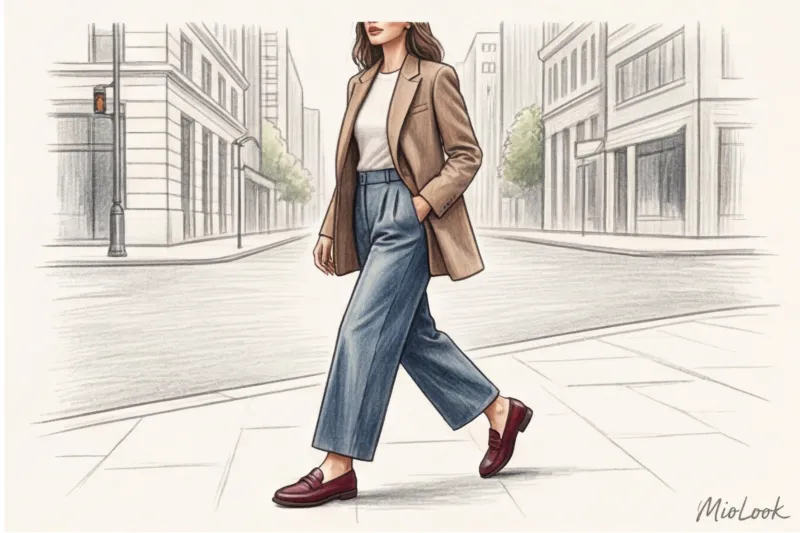
Today, even the most conservative corporate dress code doesn't require such sacrifice. Strictness and professionalism are perfectly conveyed by high-status leather loafers with a rigid frame, derbies, or elegant menswear-inspired brogues. They provide that perfect structure to the silhouette, add weight to the look, but still allow one to focus on work tasks rather than on foot pain.
Another stereotype that requires immediate revision is the mandatory presence of basic white sneakers. Yes, a crisp, crisp white pair, straight out of the box, looks stunning. But let's look at things from the perspective of a textile technologist: in a typical metropolitan environment with its dust and precipitation, white leather (especially with the now-common polyurethane coating) becomes irreversibly coated with ingrained dirt and micro-scratches within a couple of weeks. Nothing cheapens a look more than tired white sneakers with worn-out toes. The difficulty of maintaining them is colossal—it literally requires daily use of foam cleaners and white welt paint.
My professional solution? Invest in minimalist leather sneakers in muted tones. Complex shades—taupe, sage, dusty gray, dark beige, or deep khaki—work just as neutrally with trousers and skirts as white. Furthermore, from a coloristic perspective, soft graphite or taupe create a smoother visual transition to the ankle, without cutting into the leg with a contrasting spot. They are phenomenally practical: they don't show city dust, they age gracefully, and they eliminate the need to obsessively bleach seams after every outing.
The formula for the perfect shoe capsule: the 3x3 rule
In textile engineering and architecture, there's an unshakable principle: form should always follow function. Approaching shoe selection as an emotional shopping experience means consciously dooming yourself to morning stress and the "nothing to wear" problem. I propose eliminating chaos entirely and adopting a structured approach. It's based on a matrix, which in the styling profession we call 3x3 rule.
The essence of this formula lies in the intersection of three fundamental axes of your wardrobe. For a shoe capsule to be considered complete and functional, it must meet needs across three vectors:
- Three categories of situations: professional environment (office, business meetings), active city life (traveling around the city, long walks, shopping) and evening/social activities (theatre, dinners, exhibitions).
- Three levels of formality: strict (rigidly structured shapes, smooth leather), smart-casual (semi-rigid shapes, suede, broguing) and relaxed (utilitarian details, soft shapes).
- Three temperature modes: cold (below +5°C), transitional demi-season (from +5°C to +15°C) and warm (above +15°C).
The magic of this rule is that it mathematically calculates your ideal outfit. If you analyze your calendar and realize that you spend 70% of your time in "active city life + off-season" mode, that's where the lion's share of your shoe budget should go, not on buying a third pair of statement sandals for vacation.
The secret to 100% compatibility lies not in the universal black color, as many are accustomed to thinking, but in strict adherence to the concept of “visual weight” and proportions.
Shoes are the foundation of your silhouette. Heavy, voluminous garments, like wide-leg wool trousers or pea coats, require a solid base. Wearing lightweight ballet flats with thin soles underneath them will visually "topple" your figure, like a house without a foundation. Conversely, a flowing silk midi skirt paired with chunky hiking boots often looks less like stylish grunge and more like a simple misproportion.
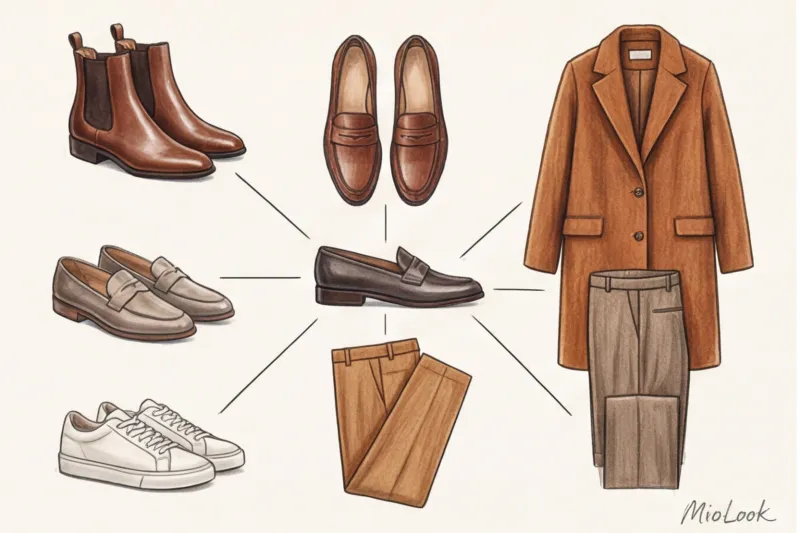
To ensure shoes fit perfectly with hems of varying lengths, it's important to control the width and height of the shaft. The golden rule of wardrobe design: between the hem of the garment and the top of the shoe or there should be no gap at all (the fabric covers the edge of the shoe) or this gap should open exactly the narrowest part of the ankle Never let your shoes end at the widest part of your calf—that's a horizontal line that instantly shortens your leg.
To avoid guessing in the store whether the height of the boots will match your favorite pants, I highly recommend loading your current items into the "smart wardrobe" feature in MioLook Artificial intelligence will help you visualize the length matching right on your smartphone screen, even before you pay the €250 bill.
Cold Season Base (Fall/Winter)
Winter and late autumn bases are always a compromise between surviving harsh conditions and maintaining elegance. Here, utility and proper geometry come to the fore.
To cover 90% of winter looks, it's enough to choose the right style to match your predominant bottoms:
- High tube boots (with a straight, loose-fitting shaft): This is a brilliant invention for lovers of midi skirts, dresses, and culottes. The hem of the garment should overlap the boot shaft by at least 3-5 centimeters. This creates a continuous vertical line. No nude tights should be in the gap.
- Chelsea boot with a tapered shaft: They pair perfectly with straight-leg and cropped trousers. The key is that the shaft should be narrow enough so that the leg can fall freely over it without catching on the edge.
- Brogues or derbies with thick soles: A lifesaver for fans of wide-leg jeans and palazzo pants. The chunky sole prevents the long legs from dragging in the mud and adds just the right amount of visual weight.
The choice of insulation is a separate issue. According to research by the Hohenstein Institute, natural sheepskin retains up to 30% more heat than synthetics. However, at ambient temperatures above 5°C, it causes localized overheating of the foot, leading to sweating and subsequent hypothermia outdoors. If your route consists of running from home to the car to a warm office, thick fur is simply not necessary. A lining made of thin flannel or natural wool is the optimal choice.
And remember: a smooth leather sole in winter is a surefire way to end up in a trauma center. For a basic winter pair, look for shoes with a high-quality polyurethane or rubber outsole (for example, with technology like Vibram), which won't stiffen and remains flexible in the cold.
Access to MioLook for €0.99 — one-time payment
Start creating perfect looks with the help of artificial intelligence and assemble your flawless capsule wardrobe.
Get access — €0.99 onceWarm season foundation (Spring/Summer)
In warmer months, breathability and lightweight design are paramount. In summer, we wear fewer layers, so shoes should be visually lighter to avoid overloading the look.
The core of the warm capsule collection is built around three styles: classic loafers, minimalist sandals, and low-heeled slingbacks. Slingbacks (closed-toe shoes with a strap over an open heel) are a sleek, modern alternative to the outdated, formal pumps. They maintain a formal look thanks to the closed toe (making them suitable for office wear with a dress code), but the open heel visually lightens the silhouette. I recommend choosing a micro-heel (kitten heel 3-5 cm)—it ensures a proper foot roll, unlike a completely flat sole, which can deform the arch over time.
Minimalist sandals made of thin leather straps are a versatile addition: they look equally at home with a linen suit in the city and with a flowing sundress on the embankment.
But the real workhorses of your wardrobe are transitional (all-season) shoes. Statistically, these last up to eight months a year. High-quality leather loafers (like classic penny loafers with a rigid frame) work flawlessly with stylistic contrasts. Try pairing tailored, form-fitting loafers with relaxed linen drawstring trousers. It's this contrast in texture and level of formality that creates that effect of expensive, classy casualness that's so hard to achieve with casual, trendy pieces.
Color and Texture: Going Beyond Black
According to the laws of color and optical illusions, the quickest way to ruin proportions is to wear contrasting black shoes with light-colored soles. The human eye scans a silhouette continuously from top to bottom. When the gaze "trips" on a solid dark spot at ankle level, a sharp horizontal line is created. If you pair a beige trench coat or light blue jeans with black ankle boots, you visually shave 5-7 centimeters off your legs. The look becomes flat, and the silhouette becomes squat.
The Pantone Color Institute's 2024 Primary Color Palette Report confirms a global shift: consumers are tired of utilitarian black. The minimalist aesthetic has evolved toward softer, more natural contrasts.
Four deep shades have become the new pillars of the shoe wardrobe: dark chocolate, rich burgundy (the color of ripe cherries), deep olive, and cool taupe. Why these? These colors offer less contrast compared to bare skin and light fabrics. They act as a neutral base while elongating the silhouette, creating a soft visual transition from the hem of trousers or skirts to the foot.
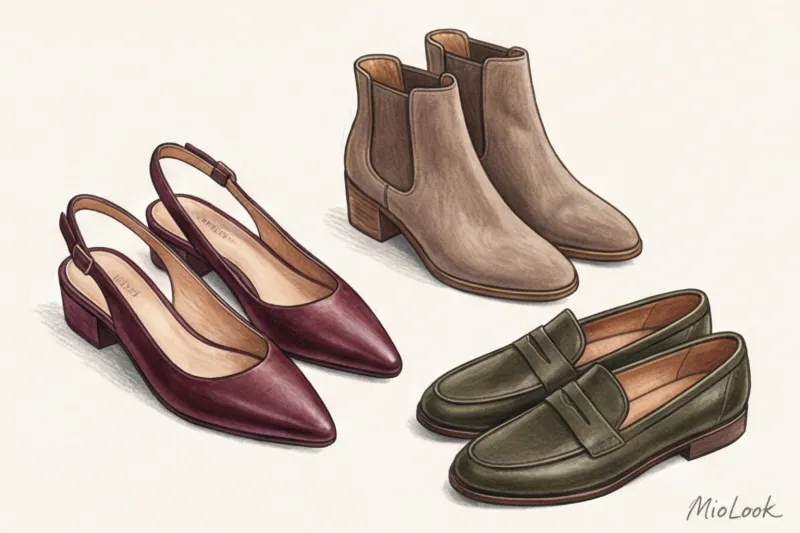
Integrating texture is the next, more advanced level of styling. Smooth black leather, especially in the mid-price range, often betrays its price due to its flat sheen. Suede works differently: its nap absorbs light, giving taupe or chocolate shades a refined, velvety depth. Consider the approach to materials at brands like The Row or Loro Piana—their everyday capsule collections are built on the textured complexity of soft suede, rather than on hard, glossy surfaces.
Another powerful tool for elevating the look of an outfit is crocodile-printed footwear. Simple loafers or ankle boots with this architectural texture, even at a price of $150–$200, instantly pull together an outfit. Imagine the simplest formula: straight blue jeans, a basic cotton T-shirt, and burgundy crocodile-print loafers. The shoes alone make this casual outfit look expensive and incredibly stylish.
To be fair, smooth black leather remains essential for a strict corporate dress code, but for smart casual it's often too formal. Before investing in your first color base, test combinations digitally. Upload a photo of your favorite light-colored trousers to MioLook Create a collage with potential pairings of olive or wine. You'll clearly see how these shades harmonize with items that previously clashed with black.
Care and Repair: A Sustainable Approach to Your Shoe Wardrobe
The fastest way to ruin a pair of excellent €300 leather shoes is to regularly wipe them with a €2 express sponge from the local supermarket. As a textile and leather materials specialist, I often see a sad scene in the lab: high-quality leather (the top layer of leather) literally suffocating under a layer of cheap chemicals.
Let's break down the physics of this process. Popular impregnated sponges coat shoes with a thick silicone film. Silicone doesn't nourish the material; it creates an optical illusion of shine by clogging the pores. As a result, the leather loses its ability to wick away moisture, dries out from the inside, and within a couple of months, develops deep, irreparable cracks at the points of greatest flex.
A truly eco-friendly wardrobe isn't about endlessly buying new pairs made from recycled plastic, but about properly maintaining what you already have.
Step-by-step instructions: how to properly nourish your skin
To ensure your basic pair lasts for years, I highly recommend implementing this weekly care ritual:
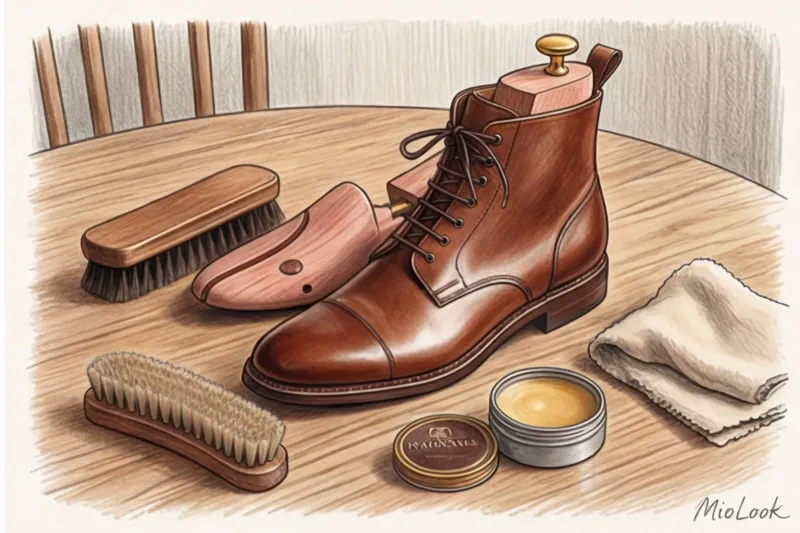
- Dry cleaning: Brush off dust with a stiff horsehair brush. Never apply the treatment to dirty shoes—this will literally rub the abrasives from the street into the leather.
- Deep nutrition: Use creams based on natural fats, almond oil, or beeswax (for example, from the professional lines Saphir or Collonil). They penetrate the dermis, maintaining its natural elasticity.
- Polishing and protection: After 15 minutes, when the cream is completely absorbed, polish the surface with a soft cloth and apply a water-repellent spray. no added silicone.
The Anatomy of Wear: The 24-Hour Rule and Shoe Trees
According to foot biomechanics research (WGSN, 2023), a person produces up to 200 milliliters of sweat during an active day. If you wear the same loafers every day, the lining simply doesn't have time to dry. The damp environment alters the pH inside the shoe, leading to thread rot and irreversible deformation of the frame.
From here follows the golden "rest" rule: Any pair needs exactly 24 hours of rest between wears. If you use the visualization feature in MioLook , plan your looks so that your shoes are always alternated. And she should spend this time exclusively on cedar shoe holders (blocks).
Why unvarnished red cedar? It's a brilliant natural tool. The wood acts like a microporous sponge, drawing excess moisture from the lining, while cedar's essential oils act as a powerful antiseptic, neutralizing bacteria. But most importantly, the last smooths out creases in the vamp and prevents the stiff heel counter from sagging.
Your ideal image
it begins Here
Join thousands of users who look flawless every day with MioLook.
Get access — €0.99 oncePrevention at the Shoemaker's: Staying Ahead
We're used to taking shoes to a repair shop only when the problem is critical: the heel has worn out or the toe has come loose. A sustainable approach requires a paradigm shift. Regular shoe maintenance is like car servicing.
- Timely roll-out: If your basic pair has a leather sole (a premium segment marker), you need to put a thin rubber sole to The first time I stepped onto the pavement, the leather soles wore down on the hard concrete after just a couple of weeks of active wear.
- Replacing the heels: Don't wait until the plastic or wooden heel cap is exposed. A worn-down heel cap changes the angle of your foot, which not only affects your gait but also physically damages the shank (the metal arch support) inside the sole.
By investing about €30 in high-quality shoe lasts and another €20 in basic shoe polish, you extend the lifespan of your shoes by three to four times. This isn't just a matter of caring for your shoes; it's the pure mathematics of a well-designed wardrobe.
Checklist: How to Conduct an Audit and Build Your Shoe Inventory
According to a large-scale consumer behavior study by McKinsey (2024), most women regularly wear only three or four pairs of shoes out of their entire arsenal, while the rest gather dust in boxes for years. To stop funding our closets and start investing in real comfort, we need not abstract shopping, but a rigorous, mathematical audit.
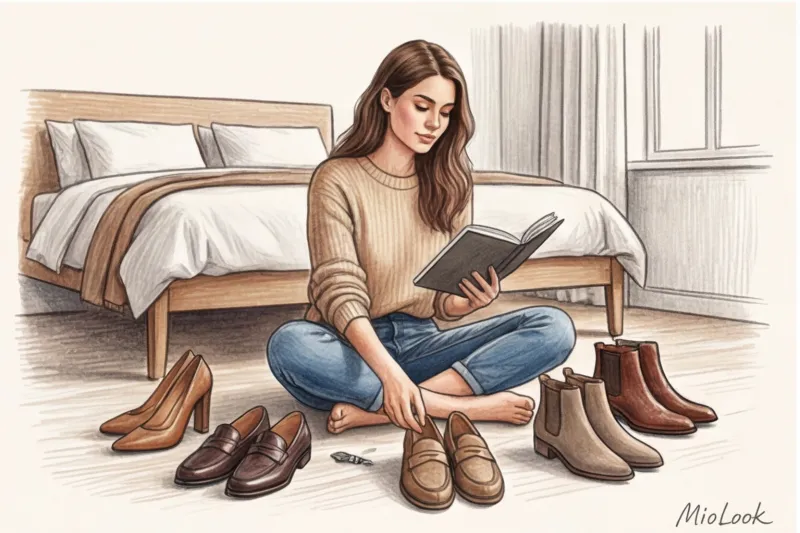
Step 1: Inventory and wear analysis of existing pairs
Take out all your shoes. Divide them into three categories: "wear constantly," "worn once or twice a season," and "waiting for repair or special occasion." Now take the pile of constantly worn shoes and turn each pair over. Physical wear is your most honest statistic.
The degree of wear on the heels, the asymmetry of the heel wear, deep creases on the vamp, and a depressed shank will reveal which last is really working for your foot. If three pairs of loafers are worn down to the ground, while your expensive, eye-catching ankle boots look like new, your stylistic priorities are obvious. Send your worn but high-quality leather boots to a specialist for restoration (preventative maintenance, insole replacement), and recycle synthetic shoes that have irreversibly lost their shape.
Step 2: Calculate the vital activity chart
My colleague, a London-based stylist and analyst, uses a great method: she asks her clients to map out their itineraries for two weeks. Split 100% of your time into sectors: for example, work, walks with the kids or dog, workouts, and social events.
If 60% of your routine consists of a formal office, 30% consists of brisk walks on park gravel, and only 10% consists of going to the theater or going out to dinner, your shoe collection should mirror these proportions. Buying a third pair of stilettos for 10% of your events is a financial crime against your budget. To automate this process, I recommend digitizing the remaining database after the cleanup. MioLook Visualizing your inventory on your smartphone screen instantly highlights imbalances: you'll immediately see if you're short in the "Everyday Walks" category and overflowing in the "Going Out" section.
Step 3: Create a prioritized shopping list
Now that you can see the blind spots in your chart, create a strategic purchasing plan. Divide it into two columns: where to invest and where to save.
- Where to invest: Shoes that cover the most intensive activity (at least 40% of your time). If these are mid-season boots for daily walking on asphalt, look for premium full-grain calfskin and durable welt stitching. The budget here can easily reach $300–$400. Considering the frequency of use, the cost per wear (CPR) will be mere cents, and the shoes will last for many seasons.
- What to save on: Pairs for short-term or specific occasions (those 10-15% of the time). Trendy metallic mules for a single summer or rubber boots for occasional trips out of town are safe bets in the mid-price range (around $50-$80).
With this checklist in hand, you'll have a reliable filter that will forever protect you from impulsive, unnecessary purchases during seasonal sales.
Conclusion
Shoes are the foundation. Literally, because they determine your posture, weight distribution, and gait, and metaphorically, because they define the architecture of your entire look. We've covered the anatomy of lasts, shoe-matching formulas, and care instructions in detail. But the key insight I want to convey in the final section isn't about shopping, but about psychology.
Many women who come to me for consultations are wary of the concept of minimalism. They think that giving up twenty pairs of impulsively purchased sandals will deprive them of their individual style. But in practice, the exact opposite occurs. Remember: A true basic shoe wardrobe isn't a limitation, but a liberation from the "nothing to wear" problem..
When your closet is stocked with Oxfords with the right arch support, impeccable Chelsea boots in a deep dark chocolate shade, and a pair of structured loafers, you stop wasting your mornings nervously trying them on. You know for sure that any of these pairs will work 100%. This dramatically reduces "decision fatigue"—a phenomenon that cognitive psychologist Barry Schwartz described as a side effect of choice overload.
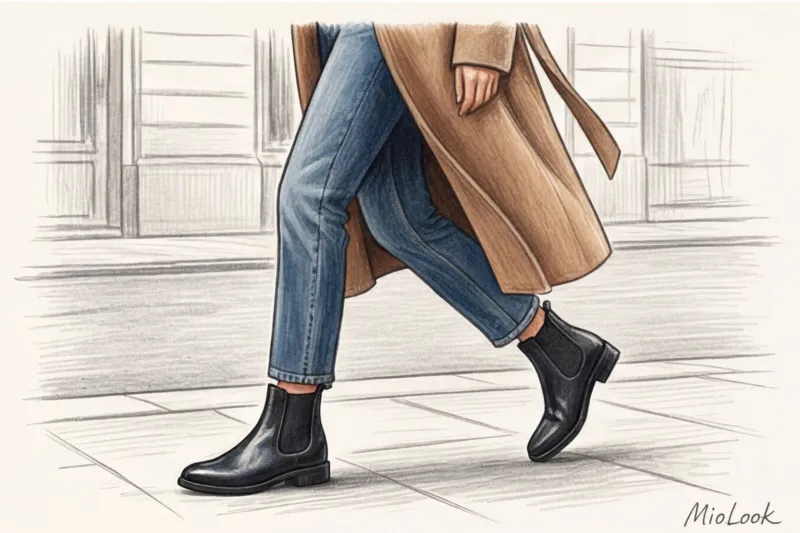
"It took one of my clients in the IT sector exactly a year to replace 18 pairs of uncomfortable mass-market shoes with four pairs of perfect shoes. At our last meeting, she confessed, 'Sofia, for the first time in my life, I pack a suitcase for a business trip in 10 minutes, just throwing in one pair of loafers and one pair of brogues, knowing they'll go with everything.'"
In the era of fast fashion, the industry has conditioned us to think of shoes as consumables: bought, worn for a season, and thrown away. According to the Global Fashion Agenda (2023), more than 22 billion pairs of shoes are sent to landfills worldwide every year. Due to the abundance of polyurethane (PU) and toxic adhesives, 90% of them cannot be recycled. My main a call for conscious consumption It sounds like this: it is better to have 3 ideal pairs that serve for years and are repaired than 10 pairs for one season.
Once you factor in the cost of endless replacements, three pairs of good boots (say, in the $250-$350 range each) with replaceable soles (Goodyear Welt or Blake) will cost you significantly less in the long run than buying $50 worth of polyurethane trends each year.
Our app's philosophy is built on this principle of sustainability and functionality. MioLook isn't designed to encourage you to buy more. On the contrary, its smart wardrobe feature helps you discover the hidden potential of what's already in your closet and make only targeted, strategic footwear investments.
Your action plan for the coming weekend:
- Don't rush to the store right now. Give yourself time to digest the information and wait for the emotional impulse to subside.
- Digitize those 2-3 pairs that successfully passed your home audit by adding them to your digital wardrobe.
- Create virtual combinations with your current clothes. You'll be surprised how few shoes you actually need to create dozens of flawless looks.
- Buy your first new pair only when you clearly feel a functional “hole” in your activity matrix.
Assembling a shoe capsule collection in one day is impossible—it's a process of testing, error, and fine-tuning to suit your unique lifestyle. But by starting this journey today, you're taking a huge step toward a smart wardrobe that works for you, not the other way around.
Ready to get started?
Try a free plan—no commitments. Digitize your shoes and start creating your perfect looks today.
Get access — €0.99 onceGuide Chapters
Investing in Style: Which Shoes Should You Skimp On?
Why do we spend half our salary on shoes for a corporate event but skimp on quality foundations? We'll break down with mathematical precision which shoes are worth investing in.
How to Properly Store Shoes: Saving Your Favorite Pairs
Got your favorite ankle boots, only to find them covered in creases and fading? We'll show you how to turn your off-season shoe care into a true "wardrobe spa."
Basic women's boots: chimney boots, over-the-knee boots or jockey boots?
Choosing fall/winter footwear is a matter of strict geometry and mathematical proportions. We'll explore how to find the perfect boots for your figure and everyday wardrobe.
Basic shoes for the office: stylish and dress-code-compliant
Forget about uncomfortable stilettos and the "beauty requires sacrifice" rule. We'll show you how to put together a stylish and comfortable shoe capsule for work.
Comfortable basic shoes for every day for women: choice
Why do we only wear 20% of our shoes? Learn how to choose the right pair of shoes to eliminate blisters and discomfort forever.
Universal shoe color: what to choose instead of black
Black shoes don't go with everything. Find out which color will truly tie your wardrobe together and visually lengthen your legs.
Basic women's Chelsea boots: a wardrobe staple
Tired of impractical shoes that only last one season? We'll tell you how one perfect pair of Chelsea boots can replace half your shoe rack and become a major investment.
How to choose the perfect basic white sneakers for women
White sneakers are no longer just sports shoes. We'll tell you how to choose the perfect minimalist pair that will complement any look.
How to match shoes to clothes: stylist tips
Forget the myth of the one-size-fits-all black shoe. We explore an architectural approach to styling and learn how to pair shoes with clothes like a pro.
Basic women's loafers: why they're essential in your wardrobe
Ditching shapeless shoes for structured classics changes everything. Learn how to choose the perfect loafers that will last for years and provide comfort.
The Perfect Basic Pumps: Heel and Color
Forget those uncomfortable black stilettos! We'll explore the anatomy of the perfect pair: how to choose the right heel, color, and toe for your body proportions.
Basic winter footwear for women: a stylish capsule collection
Forget compromising between warmth and style. Advice from a stylist with 12 years of experience will help you put together the perfect winter shoe capsule.
Basic summer shoes for women: from sandals to open-toe heels
We wear only 20% of our summer shoes 80% of the time. Learn how to stop wasting money on uncomfortable trends and build the perfect foundation.
Basic Autumn Shoes for Women: A Stylist's Guide
How many pairs of shoes do you really need this fall? We'll explore common mistakes when choosing fall footwear and put together a practical base.