Every fall, clients come to me with the same request: "Sofia, I need simple black boots to go with everything." And each time, I invite them to stop and look at their closet from a different perspective. Choosing fall/winter footwear isn't a question of color. It's about strict geometry, the anatomy of your calf, and the mathematics of your garment hems. Ideal women's basic boots They don't exist in a vacuum - they only work in conjunction with what you wear every day.
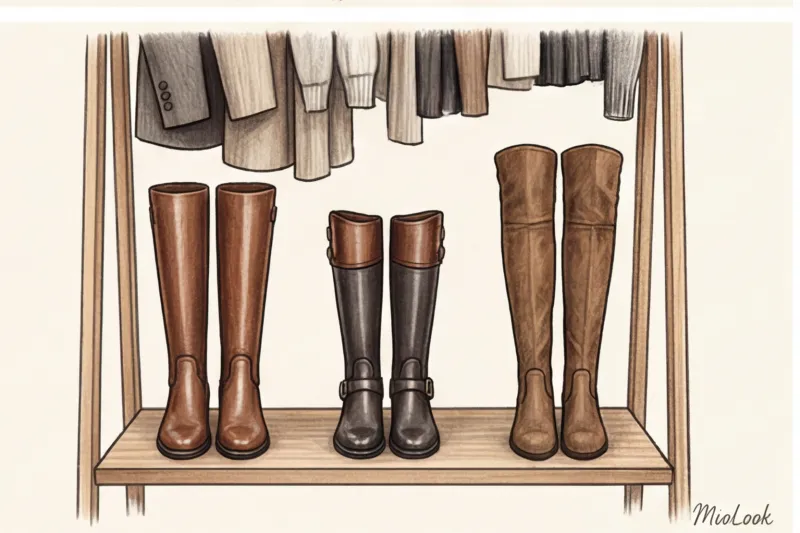
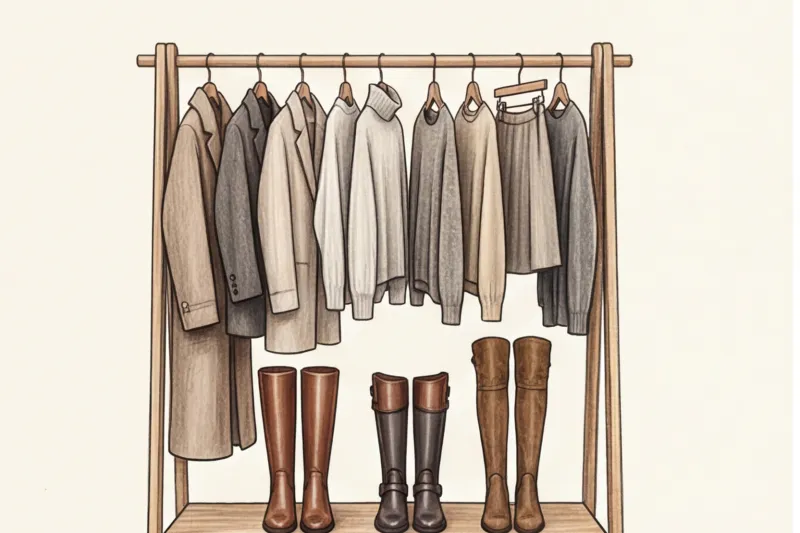
Instead of relying on standard glossy magazine advice, we'll take an engineering approach. We'll examine three key shapes—trumpets, jockey boots, and over-the-knee boots—through the lens of leather tanning quality, orthopedic load distribution, and visual proportions. We've already covered the architecture of a shoe wardrobe in more detail in our The complete guide to creating the perfect shoe capsule collection , and today we will focus exclusively on high shoes.
What makes a boot truly "basic"?
According to the MioLook app's internal statistics for 2023, 80% of shoes sit idle on shelves not because they're unattractive. The reason lies in a simple mismatch between the shoe last and the owner's "lifestyle index." If you commute by subway and walk 8 kilometers a day, a 7-centimeter stiletto heel will never be your basic shoe, no matter how elegant it looks in the fitting room mirror.
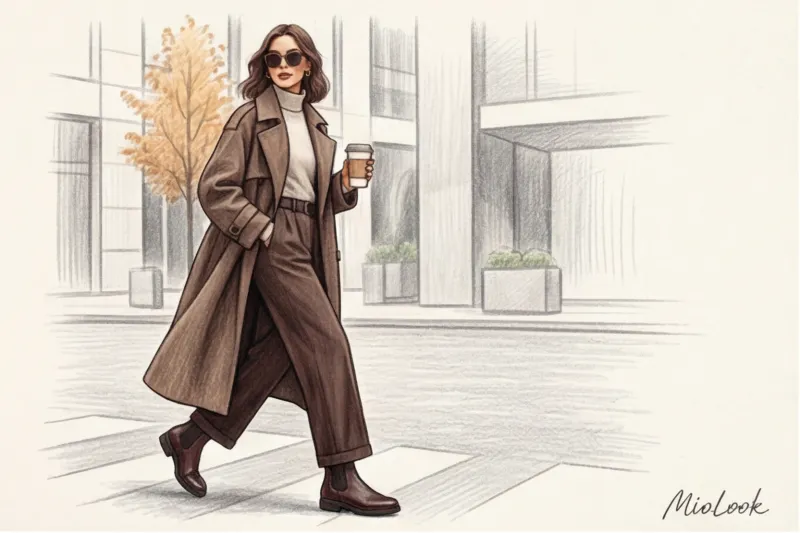
The first thing to discard is the "basic color equals black" myth. Black is the color of maximum contrast. If you wear black boots with a light beige coat and nude tights, you'll visually "cut" your leg into several blocks, shortening your height. In my experience, shades of dark chocolate, rich burgundy (oxblood), and cool taupe are three times more effective in a wardrobe. They create a soft gradient and look more expensive.
The basic shoe's architecture eschews overt embellishment. No accent buckles (unless they're classic jockey styles), contrasting stitching, rhinestones, or complex perforations. The clean toe shape (almond, soft square, or delicately pointed) and a stable heel are the two pillars that underpin this timeless shoe.
Your perfect look starts here
Join thousands of users who look flawless every day with MioLook.
Get access — €0.99 onceTube boots: a versatile geometric shape for a modern wardrobe
Tube boots are styles with a straight, loose shaft that's equally wide at the ankle and calf. Over the past five years, they've displaced fitted boots from must-have lists, and for good stylistic reasons.

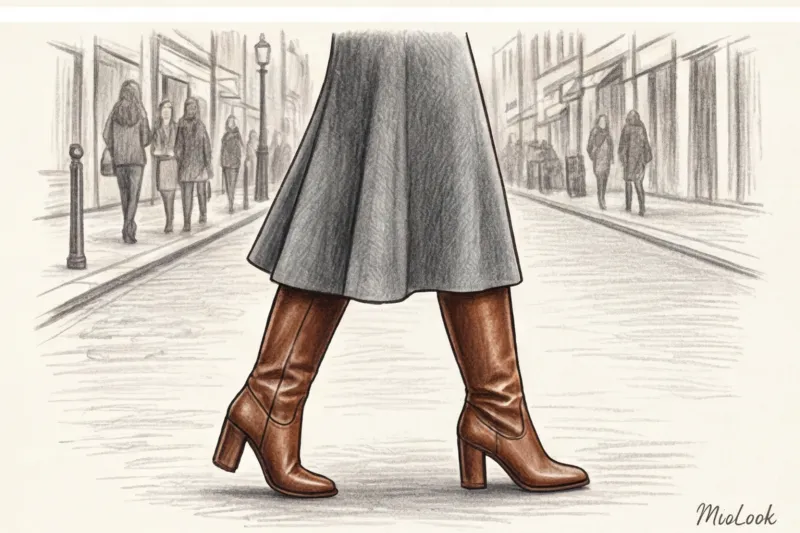
One of my clients, a top manager at an IT company, once bought a pair of luxurious, on-trend thigh-high boots, but she couldn't fit them into her wardrobe. Why? 90% of her closet consisted of thick, A-line midi skirts. The tight shaft under the wide hem created a "hut on chicken legs" effect—it visually disrupted the proportions, making her calves appear disproportionately thin compared to her hips. Once we replaced them with tube boots, the puzzle came together. The skirt hem smoothly overlapped the edge of the boot, creating a continuous, slimming vertical line.
How to choose the right boot shaft width and height
In style, there's a "2-3 centimeter rule." This is the amount of space that should remain between your shin and the top of your tube boots. This style math works to create an optical illusion: a wide boot shaft makes your leg appear more fragile and graceful. However, there's a fair limitation: if you have very thin calves, avoid overly wide tube boots (a gap greater than 5 cm), otherwise you'll create a comical "pencil in a glass" effect.
The boot should end just below the knee (at its narrowest point), without cutting through the widest part of the calf. If the boot ends mid-calf, it will visually add 3-4 kilograms to your weight.
Jockey boots: aristocratic comfort on a flat surface
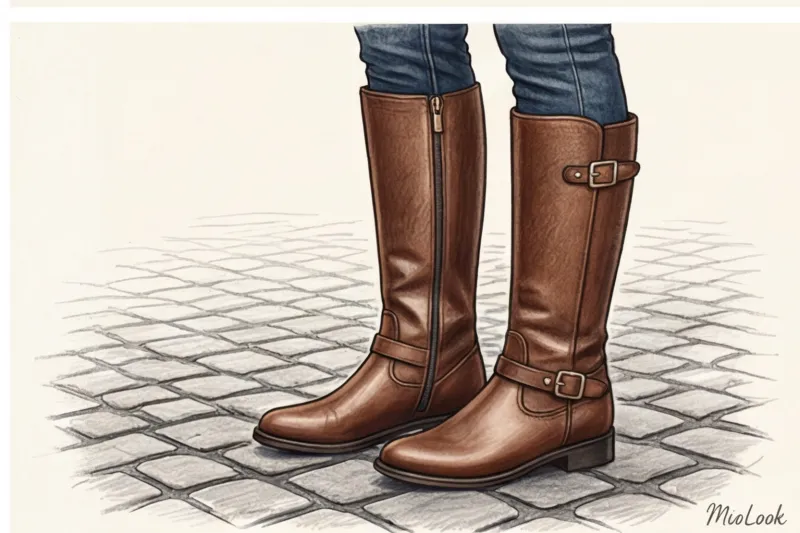
Equestrian boots originated in equestrian sports and have become firmly entrenched in the old-money aesthetic. Their distinctive features include thick leather, an asymmetrical shaft (slightly higher on the outside of the leg), and minimalist strap hardware.
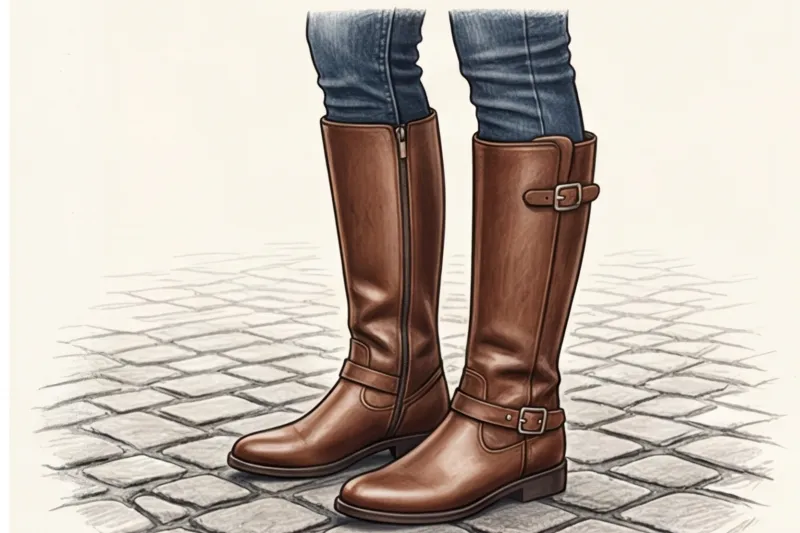
Beyond the obvious visual aesthetics, they have a powerful advantage that fashion bloggers rarely mention. According to the American Podiatrist Association (APMA), walking more than 10,000 steps daily on completely flat soles (like classic ballet flats or Ugg boots) leads to Achilles tendon strain and plantar fasciitis. Jockey boots have historically had a microheel height of 2-3 centimeters. This is the physiologically ideal instep, ensuring proper weight distribution across the foot.
They integrate seamlessly into everyday casual wear. This is the perfect pair for elegantly pairing thick leggings with oversized sweaters, skinny jeans, or knit dresses. If your office has a relaxed dress code, I recommend checking out our article. About smart casual for women , where we examine such combinations in detail.
The Secret to Longevity: Choosing the Right Leather
Over 12 years of working and regularly visiting Italian shoe factories in the Marche region, I've learned the most important rule: the durability of boots is determined by the type of tanning. Look for aniline or semi-aniline leather. It breathes, ages beautifully, and develops a noble patina.
Avoid corrected grain leather. This is low-quality leather, the top layer of which has been filed down and coated with a thick layer of polyurethane to conceal imperfections. These boots may look perfectly smooth in the store, but after just three weeks of wear, deep, irreparable cracks will appear at the folds. Also, pay attention to the markings. Leather Working Group (LWG) — This gold standard (especially the Gold and Silver categories) ensures that the use of toxic chromium in leather tanning is minimized and that production is environmentally friendly.
Access to MioLook for €0.99 — one-time payment
A smart AI stylist will select the perfect look for you, taking into account your shoe capsule.
Get access — €0.99 onceOver-the-knee boots: breaking stereotypes about "non-essential" footwear
It's commonly believed that over-the-knee boots are a flamboyant throwback to the 2000s, a footwear exclusively for parties or a statement piece. I'm willing to challenge this stereotype. In fact, flat suede over-the-knee boots are the most practical and warm staple for a winter wardrobe.

If your wardrobe consists of 70% dresses and skirts (especially mini or just above the knee length), over-the-knee boots will be your salvation in the cold. Suede boots with flat soles or neat chunky soles (no stilettos or hidden platforms!) work like warm leggings. They cover the entire leg, allowing you to wear your favorite dresses even in -15°C (-15°F) without resorting to thick wool tights, which often spoil the silhouette.
"The main rule for styling over-the-knee boots in your daytime wardrobe: there should be a minimal gap (no more than 5-7 cm) or a slight overlap between the hem of your dress and the top of the boot. As soon as you leave a wide strip of exposed leg, the look goes from cozy to provocative."
For more ideas on how to stay warm in style without losing your elegance, check out this article. About winter office style and the secrets of layering.
The Anatomy of Quality: A Stylist's Pre-Purchase Checklist
Even if the boots fit your style perfectly, poor craftsmanship can ruin all your efforts. Here's my personal checklist for shopping trips:
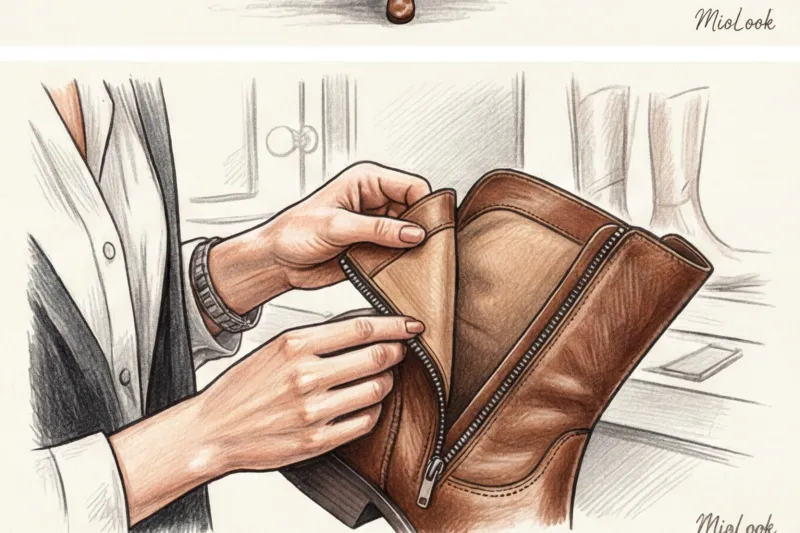
- Lightning test: In high-quality fall and winter boots, the zipper never extends all the way to the sole. It should end 1-1.5 cm above the edge. If the zipper is sewn flush with the sole, water will seep through the zipper's fabric tape the first time it gets wet.
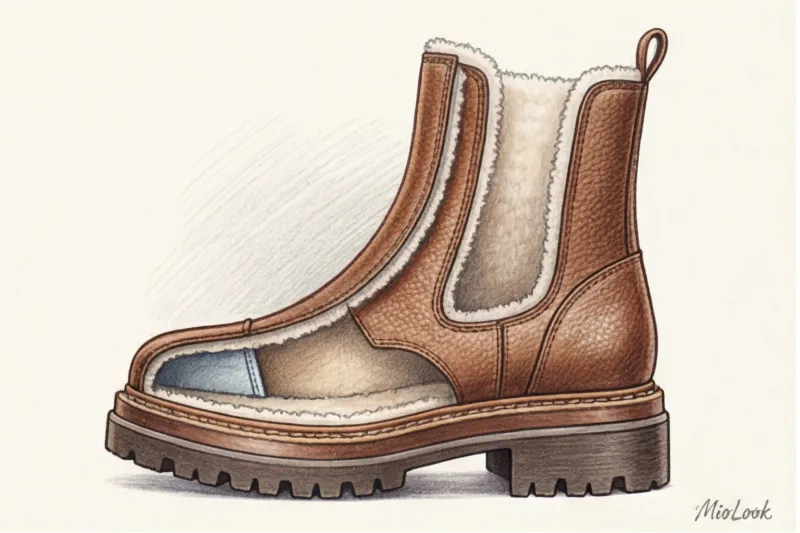
- Lining Rating: Avoid thick faux fur. It disrupts thermoregulation: feet sweat instantly indoors, and when you go outside, they freeze due to the moisture. The ideal choice is genuine flannel (for European winters) or shearling.
- Kink test: Take the boot in your hands and gently but firmly bend the toe upward (imitating a step). Look at the creases that form. If the leather wrinkles into small, hard creases, reminiscent of crumpled paper, it's low-quality split leather with a polymer coating. Good leather produces a soft, smooth wave that straightens out after unbending.
The formula for the perfect basic women's boots
To summarize, your choice shouldn't be based on seasonal trends, but on the math of your wardrobe. The formula is simple:
- Midi skirts and culottes dominate = Pipe boots.
- Skinny trousers, jeans and leggings dominate = Jockey boots.
- Short dresses and voluminous tunic sweaters dominate = Flat-soled over-the-knee boots.
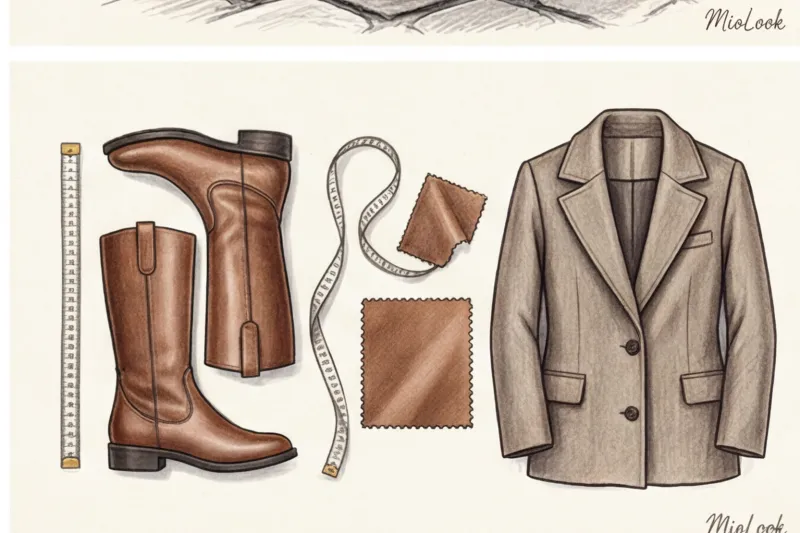
Don't be afraid to invest in quality footwear using a cost-per-wear calculation. A pair of $300 premium leather women's boots that you'll wear for three seasons in a row, 60 days each (180 wears total), will cost you $1.60 per day. A $100 mass-market pair that will lose its shape after a month of active wear (30 days) costs $3.30 per wear—double the cost in the long run!
To understand exactly what shoe geometry you need, digitize your closet in MioLook app When you see all your skirts, trousers, and dresses on one screen, artificial intelligence will help analyze the dominant silhouettes, making choosing the perfect pair of boots obvious and unmistakable.