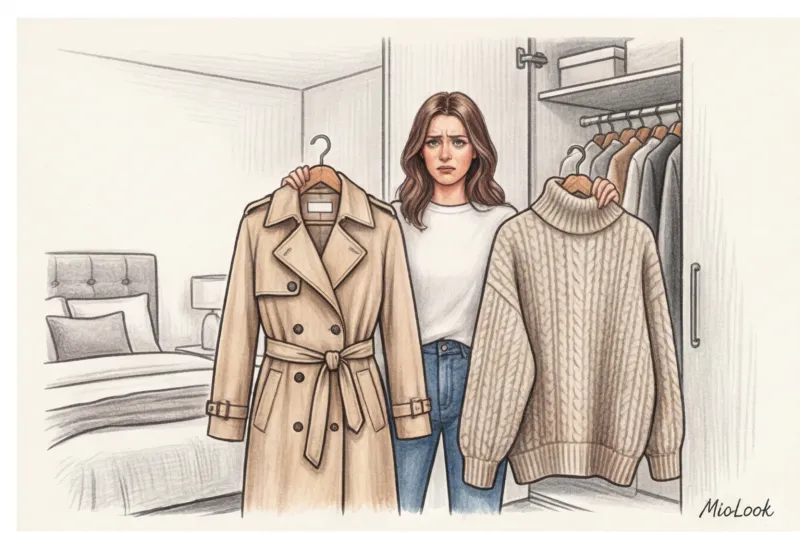
What is essential outerwear and why outdated 'must-have' lists no longer work
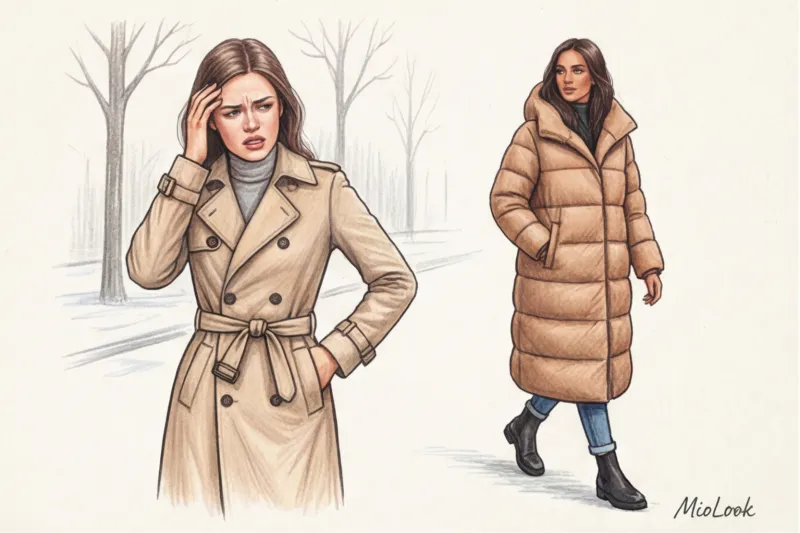
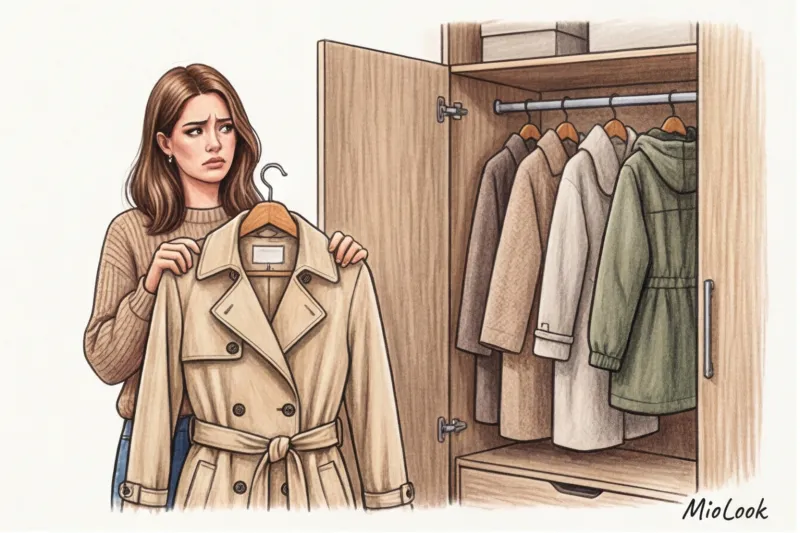
Over 14 years of working as a personal stylist, I've conducted hundreds of wardrobe analyses. And you know what I see in almost every closet? A perfect, never-worn classic beige trench coat and a black fitted coat, hanging forlornly in the far corner. Clients bought them because fashion blogs from decades ago told them to, but in real life, these items turned out to be completely useless.
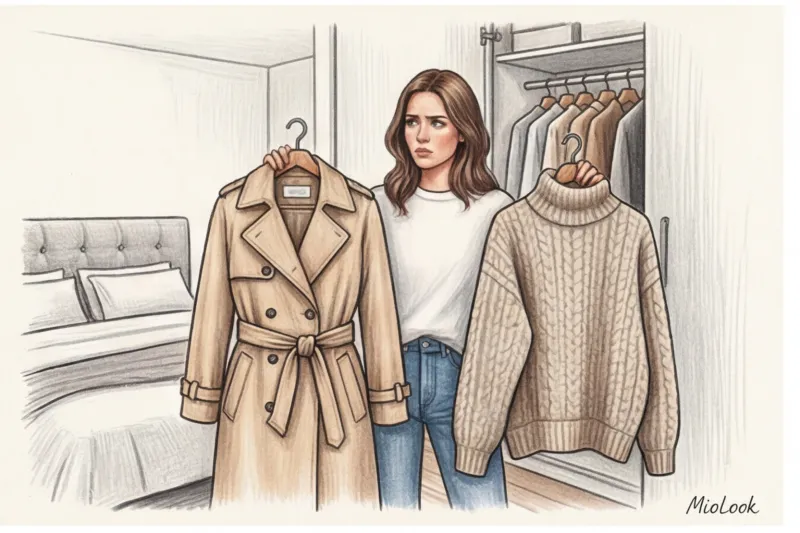
Let's face it: basic outerwear — is no longer a one-size-fits-all internet list. It's time to put the popular myth that everyone needs a classic double-breasted trench coat made of stiff gabardine into the past. Sure, it looks great in street style photos, but try wearing it early in the morning when you have to walk your child to school in a drizzle. And a well-fitting black coat? It collects every lint, requires perfect posture, and restricts movement so much that it's impossible to even comfortably raise an arm.
In my practice I use the concept "efficiency" (COP) of a thing If you bought a luxurious designer coat for €500 but only wear it three times a season because it doesn't match your everyday shoes or wrinkles while driving, its efficiency is close to zero. I've covered more about how to build a wardrobe that works, not one that just sits idle, in our complete guide to creating a capsule wardrobe.
The new style paradigm dictates completely different rules. Your personal basics are determined not by glossy magazines, but by two purely practical factors: your climate and your mode of transportation. What's the perfect basic for a female driver (for example, a cropped wool jacket) will be a disaster for a woman who walks 10,000 steps a day and waits for transport in a piercing wind.
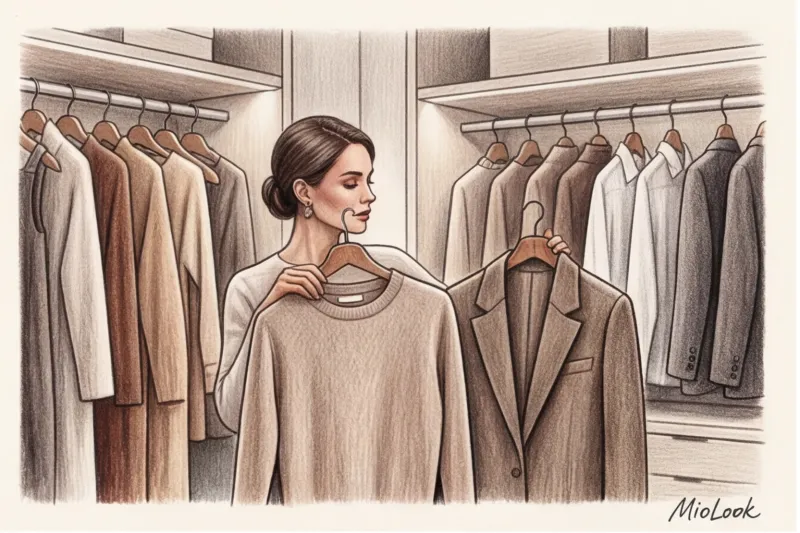
The most important principle of a modern outerwear capsule: a jacket or coat is a logical extension of your outfit, not a faceless "cover" under which you can hide anything. The outer layer should match the geometry, texture, and mood of what you're wearing underneath. This is especially critical for business attire—if you wear structured jackets, our status capsule for the office , where we examine in detail the architecture of multilayered business images.
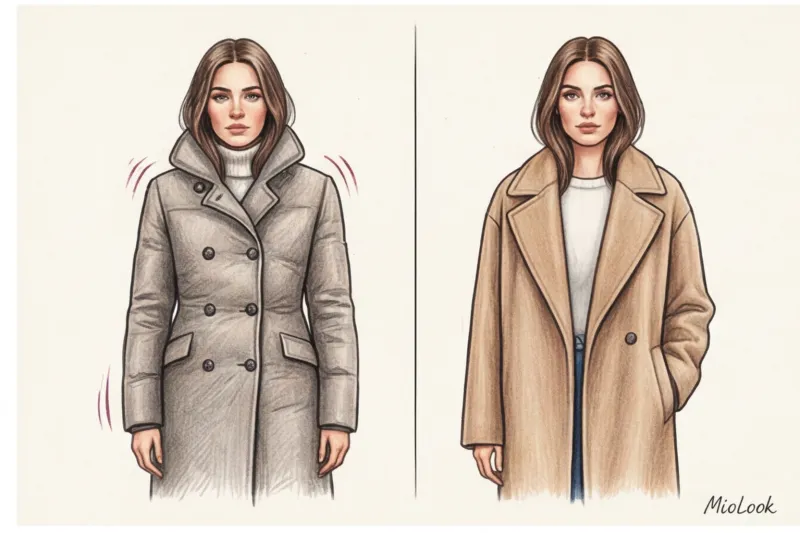
Here we come to the main technical law of stylistics, which is often forgotten - the "internal volume" rule It's the sleeve width of your sweaters, hoodies, and jackets that dictates the cut of your outerwear, not the other way around.
If your fall wardrobe consists of trendy chunky knits or oversized hoodies, you'll physically be unable to squeeze them into the narrow armholes of a classic coat. The sweater's fabric will bunch up tightly, creating a "bodybuilder arms" effect and absolute tightness in the shoulders. Therefore, the right basic jacket today is one with dropped shoulders and sleeves wide enough to accommodate your bulkiest inner layer without the slightest loss of comfort.
The Outerwear Matrix: Assembling a Capsule Strictly to Fit Your Lifestyle
Do you know what the most common reason for returning expensive outerwear to stores is? It's not a hidden defect or a dislike of the color. It's a simple mismatch between the purchased item and our real, not imagined, life schedule. We often buy coats for the version of ourselves that strolls leisurely along autumn boulevards with a cup of coffee, but in reality, we're squeezing into a crowded subway car or trying to fasten a seatbelt over a bulky down jacket.
That's why it's impossible to create a single, universal capsule that would suit both a freelancer working from a coworking space and a bank employee with a strict dress code. They have fundamentally different needs in terms of thermoregulation, presentability, and freedom of movement.
Last fall, two clients approached me simultaneously with the same request: "I need basic outerwear for the cold weather" and the same budget of €1,500. But their "essentials" turned out to be radically different.
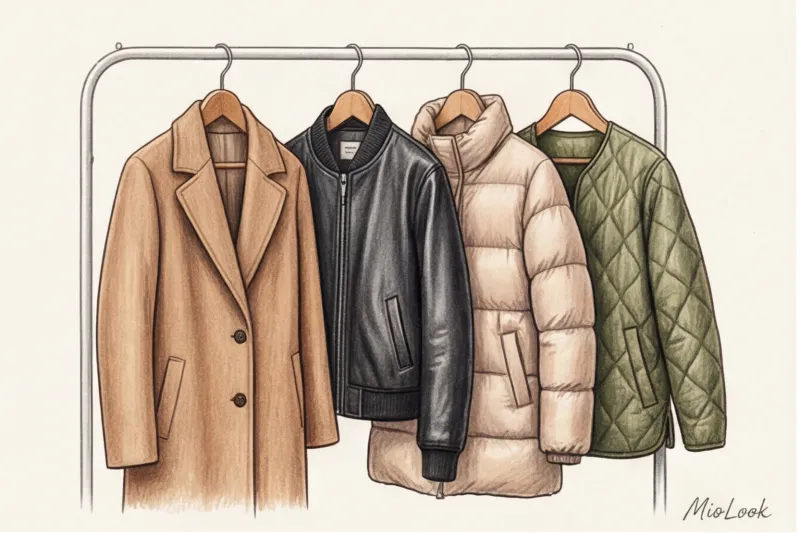
Our first client, a corporate lawyer, commuted in short bursts from the heated parking lot to the office. We put together a stylish capsule wardrobe for her: a cropped, double-faced wool-cashmere blend coat, an elegant trench coat in heavy gabardine, and a minimalist wool cocoon coat that easily accommodated a tailored jacket.
The second client, a motion designer and young mother, logged 15,000 steps a day along windy embankments. We divided her budget differently: a technical parka with a Gore-Tex membrane, an elongated down jacket with a water-repellent coating, and a lightweight quilted liner jacket for layering. Both capsule collections are 100% basic, but switch wardrobes, and both would suffer.
To avoid mistakes, I suggest using Outerwear matrix It's a coordinate system where your temperature (from mildly cool to severely frosty) is on one axis, and your activity level is on the other.

For female drivers: freedom of movement and the right length
If you spend more than an hour a day behind the wheel, your biggest enemies are maxi lengths and excess bulk. Long wool coats inevitably collect dirt from the car's sills, and their hems get tangled in your legs, creating dangerous accidents. Bulky down jackets (especially those made from slippery fabrics) not only obstruct your vision when turning your head but also reduce the effectiveness of your seat belt, which should fit snugly against your body.
Also, don't forget about creases. Classic 100% wool, when sitting on it in a warm car seat, will quickly become deformed on the back and below the waist.
Ideal solutions for your matrix:
- Cropped Aviator Jackets: They hold their shape perfectly, don't interfere with driving, and look stylish with both jeans and knitted dresses.
- Wool jackets (pea coats): A mid-thigh length is the perfect compromise between elegance and practicality. Look for styles with added polyamide (10-20%); they wrinkle less.
- Quilted shirt-style jackets: Lightweight and do not restrict the shoulder girdle.
Temperature regulation is crucial for female drivers. The heater is on in the car, but it's below freezing outside. Avoid outerwear with 100% cheap polyester linings. Choose viscose linings or breathable, high-tech materials; otherwise, you'll get out of the car damp and instantly freeze in the wind.
For active walkers and moms: wind protection and layering
When your route involves long walks with a stroller, waiting for transport, or walking between locations, the aesthetics of classic wool fade into the background. A wool coat is wonderfully warm in dry weather, but in strong winds or wet snow, it quickly absorbs moisture, becomes heavy, and becomes breathable.
This is where high-tech fabrics come into play. The modern essential for active city dwellers is items with a membrane (with a waterproof rating of 5000 mm or higher). They act as a smart shield: they keep out wind and water droplets from the outside, while wicking away perspiration from the body.
What to look for when choosing:
- Midi length: This is your salvation from the piercing wind. A jacket or parka should cover your knees securely. Anything that ends above mid-thigh will require insulated pants, which will complicate everyday outfits.
- Collar architecture: A high stand-up collar with an integrated hood is a must. Ideally, the collar should cover the chin and have a fleece lining. This eliminates the need for bulky scarves.
- Freedom to layer: A hiker's outerwear should be able to accommodate a thick hoodie or ultra-light down vest underneath. Always go a half size to a size larger than your summer clothes.
For the office and business meetings: status and compatibility with jackets
Creating a business-ready top capsule is perhaps the most challenging styling challenge. The main problem my clients face is how to wear a coat over a structured jacket with stiff shoulder pads without looking like an American football player.
If you try to pull a classic coat with set-in sleeves over a business suit, you'll get a "sausage" effect: the jacket sleeves will bunch up like an accordion, the armholes will cut into your armpits, and freedom of movement will disappear completely.
How to solve this problem:
- Correct sleeve cut: Look for coats with raglan sleeves (where the sleeve is cut out along with the shoulder section of the back and front) or with dropped shoulders. A balmacaan coat with a concealed fastening and a flowing silhouette is an ideal basic style for a business wardrobe.
- Oversized silhouettes: Straight cut with sufficient air volume inside (the “internal volume” rule we talked about earlier).
- Fabric texture: For a business capsule wardrobe, choose dense fabrics that hold up well. These can be broadcloth, heavy cashmere, or wool blends. Avoid loose textures (like cheap bouclé), which quickly pill and pick up lint from your dark suits.
Access to MioLook for €0.99 — one-time payment
A smart AI stylist will select the perfect look.
Get access — €0.99 onceBy the way, to avoid guessing at the store whether your favorite double-breasted blazer will fit under your new coat, I recommend digitizing your key inner layers in the app MioLook An AI assistant will help you visualize how a specific, oversized outerwear style will pair with your work attire, saving you hours of fittings and hundreds of euros in mistaken purchases.
Once you've identified your point in the Matrix, you narrow the endless selection in stores to two or three specific items. Only then can you begin analyzing temperature conditions—from mild mid-season to severe frosts.
Mid-season (from +15°C to +5°C): Invest in smart midlayers
Have you ever noticed how irrationally we spend money on clothes designed for the short temperature window of +15°C to +5°C? According to my clients' statistics, it's these lightweight windbreakers and dusters that have the highest cost-per-wear. They hang in the closet for ten months out of the year, waiting for those two weeks of ideal weather.
I strongly recommend abandoning the stereotypical "just light jackets." Modern basic outerwear for the transitional seasons should work in two shifts: as a standalone outer layer in early fall, and as a full-fledged insulating inner layer in winter.
The secret to a smart wardrobe isn't the number of warm items, but their ability to be layered without losing the elegance of the silhouette or the comfort of movement.
The absolute favorite of this approach is quilted jacket, or liner Forget the rule that everyone needs a classic beige trench coat. For most women living a busy urban lifestyle, the liner has become a modern and far more practical alternative to the trench coat. It pairs brilliantly with relaxed wide-leg jeans and sneakers, as well as flowy midi dresses and chunky Chelsea boots.
I'm sharing my favorite professional life hack: layer a thin, sleek liner (like basics from Uniqlo or more architectural options from COS for €100-150) directly under your light autumn wool coat. This layering trick allows you to wear your demi-season coat right up until the first serious frosts. You dramatically reduce the cost-per-wear of both pieces and get the warmth of a winter down jacket while maintaining a sharp, put-together silhouette.
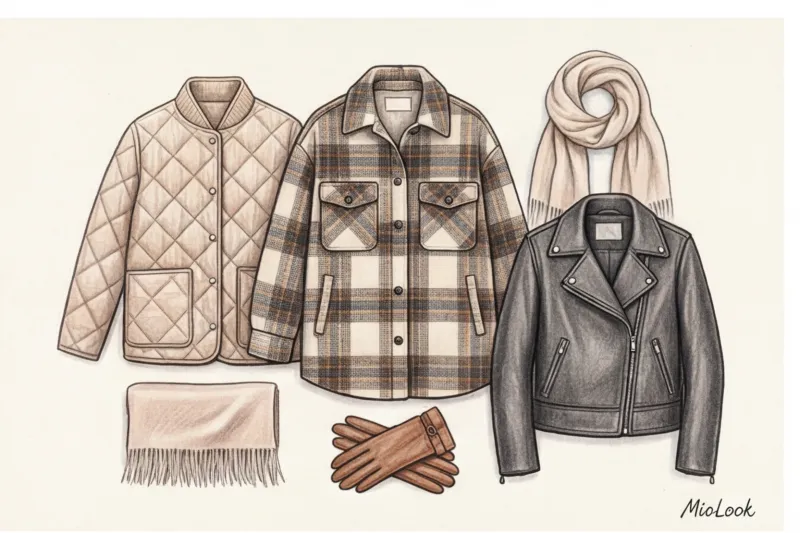
The second most important player of the offseason is thick shirt-jacket (shacket) Wool blend. This is the perfect solution for dry, cool days. But there's a stylistic trap: how to choose the texture to avoid looking like a lumberjack on a firewood smash? The secret lies in the density of the fabric and avoiding contrasting checks. Forget thin, soft flannel. Look for dense coat fabrics (at least 40-50% wool, with the rest being polyester or polyamide for dimensional stability). Choose solid, deep shades (camel, rich graphite, chocolate) or a refined, classic herringbone print. This piece should support the shoulder structure, and in winter, it will fit perfectly under your spacious down blanket.
And finally, biker jacket Let's be honest and admit it: a tight, cropped leather jacket that barely fits a thin silk T-shirt is no longer a staple. It's an outdated silhouette that hopelessly disrupts the proportions of modern layered looks. Modern, basic leather outerwear requires some "air" between the body and the jacket. The right biker jacket today has slightly dropped shoulders, a straight cut, and enough armhole room to layer a thick cashmere sweater or oversized hoodie. Only with this fit does it become a functional wardrobe investment, not just a tight accessory.
To avoid confusion about which liners and shirts will physically fit under your fall coats, I always recommend digitizing them first. Upload your midlayers and outerwear to MioLook — and the algorithm will help you collect dozens of warm combinations, saving you from time-consuming fittings in front of the mirror in the morning.
First cold weather and frosts (from +5°C to -5°C): elegant wool base
When the thermometer first dips below freezing, a stylistic dissonance begins on the streets. Hems of light dresses peek out from under short jackets, and thick, chunky knit sweaters are squeezed into the narrow sleeves of demi-season coats. For temperatures ranging from +5°C to -5°C, your basic outerwear should work as an ideal architectural facade, hiding any complex multi-layered structures inside.
That's why the ideal length for a basic wool coat is a confident midi (to mid-calf) or an uncompromising maxi. The main rule: outerwear should completely cover the hems of your skirts and dresses. If the coat ends a hand's breadth above the knee, you'll inevitably end up with a visual "cut" of your figure into several disproportionate horizontal blocks. A midi length elongates the silhouette and creates that monolithic vertical line that makes the look cohesive and sophisticated.
Here we come to a crucial technical detail that store salespeople often overlook. Most women, wanting to stay warm, simply buy a coat one or two sizes larger than their usual size, ensuring they can fit a thick cardigan or hoodie underneath. The end result? The shoulder seam slips down unsightly, distorting their posture and making them look bulky.
The solution lies not in blindly increasing the size, but in the correct armhole depth If you plan to wear bulky knitwear or structured office jackets under your coat, look for styles with dropped shoulders or deep armholes. This design naturally contours to any internal volume while maintaining your actual shoulder width and preventing you from looking like a football player.
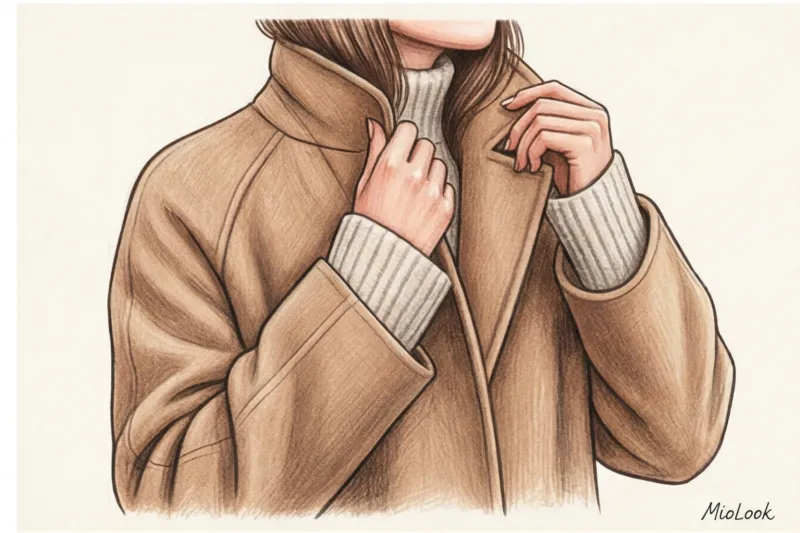
Now let's talk about materials. In mass-market clothing, we're often tempted by "Premium Wool" labels, but the devil is in the percentage on the backing tag. I often see women chasing 100% wool, shelling out $300 to $800 for such items, only to complain about pilling and stretched hemlines after a month of active wear.
It's a paradox, but for the harsh urban rhythm, a small admixture of synthetics is a blessing. The optimal composition of a high-quality base is from 50% to 70% natural wool (Sheep, alpaca, or merino). The remaining percentage should be polyamide or nylon. Why? This synthetic fiber acts as invisible reinforcement: it ensures wear resistance, prevents the fabric from deforming at the elbows, and protects against airflow. Most importantly, avoid acrylic in coat fabrics; it doesn't provide any warmth and quickly pills.
How can you check the quality of cloth right in the store without blindly trusting the label? Use a professional buyer's trick— pinch test Squeeze the edge of the coat hem tightly in your fist, hold for 10-15 seconds and release quickly.
If the fabric immediately straightens out, returning to its original shape without any deep creases, you're looking at a high-quality, highly twisted thread. If, however, you're left with a wrinkled, "accordion-like" texture, feel free to return the item to the hanger: it will lose its shape after just one trip strapped in a car.
Of course, a classic coat doesn't cover every lifestyle. If your wardrobe revolves around relaxed casual, denim, and chunky boots, a cropped aviator shearling coat is a great warm alternative. It's the perfect balance between ruggedness and comfort.
Today, brands offer a wide range of faux fur options (in the reasonable price range of $150–$250). There's only one crucial nuance when choosing one: evaluate the texture of the backing. Cheap faux fur gives away its unnatural glassy sheen and makes it squeak under your fingers. Look for matte, slightly felted textures that imitate genuine sheepskin (sherpa). Not only do they look more luxurious, but they also physically retain heat better due to the dense, tangled weave of the fibers, creating a reliable barrier against the first frosts.
Access to MioLook for €0.99 — one-time payment
Start creating perfect layered looks with AI. Digitize your outerwear and choose the right layers for it without time-consuming mirror fittings.
Get access — €0.99 onceHarsh winter (-5°C and below): warmth without losing style and the "cabbage" effect
"The thicker the jacket, the warmer it is" is perhaps the most persistent myth I have to fight every winter. According to recent reports from a global non-profit organization Textile Exchange In terms of thermal conductivity, a product's visual volume is no longer an indicator of its warming properties. Innovative microfibers retain warm air many times more effectively than thick layers of outdated synthetic padding. Therefore, it's time to forget about heavy jackets that make it impossible to bend your arms or turn your torso freely.
I once had a client come to me who had bought a premium down jacket for $1,200 for her office commute. She complained that it was unbearably hot on the subway, and outside, the slightest sleet turned the jacket into a heavy shell. The problem lay in the filling. It was natural down with a resilience factor. Fill Power 600+ (the ideal down to feather ratio is 80/20 or 90/10) is truly the gold standard, but it is intended more for long, leisurely walks in dry frost.
For an active urban lifestyle, where you constantly shuttle between the cold street, a heated car interior, and stuffy transport, high-tech synthetics win by a landslide. Modern insulation materials such as Thinsulate , Primaloft or Isosoft , were originally developed for professional mountaineering. Their main advantage: they provide warmth even when wet, whereas natural down clumps together when wet and instantly loses its insulation. Furthermore, a high-tech jacket is much easier to wash at home—the filling doesn't clump, so you won't have to pay for expensive dry cleaning on a regular basis.
The undisputed favorite of the basic winter capsule collection is the long duvet-style down jacket. How to choose a cut that elongates your silhouette without making you look like a ball? The secret lies in two details: the texture of the fabric and the seam architecture. Choose only matte materials, as a glossy sheen visually adds unnecessary volume and greatly dulls the look. As for the stitching, look for styles with vertical, diagonal, or very sparse horizontal stitching (the distance between stitches should be at least 15–20 cm). A dense horizontal "caterpillar" stitching mercilessly cuts the figure into wide segments.
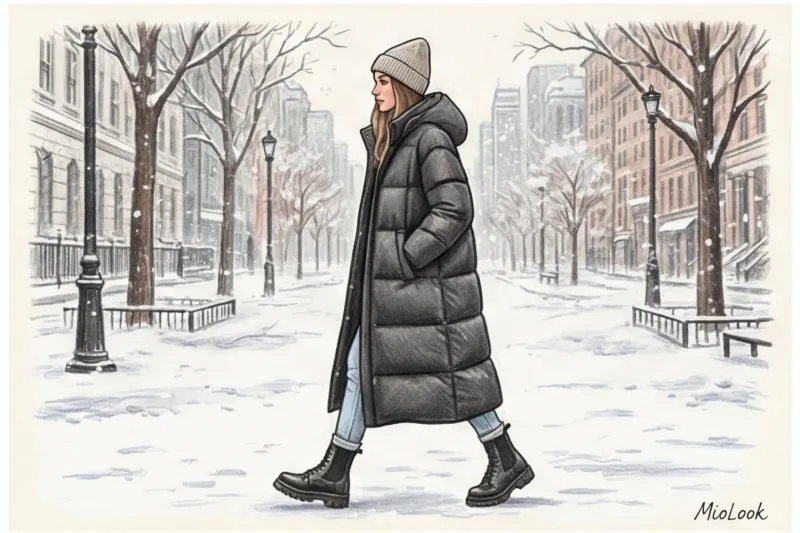
But what if your dress code absolutely abhors down jackets? For formal business attire, a winter wool coat with an insulated lining is an elegant compromise. Modern brands create hidden layers using a thin windproof membrane or high-tech wool blend. Visually, such a coat retains the clean lines of a classic English collar, but can easily withstand temperatures as low as -15°C. When choosing such a coat, be sure to pay attention to the shoulder line: it should be slightly dropped or have a raglan cut to allow room for your work suit underneath.
Winter layering is always a severe test of volume compatibility. To avoid finding the sleeves of your new high-status coat bursting at the seams under a heavy office jacket or chunky knit sweater before heading out, I highly recommend digitizing your wardrobe. After uploading your basic winter layers to the "smart wardrobe" feature in MioLook , you can create warm and comfortable outfits right on your phone. Artificial intelligence will help you visualize how a specific volume will fit under your chosen outerwear, eliminating the need to sweat in front of the mirror during long morning fittings.
Stylist's Checklist: 5 Essential Tests When Trying on Outerwear
You're standing in front of the fitting room mirror: the light is perfect, the color is refreshing, and the price tag promises a smart investment. It seems like the perfect piece of basic outerwear. But don't rush to take it to the checkout.
During shopping sessions, I strictly forbid clients from evaluating fit while standing still. A garment lives in motion. Static fittings are the main reason why a coat bought for $300 or $500 ends up hanging in the closet for years because it's simply too uncomfortable to drive in or carry a heavy bag in. This purely practical experience has allowed me to develop a strict filter. Below are five dynamic tests that regularly save my clients from returns and wasted money.
The Thick Sweater Test
The main rule of my fittings: always bring the bulkiest hoodie or chunky knit sweater in your closet with you to the store. Trying on a fall or winter item over a thin silk blouse is a fatal mistake. The right base layer should accommodate your heaviest inner layer without compromising the silhouette. If you forgot a sweater at home, simply ask the sales assistant for any bulky item from the showroom.
The Hug Test
Put on a jacket or coat (be sure to put it on over the sweater), button it up, and hug yourself tightly around the shoulders, crossing your arms over your chest. Pay close attention to how your shoulders feel: the back shouldn't be creaking, and the armholes shouldn't be digging into your armpits. If a thick fabric like drape or tweed feels tight, you need a larger size or a completely different sleeve cut.

The Top Bench Test
Imagine reaching for your bag on the overhead bin of an airplane or holding onto a high handrail on public transport. Raise both arms up. In this position, the sleeve should not extend above the protruding wrist bone. Having the sleeve lengthened at a tailor will cost you at least €40-50, and only if the manufacturer left enough fabric in the hem (a rarity in mass-market clothing these days).
Step Test
City life is all about high curbs, icy steps, and getting into a taxi. Sit down on the ottoman in the fitting room, then stand up and take an exaggeratedly long step. At this point, check the operation of the back vent and two-way zipper. If a long down jacket requires you to unzip it all the way to the waist just to get into the car, or the back vent flares out unattractively, this style will constantly irritate you.
Collar Test
Fasten the collar all the way to the top, including the hidden button or hook, and try tilting your head down as if answering a message on your smartphone. The collar shouldn't be too tight, dig into your chin, or immediately stain with foundation. The right neckline leaves just enough air to fit your favorite cashmere scarf without letting in the icy wind.
Your ideal image begins Here
Join thousands of users who look flawless every day with MioLook.
Get access — €0.99 onceUpper Capsule Formation Mistakes That Cost You Money
According to statistics from consumer research agencies, outerwear consumes up to 40% of the fall-winter shopping budget. Yet, it's in this category that the most costly style mistakes are made, leaving us staring irritated every morning at our half-empty, yet overflowing, closets.
The first and most wallet-damaging mistake is buying an "accent" piece before you've assembled your neutral base. A bright fuchsia coat, leopard faux fur, or a jacket with a complex asymmetrical cut in the spirit of Maison Margiela look incredibly striking on a mannequin. But if it's your only warm piece for the season, you'll quickly become trapped in a single look. Moreover, the accent cut will inevitably clash with half your wardrobe. Invest in muted shades (camel, graphite, deep navy, chocolate) first, and only then basic outerwear will cover 80% of your daily outputs, add trending experiments.
The second pain point I constantly correct during consultations is ignoring the length of inner layers. There's nothing more untidy than the hem of a light dress or the edge of a bulky, contrasting sweater sticking out from under a cropped jacket. This violates the basic rule of proportion and visually cuts the figure into horizontal blocks, shortening the legs. The top layer should either completely overlap the bottom layer (as with a maxi coat) or end in a way that creates a well-thought-out layering effect. To avoid guessing in front of the mirror five minutes before going out, I recommend loading your clothes into MioLook Artificial intelligence will help you create outfits in advance, taking into account the geometry of your shirts and skirts in relation to your jackets.
The third point is skimping on fittings. A cheap, overly shiny yellow zipper or flimsy plastic buttons instantly cheapen even the highest-quality wool. Herein lies my favorite styling lifehack for beginners, which I call the "button replacement rule." You can buy a coat with excellent composition at a mass-market store (like Zara or Mango) for €150-200, where the manufacturer clearly skimped on the details. Immediately go to a specialist hardware store, buy high-quality buttons made of natural horn, dense metal, or tortoiseshell plastic for €15-20, and have them altered at a tailor's. The garment will instantly be transformed and will look as if you spent at least €600 on it.
Finally, a hidden expense is improper storage during the off-season. Many people carefully hang a heavy winter coat or leather biker jacket on thin wire hangers from the dry cleaner and relegate it to the back of the closet for six months. The result is predictable: bulging shoulders and irreversible loss of shape of the backing materials, which no amount of steaming can fix. Heavy basic outerwear should be stored exclusively on wide wooden hangers with an anatomical curve (with a shoulder width of at least 4-5 cm). And I recommend storing bulky down jackets in breathable cases, horizontally on the top shelf, to prevent the natural or synthetic filling from settling under the influence of gravity.
Your step-by-step plan: how to start renewing your upper capsule today
According to the 2023 Business of Fashion report, women wear only 20-30% of their closet contents. When it comes to jackets and coats, this figure becomes critical: the average bill for a quality item starts at $200-300, and a stylistic error is prohibitively expensive. Many glossy magazines end their reviews with the abstract advice "invest in quality." But as a practical expert, I know: without a clear system, even a luxurious €2,000 alpaca coat can be a waste if it doesn't fit into your daily routine. Enough hoarding illusions – let's move on to concrete actions.
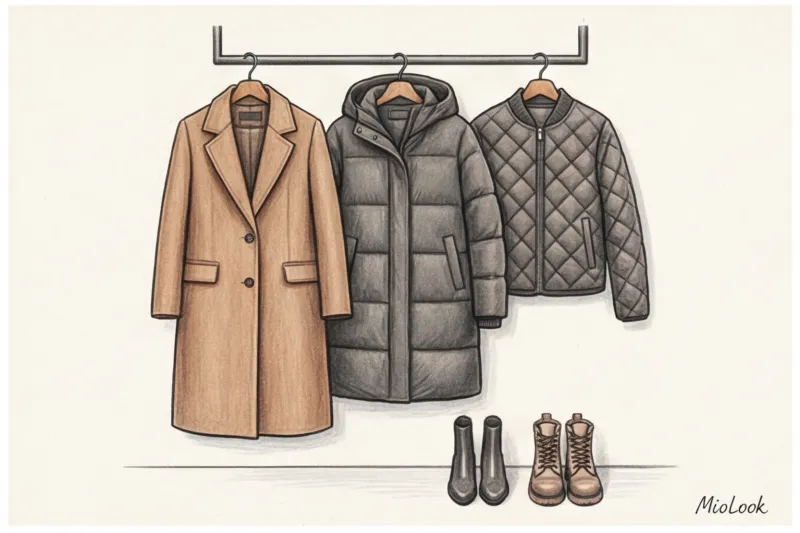
Step 1: Ruthless Audit
Conduct an audit of your current outerwear tonight. Take out absolutely everything, including what's tucked away in vacuum-sealed bags on the attic. Divide items into two strict categories: what you wear constantly, and what's hanging forlornly with tags (or has been worn once in the last three years). If you have a stunning white maxi coat collecting dust, a flashy purchase you've never worn, admit it. Basic outerwear should work for you every day. Pay attention to hidden flaws: stretched elbows, matted fur, or snagged hardware often become a subconscious reason why you don't reach for an item. Anything that can't be salvaged at the dry cleaner or tailor should go.
Step 2: Digitizing Your Lifestyle
Define your personal "Matrix." Grab a notebook and honestly write down your typical month in percentages. For example: 65% of your time is spent in the car and on quick commutes to the office, 25% is spent briskly walking the dog or hiking on weekends, and only 10% is spent in high-status business meetings or evening outings. Your capsule should mirror these numbers. It's completely illogical to invest $400 in a heavy wool coat for 10% of your life if 65% of the time you feel uncomfortable in a thin jacket that rides up while driving.
Step 3: Smart Shopping List
Create a shopping list with strict priorities. The main rule: first, we address the most common need from your Matrix. If you're a pedestrian, we search for the perfect down blanket with the right quilting or a technical parka. Only after the winter foundation is laid should we move on to the mid-season. Invest in smart midlayers: a high-quality quilted liner from brands like Arket or COS will cost around €100-150, but it will be worth every penny, knitting together your warm and lightweight pieces. No spontaneous purchases of statement trench coats with complex cuts until you have something comfortable to wear to work on a chilly morning.
Step 4. Delegate routine tasks to AI
A smart wardrobe always starts with deep analysis, but keeping every combination of textures and lengths in your head is physically impossible. How can you digitize your outerwear to avoid mistakes? I highly recommend taking photos of your coats, jackets, and essential inner layers (jackets, oversized sweaters, dresses) and uploading them to the app. MioLook.
This isn't just a digital catalog—the program acts as your personal pocket stylist, remembering all your clothes down to the last detail. AI helps you create complex, layered looks right on your phone, taking into account volumes and lengths. No more long, sweaty fittings in front of the mirror, trying to squeeze a thick jacket under a tight coat just five minutes before heading out into the cold.
Creating the perfect, functional capsule wardrobe isn't magic or an innate talent. It's a clear system, coupled with knowledge of your real needs and the use of modern technology. Don't wait for next weekend or sudden inspiration. Open your closet now and take the first step toward a wardrobe that will protect you, keep you warm, and delight you every day.
Guide Chapters
Layering Outerwear: How to Stay Warm in Style
How to stay warm in cold weather using physics, not fabric thickness? We explore the anatomy of a stylish and warm silhouette without the "cabbage" effect.
How to store outerwear so it lasts for years
How you store your coats and jackets during the off-season directly impacts their lifespan. Learn stylist secrets to keep your items from warping.
Basic denim jacket: how to choose the right style
The skinny denim jacket from the 2000s is hopelessly outdated. Together with a stylist, we explore what a modern staple looks like and why it should be layered.
What to wear with a women's bomber jacket: stylist tips
The bomber jacket is confidently replacing the classic trench coat as a wardrobe staple. Discover insider styling tips that will make this jacket your best investment.
Basic Outerwear Colors: Choosing a Palette
Why isn't a classic beige trench coat suitable for everyone? Let's learn how to choose coat and jacket shades based on your wardrobe.
Outerwear for plus-size women: styles that make you look slimmer
Forget shapeless black robes! Learn how to visually elongate your silhouette with the right cut and outerwear details.
Outerwear for Petite Women: Styling Tips
How to choose a coat or jacket if you're shorter than 160 cm? We'll debunk the myths about short cuts and learn how to visually elongate your silhouette with the right patterns.
Basic Winter Wardrobe: Outerwear for Cold Weather
Tired of freezing for the sake of beauty or looking like a shapeless snowman? A stylist explains how to choose functional and stylish outerwear for the harsh cold.
How to Match Shoes to Outerwear: A Style Guide
The wrong ankle boots can ruin even the most luxurious coat. Learn the secrets of perfect shoe and outerwear combinations based on the laws of proportion.
Women's Demi-Season Outerwear: A 5-Piece Capsule Collection
Forget those uncomfortable trench coats gathering dust in your closet. A stylist explains how to put together a functional capsule wardrobe for the off-season using just five pieces.
How to Choose a Basic Down Jacket: A Stylist's Guide
Eight out of 10 women are unhappy with their winter jacket. A stylist explains how to avoid the most common mistakes and find the perfect down jacket for your lifestyle.
What to wear with a women's leather jacket: incorporating it into your basic wardrobe
Has your leather jacket been hanging in your closet for years? We'll explore the main mistakes people make when choosing a biker jacket and learn how to skillfully incorporate it into their everyday wardrobe.
How to Choose a Basic Coat for Fall and Winter: Stylist Tips
A beige robe coat isn't for everyone. We'll explore the architecture of outerwear and learn how to choose the perfect coat with a professional stylist.
A Basic Women's Trench Coat: The Perfect Length, Color, and Cut
Got a classic beige trench coat, but it makes you look like Inspector Gadget? We're talking to a personal stylist about choosing the perfect trench coat for your wardrobe.