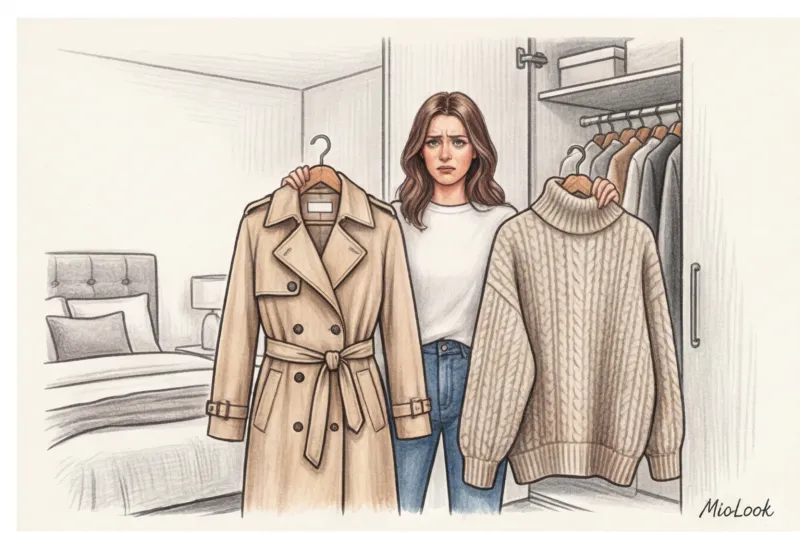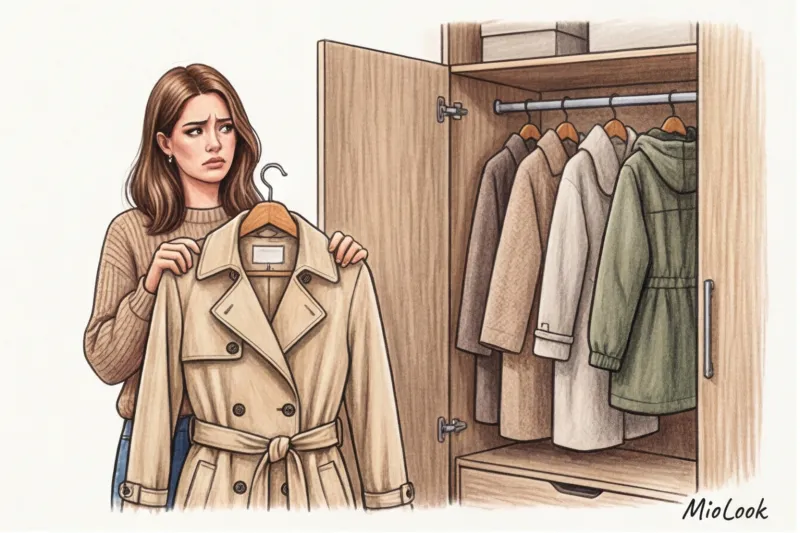
Over 14 years as a stylist, I've sorted through hundreds of closets. You know what I most often pull from the deepest shelves? A perfect, crisp, double-breasted beige trench coat. With the tag still intact or worn maybe twice.
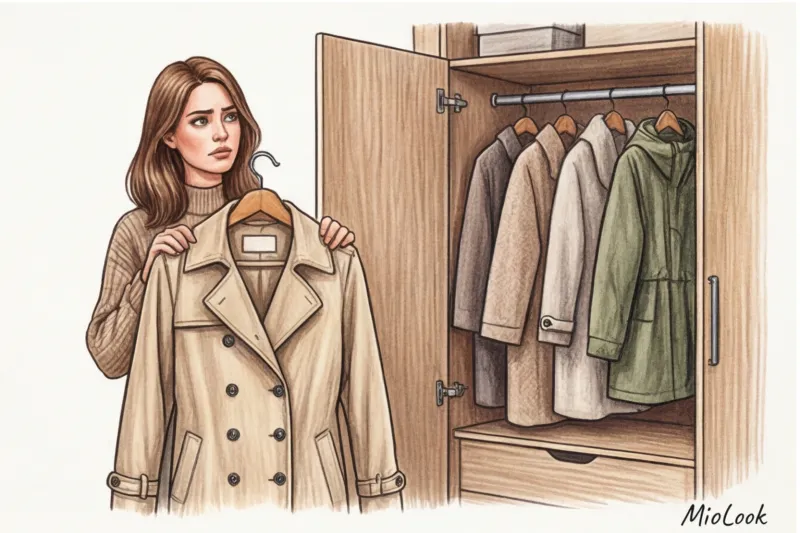
When I ask my clients why they don't wear it, the answers are always the same: "It's cold in the morning, hot during the day, it gets dirty instantly on public transport, and you can't lift your arms while driving." But every glossy "10 essentials" list says you can't live without it!
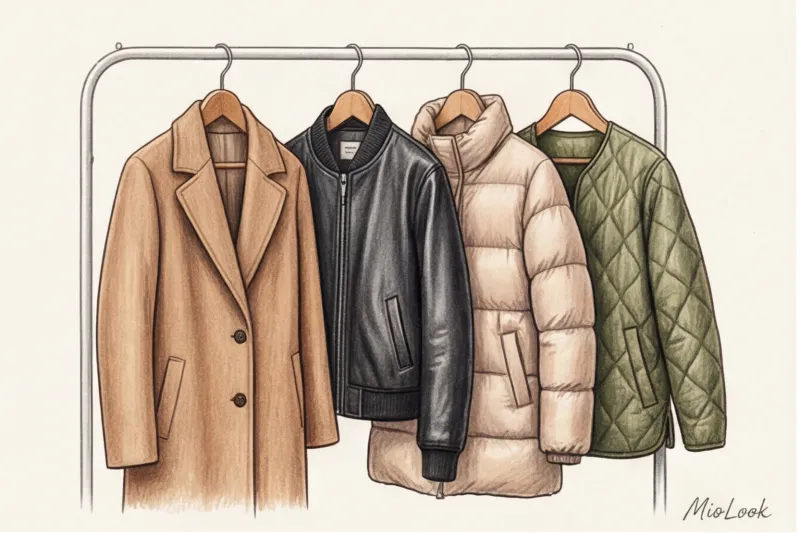
Let's be honest: classic women's demi-season outerwear is often created for beautiful street style photos, not for real life with its subway rides, morning frosts, and sudden rain. We've already discussed the architecture of a functional wardrobe in more detail in our The complete guide to basic outerwear , and today I want to offer you a completely different approach to the off-season.
We won't be compiling a template list of styles. We'll assemble a capsule of five functional layers, based on a metric I call the "efficiency coefficient" (EC) of a garment.
Why Rigid Must-Have Lists No Longer Work
For years, the fashion industry has sold us the idea of universal essentials. Buy a biker jacket, a beige coat, a denim jacket, and a trench coat—and you'll be happy. But a 2024 study of consumer habits by McKinsey shows that 60% of purchased outerwear is worn less than seven times per season.
Why does this happen? Because we buy things , and not solutions One of my clients, a top manager at an IT company, bought a premium wool duffle coat because it was "on trend." The result? It turned out to be too heavy for her hectic schedule, where she constantly jumps from the car to the office and back.
"Your basics don't have to match those of a Milan fashion blogger. If you're sprinting from the parking lot to the office, your must-have isn't a long cashmere coat, but a stylish cropped bomber jacket or vest."
That is why I introduced the concept for my clients Efficiency of outerwear A high-performance item works for you: it addresses a specific weather need, matches 80% of your bottoms, and doesn't require a lot of effort (like constant dry cleaning after every drop of rain).
Access to MioLook for €0.99 — one-time payment
A smart AI stylist will select the perfect outfit from your items, taking into account the weather and your plans for the day.
Get access — €0.99 onceThe formula for a demi-season capsule: 5 functions, not 5 things
I borrowed this approach from professional outdoor gear, where the concept of layers reigns supreme. Translating this to the urban environment, we get a wardrobe that adapts to temperature fluctuations from +5 to +15 degrees Celsius.
The idea is simple: instead of thinking, "I need a leather jacket," think, "I need a layer that will protect me from the wind but is comfortable to drive in." Once you change your focus, shopping becomes more mindful, and your budget will shrink dramatically.
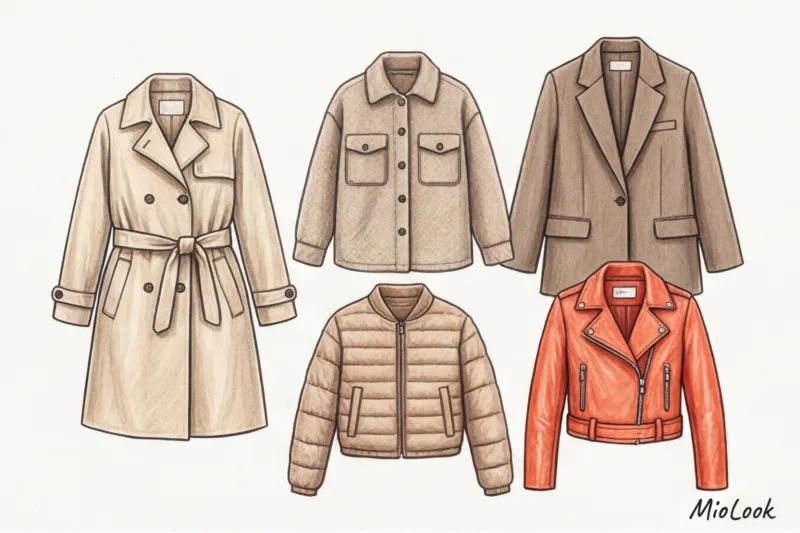
Function 1: Wind and moisture protection (The Shield)
That's the moment when we ditch the easily soiled cotton gabardine in favor of something more technologically advanced. In spring and fall, we need a "shield"—something that won't get wet and can be easily wiped clean.
What to look for:
- Mac coat is a simple coat without unnecessary details, belts or shoulder straps. It fits perfectly into both smart casual for the office , as well as in relaxed images.
- Parka made of membrane fabric (in the spirit of Scandinavian brands like Rains or COS).
- Stylish urban anorak.
Stylist's advice: Always check the tag for the abbreviation DWR (Durable Water Repellent) - this is a water-repellent treatment that makes water droplets roll off the fabric rather than soak into it.
Feature 2: Warmth and Coziness for Dry Days (The Cozy Layer)
For dry, cool days when you don't want to bundle up in a raincoat, this layer provides tactile comfort.
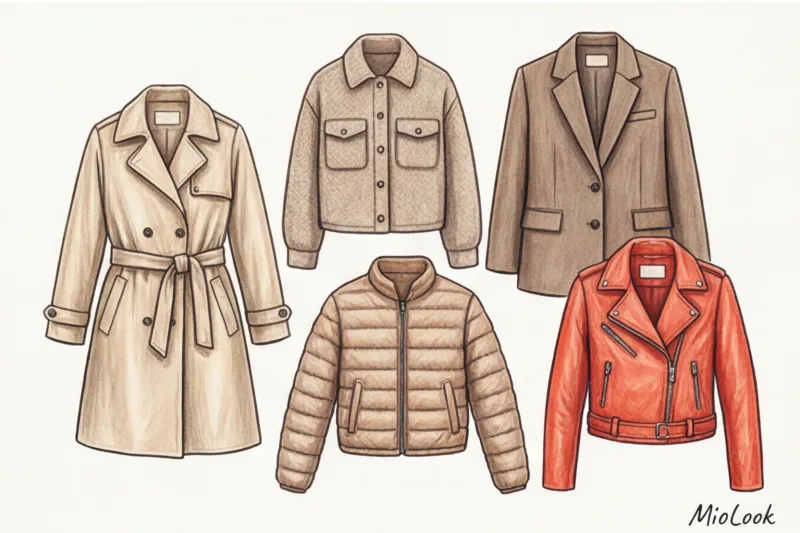
What to look for:
- Shackets made of thick fabric.
- Oversized, tightly knit cardigans that hold their shape.
- Cropped coat-jackets.
There's an important nuance to consider here regarding composition. Many people are chasing 100% wool or cashmere. But according to textile technologists, the ideal composition for demi-season outerwear is 75-80% wool and 20-25% polyamide or nylon Synthetic thread acts as reinforcement: it prevents the garment from stretching at the elbows, protects against pilling, and makes the fabric more resistant to light abrasion from the bag.
Feature 3: Office Status Base (The Smart Layer)
A piece that instantly ties together an outfit, even when worn with simple jeans and a white T-shirt. It's a wardrobe staple.
What to look for:
- Straight cut coat, midi length (below the knee).
- Oversized jacket made of thick suit wool.
When choosing the length of your coat, keep in mind hem overlap rule There's nothing more unsightly than a skirt hem sticking out 5-7 centimeters from under a coat. A coat should either completely conceal the skirt or dress, or be significantly shorter (a hand's breadth or more). That's why a midi (calf-length) is the safest investment.
Feature 4: Mobility and Comfort (The Active Jacket)
A jacket for weekends, dog walks, trips out of town, or coffee breaks. The key here is dynamism.
What to look for:
- Quilted jackets in country style.
- Voluminous bombers.
- Loose-fitting leather jackets (forget the tight biker jackets of the 2010s).
The biggest mistake when buying this layer is choosing a size that's too tight. In the off-season, you absolutely need some room between your body and the garment. In the fitting room, always wear the heaviest hoodie or sweater in your closet under your jacket. If the armholes are tight, go up a size.
Feature 5: The Statement Piece
While the first four functions cover the base, this layer is responsible for the mood and individual style. Without it, the capsule will be functional but boring.
What to look for:
- Textured suede jacket (a hit of recent seasons according to Vogue).
- Trench coat made of patent eco-leather.
- A coat in a complex, deep shade (for example, burgundy or emerald instead of gray).
To ensure your statement piece doesn't just sit there, it should complement your neutral base. If blue jeans and gray trousers predominate in your wardrobe, a mustard or burgundy jacket will be a great accent.
Your perfect look starts here
Join thousands of users who look flawless every day and save time in the morning with MioLook.
Get access — €0.99 onceWomen's Demi-Season Outerwear: Adapting to Your Lifestyle
Let me be clear: this approach does NOT work if you're trying to copy someone else's capsule wardrobe without taking your own reality into account. Demi-season outerwear (women's logic here should be extremely pragmatic) directly depends on two factors: how you travel and where you live.
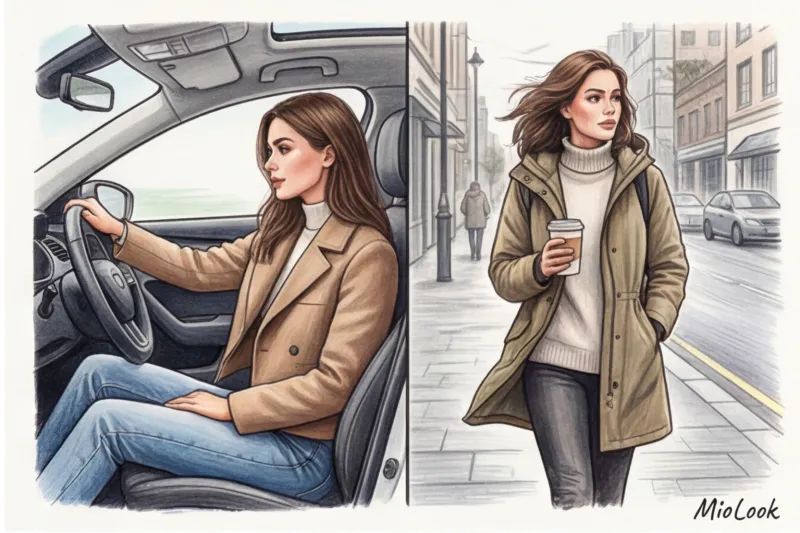
Capsule for "autoladies"
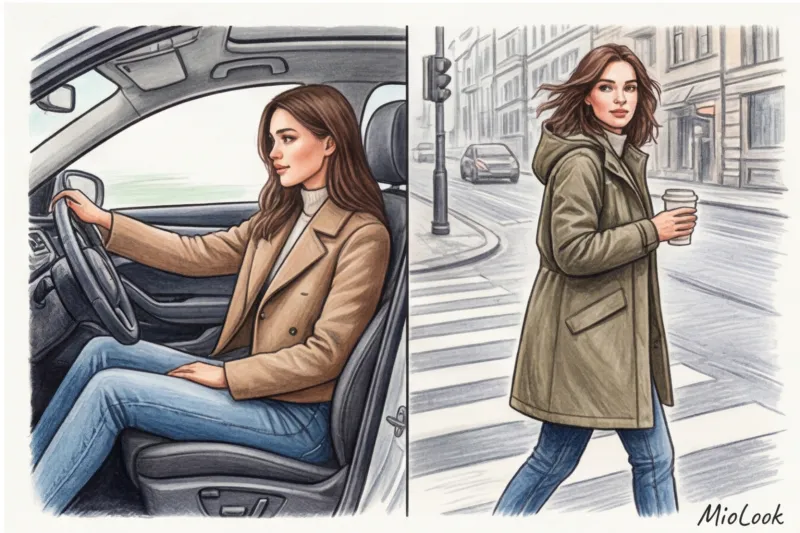
If you spend 80% of your time behind the wheel, long coats made of delicate fabrics will become your nightmare. They wrinkle on the seat, get tangled in your legs when you get in, and quickly get worn out by the seat belt.
Your focus: Cropped styles. Hip-length quilted jackets, thick wool bombers, and, most importantly, insulated vests. A vest is a brilliant invention for a car: it keeps your back and chest warm, but leaves your hands completely free for the steering wheel.
A capsule for an active pedestrian
If your commute includes a 15-minute commute to the metro, waiting at stops, or long walks, the rules of the game change.
Your focus: A midi length protects the hips from the wind. A hood is a must (an umbrella won't protect you from slanting rain and wind). And pay attention to the color of the bottom of the coat—light-colored hems on long coats will need to be washed every three days in slushy conditions.
Stylist Secrets: How to Wear Spring Clothes in the Fall
The off-season is tricky because it can be +3 degrees in the morning and +15 degrees in the afternoon. Buying a separate jacket for every degree is a waste of money. As a stylist, I use layering techniques that extend the temperature range of clothing by 7-10 degrees.
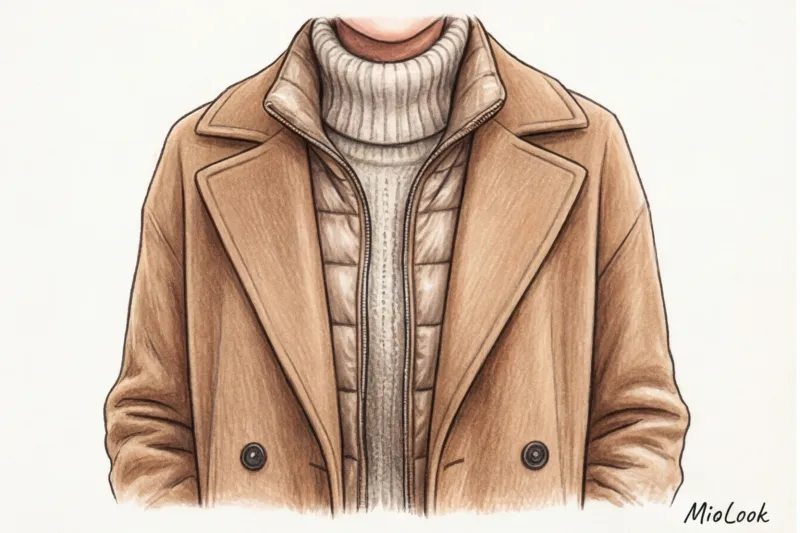
Hidden layer rule. The finest down jackets (like those from Uniqlo or Massimo Dutti) and quilted vests aren't meant to be worn solo. Wear them under A lightweight wool coat or a roomy trench coat. You get the warmth of a winter jacket while maintaining an elegant fall silhouette.
Invisible base. Thermal underwear has long ceased to be a mere accessory for skiers. Modern thermal underwear made from a blend of silk and merino wool (as thin as a second skin) allows you to wear a lightweight jacket as outerwear even in November.
Stylistic multi-layering. Don't be afraid to mix layers: wear a thin denim jacket under a voluminous coat, or a thick hoodie under a classic blazer. This not only keeps you warm but also adds complexity, texture, and modernity to the look.
Ready to get started?
Digitize your wardrobe and create layered looks in one click. Try the free plan—no commitment.
Get access — €0.99 oncePre-purchase checklist: efficiency test
Before you take an item to the checkout, run it through three filters. I use this algorithm during every shopping experience.
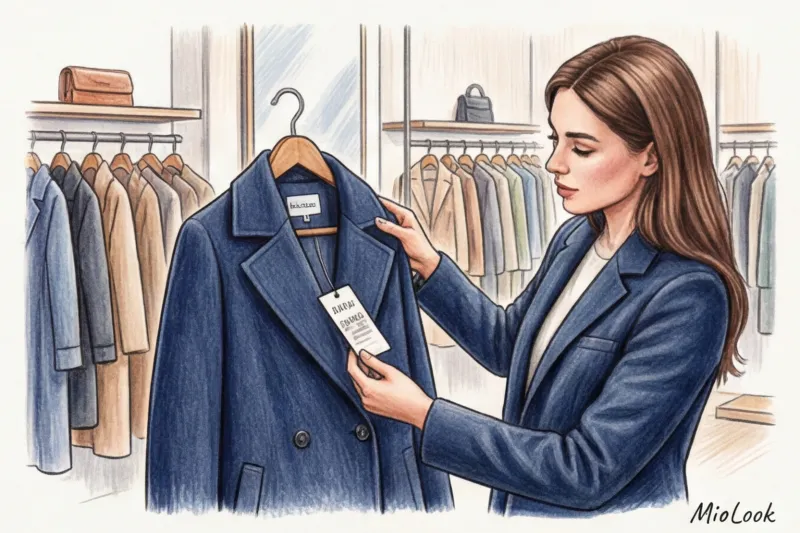
- We calculate Cost Per Wear (cost per exit). Divide the cost of an item by the approximate number of days you'll wear it. A trendy $100 jacket that you'll wear twice costs $50 per outing. A basic, quality $400 coat that you'll wear 100 days across three seasons costs just $4 per outing. Invest in the basics, save on microtrends.
- Test "3 by 3". Ask yourself: "Can I wear this jacket with three pairs of my everyday shoes and three bottoms (jeans, trousers, skirt)?" If the answer is "no," the item will sit in the closet.
- Crash test in the fitting room. Never judge outerwear by simply standing in front of a mirror. Button it up. Raise your arms up (as if you were holding onto a handrail on a bus). Sit on a ottoman (as if you were in a car). Bend over to tie your shoelaces. If there's any pulling, squeezing, or if the item rides up to your ears, leave it in the store.
Conclusion: A Smart Approach to the Off-Season
A proper demi-season wardrobe isn't about the number of hangers in your closet or blindly following online lists of "essential items." It's about honestly analyzing your lifestyle and choosing the features that are right for you.
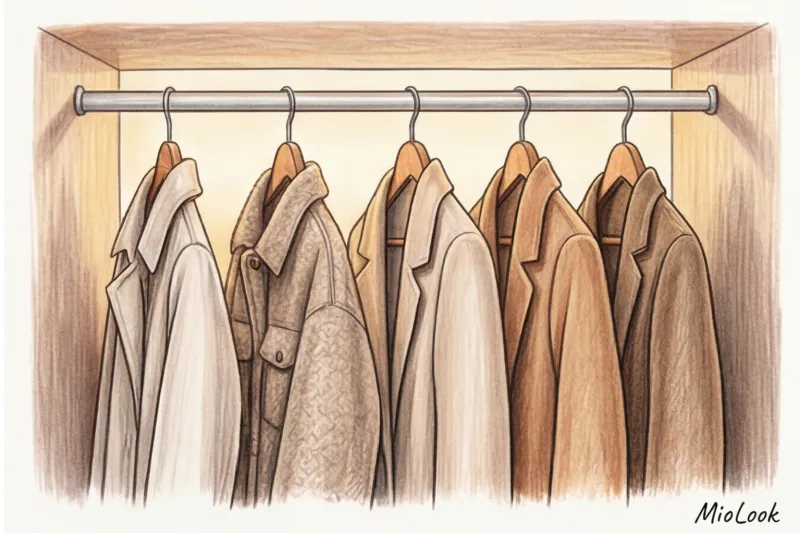
You don't need a raincoat unless you're walking in the rain. You don't need a long coat if you live in your car. Focus on the quality of the fabric, the right amount of looseness, and the ability to layer.
To avoid buying another unnecessary jacket this season, I recommend taking stock. Add your current jackets and coats to MioLook app Artificial intelligence will help you clearly see which functional layers you need for complete comfort and will create dozens of new outfits from what you already own. Invest in a smart wardrobe, and you'll always have something to wear—no matter the weather.