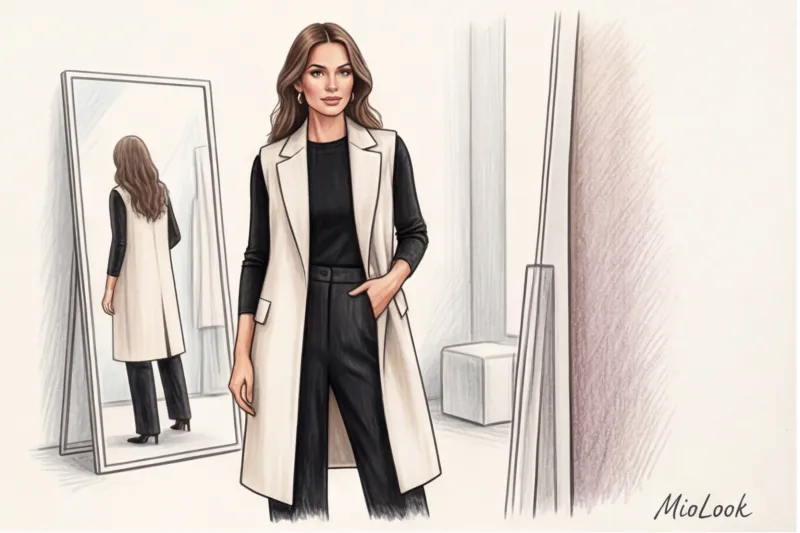
The Anatomy of Style: How Clothing Works to Shape Your Figure
Do you know what phrase I most often hear in fitting rooms from new clients? "Olena, I'm a typical pear, so I absolutely can't wear light-colored pants." or "With my apple-shaped body, all I can do is hide in voluminous tunics." And every time, I want to physically ban these terms. In 14 years of working as a personal stylist, I've realized one critical thing: there's nothing more destructive to a woman's self-esteem and style than trying to squeeze her unique, living body into a static fruit basket.
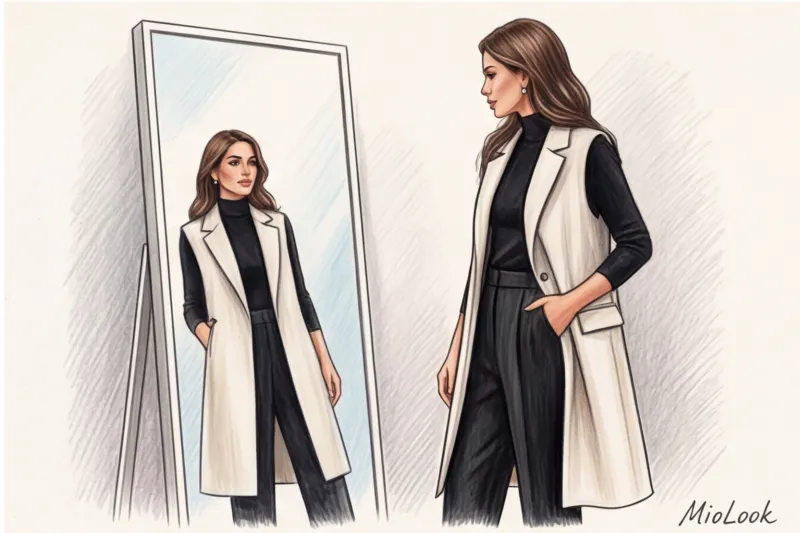
That's why it's literate visual correction of the figure with the help of clothing It all starts with a complete rejection of the fruit typology. Why are the "apple" and "pear" body shapes so hopelessly outdated? First, they focus your attention exclusively on "flaws"—areas that supposedly need to be urgently hidden. Second, they perceive the body as a flat 2D image, ignoring volume, posture, height, and movement dynamics. My approach changed dramatically when I stopped limiting my clients with strict rules and embraced the freedom of optical illusions.
"Clothing isn't a camouflage for your flaws. It's an architectural tool for controlling the gaze. People don't see your body beneath the fabric—they only see the lines, proportions, and shapes worn over it."
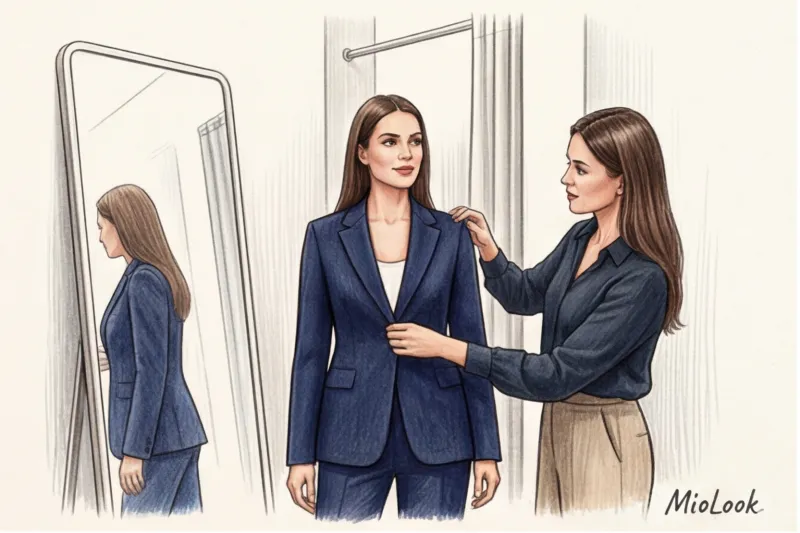
Think about it: when you put on a thick, well-tailored wool jacket (for example, from the premium Massimo Dutti or COS lines in the €150-€200 range), your silhouette automatically takes on the shape of the jacket. We see a defined shoulder line, a straight back, and a defined diagonal lapel. We read the garment's geometry, not the volume of the body underneath.
The main secret of optical illusions lies in focal points. They're your remote control for others' attention: you can literally force people to look where you want them to and ignore what you don't want them to focus on. In terms of style, we highlight three foolproof focal points that look flattering on absolutely any figure:
- Portrait zone: face, neck, collarbones. This is where we direct the eye with V-necklines, silk scarves, and jewelry. If you're unsure about the details, I recommend checking out our guide on How to choose jewelry to match your dress's neckline: stylist tips.
- Wrists: The most graceful part of the arm. Simply rolling up or pulling up the sleeves of a shirt, sweater, or jacket can instantly make the entire silhouette appear a couple of kilograms lighter.
- Ankles: Cropped trousers or jeans that reveal a thin ankle (paired with loafers or elegant ankle boots) work on the same principle, creating the illusion of overall fragility.
Understanding how these points work, we move from theory to the pure science of visual perception.
Illusions of Perception: From Müller-Lyer to Helmholtz
When I tell my clients that style is half math and half physics, they're often surprised. But the classic laws of optics work flawlessly in wardrobe. Take, for example, the famous Müller-Lyer illusion, discovered back in 1889. Its essence is simple: a line segment with outward-pointing arrows at its ends appears longer to our brain than the same line segment with inward-pointing arrows.
How does this work in clothing? A V-neckline is a classic "outward facing" neckline. It doesn't just reveal skin; it physiologically forces the eye to move up and down in an elongated trajectory, making the neck appear longer and more swan-like, and the face more sculpted. And to maximize the effect, it can be enhanced with the right accessories, which I discussed in detail in the article. How to choose earrings for your face shape: a guide to proportions.
Now let's debunk the biggest fashion myth that has ruined the lives of millions of women: "horizontal stripes make you look fat." Science says otherwise! Back in 1867, German physicist Hermann von Helmholtz proved that a square of horizontal stripes appears visually taller and narrower than a square of vertical stripes. Why can a Breton top make you look taller? The secret lies in the number of stripes: if there are many, they're narrow, and placed close together, the eye can't focus on each one individually. The brain "collapses" them and glides from bottom to top. Therefore, a high-quality Breton longsleeve (like Saint James or local brands for €50-€80) is your ally, not your enemy.
Another powerful tool is the law of continuity, which in stylistics translates as monochrome images. Our eyes are lazy. They love continuous lines. When you dress in one color from head to toe (for example, a navy pantsuit with a navy turtleneck), you create no obstructions for the eye. The silhouette is read as a single, long, slender column.
The Rule of Thirds: The Golden Ratio in Wardrobe
While perceptual illusions operate on specific areas, the "rule of thirds" governs the overall architecture of an image. You've probably heard of the golden ratio in art and photography. In stylistics, this principle is adaptive and works like the formula 1/3 to 2/3.
Now think about your most common morning mistake. You put on jeans and a contrasting untucked top (for example, a white sweater over black jeans) that ends right at the widest part of your hips. What's happening? You're cutting your body in half. A 50/50 ratio makes your legs appear shorter, your torso heavier, and your overall appearance squat. The human eye doesn't appreciate the symmetry of a square; it craves the dynamism of a rectangle.
The 1/3 to 2/3 formula solves this problem instantly. In practice, this means a tucked-in top and high-waisted pants. The pants take up two-thirds of your silhouette, visually elongating your legs, and the top takes up one-third. See the appendix. MioLook , which has a convenient "smart wardrobe" feature, I often show my clients how a simple visual shift in their waistline in photos changes the perception of their height and weight. It's a visual magic of proportions that can be appreciated on the screen before leaving the house.
How do you apply the rule of thirds to outerwear, especially in the colder months? The principle remains the same. If you're wearing a cropped aviator or cropped jacket, it should end at your waist (taking up 1/3 of your silhouette), leaving 2/3 for long pants or a skirt. If you choose a midi or maxi coat, the coat itself should cover 2/3 of your figure, leaving only the lower third (like boots or the hem of a dress) exposed. Avoid knee-length pieces, which again mercilessly cuts your figure in half.
The Biggest Myth: Why Black Doesn't Always Make You Look Slimmer
Let's conduct a little thought experiment. Open your closet and evaluate the color scheme on the shelf with everyday items. We bet black dominates there? For generations, most women have believed in the unshakable mantra "black makes you look slimmer and hides imperfections." But in practice, a smart visual correction of the figure with the help of clothing obeys completely different laws of physics and optics, where color does not play a leading role.
Let's start with how dark shades interact with space. In daylight or a well-lit office space, black offers maximum contrast to its surroundings. Imagine outlining your silhouette with a thick black marker on a light background. This is exactly how all-black works against beige walls or a sunlit street. Black mercilessly highlights every line and curve that defines your silhouette. If your goal is to conceal the nuances of your thighs by wearing black leggings or skinny pants, you're achieving exactly the opposite: highlighting these contours through sharp contrast with the background.
Here we come to a crucial aspect: the combination of cut and fabric density. Why do shapeless black robes, tunics, or loose, flowing dresses always add weight? It's all about the mechanics of the human eye. When we see a solid dark blob with no defined internal proportions (for example, no accent at the waist or wrists), the brain automatically perceives the outermost points of the garment as the actual dimensions of your body. You try to hide your belly, but the observer ends up adding volume across the entire width of this "black bag." Instead of the desired lightness, you get a massive, monumental silhouette.
One of the most revealing transformations in my practice happened to a client (let's call her Irina). She came to me with a request to visually lose weight and brought a suitcase brimming with shapeless black waterfall cardigans, tunics, and thin dark trousers with elastic waistbands. The first thing we did was completely get rid of this wardrobe of "black bags." I suggested a radical step: try light shades in structured fabrics.
When Irina put on a white, straight-cut jacket made of thick cotton (a great basic investment for around €150) and beige pleated trousers, she froze in front of the mirror. The jacket defined her shoulders, created two elongating vertical lines with the unbuttoned cuffs, and, most importantly, held its shape without clinging to her waist. Visually, Irina dropped two sizes in exactly three minutes. It was a revelation for her: white worked as a powerful slimming tool simply because The architecture of the cut turned out to be more important than the pigment.
The texture of the fabric is more important than the color
Continuing our discussion of the physics of materials, we must consider texture. Light can be absorbed or reflected, and this dramatically changes the perception of your proportions. Matte fabrics—such as high-quality suiting wool, heavy cotton, linen, or gabardine—absorb light rays. They create a deep, uniform tone that truly reduces volume and makes the silhouette appear more compact and composed.
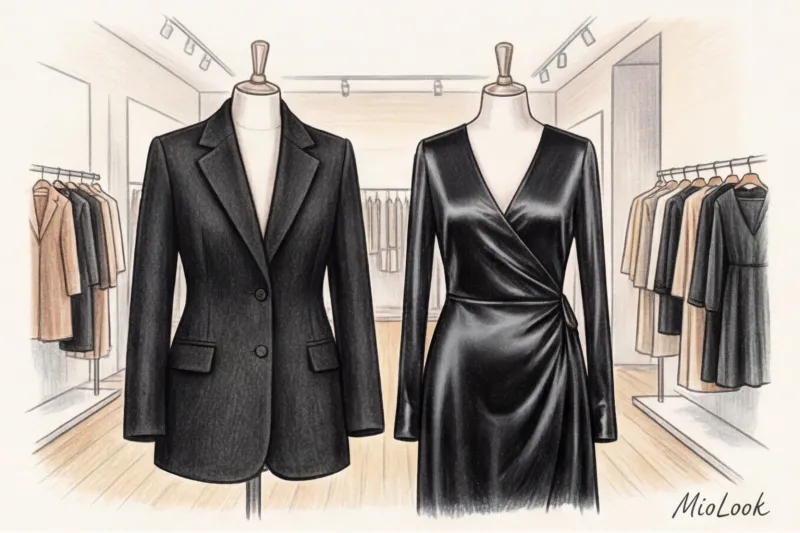
But take that same black in a shiny finish, and the rules of the game change 180 degrees. Shiny fabrics—satin, silk satin, lurex, sequins, and smooth leather—act like mirrors, reflecting light. Natural curves (like the bust, a protruding tummy, or hips) inevitably create highlights. These highlights instantly create the illusion of 3D volume, visually expanding the area they're worn on. It's a simple fact: a black satin slip skirt cut on the bias will add volume to your hips much faster than a matte light gray A-line skirt made of a dense fabric.
Finally, the main enemy of any figure, even the most flawless one, is flimsy, thin knitwear. Over the years of wardrobe reviews, I've thrown away hundreds of such turtlenecks, blouses, and dresses. The problem with thin viscose knitwear is that it lacks its own "skeleton." It's physically incapable of shaping the silhouette. Instead, it clings limply to whatever's underneath, gathering in treacherous horizontal folds, highlighting the texture of lace underwear and the slightest unevenness of the skin. Even if this flimsy knitwear is jet black, it won't make you look slimmer; it will merely delineate your contours. If you can't imagine life without cozy knitwear, choose a dense, smooth knit that leaves air between the fabric and the body (high-quality jumpers of this type are easily found in the mass market segment in the €60-€120 range).
Stop hiding in black!
Try MioLook for free: A smart AI stylist will create the perfect look based on your body shape and suggest structured pieces that truly work for you.
Get access — €0.99 onceVerticals and Horizontals: Silhouette Architecture
Eye-tracking studies, regularly published by visual merchandising laboratories, prove a physiological fact: the human eye always reflexively follows lines. If you want visual figure correction with clothing to work reliably, you need to become an engineer of these very lines. In my practice, I divide them into verticals (which elongate and slim) and horizontals (which cut and widen).
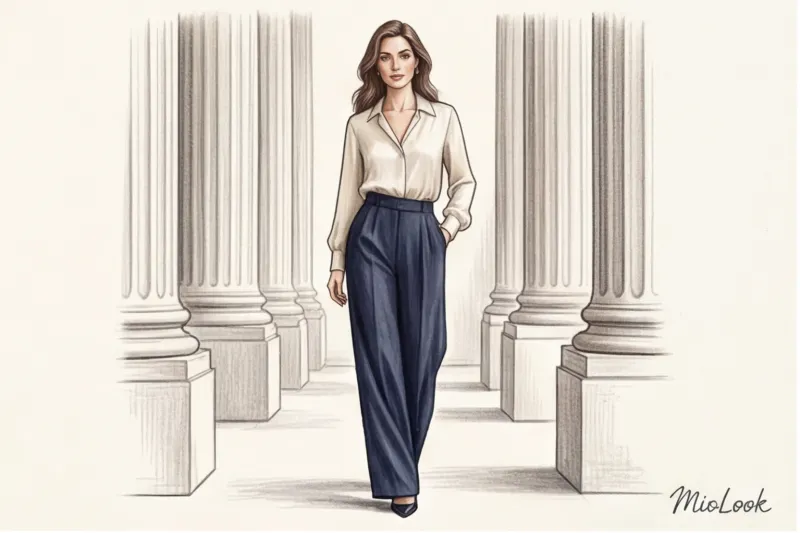
Let's start with the basics—natural vertical lines already woven into the cut of clothing. The most powerful and accessible tool here is a pressed creased trousers. Straight-leg trousers with a crease in a thick wool blend instantly make legs appear longer and straighter. A continuous row of buttons on a shirtdress or deep slits on midi skirts also fall into this category. A slit acts as a window, creating a narrow vertical line as you walk, forcing your interlocutor's gaze to move from top to bottom rather than wandering across your hips.
If a garment's cut doesn't have pronounced vertical lines, we create artificial ones through layering. An unbuttoned, straight coat thrown over a contrasting underlayer creates a so-called "slender column." A long suit vest or a long scarf with loose ends works similarly. By collecting capsules through Smart wardrobe at MioLook I always make sure a girl has at least three pieces for creating these optical illusions during the fall/winter season. Imagine a black turtleneck and trousers, with an unbuttoned beige trench coat over it. You get two light vertical stripes on the sides that visually "cut" the volume.
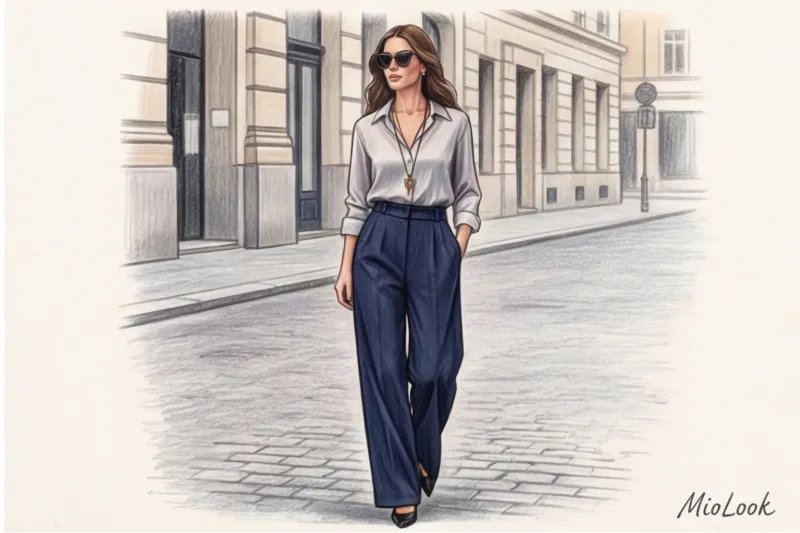
But all this carefully crafted architecture will collapse if it's interrupted by dangerous horizontal lines. Any horizontal line visually expands the area it runs through. A classic mistake I often see on the street is a contrasting belt draped across the hips. It instantly adds a couple of extra dimensions. A particular pain for a stylist is ankle straps paired with cropped trousers. They literally "cut off" the foot, taking 5-7 centimeters off your height. The same goes for awkward sleeve length: if the sleeve hem or cuff ends exactly at the level of curvy hips, it will act as a neon sign. Simply roll the sleeve up to the elbow or wrist, and the focus will shift to the more graceful parts of the body.
Any horizontal line on the body acts as a highlighter. Before putting something on, ask yourself: Do I really want to emphasize this particular width?
Herein lies my golden rule of styling regarding lengths. Where exactly should a skirt, dress, or cropped trousers end? Exclusively at at the narrowest point Legs. Never let the horizontal hem cut into your calves at their widest point—this is guaranteed to make your legs look bulky. If you have slender ankles, choose a midi length that only reveals the ankle bone. If you have slender knees, the hem should end just above or just below the kneecap. Having a skirt shortened at a reputable tailor costs between €15 and €20, but this tiny investment pays for itself instantly, transforming an otherwise unflattering garment into the perfect tool for sculpting your silhouette.
Individualized visual body shaping: solutions for frequently requested needs
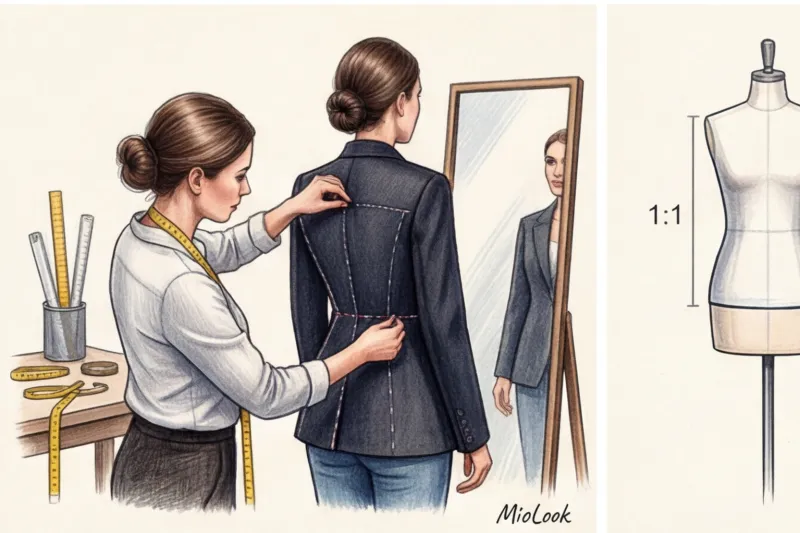
During one of the clothing design intensives at Milan's Istituto Marangoni, a professor uttered a phrase that became the foundation of my styling practice: "The body is just a mannequin. The tailor draws the lines." It's time to put the fruit metaphors to rest. Visually shaping the figure with clothing isn't an attempt to squeeze oneself into an "apple" or "pear" shape, but a targeted solution to specific problems through the architecture of the cut.
The main principle we'll now apply in practice is volume balance. As a stylist, I want to convey a crucial idea: visual correction doesn't always mean simply "slimming" or the desire to appear thinner at any cost. More often than not, our real goal is to harmonize the silhouette. We can easily distract attention from one area by simply adding the right volume to another. Let's move from theory to practice and examine how this law of physics applies to the most frequently searched for areas.
How to visually lengthen your legs
The most common request I get from girls of all heights is: to make your legs appear endless, you need to create a continuous vertical line that starts as high as possible and ends as low as possible. The first and most powerful tool here is shoes that match the bottom. Black opaque tights or trousers paired with black ankle boots work flawlessly. If you're barefoot (or wearing nylon tights), choose nude shoes that match your skin tone as closely as possible. Even a basic pair of beige pumps made of high-quality leather in the €100-€150 range can work wonders, becoming an extension of your legs.
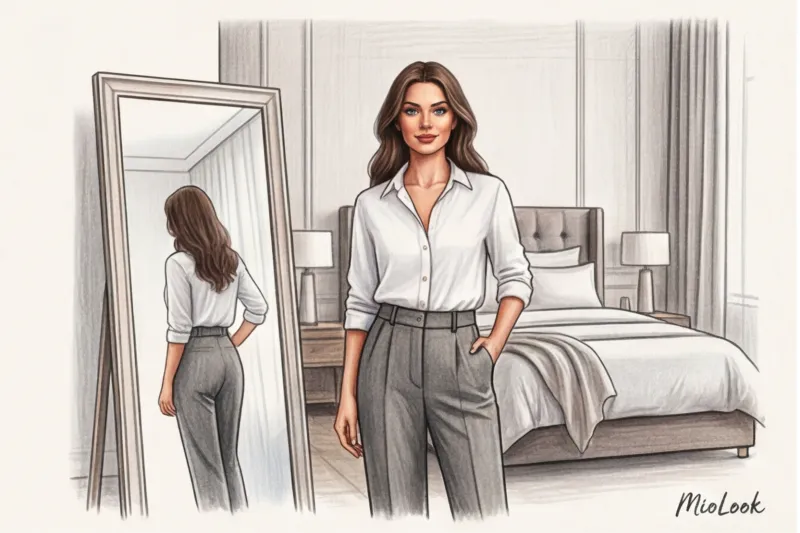
The second step is proper fit. High-waisted pants, jeans, and skirts literally redraw the line where your legs start. When you tuck your top in, you create a new starting point for others to look at. A low waist, on the other hand, steals precious inches from your legs, giving them to your torso.
The third secret lies in the shape of your shoe's toe. A pointed-toe adds those extra 2-3 centimeters of length to the foot, visually elongating the entire silhouette. A round or square toe creates a sharp horizontal "point," cutting off the line. Furthermore, if your shoes have a deep V-neck, this acts as an additional arrow pointing downwards and lengthening the instep.
We level out the volume in the abdominal area
The abdominal area is often a source of insecurities, but from a styling standpoint, it's just a minor challenge. The main rule here: no smooth, thin, or clinging fabrics in this area. Flimsy knits or thin viscose will treacherously highlight every anatomical detail.
We choose matte, dense fabrics that hold their shape and don't cling to the body at the waist. Heavy cotton, high-quality suiting wool, or gabardine will create their own framework, leaving a safe space between the fabric and the figure. But the real magic begins when we incorporate the right cut: draping, wraps, and asymmetry.
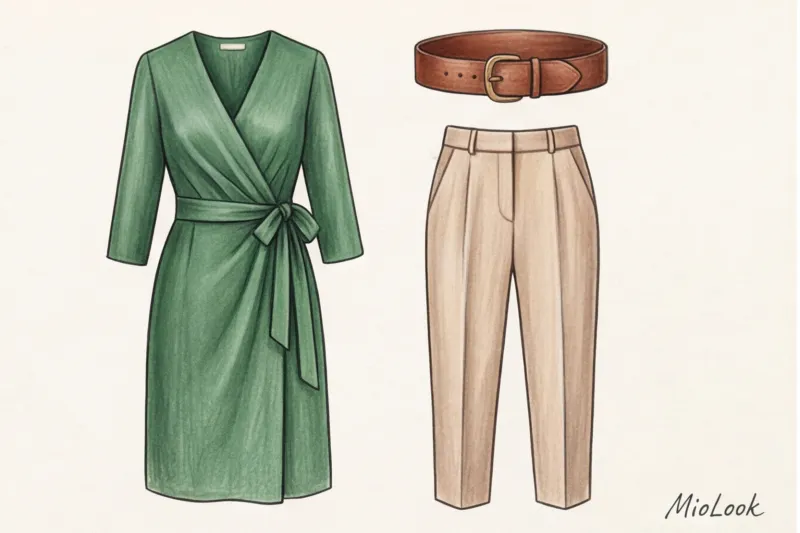
In 1974, Diane von Furstenberg revolutionized fashion by creating the perfect shapewear tool: the wrap dress. Two diagonal lines crossing the torso visually "cut" the midriff, creating an X-shaped silhouette. An asymmetrical hem or subtle side draping draws the eye along the complex lines of the cut, ignoring the actual curves of the body.
If you want to completely draw attention away from the center of the composition, use a focus on the portrait area. Large statement earrings, a chunky chain, or a bright silk scarf near the face will force the person you're talking to to look at your eyes and collarbone. Their gaze simply won't drop to your waist.
Access to MioLook for €0.99 — one-time payment
Start creating perfect looks with artificial intelligence and assemble harmonious capsules in just a few clicks.
Get access — €0.99 onceSecrets to Balancing Your Shoulders and Hips
Here, we're working with the pure principle of leverage. If you have broad shoulders and narrow hips (an inverted triangle), our goal is to break up the top horizontal line and add volume downwards. A deep V-neck or raglan sleeve is ideal for the shoulder area—its diagonal seam visually softens and narrows the shoulder. Below, we offset this volume with full A-line skirts, palazzo pants with pleats at the waist, or balloon jeans. Adding emphasis to the waist creates a harmonious hourglass figure.
The opposite situation: full hips and a delicate, narrow shoulder girdle. Don't try to squeeze your hips with shapewear to the point of physical discomfort. Adding weight to your upper body is sufficient. The classic "light top/dark bottom" technique works precisely because light colors visually expand objects.
But my favorite tool is the structure of the shoulder. Loading things into MioLook To digitalize a wardrobe, I always recommend my clients add jackets with a clear shape. Shoulder pads have made a comeback for a reason: they create a strong, wide horizontal line at the top, which instantly balances out a heavy bottom. Add a strong collar (for example, wide lapels or a shirt with a large collar), and your hips will appear much slimmer against the confident, architectural line of your shoulders.
The Role of Prints and Scale: How Design Size Changes Proportions
Remember how in geography class we were taught about scale distortions when transferring the spherical Earth onto a flat map? The same thing happens with prints on the human body, which has its own curves and volumes. A pattern isn't just a decorative element of fabric, but an active optical instrument. According to optical distortion data from visual ergonomics studies, a large print physically "stretches" the perceived surface area. When the eye is drawn to a large-scale pattern repeat, the brain automatically perceives the object as wider and more massive.
That's why the basic rule of stylistics when working with patterns is strict proportionality. If a petite woman wears a dress with giant tropical flowers or huge abstract spots, she's visually "lost" in the splendor. The print simply overwhelms her, making her figure appear even smaller and squatter. Conversely, plus-size women should avoid small, speckled patterns—for example, classic polka dots a couple of millimeters in diameter. Against such endless flickering, the overall silhouette appears monumental due to the contrast. The optimal guideline for most figures is a medium-sized print, comparable to the size of your fist.
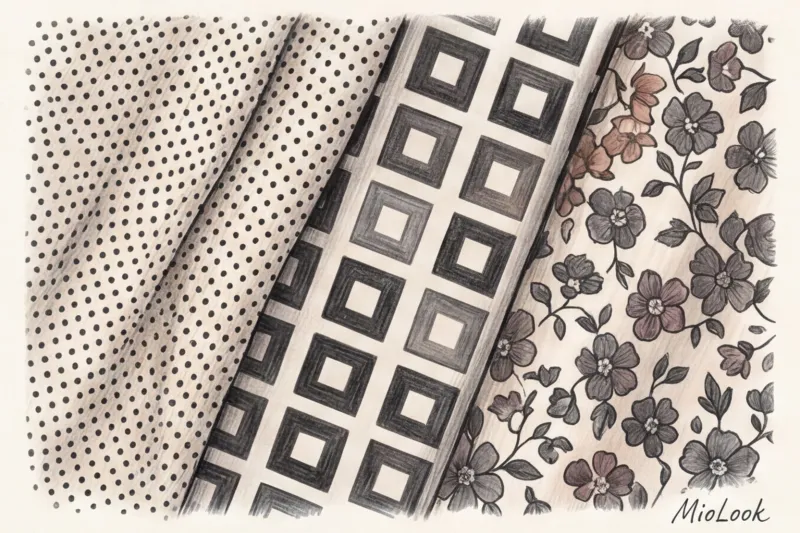
The second trap often encountered while shopping is the insidiousness of contrasting prints. Any pattern with a high color polarity (black and white zebra, neon flashes on a dark background) acts as a visual target. It inevitably draws the eye to the area where it's placed. If your goal is to distract attention from your voluminous hips, wearing pants with a bold, contrasting houndstooth pattern will be a mistake that will ruin all your efforts. Save such patterns for areas you want to emphasize. And for difficult areas, choose low-contrast solutions (tonal prints)—say, an emerald pattern on a dark blue background.
And finally, the ultimate battle of shapes: geometry versus florals. The smooth, rounded lines of flowers and imaginative patterns tend to flow across the figure, echoing and enhancing its volumes. If you're looking for the perfect slimming print, your absolute favorite is diagonal tartan. When the fabric is cut on the bias (a technique brilliantly used by Madeleine Vionnet), the rigid tartan grid transforms into elongating diamonds. Sharp angles and diagonal lines crossing the body create a clear, dynamic rhythm and literally trim away excess inches on the sides.
Upload your items with a pattern in the "smart wardrobe" feature in MioLook Try creating virtual images: you'll clearly see how an A-line skirt with a diagonal check pattern elongates the lower half of the body compared to a floral print. A high-quality, geometrically designed piece from brands like COS or Arket will cost between €90 and €150, but this investment will be worth every penny thanks to the impeccable architecture it creates for your silhouette.
The Hidden Foundation: Proper Underwear and Fit
I'll let you in on the biggest professional secret of glossy photoshoots. When you look at the flawless silhouettes of models in lookbooks or on the red carpet, you're not seeing unique genetics. You're seeing the work of a stylist, dozens of meters of double-sided tape, special tape, and carefully chosen basic shapewear. A perfectly fitting silk or thin viscose simply doesn't come naturally. The human body has texture, and the skin shifts as it moves, and this is completely normal.
In fact, the right underwear does exactly 50% of the work when it comes to visually shaping your figure with clothing. You can invest in a luxurious silk slip dress for €300, but textured lace on a bra or digging elastic on panties will instantly ruin the magic, adding visual bulges where none physically exist. My strict rule for a basic wardrobe: under any thin, light, or flowing fabrics, wear only smooth, seamless, nude-colored underwear. Many girls mistakenly buy white underwear to go with white summer clothes, even though it will stand out like a neon sign under the fabric. Only a shade that closely matches your skin tone will blend in and become invisible. Seamless shorts with a medium level of shaping work like the "blur" tool in a photo editor—they create a smooth, uniform canvas for your looks.
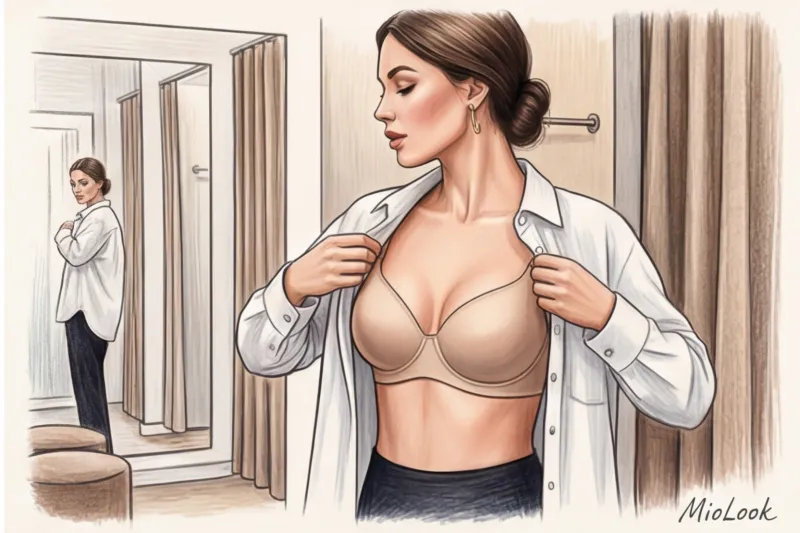
The second most important aspect of a perfect fit is the so-called "air" between the body and the fabric. There's a paradoxical, yet ironclad, stylistic rule: tight-fitting clothes always make you look fat. When fabric stretches across the hips, chest, or arms, creating characteristic horizontal creases, our brain subconsciously interprets this as "the person doesn't fit in the clothes."
Leave at least one and a half to two centimeters of clearance. A loose fit makes the figure look more fragile, because others see the straight lines of the cut rather than the detailed anatomical details. Analyzing your capsules through MioLook smart wardrobe Always evaluate items dynamically: if the fabric bursts at the seams when you move or try to sit down, it means the size or pattern is incorrect.
Finally, the upper body's architecture always hinges on the shoulder girdle. The importance of a proper armhole and a defined shoulder line cannot be overstated. An armhole that's too high or too narrow will dig into the armpit, creating unsightly folds. A dropped, loose shoulder seam on a soft cardigan will instantly make the back appear hunched and the upper body appear bulky. The ideal armhole for a classic set-in sleeve should lie precisely along the natural joint. Even a minimal, barely noticeable shoulder pad on a jacket acts as a frame: it creates a straight horizontal line that lifts the entire silhouette. If you try on a jacket and it fits perfectly everywhere except the shoulders, leave it at the store. Retailoring this area at a tailor is prohibitively expensive, and an improper fit will ruin all your efforts to correct your proportions.
Your ideal image begins Here
Join thousands of users who look flawless every day with MioLook.
Get access — €0.99 onceChecklist: Wardrobe audit for distorted proportions
We've covered the theory of lines, prints, and fit. Now it's time to open your closet doors. Analyzing my own practice, I've discovered an interesting pattern: about 70% of the items women consider "fat-making" are actually simply poorly paired with their neighbors. We become accustomed to our reflection in the mirror and stop noticing the optical traps that we create with our own hands.
To avoid throwing away good essentials, let's conduct a self-audit right now. If you already use the wardrobe management feature in MioLook Just open the image gallery—it's much easier to spot distortions in photos than in real-time. If not, try on your favorite everyday outfits and check out the four critical areas.
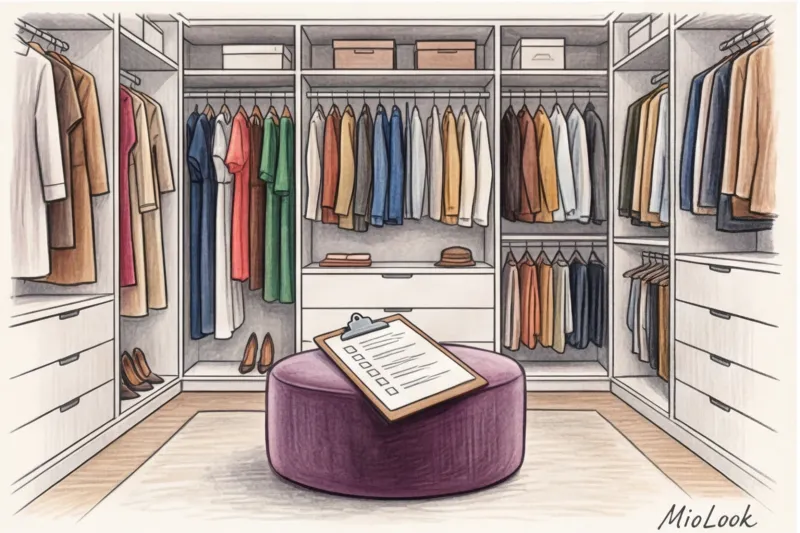
Length test: Do skirts and shorts cut your legs at the widest point?
The golden rule of design: any horizontal edge should follow the narrowest part of the figure, not its widest point. Our brains are wired to automatically interpret the width of a horizontal edge as the overall thickness of the limb. Stand up straight and look at the edges of your clothing. If your summer shorts or cropped trousers end right at the mid-thigh (where the volume is greatest), they will visually make your legs appear larger.
The ideal hemline for a midi skirt or Bermuda shorts should fall at the narrow part just below the knee or the thin ankle, subtly avoiding the calf. If the hemline cuts off the widest part of the calf, the skirt should be shortened or, conversely, replaced with a longer style.
Contrast analysis: where are the brightest horizontal lines?
Look at the contrasting colors in your favorite outfits. Where do you draw the line? If you wear a white sweatshirt untucked with dark jeans, and the hem falls exactly on the widest part of your hips, you've created a widening horizontal line. The same thing happens when you wear a contrasting belt over a long sweater.
The solution is simple: use a partially tucked edge (a famous styling technique French tuck By tucking your top only at the front waist, you move the color line higher and create a slimming diagonal across your hips that breaks up the rigid horizontal line.
Checking the "air": is there a gap between the body and the fabric?
Perform the so-called "pinch test," which we teach to beginning stylists in our fit classes. In the areas you want to conceal or correct (stomach, hips, forearms), pinch the fabric with your fingers. If there isn't at least 2-3 centimeters of space between your body and the material, the garment is dangerously tight.
Even a high-quality basic T-shirt or shirt for €50 will mercilessly ruin the silhouette if the fabric is stretched too tightly over the stomach or back without any air space. The lack of this space immediately reveals all the anatomical nuances and adds visual weight. A garment should softly envelop the figure, not constrict it.
Shoe test: do ankle boots make you look shorter when paired with a midi?
Perhaps the most insidious mistake in demi-season looks is a broken leg line. Pair your midi skirt with your usual autumn ankle boots. If there's a 5-10 cm strip of skin (or light-colored tights) between the top of the shoe and the hem, your legs are visually "cut" into three distinct sections: skirt, bare leg, and boot.
This mercilessly steals height and makes even tall women look shorter. Proper design requires continuity: the shaft of boots or ankle boots should extend exactly under the hem of the skirt. If your shoes are shorter, choose tights that match the color of your shoes to create a unified color line without any contrasting gaps.
Summary: Focus on strengths instead of fighting weaknesses
In 2022, the Fashion Psychology Institute, led by Dawn Karen, published intriguing data: women who dress primarily to "hide" their bodies experience 40% more stress when choosing outfits daily. Rethinking your wardrobe is the first and most important step toward personal style. Clothes should delight, comfort you, and express your individuality, not serve as a camouflage for perceived flaws. When we spend all our energy trying to hide something, we unconsciously transmit tension to the world. But shift your thinking, and your very shape changes.
This is where my favorite, absolutely ironclad rule comes into play: find your two or three main focal points and make them the architectural center of your looks. Each of us has areas that are objectively beautiful, graceful, and not subject to significant changes with age or weight. Most often, these are the curve of the neck and collarbone, slender wrists, or slender calves. Instead of wrapping yourself in a shapeless dark cardigan, trying to drape your hips, wear a structured jumper with a deep V-neck (excellent basic options in thick cotton can be found at COS or Arket for €60-€80) and slightly roll up the sleeves to a 3/4 length.
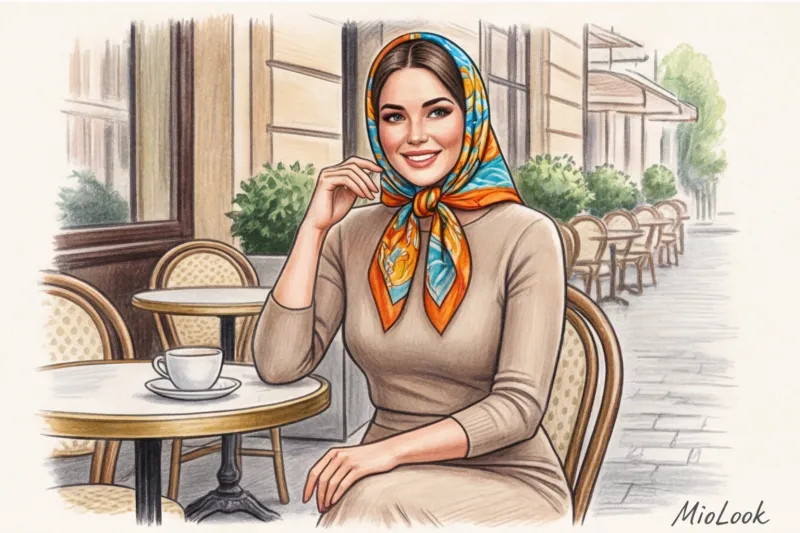
You'd be surprised, but the human eye is lazy—people will look precisely where skin is exposed and where light is accented. Beautiful wrists accented by a chunky metal bracelet or graceful collarbones framed by a well-designed collar will do hundreds of times more for your attractiveness than miles of shapewear.
We recently worked with a client who spent around €300 on rigid shapewear and thick black turtlenecks to appear slimmer. We tossed it all aside and simply revealed her ankles with cropped, straight-leg trousers and accented them with loafers. The effect was striking: the entire silhouette instantly became lighter, and she smiled at her reflection for the first time in a long time.
It is important to understand one fundamental thing: visual correction of the figure with the help of clothing It's not an innate gift reserved for Hollywood stylists. It's a purely practical skill of optical illusion that anyone can learn. It's like learning to reverse park or adjust lighting for a selfie. You simply memorize how vectors work, where you need to add volume for balance, and where you need to remove color contrast.
In closing this guide, I want to leave you with one key piece of advice: don't be afraid to make mistakes in the fitting room. Modern fashion has long since ceased to be a dictator with a set of rigid prohibitions. If you absolutely adore a midi skirt, which, according to dry theory, slightly cuts off your height, wear it with pleasure! Now you just know how to counteract this effect: choose boots that fit under the hem, or wear a top that creates a strong vertical line. Experiment, play with proportions, try on textures you once feared.
And to avoid losing successful discoveries, document your experiments. Save photos of the images in MioLook , you will be able to build a personal database of reliable formulas where your strengths are always at the forefront.
Guide Chapters
How to hide love handles with clothing: stylist tips
Forget baggy clothes. Learn how the right fabric density and cut can help you hide saddlebags for good and visually lift your buttocks.
How to visually lengthen your neck: the best necklines
Forget the boring V-neck! We'll explore real styling tricks that will help make a short neck look graceful and long.
How to visually reduce breast size: clothing tips
Forget shapeless oversized clothes and black robes. Discover stylist secrets that will help you balance your silhouette and perfectly define your décolleté.
How to visually enlarge your breasts with clothing
Forget about uncomfortable push-up bras and tight knitwear. Learn the secrets of proper tailoring to create a harmonious and voluminous silhouette.
How to Hide Full Arms with Clothes: Stylist Tips
Forget about shapeless hoodies and hot cardigans this summer. A stylist explains how to visually enhance your arms with the right sleeves.
Optical illusions in clothing: how to change your figure
Forget stereotypical body types. Learn how to use science, prints, and geometric contrasts to create the perfect silhouette.
Color Correction: Secrets to a Perfect Silhouette
Forget boring black pieces designed to hide flaws. Discover how expert use of color, monochrome, and texture can visually slim your figure.
How to visually narrow your waist: belts, peplums, and tailoring
A slim waist isn't the result of rigid cinching, but rather the careful design of clothing. We'll explore how to create the perfect silhouette through tailoring and accents.
How to Hide Broad Shoulders with Clothing: Stylist Tips
Broad shoulders aren't a flaw, but rather an aristocratic presence. Learn how to effectively use architectural cuts and silhouettes to achieve a feminine look.
How to Hide Wide Hips: Styling Tips and the Best Styles
Forget black leggings and shapeless tunics. Learn how to visually enhance your hips with the right cut and shape of your clothing.
How to Look Slimmer with Clothes: Stylist Secrets
Clothes shouldn't be a cover. Discover 10 key rules for visually shaping your figure using the architecture of dense fabrics and optical illusions.
How to Look Taller with Clothes: Stylist Tips
Many short women believe that stiletto heels are the only way to gain height. Learn how to elongate your silhouette and add a touch of class with the right cut.
How to visually lengthen your legs: stylist tips
Leg length isn't just a matter of genetics, it's also a clever optical illusion. We'll explore how to adjust your figure proportions with the right clothing.
How to Hide Your Belly with Clothing: The Best Styles and Tricks
Forget outdated "apple-shaped" dresses and baggy robes. Learn how to create the perfect silhouette using tailoring and optical illusions.