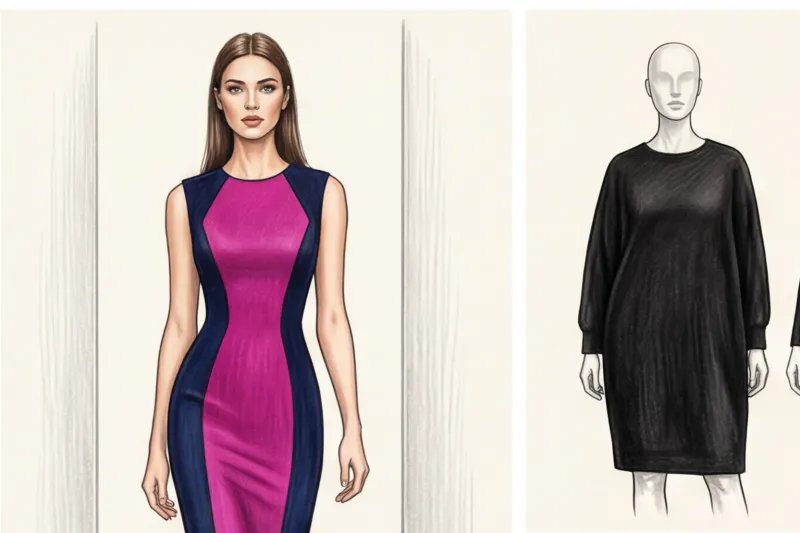
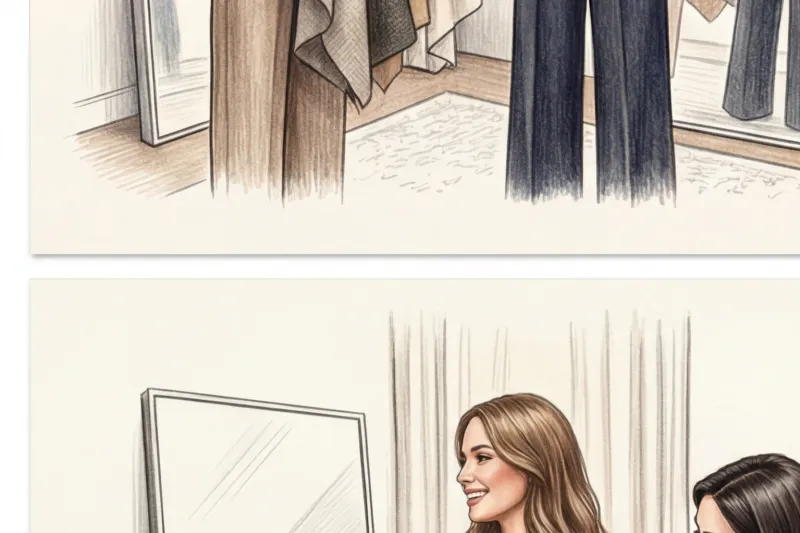
"I never wear light colors; they make me look fat," a client confidently told me last week, clutching a shapeless black dress made of thin polyester. She was certain this piece of dark synthetic material would save the day. I gently took the dress from her and handed her a voluminous, structured ivory suit made of thick merino wool. When she emerged from the fitting room, the mirror reflected a woman two sizes thinner and ten centimeters taller.
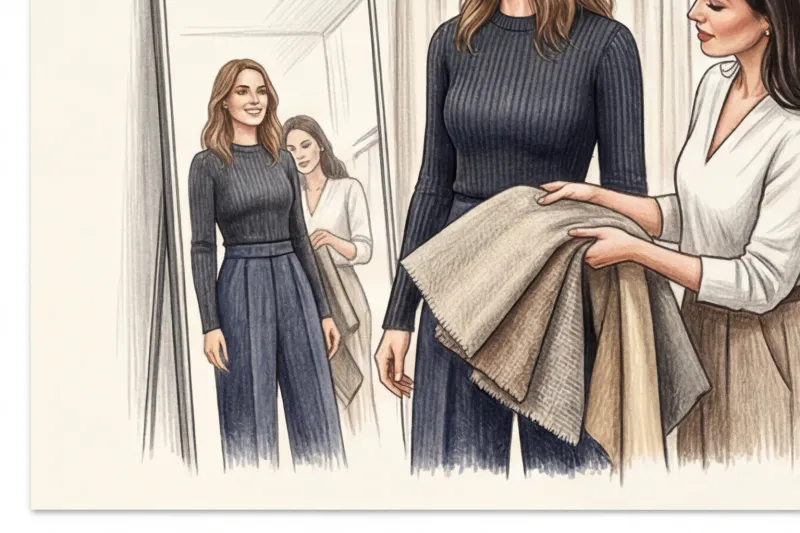
This case from my practice perfectly illustrates the main misconception: we are accustomed to hiding the body in the darkness, forgetting about the laws of physics. The real color correction of the figure — this isn't an attempt to "mask imperfections" with mournful shades. It's a delicate, precise work with light, shadow, and premium textures. We've already discussed the basic principles of silhouette construction in more detail in our a complete guide to visually correcting your figure with clothing.
Today, we'll forget about glossy clichés and look at monochrome and color blocking through the eyes of an architect. I'll tell you how to control the eye with fabric density, why glossy silk is tricky, and how a well-designed color vertical works better than any diet.
Color Architecture: Why Color Correction Works Better Than Diets
In 14 years of working as a stylist, I've ruthlessly erased the "fruit typology" from my vocabulary. You're not a pear, an apple, or an inverted triangle. You're a complex architectural form, the contours of which are discernible to the human eye solely through the refraction of light.
Back in 1961, Swiss artist and theorist Johannes Itten demonstrated in his book "The Art of Color" that the perception of volume is directly dependent on the temperature and lightness of a hue. Warm and light tones possess centrifugal force—they optically "expand," moving toward the viewer. Dark and cool tones are centripetal, receding into the depths.
"Color is an optical illusion that can and should be manipulated. A well-placed block of color forces the viewer's eye to follow the path you've set, ignoring what you want to leave in shadow."
But this theory falls apart in the face of mass-market reality if we don't take into account the density of the material. Color works for you. only in synergy with the right cut. If a garment doesn't hold its shape, no shade of navy blue, even the deepest, won't save the silhouette.
The biggest myth of color theory: why black isn't always slimming
The most dangerous stereotype I fight daily is: "I'll wear black to hide what's too much." Let's turn to the laws of optics.
According to research by textile laboratories (including The Woolmark Company), matte dark wool absorbs up to 80% of incident light. Yes, in this case, volume is indeed reduced. But what happens when you wear thin black knitwear made of viscose or cheap acrylic? The fabric stretches along the curves of the body, begins to shine, and acts as a marker, outlining every wrinkle and unevenness. In 70% of cases, all-black clothing made of a thin material makes the figure appear bulkier.
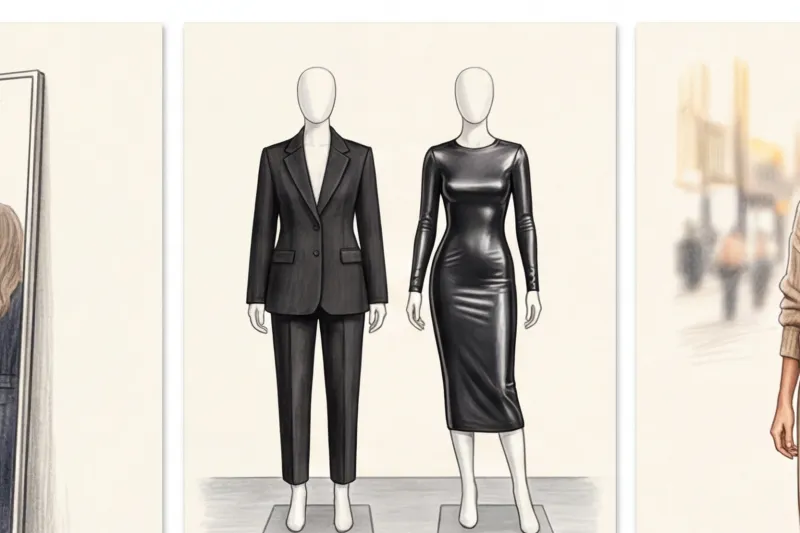
In contrast, there's the concept of "structured light." A light-colored suit made of thick cashmere, tweed, or structured cotton (180 g/m² or higher) creates a clear outer frame. It doesn't cling to the body, but rather creates new, smooth lines over it. This is why white palazzo pants in a dense fabric are phenomenally slimming compared to black leggings.
Texture is more important than color: a guide to premium materials
When you're budgeting for a wardrobe update (say, in the €300-€500 range for a seasonal capsule), invest in texture rather than trendy color.
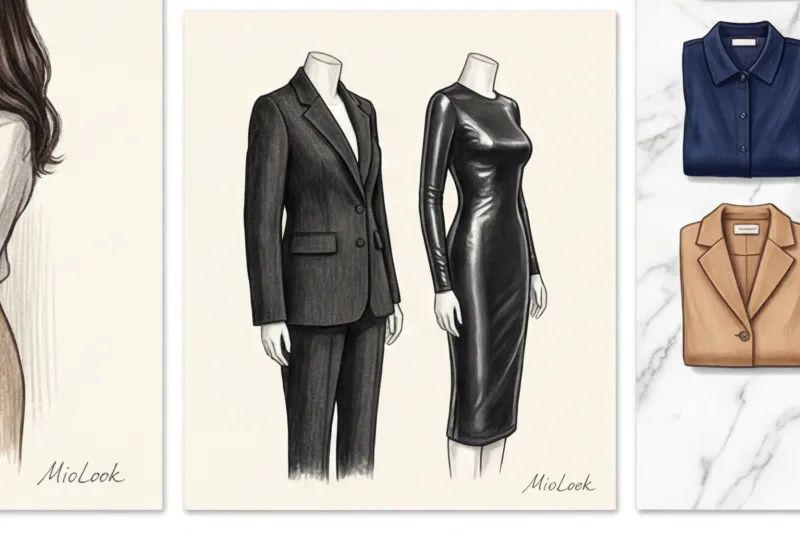
- Matte fabrics (absorb light and conceal volume): Cashmere, dense merino wool, crepe, suede, and suiting viscose are your best allies in color correction.
- Glossy fabrics (reflect light and add up to 10-15% visual volume): silk, satin, velvet (due to the play of light), leather with a shiny finish.
Fair Limit: If you want to wear a silk slip skirt but are worried about the volume around your hips, that doesn't mean you have to give it up. Simply cover your hips with a matte, oversized sweater or a long jacket. You'll maintain the textured contrast while reducing glare in the problem area.
Access to MioLook for €0.99 — one-time payment
A smart AI stylist will select the perfect look based on your proportions and help you digitize your wardrobe.
Get access — €0.99 onceMonochrome as an investment in silhouette: rules for creating a unified vertical
A monochrome look isn't just a "quiet luxury" aesthetic. It's the most powerful tool for elongating the silhouette. When you dress in a single color from head to toe, the observer's eye glides over you from top to bottom without stopping. There are no horizontal color lines—no "cutting" of the figure. In practice, a properly composed vertical color line visually elongates your height by 5-10 centimeters.
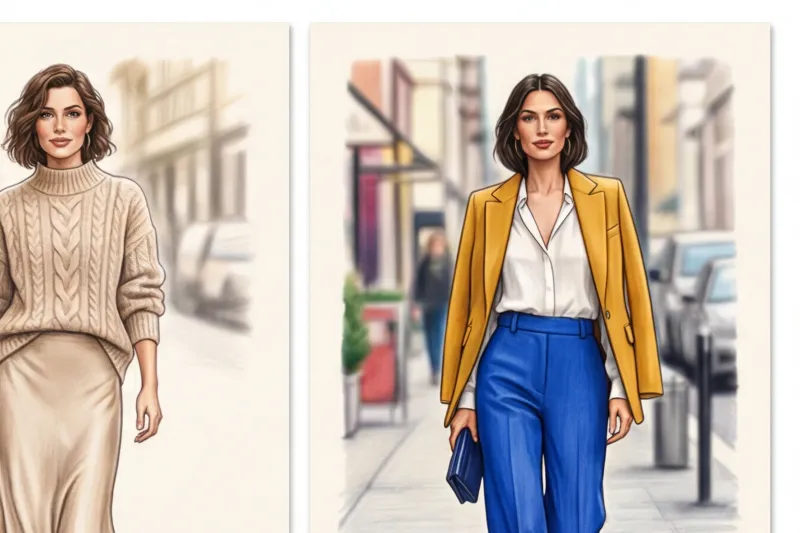
But there's a catch. There's a huge difference between a cheap monochrome (a single-color sweatsuit) and a high-status monochrome. A high-status monochrome increases your cost-per-wear (cost per wear) because it looks just as appropriate for a business lunch as it does for a fashion show. The secret to creating it is simple, yet often overlooked.
The secret to "expensive" monochrome: a play of textures and density
To prevent the monochrome from looking like a cleaning company employee's uniform, use rule of three textures In one image, materials with different light reflections should collide.
An example of an ideal autumn set (the approximate cost of basic items in the mid-range segment is from €100 to €250 per item):
- Smooth matte leather (trousers).
- Fluffy, voluminous pile (mohair or alpaca sweater).
- Flowing softness (silk scarf or cashmere coat on top).
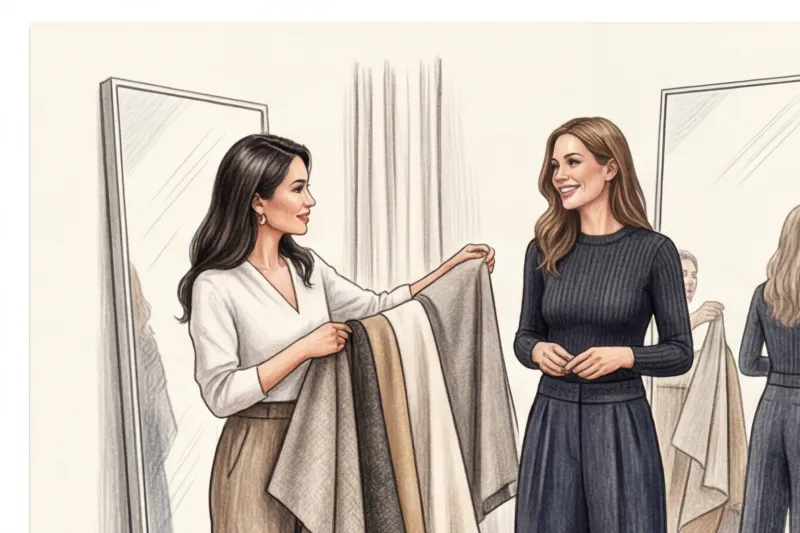
I also always recommend my clients to use tonal monochrome You don't need to obsessively search for items that are exactly the same shade. Use similar tones of the same temperature. For example: dark chocolate, warm taupe, and cappuccino. This subtle color variation creates depth and makes the look more expensive.
Color Block Geometry: How to Control Others' Eyes
Color blocking is often considered a playful '60s trend, a legacy of Yves Saint Laurent and Piet Mondrian. But for me, as a stylist, it's primarily about rigorous mathematics and geometry. It's a tool for creating focal points.
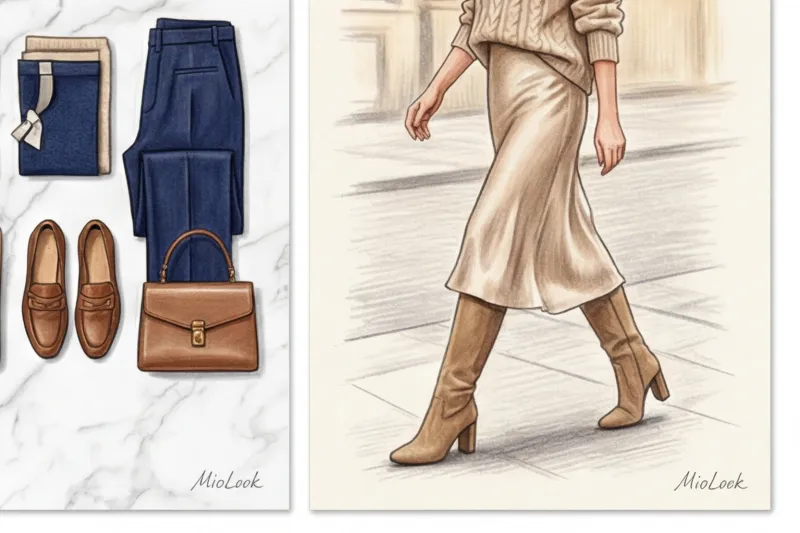
The human eye is lazy—it always gravitates toward the brightest spot. If you have a gorgeous headband and graceful shoulders, but want to draw attention away from your heavy hips, wear a bright emerald top with a sophisticated cut and simple, dark blue wide-leg pants. People won't even look below your waist.
Proportions of 1/3 to 2/3: visual lengthening of the legs
In the fashion world, the classic golden ratio rule applies. A figure looks harmonious when the top of the garment takes up 1/3 of the silhouette and the bottom 2/3. Any horizontal color line (where a sweater ends and jeans begin) sharply cuts off the figure.
If you wear a contrasting sweater untucked (1:1 ratio), you visually shorten your legs right at the bottom of the sweater. How can you shift this line?
- Tuck your top into high-waisted pants (even partially, at the front).
- Use a cropped jacket that reaches to the waist.
- If your clothes are bulky and can't be tucked in, add a belt that matches the color of your trousers (not the color of your top!).
Side Contrasts: How to Draw a Waist Using Two Colors
This is where the famous Müller-Lyer optical illusion comes into play, adapted for tailoring. I once put together a wardrobe for a top manager at an IT company. She had a completely straight figure (the difference between her waist and hips was less than 15 cm). We didn't use corsets to cinch her in.
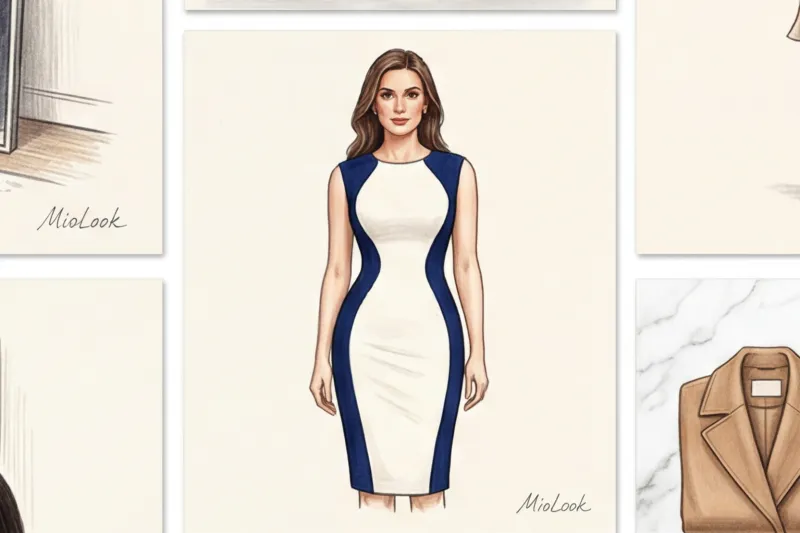
We used dresses with a deep dark color (navy or burgundy) on the sides and a light, ivory center panel. The light panel had an hourglass shape. The viewer's brain only read the light patch, ignoring the dark sides that blended into the background. The waist appeared out of nowhere.
A more casual version of this trick is: open jacket rule Wear a light top and light pants (vertical), then layer a dark jacket or cardigan over it, leaving it unbuttoned. This creates a narrow, light inner column, cutting off excess volume on the sides.
Your ideal image begins Here
Join thousands of users who look flawless every day with an AI assistant. Take a photo of your things, and MioLook will assemble stylish capsules from them.
Get access — €0.99 onceOptical Illusions in Practice: Color Correction for Different Tasks
Let's move on to specific scenarios. What should I do in the most common situations my clients come to me with?
Task 1: Shift focus from broad shoulders.
Never wear a light-colored top with an open boat neckline and dark skinny pants. Use reverse color blocking: a dark V-neck on top and light palazzo pants or an A-line skirt on the bottom. The dark angle of the neckline will visually "cut" the width of the shoulders, while the light bottom will balance the proportions.
Task 2: Lengthen legs if you are short.
The simplest and most effective styling trick, one that's worked flawlessly for decades, is matching the color of your shoes and bottoms. Tights that match your skirt and ankle boots, or trousers that blend into your shoes of the same shade, visually lengthen your leg by an average of 7-12 centimeters. Contrasting white shoes with black trousers "choppes" the leg at the ankle.
Task 3: Hide your tummy for an office dress code.
Forget tight black turtlenecks. Opt for tonal monochrome in medium shades (graphite, emerald, camel) using dense fabrics. Pant with a vertical crease and a straight-leg jacket worn open will create that all-important optical illusion of a column.
Checklist: Building a Wardrobe That Flatters Your Figure
Color-correcting your figure is a skill that requires mindfulness when shopping. It's impossible to create a beautiful silhouette from items that have lost their shape after the first wash.
Where to start today?
- Conduct a rigorous audit. Get rid of flimsy knitwear, especially in dark shades. If it's shiny where it shouldn't be and shows the outline of your underwear, it doesn't belong in your closet.
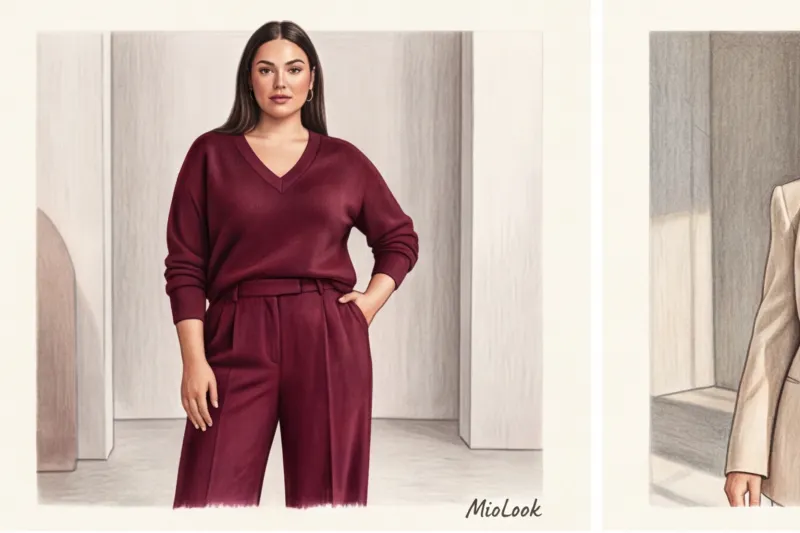
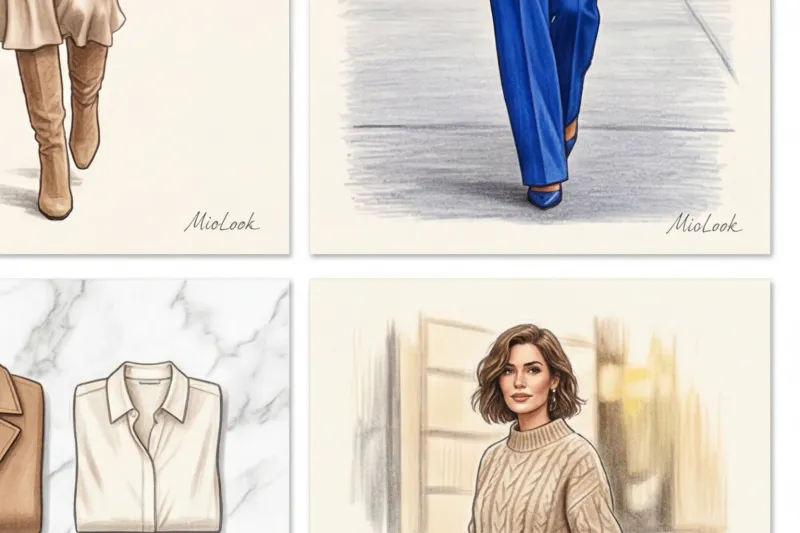
- Assemble the first monochrome base. Start with a neutral palette. Buy trousers in a crisp fabric and a tone-on-tone jumper (for around €150, you can find great wool-blend options). Add a leather belt.
- Practice "structural light". Challenge yourself: buy a light-colored jacket or cardigan made of thick material and wear it over your usual dark clothes.
Color should serve your architecture, not mask it. When you stop hiding in shapeless black and start directing attention through density and color blocking, your wardrobe will become your greatest source of self-confidence. Choose quality, invest in textures, and remember: the perfect silhouette is created not by dieting, but by understanding the laws of optics.