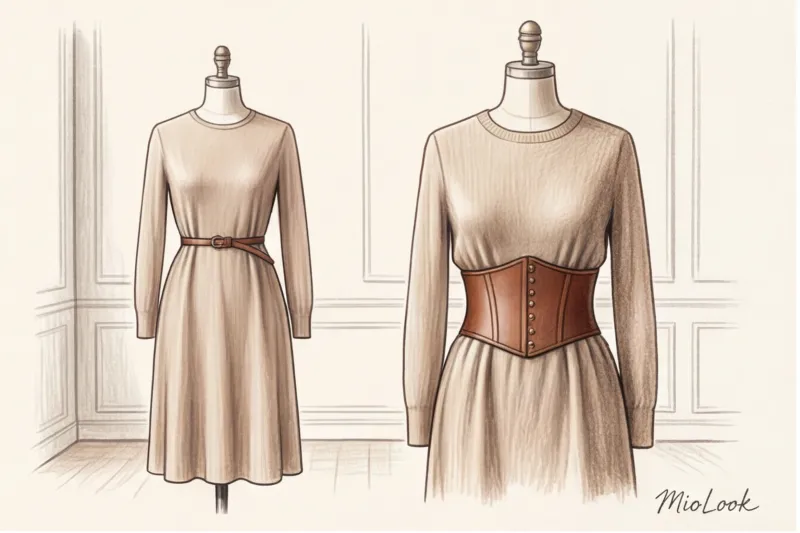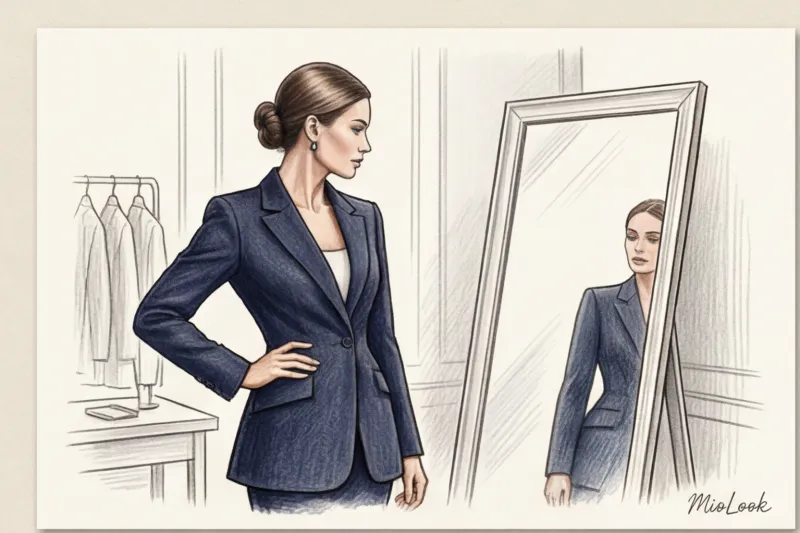
Paris, 2019. In the fitting room of a Marais boutique, my client struggled to tighten a thin leather belt over a soft cashmere dress. She wanted to recreate an hourglass silhouette, but instead, we ended up with an over-stretched caterpillar effect—the fabric bunched up in untidy folds, and her stomach appeared larger. Sound familiar? This moment clearly demonstrates a key misconception: we're used to thinking that to achieve a slim waist, we need to literally tighten it.
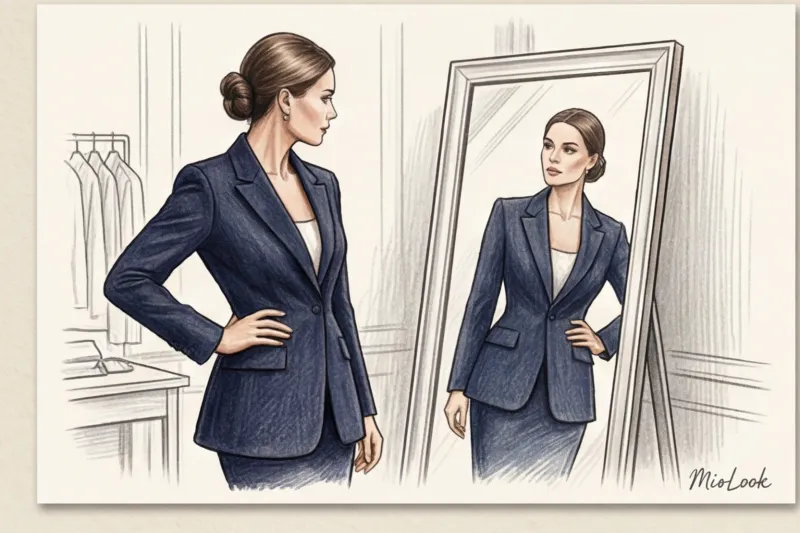
But clothing is not a whalebone corset. It is architecture. To understand, How to visually narrow your waist , we need to stop fighting our own bodies and start commanding the viewer's attention. We discussed the basic principles of this approach in more detail in our complete guide to visual correction of the figure with the help of clothing Today, we'll explore specific tools: why a stiff jacket works better than the gym, how a peplum can save rectangular figures, and why your belt is likely too tight.
The Illusion of Proportion: How to Visually Narrow Your Waist Without Corsets and Diets
Over 12 years of working as a stylist, I've learned one rule from Gestalt psychology that works reliably in fashion: the human eye always reads the contours of the heaviest garment, not the contours of the body underneath. Attempts to literally "overstretch" soft fabrics (especially fine knits or viscose) always fail. The fabric stretches, treacherously highlighting the slightest unevenness.
Instead of camouflage, we should use focal points. Our goal is to draw the eye diagonally toward the center of the silhouette. If you create clear shoulder and hip lines, the waist will naturally appear simply by contrast. You can capture good proportions by photographing the look in MioLook — Our AI stylist perfectly analyzes the geometry of the silhouette and suggests where volume is lacking.
The Architecture of Cut: Why Your Shoulders and Hips Shape Your Waist
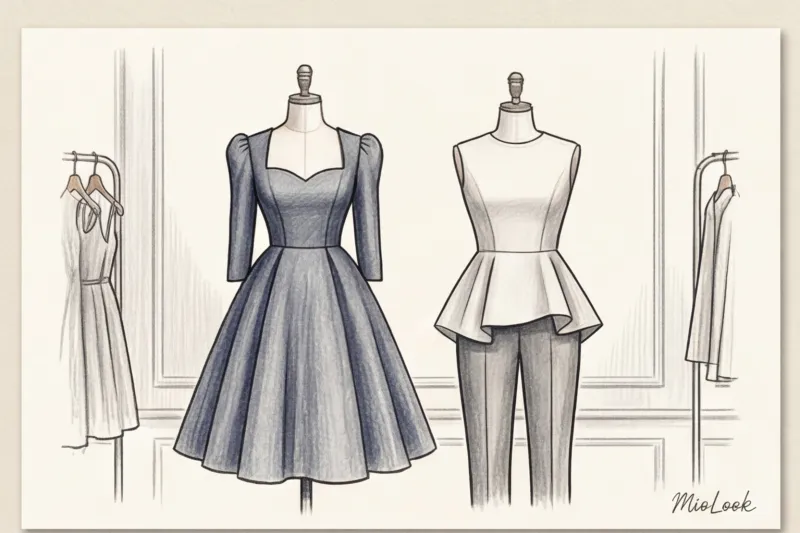
The theory of relativity in style goes like this: your waist appears small only in comparison to what's above and below it. Christian Dior brilliantly embodied this formula in 1947 in his first Corolle collection, giving the world the New Look silhouette. It didn't just cinch the models' waists—it broadened the shoulders and created enormous volume at the hips. Against this magnificence, the waist seemed impossibly fragile.
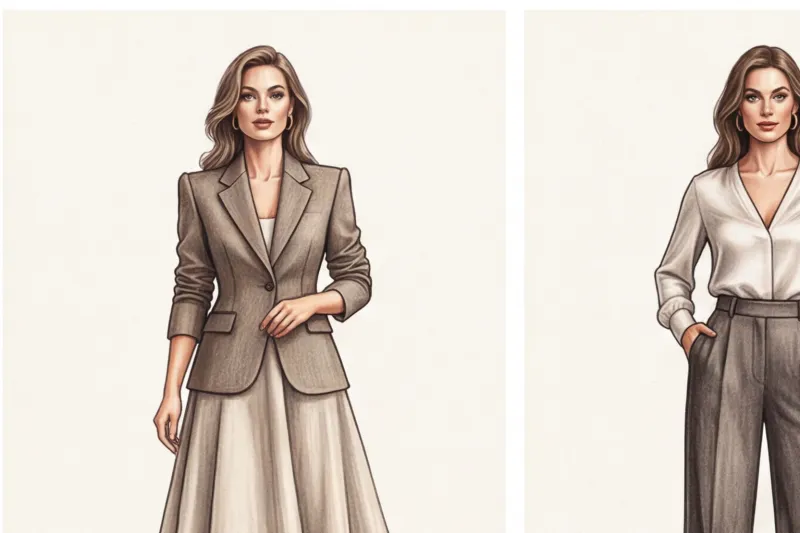
According to the golden ratio, to create the perfect hourglass illusion, the shoulder width in clothing should be approximately 1.6 times wider than the waist. This is why we've seen the triumphant return of shoulder pads at the latest Alexander McQueen and Schiaparelli shows. A widened shoulder line on a jacket (called "hard tailoring") does all the work of narrowing your waist. As the WGSN 2024 report notes, structured shoulders have finally replaced shapeless, oversized cardigans as wardrobe staples.
The Basque as a Sculpting Tool: Who It Suits and How to Wear It
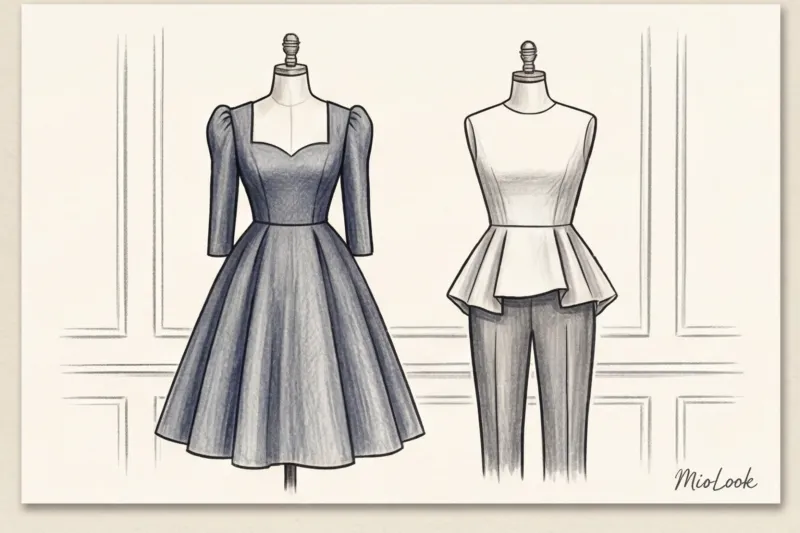
A peplum is the perfect way to "draw" hips where there aren't any naturally. But forget the soft, floppy ruffles made of flimsy polyester that were popular in mass-market fashion in the early 2010s. The modern peplum is an architectural element. It should be asymmetrical or have a rigid shape reminiscent of an inverted bud.
"A structured peplum acts as a visual shield. It draws attention away from the actual line of the stomach and creates the illusion of a perfect transition from a narrow waist to rounded hips."
But there is an important limitation: This technique doesn't work for everyone. If you have a short torso (the distance from your chest to your waist is minimal), the peplum will eat up any remaining length, throwing off your proportions. In this case, it's better to choose a longer, straight-cut jacket, worn unbuttoned.
Your ideal image begins Here
Join thousands of users who look flawless every day with MioLook.
Get access — €0.99 onceBelt anatomy: how to choose and where to tie it to avoid injury
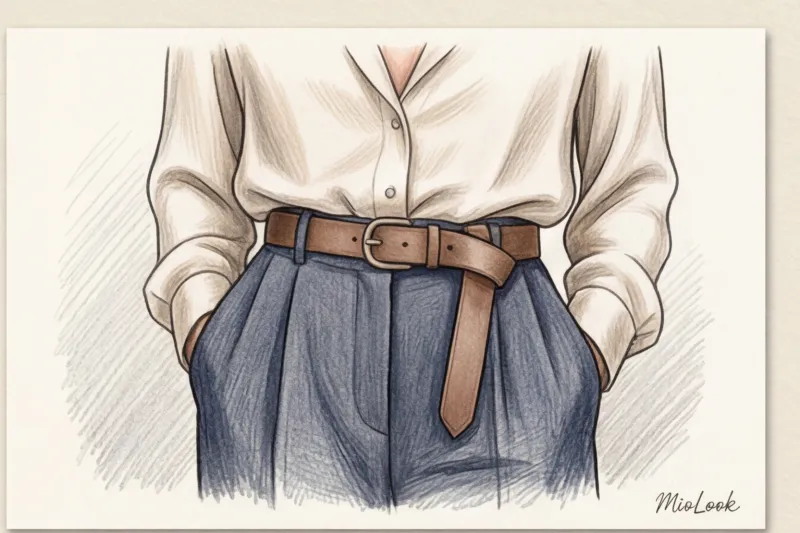
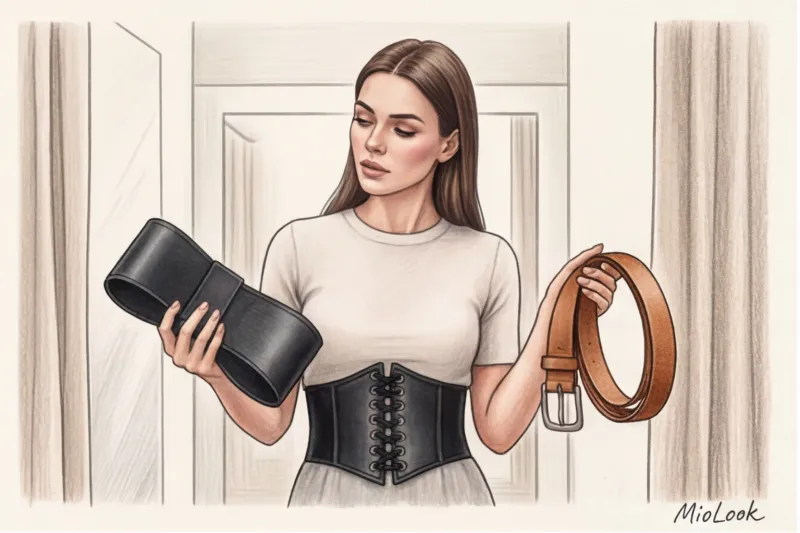
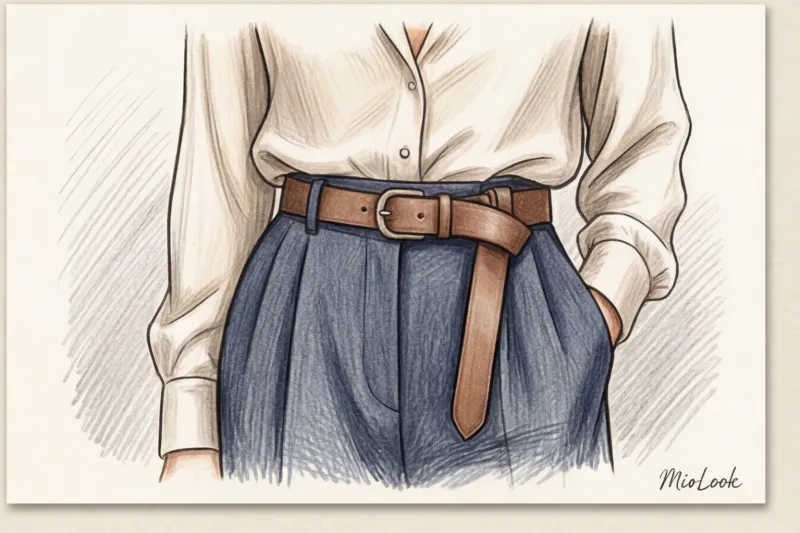
One of the most common mistakes I see on the street is wearing a wide, tight elastic waistband on apple- or rectangle-shaped bodies. It's counterintuitive, but a tight belt makes you look wider. It cuts into the body, creating rolls of flesh above and below the waistband, screaming to everyone around you, "Look how tight I am!"
The real magic lies in the loose fit. I always teach my clients the "two-finger rule": two fingers should fit comfortably between the fastened belt and your body. This extra space creates the illusion that you're so fragile that even the belt fits loosely.
When it comes to color, a simple rule applies: if you want to trim your height and emphasize your waist, use a contrasting belt. If your goal is to elongate your silhouette and slim your waist without sacrificing height, choose a belt that matches your outfit. Monochrome vertical lines are always slimming.
Width and Texture: A Guide to Choosing a Belt
Thin straps (1–2 cm wide) worn over bulky, chunky knit sweaters are the worst choice for plus-size women. They create a "watermelon thread" effect, which only emphasizes the bulk of the sweater.
- Universal size: The average width of 3.5–4 cm suits 90% of women and looks harmonious with most belt loops on trousers and jackets.
- Texture: Avoid patent leather around the waist. The shine reflects light and visually adds volume to the belly. Opt for thick, matte leather or suede.
- Investments: A high-quality, basic matte leather belt in the mid-price range will cost €60–€120. It will last for years, unlike the cardboard fast-fashion equivalents that cost €15 and lose their shape after a month.
Optical illusions in color and print
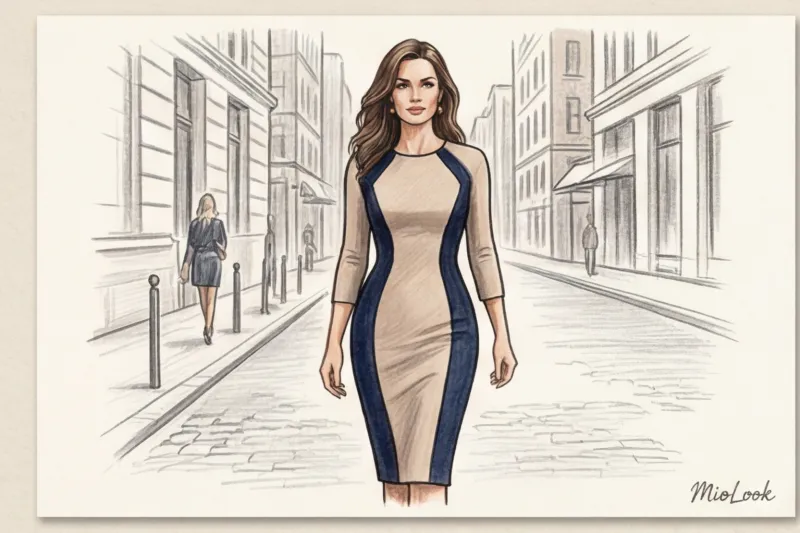
Have you ever wondered why the wrap dress, invented by Diane von Furstenberg half a century ago, is still considered the epitome of femininity? The secret lies in the diagonal line. The human eye is lazy—it follows guiding lines. A diagonal line crossing the torso visually splits its width in two.
An even more powerful tool is the color block technique. Dresses with a light center panel and contrasting dark (black or navy) side panels work wonders. The famous "Miracle Dress" by Stella McCartney, worn by Kate Winslet in 2011, vividly demonstrated this effect to the world. Due to the physiological nature of visual perception, we simply "cut out" the dark sides from the image, reading the figure only by the width of the light panel.
Access to MioLook for €0.99 — one-time payment
A smart AI stylist will select the perfect look for you, taking into account all optical illusions.
Get access — €0.99 onceFabric density: why thin knitwear betrays, while suit wool saves
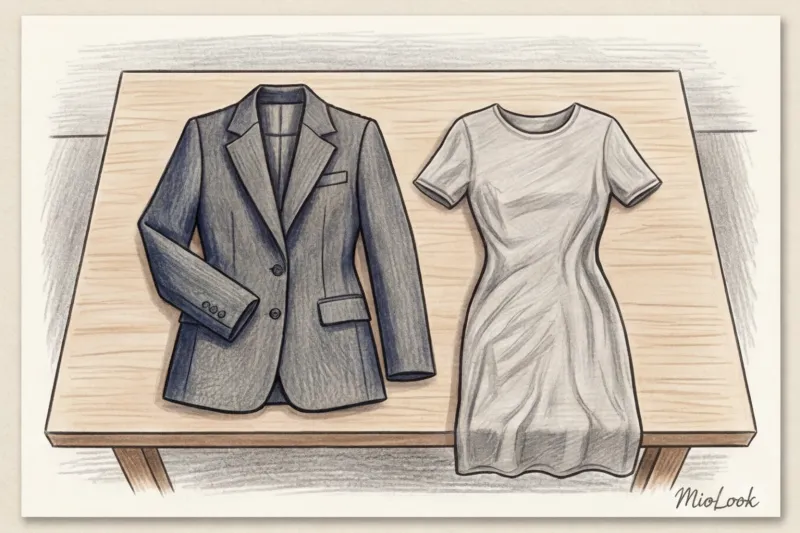
All your tricks with cut and color are useless if you choose the wrong material. Flimsy viscose, thin jersey cotton, or cheap polyester won't hold their shape. They spread across the body, revealing the contours of your underwear and every crease at the waist.
A perfect silhouette requires a framework. Historically, tailors on Savile Row (London's famous tailoring street) used horsehair binding to create a jacket's shape independent of the wearer's figure. Today, choosing the right fabric is all that's needed. Look for suiting wool (super 100s/120s), gabardine, or heavy denim on the tags. The optimal fabric weight for a structured jacket or trousers is 280 to 350 g/m².
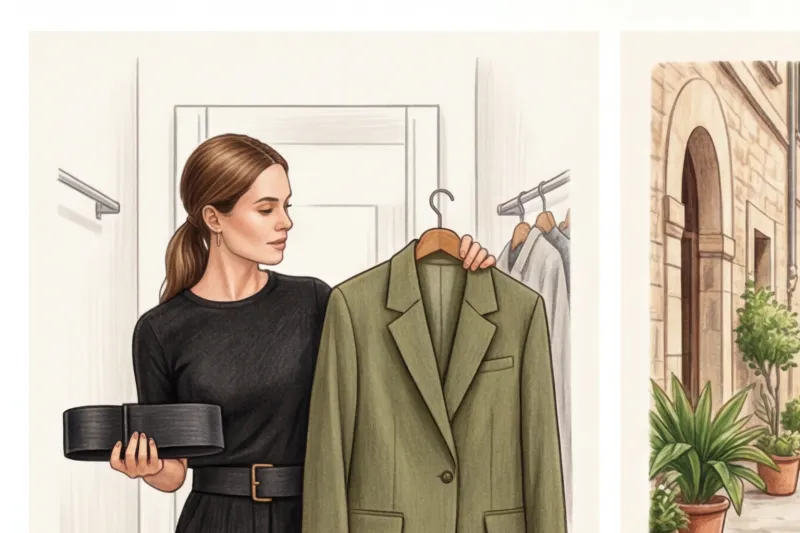
My main rule when shopping: Take the garment off the hanger and hold it by the hangers. If the fabric immediately sags under its own weight, like a rag, it won't make your waist look smaller. If the garment maintains its architectural shape even in mid-air, take it to the fitting room.
Checklist: 5 Steps to the Perfect Silhouette (Without Corsets)
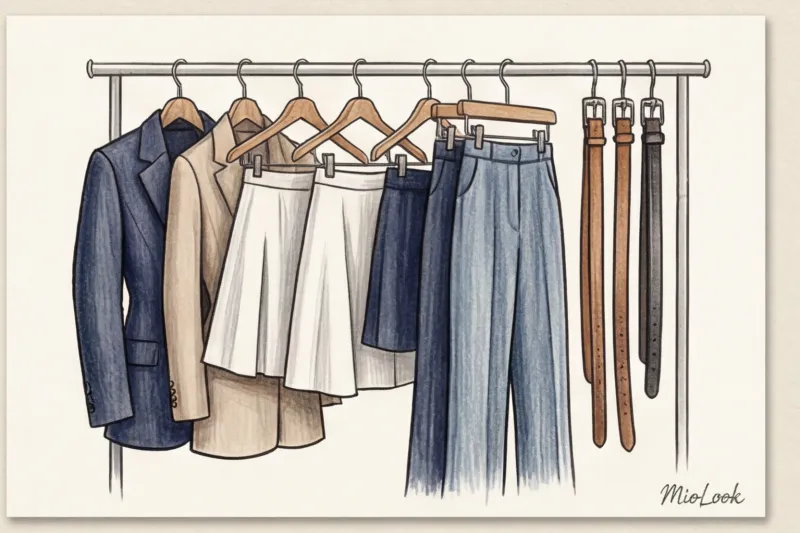
So, let's put all these architectural techniques together. To visually narrow your waist tomorrow morning, check your look against these five points:
- Check the shoulder line: Add volume with a jacket with stiff shoulder pads or a top with accent sleeves. By widening the top, you'll automatically narrow the center.
- Choose the right fit: High or mid-rise trousers made of thick fabric (at least 280 g/m²) will tuck in your belly better than any corrective waistband.
- Leave air: Use a semi-fitted cut. If there isn't at least a couple of centimeters of space between your body and the fabric, you won't look slimmer, but rather, you'll look clingy.
- Loosen your grip: Wear matte leather belts of medium width (3.5–4 cm), using the "two-finger" rule. Avoid fanatical tightening of elastic waistbands.
- Use diagonals: Incorporate wrap dresses or asymmetrical pieces into your wardrobe to draw the eye to your waist rather than stopping at the waist.
A slim waist isn't a number on a measuring tape, but the precise geometry you create with fabric. Leave the grueling struggle with centimeters behind and let a high-quality, tight fit do the hard work for you. After all, elegance isn't about the size of your clothes, but how skillfully you manage your proportions.