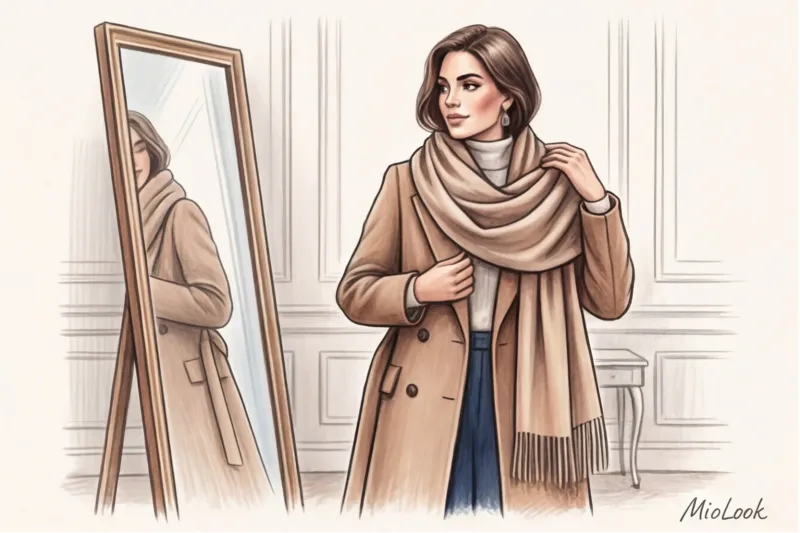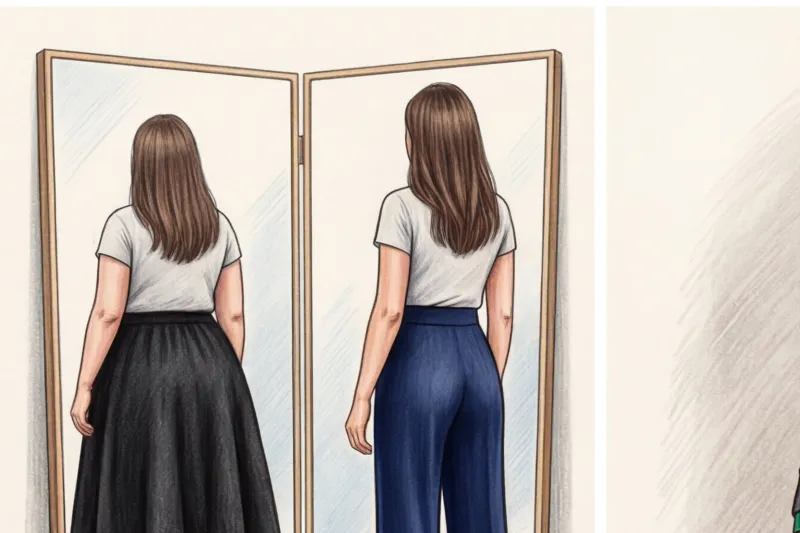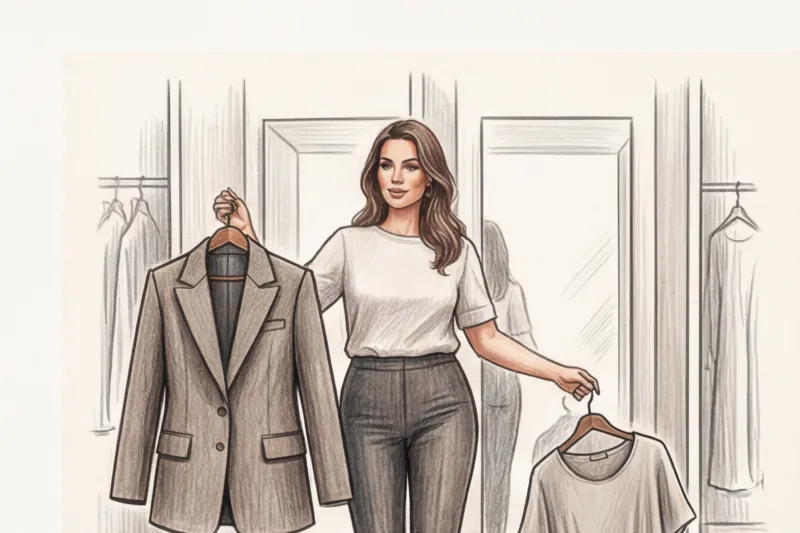
Last Friday, in the Massimo Dutti fitting room, my client was tearfully taking off her usual black leggings. She was convinced that only the deep black color and tight waistband could disguise her size 50 bottom. I silently handed her a pair of white wool straight-leg trousers. "White? On my hips? Are you kidding?" she protested. But when she put them on with a structured jacket, we both saw in the mirror how her hips had visually dropped two sizes. And it's not magic; it's pure geometry.
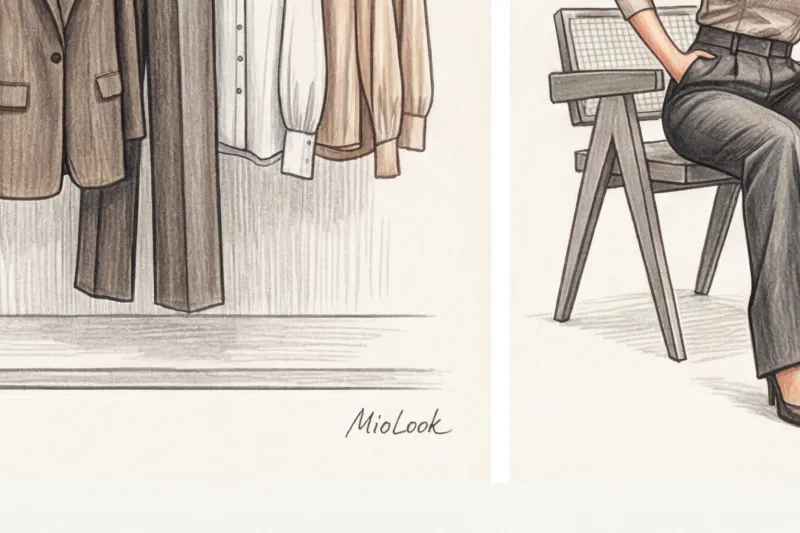
Girls have been googling for years, How to hide wide hips , and they find the same harmful advice from glossy magazines of the 2000s: wear shapeless tunics, wrap themselves in black, and avoid light colors. Over 12 years of working as a stylist in Europe, I've seen hundreds of wardrobes filled with items that, instead of camouflaging, only accentuated every extra centimeter. We covered this in more detail in our a complete guide to visually correcting your figure with clothing , but today we'll focus on the lower body.
The main insight I want to get across right away is that black is NOT slimming if the garment is made of thin, flimsy knitwear. White pants made of a heavy, shape-retaining fabric will make your hips appear slimmer than any black stretch pants. Let's figure out how this works in practice.
Forget the pear shape: Why the old rules for hiding wide hips no longer work
The first thing I ask my clients to do is forget the "fruit" body type theory. You're not a pear or an apple. The human body is a complex 3D volume, not a flat image from an old style textbook. When we try to "hide" our voluminous hips under wide, shapeless clothes, we're not camouflaging them. We're essentially telling the world, "My body takes up all this vast space under that fabric."
Modern styling takes an architectural approach. We don't constrict the body or hide it in robes—we create new lines around it. If you have curvy hips, it's not a flaw to be overcome. It's a luxurious foundation for creating an hourglass silhouette. Our goal is to shift the focus from a specific area to the overall harmony of proportions.
Your perfect look starts here
Join thousands of users who look flawless every day with a smart AI stylist.
Get access — €0.99 onceArchitecture instead of camouflage: building the right proportions
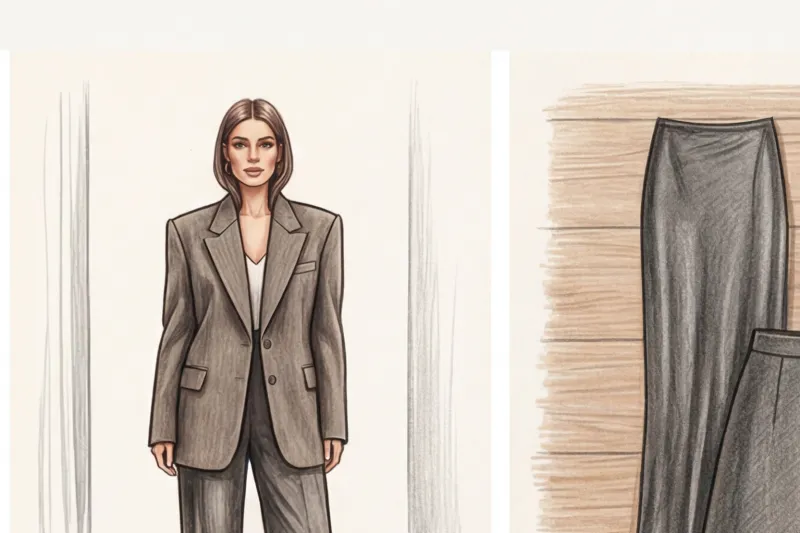
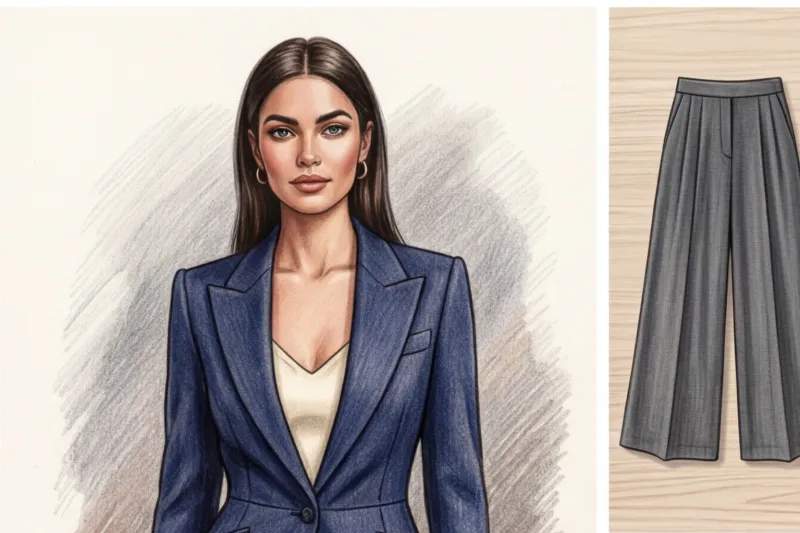
The basic rule of visual balance sounds counterintuitive: to make your hips appear smaller, you need to make your shoulders appear larger. This is the golden ratio in clothing design. If you have sloping or narrow shoulders with a wide hips, you will always appear heavier from below.
That's why jackets with a sharp shoulder line (or shoulder pads) are your best friends. Excellent straight-cut silhouettes are regularly found at brands like &OtherStories or COS. By wearing such a jacket, you create a clear vertical line. The edges of the jacket literally "cut off" the side volume of the hips, leaving only a narrow inner part visible.
"We can't physically reduce the width of the bone, but we can increase the width of the shoulder girdle. Once the upper and lower horizontal lines are equalized, the waist becomes visually thinner and the hips more harmonious," – from the Istituto Marangoni lectures on suit design.
The Magic of Rigid Fabric: Why Density Matters
The difference between something that disfigures you and something that makes you look like a statue is the grams per square meter (GPS). Flimsy mass-market knitwear clings to every wrinkle and cellulite. Fabric should dictate the shape of the body, not the other way around.
In the premium segment (and high-quality mid-market), suiting wool or heavy cotton are highly dense. Heavy fabrics tend to stand upright, creating a frame. This is why light, wide-leg trousers made of heavy wool will conceal the true volume of your legs, while thin black joggers will highlight it.
Focus on the top: control the focus of attention of others
The human eye is lazy: it looks where there's contrast and detail. Create a strong focal point in the portrait area. Use large collars (like those on Victorian-style blouses), deep V-necklines, chunky chains, or statement brooches. If you're wearing basic bottoms and a top with elaborate puff sleeves, no one will even glance at your hips—all the attention will be on your face and neckline. You can easily experiment with such combinations by uploading items to your virtual wardrobe in MioLook , to assess in advance where the focus of attention falls.
The Worst Clothes for Big Hips: Take Them Off Immediately
In fitting rooms, I often encounter the same ironic situation: women sincerely believe that skinny jeans with 5% elastane will "tighten" them. In reality, the elastane simply stretches to your shape, treacherously emphasizing your breeches.
Another common nightmare is pairing skinny pants with a short, waist-length jacket. I call it the "lollipop" effect: a massive bottom on thin legs with a tiny top. This artificially adds 5-7 kilograms to your figure that aren't actually there.
Mistake #1: Thin knitwear and shiny textures
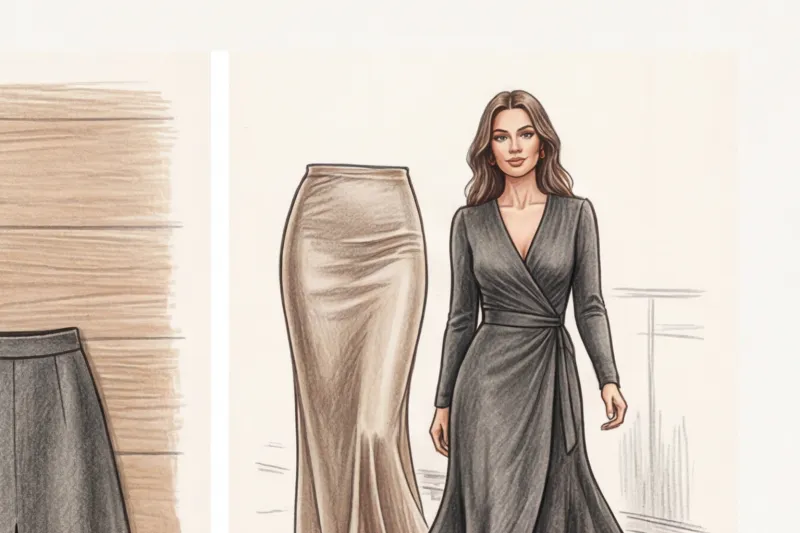
According to research by the WGSN Institute, glossy textures visually increase volume by 10–15% solely due to light reflection. Silk and satin skirts cut on the bias (slip skirts) are the main enemy of wide hips. The fabric catches the light at the most prominent points, creating a magnifying glass effect. The same applies to thin leggings and joggers made of loose viscose.
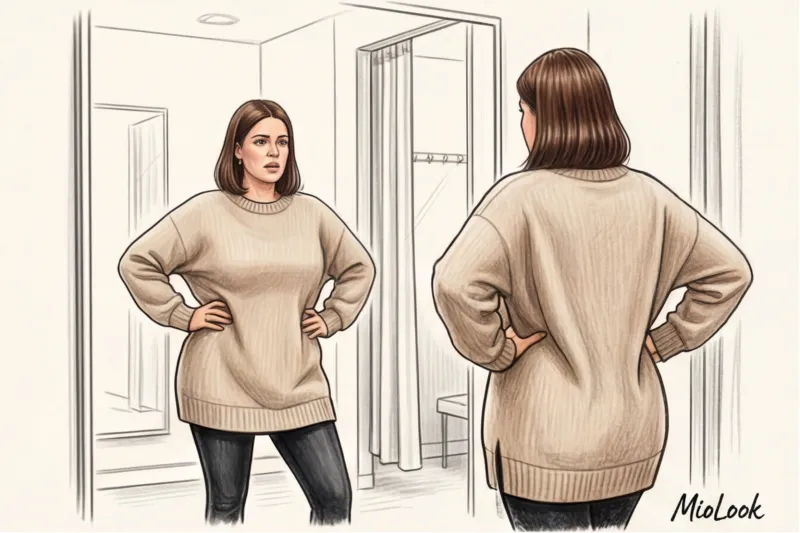
Mistake #2: Long, shapeless tunics and cardigans
This is the most popular and most damaging advice on the internet. It's counterintuitive: a length that "covers your butt" cuts your silhouette along the widest horizontal line. Visually, the eye reads this line as your overall width, turning your figure into a square.
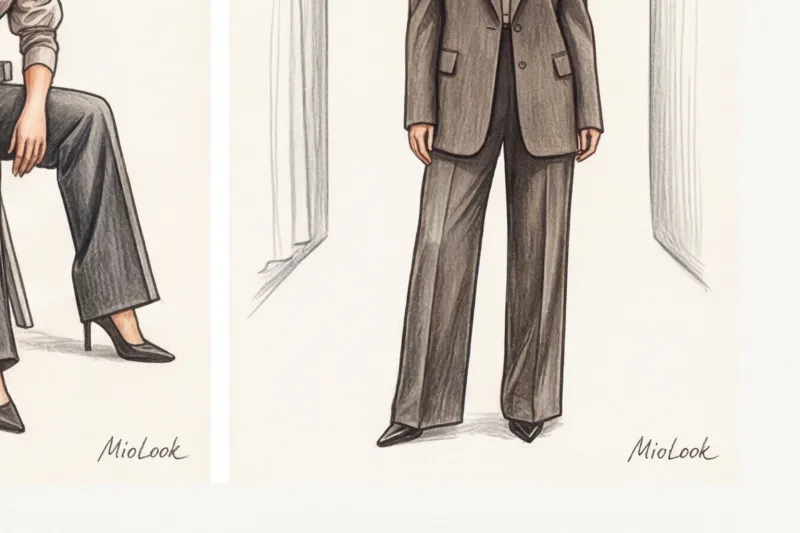
What to replace them with? Either cropped jackets (straight to the hipbone) or, conversely, longer trench coats and maxi coats worn open. Long, open hems create two powerful vertical lines that literally "cut off" the sides.
Access to MioLook for €0.99 — one-time payment
A smart AI stylist will analyze your clothes and select the perfect look that will conceal flaws and highlight your best features.
Get access — €0.99 onceThe Perfect Trousers and Jeans: How to Hide Wide Hips with the Right Styles
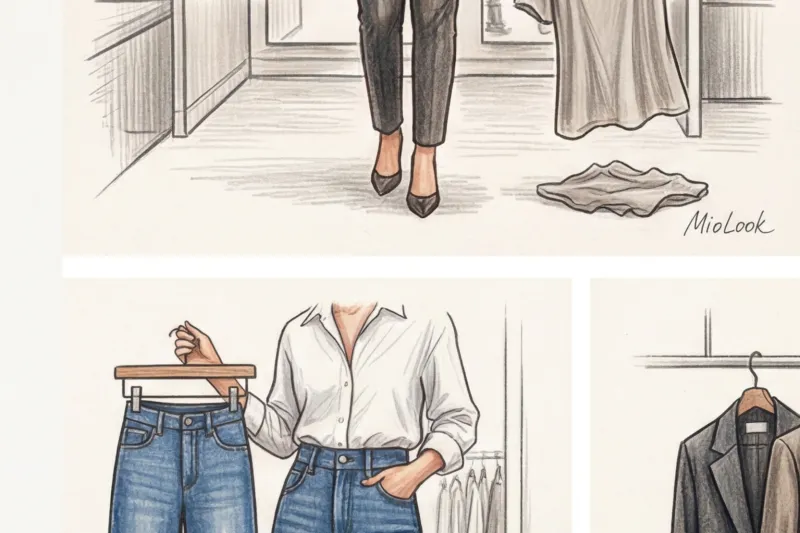
The right trousers are an investment. A high rise is crucial. Why hide the narrowest part of your body (your waist)? By accentuating the waist, we create a difference in volume that looks incredibly feminine. Length is also important: floor-length trousers paired with matching shoes will elongate your legs infinitely.
But there is an important limitation here: This tip doesn't work if your pants have large pleats at the stomach and the fabric is too soft. In this case, the pleats will simply spread out at the hips, creating a balloon-like effect.
Palazzo pants and straight styles
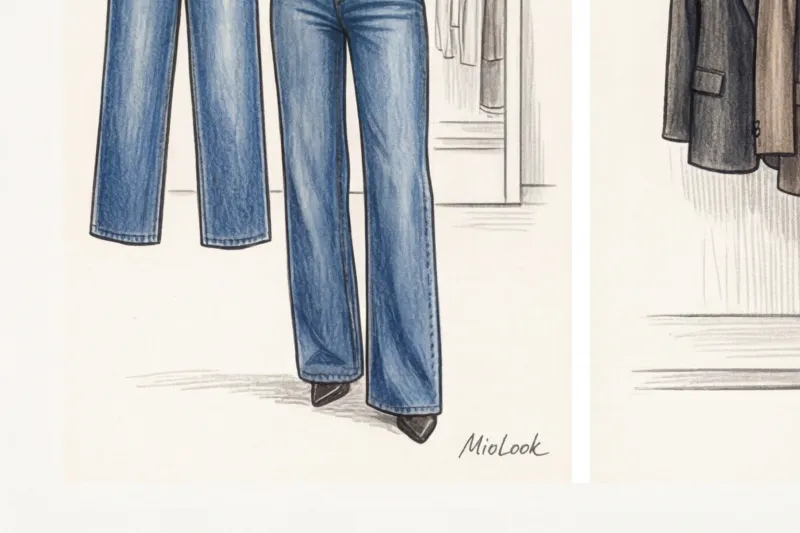
The secret to the perfect palazzo is how the fabric behaves. It should fall smoothly downwards from the highest point of the hip. The viewer sees a straight line and doesn't know where the leg ends and the air begins. Excellent fits are regularly found in the Zara Wide Leg or Massimo Dutti lines (usually in the €80–€130 range). Look for styles with pressed creases—this is your built-in slimming filter, a powerful vertical line.
Jeans: The Right Denim Denim Weight and Fit
Forget jeggings. Look for 100% cotton with a weight of 12 to 14 ounces (oz) or denim with minimal elastane content (no more than 1-2%). Yes, they're a bit less comfortable for the first couple of days, but they do act as a corset for your hips and buttocks.
Pay attention to the back pockets. Pockets that are too small and too far apart will make your buttocks appear larger. Opt for larger pockets positioned closer to the center seam. Ideal styles include bootcuts (a slight flare from the knee balances out the hips) and classic straights.
Skirts and dresses that elongate the silhouette
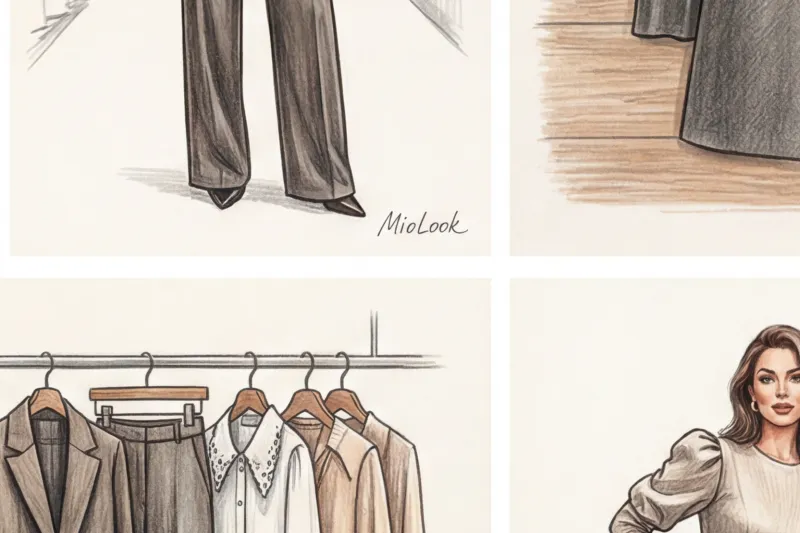
A geometric dress works better than any diet. The main rule is a one-piece cut. Avoid horizontal color blocking at the hips (for example, a white top that abruptly transitions to a black skirt at the hip line). A single color or a small print throughout the dress draws the eye upwards and downwards without stopping.
Wrap and A-line dresses
The wrap dress is a brilliant invention by Diane von Furstenberg. The diagonal line of the wrap breaks up the solid volume and creates a waist even where there isn't one. For wide hips, choose A-line styles made of thick cotton, linen, or crepe. The skirt should flare out gently at the bottom, leaving air between the fabric and the body.
Midi Skirts: The Perfect Length and Slit
A skirt should end at the narrowest point of your leg. This is usually just below the knee or the thinnest part of your ankle. If the hem of the skirt cuts across the widest part of your calf, it will visually weigh down your legs.
An absolute must-have is a skirt with a deep vertical slit in the front or slightly on the side. When walking, the leg is delicately exposed, breaking up the monolithic width of the skirt. However, be careful: If the slit flares out like a house when you're standing, the skirt is too small in the hips. Go up a size and have it taken in at the waist by a tailor (it costs about €15-€20, but the results look like a million bucks).
Ready to get started?
Try MioLook's free plan—upload your items and let AI create slimming outfits for you, no strings attached.
Get access — €0.99 onceShopping Checklist: 5 Rules for Those with Luxurious Hips
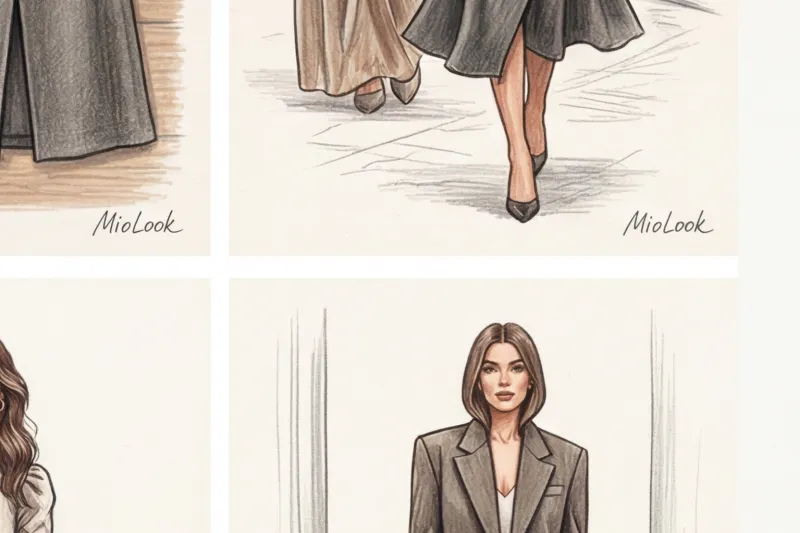
I love clarity. When you go shopping, keep this strict checklist in mind. No fluff, just action:
- Crumple test (density check). Crumple the fabric of the pants in your fist for 5 seconds. If it remains wrinkled and hangs like a rag, return it to the hanger. If it quickly straightens out and holds its shape, take it to the fitting room.
- We are looking for accent shoulders. Any top (jacket, coat, even a T-shirt) should have a clearly defined, slightly widened shoulder line.
- Control of the top length. Check where your sweater or blouse ends. This line shouldn't line up with the widest part of your hips. It should either be higher (tucked in) or significantly lower.
- High waist - always. No Y2K-style drop waists unless you want the effect of shortened legs and a heavy bottom.
- The right shoes. Choose shoes with a pointed or elongated toe. Square or round, blunt toes cut off the leg, while a pointed toe continues the vertical line of the trousers.
Stylist's Take: Your Hips Are an Asset, Not a Problem
It's time for a paradigm shift. Gorgeous, full hips are beautiful when they're properly packaged. Stop apologizing for your figure, slouching, and wearing camouflage clothes bought in the maternity aisle.
True style begins with embracing your proportions and understanding the basic laws of geometry. Once you swap flimsy knits for heavy wool and shapeless cardigans for structured jackets, you'll stop fighting your reflection in the mirror. Choose architecture over hide-and-seek—and your figure will respond in kind.