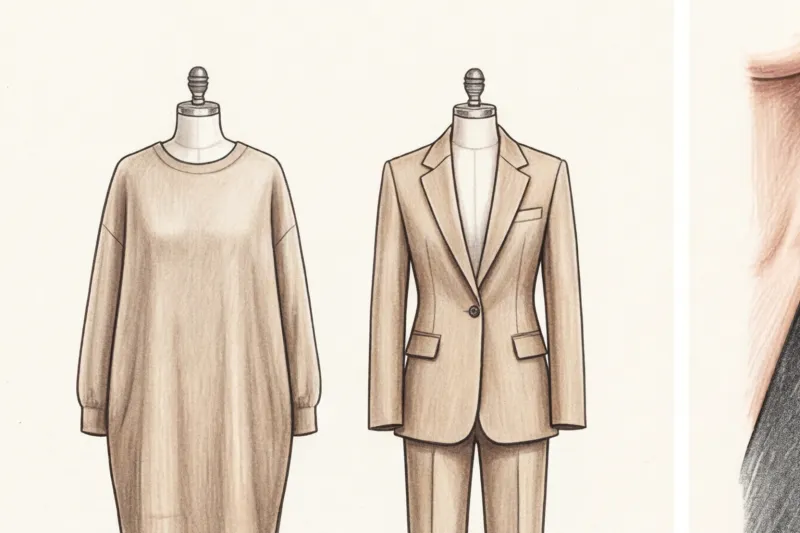
I still remember the tears of one of my clients in the fitting room. Anna, a luxurious size 52, stood in front of the mirror in an oversized black hoodie and quietly said, "I look like a mountain." Ten minutes later, I brought her a structured, double-breasted dark chocolate-colored jacket and straight-leg trousers with a crease. When she put them on, her posture instantly changed, and her shoulders straightened. Visually, she lost about 10 kilograms in a couple of minutes. It's not magic; it's pure geometry and the knowledge that... How to look slimmer with clothes.
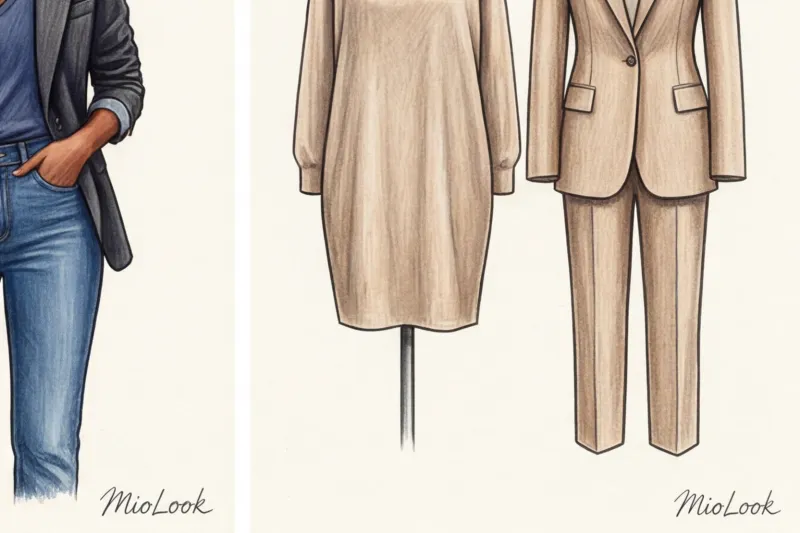
Over 14 years of working as a personal stylist, I've learned that the biggest mistake women make when they're unhappy with their weight is trying to hide it. But clothes shouldn't be a cover for a tank. I've already discussed the basic principles in more detail in our a complete guide to visually correcting your figure with clothing , but today we'll delve into the mechanics. We'll discuss how to use the "architecture" of dense fabrics and optical illusions to command attention rather than hide your body.
The illusion of volume: why oversized clothes make you look fat rather than hide it
Let's dispel the most pernicious fashion myth once and for all: "hide your excess weight under a robe." How does our perception work? The human brain is lazy. It reads an object's dimensions by its outermost contours. If you put on a shapeless, flowing tunic that's five feet wide, the brain of the person looking at you decides, "Aha, it takes up all that space, so that must be her body size."
Oversized clothing doesn't hide excess weight; it adds bulk to your actual size, adding the fabric's volume. Instead, I always use the "air" rule with my plus-size clients. A proper semi-fit is when there's exactly 2-3 centimeters of space between your body and the fabric. You're not tucked in like a caterpillar, but you're also not drowning in meters of fabric. The silhouette is clear, but the details of your contours remain a mystery to others.
How to Look Slimmer with Clothes: Architecture Instead of Camouflage
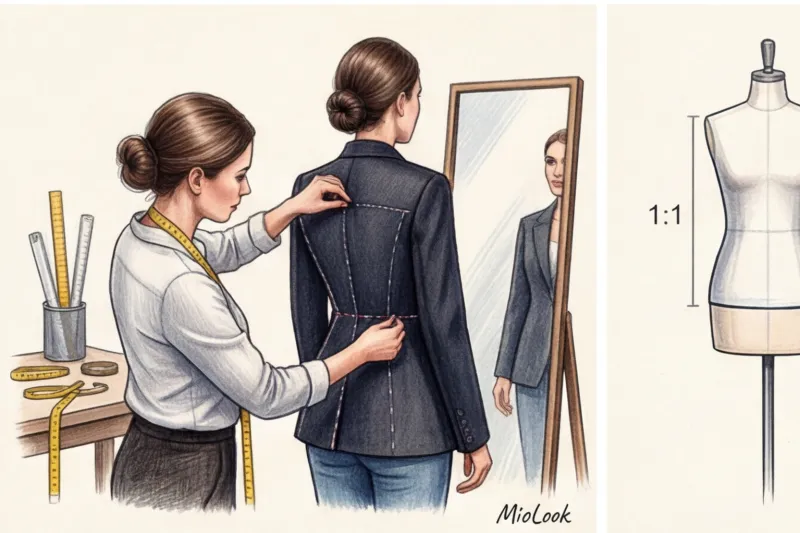
The main secret to looking slimmer with clothes is choosing the right fabric. I often tell my clients: your clothes should act like a stylish exoskeleton. They should take responsibility for your silhouette, not hang limply off it.
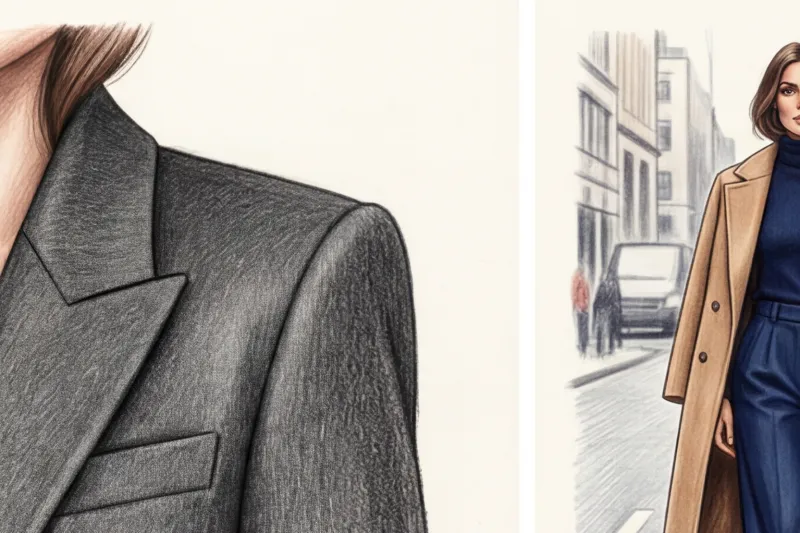
Slimness is directly dependent on the density of the material. According to the design standards of premium Italian brands (such as Marina Rinaldi, which specializes in plus sizes), the fabric for a shapewear jacket or trousers should have a density of at least 300–350 g/m². This includes dense wool blends, heavy denim, gabardine, or structured cotton.
That's why I categorically forbid my curvy clients from buying thin viscose knitwear (120-150 g/m²). It acts like a treacherous "second skin," sinking into every fold and emphasizing the texture of lingerie. A good structured mid-price jacket (for example, in the €120-€180 range from COS or Massimo Dutti) will do more for your figure than a month of strict dieting.
Your ideal image begins Here
Join thousands of users who look flawless every day with the MioLook smart wardrobe.
Get access — €0.99 onceRule #1-3: Verticals that work without fail
In clothing design, we actively utilize the Müller-Lyer optical illusion. Two identical lines appear to differ in length depending on the direction of the arrows at their ends. In styling, this means that any continuous vertical line elongates an object, making it appear narrower and taller.
Monochrome columns of color
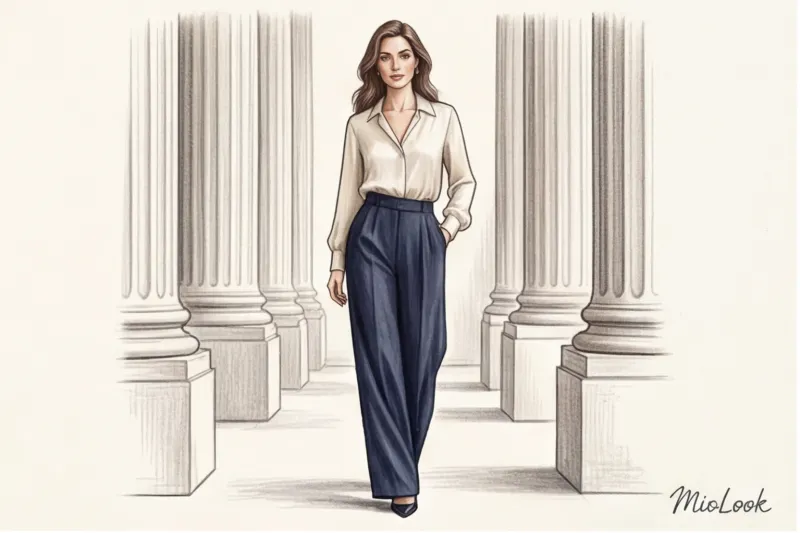
The most powerful slimming technique is creating an internal monochromatic column. Wear a top and pants (or skirt) in the same color. The eye moves from top to bottom, avoiding horizontal barriers that would cut off height.
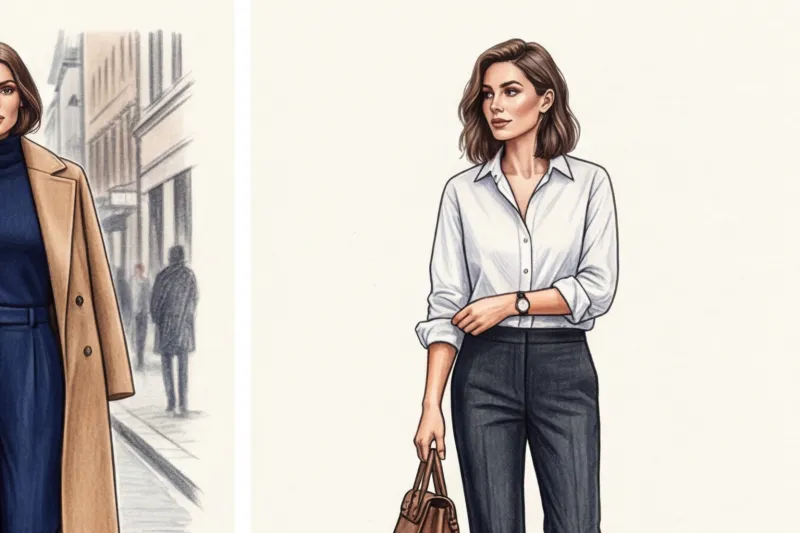
But the real trick begins when you layer a contrasting jacket or cardigan over this inner monochrome column and leave it unbuttoned. The two vertical flaps of the top layer literally "cut off" your sides to the viewer. People see only the narrow strip of color left between the flaps.
Unbuttoned jackets and coats
For this technique to work perfectly, the top layer must have a strong shoulder line. A set-in sleeve and a defined shoulder pad create a geometrically perfect rectangle. If you throw on a soft, shapeless cardigan with a dropped shoulder, the vertical lines will become loose, and the magic will be lost.
Trousers with creases and slits
Never underestimate the power of details. Pressed creases on full-length trousers act as directional vectors. The same goes for front slits on pant legs (a very trendy technique in recent years) or vents on a midi skirt. By the way, if you're choosing a work wardrobe, check out our article on Office wear for plus-size women: style secrets — there I analyze in detail the styles of ideal trousers.
Rule #4-6: Managing Focal Points
Forget the outdated "apples and pears" theory. Modern styling works differently: we seek out your personal "zones of grace" and transform your look into a control panel for attention. You decide where people will look.
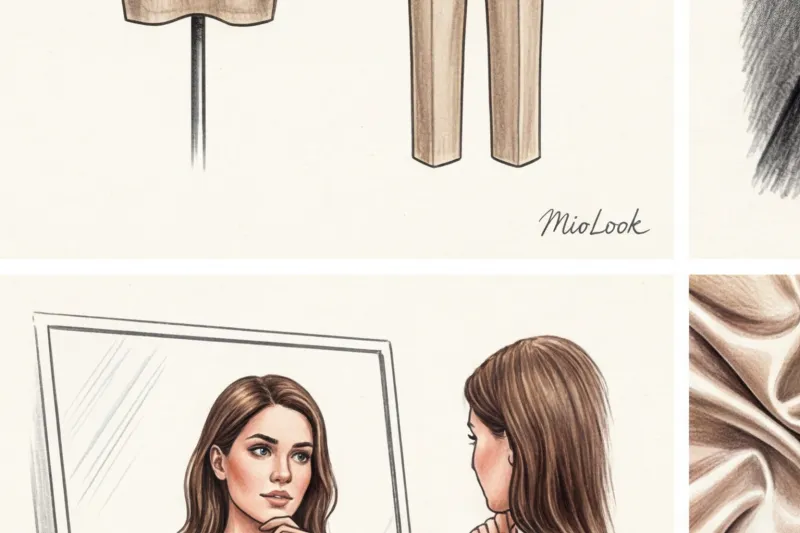
Neckline and V-neck
A V-neck is a classic visual enhancement. It reveals the collarbones, elongates the neck, and visually narrows broad shoulders or a full chest. If you don't like deep necklines, simply unbutton the top two buttons of a thick cotton shirt.
But there is an exception to this rule. If you have a naturally long, thin face and a long neck (with more volume at the hips), a deep V-neck will make your upper body look emaciated. In this case, a boat neckline or U-neckline would work better.
Accent on the wrists and ankles
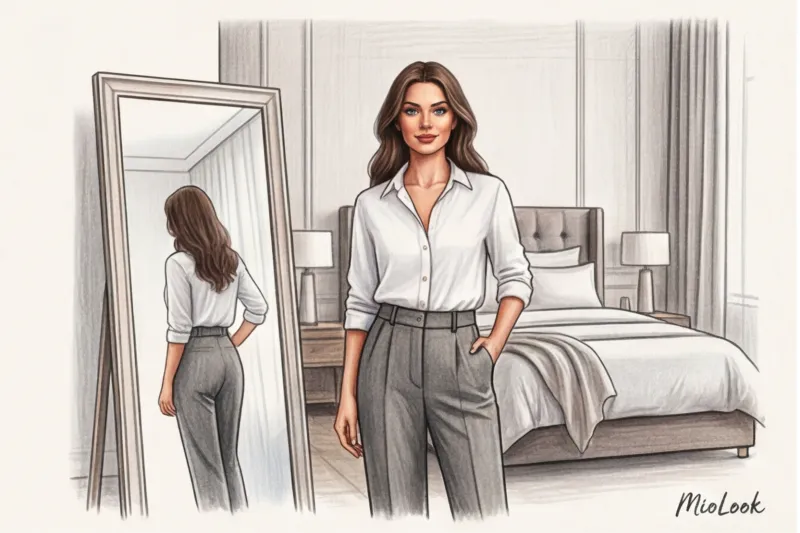
This is my favorite trick that I use during every shopping experience. Wrists and ankles are the thinnest parts of a woman's body, regardless of size. By showing them off, you send a signal to your conversation partner: "Look how fragile I am." Simply roll up the sleeves of your shirt or jacket to the elbow. Choose 7/8-length trousers that show off the ankle bone. Your silhouette will instantly become lighter.
The right top length: avoid horizontal lines
Remember the stylist's golden rule: the hem of a jumper, jacket, or shirt should never end at the widest part of your hips. A horizontal line running along the "equator" of your figure visually adds 3 to 5 centimeters of volume to your hips.
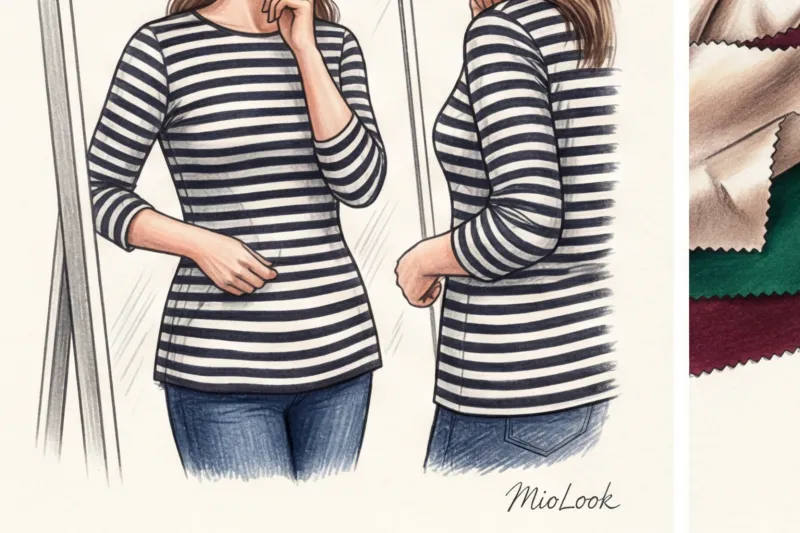
The length of the top should end either above the widest part (at the waist or slightly below), or fall below the problem area, covering the groin and buttocks (long blazers).
Access to MioLook for €0.99 — one-time payment
A smart AI stylist will analyze your clothes and select the perfect look based on the right lengths and proportions.
Get access — €0.99 onceRule #7-8: The magic of textures and prints without banal black
"To look thinner, you need to wear black." This is perhaps the most dangerous misconception in the world of style. I often shock new clients with the assertion: heavy white denim will make you look ten times slimmer than thin black viscose.
Matte fabrics in noble shades
Black is slimming only under one condition: if it's a dense, matte fabric. The physics of light is unforgiving: according to research on visual perception of materials by the Fashion Institute of Technology (2023), matte fabrics absorb up to 80% of light. They don't produce glare and literally blur the contours of the body (for example, folds on the stomach).
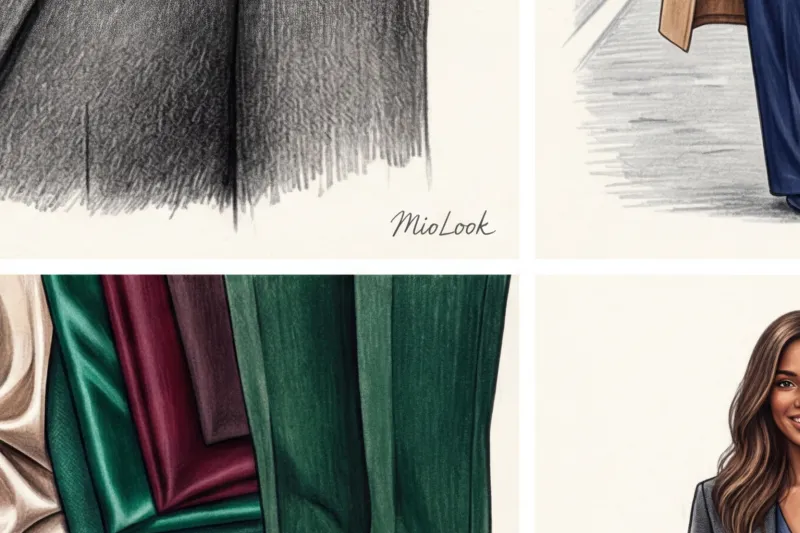
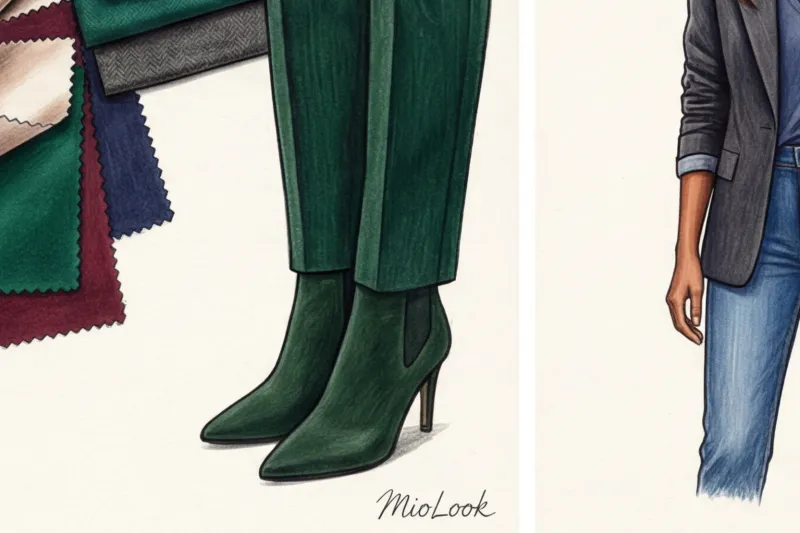
Shiny fabrics (satin, silk, lurex, velour) reflect light. Any reflection adds visual volume. A shiny blouse will make you look a size bigger. If you're tired of black, try rich, deep alternatives: navy, emerald, burgundy, and dark chocolate. They work just as well, but look much more expensive.
Proportionality of the print
Another pitfall is a small flower print on a fuller figure. The law of contrast is at work: the smaller the print, the larger the body appears against it. If you wear a size L or larger, choose medium or large abstract, geometric prints. They're proportionate to your body and don't create the "oversized flowerbed" effect.
Rule #9-10: Shoes and accessories that elongate the silhouette
Even a perfectly tailored suit can be ruined by the wrong shoes, which will cut your feet.
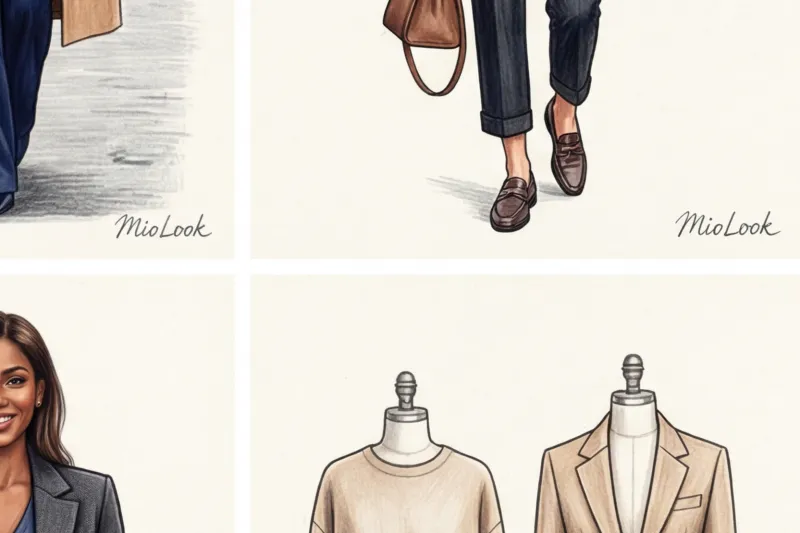
The secret to infinitely long legs is simple: your shoes should match the color of your tights or pants, continuing that unbroken vertical line. If you're wearing black pants, pair them with black ankle boots (no white sneakers if the goal is to add height). The shape of the toe is also important. A pointed or slender almond-shaped toe continues the line of the leg. A round, chunky, or square toe ("doll" shoes) cuts off the foot, making the leg appear shorter and fuller.
Don't forget about accessories. Long chains with teardrop pendants, sautoirs, and casually draped thin scarves all create additional vertical lines in the portrait area.
Checklist: 5 Mistakes That Visually Add 5 Kilograms to Your Weight
Before you leave the house, look in the mirror and check for these pesky details. In my experience, they're the ones that most often ruin your proportions:
- Too thin and flimsy knitwear. If your bra lace is visible through your turtleneck, it's a bad turtleneck. Replace it with a thick, textured knit jumper or a viscose-nylon pullover with a weight of at least 250 g/m².
- Shiny tights (with high lycra content). Shine on your legs makes them look bulky. Choose matte styles in 20–40 denier. Check out our cheat sheet: Tights: Business Etiquette, Selection Rules, and Density.
- Contrast belt at the waist if you have a tummy. If your problem area is your stomach, a horizontal contrasting stripe right across it will draw all the attention to it.
- Shoes that cut the foot. For example, black contrasting ankle boots worn with nude tights and a short skirt literally divide the leg into three short segments.
- Shapeless hobo bags hanging at hip level. A bag always adds volume wherever it's carried. Carry rigid, structured bags under your arm (like a baguette) or in your hand.
Conclusions: a style that supports, not hides
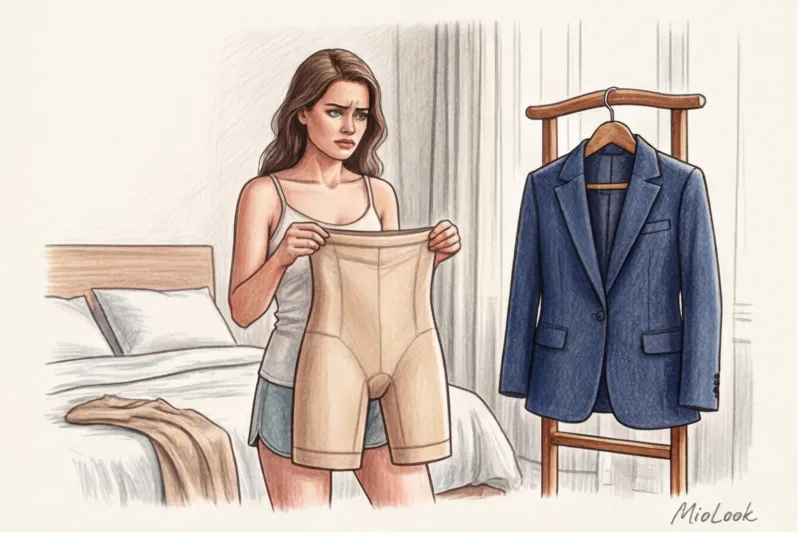
Your clothes are a tool for impression management, not a camouflage bag. Slimness is created by the architecture of dense fabrics, well-placed verticals, and accents on the thinnest parts of the body. Stop constricting yourself into uncomfortable underwear and hiding in black oversized hoodies.
Love your body at its current size today. Let high-quality, form-fitting clothing take care of your proportions. When you put on the right fit, it's not just your reflection in the mirror that changes—it's also how you walk and look.
Ready to get started?
Try the MioLook free plan—no commitments required. Our AI assistant will create a capsule for you that will highlight your best features.
Get access — €0.99 once