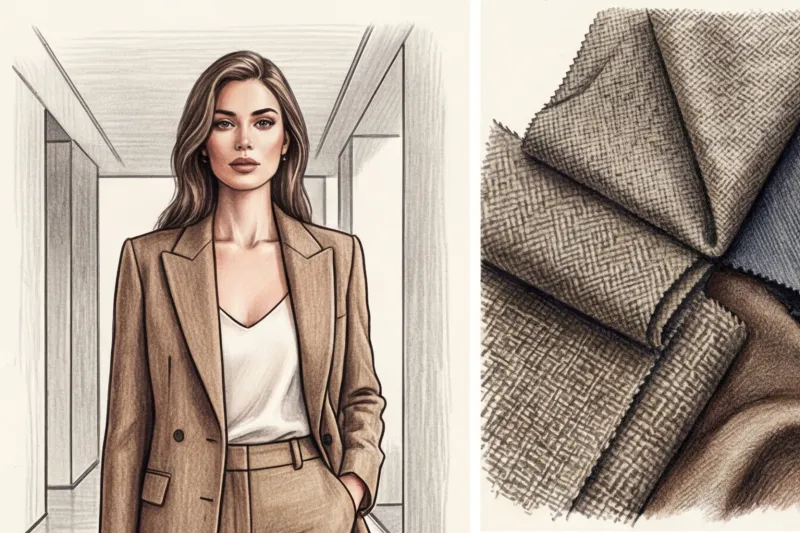
In my 14 years as a personal stylist, I've thrown out hundreds of glossy magazines that advised my clients to define themselves as "apples" or "pears." This outdated fruit-based typology makes women feel unconventional and offers the only dubious solution—hiding under shapeless robes. But let's be honest: the question is How to hide your belly with clothes , is solved not by camouflage, but by the laws of physics, textile engineering and a well-designed silhouette architecture.
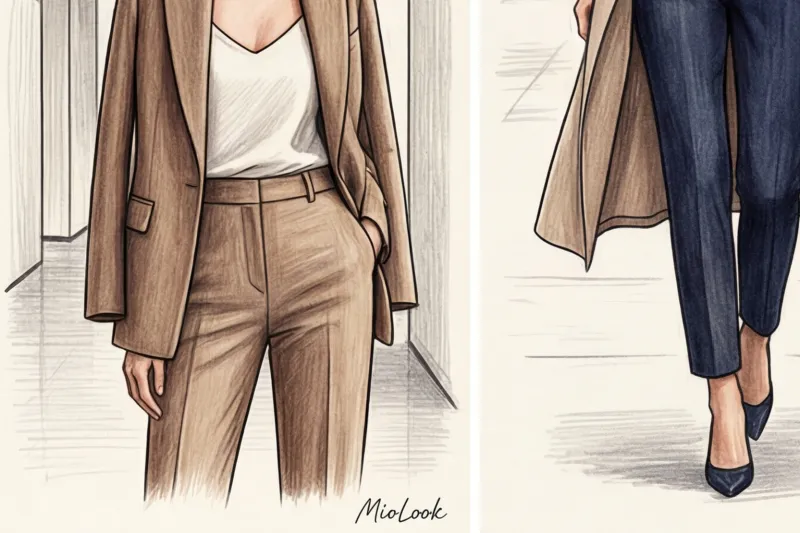
Instead of wrapping yourself in meters of excess fabric, we'll use the density of materials and optical illusions to construct a completely new contour over your body. You'll be amazed at how predictably the human eye responds to the right lines.
Architecture over camouflage: why baggy clothes only make your belly bigger
We talked in more detail about the architectural approach and the rejection of stereotypical body types in our a complete guide to visually correcting your figure with clothing Here I want to address the main misconception that is ruining the lives of thousands of women.
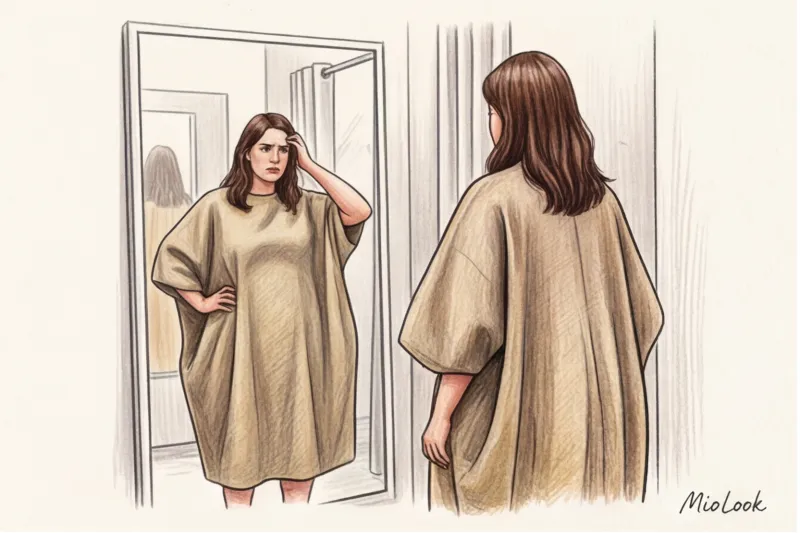
Conventional wisdom says: if you have a belly, wear an oversized hoodie or a wide tunic. This is fundamentally wrong. Shapeless clothing works against you: it transforms your figure into a monolithic block, visually expanding you to your fullest points. The viewer's eye doesn't see the graceful curves beneath the tunic—it reads the overall, bulky volume.
"Clothing should function like an exoskeleton. The right cut creates a rigid form, forcing others to read the garment's geometry rather than the anatomical dimensions of your body."
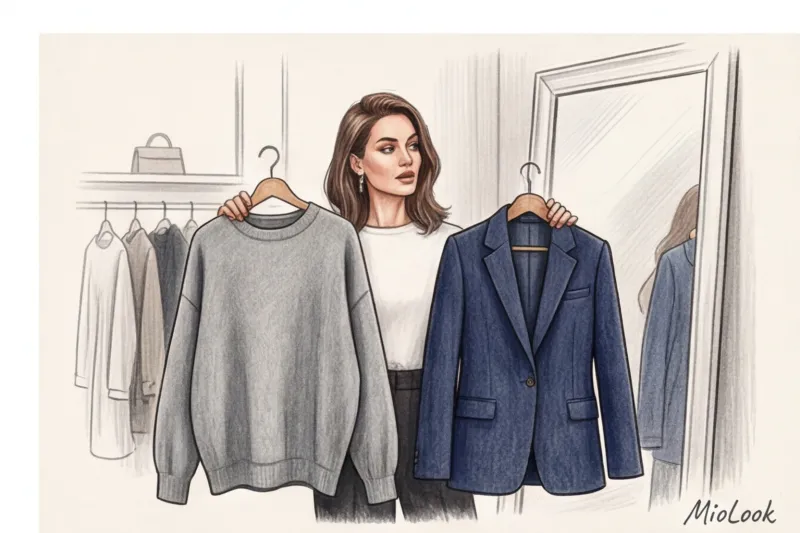
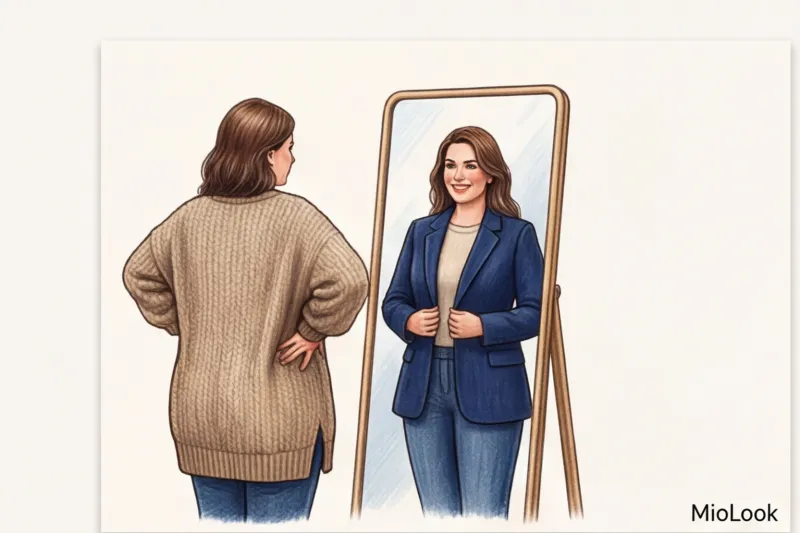
I had a client named Anna. She came to see me wearing an oversized knit sweatshirt, bought two sizes too big, and literally cried in the fitting room, hating her reflection. When I removed this "cover" and put on a thick, structured, semi-fitted double-breasted jacket, her posture changed instantly. The necessary "air" appeared between her body and the garment, and the rigid shoulders of the blazer created the perfect geometry.
Access to MioLook for €0.99 — one-time payment
A smart AI stylist will select the perfect look based on your proportions and goals.
Get access — €0.99 onceTextile engineering: which fabrics save and which betray
The cut is only half the battle. If you've chosen the right style but the wrong material, all the magic will be ruined. In the world of fashion design, there's a measurement of fabric density—GSM (grams per square meter). And it's your most important weapon.
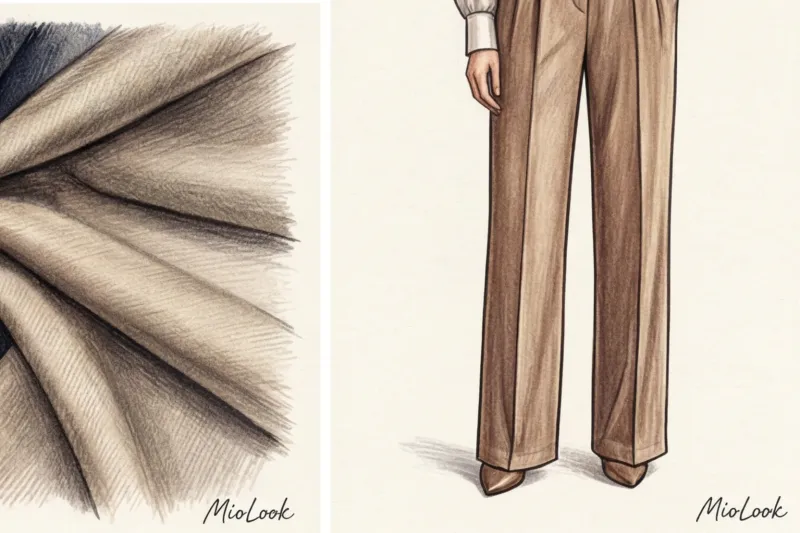
According to the principles of textile materials science, the optimal fabric density for shapewear (not to be confused with shapewear!) starts at 250 g/m². The denser the fabric, the better it holds its shape under its own weight, without sagging into the body's natural folds.
Also consider light reflection. Shiny surfaces (satin, silk, satin) act like a magnifying glass. By reflecting light, they visually add volume to the abdominal area. Matte fabrics, on the other hand, absorb light and conceal definition.
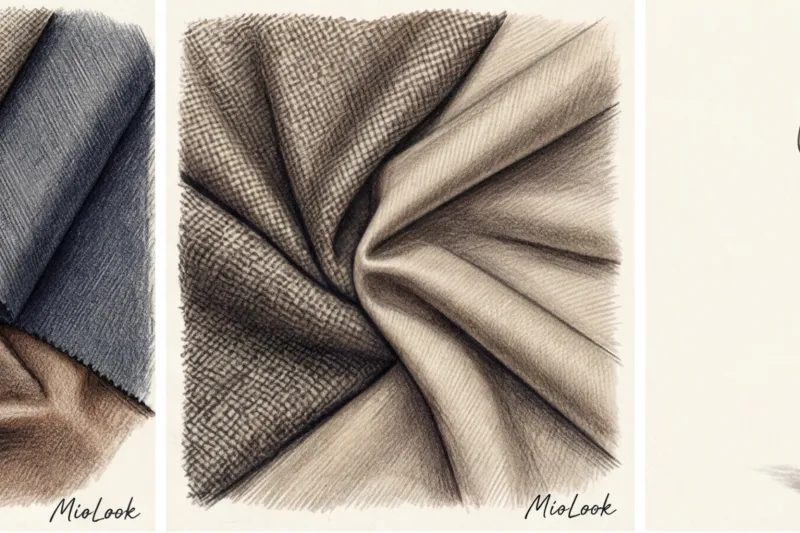
Traitorous Fabrics: What Should You Get Rid of Immediately?
Avoid thin, flimsy knits (plain weave), cheap viscose without a dense backing, and thin polyester. Why? Because these fabrics are highly draped without a frame. They cling to the body due to static electricity or humidity, highlighting every anatomical detail, right down to the seams of your underwear.
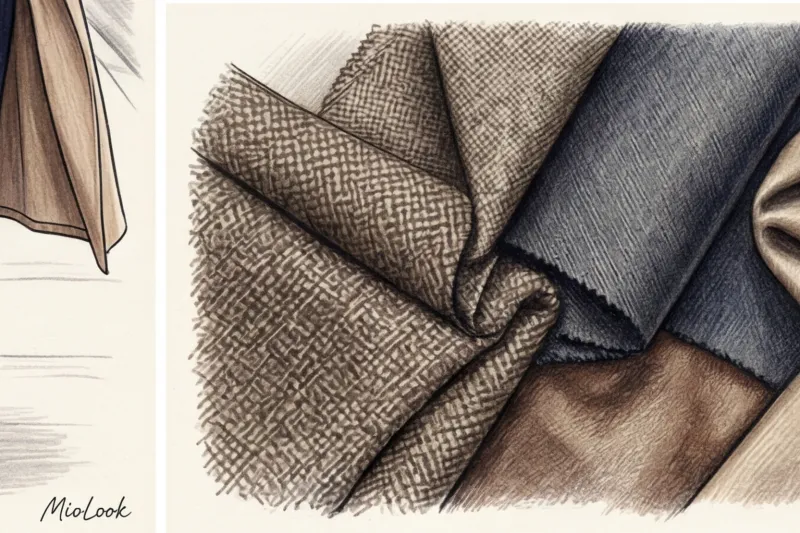
"Savior Fabrics": Your Frame and Support
Your best friends are heavyweight cotton (12-ounce denim and gabardine), structured wool, tweed, and high-quality suiting blends. They are shape-resistant. By wearing heavyweight wool trousers, you mold your body into a beautiful, pre-created shape.
By the way, if you have a lot of things in your closet and you are not sure how to combine dense textures with lighter ones, try the "smart wardrobe" feature in MioLook The app helps you digitize your items and suggests stylish combinations.
Anatomy of a cut: how to hide your belly with the right styles
Let's talk about specific tools. Our goal is to break up the horizontal waistline and create elongating lines.
- The magic of asymmetry: Wrap dresses or tops with asymmetrical hemlines work wonders. A diagonal line across the silhouette disrupts the visual perception of width. The eye moves diagonally, not horizontally.
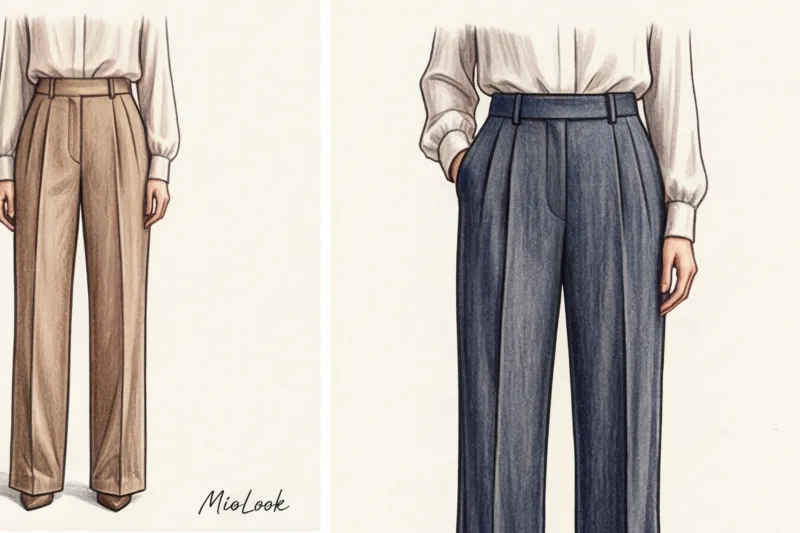
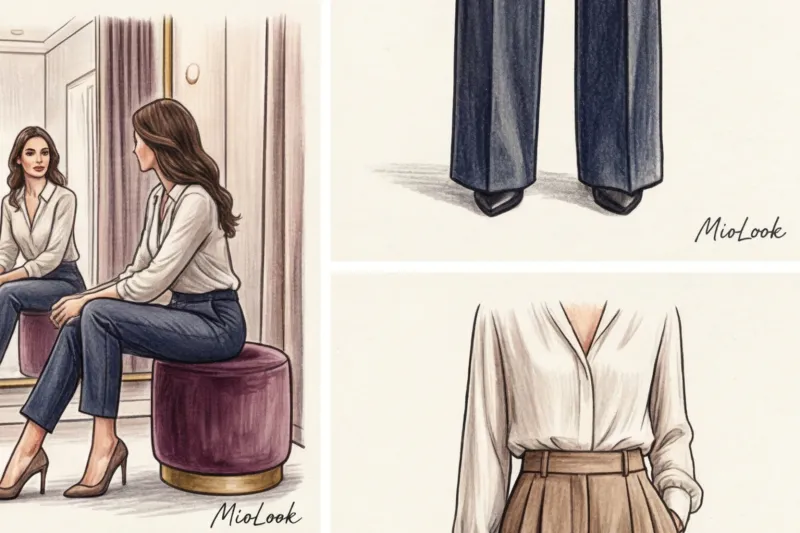
- Correct tucks (trousers with pleats): Many women are terrified of trousers with pleated waists, thinking the extra fabric will add bulk. This is a myth. Deep pleats create controlled volume ("air") exactly where needed, disguising a protruding belly in the folds of dense fabric. The high waist also brings the silhouette together.
- The dangers of rubber bands: Thin elastic waistbands and narrow drawstring belts are your worst enemies. They cut your silhouette in half, creating a "stretched sausage" effect. Opt for stiff, wide belts or trousers with a classic suit fly.
Fair Limit: The high-waisted advice doesn't work for everyone. If you have a short torso (the distance from your lowest rib to your hipbone is minimal), high-waisted pants will sit right against your chest, creating a "ball-on-legs" effect. In this case, a mid-rise, exactly two fingers below your belly button, is your best bet.
Your perfect look starts here
Join thousands of users who look flawless every day with MioLook. Digitize your wardrobe now.
Get access — €0.99 onceOptical illusions and layering: the two-vertical rule
One of the most powerful techniques in a stylist's arsenal is based on the Müller-Lyer illusion. We can visually "shave" up to 30% off the waist with a simple layering trick.
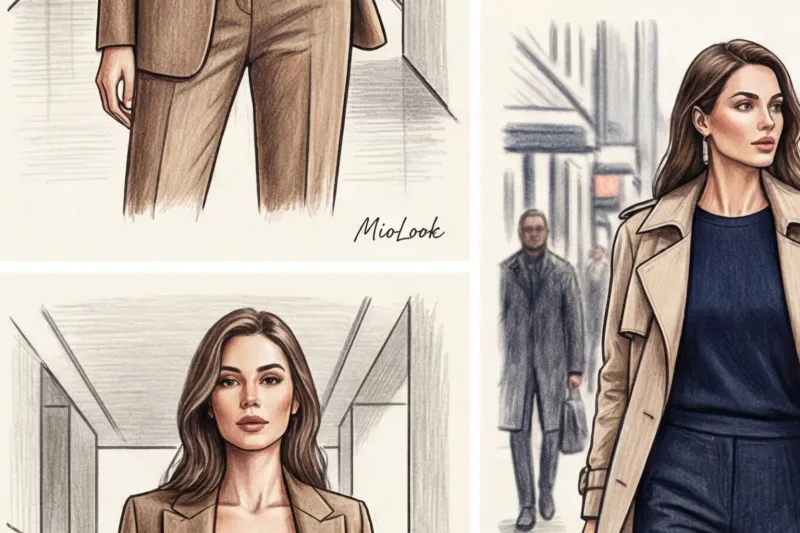
Put on a basic top and trousers. Now layer a heavy jacket, long vest, or structured shirt over them, leaving them unbuttoned. The pleats of the top layer create two distinct vertical lines down the center of your body. People subconsciously judge your width by the distance between these pleats, while any excess on the sides becomes a blind spot.
To enhance the effect, use the "color column" rule. According to color and design research (including WGSN 2024 reports), if the inner layer (top and pants) is a single dark or neutral shade and the outer layer contrasts with it, the silhouette is maximally elongated.
As for prints, forget about small, contrasting polka dots and classic horizontal striped shirts. Choose medium-sized abstract geometric prints or thin vertical pinstripes to create a rhythm throughout the entire look.
Focal Points: Remote Control for Someone Else's Gaze
There's a fundamental rule in styling: if you want to draw attention away from one area, create a powerful, hypnotic accent in another. You literally control where your interlocutor looks.
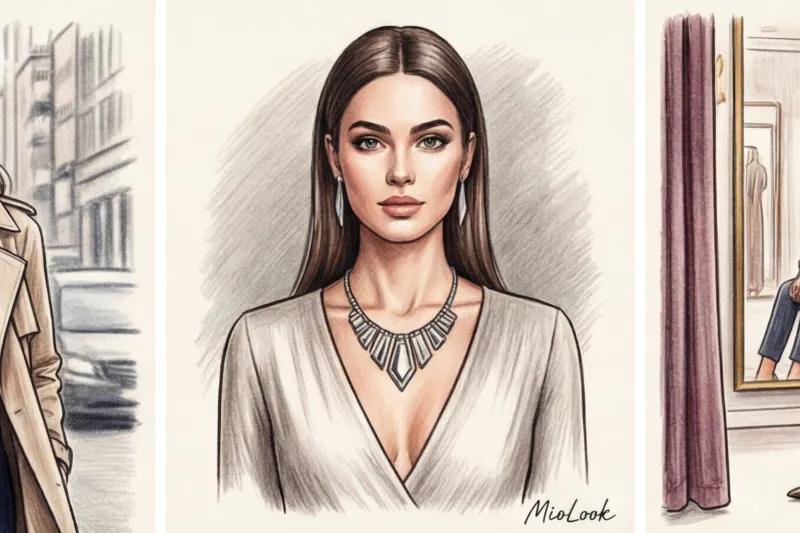
Shifting attention to the portrait zone. Opt for deep V-necklines—they elongate your neck and reveal your collarbones (one of the most graceful parts of the body, no matter your weight). Add statement jewelry. Accent chandelier earrings for €50–€150 or a statement designer necklace will be a real eye-catcher. No one will look at your belly if you have impeccable hair and a stunning piece of jewelry near your face.
Shifting focus to shoes. The impeccably tailored trousers, revealing slender ankles, paired with bright, architectural shoes, draw the eye downwards. A pair of rich wine-colored suede pumps paired with a navy suit will do all the work for you.
Fitting Room Checklist: How to Test Clothes Before Buying
Knowing the theory is great, but practicing takes place in cramped, poorly lit fitting rooms. To avoid impulsive weight-loss purchases, use my professional checklist:
- Squat test. Never evaluate a garment while standing. In everyday life, you sit in the office, at a cafe, in the car. Be sure to sit on a ottoman in the fitting room. If the waistband of your trousers or skirt is digging into your stomach, making it difficult to breathe, take it off. It's not your style.
- Tension test. Grasp the fabric with your fingers in the abdominal area. There should always be a gap of at least 1–2 centimeters between your body and the material. If the fabric is taut like a drum, it will show even the slightest unevenness.
- Profile verification. Turn sideways to the mirror. The correct garment should fall straight from the bust (in dresses) or from the shoulders (in jackets), without clinging to the stomach below. A fold under the stomach is a sign of fabric that is too thin or an incorrect fit.
The main takeaway from this article is that there are no "wrong" body shapes, only poorly chosen patterns and flimsy fabrics. Clothing is a tool that should serve your needs and give you confidence. Don't try to shrink yourself for the sake of a dress—choose a dress whose density and cut will create a luxurious, classy edge.
Ready to get started?
Try the MioLook free plan with no commitment. Upload your photos, and AI will select the perfect looks based on your features.
Get access — €0.99 once