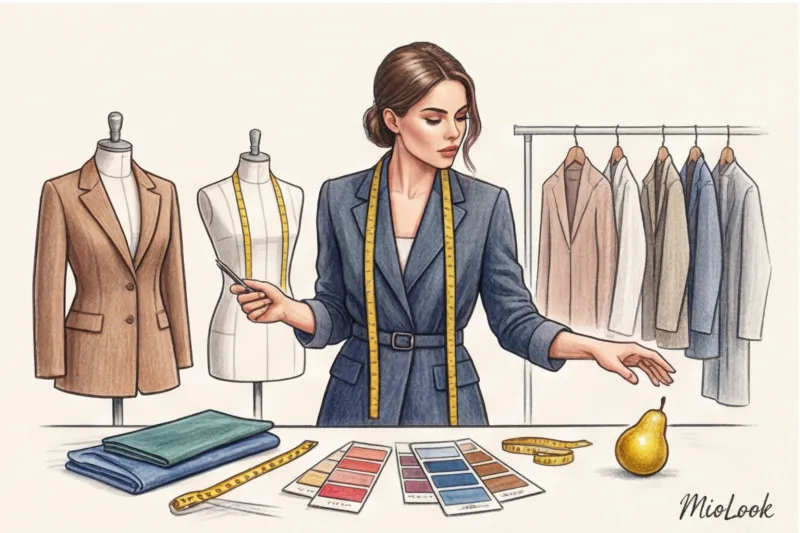
Last week, my new client stood in the fitting room with tears in her eyes. "I've tried on ten pairs of pants, and in all of them, my thighs look like jelly and my butt is just gone," she said. We removed the flowing viscose pants she'd been wearing and put on a pair of straight-leg jeans made of dense 100% cotton. A moment's pause. Her silhouette instantly elongated, the bulk on her hips disappeared, and her butt acquired a firm, toned shape. No magic or grueling workouts—just the basic physics of fabrics and clever garment construction.
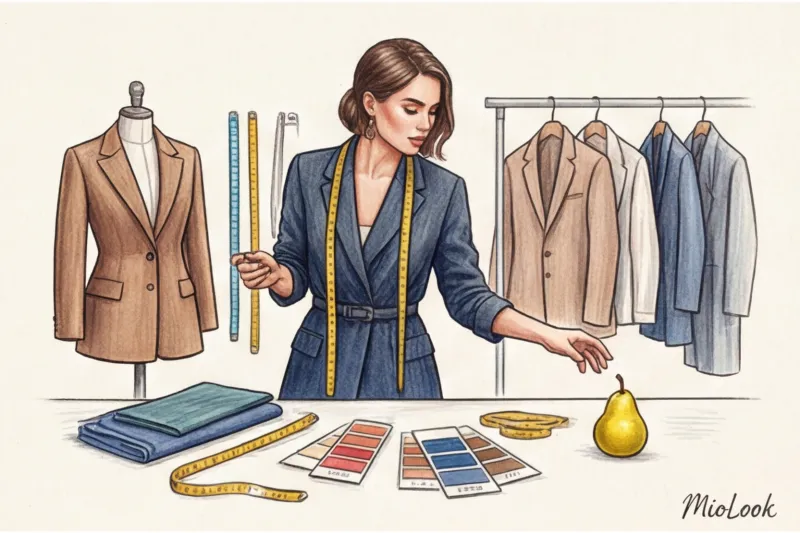
Over 12 years of working as a stylist, I've realized one important thing: a woman's figure isn't a problem to be "hidden." It's an architectural design. And if the walls of your house look crooked, it's not the house's fault, but the builder's, who chose drywall that was too thin. Today, we'll explore the problem of "breeches" not from the perspective of trite advice like "wear black," but from the perspective of textile engineering.
Silhouette Architecture: Why We're Forgetting the Pear-Shaped Body Type
Let's agree: you are a woman, not a fruit basket. The typology of "pears," "apples," and "inverted triangles" is hopelessly outdated and only damages our self-esteem. A flat buttock or fullness in the saddlebags (or "ears") area is a completely normal distribution of subcutaneous fat, dictated by female anatomy.
Instead of masking "flaws," we'll use the concept of optical illusions. Clothing is a remote control for someone else's attention. You decide where the other person looks and how the brain calculates your proportions. We discussed this fundamental approach in more detail in our a complete guide to visually correcting your figure with clothing.
The volume on the hips is caused by the sharp difference in width between the waist and the breeches. Our goal is to soften this angle, creating a smooth vertical line. And here, something that glossy magazines often ignore comes to the forefront: the characteristics of the fabric itself.
Fabric Physics: The Secret to Hiding Love Poses with Clothing
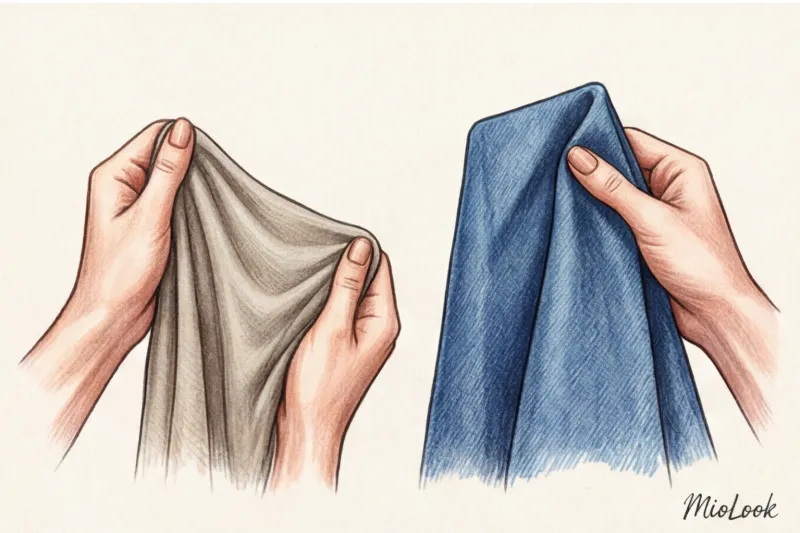
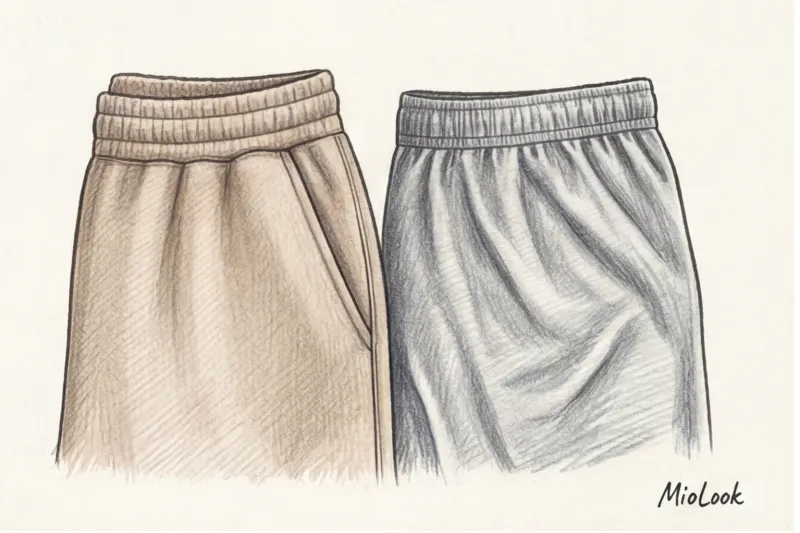
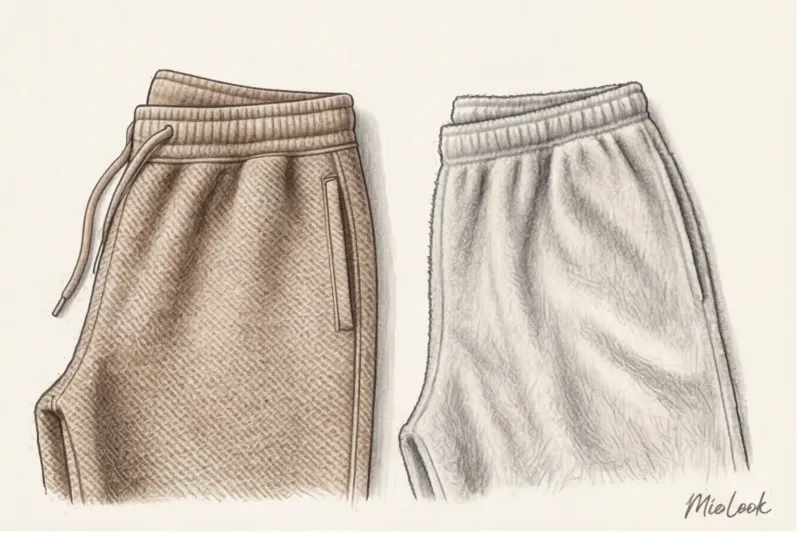
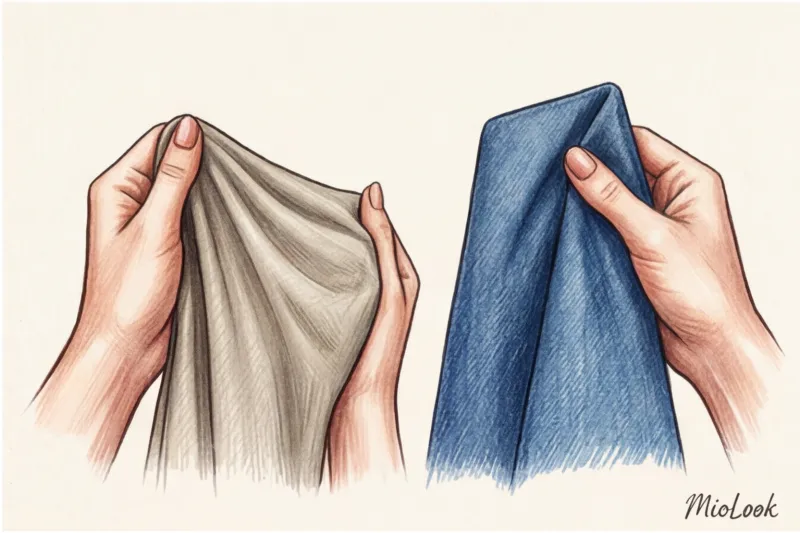
If you're looking for a way to hide thigh fat with clothing, start with a ruthless review of the materials in your closet. According to WGSN research (2024), which describes trends in the textile industry, fabrics weighing less than 250 g/m² (GSM) lack inherent dimensional stability. They completely conform to the contours of the body.
Thin knits, viscose, and cupra—all these fabrics physically sink into the hollows under the buttocks and stretch at the widest point of the thighs. As a result, they create the appearance of cellulite even where there isn't any.
"The ideal bottom fabric should have its own 'frame.' It doesn't cling to the body, but rather creates a sheath around it, molding its shape to your anatomy."
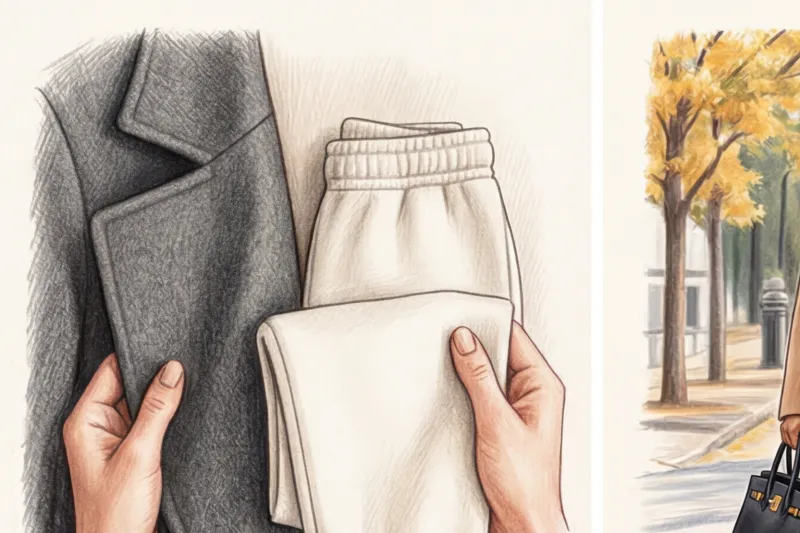
Density rule: Choose materials that are difficult to crush in your fist. These include denim weighing at least 12 ounces (oz), heavy gabardine, tweed, or suit wool.
And one more secret: beware of elastane. Many people believe that stretch jeans flatter their figure. In fact, if the fabric contains more than 2-3% elastane, it loses its ability to support the figure. It acts like a rubber band, flattening the buttocks, making them appear flatter and wider, and mercilessly tightening the buttocks. 100% dense cotton (Raw Denim) may feel stiff the first few days of wear, but it's what creates that firm silhouette.
Access to MioLook for €0.99 — one-time payment
Start creating your perfect look with artificial intelligence. Upload your items, and we'll create a capsule wardrobe that will flatter any figure flaw.
Get access — €0.99 once3D geometry of the buttocks: yoke, pockets and seams creating a push-up effect
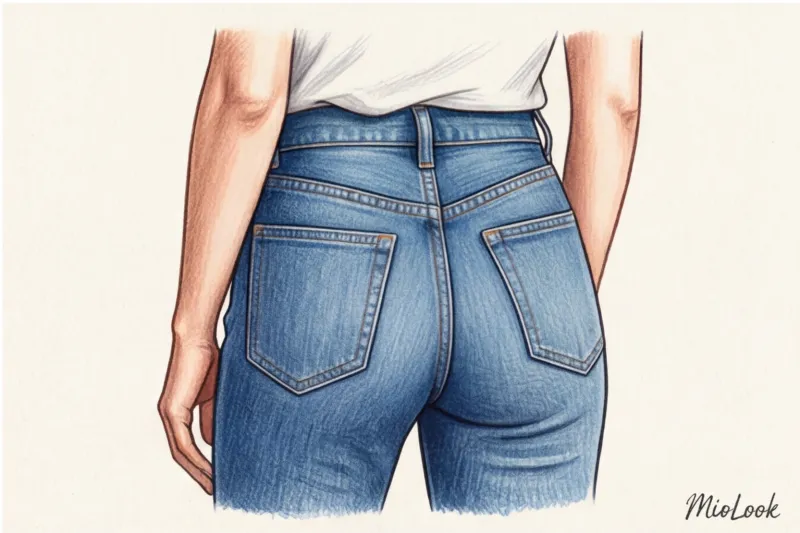
A rounded buttock is created not only in the gym but also on the cutting table. According to the clothing design methodology of the German institute M. Müller & Sohn, the visual perception of volume at the back depends on the angle of the yoke and the arrangement of the details.
Yoke: This is the seam between the waistband and the pockets on jeans. If it's straight, your buttocks will appear flat as a board. The ideal yoke has a V-shape (at an angle no greater than 130 degrees). It creates a downward-facing wing that visually lifts the center of the buttocks and creates that signature "heart" effect.
Pockets: This is the most powerful tool for distorting proportions. Remember the three golden rules:
- Size: The optimal pocket height is 12–14 cm. Pockets that are too small will make your buttocks look larger.
- Location: The bottom edge of the pocket shouldn't fall below the crease between the buttock and thigh. If the pocket is lower, the buttocks will look sagging.
- Distance: Pockets that are placed too far apart visually widen the pelvis.
On classic trousers, darts serve as a push-up feature. High-quality tailoring always includes one or two darts at the back of each leg—they create space for volume, allowing the fabric to flow smoothly around the buttocks rather than being pulled tightly over them.
5 common mistakes: things that catastrophically emphasize breeches
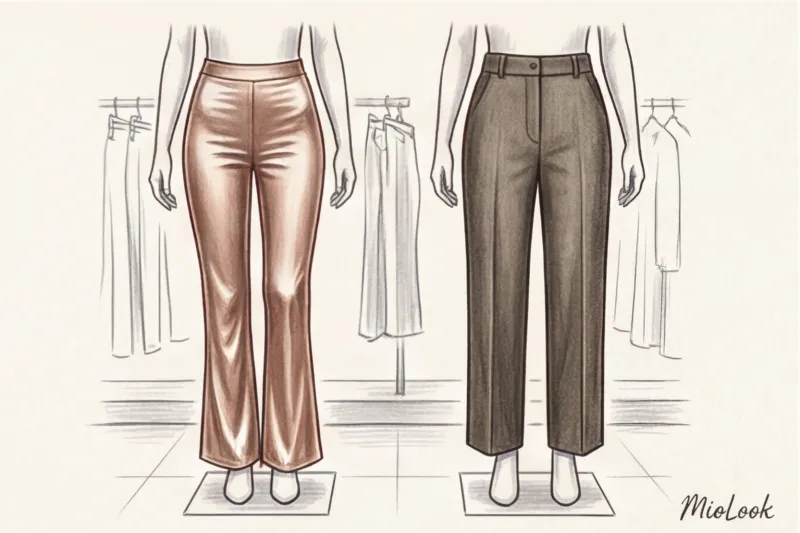
In my practice, I often encounter the same myth: "To hide your hips, you need to wear something wide and flowy." This is a catastrophic mistake, and physics proves why. The soft, wide fabric catches on the most prominent point (your "ears") and falls vertically downwards. As a result, your legs appear as wide as your hips along their entire length. The silhouette becomes monumental.
What other things should you avoid if you want to correct this area:
- Thin satin skirts cut on the bias. Silk and satin are highly drapeable, creating reflections of light on every curve, turning the breeches into a focal point.
- Culottes made of soft fabrics. Ending at mid-calf, they cut into the leg, and the soft fabric on the thighs creates a square shape.
- Low rise skinny jeans. They physically cut across the widest part of the thigh, squeezing the volume outward.
- Thin leggings outside the gym. They're designed for workouts, not street style. Without the long top, they put your anatomy on display.
- Decor at the level of breeches. Cargo pockets, horizontal distressing on jeans, or bold embroidery right at the hips act as a neon "Look Here" sign.
Your perfect look starts here
Join thousands of users who look flawless every day with MioLook Analyze your wardrobe in 5 minutes.
Get access — €0.99 onceThe Perfect Bottoms Formula: What to Look for in Stores
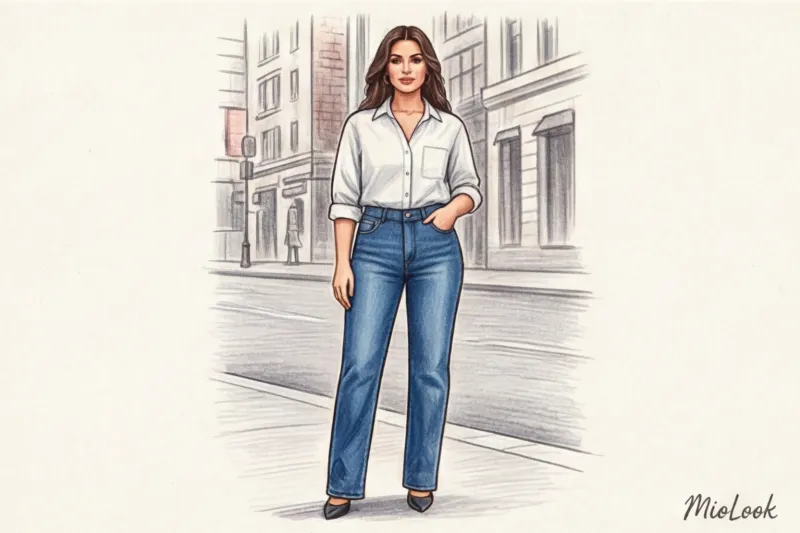
We've established that we need density and structure. But which styles work best? Here's a tried-and-true list of wardrobe investments (on average, quality pieces with this cut and good fabrics can be found in the €80-€200 range):
- Straight leg jeans. A timeless classic, they should sit snugly at the waist and upper hips, tapering straight down from the breeches. This creates a smooth column, completely concealing the curve of the ears.
- Trousers with creases made of suit wool. A pressed wing is your best friend. It creates a central vertical axis. The eye focuses on this hard line, ignoring the soft volumes on the sides.
- A-line skirts made of shape-holding materials. Thick leather, suede, heavy corduroy or denim. The skirt should flare out. from the waist , and not fit around the hips to the middle.
- Pencil skirts made of thick jersey (Ponte Roma), midi length. Ponte knitwear is double-knit. It's stretchy yet provides gentle compression.
Fair Limit: This tip for stiff fabrics works perfectly only if you don't have an extremely strong lower back. If your waist-to-hip difference is more than 30 cm, heavy denim will bulge significantly in the back. In this case, your solution is to buy pants that fit your hips and have the waist adjusted at a tailor's (by adding darts).
The Architectural Frame Method: Using Layers to Narrow Your Hips
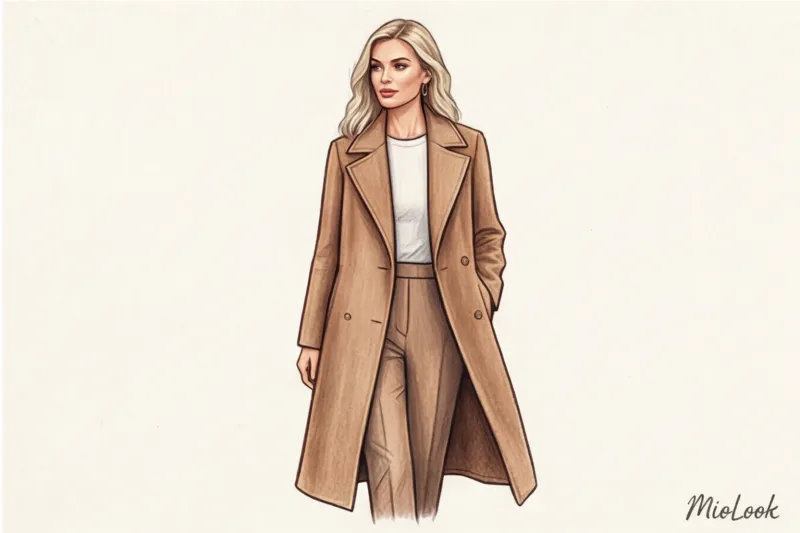
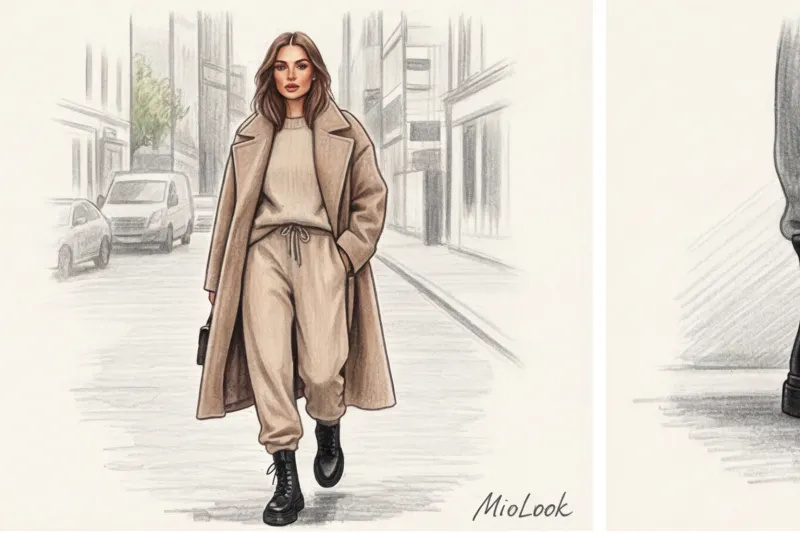
There's a styling trick I call the "Architectural Frame." If you wear a light-colored top with a dark, stiff, straight-cut jacket, leaving it unbuttoned, you create an optical illusion. The two vertical flaps of the jacket will visually "cut off" the sides of your hips, leaving only a narrow, light center visible.
The length of the top layer is critical. Jacket, cardigan, or coat should never end at the widest point of the hips Otherwise, the horizontal edge will make you look wider at that point. The ideal length is a hand's breadth above the knee or to mid-thigh (clearly below the breeches).
A smart wardrobe is perfect for testing out these types of layered looks. MioLook: You can take photos of your jackets and trousers, and artificial intelligence will show you which length proportions will work best on your figure.
Fitting Room Checklist: How to Test Out Clothes Before Buying
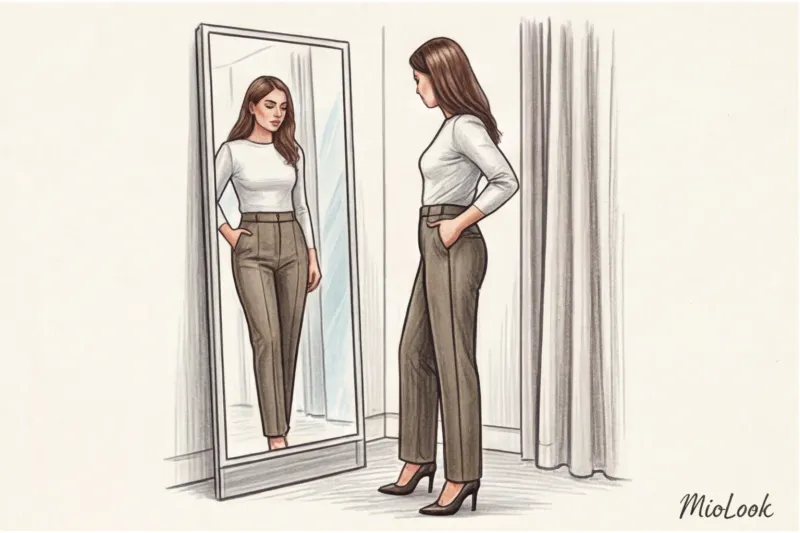
To reduce the number of environmentally harmful clothing returns and save yourself some stress, use this checklist every time you take an item into the fitting room:
- Side seam test. Stand sideways to the mirror. The seam on your pants should be perfectly perpendicular to the floor. If it curves in an arc at the hip, the pants are too small or cut incorrectly. They won't elongate you.
- Tension test (stress lines). If horizontal folds form in the groin area (from the fly to the hips), the garment is too small at the hips. The fabric is screaming for help.
- Light test. Put on your pants, sit down slightly, and look in the mirror. If skin (or the contours of your underwear) begins to show through the fabric at your knees or thighs, it's not tight enough and will highlight your entire figure.
- Assessment from behind. Turn your back to the mirror. The yoke of your jeans should form a distinct V, and the pockets should be positioned precisely in the center of each buttock, not flaring out to the sides.
The main takeaway I want you to take from this article is: don't try to shape your body to fit poorly designed mass-market pieces. If a garment fits poorly, the problem isn't your figure, but rather cheap fabric and poor seam geometry. Choose dense materials with minimal elastane, pay attention to the shape of your back pockets, and don't be afraid to wear straight, architectural silhouettes. Your body deserves a well-sculpted silhouette.