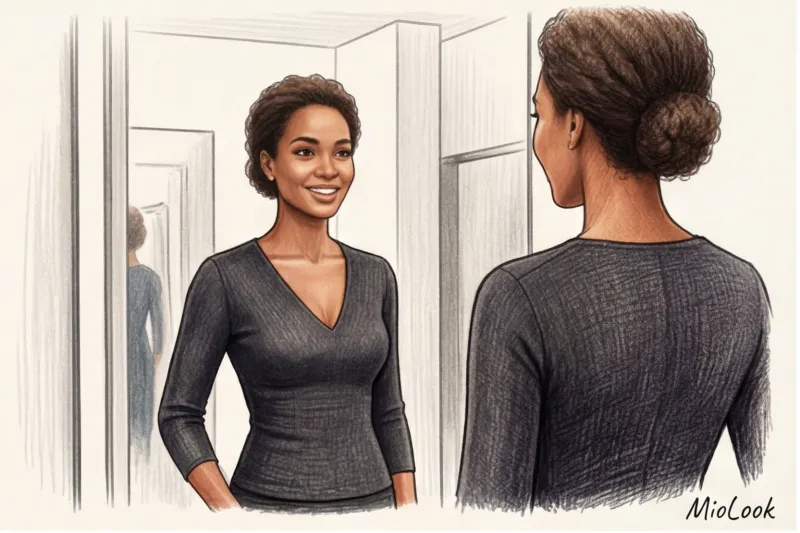
Do you know what fashion advice girls with a D cup and above hear most often? "Wear black and hide in oversized clothes." Over 14 years of working as a personal stylist, I've literally forcibly taken hundreds of shapeless hoodies and tight tunics from my clients. Why? Because trying to "hide" a large bust under meters of loose fabric always backfires: you end up with a massive, boxy silhouette. If you're worried about how to visually reduce your bust, it's time to fundamentally change your approach and stop treating your curvaceous figure as a problem.
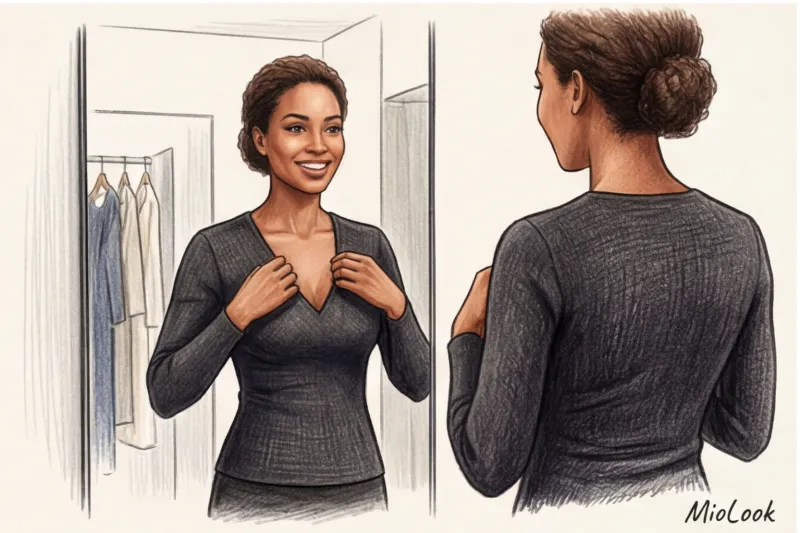
Clothing is not a cover, but an architectural tool. We can't physically remove volume, but we can skillfully integrate it into the overall geometry of the body through texture density, structural cuts, and focal points. We discussed this principle in more detail in our a complete guide to visually correcting your figure with clothing , and today we will take a detailed look at the décolleté area.
Take measurements, not labels: how to visually reduce breast size without stereotypes
First, let's forget about so-called "fruit" body types. Dividing women into "apples" and "pears" is hopelessly outdated and only creates insecurities. A large bust is simply a characteristic of proportions that requires the right shape. Over the years of working in fitting rooms, I've learned one important thing: when a woman with large breasts puts on a well-cut garment, even her posture changes. She stops slouching, trying to squeeze in those extra inches.
The main rule I impart to my clients is that we control the gaze of others with lines. Vertical lines elongate, diagonal lines break up volume, and horizontal lines (especially in the form of an irregular neckline) expand. And before we move on to choosing jackets or blouses, we need to lay the right foundation. Without it, no top, even the most expensive one costing €150, will work.
Step Zero: The Foundation 80% of Women Forget
In my practice, I regularly encounter stories where a client and I solve the problem of a "big top"... simply by going to a lingerie salon. According to a global study by the lingerie brand Bravissimo (2023), over 80% of women wear the wrong bra size. Most often, they choose a band that's too wide and a cup that's too small. What happens as a result?
- The chest falls below its natural line.
- The torso is visually shortened (the distance from the chest to the waist becomes minimal).
- Extra volume is added to the abdominal area.
The "lift and separate" rule works without fail. The ideal bustline in profile should be exactly halfway between the shoulder joint and the elbow. If the bust falls below this line, any top will look baggy. Invest in professional bra fitting. A good, smooth, basic bra in the right size will do more for your figure than a year's gym membership.
Your perfect look starts here
Join thousands of users who look flawless every day with MioLook. The smart algorithm takes your body shape into account.
Get access — €0.99 onceThe Biggest Fitting Room Myth: Why Oversized Clothes and Turtlenecks Make You Look Bigger
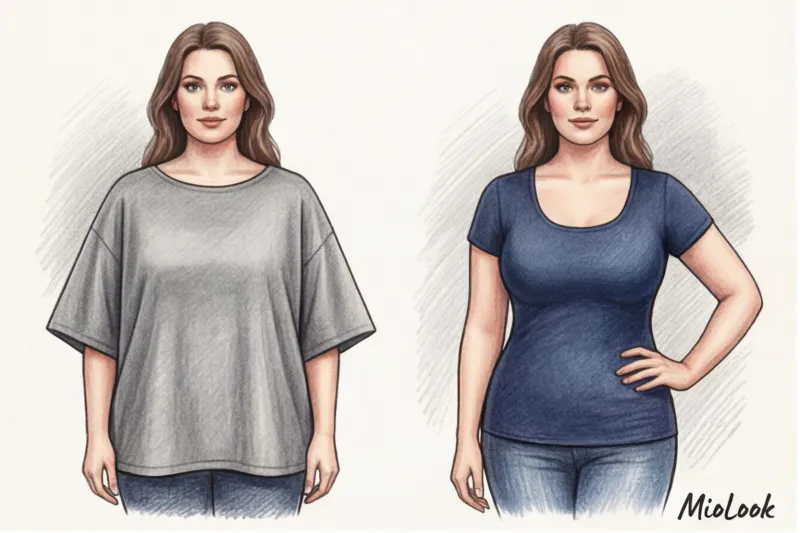
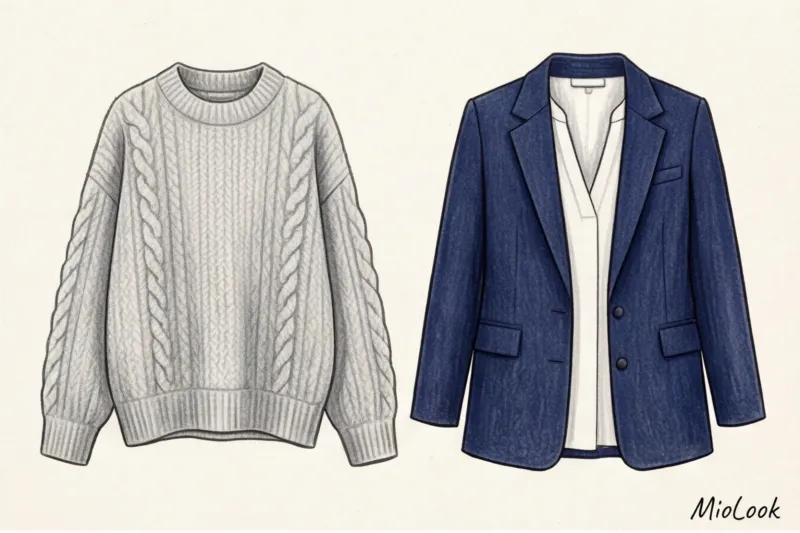
"I'll just put on a sweater two sizes too big, and nothing will show." Sound familiar? This is the most dangerous misconception. In styling, there's a concept called the "tent effect." When you put on a loose, soft garment over a large bust, the fabric falls vertically from the fullest part of your body. As a result, your entire waist and stomach become visually the same width as your bust. You voluntarily add 2-3 sizes to your figure.
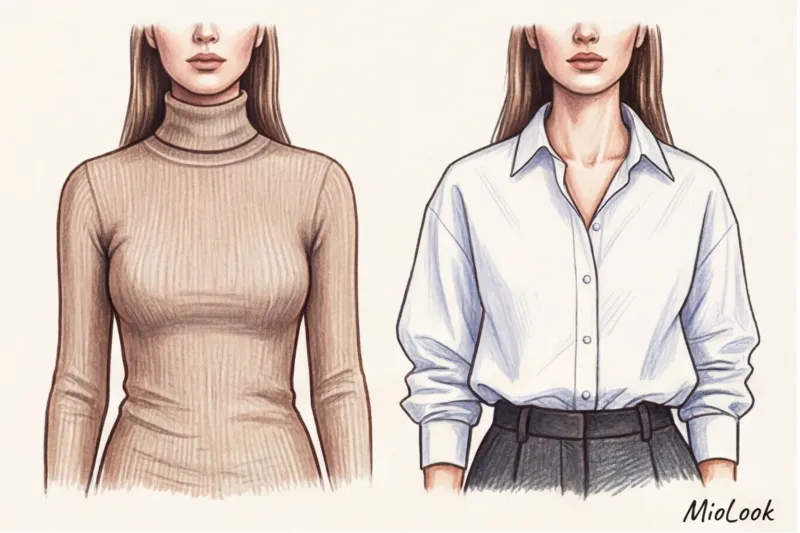
The other extreme is a tight turtleneck made of thin knit with a stand-up collar. They create a ruthless "mono-bust" effect. Have you ever noticed how a tight turtleneck makes your upper body look like a solid, undifferentiated, massive block? The neck disappears, and your volume appears twice as large.
"One of my clients, a top manager at an IT company, constantly wore bulky gray hoodies, trying to hide her E-cup size. The first time I put her in a structured, semi-fitted, heavy wool jacket, she looked in the mirror and said, 'I just visually lost 10 kilograms in one minute.' The secret is not to be too tight, but also not to hide, but to create a semi-fitted contour."
The architecture of the perfect top: cuts and fabrics that work for you
So, how can you visually reduce the appearance of a large bust when choosing blouses, T-shirts, and shirts? The answer lies in sculpting. The WGSN trend study (2024) confirms a global fashion shift away from shapeless, relaxed knitwear toward structured tailoring. And for fuller busts, this is the best news of the decade.
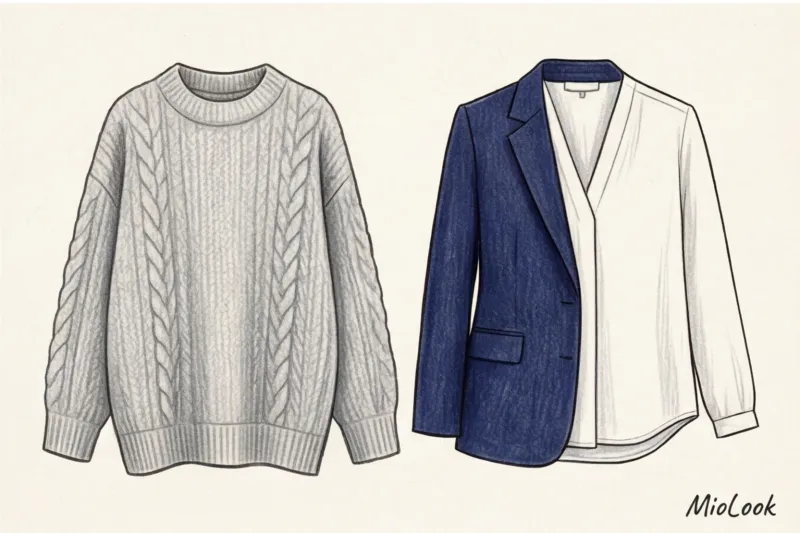
Fabric density: your main ally
Your main enemies in stores are flimsy ribbed knits, viscose "noodles," and thin cotton. Such fabrics stretch treacherously across the bust, distorting the pattern (especially stripes), and gather in untidy folds under the bust. The fabric should hold its shape, not cling to your body.
Choose high-density fabrics. For a basic T-shirt or long-sleeve, choose cotton with a minimum weight of 200–250 g/m² (gsm). If the tag doesn't indicate this, do a simple test in the store: stretch the fabric over your palm. If your skin is translucent or your fingertips are clearly visible, hang the garment. Excellent structured fabrics in the mid-price range (€50–€100) can be found at brands like COS, Massimo Dutti, or Arket. Heavy linen with a viscose blend (the viscose will prevent the linen from standing upright), heavy denim, and fine suiting wool work well.
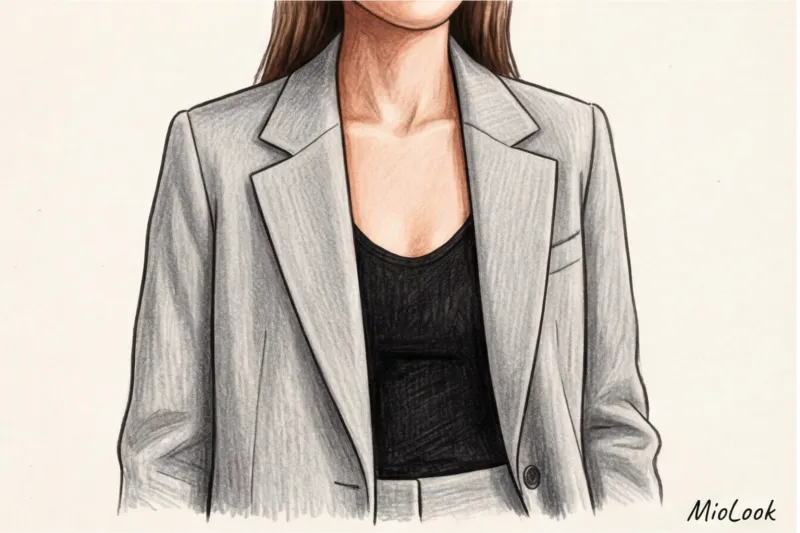
Cutout Geometry: Creating Correct Vectors
We've reached the most important geometry in your look. V-necklines and U-necklines are your best friends. They reveal the collarbones, create a vertical line, and visually lengthen the neck. The optimal neckline depth is about 10–15 cm from the sternal notch. This lightens the décolletage without making the look vulgar.
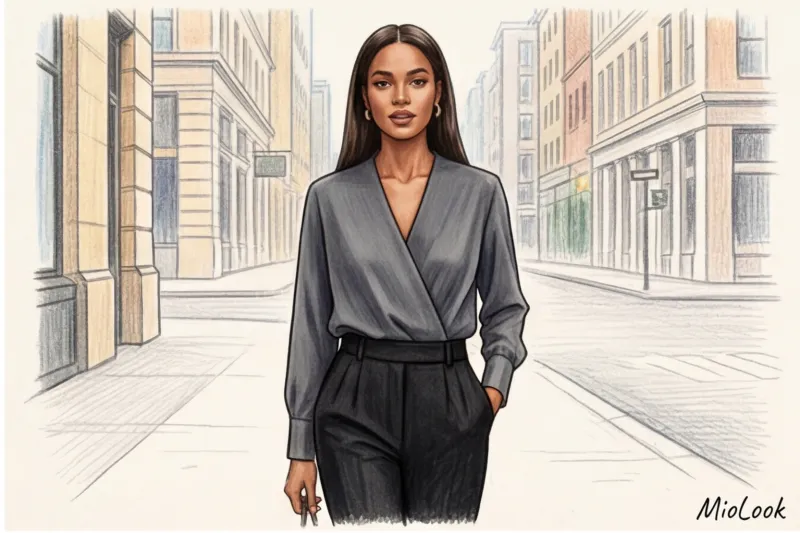
Wrap tops and dresses work great. They create a powerful diagonal line that cuts the bust into two asymmetrical sections, making it appear more compact. However, I must add a disclaimer: this advice doesn't always work. If a wrap blouse is made of the finest silk or cheap polyester (less than 150 g/m²), it will constantly unravel on a large bust, requiring readjustment every five minutes. Look for a wrap on thicker fabrics.
What if you have a strict corporate dress code where deep V-necks are prohibited? In this case, a heavy, men's-style shirt unbuttoned the top two buttons (which creates that very V-shaped contour) and a smooth silk top underneath will do the trick.
Color, Print, and Optical Illusions: Managing Attention
Back in 1889, psychiatrist Franz Müller-Lyer described an optical illusion proving that the human eye misjudges the size of an object based on surrounding lines. In stylistics, this principle works 100%. You can visually reduce your breasts simply by shifting your focus.
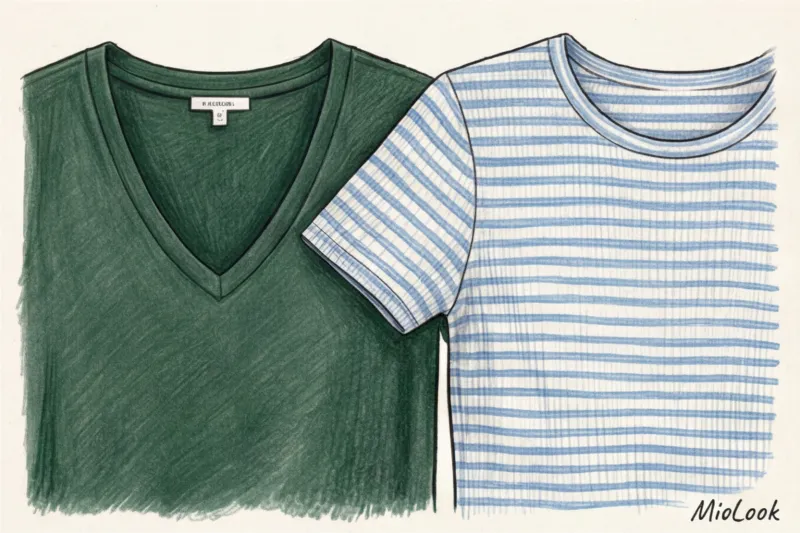
What you should absolutely avoid: wearing tops with large prints near the neckline (oversized flowers, large polka dots, wide horizontal stripes). Any large pattern acts as a magnifying glass. Avoid patch pockets on the chest, ruffles, frills, and large appliqués in this area. This is obvious, yet often ignored advice.
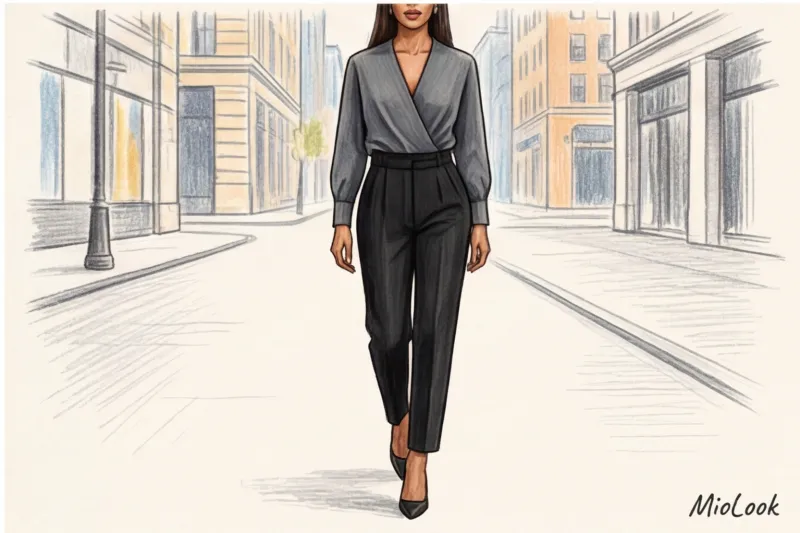
Use color blocking: a dark, matte top paired with light or bright bottoms. Light-colored pants, statement shoes, or a bright skirt will draw attention downwards, drawing attention away from your full top. And remember: matte textures absorb light and reduce volume, while shiny ones (satin, lurex) reflect light and visually add at least half a size to your figure.
Ready to start creating your perfect capsule wardrobe?
Upload your items to MioLook, and the algorithm will help you create harmonious looks for every day, taking into account the rules of proportion.
Get access — €0.99 onceThe Magic of Layering: How Jackets Cut Volume
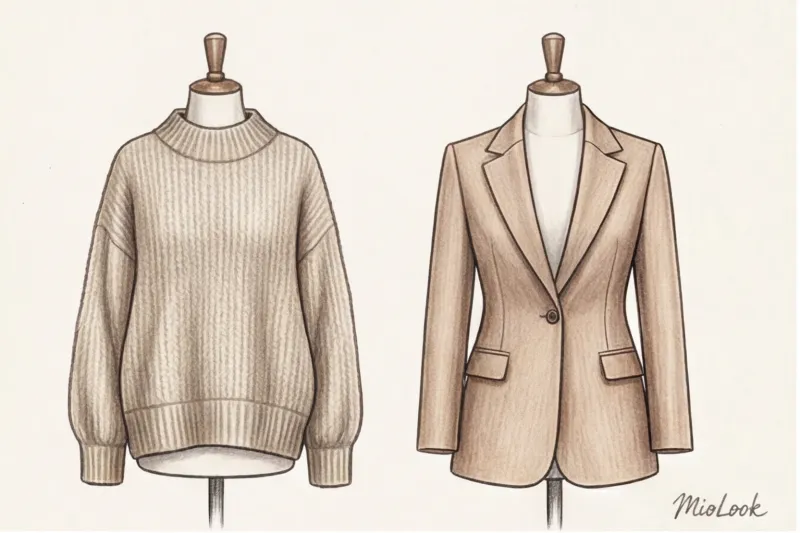
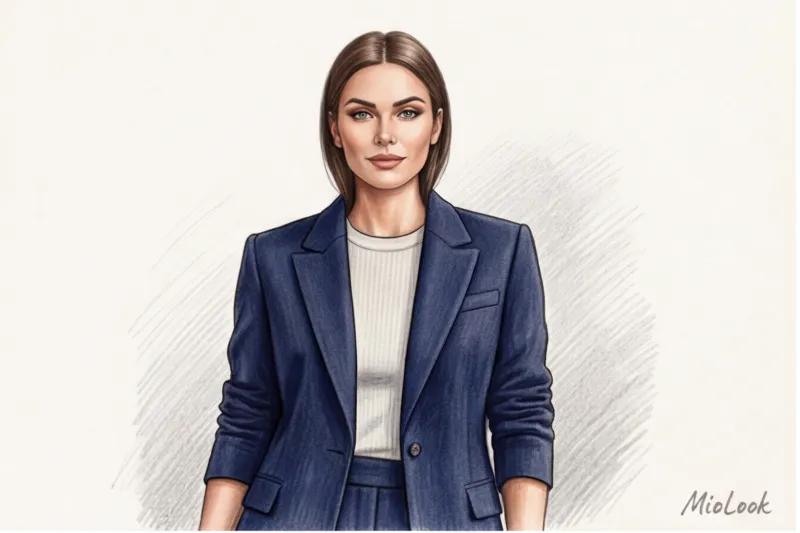
Let's move on to an advanced level. The most effective way to visually reduce bust size is to use structural layering. Imagine a wide column. If you place two dark panels on either side of this column, the visible portion of the column will narrow. An unbuttoned jacket works in the same way.
By wearing a thick, well-tailored jacket over a basic top and leaving it unbuttoned, you create two vital vertical lines along your torso. Your chest is now visible only to the extent of the jacket's exposed width.
- Choose single-breasted models. Double-breasted jackets with two rows of buttons create a horizontal line and inevitably add width to the chest.
- Watch your lapels. They should be proportionate to your figure. Lapels that are too narrow against a full bust will emphasize its size by contrast. Choose classic or slightly wider peak lapels.
- Length matters. The top layer shouldn't end at the widest point of your figure (for example, at the widest part of your hips). Keep the jacket slightly longer (covering your buttocks) or shorter (but not ending right under your bust).
By the way, it’s very convenient to digitize your basic tops and jackets to see how they go together the "smart wardrobe" feature in MioLook You'll immediately notice if your wardrobe is skewed towards shapeless sweaters.
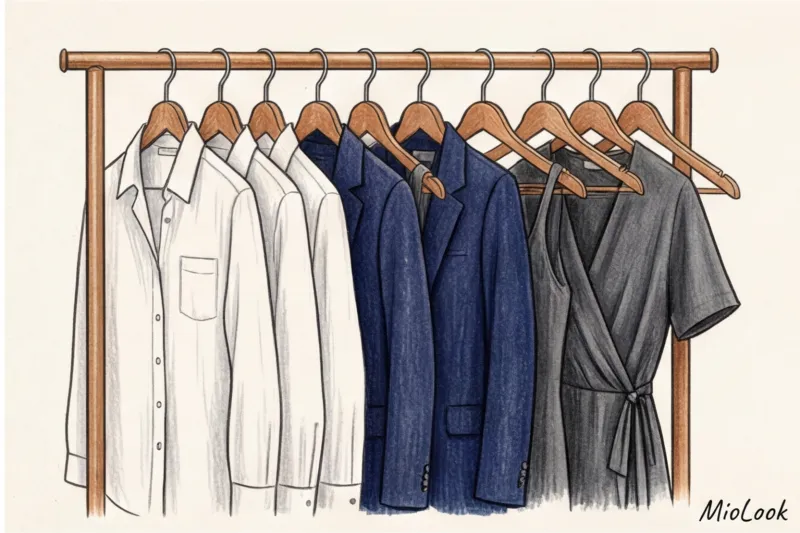
Stylist Checklist: A Shopping Cheat Sheet
Let's summarize all of the above. If you want to put together a stylish base that will complement your figure, not undermine it, take a quick inventory.
3 things you should get rid of right now:
- Turtlenecks made of thin, translucent knitwear (opt for thick jumpers with a V-neck or polo collar).
- Blouses with abundant decoration on the chest (jabot, large flounces, massive patch pockets).
- Shapeless tunics and hoodies in a tent-style design made from soft, flowing fabrics.
3 things worth investing in this season:
- The perfect basic bra after professional fitting (smooth, nude, lifting the bust to the right height).
- A thick cotton top or T-shirt with a proper V-neck or U-neck (pay attention to the fabric density of 200 g/m²).
- A well-tailored single-breasted jacket made of dense fabric (wool, thick linen with viscose) that holds the shoulder line.
My main advice: your figure is already beautiful. Large breasts are a luxurious, feminine accent, not a flaw to be shamefully hidden under layers of oversized fabric. Replace the desire to "hide" with the desire to "sculpt" your silhouette. Find your ideal proportions, invest in sturdy fabrics, and remember: clothes should serve you, highlighting your beauty, not dictate how you feel.