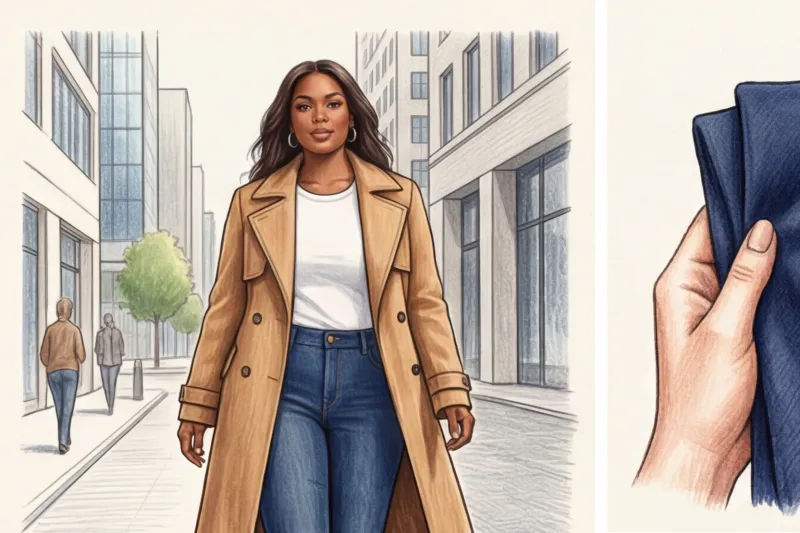
Basic Wardrobe for Plus-Size Women: A Paradigm Shift from 'Hide' to 'Construct'
Remember the glossy magazines of the early 2000s? Their advice for women over size 50 boiled down to one cruel and absurd rule: "Wear black, choose a looser style, and try to blend in with the wallpaper." As a stylist with 12 years of experience, I'm still cleaning the consequences of this toxic fashion diet from my clients' closets. One of them, a brilliant financial analyst, spent years buying exclusively black knit tunics two sizes too big. The first time we put her in a structured jacket with a sharp shoulder line, she looked in the mirror in amazement: "I didn't even know I had such beautiful posture."
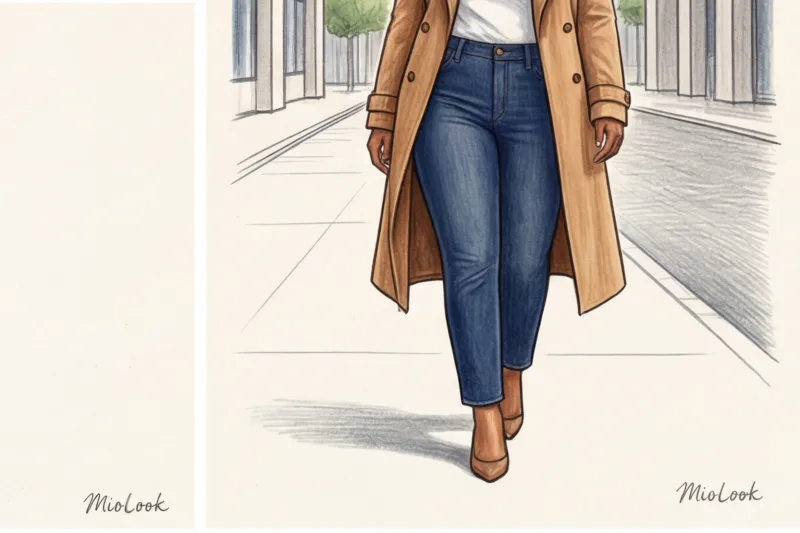
Let's face it: collecting Basic wardrobe for plus-size women , we must forever erase the verb "hide" from our vocabulary. Shapeless robes don't disguise weight. They visually transform your figure into a heavy, monolithic block, erase your individuality, and, worst of all, systematically destroy your self-esteem. Research Fashion Psychology Institute (2022) showed that regularly wearing oversized clothing out of a desire to “hide” increases the level of body dysphoria by 40%.
Instead of camouflage, I suggest you change the paradigm to architectural approach Think of your clothes as an engineering framework. Your body is a beautiful foundation, and the right cut is the supporting structure that creates clear lines, organizes space, and highlights your best features. Structured fabrics, precise darts, and precise geometry work like a skilled sculptor. They don't constrict you to the point of rib pain, but create a flattering, composed silhouette.
"Plus-size clothing shouldn't be a furniture cover. It should be a frame for a masterpiece, where every line serves the architecture of your body."
It is on this principle that philosophy is built. smart wardrobe in the MioLook app Its artificial intelligence helps select and combine items based on body shape, rather than blindly relying on standardized sizing, which often ignores individual proportions.
Here we naturally move on to the concept of sustainable fashion. In the plus-size segment, the principle of "fewer items, but of the highest quality" has a strict physical basis. Large stretch areas and natural friction (for example, on the inner thigh or armholes) require exceptional strength from the fabric. Cheap mass-market clothing skimps on patterns and thread count. Thin viscose for $20 will stretch out on the hips after the first wash, turning into that shapeless baggy mess.
The perfect capsule doesn't require 50 hangers. We discussed the mechanics of creating one in more detail in our The Complete Guide to Creating a Capsule Wardrobe You only need 12-15 impeccably tailored pieces. Yes, palazzo pants made of thick gabardine or a blazer with the right piping might cost €150-250. But this is an investment in a frame that will last you for years, preserving its shape, your nerves, and your self-confidence.
Fabric Anatomy: Why Density Matters More Than Fit
Have you ever noticed the paradox: two skirts of the exact same cut and size can look completely different on a figure? One transforms the silhouette into a stately column, while the other distorts proportions and highlights even the slightest imperfections. As a textile expert, I often repeat: a well-designed basic wardrobe for plus-size women doesn't start with patterns. It begins with the physics of materials. Fabric density is always primary, and only then do we consider darts and seams.
Let's debunk one of the most persistent and harmful fashion myths that has been instilled in plus-size women for decades: the legend of the salvation of "flowing" fabrics. Sales associates still love to offer tunics made of the finest viscose or flimsy polyester, promising that the material will "softly contour to your figure." In reality, thin knits, cheap silk, or chiffon act like a treacherous 3D scanner. Due to their low density, they have no inherent weight. Such fabrics become magnetized, bunch up when you walk, and mercilessly outline the contours of your underwear, the microrelief of your skin, and those anatomical nuances we usually prefer to smooth out.
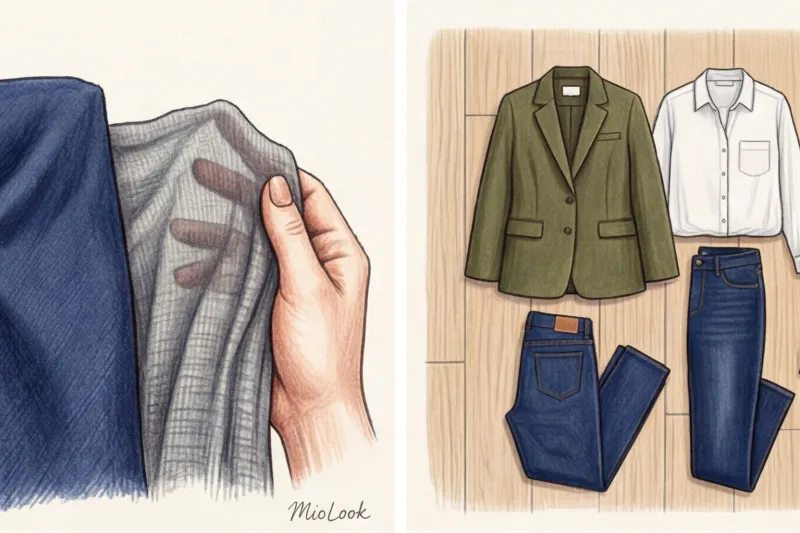
Instead of trying to drape or conceal the body under flowing layers, we need to create an architectural framework for it. Materials with high dimensional stability (the ability to retain a factory-imposed shape) physically "assemble" the figure, creating clear, continuous lines. Here's your textile gold standard:
- Heavy cotton (poplin or twill) — an ideal choice for basic shirts. It's stiff enough to maintain a stand-up collar and a defined shoulder line, visually elongating the neck.
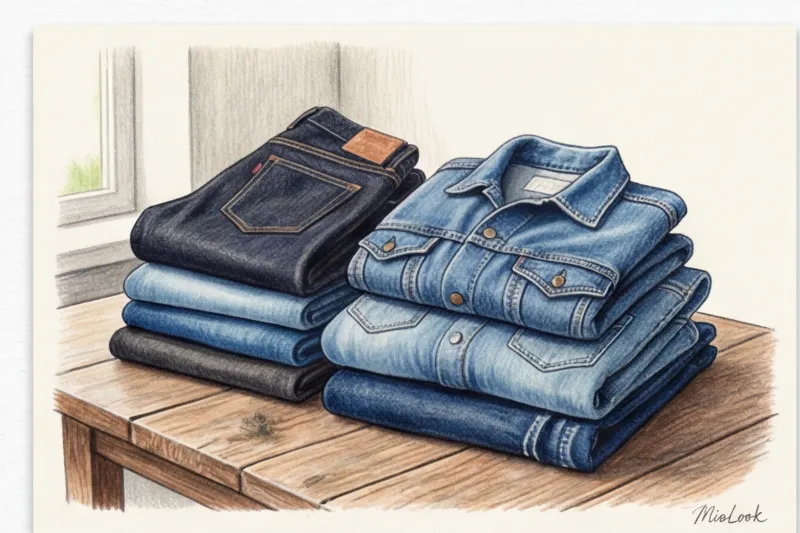
- Denim 11-13 ounces (oz) In the world of denim, this is a critical factor. Anything lighter than 10 ounces is considered jeggings and will quickly sag. Denim weighing between 11 and 13 ounces offers the perfect amount of stiffness: it works like a lightweight compression corset, cinching the stomach and hips without restricting your stride.
- Blended wool (For example, twisted suit wool with a density of 250 g/m² or more). It's incredibly smooth, matte, withstands temperature fluctuations well, and maintains a crisp crease on palazzo pants.
- Gabardine — thanks to the diagonal rib (twill weave of the threads), it stretches slightly along the bias, providing comfort in movement, but along the grain line it firmly holds the shape of the product.
Over the years of testing hundreds of brands, I've come up with a simple rule. To determine whether new pants will stretch out at the knees or inner thighs by evening, right in the fitting room, perform the "pinch test." Grasp the fabric with two fingers at the seam, pull it tight, and then release it quickly. High-quality material should instantly, with a slight pop, return to a perfectly flat state. If the stretched area ripples or remains bulging for even a couple of seconds, the garment is doomed to become a shapeless sack after just one wash.
Access to MioLook for €0.99 — one-time payment
A smart AI stylist will select the perfect look.
Get access — €0.99 onceLabel Reading Guidelines: How Much Elastane Is Allowed?
Turn over the inside tag on your favorite pants. What you see there will explain 90% of fit issues. In recent years, in the pursuit of instant comfort, manufacturers have begun adding excessive amounts of synthetic stretch fibers to fabrics.
The ideal formula for clothing that should structure the silhouette is 97-98% natural fibers (cotton, wool, high-quality cellulose) and only 2-3% elastane (spandex or lycra). These 2-3 percent are a technological micro-dose, necessary solely to allow you to sit comfortably in an office chair or raise your arms. This proportion preserves the fabric's so-called "memory effect." The fibers remember the original pattern structure and tend to return to it after the tension is released.
But what happens if the label boasts 5% spandex or more? Such a garment seems incredibly comfortable when first tried on, stretching like yoga leggings. However, elastane has a fatal weakness: its fibers are destroyed by body heat, friction from walking, and hot water in the washing machine. Pants costing €30 or $40 with 7% elastane will become irreversibly deformed after two weeks of active wear: unsightly sagging will appear on the buttocks and blisters will appear on the knees.
By choosing items with a minimal elastane content, you're investing in aesthetics and durability. Yes, thick, high-quality jeans made from 98% cotton will feel a little stiff for the first couple of days. They need time to adapt to your body temperature and fit perfectly. But once this break-in process is complete, you'll have a custom-molded "frame" that will fit flawlessly for years to come.
The Formula for the Perfect Plus Size Capsule: 12 Things That Decide Everything
According to last year's reports from the analytical agency WGSN, the average woman regularly wears only 19% of her closet's contents. In the plus-size segment, this figure often drops to 12-15%. The reason lies in impulsive purchases of "compromise" items that seem to fit, but fail to bring joy and confidence. The ideal basic wardrobe for plus-size women is built not on endlessly expanding the selection, but on mathematically precise combinations. The essence of the capsule method is to create 30 to 40 unique looks from 12 essential clothing items (not counting underwear, shoes, and accessories) that cover the vast majority of life situations—from work video calls to dinner at a restaurant.
Last month, I was putting together a functional wardrobe for a client who is a size 54 (RU). Her initial request was a classic: "My closet is bursting, but I have absolutely nothing to wear." We conducted a thorough inventory review, removed all the pieces that didn't hold their shape, and assembled a capsule wardrobe of just a dozen items in a palette of deep emerald, caramel, and milky shades. The math for our capsule wardrobe was as follows: three bottoms, four tops, two dresses, two thick outer layers, and one statement piece. She invested about $850 in quality pieces, receiving a complete wardrobe builder. Now she spends no more than two minutes getting ready each morning, as any top pairs flawlessly with any bottom.
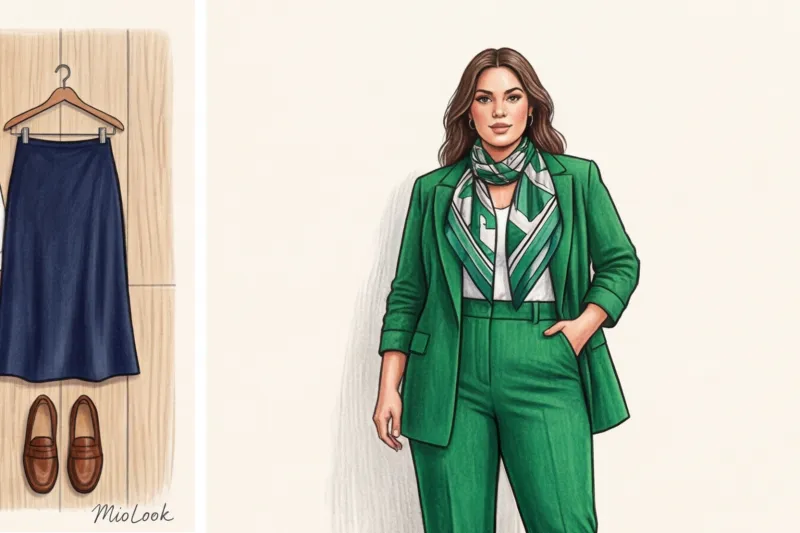
The foundation of this matrix is the right bottoms. Our formula has three. First: straight-leg or slightly flared bootcut jeans with a high waist made of heavyweight denim (12-13 oz). Because they lack excess elastane, they don't cinch the midsection but rather act like a corset, physically gathering and elongating the silhouette. Second: palazzo pants made of heavy suiting fabric with added viscose. Their weight allows them to fall in even vertical folds without catching on the calves and thighs as you walk. The third bottom varies depending on your lifestyle: it could be an A-line midi skirt made of heavy cotton or classic straight-leg trousers with creases that create an additional vertical line.
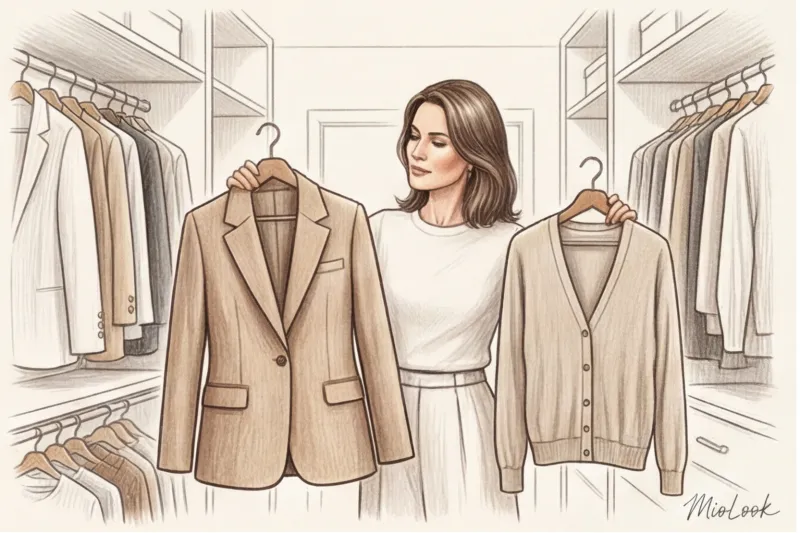
Plus-size capsule tops must hold their shape. We're saying a firm farewell to so-called "rag cardigans" made of thin, flimsy knits that sag treacherously across the shoulders and chest, creating a slouched effect and highlighting even the slightest unevenness in the silhouette. Instead, we're introducing structured jackets into the basics. A defined shoulder line instantly sculpts the figure, creating architectural geometry. A single-breasted, straight-cut jacket worn open creates two elongating vertical lines along the torso, visually trimming volume at the sides.
We complement jackets with straight-cut shirts made of heavy cotton (they can be worn alone or unbuttoned over a top) and basic T-shirts weighing at least 180-200 g/m². The T-shirt should not be see-through or tight—there should always be some air between the fabric and the body. When wearing such tops, use a French tuck—the front hem of the garment is tucked slightly into the waistband. This stylistic micro-trick instantly defines the waistline while maintaining the necessary looseness and relaxed look.
To avoid having to keep dozens of combinations in your head and wasting time in front of the mirror, digitize your new capsule wardrobe. Download these 12 basic pieces into MioLook app , you can generate daily looks in one click, knowing in advance how a structured jacket will work with palazzo pants or jeans in your specific color scheme.
Investment Dresses: Ditch the "Bag"
Historically, for decades, mass-market fashion has encouraged curvy women to hide behind shapeless, baggy dresses. This is a grave stylistic error. A loose, unstructured cut doesn't conceal volume; on the contrary, it visually expands your entire figure to the fullest point of the fabric. Clothes shouldn't hang loose; they should define proportions.
The best investment for your summer and mid-season wardrobe is a shirtdress made of heavy linen or mercerized cotton. A vertical row of contrasting buttons from collar to hem creates a powerful optical illusion, elongating the figure and slimming the silhouette. Choose semi-fitted styles that emphasize the waist with a wide, sewn-in belt made of the same fabric. Avoid thin belts, which can visually cut the figure in half and throw off proportions.
The second essential element of a basic capsule wardrobe is the wrap dress. However, there's a crucial technical nuance here. This famous style works on a fuller figure only if the fabric is of the right density. If it's thin, loose viscose, the dress will immediately gather into untidy folds at the back and accentuate the contours of your underwear. Look for options made of thick crepe, heavy silk, or a high-quality, lined blend. Only then will the diagonal cut create an elegant V-neck, smoothly define the waist, and provide that premium fit for which this style is prized worldwide.
Color and Prints: Myths It's Time to Stop Believing
Let's conduct a thought experiment. Open any style forum, and the first piece of advice you see will be something like, "Wear black, it takes away volume." As a textile and color researcher, I consider this one of the most insidious misconceptions in the fashion industry.
From a physics perspective, all-black does absorb light. But when a curvy woman wears a black garment made of a soft, matte fabric, devoid of a rigid, architectural cut, the color begins to work against her. It erases the body's inner contours and shadows, turning the figure into a flat, heavy silhouette. monolithic block In this look, our eye is drawn exclusively to the outer contour of the silhouette. And if this contour has pronounced curves and volumes, black won't hide them, but rather literally outline them with a thick marker.
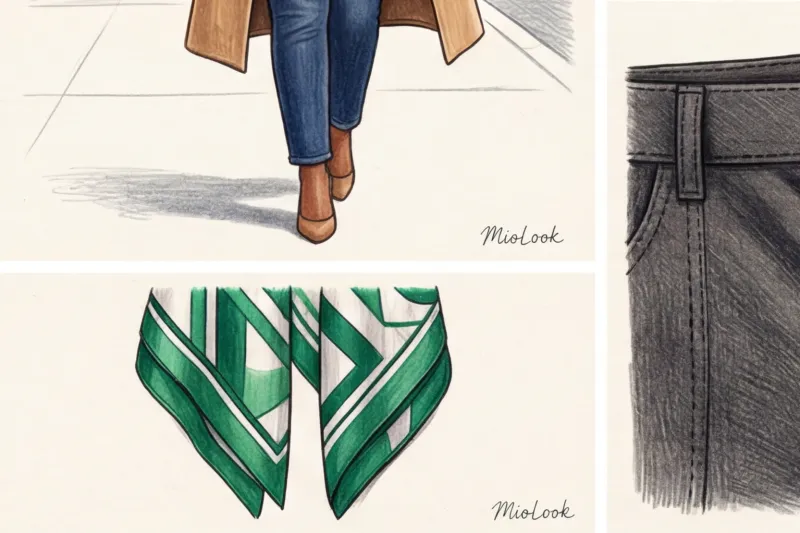
Deep, complex shades like sapphire, emerald, rich burgundy, or dark chocolate work much more effectively in the basic capsule. They preserve the interplay of light and shadow, adding depth and dynamism to the silhouette.
Instead of hiding in a dark uniform, I highly recommend mastering color blocking (color blocking method). This is pure geometry that allows you to resculpt your figure. Carefully placed contrasting colors literally "draw" a new waist. How does this work in practice?
- Trompe-l'œil effect: A dress with charcoal gray or navy blue side panels and a light center panel visually narrows the waist by 10-15 centimeters. The human brain is lazy—it only reads the light center panel. (This technique is brilliantly used in Stella McCartney sheath dresses starting at $800, but the principle is easily replicated in the affordable segment.)
- Contrast vertical: Wear a light top and an unbuttoned, dark, structured jacket over it. The two dark lines of the jacket will visually "cut off" the sides.
Access to MioLook for €0.99 — one-time payment
Start creating perfect images with the help of artificial intelligence
Get access — €0.99 onceWhile we've sorted out monochrome, prints are a veritable minefield. Here, color studies and the classical theory of proportions by Johannes Itten (a Bauhaus teacher) come to our aid. The basic law of proportionality states that the scale of the details must strictly correspond to the scale of the base.
That's why small flower (The so-called ditsy floral) or micro polka dots are absolutely contraindicated for plus-size women. They create a clash of scales: tiny buds against a stately figure make the body appear even more massive due to the sharp contrast. The small print begins to "ripple," visually expanding the fabric.
"For a print to be slimming, it should be proportionate to your figure. Choose medium and large motifs: wide diagonal stripes, large geometric patterns, or abstract brushstrokes. The ideal repeat size for plus-size women is no smaller than the size of your fist."
When creating a basic wardrobe for plus-size women, avoid the idea of camouflaging yourself with a black robe or a miniature daisy-print dress. Use color as an architect's tool, directing the viewer's eye exactly where you choose.
Eco-Wardrobe: How to Check the Quality of Plus-Size Clothing
According to the Global Fashion Agenda 2023 report, approximately 60% of discarded clothing could last at least three times longer if manufacturers didn't skimp on basic seam design. For curvy women, this statistic becomes a daily financial and emotional burden.
In a high-quality basic wardrobe for plus-size women, the fabric and threads are subject to a completely different physics of weight distribution. Weak spots are well-known: the inner thighs (where the fabric literally burns from the constant friction of walking), armholes, and waist seams. When we sit, the abdominal volume physiologically expands, creating colossal horizontal pressure on the waist. Mass-market clothing often ignores these stress zones, using standard patterns and cheap elastic threads that snap within a month.
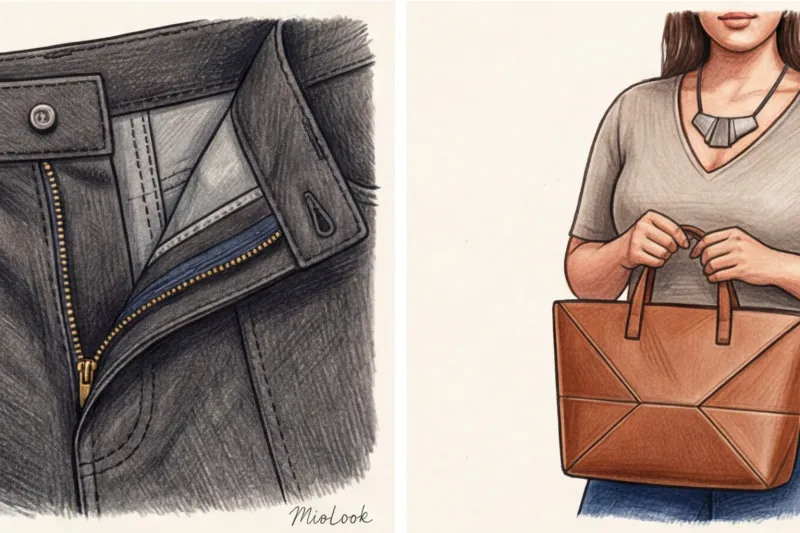
How can you protect your investment and your nerves right in the fitting room? My first and foremost advice is to always turn the garment inside out. A proper seam on a quality garment should have at least 4-5 stitches per centimeter. Gently pull the fabric sideways along the stitching line: if you see wide gaps and taut threads, the garment will begin to unravel very quickly. Furthermore, in properly constructed garments, the shoulder seams, armholes, and waistline are always reinforced with backing tape (thick twill or clear silicone), which physically prevents the fabric from deforming under body weight.
"70% of a product's durability is determined by the design of the internal components, not the choice of the outer fabric. The hidden architecture is crucial," notes a report from the Institute of Textile Technology in Aachen.
As a textile expert, I'd like to share a professional technique I regularly use when shopping. It's called the "pinch test." To determine whether a jacket's collar or cuffs are lined with high-quality interlining, grasp the collar edge with two fingers and gently rub the layers of fabric together. You should feel a dense, rigid interlayer, not a void between the outer fabric and the lining. If the collar is empty, after the first wash or dry cleaning it will develop unsightly ripples and lose its shape forever.
This naturally brings us to the concept of Cost Per Wear—the core principle of a sustainable eco-wardrobe. Let's do the math. You can buy five pairs of cheap, thin viscose pants for $30 each, which are guaranteed to wear out on the inner thigh after exactly one month of active wear. Or you can invest $150 in a single pair of heavy-duty pants made from the right wool blend, where the manufacturer has included a special detail—a gusset.
A gusset is a small diamond-shaped insert in the inseam that absorbs all the tension from the crotch seam. Trousers with a gusset last for years because the fabric physically cannot tear under the strain. The math is clear: expensive trousers with the right construction ultimately cost you mere pennies per wear, while cheap ones drain you with dollars and constantly require replacement.
To clearly track which items are actually worth their cost, I recommend adding them to MioLook By digitizing your closet and recording how often you wear items, you'll quickly see the true cost per wear stats. This is a sobering experience that will once and for all discourage you from spending money on low-quality, one-time-use items.
Shoes and Accessories: The Architecture of Proportions
In the psychology of visual perception, there's a classic Ebbinghaus illusion: the same circle appears enormous when surrounded by small details, but tiny when surrounded by large objects. In styling, this optical principle works flawlessly. The biggest mistake I regularly see when sorting through wardrobes is trying to "balance" a curvy figure with tiny details. Thin stiletto heels and micro-bags in the style of Jacquemus Le Chiquito visually weigh down the silhouette, creating an unnecessary and sometimes comical imbalance.
"The devil isn't in the details, but in the scale. A basic wardrobe for plus-size women only looks truly classy when it adheres to a strict rule of proportionality."
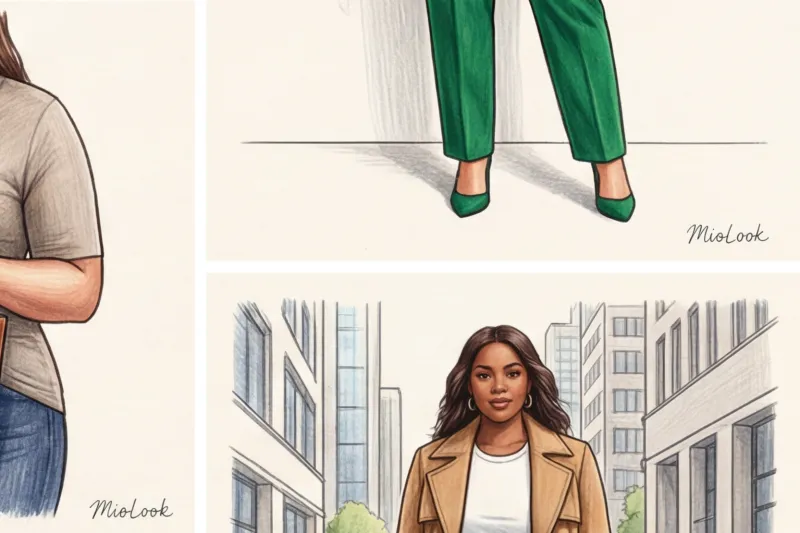
The architecture of a premium look abhors flimsy details, so pay special attention to your bag selection. Soft, shapeless fabric shoppers will instantly "dull" your look, adding a touch of sloppiness. Opt for a rigid frame in a medium or large size. Geometric totes or structured hobo bags made of thick cowhide are ideal choices. In the $150-$300 price range, you can find stunning architectural styles from brands like COS or Coccinelle. The rigid shape of the bag acts as a visual anchor, bringing together the soft lines of the body and conveying a touch of polish.
Your perfect look starts here
Join thousands of users who look flawless every day with MioLook.
Get access — €0.99 onceThe same architectural principle applies to footwear. Your goal is to create a solid visual foundation that will proportionally support the volume of your upper body. Avoid ballet flats with completely flat, paper-like soles and shoes with round toes—they visually chop off your foot, turning it into a stump. Your arsenal: a stable block heel, a chunky cleat or platform sole, and a slightly elongated (but never extremely pointed) toe. It's the elongated shape that delicately extends the line of your leg, while the voluminous sole balances the width of your hips and calves.
To be fair, I'll point out one important detail. Chunky shoes don't have to mean leaden weight. Look for models with a midsole made of high-tech EVA foam. It provides the necessary, on-trend volume but weighs literally grams. It's the perfect compromise between monumental aesthetics and joint care.
By the way, to avoid buying another ill-fitting item on impulse, I recommend digitizing your successful bags and shoes in advance through MioLook By creating outfits directly on your phone, you'll instantly see how the size of an accessory compares to the thickness of your coats and jackets, avoiding embarrassing styling mistakes.
Step-by-step checklist: building a basic wardrobe from scratch
Do you know what stage of a style transformation scares women the most? Not shopping, but taking an honest inventory of your closet. However, a well-designed basic wardrobe for plus-size women cannot be built on a foundation of items that don't make you happy and ruin your proportions. Start with a thorough audit of your current wardrobe: ruthlessly get rid of stretched-out T-shirts with sagging collars, jeans that have lost their shape, and those treacherous thin cardigans. The latter are the main enemies of a statuesque silhouette, as they don't create the necessary framework, but rather weigh down the figure, hanging in shapeless tails. Keep only the clothes that hold their shape right now.
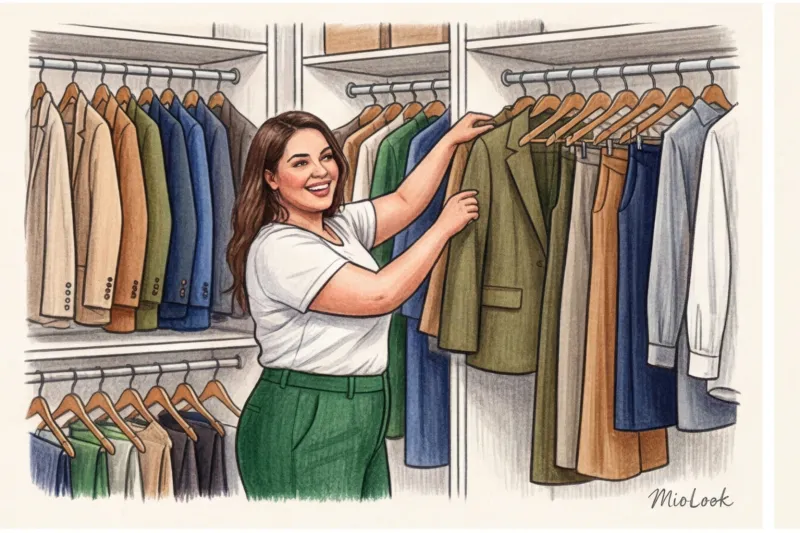
The next step is defining your palette. Forget the boring "everything must be black or gray to make everything easy to combine" rule. My favorite formula for creating a capsule wardrobe is a deep base plus two accent colors. For the base, choose three refined, dark shades, such as rich navy, dark chocolate, and graphite. Then add two vibrant accents that highlight your face and complement your skin tone—say, terracotta and deep wine. This simple yet expressive scheme will allow you to create dozens of outfits without overwhelming your look with too much color.
Now let's move on to creating a shopping list based on your actual, not your fantasy, lifestyle. I'll be honest: one of the most common mistakes I made early in my career as a stylist was trying to assemble the perfect wardrobe for my clients for a life they don't yet have. If 70% of your time is spent freelancing and working from home, your focus should be on quality smart casual (heavy wool-blend joggers, structured long sleeves), not $400 tailored three-piece suits. For an office with a relaxed dress code, it's better to invest in a pair of impeccably fitted palazzo pants and a couple of quality shirts. To avoid buying too much, I recommend digitizing the remaining items after cleaning by uploading them to MioLook app Smart wardrobe tools will clearly show you which pieces are missing to complete your wardrobe.
Finally, my golden guide to trying on new clothes. The way clothes sit when you stand still in front of the mirror, with your stomach sucked in and your shoulders back, is an optical illusion. Clothes must move dynamically. In the fitting room, always perform a rigorous crash test: sit on a ottoman and cross your legs. The waistband of your trousers or skirt shouldn't dig into your waist, cutting off your breathing. Then, raise both arms up, as if trying to reach a box from the top shelf—the armhole shouldn't drag down the entire bodice of your shirt, and the buttons on the chest shouldn't be treacherously parted. Lean forward: if the back exposes your lower back, the garment won't pass the test of an active day. Remember: the perfect garment is one that you can live and move in comfortably, not just pose in.
Conclusion: Your wardrobe is an investment in your confidence.
In 2012, researchers at Northwestern University in the United States published a breakthrough paper that introduced the term into cognitive psychology. enclothed cognition (clothed cognition). Their experiments proved that clothing doesn't just change how others see us. It physiologically influences our own thought processes, heart rate, and self-confidence. How much energy do you waste throughout the day tugging at a too-short top or trying to discreetly adjust a belt that's digging into your waist? Now imagine all that energy finally being released.
When putting together a smart basic wardrobe for plus-size women, we rely on the laws of physics, not on attempts to hide behind shapeless knitwear. Let's reinforce the three fundamental principles we've discussed in detail. First, density — your absolute priority (choose denim from 12 ounces, gabardine and cotton with elastane content of no more than 2-3%). Secondly, architecture - a structured cut that creates clear lines on the body and acts as a supporting frame. Thirdly, proportionality — a precise selection of prints, trims, and accessories that complement your natural curves rather than clash with them. This isn't abstract fashion advice, but pure engineering of your personal style.
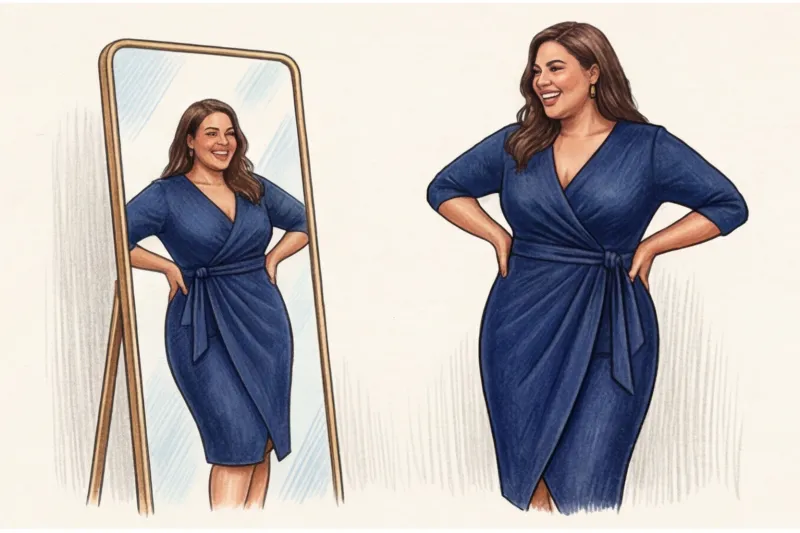
During a recent shopping experience, my client, a curvy, full-figured woman, nearly burst into tears in the fitting room. The palazzo pants fit perfectly, elongated her legs, and visually flattered her silhouette, but the tag listed a European size 52 (US 20) instead of her usual 48. Do you know what I did? I asked the salesperson for scissors and cut off that unfortunate tag right there. Your style and your value are completely unrelated to the number sewn on at the factory. Size charts among different international brands—from COS to Marina Rinaldi—can vary by three or four sizes. These are simply the patterns of a particular designer, a mathematical convention that has no bearing on your attractiveness.
If we look at the process of building a base from an economic perspective, a well-designed capsule wardrobe is also a brilliant financial strategy. By purchasing one structured white shirt made of heavy cotton for $80, which can be worn in fifteen different outfits, you quickly reduce your Cost Per Wear to pennies. This is incomparably more cost-effective than buying five thin blouses for $20, which will pill within a month and end up as dead weight.
Once these 12 perfect items are in your closet, the fun part begins: managing them. To avoid having to remember dozens of combinations and to forever forget the morning stress of facing open doors, you need to digitize your system. I highly recommend using MioLook By uploading your new architectural bottoms and structured tops to the app, you delegate the routine to artificial intelligence. The smart algorithm will help you create dozens of fresh looks from your compact database, allowing you to plan your outfits for the week ahead in just two clicks.
Your wardrobe isn't a warehouse of textiles. It's your armor, your tool of influence, and your daily declaration of love for your body. Stop putting off buying a quality trench coat or the perfect pair of jeans until you hypothetically "lose a few pounds." You deserve beautiful, luxurious-feeling, impeccably fitting pieces right now. Invest in rich textures, maintain a regal posture, and let your clothes become a frame worthy of your uniqueness.
Guide Chapters
Office wear for plus-size women: stylish looks
Forget shapeless tops that hide your figure. Learn the secrets of tailoring and create the perfect plus-size business wardrobe without stereotypes.
What colors make a full figure look slimmer: prints and silhouettes
The habit of hiding in black is a major mistake. We'll show you how to use colors and prints as optical illusions to create a slimmer silhouette.
Layering for Plus Size Women: How to Avoid Looking Fat
Worried about adding extra layers will add bulk? We'll explore how to use layers effectively to visually elongate your silhouette.
How to choose shoes for full feet and the perfect bag
Forget the 2000s advice about shapeless clothes. Learn how to properly balance your plus-size figure with architectural bags and stylish shoes.
The Best Plus-Size Clothing Brands: Where to Buy Essentials
A personal stylist's advice on choosing a basic plus-size wardrobe. Find out where to find quality clothing that flatters your figure.
Summer Basic Wardrobe for Plus Size Women: Stylish in the Heat
Forget shapeless robes that hide your figure from the heat. We'll show you how to create a stylish plus-size summer capsule collection using the right cuts and fabrics.
Autumn Basic Wardrobe for Plus Size Women: Warmth Without Bulge
Learn how to build a warm wardrobe for curvier figures without adding inches. Secrets to choosing the right fabrics and silhouettes for cold weather.
Basic wardrobe for plus-size women over 50: capsule
It's time to ditch those shapeless tunics that add visual weight. Learn how to create an elegant silhouette with the right fabrics and styles.
Guide: How to Dress for Plus Size Women with Wide Hips
Forget outdated advice about hiding your figure behind shapeless clothes. Learn how to create a luxurious silhouette for a pear-shaped figure using architectural tailoring.
Dress styles for plus-size women: what makes you look slimmer
Forget shapeless, figure-hugging robes. We'll show you how to create a graceful silhouette and accentuate your waist with architectural cuts and thick fabrics.
Fashion for Plus-Size Women Over 40: A Stylish Basic Wardrobe
Forget shapeless robes! Discover a new approach to creating a basic wardrobe that will highlight your status and self-confidence.
Clothes for plus-size women with a big belly: the apple shape
Forget about shapeless, apologetic pieces! Learn how to create a stylish base for an apple-shaped figure and create a silhouette that enhances rather than hides.
How to choose shapewear for plus-size women
The right plus-size lingerie isn't rigid armor, but an invisible framework for a perfect fit. We explore an engineering approach to choosing the right base without stereotypes.
What trousers should plus-size girls wear: choosing the perfect bottoms
The secret to perfect bottoms for plus-size women lies in proper textile engineering. Learn how to choose trousers and jeans that will visually elongate your silhouette.