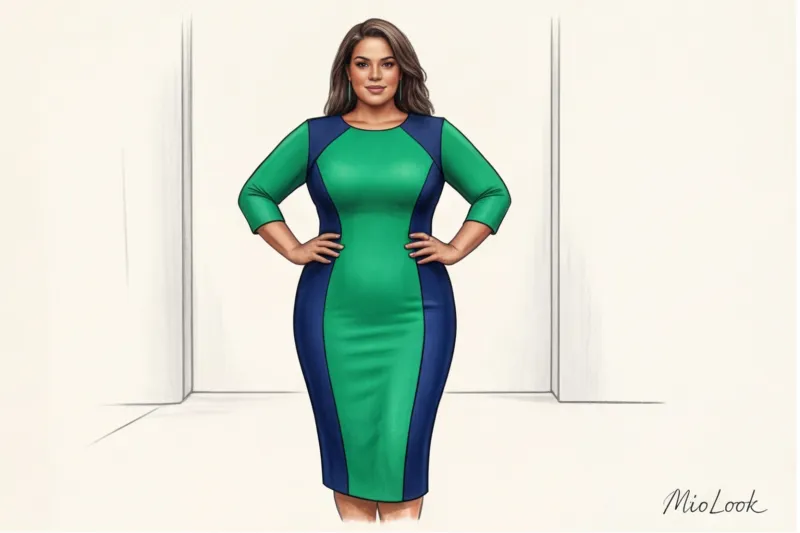
A few months ago, Anna, a 42-year-old financial director with a stellar career and a suitcase stuffed to the brim with black, shapeless robes, came to see me for a consultation. When women search for something, What colors make a full figure look slimmer? , they subconsciously seek indulgence to buy another black tunic. Anna and I threw out ten of those items. Instead, she wore a color-blocked dress made of thick crepe with dark blue side panels for the first time—and the next day, her colleagues bombarded her with questions about how she'd managed to "lose 10 kilos" over the weekend.
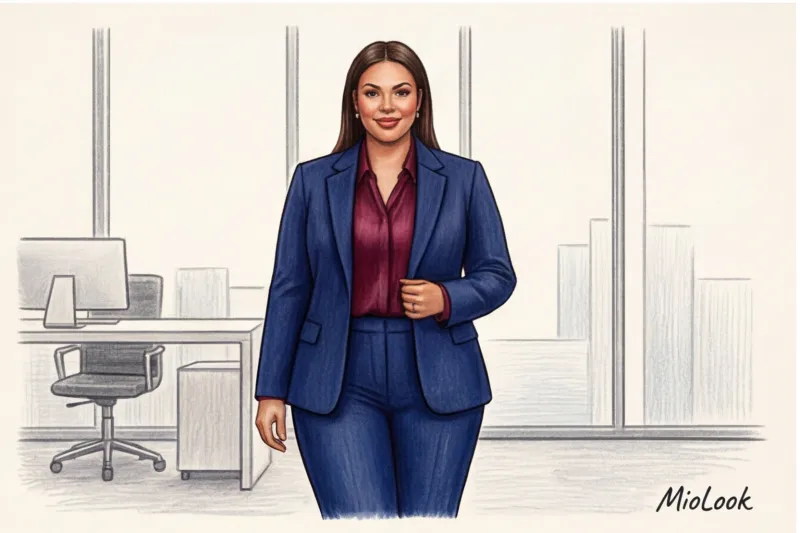
Over 12 years of working as a personal stylist, I've learned that the habit of hiding a voluminous body in black and a small, indistinct print is the most toxic stylistic mistake. We'll be using an architectural approach: color and print should work as tools of optical illusion to create a stately, composed silhouette. We've explored the philosophy of construction, not concealment, in more detail in our complete guide to a basic wardrobe for plus-size women And today we'll talk about the physics of color.
The biggest myth of coloristics: why black isn't actually slimming
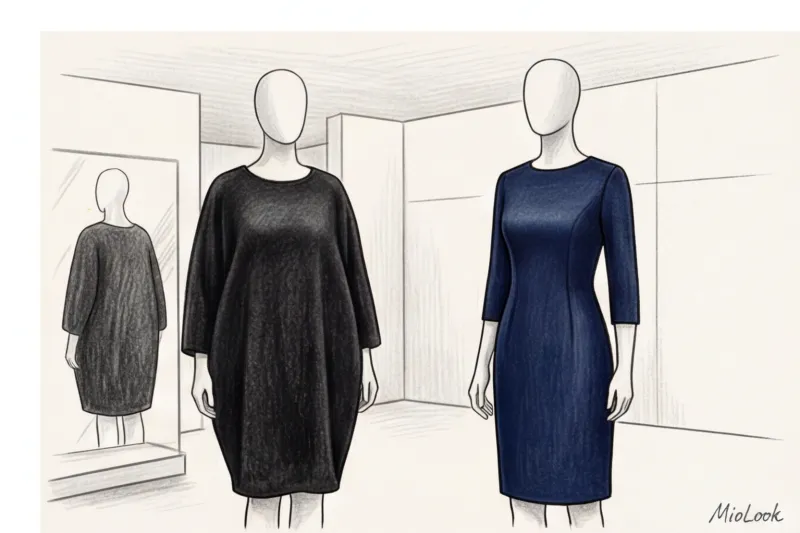
"If you want to look thinner, wear black." This harmful advice from the 2000s still forces millions of plus-size women to hide in dark clothing. But let's look at it from the perspective of color physics. Black completely absorbs light. It deprives an object of volume, shadows, and relief, turning it into a dense, heavy blob.
Back in 1839, French chemist Michel-Eugène Chevreul formulated the law of simultaneous contrast. If you wear solid black and step out onto a bright street or into a brightly lit office with white walls, the most extreme contrast is created. Against a light background, the black spot outlines the true contours of your body with merciless clarity. Instead of "hiding" volume, oversized black makes you appear heavier and more monumental.
"All-black only works for a slimming effect in one situation: if you're wearing a stiff, structured matte suit and standing against a dark wall in the dim light. In real life, black often conveys a desire to become invisible, which is immediately picked up by others and hurts your self-esteem," says Darina Marchenko.
What colors slim a full figure: the architecture of complex shades
To move from the "hide" paradigm to the "construct" paradigm, we need to understand how lightness and temperature influence the perception of form. Warm colors (orange, yellow, scarlet) have a long wavelength—they appear optically closer to the viewer, meaning objects in these colors appear larger. Cool colors (blue, emerald, plum) have a short wavelength—they visually recede from the viewer, making them appear more compact.
Deep tones: a noble alternative to dull black
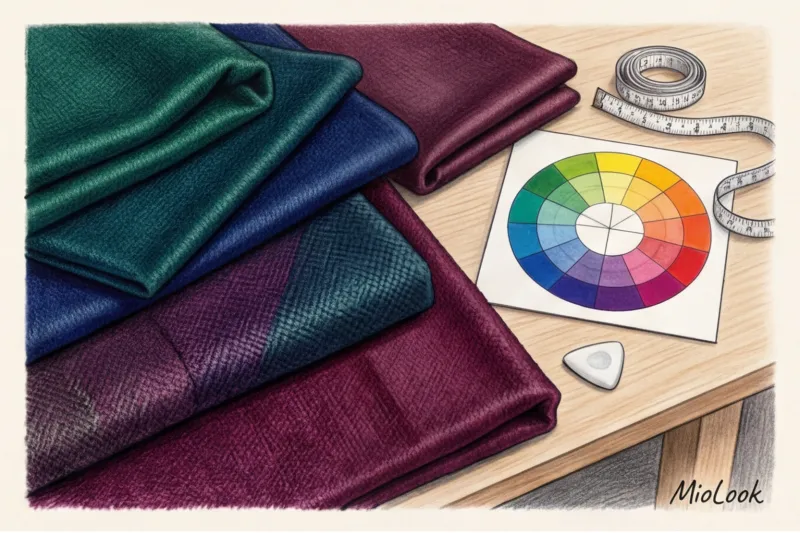
My absolute favorites for plus-size clients are the so-called "new blacks." According to WGSN reports, deep, rich tones are currently dominating collections from brands ranging from mass-market (COS, Massimo Dutti) to premium brands. Add to your list:
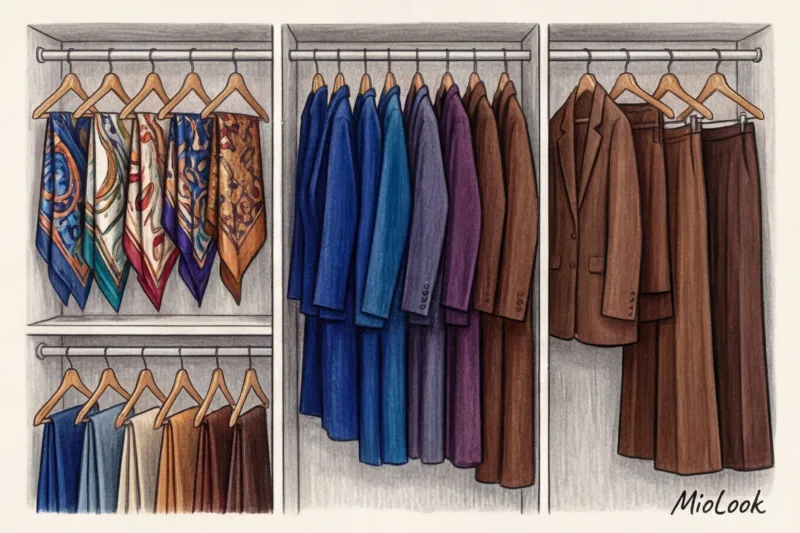
- Navy (deep sea blue): the most prestigious color for a business wardrobe.
- Coniferous green and emerald: perfectly refreshes the complexion.
- Marsala and ripe cherry: create an expensive, sensual image.
- Dark chocolate and graphite: an ideal replacement for black in an everyday base.
Why do they work better? These colors have depth. They create soft shadows in the folds of the fabric, giving the figure a natural relief. You stop being a flat silhouette and gain shape.
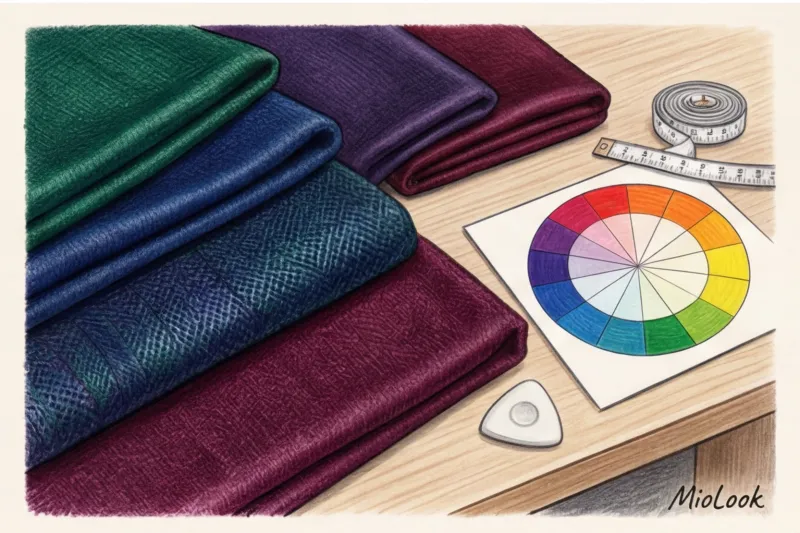
Monochrome verticals are the key to elongating your silhouette.
Color verticality is a technique where you dress from the neck down to your shoes in a single or related shade. When the viewer's eye moves from top to bottom without encountering horizontal "scars" (for example, a white blouse that abruptly transitions into dark pants), the brain perceives the silhouette as a single, continuous line. This visually adds 3 to 5 centimeters of height and elongates the figure.
Your perfect look starts here
Join thousands of users who look flawless every day with MioLook. Its smart algorithm will help you create the perfect capsule makeup look.
Get access — €0.99 onceThe biggest mistake in monochrome is wearing the same texture from head to toe. If you wear a matte wool jumper with matching matte trousers, the look will look boring. The secret to luxurious combinations is in the difference in textures: pair a silk or satin blouse with matte trousers made of wool or high-quality viscose with a weight of at least 180 g/m². The shimmer on the silk will add movement, while the matte hem will conceal any subtleties of your figure.
Optical illusions: how colors control attention and volume
There's a simple rule in clothing design: bright colors attract the eye (create a focal point), while dark colors draw the eye into shadow. If you have curvy hips but a beautiful décolleté and a slender neck, there's no point in wearing a black turtleneck and a bright skirt. Do the opposite.
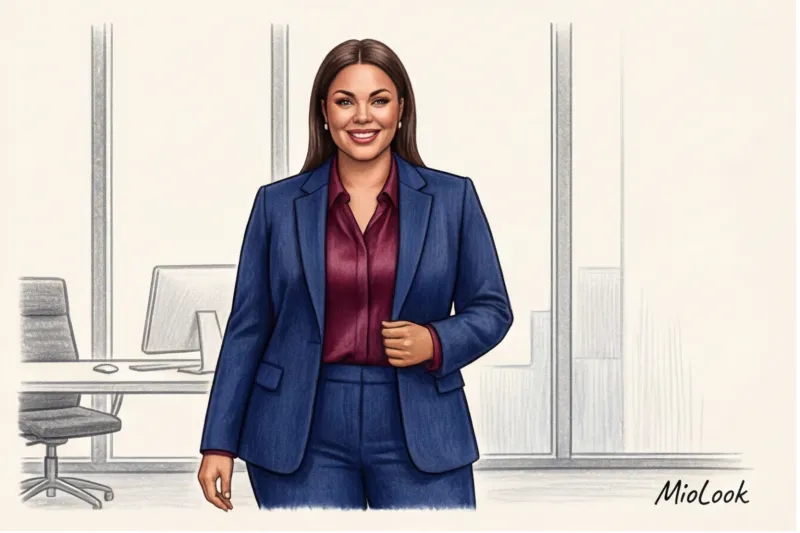
A great strategic move is a bright top or blouse worn under a dark, unbuttoned, structured jacket. The jacket cuts off the sides, leaving only a narrow vertical stripe of bright color visible. This narrow, light stripe is what helps the viewer judge your size.
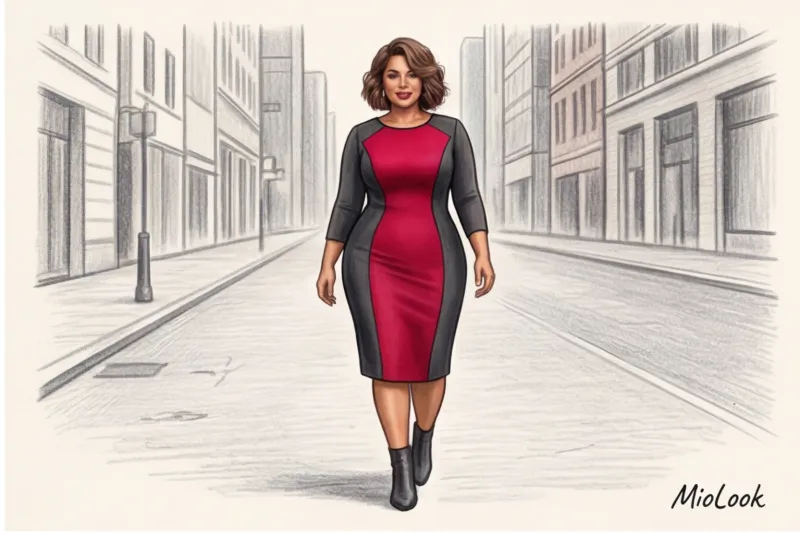
Color blocking and the magic of contrasting side panels
This technique is based on the Müller-Layer optical illusion. Dresses with a bright or light-colored center panel and dark side panels literally work wonders. The brain ignores the dark side panels, which blend into the background, and estimates your waist width solely based on the light center panel. This "cuts off" up to 15% of your visual volume.
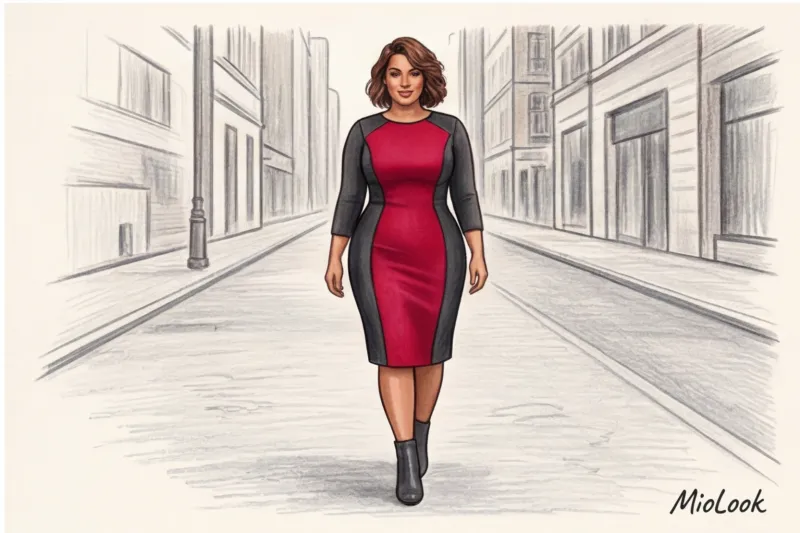
Fair Limit: This technique absolutely DOESN'T work on flimsy, thin knits that cling to every fold. Color blocking requires dense fabrics with a stiff edge (crepe diving, heavy cotton, suiting wool). If the fabric sags, the illusion is ruined.
Scale Matters: How to Choose Prints for Plus Size Women
There's a fundamental rule of proportion in style. If you place an elephant next to a dog, it will appear even larger by contrast. The same thing happens when a large woman wears a dress with tiny calico flowers. The scale of the print should be proportionate to the scale of your appearance and facial features.
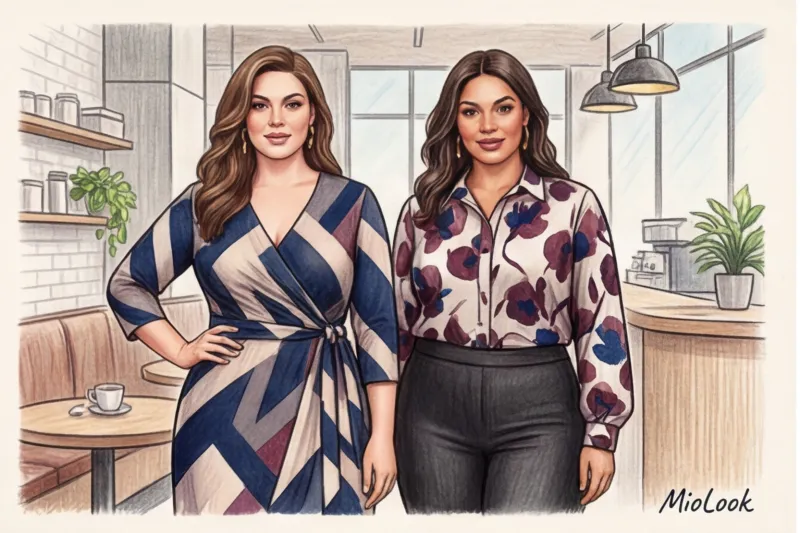
A ditsy floral is your worst enemy.
The myth that "only a small pattern can make you look full" has ruined more than one wardrobe. A small, high-contrast print on a full figure creates a seemingly endless ripple effect. It visually expands space, drawing the eye along the wide surface.
Moreover, a blurry, small pattern often cheapens the look, making the silhouette look sloppy and reminiscent of a dressing gown. Replace it with medium or large prints with clear, graphic borders.
Access to MioLook for €0.99 — one-time payment
A smart AI stylist will select the perfect look based on your body proportions and coloring. Upload your items and create a capsule wardrobe in 5 minutes.
Get access — €0.99 onceGeometry, diagonals, and abstraction: sculptural prints
If you want to use the design for body contouring, choose the following options:
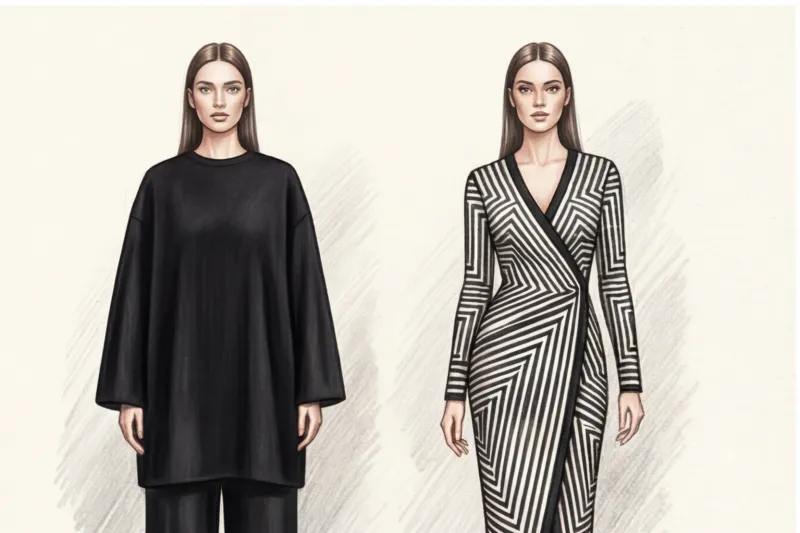
- Diagonal lines: Bias check, asymmetrical wrap-around stripes. Diagonal is the most dynamic and slimming line in clothing; it breaks up horizontal volumes.
- Abstract spots: Watercolor splashes or medium-sized geometric abstractions work on the principle of camouflage—they hide the actual contours of the body (especially the tummy) unless the goal is to sharply emphasize the silhouette.
- Correct vertical stripe: A wide, contrasting "mattress" stripe (wider than 4 cm) makes you look fat, as the eye begins to count the stripes by their width. You need a thin "pinstripe" (1-2 mm thick, spaced 1-1.5 cm apart) on a dark background.
A practical checklist: how to incorporate color and print into your wardrobe
When you're ready to give up your life-saving black, implement changes gradually. Here's the step-by-step algorithm I give my clients:
- Step 1: Start by replacing black with dark blue, graphite, or dark chocolate in your most basic pieces (pants, skirts, basic turtlenecks).
- Step 2: Create your first monochrome column using items you already own. Take a photo of yourself in the mirror or upload items to MioLook To look at the silhouette from the side, you will be surprised at how much longer your legs have become.
- Step 3: Add one accent (bright) element to the portrait area. This could be a silk scarf, a brooch, or a contrasting blouse collar peeking out from under a sweater. This draws attention to the face.
- Step 4: Buy a second layer (a straight jacket, a thick cardigan or a vest) with a well-proportioned geometric print.
- Step 5: Check the density. Remember: prints and colors only work like sculptors on dense, structured fabrics. A loose knit will ruin any color magic.
Conclusion: From Disguise to the Art of Being Yourself
By eschewing color and prints for fear of "looking bigger," you're not making yourself smaller—you're simply depriving yourself of individuality, erasing your character in favor of stereotypes. Your size isn't a flaw of nature to be erased with a black marker.
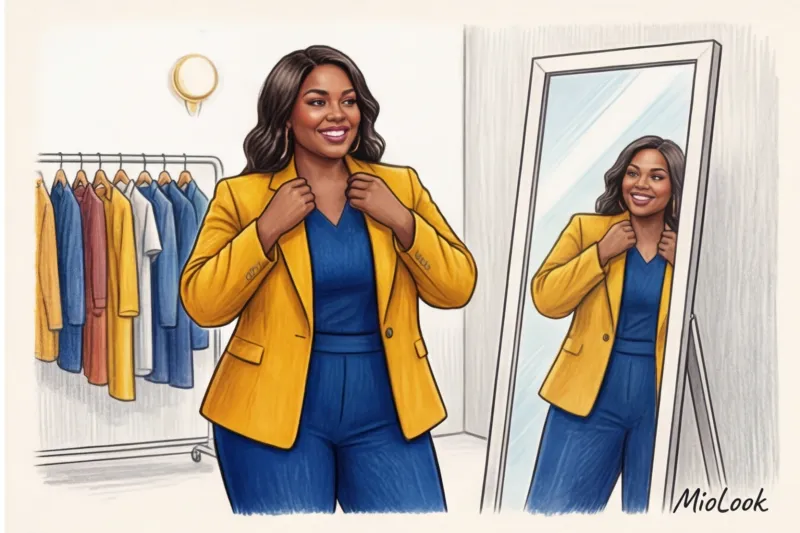
Clothes should serve as an architectural frame for your body. By choosing deep, refined shades, well-scaled prints, and dense textures, you create the perfect lighting for this masterpiece. Start with one deep blue or burgundy piece tomorrow—and you'll feel how not only your silhouette but also your posture changes.