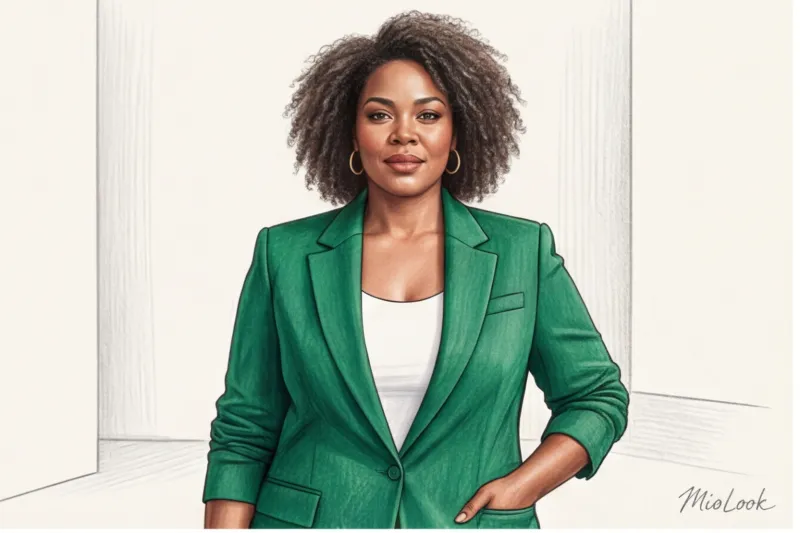
In 12 years of working as a stylist and fashion journalist, I've come to loathe one cliché: "how to hide flaws." For decades, the industry has taught us that fashion for plus-size women over 40 should be about the art of camouflage. We were taught to wrap ourselves in shapeless knit tunics, layer chiffon, and avoid sharp lines, as if a curvy body were a secret to be carefully draped.
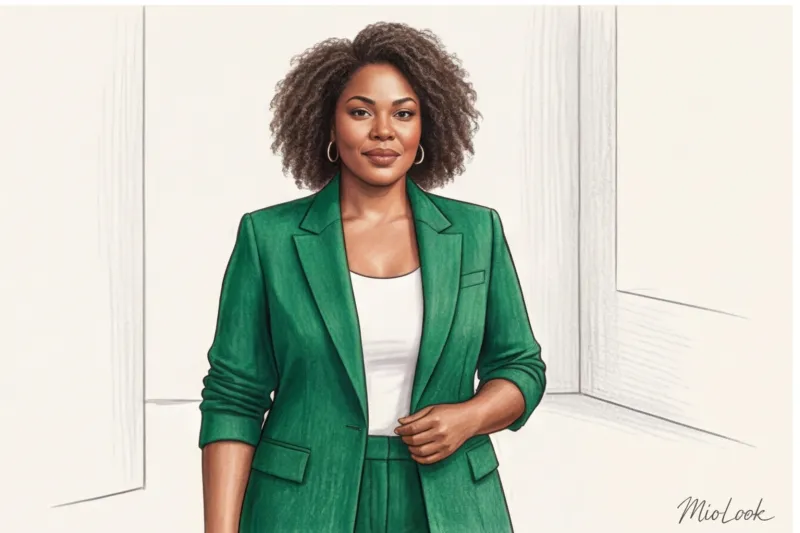
Let's be honest: it doesn't work. Trying to "hide" your figure under soft robes only increases your visual size. Today, I offer you a completely different approach. We'll use the laws of fabric physics, cut geometry, and optical illusions to create a classy, flattering silhouette that will highlight your life experience and confidence. We discussed the mechanics of creating a base in more detail in our A complete guide to creating a capsule for plus-size women , and in this article we will move on to the highest level – to the architecture of style.
Architecture Instead of Camouflage: New Fashion for Plus-Size Women Over 40
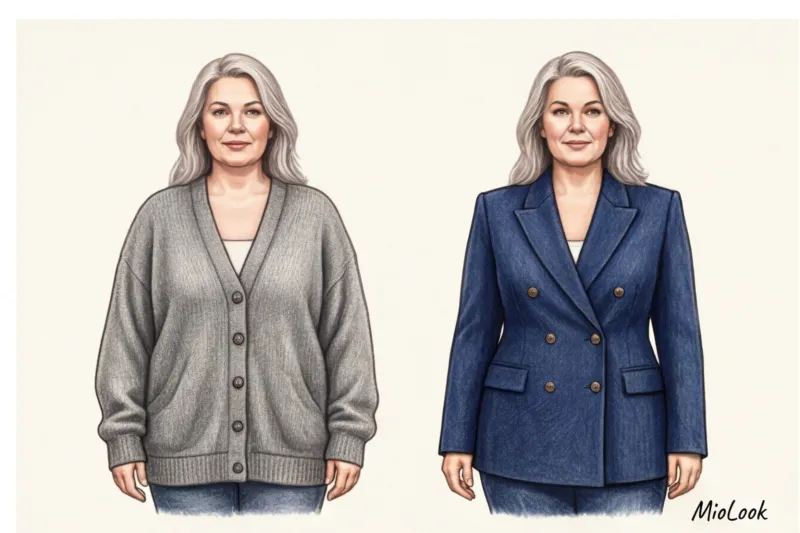
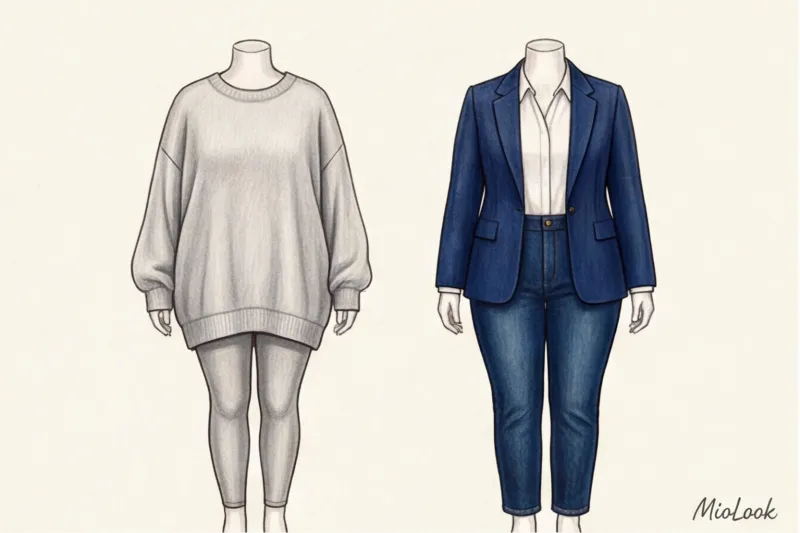
The shift from the concept of "hiding the body" to the concept of "building the silhouette" is a key insight that changes everything. Treat your body as a foundation and your clothes as supporting structures. Soft knits hug what's already there. Stiff fabrics (gabardine, raw denim, heavy cotton) shape what's needed.
Remember the legendary "Bar" jacket, created by Christian Dior in 1947? Dior wasn't looking for women with a perfect waist—he constructed it with a rigid frame and dense fabric. The same rule applies to modern plus-size fashion: you need pieces that hold their shape on their own.
A 2022 study by the Fashion Psychology Institute found a direct link between consistently wearing oversized clothing and the development of body dysphoria in women over 40. Baggy clothing subconsciously forces us to slouch and "hide" in space, which is immediately perceived by others as a lack of confidence.
When you put on a structured jacket with a sharp shoulder line, your posture shifts reflexively. You square your shoulders and lift your chin. It's not just style—it's body language.
Why Total Black Doesn't Work Anymore
"Black is slimming" is perhaps the most persistent and damaging illusion in style. In my practice, nine out of ten new clients come to me with wardrobes consisting of black knitwear in varying degrees of wear.
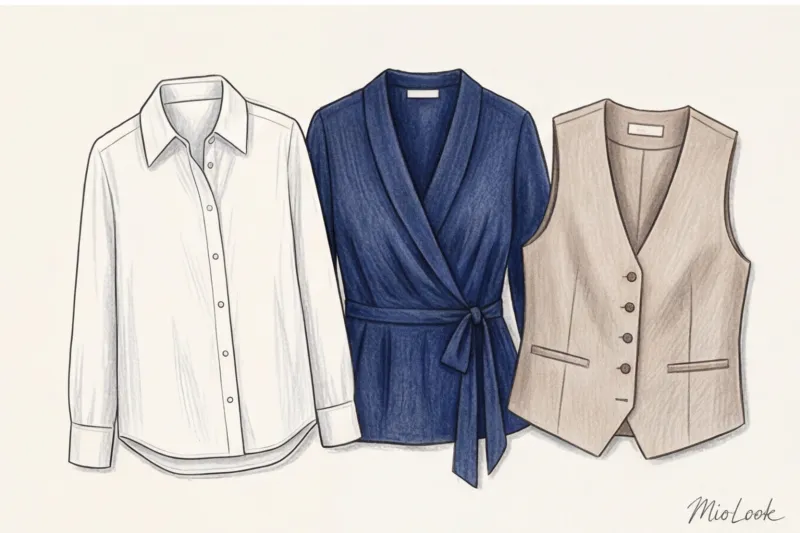
Let's look at optics. Black does absorb light, but when used on a shapeless, matte fabric, it transforms your figure into a heavy, monolithic block. You strip away depth and definition, leaving only a massive outer contour. Black only works when the fabric has texture (leather, thick silk, suiting wool).
Deep emerald, navy, dark chocolate, or rich burgundy in a stiff fabric are 10 times more slimming than black spandex. These shades create a refined interplay of shadows in the folds of the cut, adding dynamism and a touch of luxury to the silhouette.
Your perfect look starts here
Join thousands of users who look flawless every day with MioLook. The smart algorithm takes your body type and color palette into account.
Get access — €0.99 onceThe formula for the perfect top: jackets, shirts, and blouses
The perfect top for a plus-size woman is always a triumph of straight lines over curves. Let's start with the shoulder girdle. Shoulder pads are your best friend, and I'm not talking about the oversized ones from the '80s. A neat, integrated shoulder pad (even on a T-shirt) balances the proportions between your upper body and wide hips, creating the illusion of an hourglass shape.
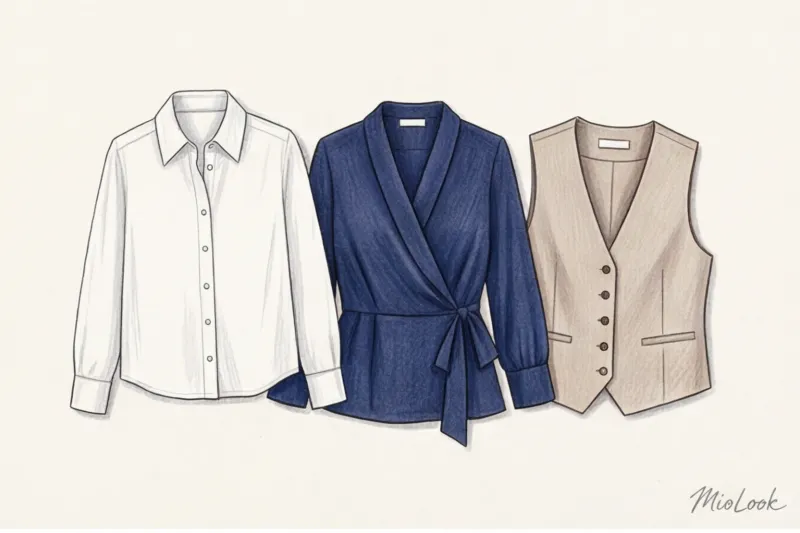
Two golden rules for outerwear styling:
- Jacket length rule: Never cut the horizontal line at the widest point of your figure. The ideal length for a jacket, cardigan, or untucked shirt is exactly 3-4 centimeters below the widest part of your hip. This elongates your legs and minimizes the size of your pelvis.
- Sleeve rule: Forget sleeves that end mid-forearm (the fullest part of the arm). Your choice is full length or classic 3/4 length. The cuff should only reveal the thinnest part of the arm—the wrist.
I also strongly recommend avoiding tight, round necklines in favor of a V-neckline. A V-neckline acts as a powerful downward vector. It visually lengthens the neck and draws attention to the face rather than the bust. If you're choosing stylish office clothes , replace your usual knitted blouses with thick cotton shirts of a men's cut.
Trousers and skirts: designing the right proportions
In 2019, at the Premiere Vision fabric exhibition in Paris, I had a long conversation with engineers and technologists from major textile mills. What they revealed about the composition of modern fabrics forever changed my approach to choosing bottoms for my clients.
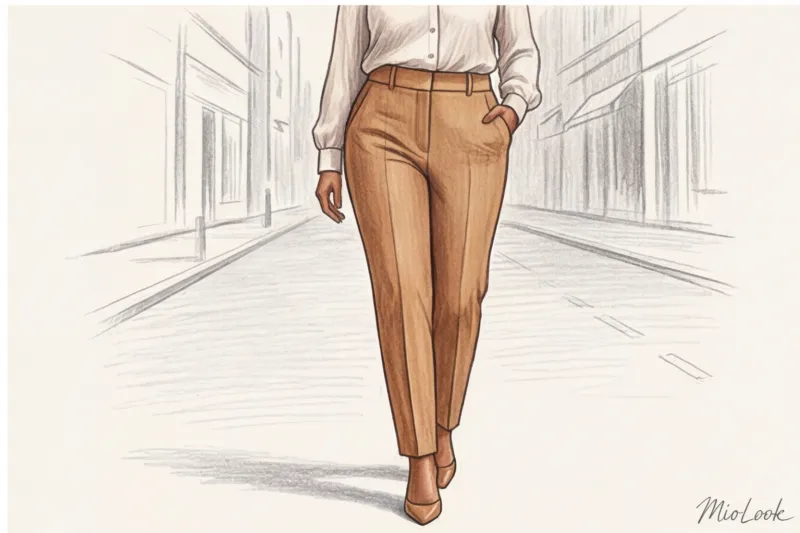
The main enemy of a sleek silhouette is too much elastane. Read the labels: the right trousers or jeans should contain no more than 2-3% elastane If it's 5% or more, the fabric begins to act like a thin rubber film. It doesn't tighten the figure, but instead treacherously sinks into every unevenness of the skin, emphasizing cellulite and folds. 2% elastane provides comfort during movement but maintains the physical tension of the fabric, which acts like a corset.
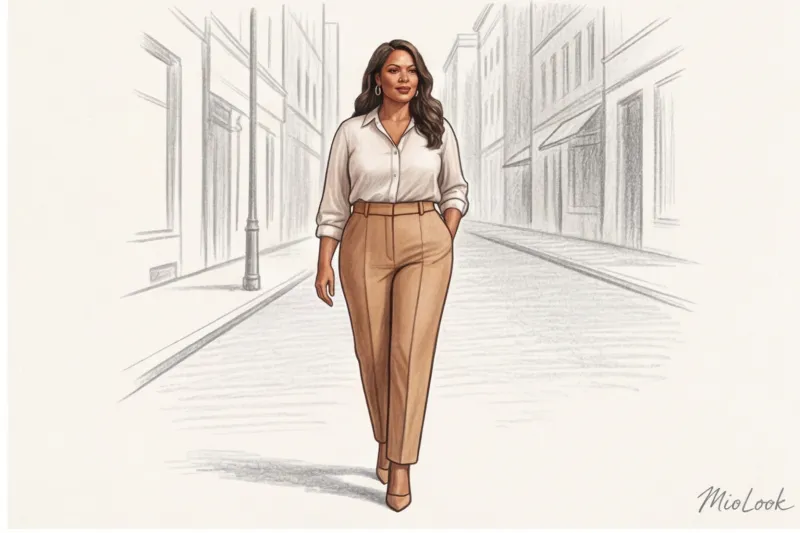
I would like to separately address the popular myth about wide palazzo pants. This doesn't always work. If palazzo pants are made of a lightweight, flowing fabric and you have a fuller midsection, they will transform your lower body into a monumental square. Palazzo pants are only slimming if they have a high waist (which helps cinch the midsection) and are made of a dense, heavy suit fabric that falls in smooth, unwavering folds.
When it comes to skirts, avoid the sun-cut style with elastic. A straight pencil skirt or an A-line silhouette made of thick wool or denim is your best bet. This type of skirt maintains its shape as you walk, creating a perfect geometric frame around your body.
Access to MioLook for €0.99 — one-time payment
A smart AI stylist will select the perfect trousers and jackets based on your individual measurements.
Get access — €0.99 onceA Basic Wardrobe for Plus-Size Women Over 40: A Capsule for Every Day
One of my clients, 42-year-old Anna, a logistics director, spent years hiding in turtlenecks and long, shapeless viscose cardigans. When we threw out all the soft knitwear and assembled a compact yet structured capsule, colleagues started asking what diet she was on. Six months later, Anna got a promotion—not only did her weight improve (visibly losing 10 kg), but so did her demeanor in meetings.
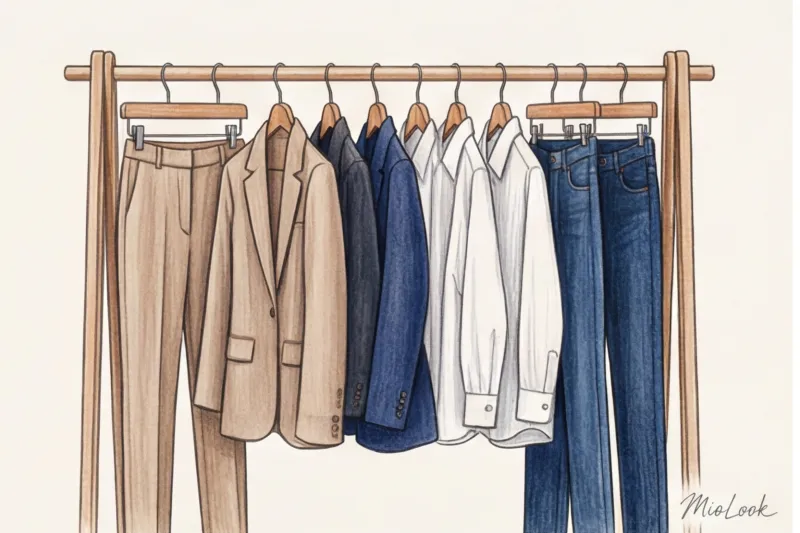
Here's the core of the perfect basic wardrobe (size 50+) we used:
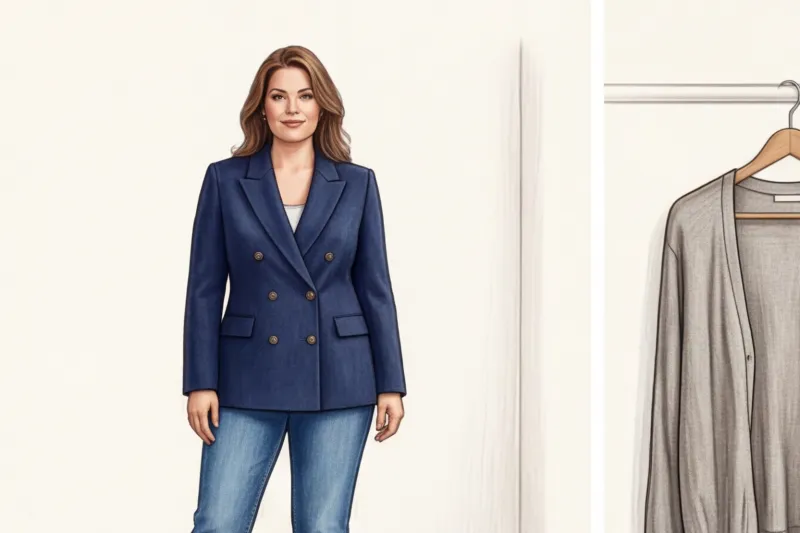
- Structured jacket with a straight or semi-fitted cut. Single-breasted, with an English collar. Color: deep blue or camel.
- Straight jeans made of dense raw denim. No fraying, no rhinestones. The uniform indigo color works as a perfect vertical line.
- White poplin shirt. The cotton density should be at least 120 g/m² - the underwear should not be visible through it.
- Shirt dress made of tencel or thick viscose. The vertical row of buttons splits the figure in half, stretching the height.
- Trousers with arrows. An ironed or stitched arrow is the most powerful optical technique for lengthening legs.
- V-neck top. Made from matte silk or thick, non-transparent viscose to create a base layer under a jacket.
With these 6 items plus a couple of the right accessories, you can create dozens of looks for any situation: from winter office routine with their multi-layered nature before going to the theatre.
Shoes and accessories: the finishing touches that define status
Scale is a key concept in plus-size styling. The law of proportionality dictates that accessories should be proportionate to the size of the person and figure. A thin chain with a microscopic pendant will simply disappear on a woman of size 52, and the contrast will make the neck and décolleté appear larger. Choose large, statement jewelry: chunky chains and large geometric earrings. They create the right focal point for the face and project confidence.
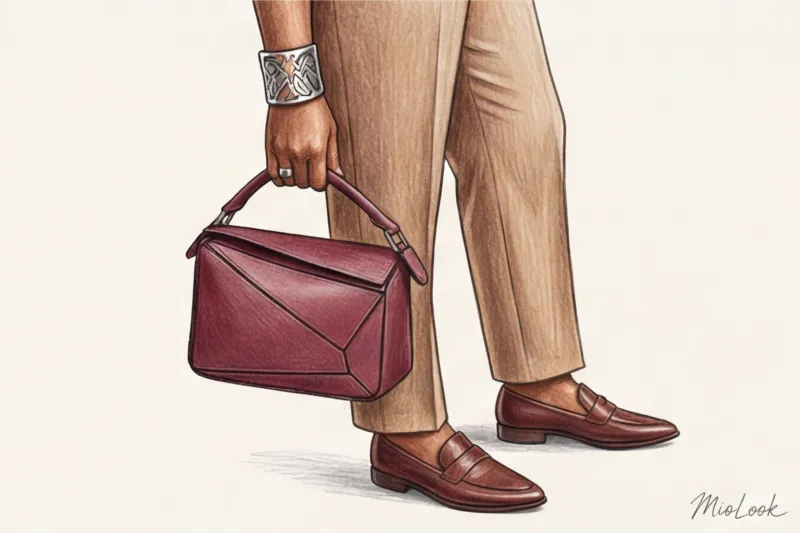
Bags are a particular pain. Shapeless hobo bags or soft tote bags add unnecessary laxity to your look, which, when paired with a fuller figure, often comes across as sloppy. You need bags with a rigid, geometric shape (tote, satchel, or framed crossbody). They pull the look together.
When choosing shoes (whether you are choosing casual loafers or looking for, What shoes to wear to a celebration ), pay attention to the toe and heel. A round, blunt toe is forgiving and simplifies the look. Opt for an almond-shaped or modern, soft square. The heel should be stable and architectural—a thin stiletto heel under a heavy figure looks unstable and comical.
Stylist Checklist: Reviewing Your Current Wardrobe
For this theory to work, you need to conduct a ruthless closet audit. As a practicing stylist who has conducted hundreds of closet audits, I offer a three-step algorithm you can implement today.
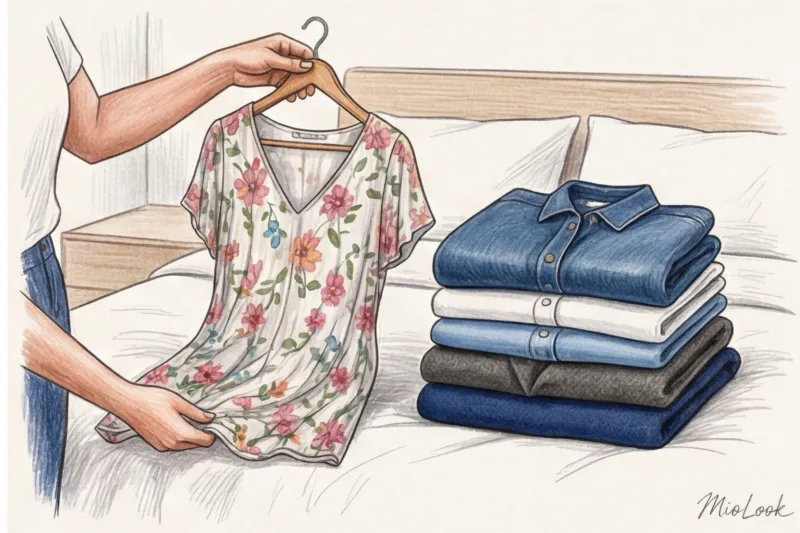
- Hanger Test: Take the item out. If it hangs on the hanger like a sad, shapeless rag, it won't hold its shape on you either. Such items (thin viscose cardigans, flimsy tunics) are only suitable for indoor wear.
- The Three Layer Rule: Keep only tops and shirts in your base that can be worn with a jacket or, in the case of shirts, with a tank top underneath. If a piece has unusually voluminous batwing sleeves that won't fit under a coat, it's just too much.
- Toxic "expectation things": Get rid of those jeans that are waiting for you to lose 5 kilograms. Daily staring at clothes you don't fit into is devastating to your self-esteem. You deserve to look fabulous in the body you have now.
Ready to get started?
Try the MioLook free plan—upload your wardrobe to the app and let AI create stylish capsule collections for you, no strings attached.
Get access — €0.99 onceDeveloping a style after 40 as a plus-size woman isn't about compromise. It's about taking impression management to a whole new level. When you stop hiding behind drapes and start embracing the geometry of dense fabrics, magic happens. It turns out you didn't need a new body—you just needed the right cut.