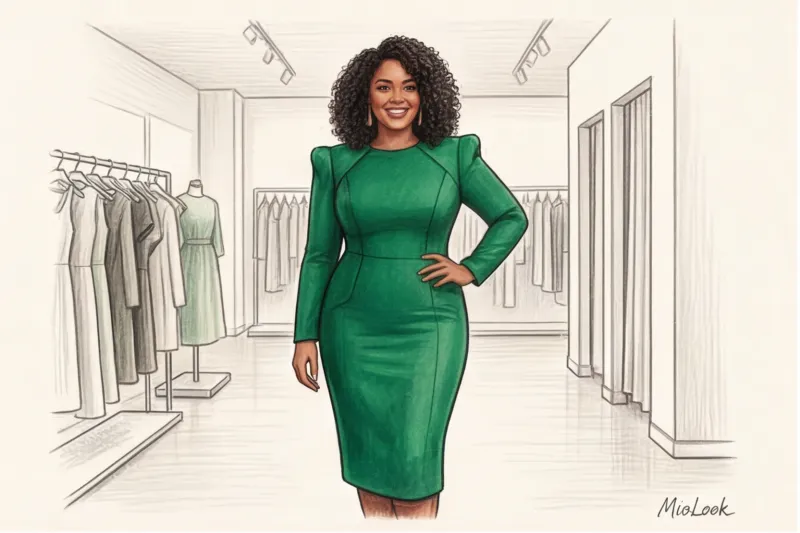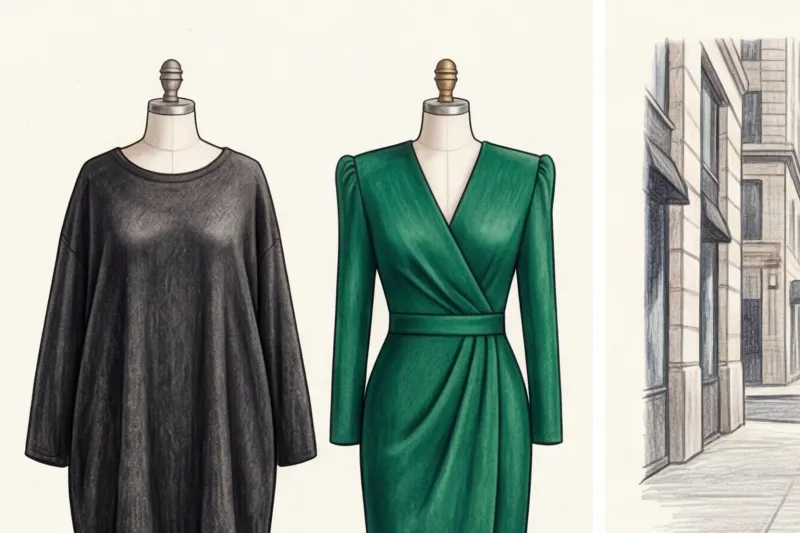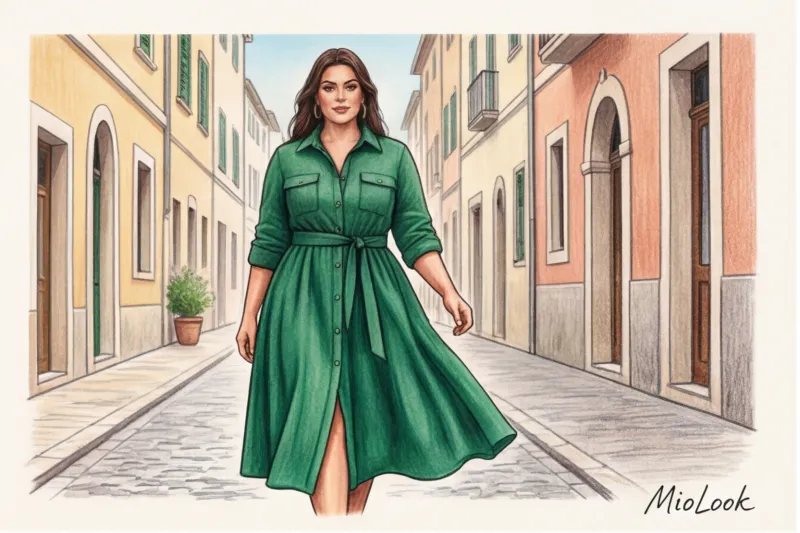
I'll never forget the day my client Anna burst into tears in the fitting room. We'd taken off her usual black knitted smock she'd been wearing for the past five years and put on a thick, stiff emerald-colored cotton shirtdress. She looked in the mirror in disbelief: "Isabella, where did I get my waist? I thought it disappeared after my second baby." That moment is the best proof that most curvy women make the same fatal mistake: they try hide body instead of it design.
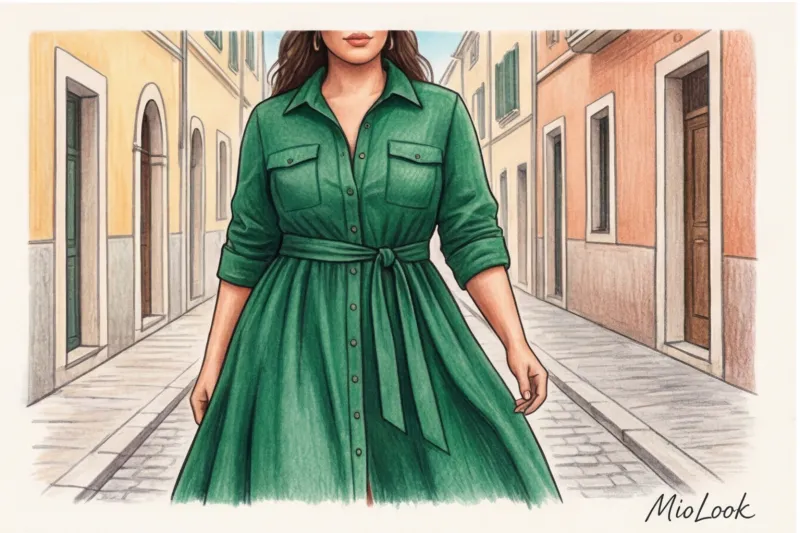
We talked about this foundation in more detail in our complete guide: Basic Wardrobe for Plus Size Women: Putting Together a Capsule Today, we'll take things a step further. If you're looking for the perfect dress styles for plus-size women, forget the 2000s advice about "drapery that hides the belly." I'm offering you an architectural approach: we'll use dense fabrics, clean lines, and precise proportions. They act as an engineered framework that holds your shape, highlights your best features, and encourages you to square your shoulders.
The Anatomy of a Perfect Cut: Why "Hiding" Is No Longer Fashionable
Shifting from a camouflage paradigm to an architectural approach isn't just a change in style; it's a shift in mindset. When you put on a shapeless garment, your body subconsciously relaxes, your shoulders slouch, and your gait becomes heavy. Researchers from Northwestern University in the US (2012) coined the term enclothed cognition (embodied cognition) is a scientifically proven fact that the structural characteristics of clothing directly affect our posture and self-perception.
A more recent 2022 study by the Fashion Psychology Institute found a direct correlation: women who constantly wear oversized clothes to hide their weight are twice as likely to experience body dysphoria. The key rule for basics is that they should form a frame, not hang like a furniture cover. Clothes should support you like soft yet confident hands.
Plus-size clothing shouldn't be a compromise between beauty and the desire to be invisible. Clean lines act as a visual lift for the entire figure.
Access to MioLook for €0.99 — one-time payment
A smart AI stylist will select the perfect look based on your proportions and body structure.
Get access — €0.99 onceThe Comfort Trap: Why Thin Knitwear Sabotages Your Silhouette
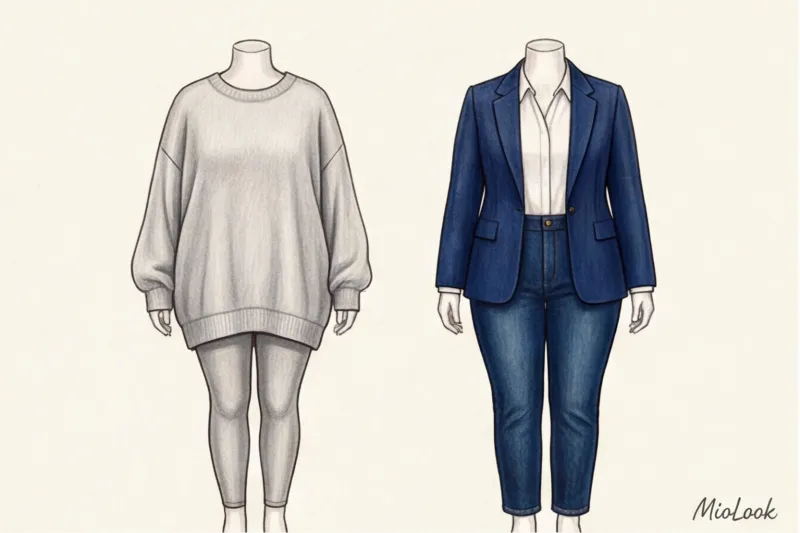
The most popular and most damaging myth I fight every day is: "Plus-size women need soft, stretchy knitwear because it doesn't squeeze anywhere." Let me be categorical: thin, cheap viscose knitwear is your worst enemy. Why? Because it's a traitor. It clings to every fold, every tiny indentation left by underwear, creating shadows where we want a smooth surface.
Dense fabric works in exactly the opposite way. It stretches between the most prominent points of your figure (like your bust and hips), ignoring everything in between. It's the effect of a delicate corset without the suffocation.
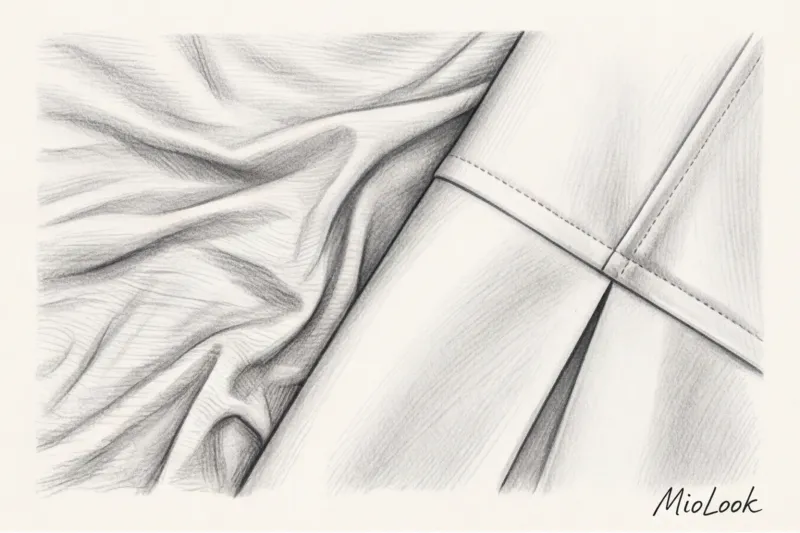
What to look for on tags? Ideal fabrics for a basic wardrobe include heavy cotton (from 180 g/m²), suiting wool blends, or heavy viscose with 2–3% elastane. According to textile technologists, 3% elastane in heavy fabric allows garments to retain their shape four times better than popular single-knits, without restricting movement. You get comfort without sacrificing structure.
Dress Styles for Plus Size Women: 3 Architectural Cuts That Work Without Failure
Forget about endlessly trying out different options. There are three golden standards, three style formulas that create the perfect vertical line. Vertical lines in tailoring (buttons, seams, deep necklines) draw the eye downwards, which optically elongates the silhouette.
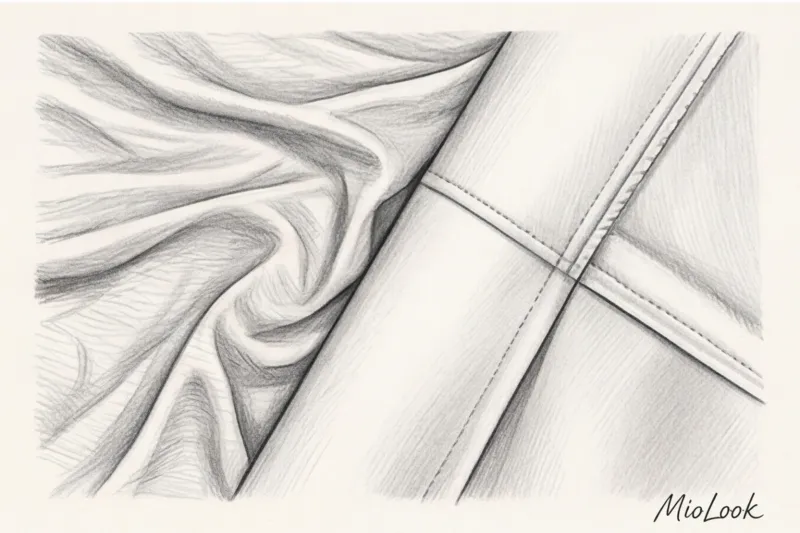
Shirt dress: vertical and strict collars
This isn't just an oversized men's shirt. The perfect shirtdress has a stiff collar that draws attention to the head and face. A row of contrasting buttons down the front creates that elongating vertical line.
Working formula: A tight midi shirt dress + a wide leather belt (no thinner than 4 cm, so it doesn't bunch up at the waist) + structured loafers = classy casual. A great option if you're looking for office clothes for plus size women , which looks collected, but not boring.
The Perfect Wrap Dress: Creating an Hourglass Figure
Don't confuse a cheap knit wrap dress that constantly flutters open in the wind with a structured, architectural cut. A true wrap dress made of heavy crepe or thick silk works wonders. A V-neck elongates the neck and gracefully accentuates the décolletage, drawing attention away from the shoulders.
One of my clients, Elena (size 54), always believed she had a rectangular figure with no defined waist. When we found her a dress with the perfect wrap angle (the diagonal line should fall directly under the bust and taper to the hipbone), her figure instantly transformed into an hourglass. The diagonal line breaks the horizontal volume—it's pure geometry.
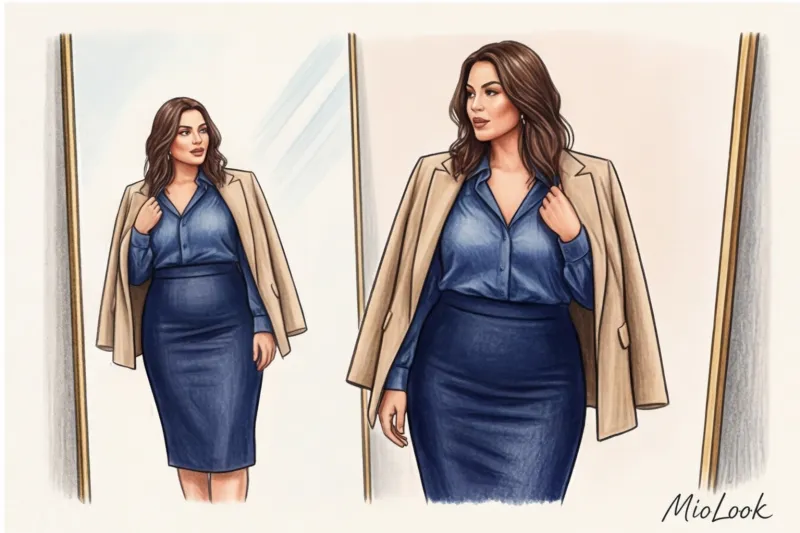
New generation sheath dress
The stereotype is that sheath dresses are only for thin women. This is a lie. Sheath dresses for plus-size figures are tailored according to different rules: they must have the right bust and waist darts. A well-placed bust dart can visually "lift" the waistline by 3-5 cm, lengthening the legs.
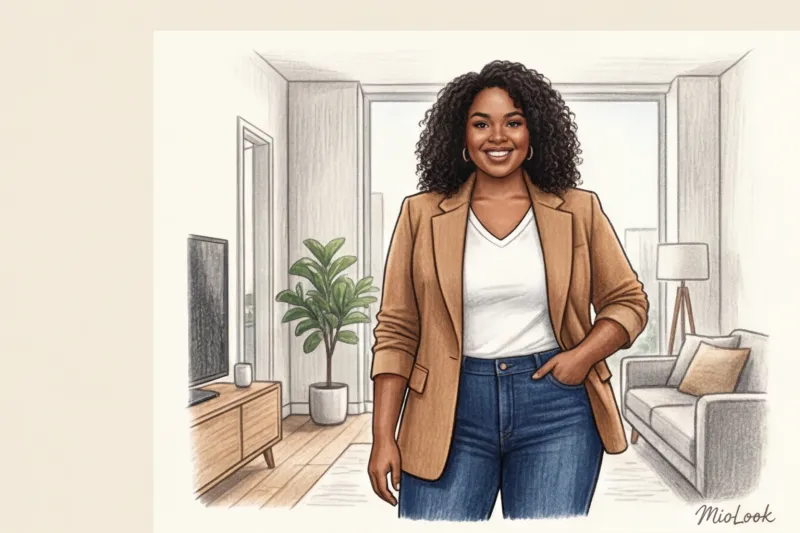
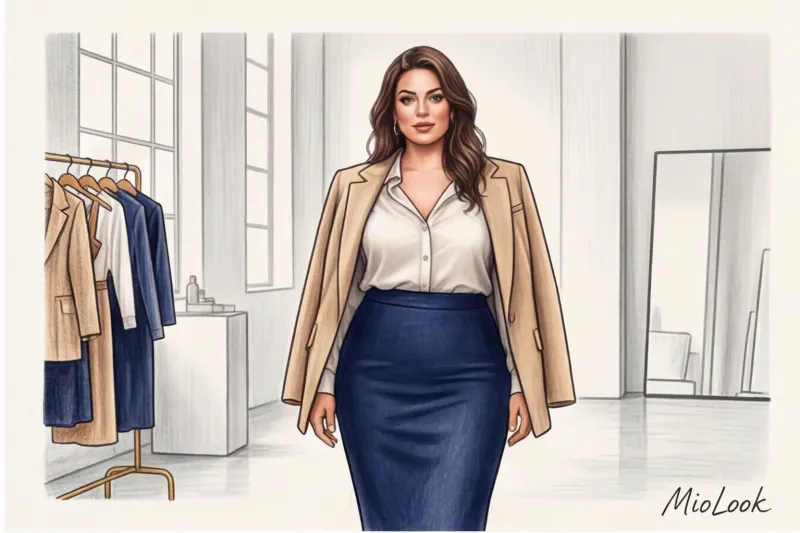
Stylist's secret: Wear a fitted sheath dress with an unbuttoned, straight-cut jacket. This creates a "slimming side panel" effect. The jacket covers your sides, and the eye only perceives the width of your figure by the narrow strip of dress visible in the front.
Your perfect look starts here
Join thousands of users who create harmonious capsules every day with MioLook.
Get access — €0.99 onceBasic Plus-Size Skirts: Geometric vs. Shapeless
The same rule applies to skirts: we create lines, rather than wrapping fabric around our hips. capsule wardrobe You only need three right styles to cover 90% of life situations.
- A-line skirt made of thick fabric: An A-line skirt made of thick denim, leather, or suiting fabric conceals the true size of your hips. The viewer sees the flared shape of the skirt and subconsciously assumes it's the design, not your waist, that's driving the change. The key is to emphasize the waist.
- High-waist pencil skirt: It absolutely shouldn't end mid-knee (more on that below). Look for styles with a front or side vent, not a back vent—this allows for freedom of movement without the fabric pulling on your buttocks.
- Bias-cut slip skirt: Seemingly thin, flowing fabric? Yes, but the cut is crucial. As experienced tailors explain, fabric cut at a 45-degree angle to the grain loses its rigidity and gains incredible flexibility. It gently contours to the stomach and hips, stretching where needed and tapering below. Choose heavy silk or dense viscose, avoiding cheap polyester, which tends to cling to your legs.
Stylist's Secret: The "Bottleneck" Rule and the Ideal Length
You can buy a perfect dress for a thousand dollars, but if its hem cuts into your calf at its widest point, you'll visually add two sizes and shorten your height. This is the most common mistake I see on the street.
Every woman has her own "tight spots" on her legs. Typically, this is the area just below the kneecap or the ankle (just above the ankle bone). The hem of your skirt or dress should end exactly in these areas.
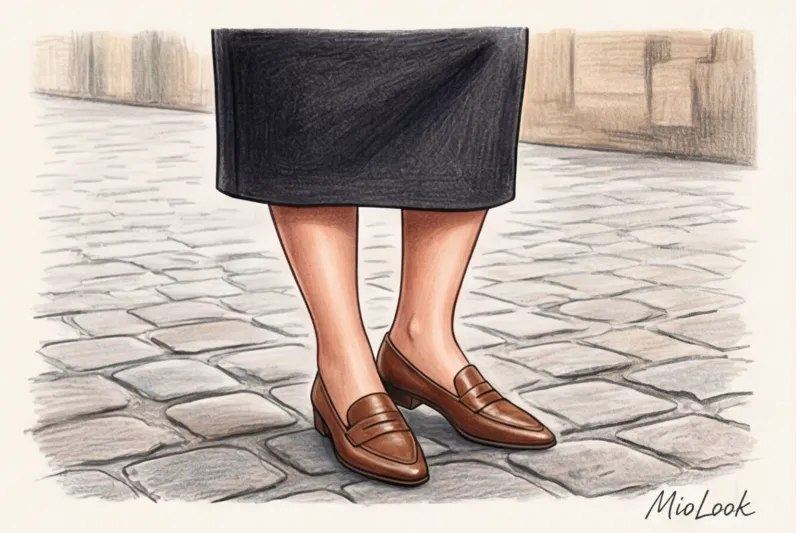
Insider practice (the "3-centimeter rule"): Over 12 years of work, I've developed a formula: changing the hem by just 3-4 centimeters dramatically alters the visual weight of a figure. Before taking a garment to the tailor, try it on at home with your regular shoes. Take pins and, in front of a large mirror, begin pinning the hem, raising it centimeter by centimeter. You'll see for yourself that precise millimeter point where your leg suddenly becomes graceful and your silhouette light.
Checklist: How to Test Dresses and Skirts in the Fitting Room
Store lighting and pretty mirrors often lie. Here's a simple technical checklist to help you avoid buying something that will end up as dead weight in your closet.
- Armhole test: The armholes shouldn't be too low. If the sleeve seam hangs 5 cm below the armpit (the "dolman effect"), it will pull the entire side of the dress down with it whenever you raise your arm. This will create a squared-off upper body. Look for a high armhole.
- Back test: Turn your back to the mirror and gently clasp your hands together in front of you. If the fabric between your shoulder blades is stretched to the point of straining and the creases are screaming for help, the garment is too small, even if it looks great from the front.
- Squat test: Never buy a skirt or sheath dress by standing up and twirling around. Be sure to sit on a ottoman in the fitting room. Check the stretch across your stomach. Is the fabric digging in? Are the buttons about to fall off? Leave the item in the store.
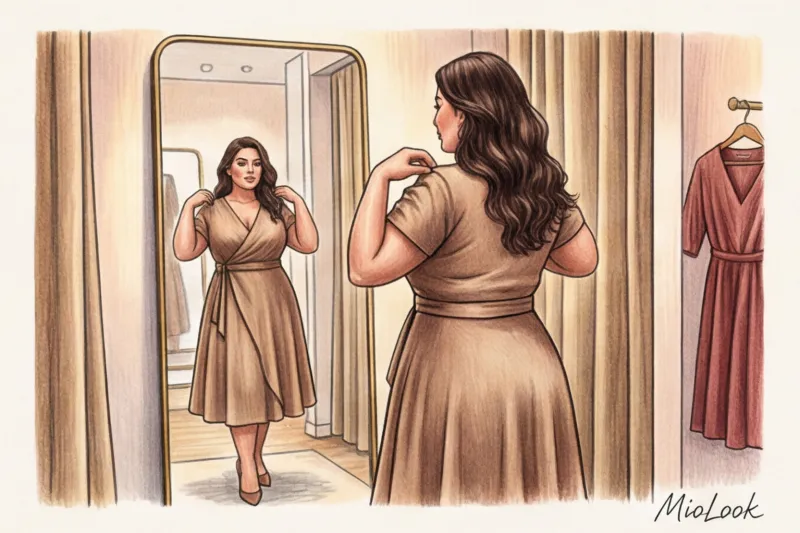
I always make my clients bring two sizes to the fitting room: their usual size and the one size up. My experience shows that eight out of ten plus-size women instinctively try to squeeze into a smaller size, hoping it will make them look slimmer. In fact, a slightly loose, well-cut garment is much more slimming than one that's bursting at the seams.
Important limitation: Architectural tailoring isn't all-powerful and requires personalization. For example, if you have a pronounced apple-shaped figure (with most of your volume at the waist and slender legs), a classic sheath dress with a defined waist won't work—it'll bunch up at the stomach. In this case, your "architectural" salvation might be a cocoon cut made of a dense fabric or a straight-cut shirtdress, not cinched with a belt.
Ready to get started?
Create your perfect basic wardrobe without the stress. Try the free plan—no commitments.
Get access — €0.99 oncePlus-size style isn't about playing hide-and-seek with your body. It's about pure geometry, understanding the physics of fabrics, and respecting your proportions. Stop looking for "slimming" hoodies. Invest in thick textures, stiff collars, proper darts, and the perfect length. When clothes hold their shape, you automatically maintain a straight back. And a confident woman with impeccable posture looks stunning at any size.