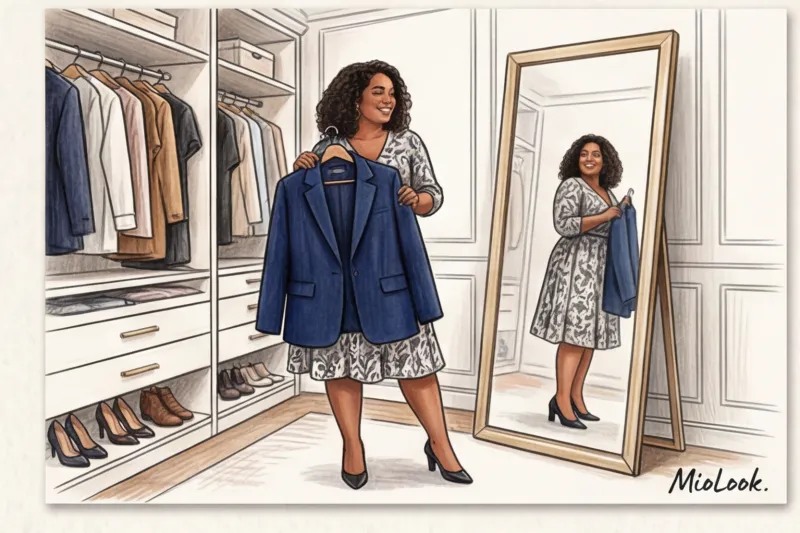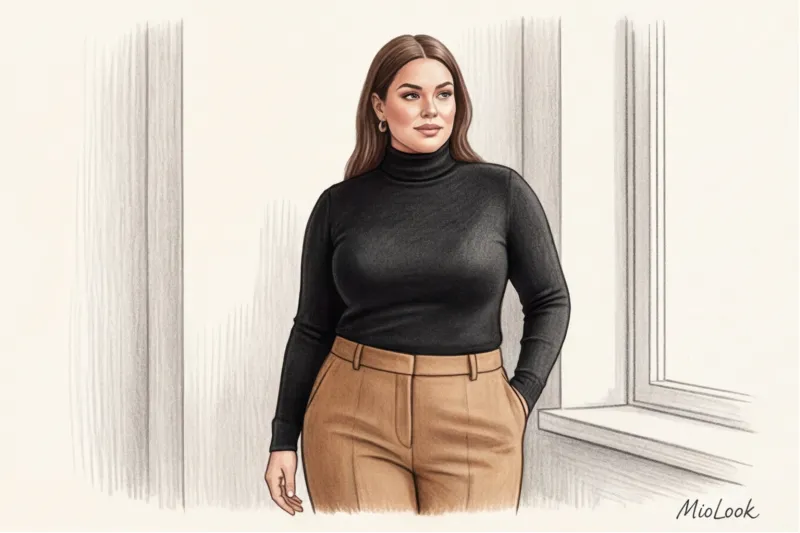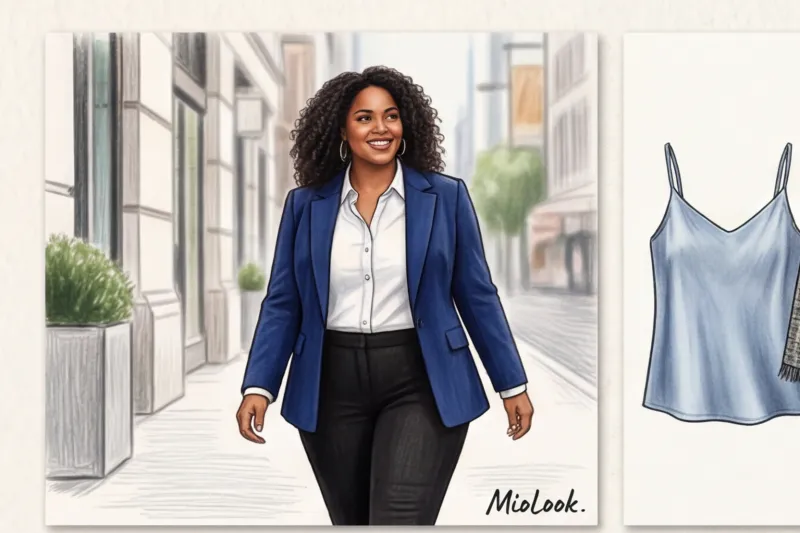
"Camilla, if I wear a jacket over it, I'll get even wider!"—I hear this phrase almost every first consultation from clients in sizes 50+. Fear of added bulk leads many women to opt for a single, often shapeless, layer. But the paradox is that this very approach accentuates the very nuances of their figure that we usually want to minimize.
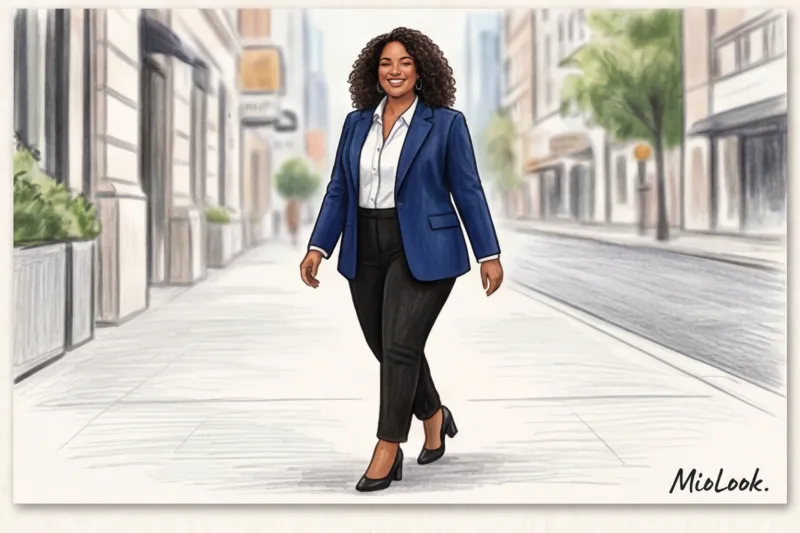
Let's be honest: the right one layering in clothing for plus size women It's not about throwing on all your warm clothes at once. It's about clever silhouette architecture. We've already discussed in more detail how to abandon the idea of "hiding" and start intelligently constructing your silhouette in our A complete guide to a basic wardrobe for plus-size women Today we'll take things a step further and explore an advanced styling tool: layering.
The "Added Weight" Myth: Why Layering Works Differently
The main myth I want to bust right now is: “extra layers = extra pounds.” Research Fashion Psychology Institute (2023) on the influence of architectural cuts on the perception of body volumes confirms what stylists know intuitively: the human eye does not read the actual volume of the body, but the boundaries drawn by clothing.
Layering creates optical illusions. Remember the famous Müller-Lyer illusion: two identical lines appear different because of the directional arrows at their ends. The same principle applies to clothing. When you wear an unbuttoned jacket over a top, you create two strong vertical lines that literally "cut off" the volume at the sides. Your silhouette is read by the width of the inner top, not by the shoulders of the jacket.
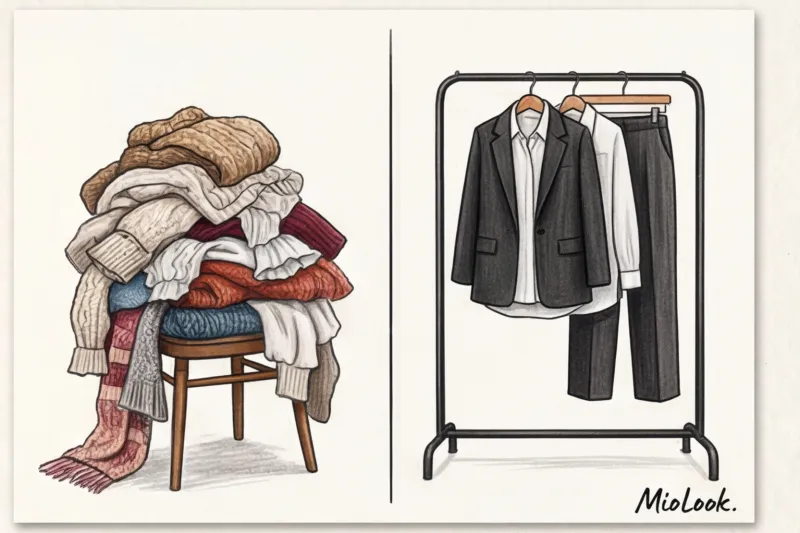
"A common misconception: thin, flowing fabrics are slimming, while dense fabrics are fatter. In fact, layering thin, shapeless fabrics clings to every fold and creates the notorious cabbage effect. The dense outer layer acts as a sculptural framework."
Density Hierarchy: A Plus-Size Stylist's Top Secret
In 2018, I worked backstage at the Marina Rinaldi show in Milan. It was there that I witnessed firsthand how plus-size fashion designers utilize micro-layering. The secret to the perfect fit lay in one strict rule: the outer layer should always be harder and denser than the inner one.
According to statistics we collected while analyzing the wardrobes of new clients, about 80% of curvy women mistakenly layer with soft knits. Those same "waterfall" cardigans with asymmetrical soft edges. Remember: thin knits over a thin blouse don't hold their shape; they simply replicate the contours of the body, visually adding up to a size and a half!
Instead, use "skeleton" materials for the outer layer:
- Heavyweight denim (12-14 oz)
- Suit wool or blended gabardine
- Eco-leather or natural thick leather
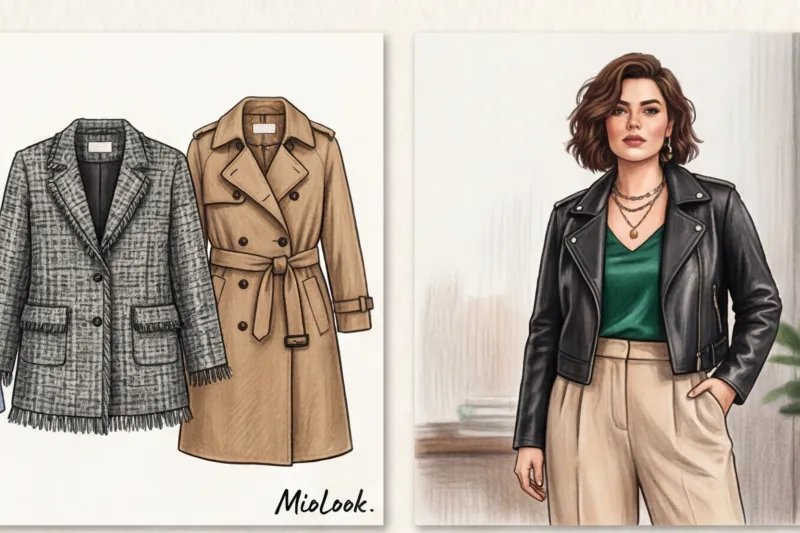
- High-density cotton (from 250 g/m²), for example, for trench coats
Base and Mid Layers: Creating the Right Foundation
If the outer layer is your exoskeleton, then the inner layer is your second skin. Here, we need fabrics that will allow the outer layer to glide easily without snagging or creasing.
Ideal choices: viscose, pure silk, Tencel, or high-quality cotton (from 180 g/m²) with a minimal amount of elastane (no more than 5%). Important: Never wear bulky items like a brushed sweatshirt as a base layer under a jacket if you're larger than a size 48. This will inevitably restrict movement and make you look heavier.
Your perfect look starts here
Join thousands of users who look flawless every day with MioLook. Digitize your wardrobe and create layered looks in one click.
Get access — €0.99 onceThe Mathematics of Lengths and Proportions: How to Avoid Cutting a Figure into Layers
In design office wear for plus size women The length of the product is everything. The golden rule of proportions is: the ideal outer layer should overlap the inner layer by at least 15-20 centimeters. If the layers end at the same level, you get a massive horizontal roll.
Absolutely prohibited: No layer should end at the widest part of your hips. This is the most common mistake. Draw a horizontal line across the fullest part of your hips—your tops, shirts, and jackets should be either 5-7 cm above this line or significantly below.
A great way to elongate your legs is to pair a cropped, structured top (like a waist-length crop jacket) with a longer base layer (like an untucked shirt). Asymmetrical hems (where the back of the shirt is longer than the front) also elongate the silhouette, creating diagonal lines.
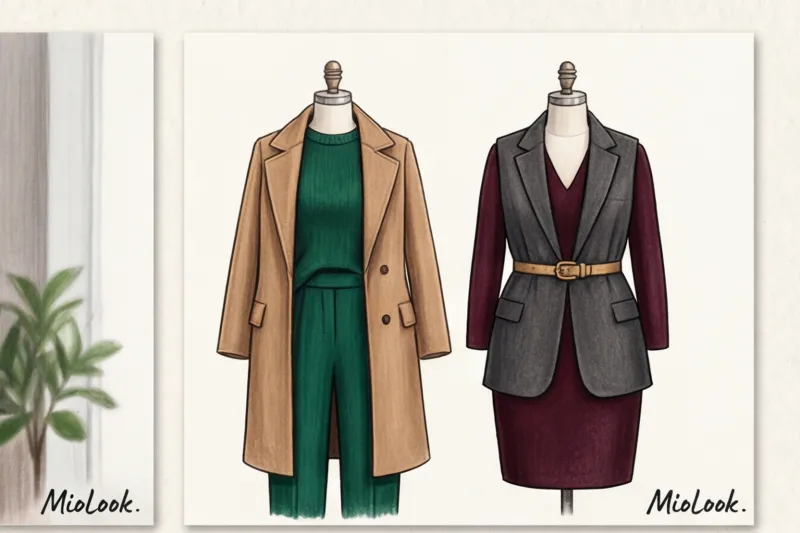
Vertical color and play of prints in multi-layered looks
Christian Dior's design principles, adapted for plus-size models, are based on the play of contrasts. Creating a "color column" is my favorite technique for instantly slimming the look.
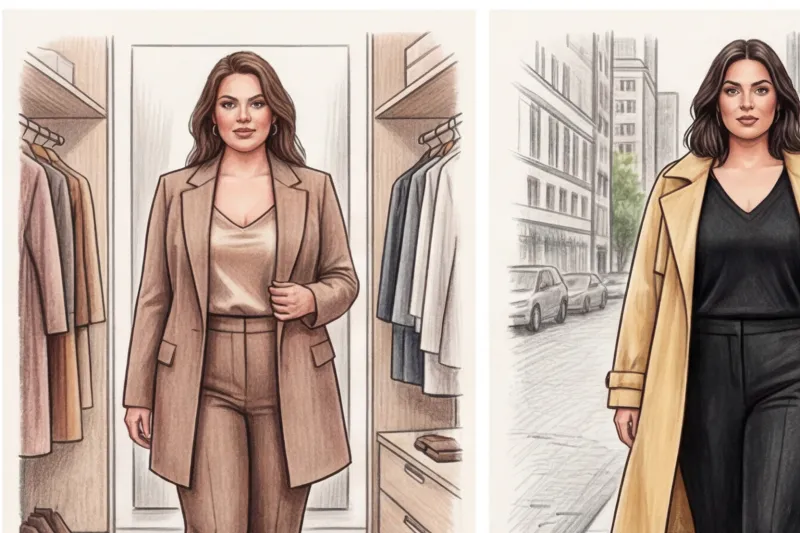
How does this work in practice? You wear a monochrome base layer (for example, black full-length pants and a black silk top) and a contrasting outer layer (a camel-colored jacket or light denim). Unbuttoning the jacket reveals only a narrow central black stripe. The brain of those around you calculates your width based on this black stripe. You literally "lose" 5 centimeters on each side.
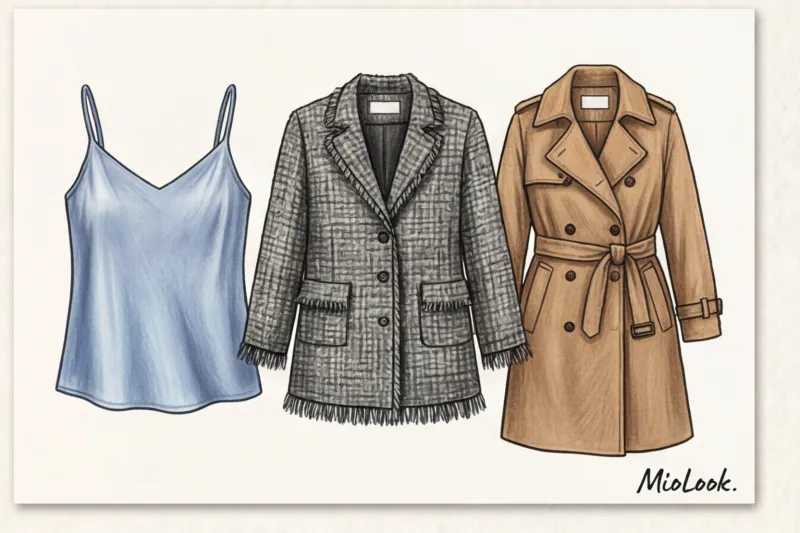
If you love prints, the rule for layering is to hide the print inside. A blouse with a bold floral or geometric pattern under a plain, understated blazer looks stylish and unobtrusive.
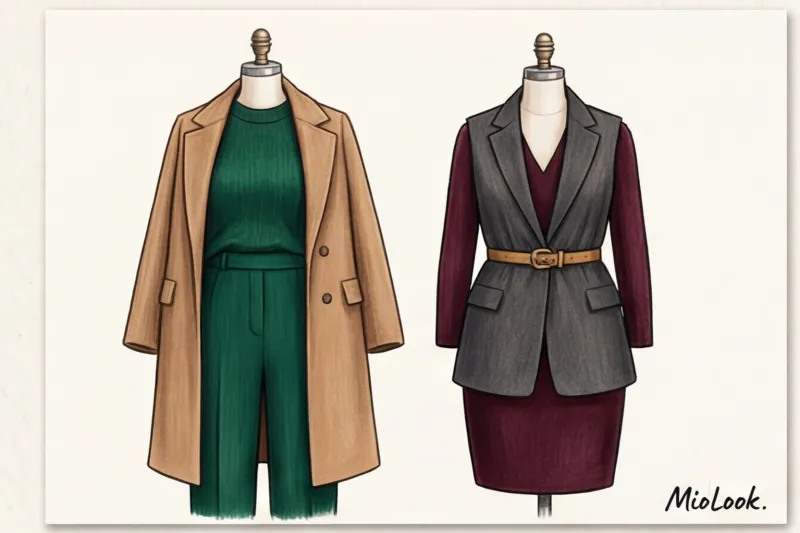
4 Working Layering Formulas for Every Day
Theory is great, but let's move on to practice. I regularly use these four formulas when creating capsules for my executive clients.
Formula 1: For office dress code
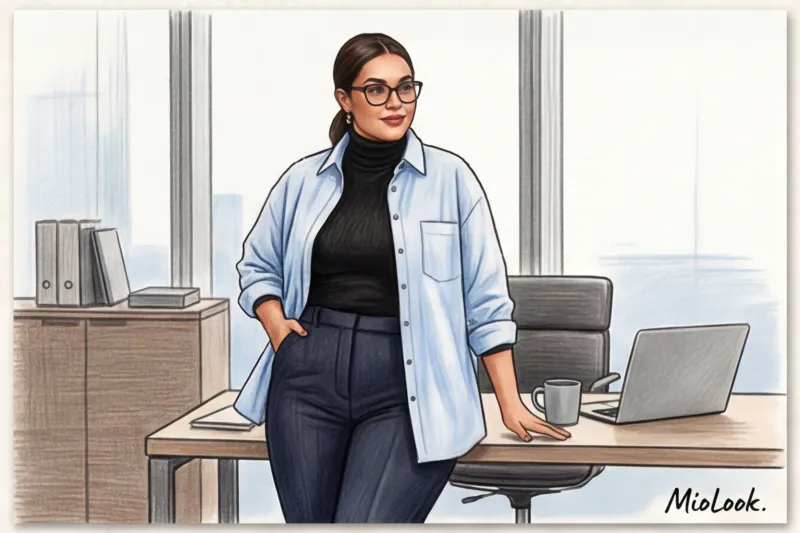
A silk V-neck top + a crisp button-down shirt (one-third unbuttoned) + a structured menswear-style jacket. This look is perfect for business capsule wardrobe , leaving the look collected but not stuffy.
Formula 2: Casual Friday at an IT Company
A thin ribbed wool-blend turtleneck + a heavy denim shirt (worn over the turtleneck, unbuttoned) + a long, classic trench coat. Wearing a turtleneck under a shirt is a modern styling trick that adds texture to your look.
Formula 3: Abdominal Correction
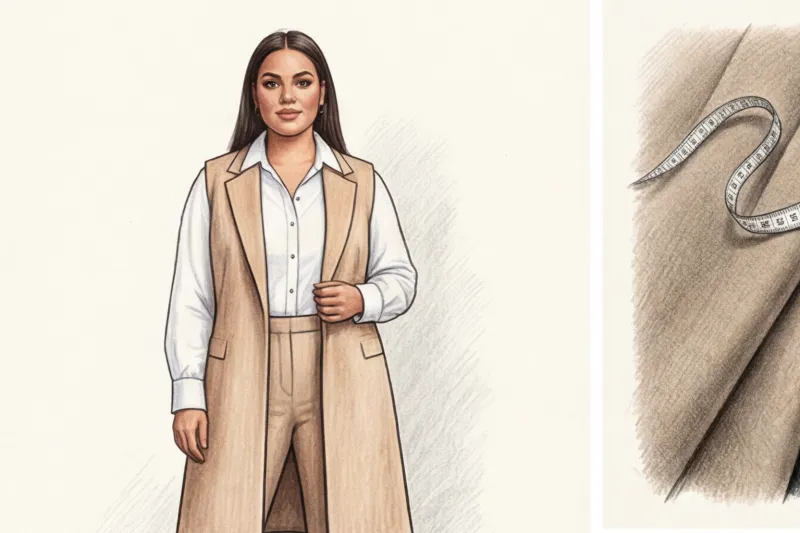
A smooth cotton shirt + a vest made of a thick suiting fabric (not a knitted ded-cor, but a suiting one that holds its shape) + loose palazzo pants. The stiff vest minimizes the belly, and the shirt underneath creates a feeling of lightness.
Formula 4: Romance with a Dress
A slip dress + a voluminous yet thick jumper (worn over the dress and cinched with a thin belt at the waist for proportion) + a leather biker jacket. The contrasting textures (silk, chunky knit, leather) add incredible depth to the look.
Access to MioLook for €0.99 — one-time payment
A smart AI stylist will create the perfect layered look from your existing items and suggest additional items.
Get access — €0.99 onceThe Biggest Mistakes: What Turns a Stylish Look Into "Cabbage"
Over 12 years as a stylist, I've cleared hundreds of clients' closets of the consequences of the toxic fashion diet of the 2000s. Here's what you absolutely must not do if you want to maintain a slim silhouette while layering.
Mistake 1: Buttoning everything up tightly. Layering for plus-size women works like magic when unbuttoned. Once you button up a double-breasted jacket over a shirt and top, you truly look bigger.
Error 2: Chaos in the portrait area. Too much detail near the face can kill elegance. If you're wearing a turtleneck and shirt, avoid adding a bulky scarf, massive necklace, or brooch. Airiness in the portrait area is vital.
Mistake 3: Excessive oversize. Oversize should be considered. A garment 1-2 sizes too big is oversized. A garment 4 sizes too big, with a shoulder seam dropped to the elbow, is a sack, which, when layered, will turn you into a monument.
Mistake 4: Wrong underwear. This is the foundation without which everything will collapse. A poorly fitted bra that cuts into your back and pushes your breasts low toward your waist will ruin the fit of even the most expensive blazer. Outdated style rules They said that underwear should be invisible. Modern rules say it should be architectural.
Important note: layering with stiff fabrics is NOT suitable for the neck area if you have a full bust and a short neck. In this case, strictly avoid turtlenecks and button-down shirts. A deep V-neck on the base layer and longer lapels on the jacket, without unnecessary details on the collar, are your best bet.
Summary: A Checklist for the Perfect Layered Look
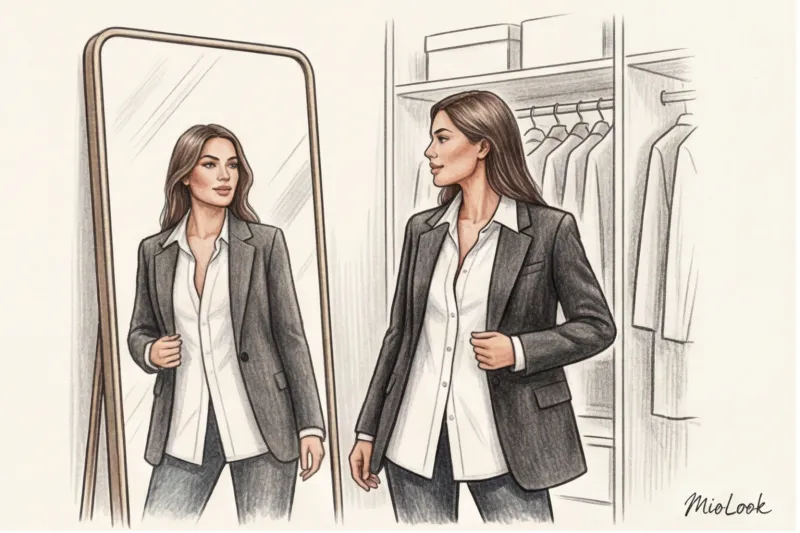
Let's recap. Before leaving the house, go through this checklist, which I call the "mirror test":
- The two-finger rule: There should be room for two fingers between your body and the first layer, as well as between each subsequent layer. If the clothing is creaking, the layers won't work.
- Density test: Feel your clothes. Is the layer closest to your body softer than the one on the outside? If so, you've done everything correctly.
- Dynamic assessment: Raise your arms, sit on a chair, and hug yourself. Is there any pulling or strain? Has the inner layer "slipped" upward?
Layering isn't just for the skinny. It's about mathematics, geometry, and the physics of fabric, accessible to everyone. Stop wrapping yourself in shapeless, soft knitwear hoping to hide from the world. Start consciously building your silhouette by choosing dense, confident fabrics. You'll be amazed at how much it changes not only your reflection in the mirror but also your inner sense of self.