What is the “perfume self” and why is one scent for life a myth?
"Julia, why has my favorite perfume become weaker? The brand must have changed the formula in the new batch," was how I began my consultation with a client last week. While she was complaining about the "spoiled" bottle, I was trying my best to discreetly open the studio window. The air was so thick with heavy amber and tobacco that you could literally cut it with a knife. Wondering... How to find your scent , many women make the same classic mistake: they choose the perfect, expensive perfume and start using only it every day for years.
Perfume "I" (in professional terminology - Signature Scent ) is the invisible signature of your personal brand. It's that signature scent that's associated exclusively with you, precedes your arrival in the meeting room, and lingers in your interlocutor's memory long after you've left. The right fragrance works like a perfectly tailored Saint Laurent jacket: it ties together your look, conveying status and inner confidence.
Glossy magazines used to teach us: find your one and only scent and stick to it for life, like Marilyn Monroe with her iconic Chanel No. 5. But let's be honest—that concept is hopelessly outdated. We no longer live within the paradigm of a single, fixed role. The modern woman is too multifaceted. This morning, you're handling tough negotiations in a tailored wool suit, tomorrow, heading to a relaxed brunch in a voluminous cashmere sweater, and on Friday night, slipping into a flowing silk slip dress. The same perfume physically can't seamlessly serve all these contexts, just as the same pair of shoes wouldn't work for both the red carpet and a stroll along the waterfront.
Moreover, wearing the same perfume every day is a sure way to lose the pleasure it brings. There is a physiological phenomenon that neuroscientists call olfactory blindness or olfactory fatigue. According to long-term research by Dr. Pamela Dalton of the Monell Chemical Senses Center (an institute that studies chemical senses), the receptors in our nasal cavity adapt to familiar odors in just a few breaths. This is an ancient evolutionary mechanism: the brain intentionally filters out familiar, safe background odors to avoid overloading the nervous system and to detect new, potentially dangerous odors in the environment.
Due to sensory adaptation, you stop smelling your favorite perfume within 15-20 minutes of applying it. What do most people do in this situation? Instinctively increase the dose.
Three sprays instead of one, then five, then regularly refilling every two hours. The result is a chemical attack that gives everyone around you a headache. To avoid this awkward mistake of "overdosing" on your favorite bottle, there's only one solution: alternate fragrances. Your olfactory receptors need regular contrast to begin perceiving a familiar composition vividly and dimensionally.
Olfactory Wardrobe: The Concept of a Perfume Capsule
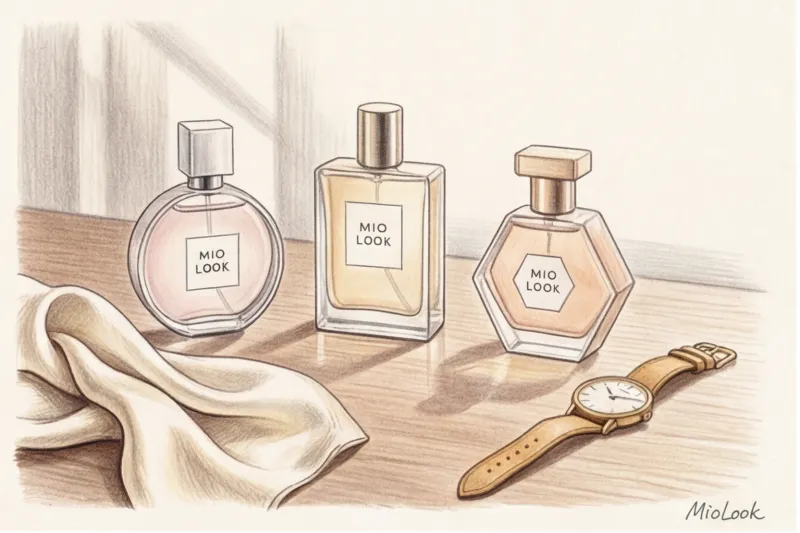
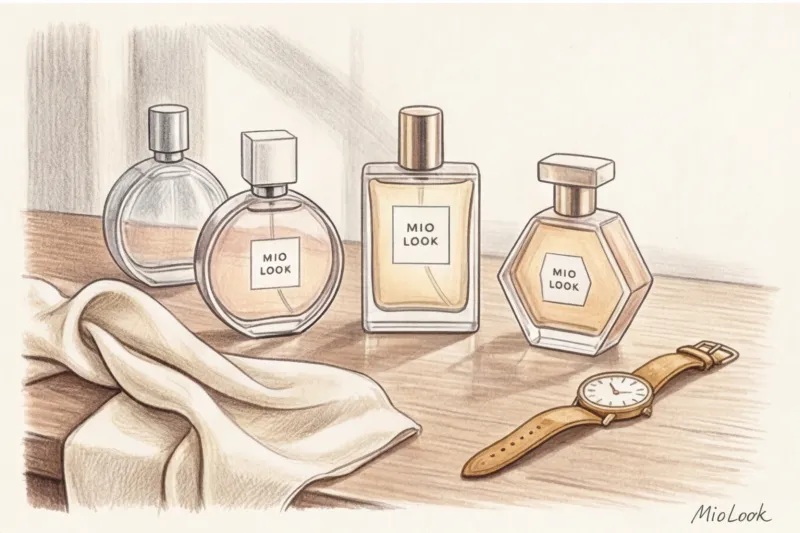
As a stylist working with the premium segment, I always emphasize that the approach to perfume should be as systematic as buying a classic €3,000 handbag. Instead of endlessly searching for one mythical ideal, I encourage my clients to collect olfactory wardrobe It works according to the same laws as a basic capsule in clothing.
Fragrances should be categorized by context: for the office, for evening outings, and for relaxation. A sophisticated woody or iris-based perfume will perfectly complement your look for an important meeting—by the way, if you're preparing for a professional photo shoot, I highly recommend checking out Secrets of lighting in makeup for a business photo shoot. And for your everyday office routine, it’s better to choose delicate green or tea compositions that won’t clash with your business makeup and violate the personal boundaries of colleagues.
How to create the perfect perfume capsule without blowing your budget? All you need is three carefully selected bottles. The key is to unite them with a common DNA. Let one favorite note lead all your fragrances, becoming your signature. For example, noble vetiver or pure white musk. In the morning at the office, it could be a transparent citrus-musk cologne, at brunch with friends, a suede-musk composition of medium density, and in the evening, a rich floral-musky extract. You change the context, but your unique signature remains recognizable.
When building such a system, it's incredibly helpful to visualize your entire imagery. I often recommend that clients add photos of their perfume bottles directly into MioLook app When creating capsule wardrobes, when you see a textured tweed jacket, a silk blouse, and a bottle of sophisticated chypre perfume on one screen, the look comes together as a seamless, flawless puzzle, saving you time in the morning.
The Anatomy of Smell: How to Find Your Scent by Understanding Notes and Concentrations
Have you ever noticed how most women choose perfume in boutiques? A spritz on a blotter, a quick whiff, and the verdict is immediately: "I'll take it!" or "Too strong, not my thing." As a stylist who regularly accompanies clients on perfume shopping trips, I always physically stop them at this point. Buying a perfume based on the first few seconds of its scent is like judging the quality of a cashmere coat solely by the buttons sewn on it.
If you are seriously wondering, How to find your scent To find a scent that won't disappoint by midday, you'll need to understand the anatomy of scent. The olfactory pyramid isn't a poetic marketing metaphor, but the strict physics of how molecules of different weights evaporate.
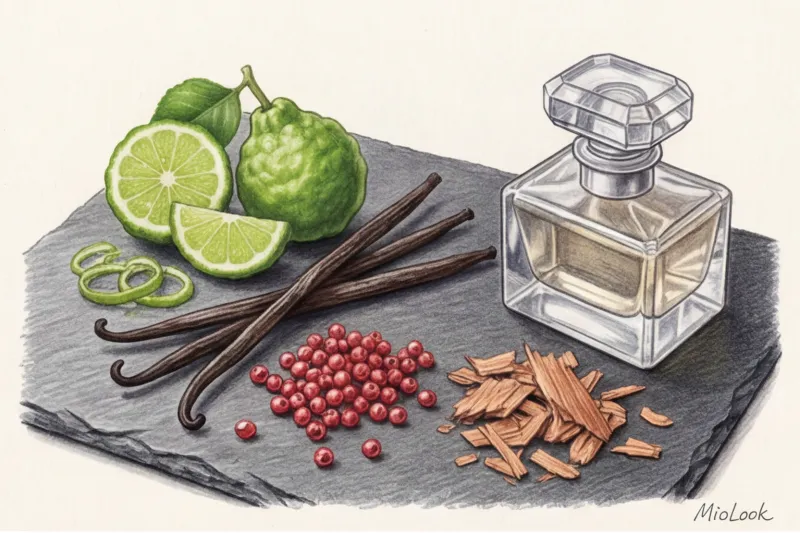
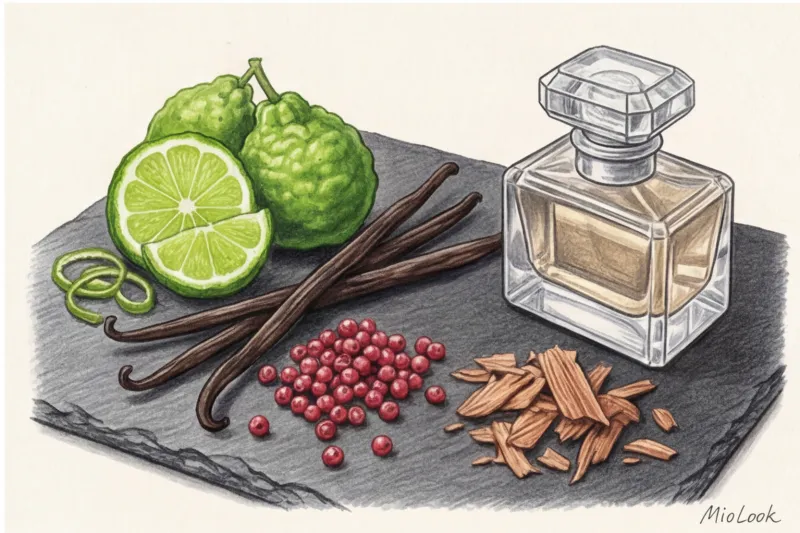
- Top notes (first 10-15 minutes): Citrus, light herbs, pink pepper. These are the most volatile and are created solely to grab your attention and "sell" the bottle. They should absolutely not be relied upon.
- Heart notes (2–4 hours): Flowers, spices, fruits. This is the true character of the composition, its core, which will accompany you for most of your active day.
- Base notes (6-8 hours and longer): Heavy molecules—cedar, amber, patchouli, musk, resins. This is the foundation. It's the base, not the sparkling bergamot at the start, that your colleagues will smell by the end of the workday.
When reviewing clients' wardrobes, I often see a frustrating dissonance: an impeccable fine wool suit, a €3,000 bag, and... a completely flat, cheapening trail. The perfume's family affiliation is subconsciously perceived by others.
Chypres (a combination of bergamot, oakmoss, and patchouli) is an absolute marker of elegance and status. They create an intellectual distance, sounding austere and expensive. Wine glasses (lavender, coumarin, geranium), historically considered masculine, on women's skin give the stunning effect of a crisp white shirt. Aldehydes They exude a cool, soapy purity in the spirit of classic French couture, but they require perfect tailoring, otherwise they risk adding a couple of extra years to your age.
"Gourmand fragrances are the most dangerous territory in perfumery. Cheap ethyl maltol (the scent of cloying cotton candy) can instantly devalue any luxury image. If you love sweetness, look for a "smart gourmand" where vanilla is balanced with bitter almond, tobacco, or boozy notes."
Beyond the fragrance family, choosing the right concentration is crucial. The fragrance's density should strictly match your lifestyle and context. The French School of Perfumery (including the standards of the Versailles-based ISIPCA Institute) strictly regulates this parameter:
- Cologne (EDC, 2–5% fragrances): Lasts on skin for 1–2 hours. Ideal for a morning tennis practice or a hot summer weekend.
- Toilet water (EDT, 5–15%): Lasts 3-4 hours. It's a great choice for the office—you won't choke anyone in a closed conference room, and you can change your perfume by the evening.
- Eau de Parfum (EDP, 15–20%): The gold standard for everyday use. Lasts 5-8 hours and leaves a beautiful yet subtle trail.
- Perfume (Extrait de Parfum, 20–40%): Herein lies the main paradox. Contrary to myth, perfumes don't "shout" to the whole street. Due to their low alcohol content and high concentration of oils, they produce virtually no sillage. Extrait sits very close to the body, smells intimate, and lasts up to 24 hours. This is a scent for an evening silk slip dress and dates, not for a subway ride.
Access to MioLook for €0.99 — one-time payment
A smart AI stylist will select the perfect look that will perfectly match your perfume personality.
Get access — €0.99 onceThe Connection Between Perfume and Personal Branding: Choosing a Scent to Match Your Archetype and Style
Neuroscientists from Rutgers University (2022) have proven that the olfactory bulb has a direct neural connection with the amygdala—our center of emotion and memory. In practice, this means one ruthless thing: just as perfume shapes impressions before you speak, so your personal brand begins to take shape milliseconds before your first word. Smell is perceived by the person you're speaking to unconsciously, instantly assigning you a certain social status and archetype.
I recall a telling example from my own practice. The CFO of a large holding company approached me for a consultation. Her request was as follows: "At board meetings, male partners constantly interrupt me and treat me condescendingly, even though my financial statements are impeccable." We began sorting through her wardrobe. Visually, everything was meticulously planned down to the millimeter: tailored wool suits from Jil Sander costing around 1,500 euros, a simple Cartier watch, and a perfectly sleek hairstyle. But when she walked into my studio, the space was instantly filled with the dense, lingering aroma of strawberries in burnt caramel.
A severe cognitive dissonance arose. Sweet gourmand notes (ethyl maltol, praline, berries) are evolutionarily and culturally associated with relaxation, childhood, relaxation, and pastries. When you wear a formal jacket with sharp shoulders, you visually convey a sense of collectedness. But your perfume screams, "I'm a carefree teenage girl on vacation!"
In the battle between sight and smell, the latter always wins. How to avoid dissonance between a formal business suit and a frivolous fruit compote? The answer is simple: the olfactory weight must match the visual. Thousands of euros invested in a perfect cut are instantly devalued by an inappropriate scent. When we changed my client's perfume to a strict leather-iris profile, the dynamics of meetings changed dramatically—they stopped interrupting.
That is why, when collecting capsules for my clients through the "smart wardrobe" feature in MioLook I always insist on adding a matching fragrance tag to every look. Fragrance is an invisible accessory that should logically complement the texture of the fabric.

Fragrances for status and distance
If your goal is to establish personal boundaries and demonstrate authority and expertise (critically important for executives, top managers, and lawyers), choose a perfume that creates a sense of space and distance between you and your conversation partner. Look for woody accords (cedar, dry vetiver), cool iris notes, and delicate suede and leather in the fragrance pyramid.
Why does it work? Leather notes convey confidence and inner strength. Orris root in perfumery creates a powdery yet cool effect, like a freshly starched white shirt—it sounds expensive, dry, and detached. Woody notes (as in the legendary Chanel Sycomore or Bottega Veneta Eau de Parfum ) ground the image, stripping it of any flirtatiousness. There's not a hint of "edibility" in them that could undermine the chain of command.
Fragrances for trust and communication
A completely different challenge faces those whose professional work relies on empathy, engaging communication, and breaking down barriers: psychologists, coaches, HR specialists, doctors, and educators. In this situation, austere woody chypres can sound too aggressive, triggering subconscious anxiety in the client.
You need scents that foster trust and communication. Ideal choices include lactonic (milky) notes, white or green tea accords, and delicate, non-indolic florals (such as freesia or water lily). Tea notes (as in Bvlgari Eau Parfumée au Thé Blanc ) physiologically calm the interlocutor's nervous system. Lactone accords mixed with soft sandalwood (as in Zadig & Voltaire This is Her in microdoses), on a deep subconscious level are associated with safety, maternal warmth and comfort.
When getting ready for work in the morning, ask yourself one practical question: "What social role do I play today?" If you're facing tough budget negotiations, don the olfactory "armor" of vetiver. If you need to resolve a team conflict and listen to your employees, choose a soothing tea profile. Manage your impressions consciously.
Skin Fabrics and Chemistry: The Hidden Factors That Change the Perfume Experience
You buy the coveted bottle for 250 euros because on your colleague it revealed a noble suede and creamy vanilla scent. But apply it to your own wrist, and the composition suddenly reveals a flat scent of burnt sugar or, worse, harsh rubbing alcohol. This isn't a counterfeit or a defective batch. This is physics and biochemistry in action. To understand, How to find your scent It's not enough to simply study the note pyramid on the brand's website. You need to consider the properties of the "canvas" you're applying it to.
In the perfume industry, there's an unspoken division of skin types into "cool" and "hot." This classification is directly related to blood microcirculation, epidermal thickness, and body temperature. If you have pale skin, are often cold, and have deeply hidden veins on your wrists, you belong to the "cool" skin type. This skin type acts as a kind of cryo-safe for perfume: citrus, aquatic, and light floral top notes can linger for hours, unfolding slowly, crisply, and crystal clear.
Those with "hot" skin (typically dark-skinned, easily tanned, with blood vessels close to the surface), on the other hand, literally "burn" the upper levels of the olfactory pyramid in 10-15 minutes. A heavy base immediately appears on them. For example, the famous Baccarat Rouge 540 On hot skin it quickly fades into a deep woody-ambery sweetness, while on cold skin it often gives off those notorious “medical bandages” due to the frozen, sterile sound of the evernil and saffron molecules.
According to the International Fragrance Association (IFRA), the individual pH level of the skin's acid mantle and the activity of the sebaceous glands can completely alter the molecular structure of a perfume upon contact with the body.
A normal pH ranges from 4.7 to 5.5. However, the slightest shift due to stress, menstrual cycle phase, or even spicy food eaten the day before can cause the same perfume to smell different. Furthermore, oily skin retains fragrances for a phenomenally long time—the sebum traps essential oils, preventing them from evaporating. Dry skin, on the other hand, sheds perfume instantly, so it's essential to moisturize with a fragrance-free base lotion before applying.
But body chemistry is only half the equation. As an investment wardrobe expert, I always coach my clients to match their fragrances to the texture of their fabrics. Clothing fibers absorb and release fragrances differently.
Natural cashmere, alpaca, and dense merino wool delight in gourmand and woody notes. The porous, fluffy structure of the pile captures the heavy molecules of vanilla, tonka bean, praline, and sandalwood, creating an incredibly soft, luxurious, and enveloping cocoon around you. The sharp edges of the fragrance are softened, and the scent is quieter yet more voluminous.
Smooth, heavy, flowing silk demands a completely different approach. Icy aldehydes, white flowers (tuberose, neroli, jasmine), and classic, vibrant chypres shine flawlessly on it. The smooth surface of the silk thread doesn't trap the scent, allowing it to reflect off the surface and sound sharp, lingering, and aristocratic.
What you absolutely must not do is apply perfume to polyester, acrylic, or other completely synthetic materials. Synthetic fibers mercilessly distort the formula, drawing out the harshest, most plasticky nuances of the base fixatives. Furthermore, the alcohol in perfumes often reacts unpredictably with the dyes in cheap synthetics.
This is where the main danger for a luxury wardrobe lies. I regularly see clients' damaged items that are beyond saving. Remember the golden rule: never spray perfume directly onto expensive fabrics. The oils, which reach a concentration of 15-20% in EDP, are instantly absorbed into the fibers, leaving yellowish, greasy stains on light silk or fine wool suits (such as Loro Piana).
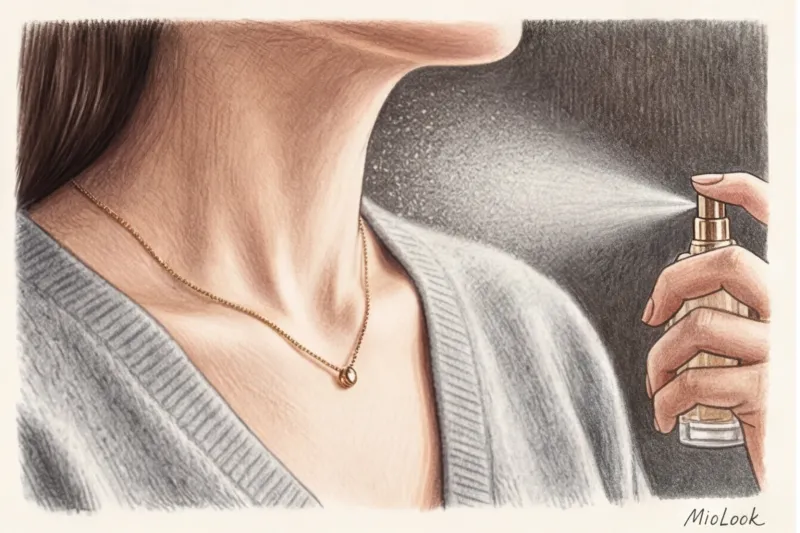
If you want to scent your favorite jacket, use the old French method: spray the perfume on the seams of the inner lining, or spray it on a cotton or silk pocket square and tuck it into your pocket. The safest method for delicate fabrics is to apply the perfume exclusively to the back of the neck, just below the hairline. This way, the scent will linger on your skin and keep your garment in pristine condition.
Access to MioLook for €0.99 — one-time payment
Start creating your perfect looks with AI and find a wardrobe that perfectly matches your style and perfume.
Get access — €0.99 onceStep-by-step instructions: how to find your fragrance in a boutique (without mistakes)
Ninety percent of impulse purchases in niche perfumery end in disappointment. You stand at the checkout with a €250-300 bottle, captivated by the sparkling Sicilian lemon opening, only to find a monotonous, suffocating musk on your skin a few hours later. To avoid this costly mistake, I've developed a strict perfume shopping protocol for my clients that eliminates emotion and leaves only cold calculation.
You should start preparing at home. The ideal time to visit a perfume boutique is first thing in the morning, between 10:00 and 12:00. During these morning hours, cortisol levels are normal, our olfactory receptors are at their most sensitive, and our brains haven't yet been overwhelmed by city smog and other odors. The most important rule: on the day of your visit, avoid wearing any perfumed cosmetics. No shower gels with strong fragrances, body lotions, or hairspray. Your skin should be a completely neutral canvas.
When you walk into a corner at, say, Tom Ford or Maison Francis Kurkdjian, it's easy to succumb to the consultant's entreaties and try on a dozen beautiful bottles. Stop. I always insist on the "three blotters and one wrist" rule.
- Step 1: Select a maximum of three compositions based on the note description.
- Step 2: Spray them onto paper blotters. Important: Never hold freshly sprayed cardboard close to your nose—the alcohol will instantly burn the microvilli of the mucous membrane. Wait 30 seconds and smell the aroma from a distance of 10–15 centimeters.
- Step 3: Spray the one scent that resonates with you most on your wrist. Ruthlessly discard the rest. The human nose is physiologically incapable of adequately analyzing more than three complex fragrance profiles at a time.
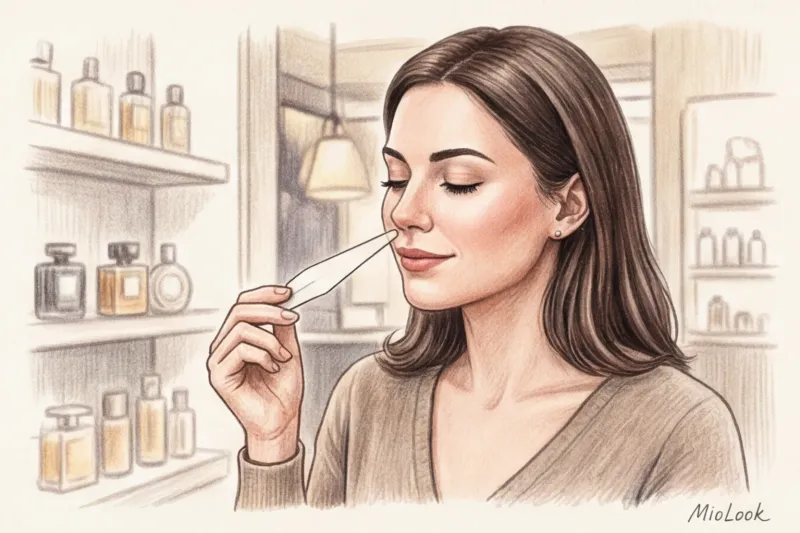
Here we inevitably encounter the main myth of perfume shops: jars of coffee beans that the seller will solicitously hand you.
Coffee absolutely does not cleanse the receptors. It is a powerful olfactory irritant, containing over 800 volatile compounds. Inhaling it doesn't "zero" your nose; it delivers another crushing blow, completely blocking your ability to distinguish subtle floral or aldehyde nuances.
What to do instead? Drink a few sips of pure, still water—hydrating the mucous membranes instantly restores their sensitivity. If you need to quickly refocus your sense of smell, bury your nose in your own sleeve made of natural fabric (undyed wool or cashmere are ideal). The famous perfumer Jean-Claude Ellena always advised his students the simplest method: simply step outside into the fresh air for 10 minutes.
Now comes the hard part: leaving the store without buying something. Sales associates will offer limited-edition miniatures as gifts or discounts "only today," but you need a test drive. The 8-hour rule kicks in. You need to live with this fragrance for a full day. Observe how it behaves in an air-conditioned office, on a cool street, during lunch. Heavy base molecules (amberwood, oakmoss, thick resins) have a high molecular weight and reveal their true character only after 4-6 hours.
During this testing period, it is very useful to record your feelings. I recommend that clients add an image of the current day to MioLook and make a note about the perfume you're testing in the app. Evaluate how harmoniously this particular sillage pairs with your tailored jacket or, conversely, a relaxed cashmere sweater. If by late evening the scent hasn't given you a headache, hasn't become too cloying, and you still want to greedily inhale it from your wrist, you can confidently return for a bottle tomorrow. My personal styling advice: start with a travel-size (10-15 ml). This is the best insurance against an expensive perfume gathering dust on the shelf for years after the first week of use.
The Art of Layering: How to Create a Unique Trail from Two Perfumes
In Middle Eastern perfumery tradition, layering several oils and essences is a centuries-old ritual. Today, this technique, known professionally as layering, has become a top secret among European perfumers. Why limit yourself to a ready-made composition when you can collaborate with a perfumer? Layering is the most elegant answer to the question of how to find your scent when no bottle in a boutique fully captures your personality. It's a tool for creating a completely unique olfactory code, your personal, invisible signature, impossible to copy or simply buy in a store.
The architecture of proper layering is governed by the strict laws of physics and chemistry. A basic rule to grasp once and for all: heavy on the bottom, light on top. We first apply dense, resinous, deep woody, or spicy compositions. These have low molecular volatility and serve as a reliable foundation. After allowing the base to settle on the skin for just a couple of minutes, we spray a lighter, more diffuse fragrance on top—a citrusy, green, or vibrant white floral. For example, a dense base of sandalwood and amber will beautifully complement a fresh accord of bergamot or neroli. If you do the opposite, the dense base will simply smother the fragile top notes, and the composition will fall apart.
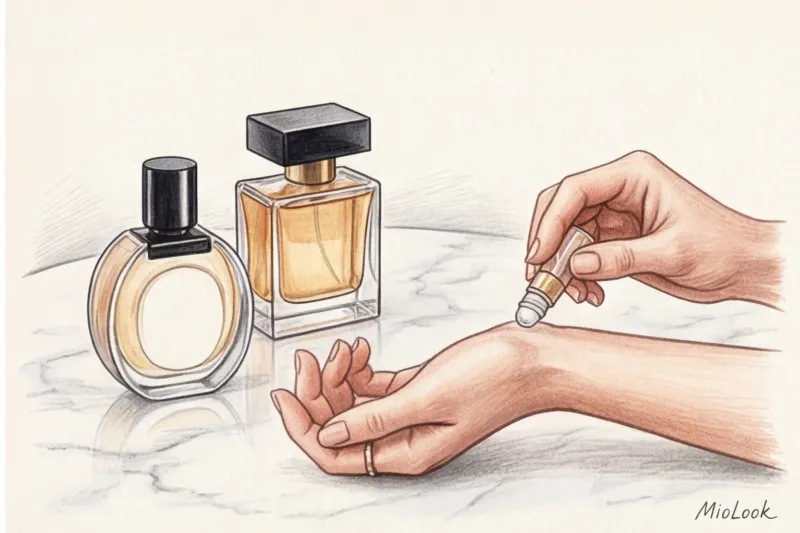
If you're just starting out, I recommend a surefire trick for advanced users: using molecular fragrances as a kind of primer. Formulas based on synthetic ingredients, such as Iso E Super or Ambroxan (a classic example is the famous Escentric Molecules line), work like a magnifying glass for any other perfume. On its own Iso E Super It possesses a subtle, velvety cedar note that doesn't overpower, but rather "illuminates" the other notes from within. Applied as the first layer, the molecule melds with your skin's chemistry, significantly prolonging the longevity of the main scent and imparting incredible volume and airiness to the trail, without distorting the perfumer's original intent.
By the way, when collecting your collection for such experiments, it is very convenient to digitize the bottles. By adding them to MioLook Along with basic items, you can plan a complete look for the day, immediately marking the most successful perfume combinations for specific outfits in the app.
However, layering also poses serious dangers. Olfactory disaster is inevitable if the rules of pairing are violated. It's absolutely forbidden to mix two complex, multi-component fragrances with pronounced sillages. Imagine layering a heavy oud over a dense vintage chypre—the result will be an aggressive cacophony that will simply give everyone a headache. Also, avoid layering two distinctly gourmand compositions (for example, praline and thick vanilla)—it will create the effect of a sticky, cheap syrup. Another no-no is mixing dense aquatic notes (sea salt, seaweed) with overt sweetness. Such dissonance can instantly cheapen even a flawless look costing several thousand euros.
Your perfect look starts here
Join thousands of users who look flawless every day with MioLook.
Get access — €0.99 oncePerfume Etiquette: How to Wear Fragrance to Be Remembered, Not Hated
In 2023, the Swiss hospitality and business etiquette school EHL Group published a curious study: strong perfume was among the top three most annoying factors in business negotiations, even surpassing regular lateness. In the corporate world, an overly strong scent is perceived as an invasion of personal space and a demonstrative lack of respect for colleagues. In investigating, How to find your scent We often focus solely on the note pyramid and longevity, forgetting the most important thing: it's not enough to choose a brilliant composition; you also need to master the art of wearing it. Your perfume is an invisible calling card, but if handled incorrectly, it can become the cause of unspoken rejection.
There is a beautiful term in the French perfumery school sillage (sillage) is the trace a fragrance leaves in the air after you pass by. In everyday life, and especially in a strict office dress code, the ironclad "arm's length rule" applies. Your perfume should be detectable only by those you've allowed into your intimate social zone. If colleagues can unmistakably detect your presence in a conference room from ten meters away, that's not a compliment to the luxury of your niche collection; it's a toxic violation of their boundaries. Strong scents can trigger migraines in others, so for an office capsule, I strongly recommend choosing delicate Eau de Toilette concentrations or clear colons.
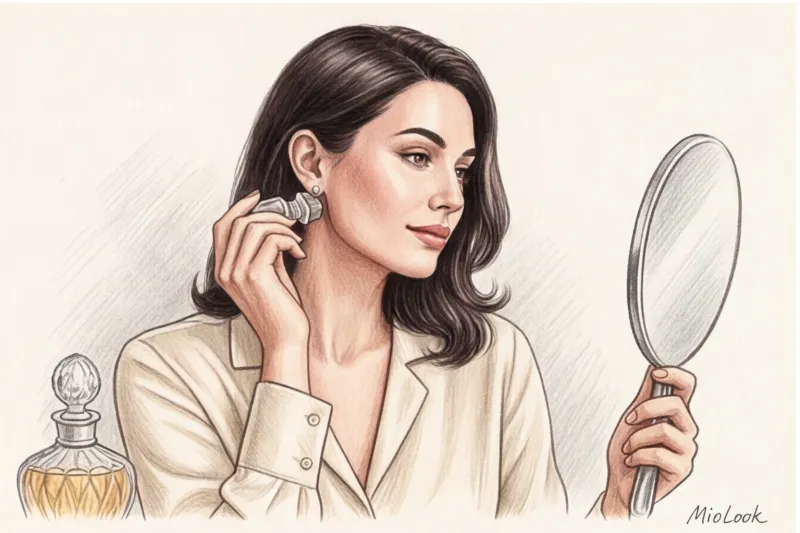
The secret to an elegant and luxurious scent lies not in the number of sprays, but in a precise application pattern. Forget the popular habit of generously spraying the front of your neck and décolleté. Firstly, alcohol dries out delicate skin, and secondly, the scent will constantly assault your nose, causing olfactory blindness. To make your perfume feel like a natural extension of your skin, apply it to discreet pulse points where blood vessels run closest to the surface, gently warming the fragrance oils. A single micro-spray on the back of your neck (just under your hairline) will create a subtle aura that will subtly come to life only when you turn your head. The crook of your elbows and behind your knees are brilliant choices for warmer weather. Warm air rises, and the scent will unfold gradually, enveloping you in a soft cocoon rather than overwhelming passersby.
What should you do if your favorite fragrance has faded by mid-workday? Remember the cardinal rule of perfume etiquette: never renew your perfume at your desk, in an open-plan office, or, worse yet, in a restaurant. A fine cloud of alcohol will inevitably settle on your colleagues' keyboards or the plates of your tablemates. If you need to refresh your scent before an important evening meeting, opt for solid perfumes or rollerballs. These are applied locally, melt with the warmth of your fingers, and don't have a diffuser. If you only have a classic spray bottle at hand, retire to the ladies' room, spray a delicate mist on your wrist, and gently touch it to the back of your neck. Never rub your wrists together—aggressive friction breaks the fragile top notes of the pyramid (especially citrus and floral), irreversibly distorting the perfumer's intention.
To avoid morning rush and olfactory mistakes, I advise clients to visualize their collection. In the app MioLook You can create separate tags for your fragrance wardrobe. By tagging formal business looks with an "office-safe scent," you'll be sure to avoid accidentally pairing a heavy oriental oud with a simple, fine wool suit.
To summarize our guide, I want to emphasize: discovering your "perfume self" isn't an exhausting quest to find the perfect bottle to last a lifetime. It's a fascinating exploration of yourself, your social roles, and your contexts. Start applying this knowledge today: sift through your collection, put aside the "loud" evening essences, and select three delicate fragrances that will become the foundation of your daytime capsule. Remember that true luxury always whispers, not shouts. Let your fragrance be an exquisite mystery you'll want to unravel upon approaching, not a statement that knocks you off your feet right from the door.
Guide Chapters
Cold and Hot Skin: Perfumes and Body Chemistry
Why does perfume smell luxurious on your friend, but harsh on you? It's all about skin temperature and your unique body physiology.
Stylist Tips: How to Choose a Perfume to Suit Your Style
The wrong perfume can ruin the most treasured look faster than worn-out shoes. Learn how to sync your scent with your wardrobe and personality.
Perfume Fragrance Groups: A Complete Note Guide
Fragrance is a powerful, invisible element of your personal brand. Learn how to choose the right perfume to match your look by understanding the main fragrance families.
What is a perfume wardrobe and how many fragrances do you need?
The concept of one fragrance "for life" is hopelessly outdated. Learn how to consciously curate a perfume collection to suit any social role and purpose.
How to choose perfume online: buying perfume without mistakes
Buying perfume blindly often ends in disappointment. Learn how to read fragrance descriptions correctly and choose a perfume online using a precise algorithm.
Niche Perfumery: What It Is and How It Differs from Luxury
We'll explore the differences between niche fragrances and traditional luxury fragrances and how to choose the right one. Learn how to transform your perfume into a stylish, invisible accessory.
How to Choose Perfume by Season: A Fragrance Guide
Wearing the same perfume year-round is like wearing a wool coat in the heat. We'll show you how to create the perfect fragrance wardrobe for any season.
Layering Fragrances: How to Mix Perfumes Properly
Learn how to apply the "base + accent" formula in perfumery. Discover how to salvage failed perfumes and create your own unique scent by blending niche and mass-market offerings.
How to Properly Test Perfume: Mistakes and Rules
Perfume is a complex chemistry, not just a pleasant scent. We'll explain how to test fragrances in the store to find the perfect one without ruining your clothes.
What's the difference between eau de parfum and eau de toilette: a guide to choosing
Think the only difference is longevity and price? Find out how fragrance concentration affects your image and how to choose the right perfume for any occasion.
How to Choose a Long-Lasting Perfume: Secrets to a Long-Lasting Scent
Why does your favorite perfume fade after an hour, and how does skin chemistry affect sillage? We explore the physics of fragrances and learn how to find truly long-lasting perfumes.
The Fragrance Pyramid: What It Is and How the Notes Unfold
Why does my favorite perfume suddenly become stifling after just a couple of hours? We'll explore the structure of a scent and why you shouldn't choose a perfume based on its opening notes.