One of my clients once bought a bottle of niche perfume at Duty Free before an important business trip. She fell in love with the sparkling, juicy grapefruit at first sniff and applied it generously just before landing. Two hours later, sitting in a cramped conference room at a business meeting, she was literally suffocating: not a trace of the citrus remained, and her cashmere jacket emanated a heavy, animalistic scent of patchouli and musk that completely clashed with her formal attire. This story is a classic example of what happens when we choose a perfume based on its first few minutes, ignoring its true structure.
When clients ask me: What is a fragrance pyramid? And why perfumes change so insidiously throughout the day, I always suggest viewing perfumery not as magic, but as both physics and style. The way your scent unfolds should sync with your work schedule and even the texture of your clothes. We've covered more about finding your unique fragrance code in our complete guide: How to Find Your Scent: Secrets of the Perfumery Self.
Let's break down the concept: what is a fragrance pyramid in simple terms?
The olfactory pyramid is a classic French model for constructing perfumes, devised in the late 19th century (Aimé Guerlain is credited with establishing this standard with the creation of Jicky in 1889). But behind this beautiful term lies simple physics—the weight and size of molecules.
Imagine a sieve. Small, light molecules (citrus, greenery) pass through instantly—they evaporate quickly from your skin, and we smell them first. Larger molecules (flowers, spices) linger longer. And the heaviest and largest molecules (resins, woods) settle on the skin in a thick layer and take hours to evaporate. It is this difference in volatility that perfumers have beautifully captured in the metaphor of a three-tiered pyramid.
"The notes you read in a fragrance press release aren't a list of actual ingredients. They're olfactory illusions. Cashmere essential oil, sunlight, or sea breeze don't exist in nature. They're the masterpieces of chemists, assembling a chord from dozens of synthetic molecules so your brain recognizes the desired image."
So when you read a fragrance description, remember: you're looking at a marketing card, not a recipe.
Top Notes: First Impressions and the Marketing Trap
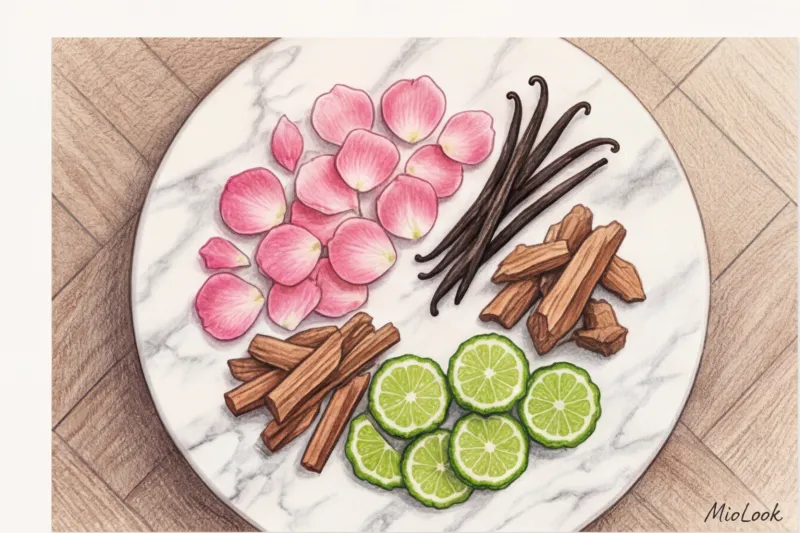
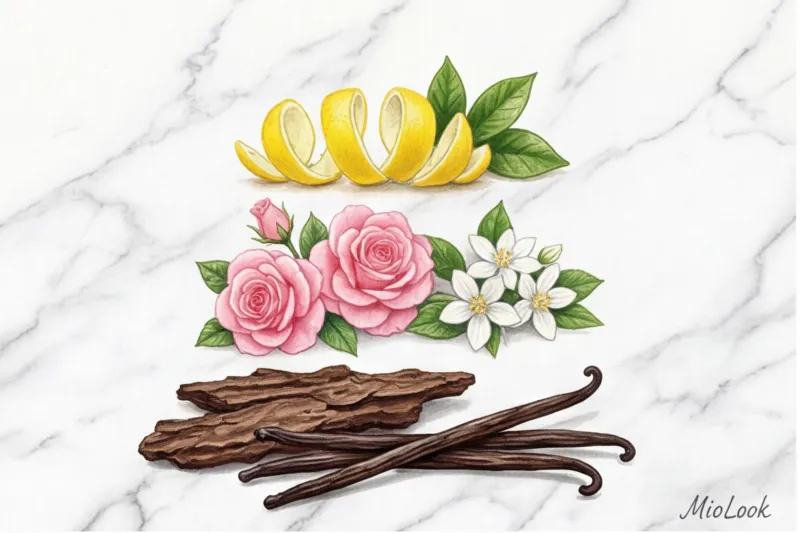
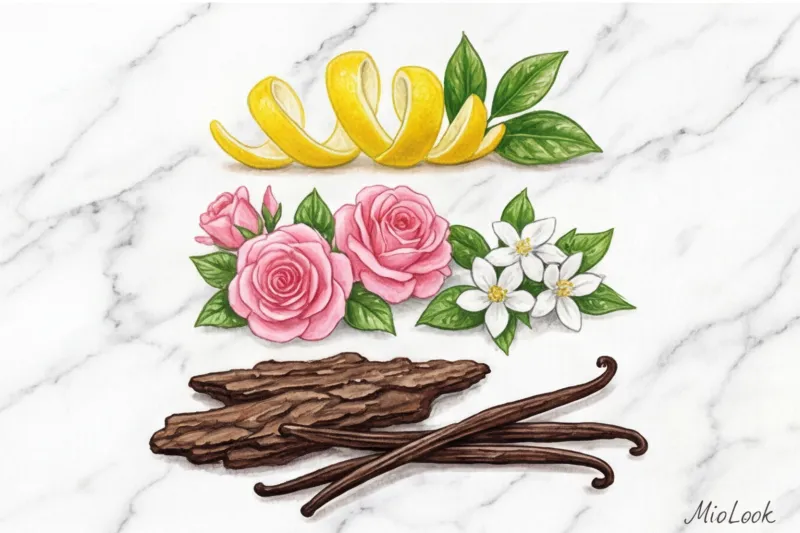
Top notes are the vanguard of your perfume. They last from 5 to 30 minutes and consist of the lightest, most volatile components: bergamot, lemon, mint, basil, light berries, and aquatic accords.

From an industry perspective, the main function of top notes is to sell you a fragrance. According to internal research by major perfume companies (such as Givaudan and Firmenich, 2023), approximately 70% of impulse purchases in perfume boutiques occur within the first 10 minutes of testing. A person sprays the fragrance on a blotter, feels a burst of freshness, experiences a dopamine rush, and then heads to the checkout.
As an image consultant, I always warn you: buying a perfume based on its top notes is like buying an apartment based on its beautiful front door. You don't know what awaits you inside. Top notes create only a fleeting mood while you're riding in the elevator or drinking your morning coffee. By the time you walk into the office, they'll have left only a faint echo.
Access to MioLook for €0.99 — one-time payment
A smart AI stylist will select the perfect look to suit your mood and perfume.
Get access — €0.99 onceHeart notes (middle notes): the character and essence of your image
When the citrus fireworks subside, the heart notes take center stage. This is the core of the composition, lasting from two to five hours. Here reside florals (rose, jasmine, ylang-ylang, tuberose), fruits (peach, plum), and spices (cardamom, cinnamon, black pepper).

The middle notes are what your colleagues, negotiating partners, and friends will smell at lunch. Therefore, when choosing a fragrance, I always start from the purpose of your look at this time.
- For a strict business look: Choose fragrances with a "cold" heart. Iris (gives a feeling of expensive powder and purity), violet, geranium, or cool spices (cardamom). They create distance and convey composure. By the way, such a perfume will perfectly complement a well-chosen business makeup.
- For networking and communication: Warm heart notes—peach, jasmine, and neroli—are ideal. They are inviting and soften barriers.
Important limitation: This rule doesn't work for all skin types. On so-called "hot" skin (with close blood vessels and a tendency to warm up quickly), the heart notes may unfold too aggressively and sweetly, turning the austere iris into a suffocating powder. Always test the fragrance on yourself, not on paper.
Base notes: a trail that remains in the memory
The base is the foundation. It begins to smell 3-4 hours after application and can linger on the skin for up to 24 hours and on clothing for weeks. It contains the heaviest molecules: woods (sandalwood, cedar, oud), resins, amber, musk, vanilla, and patchouli.
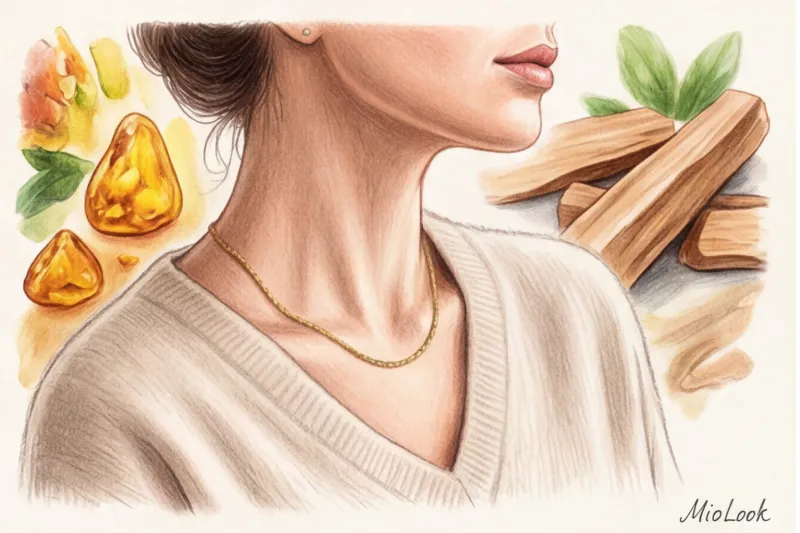
Base notes serve a dual purpose. First, they act as fixatives, preventing the lighter notes from evaporating too quickly. Second, they create that sillage that lingers in the air after you leave the room.

This is where the main secret to individual sound lies. Base notes react most actively with the secretions of your sebum. The same musk will smell like a clean, ironed shirt on one woman and a sharp, animalic scent on another. Therefore, buying a perfume "like your friend's because it smells divine on her" is the most common mistake I encounter in my practice.
Busting the Myths: Why the Classic Fragrance Pyramid is Outdated
And now for a counterintuitive fact that's rarely written about in glossy magazines: the classic three-tiered pyramid is today more of a tribute to tradition than a true reflection of the structure of modern perfumes.
The eminent perfumer Jean-Claude Ellena (formerly Hermès's chief nose) has repeatedly noted in his books that modern olfactory chemistry allows for the creation of fragrances with entirely different architectures. Several alternative structures dominate the market today:
- Linear fragrances. They sound absolutely identical from the first to the last second. What you smell when spraying will stay with you even after 8 hours. This is ideal for those who don't like surprises in the opening.
- Spherical (kaleidoscopic) aromas. In them, the notes don't alternate one after another, but appear, disappear, and return again, pulsating according to body temperature. Many Chanel creations are a prime example.
- Molecular perfumery. Fragrances built around one or two giant synthetic molecules (for example, the famous Iso E Super from Escentric Molecules or Ambroxan). They don't have a pyramid at all and act as enhancers of your own skin scent.
Your perfect look starts here
Join thousands of users who look flawless every day with MioLook, combining their wardrobe, makeup, and perfume.
Get access — €0.99 onceA Stylist's Guide: How to Properly Test Perfume, Knowing Its Structure
Considering all the transformations a perfume undergoes, testing it should be strategic. Forget about spraying it on in the store and then heading straight to the checkout.

Here's my tried and tested "8-Hour Rule" for my clients:
- Blotter - for filtration only. A paper strip at the store is only needed to filter out fragrances you're clearly not comfortable with. The paper is cold and has no pores or sebaceous glands. On a blotter, base notes (especially musks) often don't develop at all or sound flat.
- Application to skin. Have you chosen two favorites? Apply one to your left wrist and the other to your right. Avoid rubbing your wrists together! Friction heats the skin and disrupts the scent's initial release, causing the top notes to evaporate in seconds.
- Exiting the store. Get out of the perfume boutique, where the air is oversaturated with molecules that distort perception.
- Monitoring. Smell your wrists after 15 minutes (the top notes have faded), after 2 hours (the heart has opened), and in the evening before your shower (the base remains). If you like the scent at all three stages, it's yours.
Also consider the season: in hot weather, like +30°C, the pyramid "burns" twice as fast. A light citrusy cologne will disappear in an hour in the summer, but in the winter, in the freezing cold, it will sparkle with crystal clarity all day long.
Perfume Wardrobe: How Fabrics Affect the Development of Notes
As a stylist, I can't help but touch on the interaction between fragrance and clothing. In my experience, eight out of ten women don't realize that fabric is as much a player in the fragrance game as leather.

When I help clients digitize their closet and create looks in an app MioLook , we always discuss the rules for combining textures and perfumes:
- Silk, viscose and fine cotton. These smooth fabrics are the perfect canvas for top and middle notes. They don't trap heavy resins. A flowing silk blouse pairs perfectly with similarly flowing fragrances: aquatic, light white florals, and citrus.
- Wool, tweed and cashmere. They're true perfume magnets. The wool fibers tightly capture the heavy molecules of base notes (vanilla, amber, wood) and can hold onto them for weeks. If you spray a heavy oriental oud perfume on a cashmere sweater, be prepared that tomorrow you won't be able to wear that lightly floral sweater—the oud base will overpower everything.
Practical advice: To avoid ruining expensive clothing (perfume oils often leave yellow stains on light-colored silk), apply the perfume to your skin 5 minutes before putting it on. Alternatively, spray the fragrance as a cloud and step into it—this will distribute the droplets into a microscopic, safe layer.
Understanding the structure of the fragrance pyramid transforms you from a passive consumer into a conscious creator of your own style. Perfume is more than just a pleasant-smelling liquid in a bottle. It's an invisible accessory with its own timing, its own weight, and its own rules for interacting with your wardrobe. By learning to read this structure, you'll never again be held hostage by beautiful top notes disappearing on the way to an important meeting.