Just last week, my client Anna, a top manager at an IT company, poured nearly half a bottle of Baccarat Rouge 540 on herself before an important meeting. When I delicately asked if the scent was too strong for a morning meeting, she was genuinely surprised: "I couldn't smell it at all after five minutes! The perfume must have worn off." Spoiler alert: it didn't. But Anna's colleagues in the meeting room could barely breathe.
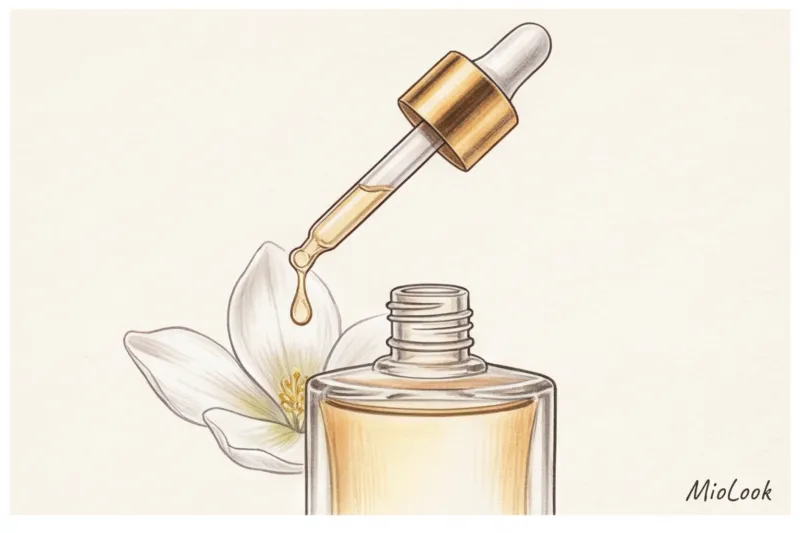
This situation is a classic example of how we confuse longevity, sillage, and the simple fatigue of our own receptors. If you're tired of spending money on bottles that seem to wear off within an hour, this article is for you. Today, we'll explore the physics of fragrances and find out... How to choose long-lasting perfume , based on science and skin chemistry, not on brand marketing promises.
Incidentally, Anna's problem also stems from her habit of wearing the same perfume every day. We've written more about this phenomenon and why the concept of wearing one fragrance for life is hopelessly outdated in our the complete guide to finding your perfume "I".
The Anatomy of Longevity: Why Some Fragrances Fade While Others Stay
Let's start with the biggest perfume myth. Sales associates often say, "Get Extrait de Parfum (perfume) or Eau de Parfum (EdP); they're more concentrated, meaning they'll last longer and have a longer sillage than Eau de Toilette (EdT)." This is only half true.
The durability does depend on the concentration of oils, but train (How far a scent carries) depends on the volatility of the molecules and the amount of alcohol. Extracts contain a lot of heavy oils and little alcohol. They lay on the skin in a thick layer and feel very intimate. Eau de toilette, on the other hand, contains more alcohol and, as it evaporates, literally pushes the scent molecules into the air, filling the entire room.
According to the International Fragrance Association (IFRA), the key factor in longevity is the molecular weight of the ingredients:
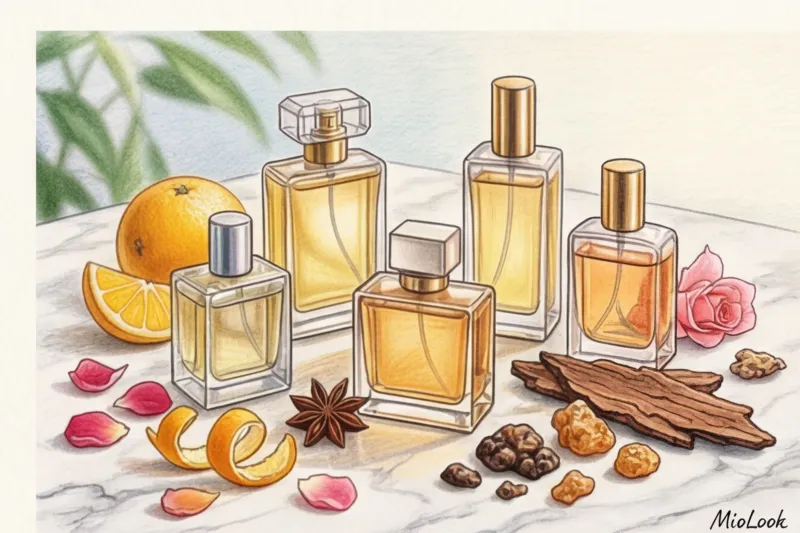
- Light molecules (citrus, green, aquatic): They evaporate within 15–30 minutes. It is physically impossible to keep them on the skin for 24 hours.
- Medium molecules (flowers, fruits, spices): live from 2 to 4 hours.
- Heavy molecules (resins, wood, musk): can last up to 48 hours, as they evaporate extremely slowly.
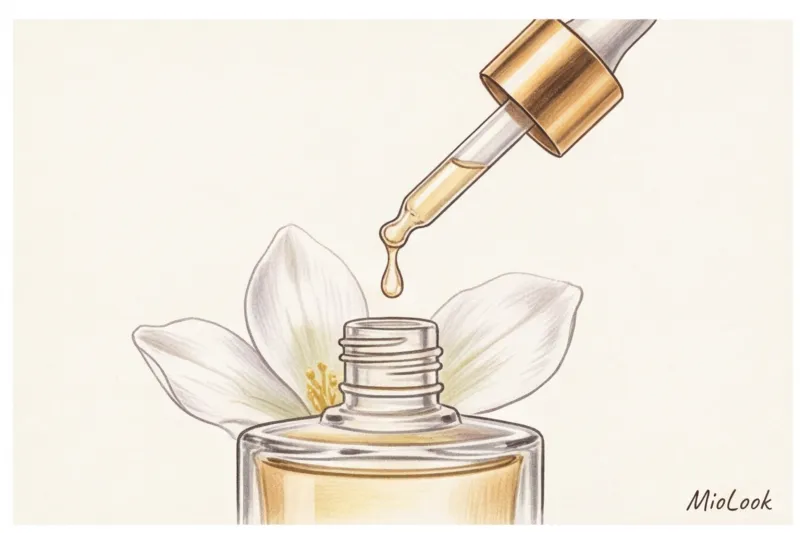
Modern perfumery has solved the problem of rapid fading with synthetics. Molecules like Ambroxan or Iso E Super act as an invisible scaffold. They not only smell themselves (often with a woody, ambery quality), but also anchor lighter notes to the skin, prolonging their life.
Your perfect look starts here
Join thousands of users who look flawless every day with MioLook. A smart AI stylist will help you choose the perfect wardrobe.
Get access — €0.99 onceHow to Choose a Long-Lasting Perfume: Read the Pyramid, Not the Label
If you're looking for a scent that will last through work, exercise, and dinner, stop looking at the "Eau de Parfum" label. Look at the base of the pyramid.
Many women are looking for a "long-lasting, fresh scent with lemon and cucumber notes." As a stylist, I have to tell you the truth: you're looking for a physical impossibility. If a fragrance is 80% citrus and aquatic, it will disappear by lunchtime. This doesn't mean the perfume is of poor quality. It's the laws of physics.
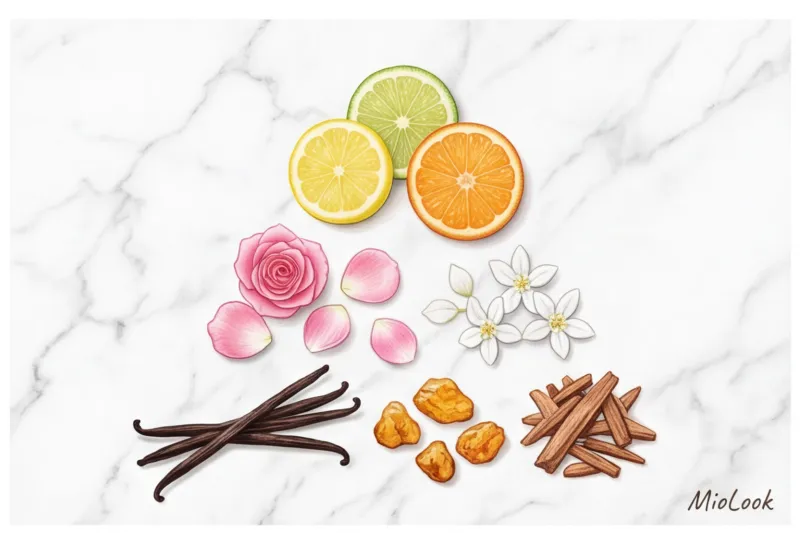
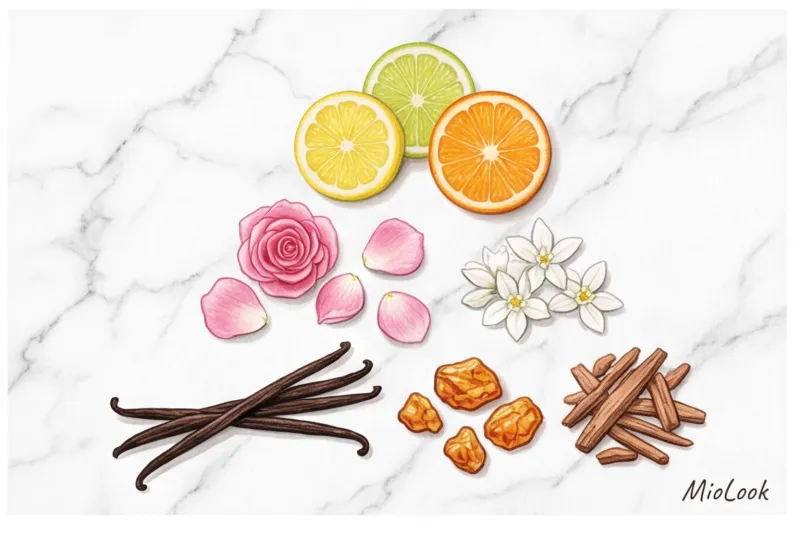
For a fragrance to last long, its base must contain powerful fixatives. These are what remain on the skin after the top and heart notes have evaporated. When reading the ingredients before purchasing, pay attention to the base of the composition.
Ingredients that hold the record for longevity
- Oakmoss and Patchouli: They leave an earthy, deep trail. A classic chypre fragrance.
- Vetiver and cedar: dry woody notes that last well even on hot skin.
- Amber and vanilla: sweet, resinous components that can even survive a shower.
- Synthetic musks: create a “clean body” effect and can linger on clothing for weeks.
Sillage and Longevity are not the same thing
In the perfume community, there is a clear distinction between these concepts that is rarely communicated to ordinary consumers.
Longevity — this is how long the fragrance lasts on your skin. You can nuzzle your wrist after 12 hours and still smell vanilla. But those around you won't notice.
Sillage — it's a comet's tail. It's that same effect when you step out of the elevator and your scent lingers there for another five minutes.

"In a business environment, a long sillage is a violation of personal boundaries. For the office, choose long-lasting, but not diffuse, fragrances (those same extracts or oil-based perfumes). They create an aura that's within arm's reach without triggering migraines in coworkers."
When creating your professional image, remember that perfume works in tandem with your appearance. If you carefully consider business makeup and a strict suit, a flashy cotton candy train will destroy the whole concept of composure.
Olfactory Blindness: Why You Feel Like Your Perfume Has Faded
Let's return to my client Anna. Why did she stop smelling her perfume? The answer lies in evolutionary biology.
Our brain is designed to respond to changes in the environment. Smell is a signal. When you apply perfume, the receptors send the information to the brain: "A new scent has appeared, it's safe." After 20-30 minutes of continuous exposure, the brain simply turns off the perception of this scent to free up its "processing power" for new, potentially dangerous odors (like smoke).
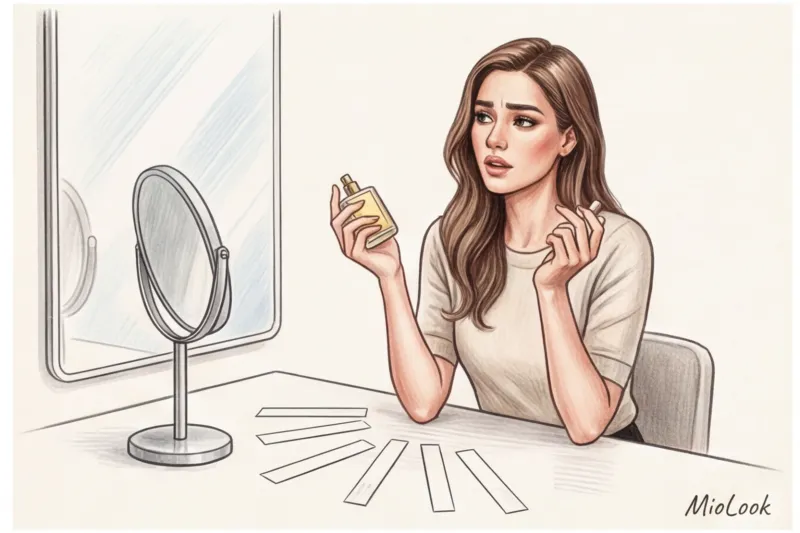
This phenomenon is called olfactory adaptation, or "olfactory blindness." The longer you wear the same perfume, the faster your nose stops noticing it. The result? You start spraying not just two, but five. Then ten. To you, the scent smells "normal," while everyone around you gasps.
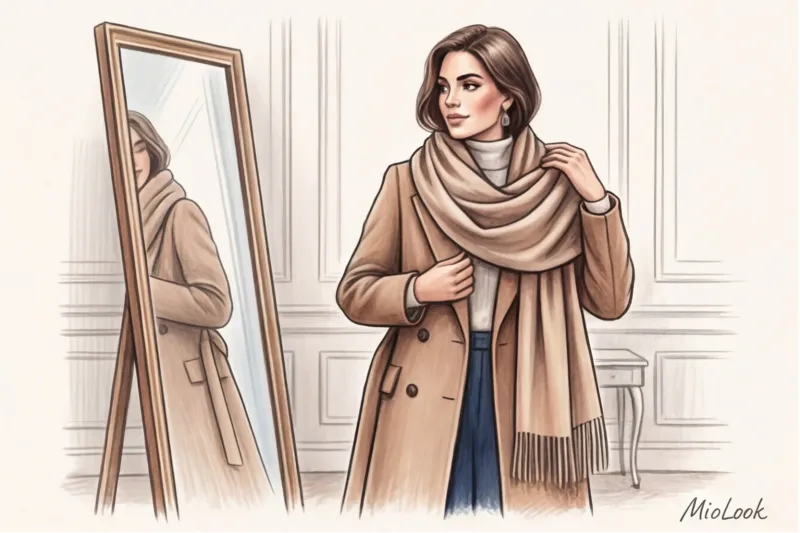
How to deal with this? Create a fragrance wardrobe. Alternate scents from radically different directions. Today it's a strong vetiver, tomorrow it's light white florals. I recommend my clients use the app MioLook Not only for digitizing clothes, but also for planning fragrances—link a specific perfume to an outfit to visually control rotation and give your senses a rest.
Ready to get started?
Try the MioLook free plan—no commitments required. Digitize your wardrobe and plan looks in just a few clicks.
Get access — €0.99 onceApplication Secrets: How to Extend the Sound Without the "Gas Attack" Effect
Even the most expensive and concentrated perfume will disappear within a couple of hours if applied to dry, dehydrated skin. Skin that lacks moisture literally "drinks" the perfume oils.
Over 12 years of working as a stylist, I've developed the perfect application formula that extends the wear of your makeup at least twice as long:
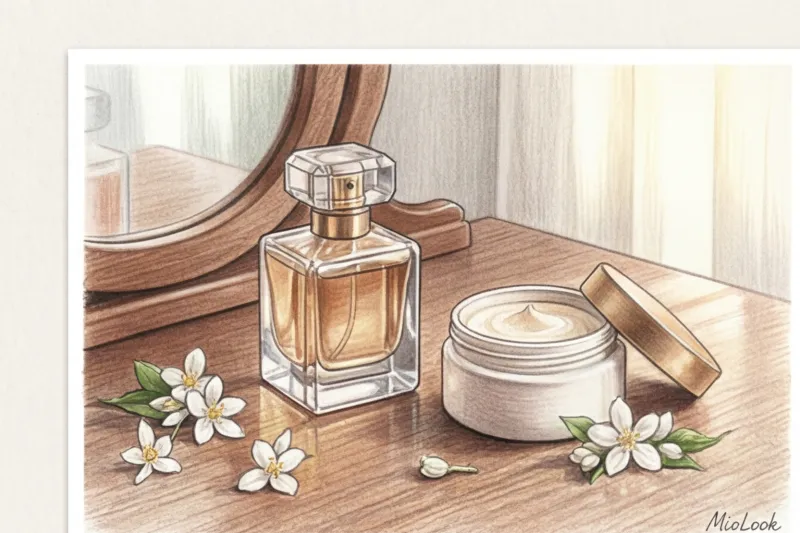
- Moisturizing Rule: Immediately after showering, apply a base lotion without fragrance or a little mineral oil to your body. Let it soak in. Perfume applied over a lipid film evaporates much more slowly.
- Change of location: Stop applying perfume to the front of your neck and décolleté. This is a surefire way to olfactory blindness—the scent constantly assaults your nose. Apply perfume to the back of your neck (under your hair) and the backs of your forearms. You'll catch a beautiful trail of scent when you turn your head, but you won't overload your senses.
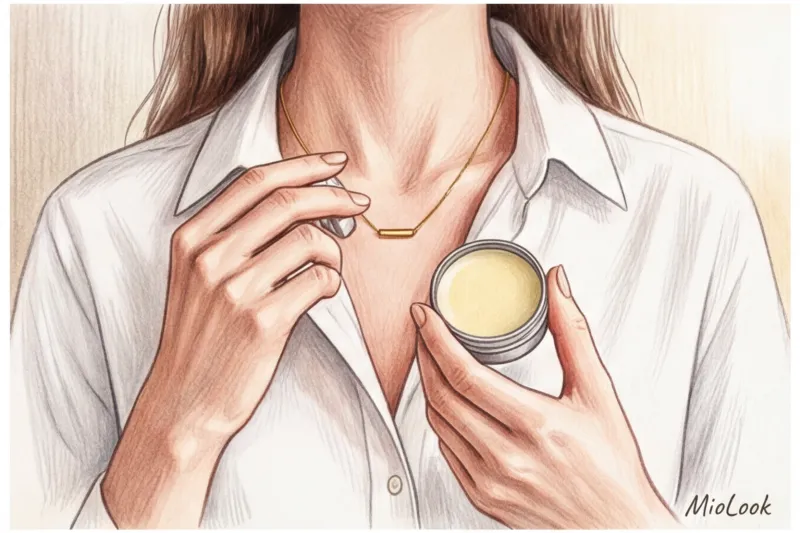
Perfume on Clothes and Hair: Safety Rules
I recently conducted a personal experiment: I sprayed the same woody-floral scent on natural silk, a wool sweater, and my own skin. The results were predictable, but still impressive. On my hot skin, the scent faded in four hours. On silk, it lasted for about 12 hours. But on merino wool, the scent lingered for... three days!
Natural fabrics (wool, cashmere, and cotton with a density of 180 g/m² or more) are ideal carriers of perfume. Their fibers retain oil molecules.
But there is a hard limitation here: Never spray dark-colored perfumes (those with high resin and vanilla content) on white shirts or light-colored silk. The oils will leave yellow stains that no dry cleaner will remove. If you want to scent your clothes, spray a cloud of the perfume and walk into it, or apply the perfume to the inside lining of your jacket.
Checklist: Testing Perfume Before Buying
Impulsively buying perfume at duty-free or at the checkout is a lottery you almost always lose. The paper blotter the salesperson gives you only shows a flat, 2D version of the scent.
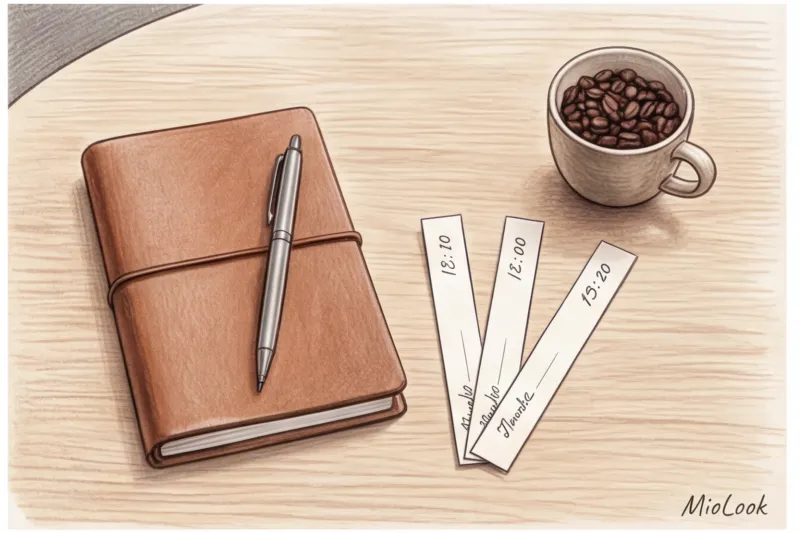
To choose a truly long-lasting perfume that's right for you, use this algorithm:
- No paper: Apply the fragrance candidate to clean skin on your wrist. The paper has no temperature or lipid layer, so it won't reveal how the base will develop.
- The 8-Hour Rule: Leave the store. Seriously, just leave. Let the scent linger for a day. Listen to what's left on your skin after 4, 6, and 8 hours. Often, a luxurious opening turns into a flat, cheap, soapy base.
- Contrast test: It's difficult to evaluate sillage on your own. Step outside into the crisp, frosty air or into a humid room (like a bathroom). The temperature difference will cause the molecules to move differently, and you'll truly understand the fragrance's strength.
Conclusion: Your fragrance is an invisible part of your wardrobe
Finding a long-lasting perfume isn't magic, but an understanding of basic chemistry. Light citrus notes will always be fleeting, while heavy resins will linger. Longevity doesn't always mean mile-long sillage, and the fact that you can't smell your perfume often simply means your nose needs a break.
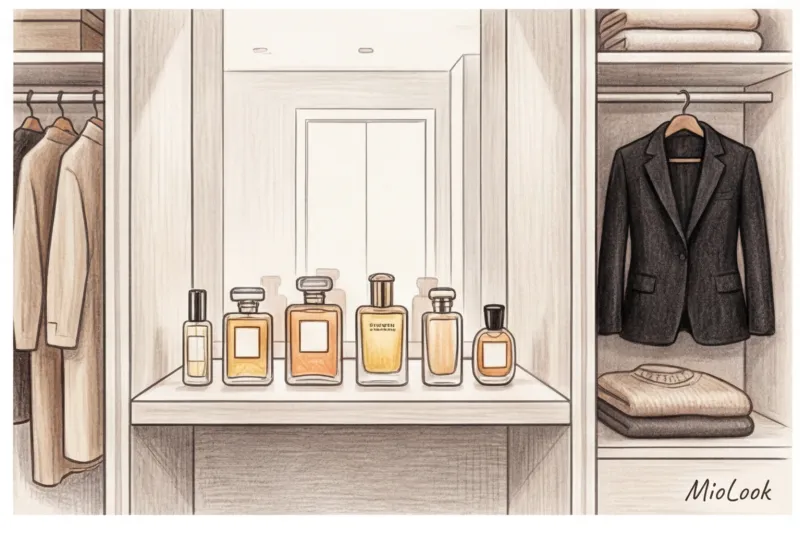
Treat your perfume the same way you would your shoes or handbag. You wouldn't have the same shoes for the gym, the office, and an evening at the theater, right? Similarly, you shouldn't have one scent for every occasion. Build your olfactory wardrobe consciously, alternate scents, and each bottle will smell vibrant, long-lasting, and appropriate.
Access to MioLook for €0.99 — one-time payment
A smart AI stylist will create the perfect look for you. Integrate your perfume wardrobe into your everyday looks.
Get access — €0.99 once