Leather, suede, or faux leather: how to make the right choice for your status
In 12 years of working as a personal stylist, I've learned one ironclad rule: the texture of a material says something about you long before you utter your first word. One of my clients, a top manager at a major IT company, bought a stunning pencil skirt from a cheap mass-market retailer. Visually, it was flawless matte leather. But right in the middle of an important meeting, the polyurethane coating treacherously cracked at the seam from the slightest strain. This awkward moment cost her more than a premium item would have cost.
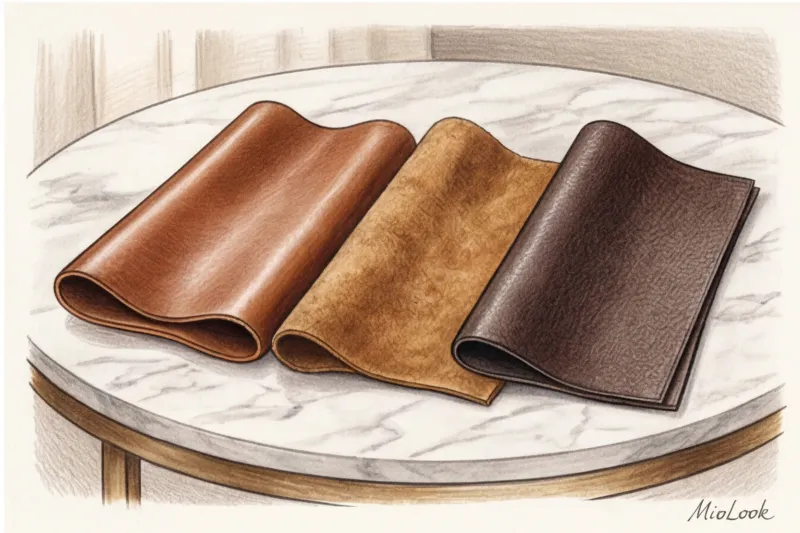
The lesson we learned then, I now repeat to every woman at the first consultation: style is not only about cut, it is about the physics and chemistry of materials. Knowing that How to care for leather items It doesn't start when you buy an expensive beeswax cream. It starts at the store counter, when you decide which texture to invest in your wardrobe.
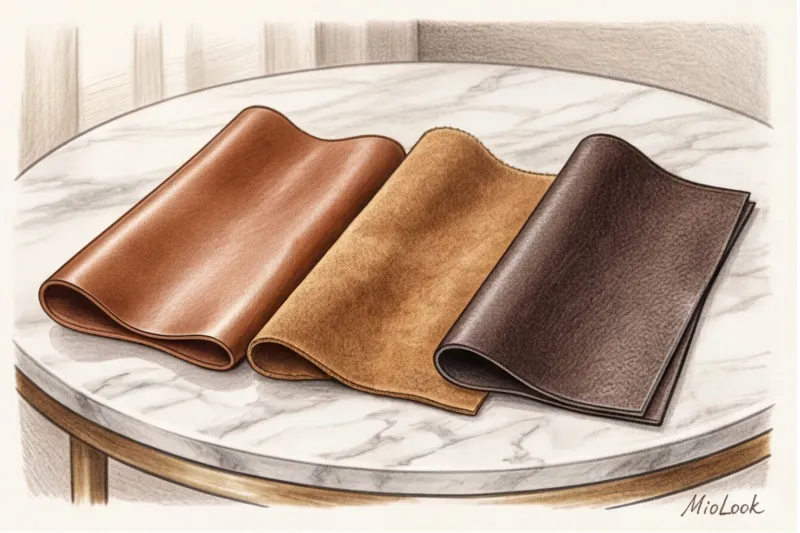
From a style psychology perspective, the materials convey completely different messages. Smooth leather reflects light, creating clear, rigid silhouette lines. Subconsciously, this is interpreted as distance, authority, and control. This is why a classic, high-status bag always holds its shape. Suede, on the other hand, absorbs light. Its velvety texture invites touch, conveying empathy, softness, and that much-talked-about "quiet luxury." Faux leather, on the other hand, thanks to its pliability and the ability to be dyed in any neon or metallic shade, exudes dynamism, adaptability, and a commitment to trends.
Magic happens when you begin to manipulate these meanings, mixing them. My favorite and foolproof style formula: Leather pants + silk blouse + suede pumps = the perfect look for a business dinner Here, the rigidity of leather (authority) is offset by the fluidity of silk (femininity), and the suede on the legs grounds the look, making it inviting but not relaxed. This approach fits perfectly with A woman's basic wardrobe: a status capsule , where every detail should work for your image.
But let's move away from aesthetics and talk about money. My clients know that I make them count. Cost per wear (CPW) is the cost per wear. This is the basis for informed investing.
According to the Sustainable Apparel Coalition's 2023 global report, high-quality genuine leather, when properly cared for, has an active lifespan of 10 to 15 years. Meanwhile, standard polyurethane (faux leather) begins to irreversibly deteriorate (microcracks at the folds) after just 1.5 to 3 years. The math is simple: a $600 designer leather jacket that you wear 400 times over 10 years will cost you $1.50 per wear. A trendy $90 mass-market jacket that will peel at the collar after 30 wears costs $3.00 per wear. A "cheap" item costs you twice as much.
Genuine Leather: Types, Status, and Investments
If you've decided to invest in natural leather, it's important to understand that not all leather is created equal. Manufacturers often misuse labeling. To avoid buying a pig in a poke, let's look at quality grades.
At the top of the hierarchy is Full-grain leather (leather with a preserved natural grain). This is the outermost, unpolished layer of the hide. Natural pores and small scars are visible on it—the material "breathes" and is phenomenally durable. Full-grain is used to make items that are passed down through generations. Below that comes Top-grain The top layer is lightly sanded to remove natural imperfections, and then often artificially embossed (like the famous Saffiano leather). This creates a more uniform appearance but lasts a little less.
"The most dangerous marker on a label is the words 'Genuine Leather.' It sounds proud, but in the industry, it signifies a lower grade. Often, it's split leather—the inner, loose layers of hide, liberally coated with paint and glue. Investing in 'Genuine Leather' is like buying a diamond with a flaw."
The main magic of high-quality full-grain leather is its patina. Unlike plastic, which deteriorates from the day you buy it, premium leather (especially vegetable-tanned) only becomes more beautiful with age. It absorbs the oils from your hands, sun, and moisture, acquiring a deep, uneven tone and softness, adapting to the contours of your body. A vintage Hermès bag or a worn Acne Studios biker jacket look luxurious precisely because of its patina.
To avoid losing control of such valuable assets, I always recommend digitizing your closet. My clients use the "smart wardrobe" feature in the app. MioLook , where they create a separate "Investments" tag. This helps track the cost-per-wear metric and promptly remind you which pair of shoes need to be serviced before the new season.
Eco-leather: Myths about eco-friendliness and real service life
Now let me debunk one of the biggest marketing myths of our time. As a stylist, I often hear the proud phrase, "I only wear vegan leather!" The truth is, the term "vegan leather" is 90% a fancy way of saying "plastic." Most often, it refers to polyurethane (PU) or polyvinyl chloride (PVC) applied to a fabric base.
Yes, animals are not harmed in their production, but claiming the eco-friendliness of a material that's a petroleum product and will take hundreds of years to decompose in a landfill (releasing microplastics) is presumptuous, to say the least. Moreover, polyurethane doesn't breathe. If you've ever spent a summer day in pants made of low-quality faux leather, you understand the "sauna effect" I'm talking about.
Does this mean that I am against artificial materials? Absolutely not! creating a capsule wardrobe Faux leather has its own very specific role. My rule is: Buy eco-leather for trends, and natural leather for the base.
If futuristic metallics are all the rage this season and you're looking for a silver trench coat for a couple of months, go for faux leather (a budget of €100-150 will pay off). If you're looking for a statement pair of neon pants for a party, that's also PU territory. But if you're looking for a classic black tote bag, basic Chelsea boots, or the perfect biker jacket that will serve you faithfully for 5-7 years, choose only high-quality genuine leather or thick suede. Faux leather will inevitably peel off in flakes in areas of high friction (bag handles, elbows, shoe toes), and unfortunately, it cannot be restored.
Basic rules: how to care for leather items every day
Have you ever noticed that even the most expensive pair of shoes can lose their shine after just a month of active wear? When my clients ask, How to care for leather items To make them last for years, I always start with developing healthy daily habits, not with expensive creams. Taking care of your wardrobe investments doesn't require hours—it requires a clear system.
Natural leather is a living, porous material. Over the course of an active day, it absorbs approximately 15–20 milliliters of moisture from your feet (yes, even in cool weather), stretching and molding to the natural curves of your body. That's why a stylist's main rule is a mandatory return-to-home ritual. Your bags and shoes need at least 24 hours of proper "rest."
If you wear the same leather ankle boots two days in a row, the fibers simply don't have time to release accumulated moisture and restore their original molecular structure. The result? Premature stretching, loss of shape, and the development of a persistent, unpleasant odor. Having two or three basic pairs and rotating them isn't a fashionable extravagance, but rather cold, practical math that will ultimately save you money by eliminating the need to buy new shoes every season.
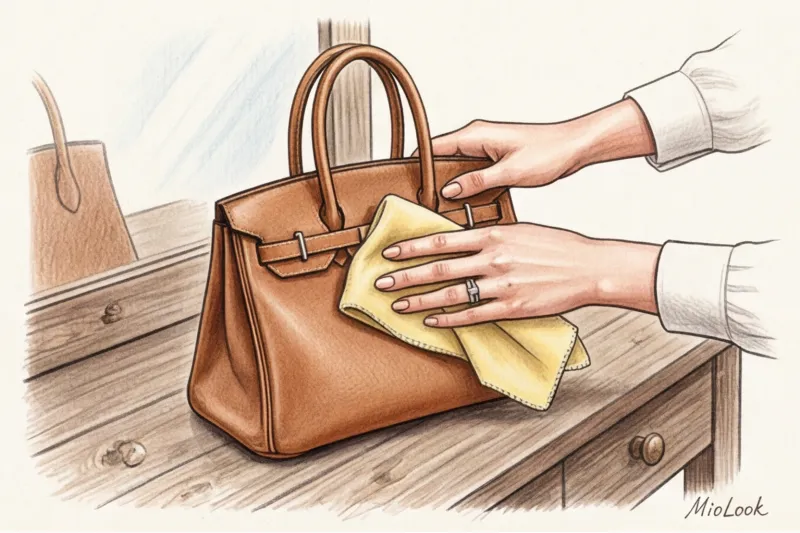
Speaking of shape retention, I had a stunningly revealing experience. Several years ago, I bought two pairs of identical classic loafers for €280. I wore one pair normally, simply leaving them in the hallway each evening, while I meticulously inserted cedar shoe trees into the other pair every time. The difference was dramatic: using unvarnished wood extended the life of the second pair by exactly three times!
The secret is simple: natural cedar acts like a powerful sponge. It instantly draws out all the damaging moisture from the lining and firmly smooths out micro-creases while the leather is still warm and pliable after wear. Wooden shoe trees are an absolute must-have for any closed-toe shoe. Yes, a pair of high-quality shoe trees will cost around $30–40, but this investment literally pays for itself within the first month, forever ridding you of worn-out heels and deep toe wrinkles.
Another crucial aspect of daily care is strict temperature control. I've seen more than one pair of stunning premium calfskin boots ruined in a single frosty night. The reason is simple: the owner left them to dry close to a heat source. Remember once and for all: a radiator, a powerful heater, or underfloor heating are the worst enemy of any leather. Aggressive and rapid heating rapidly evaporates the material's natural oils and tannins. Collagen fibers shrink, become brittle, and a network of deep microcracks appears on the smooth surface, which no restorer can repair.
Leather should only be dried at room temperature. If you get very wet in the rain, simply stuff your shoes tightly with clean, uncoated paper (it will quickly absorb the water from the inside) and lay them on their sides away from direct heat.
Access to MioLook for €0.99 — one-time payment
A smart AI stylist will select the perfect look for every day and help you create a functional wardrobe.
Get access — €0.99 onceThe Wardrobe's Main Enemy: Why Silicone Sponges Are Ruining Your Shoes
Now let's be honest about what should be thrown out of your hallway today. You know those cheap foam sponges in clear plastic containers sold at the checkout line at any supermarket? The manufacturers promise "instant mirror shine in 5 seconds," and technically, they're not lying. But the price of this quick effect is the slow and painful death of your favorite shoes.
The destruction mechanism here is extremely insidious. These express sponges are generously saturated with cheap silicone oil. When you rub them over your shoes, the silicone creates a dense, completely impenetrable synthetic film on the surface. While the shoes may shine, the pores of the leather become clogged. The material completely stops "breathing" and loses its ability to absorb high-quality care creams in the future.
Silicone on natural leather is like a thick layer of theatrical makeup left on your face for weeks. Underneath, the material suffocates, drastically drying out from the inside, and the slightest bend of your foot causes deep, irreparable creases to form.
Moreover, street dust and micro-sand adhere to the sticky silicone layer twice as readily. As a result, a true abrasive paste forms on the surface, mercilessly scratching the paint with every step.
How can you replace these toxic, quick-fix products? Switch to mindful care: use a high-quality cream based on natural beeswax, shea butter, or almond oil. Wax works completely differently: it gently nourishes the fibers at a deep level, restores natural elasticity, and creates a natural water-repellent barrier without blocking oxygen. Yes, applying a good wax cream and then polishing with a soft horsehair brush will take you about three minutes instead of five seconds. But this short, meditative ritual is the best guarantee that your items will retain their pristine, luxurious appearance for years to come.
Seasonal care for natural leather: from winter salt to summer sun
You know what always amazes me? We meticulously change our personal skincare routine with the changing seasons—switching from lightweight fluids to thick cold creams when the weather gets cold. But when it comes to expensive bags and shoes (which, remember, are also leather!), we somehow use the same cream year-round. If you really want to know how to care for leather items so they can survive both the arctic cold and the tropical heat, you'll have to implement a seasonal beauty routine for your wardrobe.
Winter is an extreme crash test. The main enemy here isn't even moisture, but harsh chemicals. Most of my new clients before meeting us made a fatal mistake: they sprayed on a water-repellent spray five minutes before leaving the house. This doesn't work, as the product simply evaporates from the surface.
The golden rule of protection against reagents is to apply the impregnation in strictly 3 layers with breaks:
- First layer: Spray the product (for example, nano-sprays from Tarrago or Saphir) onto clean shoes. It will be absorbed into the pores. Wait for 20–30 minutes.
- Second layer: Apply again. This step fills microcracks and evens out the texture. Leave on for another 30 minutes.
- Third layer: the final spray, which creates that invisible hydrophobic film. Drops of dirty snow will simply bounce off the material. This should be done in the evening to allow the impregnation to cure overnight.
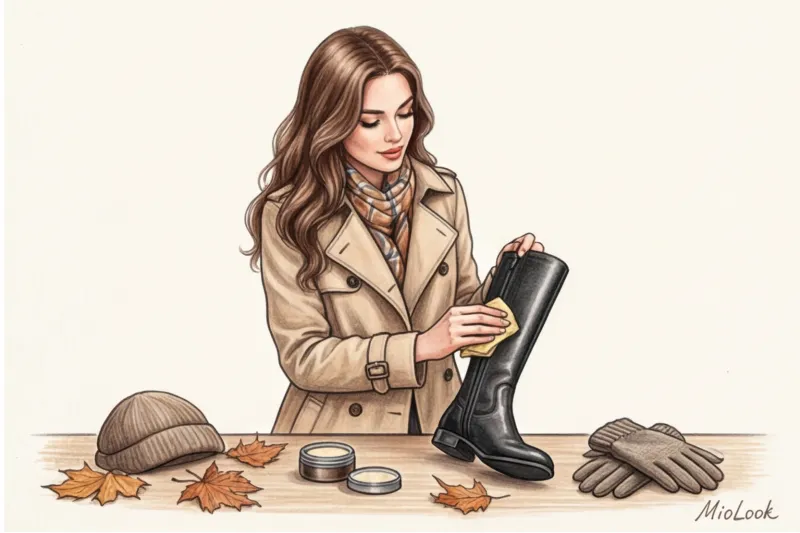
But what if disaster has already occurred and you've fallen into a puddle of salt slush? Expensive shoes instantly develop a white outline that tightens the material. Last year, I discussed this issue with the chief technologist at a Milan-based luxury shoe restoration workshop. He shared step-by-step instructions for removing white salt stains from leather.
"Salt is an alkali, and you can't simply wash it off with soapy water or cover it with cream. The cream will only 'seal' the chemical inside the pores, causing the skin to rot from the inside. You need a neutralizer—a weak acid," the restorer explained.
Rescue instructions: Mix regular white vinegar with clean water in a 1:2 ratio. Soak a cotton pad in this vinegar solution and gently blot the white stains (never rub). The vinegar will react with the salt, gently drawing it to the surface. Afterward, be sure to wipe the shoes with a damp, lint-free cloth. And most importantly, dry them properly. No radiators or hair dryers! Insert wooden cedar shoe trees (they will absorb excess moisture from the inside) and leave the pair at room temperature for 24 hours.
Now let's fast forward to July. Summer: UV protection. For some reason, it's commonly believed that leather shoes and bags are safe in the summer. However, the scorching sun dries out the natural oils within the material much faster than winter heating. Yes, leather also needs its own special SPF and intensely moisturizing lotions to prevent dryness.
This is especially true for brightly colored bags and pastel-colored shoes—direct sunlight causes the pigment to break down unevenly, causing dry microcracks to appear at the folds. For the summer, put away those heavy winter waxes. Replace them with light, moisturizing lotions based on aloe vera, jojoba oil, or lanolin (Crème Universelle is a great example). They work as a good after-sun moisturizer, restoring the elasticity of the material.
By the way, a little life hack from a stylist: when I carry out a seasonal wardrobe change and digitize a client’s capsule through MioLook I always add the "apply lotion before wearing" tag to summer leather items. This saves you from unpleasant surprises when you pull out a perfect €400 crossbody bag, only to find its strap cracking and creaking in your hands from months of dryness.
Tricky suede: step-by-step instructions for saving and caring for it
How many times have you passed up buying the perfect camel ankle boots or the softest shirt jacket simply because "in our climate, it's only beautiful until the first puddle"? As a personal stylist, I encounter this fear all the time. Women sigh heavily, put the luxurious item back on the shelf, and obediently go buy yet another pair of boring smooth leather boots. Spoiler alert: you're voluntarily depriving your wardrobe of the most noble and prestigious textures, relying on outdated myths.
My client Elena, a senior partner at a law firm, was terrified of suede. Her business wardrobe was impeccable, but the texture was completely predictable. I practically forced her to buy a pair of deep burgundy suede loafers for €320—they were vital to softening the formality of her favorite wool suits. I gave her a 15-minute masterclass right there in the fitting room. I simply handed her a crepe brush and demonstrated the basic mechanics of cleaning. That moment changed everything: suede now makes up about 40% of her shoe wardrobe, and she confidently wears them even in the slushy autumn weather.
The secret to this boldness lies in modern chemistry. Suede is indeed a porous material, but it's completely wearable if you use the right nano-impregnations. Forget cheap sprays from the supermarket! High-quality products are based on fluorocarbon resins. Independent tests by shoe technologists prove that these compounds don't stick the pile together or impair air circulation. They envelop each microscopic fiber in an invisible polymer mesh. As a result, water, spilled coffee, or liquid street dirt simply form round beads and roll off the surface like mercury.
To maintain this effect and avoid problems, you'll need a specialized arsenal. Your basic suede makeup kit should include three tools:
- Crepe brush: Natural rubber (crepe) tape is an absolute must-have. Rubber has a natural stickiness: it won't scratch the skin, but gently draws dust out of the nap while simultaneously lifting it.
- Special eraser: Works like an eraser, but for localized, dry stains. Ideal for erasing a dark streak from a shoe sole or mud splashes on a bag.
- Brass bristle brush: Heavy artillery for stubborn bald spots. If the pile has become shiny from friction (for example, on the heel of a car mat), brass will gently comb it out. Important limitation: Use it without applying pressure, otherwise you will simply pull out the fibers by the roots.
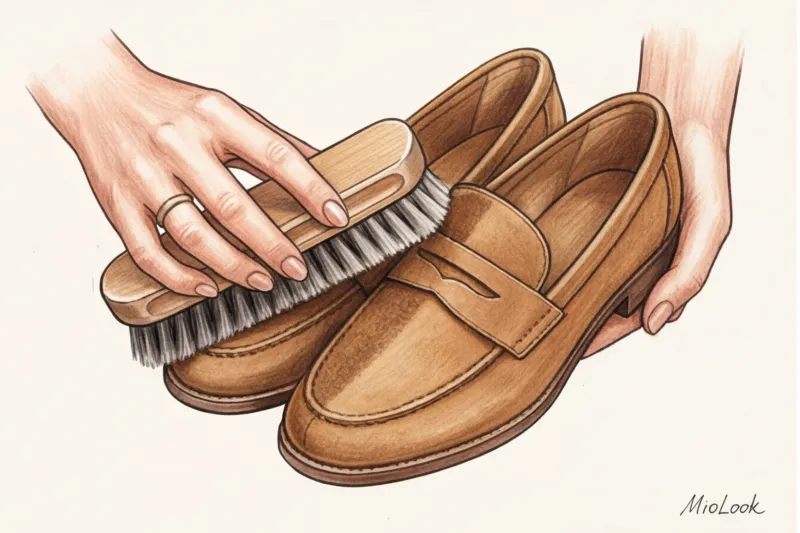
Now let me dispel the most ingrained stereotype: "You can't get suede wet." This is absolutely untrue. Suede can and should be washed if it's covered in deep, ingrained dirt. The key is to use high-quality saddle soap or a specialized shampoo for napped leather.
"The biggest mistake when washing suede is over-wetting. You should wash your shoes with foam, not water." This rule, which I once heard from a shoemaker with a long history in Florence, has saved more than one pair of my shoes.
The secret to saddle soap is its blend of natural oils and glycerin. You whip up a rich lather, apply it with a stiff brush using circular motions, and then remove the residue with a slightly damp microfiber cloth. The oils cleanse dirt without allowing the collagen fibers to dry out and shrink. Understanding these nuances will radically change your approach to caring for your leather, turning it into a mindful process.
Try MioLook
for free
Start creating perfect images with the help of artificial intelligence
Get access — €0.99 onceHow to restore suede's velvety feel after rain
Even if you're caught in a heavy downpour and forgot to reapply the sealer, it's easy to revive the item. When suede dries after being heavily wet, its nap clumps together, becomes stiff to the touch, and looks "cardboard-like." At this point, never try to aggressively scrub the material with a wire brush—you'll leave scratches.
Your best ally in this situation is regular steam. This elegant trick is used by professional restorers around the world. Use a handheld garment steamer or simply boil a kettle:
- Hold your shoes or bag 15–20 centimeters away from the steam source. The material should be exposed to warm, moist air, but no condensation (large droplets of water) should form on it.
- A 15-20 second treatment per area is sufficient. The combination of heat and micro-hydration instantly relaxes the skin fibers.
- Immediately, while the suede is still warm, brush it against the grain with a crepe brush.
You'll see the magic with your own eyes: the "stiff" material will become incredibly soft, voluminous, and velvety again before your very eyes. It only takes a couple of minutes, but the visual effect is comparable to an expensive professional dry cleaning.
Caring for eco-leather: how to extend the life of polyurethane
Let's be honest. What many brands elegantly call "vegan leather" today is, chemically speaking, 95% of the time polyurethane (PU) applied in a thin layer to a fabric base. And this is where the main pitfall for consumers lies. When we discuss... How to care for leather items I always emphasize this fundamental rule: methods for saving natural materials are absolutely unsuitable for artificial ones. They are completely different universes.
Genuine leather has a porous structure—it literally "breathes," losing and absorbing moisture. Polyurethane is, roughly speaking, an elastic plastic. Trying to apply an expensive carnauba wax-based cream to an €80 mass-market jacket is like moisturizing a plastic bottle with lotion. Faux leather is non-porous and doesn't absorb anything, so "nourishment" is useless. The cream will simply remain on the surface as a sticky film, collecting all the street dust and hopelessly ruining the garment's appearance.
What's truly dangerous about this synthetic material? According to research by the Textile Testing Institute (2023), polyurethane's main enemies are mechanical friction and sudden temperature changes. At temperatures below -15°C, the polymer layer hardens, loses elasticity, and becomes brittle. And when in close contact with a hot radiator, it dries out and begins to peel off the textile base.
Faux leather crossbody bags are a particular pain for stylists in the winter. If you wear one with a long strap over a bulky down jacket made of stiff nylon or a jacket with rough seams, the constant friction from walking will wear away the bag's outer covering in just a month. The paint will inevitably peel off, revealing the white fabric underneath. My professional advice: during down jacket season, carry faux leather bags in your hand (such as tote bags) or choose baguettes with a short strap under your arm, where movement and friction are minimal.
So how do you clean these items if traditional shoe polishes are off-limits? Forget about harsh chemicals, alcohol wipes, or harsh stain removers—solvents will simply melt the top polymer layer. Your best arsenal for gentle cleaning is a high-quality microfiber cloth and a mild soap solution (clear, dye-free baby shampoo is ideal). The process is simple: wipe the stain with a slightly damp, well-wrung-out microfiber cloth, and then—be careful, this is critical— wipe the surface dry immediately With a clean cotton cloth. Moisture should never be allowed to accumulate in the seams or be absorbed into the fabric base.
To avoid accidentally ruining your favorite polyurethane trench coat with a water-repellent treatment designed for natural suede (and such tragedies have happened more than once in my practice), it's important to always remember the exact composition of each item. I strongly recommend my clients digitize their wardrobes. Add your items to MioLook and immediately indicate the material in the card. This simple habit eliminates a lot of headaches when caring for items and helps you plan outfits based on the true lifespan of your investments.
Wardrobe Investments: How to Properly Store Leather Items in the Off-Season
According to a 2023 report by the Guild of Italian Restorers, over 70% of irreparable damage to expensive accessories and outerwear occurs not on the street, but in our own closets. We can spend €800 on the perfect leather jacket or a prestigious tote bag, and then commit a true fashion crime by storing them in completely unsuitable conditions for six months. Ultimately, the secret to caring for leather items during their "hibernation" period determines one simple thing: whether you'll unearth a luxurious piece with a refined texture next fall or an overdried piece with a lingering musty smell.
Let me start with the main no-no. Dry-cleaning plastic covers are absolute death for any genuine leather. Leather is a porous, organic material that vitally requires oxygen to maintain its elasticity. By wrapping a jacket, raincoat, or bag in tight plastic, you instantly create a greenhouse effect. Any residual condensation turns to moisture with the slightest temperature change, and moisture in the dark is a guaranteed mold problem. Removing mold spores from the deep layers of the leather is virtually impossible, even in a professional repair shop.
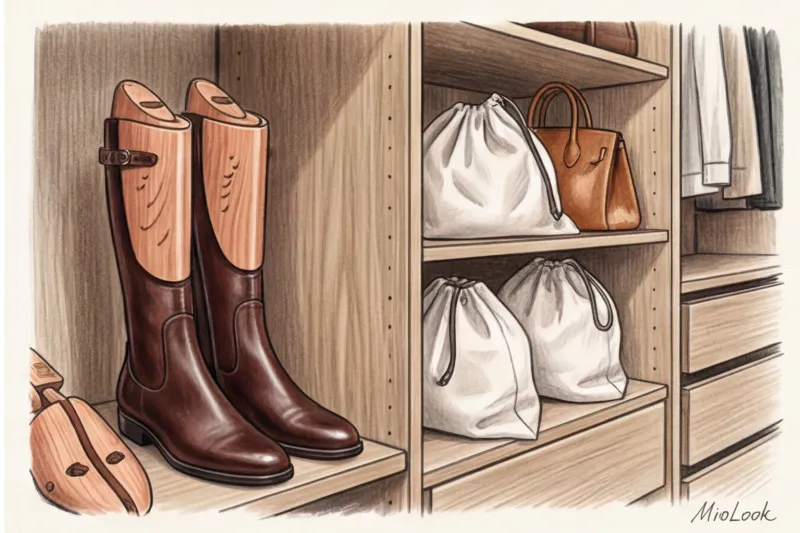
Your only alternative is strictly breathable cases and dust covers. Covers made of undyed cotton, heavy linen, or high-quality spunbond are ideal. They perform a dual function: they reliably protect the pigment from fading in the light and block dust, while still allowing the item to breathe freely.
Preparing for hibernation requires a certain ritual. You can't simply take off your favorite trench coat at the end of May and hang it in the far corner of your closet. Over four to five months of storage, microscopic particles of street dust, smog, and sebum from your hands will be absorbed into the coat, destroying the fiber structure. First, we deep cleanse it with a special lotion, then fatliquoring it. For bags and outerwear, I use thick balms with added mink oil or beeswax. We apply the product in a thick layer, let it soak in for a day, and then polish it with a soft cloth. This protective barrier will protect the material from drying out under air conditioning in the summer or central heating in the winter.
I'd like to pay special attention to shaping. My professional advice, which has saved more than one of my clients' vintage Kelly and Bottega Veneta bags: always fill your bags with acid-free tissue paper, which is sold at art supply stores. I regularly see women stuffing their bags tightly with old newspapers to save money. This is a fatal mistake—printing ink contains lead and caustic oils, which over time will permanently imprint on the light-colored fabric or suede lining of your expensive item. Acid-free paper holds its shape perfectly, does not absorb external moisture, and is completely chemically neutral.
The change of seasons is the perfect time to not only put things away, but also take inventory. If you want to always know exactly what's stored in your top-shelf storage boxes, I recommend using the "smart wardrobe" feature in MioLook By digitizing your leather jackets and bags before you clean out, you can plan your fall outfits in advance without having to rummage through your entire closet.
Your ideal image begins Here
Join thousands of users who look flawless every day with MioLook. Digitize your wardrobe and create stylish combinations in just a few clicks.
Get access — €0.99 onceStorage tips for leather jackets and trousers
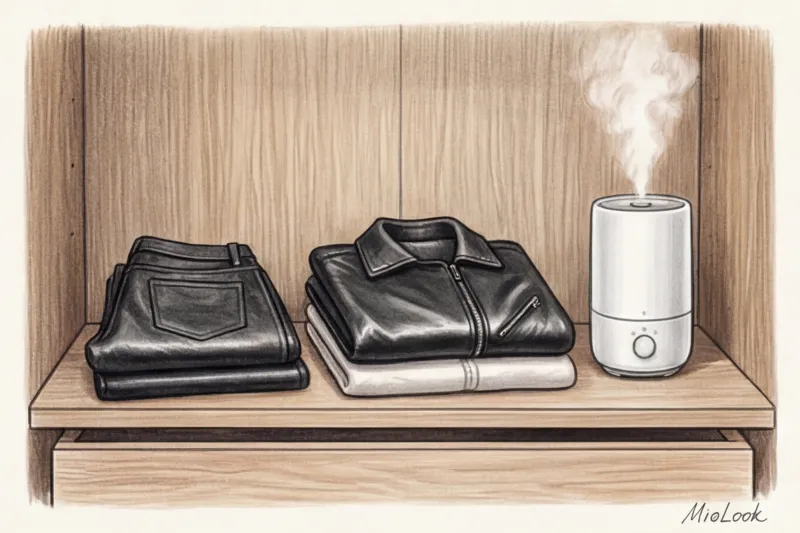
Soft leather drapes beautifully over the body, but its incredible flexibility works against it in the closet. Heavy leather jackets, trench coats, and even thin shirts should never be hung on wire or thin plastic hangers from mass-market stores. In just a couple of months, the weight of the shoulder seam (a biker jacket can weigh up to 1.5-2 kg) will permanently deform the garment, creating pointed, elongated "ears" on the shoulders. Invest in the right hangers: wide hangers made of cedar or durable plastic with flared edges mimic the shape of a human shoulder and distribute the weight evenly.
Regarding leather pants and skirts: never hang them over the bar of a traditional hanger. A deep crease will form at the fold over several months, which will be virtually impossible to smooth out without damaging the delicate structure of the material. Leather pants should be stored strictly upright, hanging by the waistband. Use special clips with soft inner pads (made of felt, foam, or silicone) to prevent the metal teeth from leaving permanent dents in the waistband. If professional hangers are unavailable, a simple life hack is to place two pieces of thick cardboard or folded cotton under regular metal clips.
Stain Removal: When to Handle It Yourself and When to Take It to the Dry Cleaner
A study by the French Institute of Textiles and Clothing (IFTH, 2022) revealed alarming statistics: 68% of irreversible damage to high-end accessories is caused not by the stain itself, but by the owner's panicked attempts to wipe it away with a damp cloth in the first few seconds. Regular supermarket wipes contain harsh surfactants and alcohol-based fragrances that instantly dissolve the protective finish. When discussing how to care for leather items in emergency situations, my first rule sounds counterintuitive: stop, take a breath, and put the wipes away.
Safety checklist: Before using any household chemicals or even expensive stain removers, remember the gold standard of restorers: always test the product on a hidden area of the item. The inside seam of a bag, the hem of a pair of trousers, or the area under the collar of a jacket are ideal. Apply a drop of the product, wait 10 minutes, and gently blot with a white paper towel. If any color from your item remains on the towel, do not use the chemical.
Let's start with the most common wardrobe nightmare: a drop of salad dressing on leather pants or a croissant stain on your favorite tote. Grease stains Avoid scrubbing with soap and water, as this will only drive the lipids deeper into the porous structure of the material. A proper first aid solution is needed: generously sprinkle the fresh stain with regular, fragrance-free talc or cornstarch. These dry absorbents act like micro-sponges. Leave the powder on for 10-12 hours, then gently brush away with a dry brush. Starch can painlessly draw out up to 90% of fresh grease.
The second headache of a business woman is ballpoint pen marks Forums often recommend soaking them in rubbing alcohol or sanitizer. Alcohol is indeed an excellent ink dissolver, but it has a critical side effect: it just as aggressively destroys the original pigment in the skin itself. If you simply rub the line with a cotton pad soaked in alcohol, instead of a blue streak, you'll get a whitish bald spot. How to deal with this? Work like a jeweler: use a sharpened cotton swab and apply the solvent precisely along the line, avoiding the clean surface. As soon as the ink comes off, immediately apply a thick cream containing beeswax to the area to restore the dried lipid barrier.
But there are situations when any amateur activity is strictly contraindicated. In my practice, there is a clear "red flag" — a list of defects that should never be rubbed. If an item has been exposed to blood (the protein immediately coagulates in the pores), red wine (the tannins bind tightly with the tannins of natural leather), or if deep scratches or damage to the flesh appear, we will, without hesitation, take the item to professional restorers.
Trying to wash out Burgundy wine with water will only increase the stain's diameter, and trying to buff out a deep scratch on smooth calfskin will permanently ruin its luster. A professional spa treatment for an accessory at a reputable European workshop starts at €80-100—a paltry price to pay for saving a prestigious piece that should last for decades.
Stylist's Checklist: A Basic Skin Care Kit for Home
Every time I send new clients shoe care products, they send me panicked photos of the store: shelves overflowing with dozens of foams, sponges with dispensers, and brightly colored aerosols. Aggressive marketing tricks us into buying too much, promising "instant shine in three seconds."
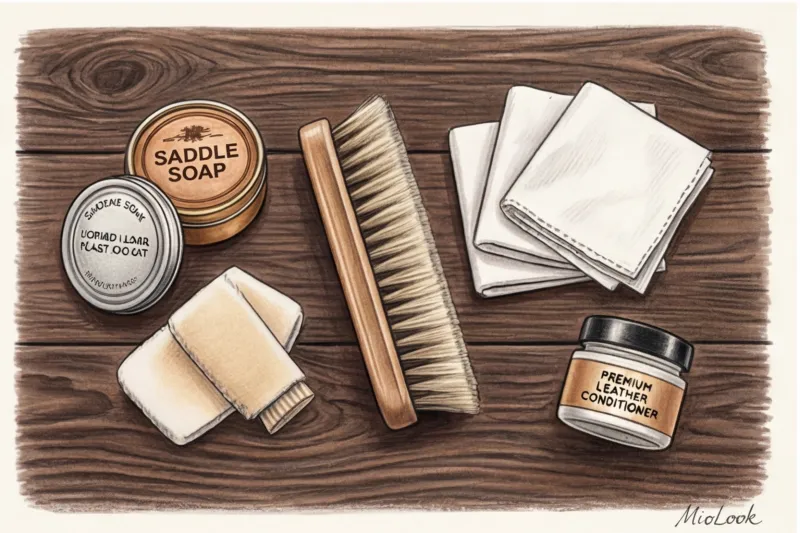
Take a screenshot of this text right now. To settle the question once and for all, How to care for leather items At a professional level, you don't need a shoemaker's arsenal. This is my well-thought-out action plan—precisely five items that will replace a whole shelf of useless chemicals:
- Leather Soap. No micellar water or wet wipes! Specialized soap (a jar of quality will cost around €12-15) gently washes away old cream, chemicals, and street dirt from pores while preserving the natural pH of the leather.
- Cream with natural wax. Throw away the liquid emulsions in plastic tubes with foam tips. We need a thick cream in a glass jar, which contains beeswax or carnauba wax, as well as almond or mink oil. This mixture nourishes the material and creates that precious patina. It's an investment of about €18, but it will last for two to three years.
- Water repellent spray (strictly silicone free). Look for fluorocarbon resins or the "Nano" label on the label. Unlike silicone, which seals pores, nano-impregnation creates a microscopic mesh on the surface: water and dirt roll off in beads, but the material continues to "breathe."
- Horsehair brush. Synthetic bristles, priced at €3, leave microcracks in smooth calfskin, which eventually develop into creases. Natural horsehair has the perfect stiffness: it doesn't scratch the surface, but with intense rubbing, it gently warms the applied wax, making the shoes shine from the inside.
- Crepe brush for suede. A natural rubber (crepe) tape works like a soft eraser. It draws dust from deep within the pile and lifts it, restoring the material's pristine velvety feel without a single drop of water.

The usage algorithm is extremely simple: shampoo once at the end of the season before putting away the closet, cream every two weeks of active wear, and we dust with brushes after each return home. To prevent routine from turning into chaos, I recommend digitizing your status investments. In the app MioLook My clients see precise statistics on how often they've been worn: if their favorite ankle boots have been worn 10 times, it's a clear sign it's time to spend 15 minutes nourishing and polishing their leather.
And my final piece of advice. I often hear the phrase "I have absolutely no time to polish my shoes" during consultations. But let's face it. Taking care of your shoes isn't a boring chore or an attempt to save money on a new pair. It's a direct extension of self-love and a deep respect for your image.
When you put on a perfectly fitting jacket that smells like expensive wax rather than a damp basement, when your shoes reflect the light with a soft, refined shine, you convey confidence to the world. You declare, "I pay attention to detail. I value what I have. I know my worth." And trust me, those around you read this visual code of impeccability in a split second.
Guide Chapters
How to remove odor from a leather jacket: stylist tips
A sour smell of sweat or mustiness can ruin the impression of even the most expensive leather jacket. Learn safe ways to refresh your favorite piece without damaging the material.
How to Store a Leather Jacket: Stylist Tips
A storage error can irreparably ruin an expensive leather item. We'll explain how to properly prepare jackets and shoes for the off-season.
Faux leather or genuine leather: which is better for a jacket?
Choosing outerwear is an investment. Learn from a professional stylist how to choose between genuine and faux leather to ensure your jacket lasts for years to come.
How to Care for Nubuck and Suede: Expert Advice
We'll explore the main mistakes in caring for fuzzy leather using a ruined Loro Piana jacket as an example. We'll also share professional cleaning protocols for nubuck and suede.
How to soften leather shoes and jackets without damaging them
Are your stiff shoes or jacket causing you discomfort? Learn how to safely break in your fine leather pieces without resorting to traditional methods or damaging the material.
Shoe waterproofing treatment: how to use it without mistakes
A cheap spray can irreparably ruin expensive suede. Learn the stylist's secrets and how to reliably protect your favorite shoes from moisture.
How to use liquid leather: step-by-step instructions
Scratched your favorite shoes or bag? We'll show you how to repair leather items yourself using liquid leather in just a few minutes.
How to Smooth a Leather Jacket Without Damaging It: A Stylist's Guide
Bought a new faux leather jacket, but it's stuck in place with creases? We'll tell you how to safely restore it to its perfect condition and avoid common mistakes.
How to Remove Scratches from Leather Shoes: Stylist Tips
Viral internet life hacks can ruin your favorite pair forever. We'll tell you how to properly and safely restore leather shoes at home.
How to distinguish genuine leather from artificial leather when buying
Buying something labeled "100% Genuine Leather" doesn't always guarantee quality. Learn tactile intelligence and how to recognize genuine leather with a stylist.
How to Clean White Leather Shoes: Expert Tips
Pristine white sneakers are the foundation of a luxurious look and a quiet luxury style. Learn how to properly care for light leather to avoid ruining your favorite pair.
How to remove salt stains from suede shoes in winter
White crusts from salt and chemicals are the main problem with suede shoes in winter. A stylist shares a proven solution to save your favorite pair.
How to wash eco-leather so it doesn't crack
Dry cleaning can permanently ruin your favorite faux leather items. We'll explore the material's properties and learn how to safely clean pants and jackets at home.