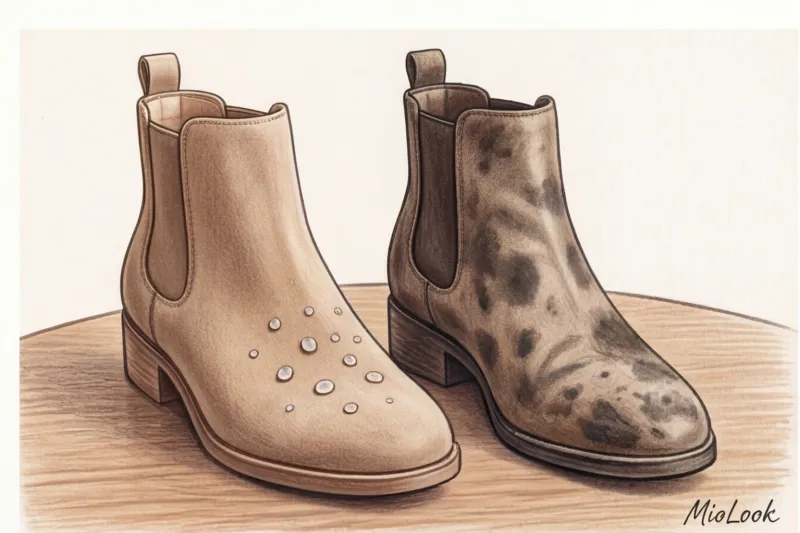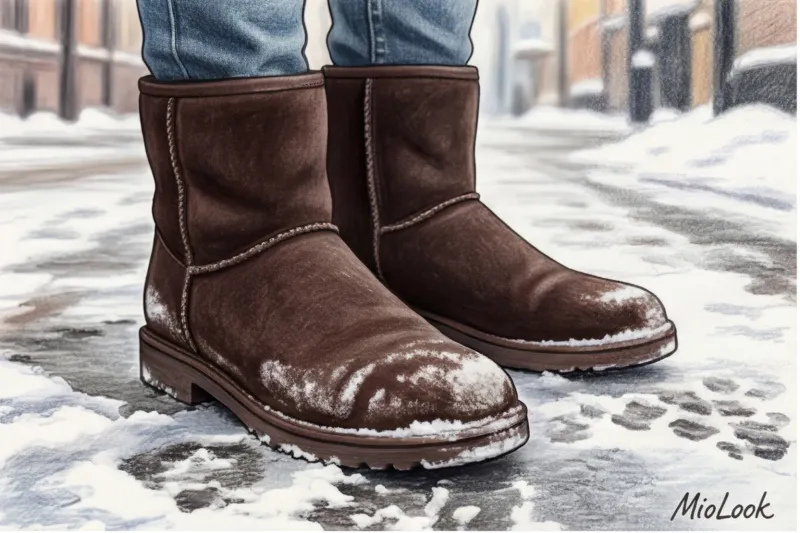
One day, a client of mine, a top manager at a major IT company, came in for a wardrobe review almost in tears. She was wearing luxurious taupe suede Loro Piana loafers, which she was wearing for the first time. A single 15-minute walk from the parking lot to the office through Moscow's March slush was enough to leave a hard white crust on the toes. She asked right from the door, "Olena, how can I remove stains from suede shoes, or are these shoes finished?" In my 14 years as a stylist, I've seen hundreds of such "killed" pairs.
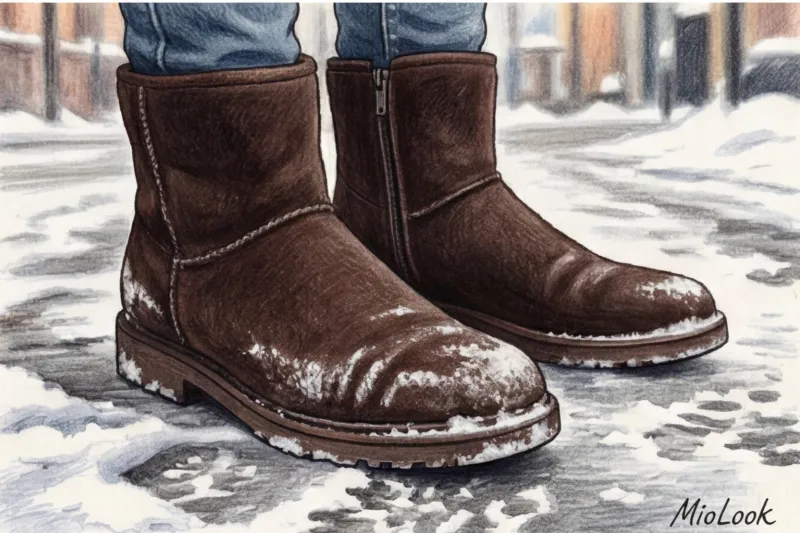
We saved her loafers that day. But this story is a perfect illustration of how winter chemicals work on the streets of our cities. I already discussed the basic principles of working with natural materials in more detail in the article about How to care for leather items: a guide from a stylist However, suede requires a separate, almost surgical, salvage protocol.
If you want your wardrobe investments to last for years, not just until your first trip to the laundry room, let's look at the cleaning process not as a household chore, but as a chemical neutralization process. And let's start with why time is working against you.
Why Salt Is Your Status's Main Enemy (And How It Kills Suede)
Suede always exudes a sense of "quiet luxury." It's a textured, deep, and luxurious material that instantly elevates any look. But white salt stains act like a giant neon marker that says "untidy." They instantly cheapen even a look crafted from premium brands.
What's really happening when urban snow gets on your shoes? It's not just dirty water. Road chemicals are aggressively alkaline or acidic.
According to the International Shoemakers' Guild (2023), sodium chloride, when combined with industrial reagents, begins to destroy the collagen fibers of natural leather within just 4–6 hours of contact. Salt acts as a powerful dehydrator, drawing natural fats from the leather's flesh.
"If you leave salted shoes in the hallway overnight, the chemical burn to the material will become irreversible. The leather will harden, and the nap will lose its elasticity." This fact should become the main rule of your winter routine.
That is why, when entering into the application MioLook My clients always add a reminder for their winter capsules to their evening skincare routine. This should be done the same day.
How to Remove Stains from Suede Shoes: Step-by-Step Emergency Help
So, you've come in from outside, and the white piping on your shoes is clearly visible. Your task for the first 10 minutes is to stop the chemical reaction.
Many people immediately run their shoes under running water or grab a wet cloth. This is absolutely not recommended. Suede is extremely sensitive to getting the base wet. If water soaks through the material, it will deform as it dries, and the chemicals will simply penetrate deeper layers.
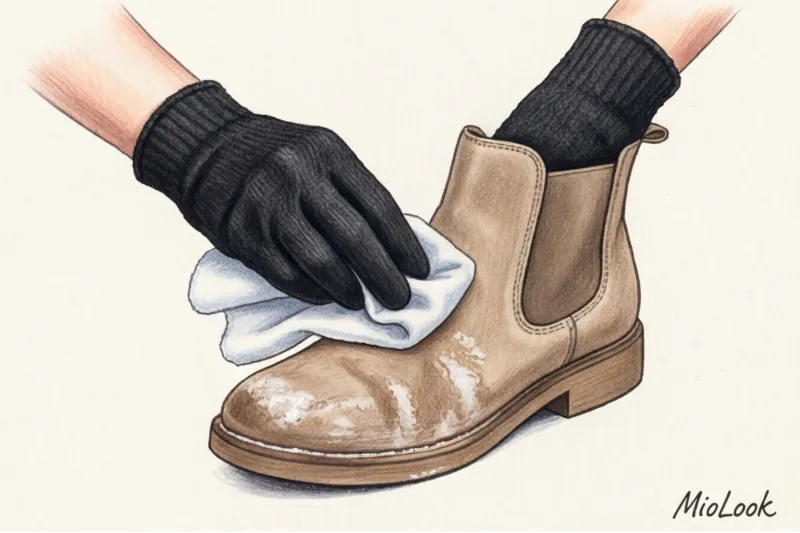
Your course of action should be as delicate as possible:
- Take a dry microfiber cloth or paper towel.
- Gently blot the wet areas, removing excess moisture along with the salt dissolved in it.
- Never rub the stain! Rubbing literally forces salt crystals into the skin's pores.
Chemistry vs. Physics: Vinegar Solution
If the stains have already started to dry and turn white, we'll need a neutralizer. Alkaline solutions are easily neutralized with a weak acid. Regular 9% table vinegar is ideal for this purpose.
Mix one tablespoon of vinegar with two tablespoons of filtered water. Dip a cotton pad or the corner of a microfiber cloth into this solution, wring it out well (it should be damp, not dripping wet), and gently blot the salt line. You'll see the white line begin to dissolve.
Be sure to test the solution on the inside of the heel or tongue. I've had cheap dye on mass-market shoes simply "bleed" from minimal contact with vinegar.
Professional cleaners: foams and shampoos
If folk remedies scare you (and I understand, especially when it comes to $500 shoes), use specialized cleaning products. Suede shampoos and foams from brands like Saphir or Tarrago work thanks to mild surfactants.
The stylist's top secret: never squeeze foam directly onto the shoe. Apply it to a special sponge or synthetic brush, whisk it in, and then distribute it over the shoe using circular motions. This will ensure even cleaning and prevent new, now water-based, stains from forming.
Access to MioLook for €0.99 — one-time payment
A smart AI stylist will select the perfect look and help you organize your winter wardrobe.
Get access — €0.99 onceThe biggest mistake that will ruin your shoes forever
Now I'm going to tell you about the most popular myth that ruins thousands of pairs of shoes every winter. You've probably heard the advice: "Let your shoes dry completely, then simply brush off the dry salt with a stiff brush."
Forget this forever. It's a fatal mistake.
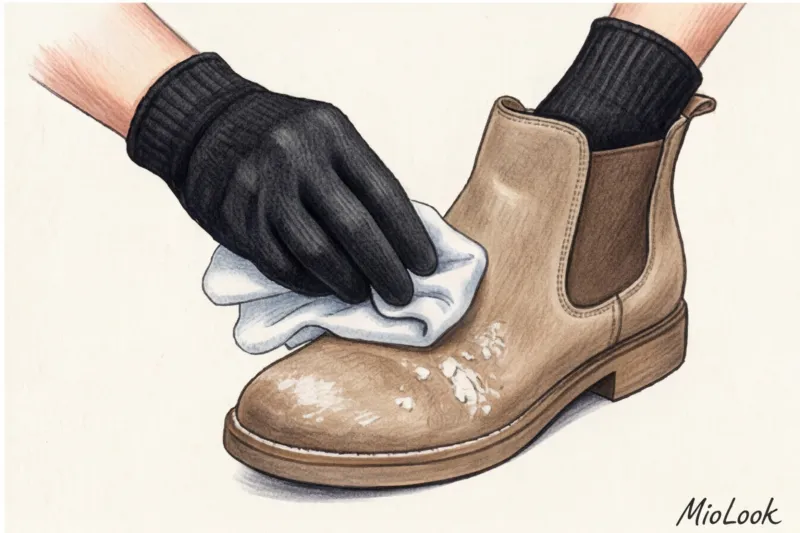
The physics of the process work against you here. Dried salt crystals have sharp edges. When you take a stiff brush (especially a metal one) and begin to vigorously scrub dry, salty suede, these crystals act like micro-blades. You literally cut the nap down to the roots.
As a result, a smooth, shiny "bald spot" forms where the salt stain once was, which is impossible to restore. The hair simply disappears.
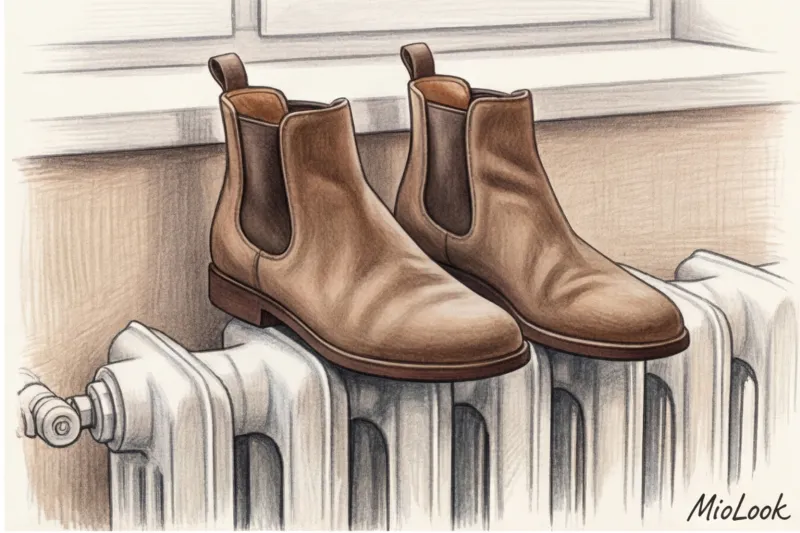
Another disastrous habit is drying suede on a radiator, heater, or underfloor heating. When exposed to extreme heat, wet leather rapidly loses moisture and shrinks. The shoe last becomes deformed, the toe curls upward, and salt residue becomes permanently baked into the material. Dry suede only at room temperature, with shoe trees inserted.
Stylist's magic: restoring pile and color after cleaning
After proper cleaning and air drying, suede often looks dull and slick. To restore its velvety, classy appearance, you need to lift the nap. This is where steam comes in.
When I was restoring my vintage Yves Saint Laurent ankle boots, which I'd bought at a flea market in Paris in a sorry state, this method saved the day. Use a household steamer or an iron with a vertical steam function.
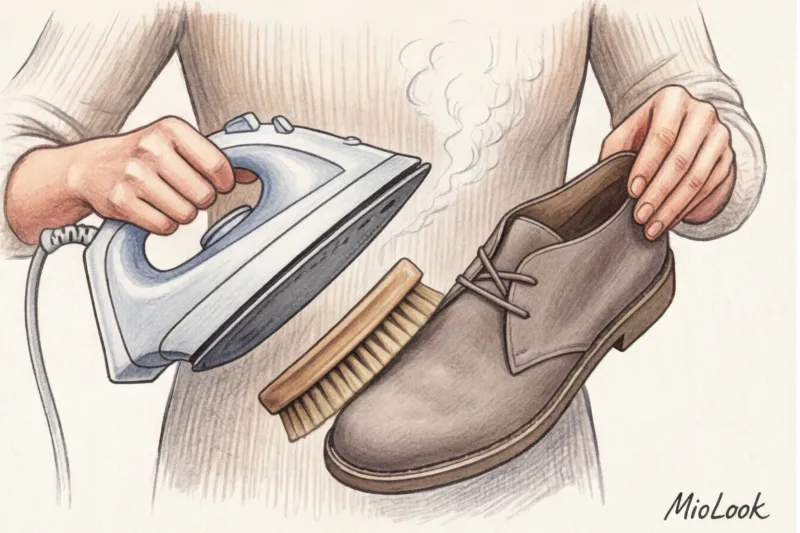
Hold the steam source 15-20 centimeters away from the shoe. Steam the shoe for just 3-4 seconds (it should be slightly damp, but not soaking wet). Then, take a crepe brush—a brush with wavy natural rubber bristles—and gently brush the nap in one direction.
Unlike bristles or metal, rubber has a slight tack. It draws out trapped dirt particles and gently lifts the bristles without damaging them.
If the salt has managed to slightly "eat" the pigment (often the case with black and dark blue shoes), use a tinting spray paint as a finishing touch. Spray from a distance of 30 cm to achieve a uniform haze of color.
Preventative measures: how to prepare suede shoes for winter
The best way to remove white salt stains is to prevent them from occurring. And this is the key difference between a well-groomed woman and one who is constantly struggling with the consequences.
For new shoes (or at the beginning of the season), there's a "three-coat" rule. Before your first time outside, you should saturate the suede with a water-repellent spray three times. Apply the first coat until slightly damp and let it sit for 20 minutes. Apply the second coat and let it dry for another 20 minutes. Let the third coat dry overnight.
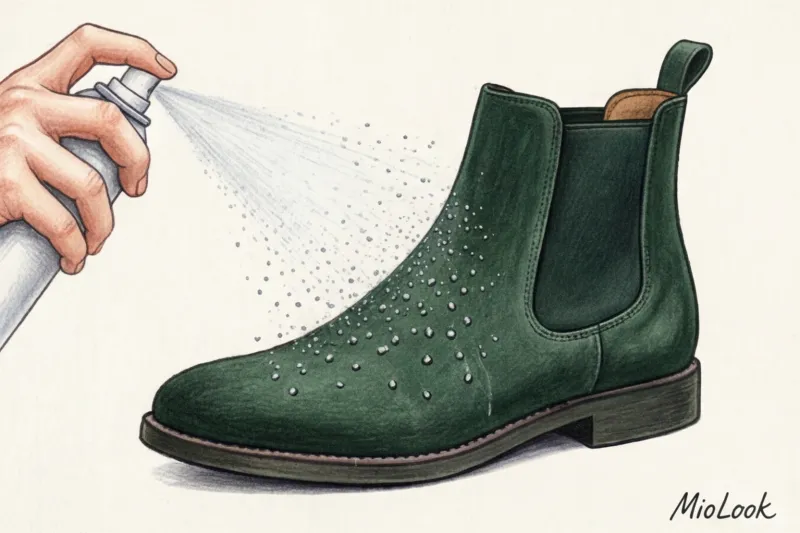
It's crucial to read the ingredients. Cheap sprays from the supermarket are usually silicone-based. Silicone clogs the pores of the leather, making the shoes unable to breathe, causing sweaty feet, and quickly making the suede leather feel rough.
Premium nano-impregnations are based on fluorocarbon resins. Research by the WGSN Institute of Materials Science has shown that proper fluorocarbon treatment increases the lifespan of suede shoes by 40-50%. It envelops each fiber with an invisible polymer mesh. Drops of water and dirt simply roll off like mercury. This protection needs to be reapplied every two to three weeks for daily wear in slush.
Ready to get started?
Try the free plan—no commitments. Upload your looks and get styling advice.
Get access — €0.99 onceChecklist: A suede first aid kit you should have in your home
If you have in your wardrobe women's office shoes Whether you're wearing suede, beautiful autumn ankle boots, or winter Uggs, you should definitely have a basic care kit at home. It's an investment in the safety of your items.
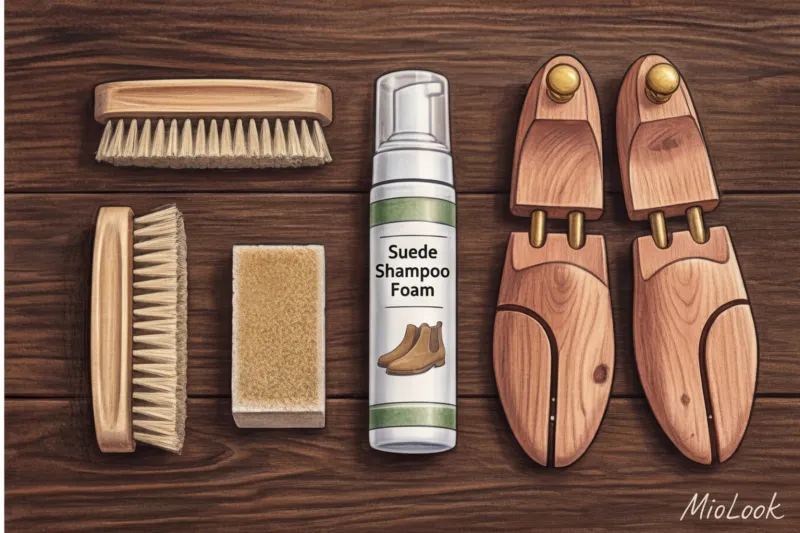
Assemble this first aid kit before the cold weather sets in:
- Brush made of natural rubber (crepe). Indispensable for raising pile and dry daily cleaning.
- Special eraser for suede. Works precisely: perfectly erases dark streaks from soles on light-colored shoes.
- Cleansing foam (shampoo) without alcohol. For deep removal of ingrained reagents.
- High-quality nano-impregnation (Carbon Pro, Invulner and similar). Your main armor against slush.
- Wooden tree trunk holders (ideally unvarnished cedar).
The presence of cedar blocks is generally a marker of a person who understands secrets of a status wardrobe Cedar not only holds the shape of the toe, preventing creases, but also draws out excess moisture from the inside, deodorizing the shoe.
When home care fails: take it to the dry cleaner
As much as I love DIY, I have to be honest: there are times when the magic of home care wears off. This is when DIY advice just doesn't work.
If your shoes have been sitting in salt stains for several weeks and a hard, unyielding crust has formed on the toe that can't be softened with steam, don't try to scrub it off at home. You'll just tear the leather. You should also stop if you see deep whitish stains after cleaning: this means the cleaning agent has burned the factory pigment right down to the base.
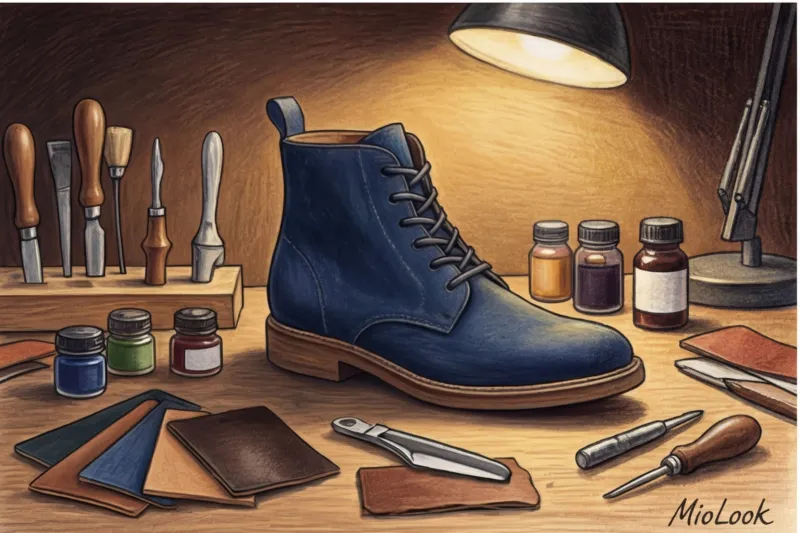
In such cases, the only solution is professional dry cleaning followed by a complete repainting of the pair. Yes, a high-quality restoration at a reputable repair shop can cost 4,000-6,000 €. But let's think in terms of investment: this is incomparably less than buying a new pair of brand-name shoes for 60,000 or 80,000 €.
In the appendix MioLook We always say: style isn't just about the right cut and trendy colors. Grooming is the foundation upon which your personal brand is built. Clean, velvety, and deeply colored suede shoes will speak volumes about your attention to detail more than the logo of any famous fashion house. Take care of your clothes, and they will respond with impeccable appearance.