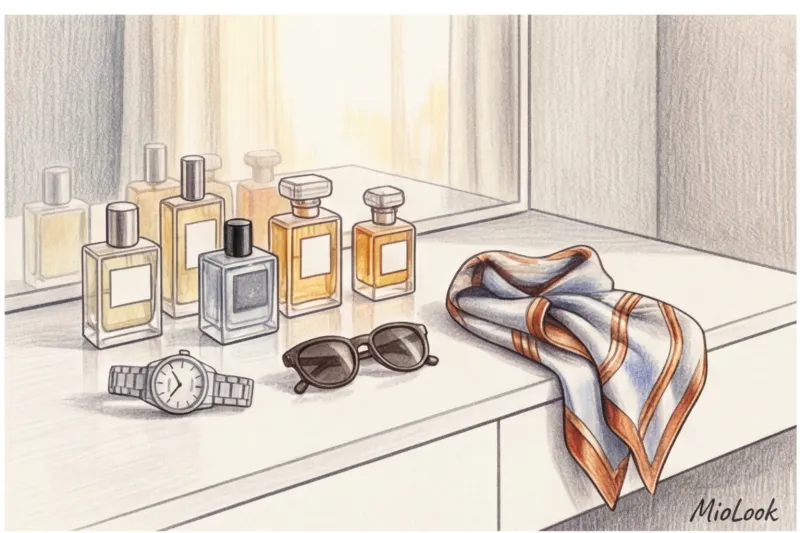
What is a perfume wardrobe and why is the concept of "one scent for life" outdated?
Over 12 years of working as an image consultant, I have heard the same phrase from clients hundreds of times: “Darina, help me find my fragrance. The one, the only one for life, so that people would recognize me by my sillage." And you know what? We never found it. Because searching for your one and only "signature scent" today is the same as trying to live your whole life in the same trench coat, even if it's impeccably tailored. That's why we need to talk about perfume wardrobe — a concept that will change your attitude to style forever.
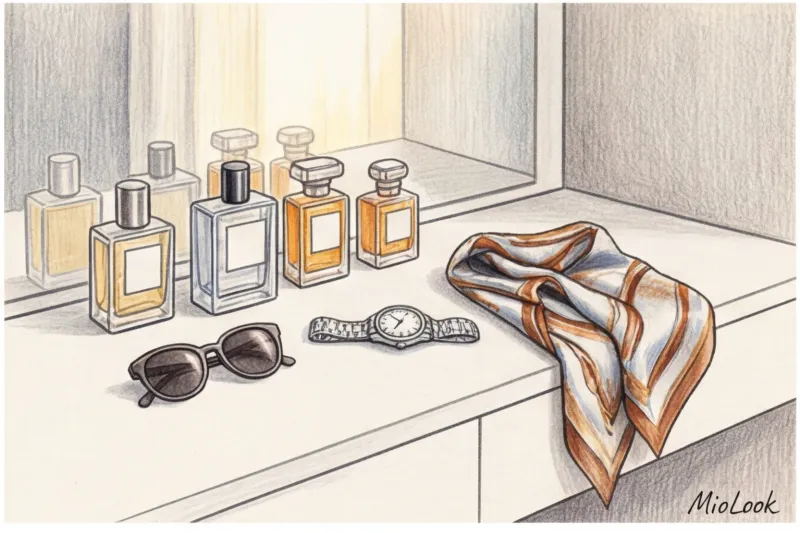
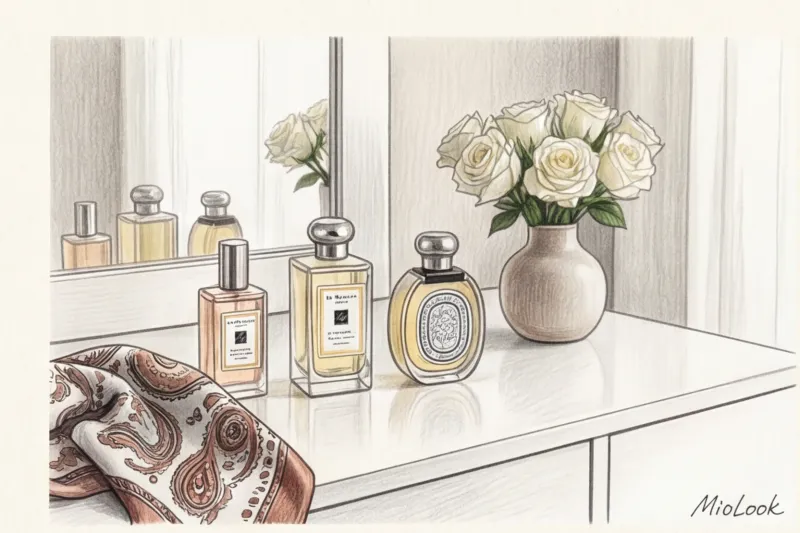
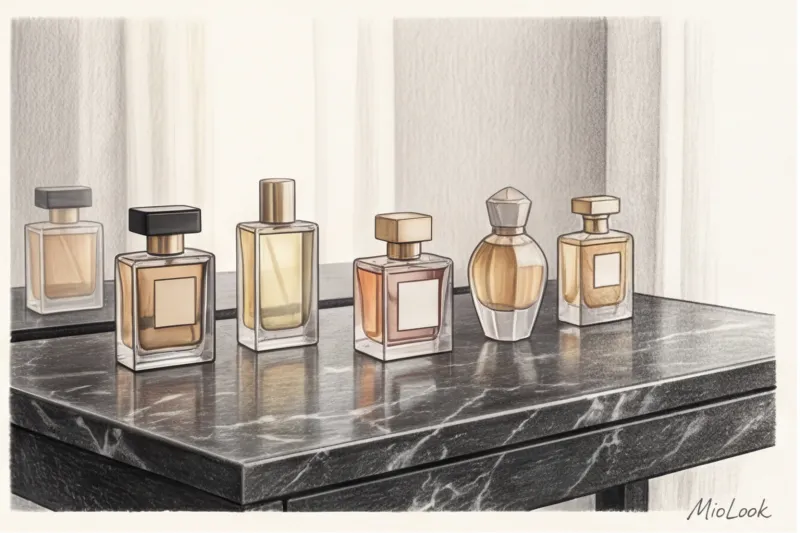
So what is it? A perfume wardrobe isn't a random shelf filled with random bottles, bought on a shopping spree or gifted for Women's Day. It's a consciously curated, practical collection of fragrances, where each perfume addresses a specific need, suits the season, the occasion, and your inner state.
The myth that a woman should have just one signature scent is incredibly limiting. You wouldn't wear silk stilettos to a country picnic or cozy fleece joggers to the Mariinsky Theatre, would you? Our lives are too multifaceted and dynamic to smell the same on a first date, a complex business negotiation, and a relaxed Sunday brunch.
My personal manifesto as a stylist: fragrance is an invisible accessory. It's the final, decisive touch that can brilliantly pull an entire look together, or it can mercilessly destroy it, even if your clothes cost thousands of euros.
I had a very revealing case in my practice. I had a client, a top manager at a large IT company, come to me. On the outside, she looked impeccable during negotiations: a graphic pantsuit, a prim hairstyle, an expensive watch. But her favorite perfume was a sultry cotton candy with powerful notes of praline and caramel (by the way, if you like such dessert scents, check out our guide about gourmand fragrances ). A severe dissonance arose: the partners' eyes saw a tough, strong-willed leader, but their noses read an infantile schoolgirl with a lollipop. As soon as we replaced her work perfume with a cool, status-conscious one chypre , her personal brand instantly gained the necessary weight.
Why does it work this way? There's a scientific term called the "Proust phenomenon"—the astonishing ability of scents to instantly evoke powerful emotional associations, completely bypassing logic. The scent goes straight to the limbic system of the brain of those you're speaking to. By choosing the right olfactory profile, you literally control how people perceive your personal brand.
That's why your perfume should change with your clothes. When putting together looks for clients through MioLook I always recommend adding an olfactory capsule to the visual one. A strict office dress code requires distance and composure, while a flowing evening gown demands sensuality and warmth. Forcing one bottle, even the most expensive one at €300, to fulfill all these scenarios is completely pointless.
Fragrance Architecture: The Technical Basis for Smart Choice
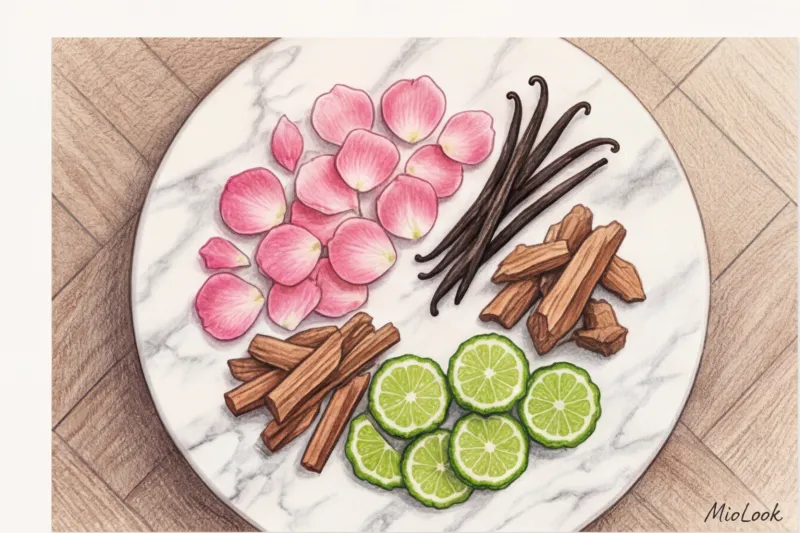
In 1992, perfume historian and systematizer Michael Edwards introduced the industry to a concept ingenious in its simplicity: the "Fragrance Wheel." Until then, choosing a perfume for most consumers felt like wandering through a fog of complex chemical terms. Edwards identified four main groups, which today serve as the foundation for effectively assembling a functional fragrance wardrobe: floral , eastern , woody And fresh.
Understanding this system works in styling just like knowing your own coloring or body type: once you identify "your" families and their hybrids, the risk of buying the wrong bottle (especially when ordering online) is reduced to zero.
The next technical detail to consider is the difference in concentration. Often, the same fragrance is released in different formats, and this isn't just a marketing ploy by brands, but rather a fundamentally different functionality for your collection:
- Eau de Cologne (Cologne): Contains only 2-5% fragrances. Ideal for a morning invigorating ritual or a workout routine. It lasts for about two hours on the skin and fades gently, giving way to your main daytime fragrance.
- Eau de Toilette (Toilet Water): Concentration: 5–15%. A versatile, airy format for the office. It provides good volume without overwhelming colleagues in the confined space of an open office.
- Eau de Parfum (Eau de Parfum): 15–20% essential oils. A classic for evening wear, special occasions, and colder seasons when you need a thick, tangible trail.
- Extrait de Parfum (Perfume or Extract): From 20 to 40%. Contrary to stereotypes, perfumes often sit very close to the body. They don't scream across the room, but rather sound intimate, deep, and intended exclusively for those you allow into your personal physical space.
In perfume schools, teachers hammer home a strict rule from the very first lecture: longevity is a property of physics, not an indicator of premium quality or the quality of ingredients.
Many clients complain to me during consultations: "I bought a selective scent for €250, and it wore off after three hours! Is it fake?" No, it's simply the physics of volatility. Citrus notes (lemon, bergamot, yuzu) have the lowest molecular weight. They are physically incapable of lasting more than a couple of hours, no matter how much the bottle costs. But heavier molecules—amber, musk, resins, or oakmoss—can linger on your wool coat for weeks.
Expecting phenomenal longevity from a lightweight aquatic or citrusy cologne is like expecting a thin silk top to have the warmth of a cashmere sweater. Furthermore, it's important to distinguish longevity from sillage—the ability of a fragrance to fill a room. A perfume can be incredibly long-lasting but sit close to the skin, or evaporate within three hours but still fill an entire office floor (as modern synthetic molecules like ambroxan do).
Your skin chemistry has a profound impact on how you perceive these technical characteristics. Perfumers and chemists conventionally divide skin into "hot" and "cold." On those with "hot" skin (close blood vessels, rapid metabolism), fragrances unfold rapidly, literally "swallowing" the opening citrus notes and instantly sinking into the dense base. On "cool" skin, on the other hand, vibrant, icy florals can linger for hours, but heavy resins risk never warming up, producing a flat, inexpressive scent.
Moreover, your individual pH level directly dictates how quickly base notes evaporate. That's why a perfume that smells luxuriously creamy sandalwood on your friend might suddenly have a sharp, metallic tang on your skin.
The Olfactory Pyramid: How Scent Lives Through Time
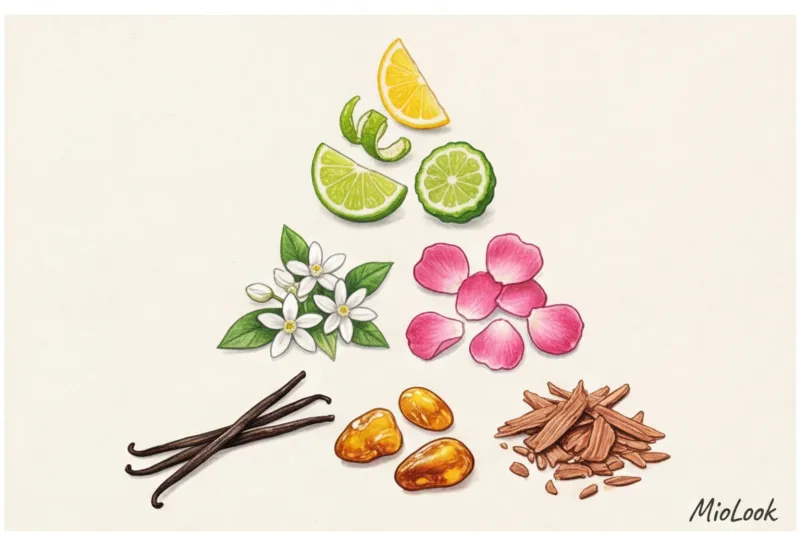
A scent isn't a static photograph, but a olfactory film that unfolds in real time. The classical French school of perfumery is built on the strict principles of the olfactory pyramid, where each level has its own lifetime on the skin.
Top notes (first 15 minutes): This is a commercial bait. The most volatile and vibrant components (citrus, green leaves, light aquatic accords) are present. Their main purpose is to make you say "Wow!" at the stand and confidently walk to the checkout.
Heart notes (2 to 5 hours): The true character and soul of the composition. Once the initial blast fades, flowers, spices, and soft fruits take center stage. This is the section your colleagues and conversation partners will be hearing for most of the day.
Base notes (up to 24 hours): Heavy artillery and foundation. Resins, precious woods, vanilla, patchouli, and animalic notes. This is that intimate residue you'll feel on your clothes or pillow the next morning.
This is where the most common one comes from. rookie mistake: Buying perfume based solely on top notes right in the boutique. You spritz the liquid on a paper blotter, fall in love with the sparkling, refreshing grapefruit, spend €120, and two hours later, a heavy, sultry clove scent appears on your skin, mixed with leather, giving you a headache. The main rule for choosing wisely is to always let the pyramid live at least part of its life on you, not on paper.
Organize your perfect wardrobe
MioLook's artificial intelligence will help you create functional clothing capsules that will easily pair with the perfect perfume.
Get access — €0.99 onceThe Basic Perfume Wardrobe Formula: 4 Essential Categories
When I review my clients' closets, I regularly see the same scene: ten luxurious sequined dresses and three intricate designer jackets hang on the rails, but not a single perfectly fitting basic T-shirt. The final verdict is always the same: "I have nothing to wear." The most interesting thing is that an identical drama unfolds on the dressing table at the same time.
Assembling a fragrance collection is like putting together a capsule wardrobe. We need basics, statement pieces, and functional pieces, all in the right proportions. If you buy five heavy oriental perfumes but work in an office with a strict dress code, your fragrance wardrobe will be dysfunctional. To make the system work, I suggest using a proven matrix of four categories, where each scent corresponds to a specific fabric texture.
The renowned perfumer Jean-Claude Ellena once aptly observed that fragrances possess a tactile quality. Our brain interprets scents through the prism of touch: some seem rough, others flowing, and still others crisp.
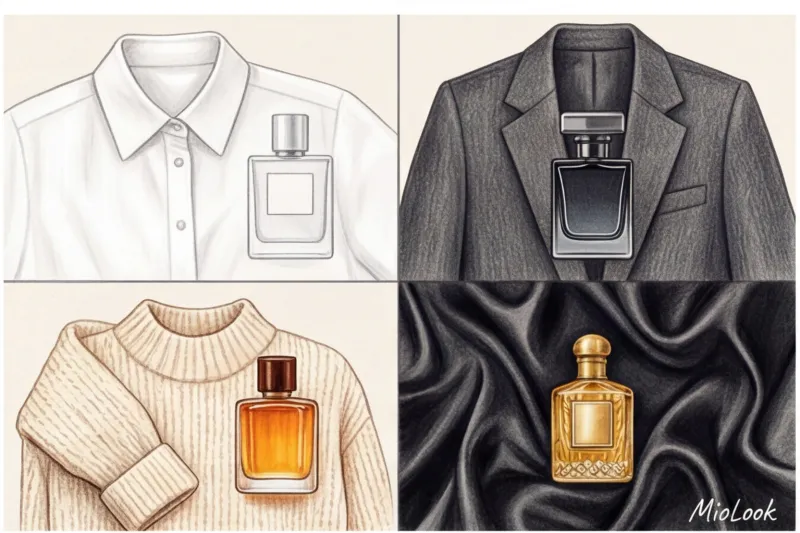
Category 1: "White Shirt" (Uniform Fragrance)
This is your absolute foundation. The perfume you put on when you don't know what to wear. Its main purpose is to smell clean, well-groomed, and not distract you or those around you.
Olfactory profile: Fresh, fleshy (musky), aldehyde, or light citrus notes. In this category, we look for the scent of freshly ironed linen, expensive soap, or cool morning air. Aldehydes, for example, brilliantly imitate the smell of a hot iron on damp fabric.
Parallel to fabric: Thick, crisp cotton or fine linen. Translated into notes, the cotton is neroli absolute (bitter orange blossom), which gives the sensation of a starched collar.
These fragrances won't irritate anyone. You can wear them on a plane, to a doctor's appointment, or in a cramped open-plan office. They sit close to the skin and don't leave a mile-long sillage. A good basic, uniform fragrance can be found in both mass-market stores for €20-€30 and in the premium segment for €150-€200 (for example, iconic pieces by Byredo or Maison Margiela).
Category 2: "Business Suit" (Fragrance Status)
If a "white shirt" is about comfort, then a "business suit" is about structure, composure, and boundaries. You wouldn't wear one on Sunday morning. It's your invisible armor for tough negotiations, stage appearances, or meetings where you need to demonstrate authority.
Olfactory profile: Woody, classic chypre, leather, and vetiver notes. There's not a hint of sweetness here. The bitterness of oakmoss and the dryness of cedar convey confidence, intelligence, and a distinct sense of distance.
Parallel to fabric: Thick English tweed, gabardine, or textured wool. In perfumery, the rough texture of tweed is perfectly conveyed by the note of patchouli—earthy, slightly prickly, and compelling to stand up straight.
Stylist's advice: Have you ever noticed how your posture changes when you put on a formal double-breasted jacket? Status fragrances do the same to our psyche. But be careful: if you already have a very strict, authoritarian image, such a perfume can make you appear too "prickly" to your interlocutor.
Category 3: "Cashmere Sweater" (Fragrance Cocoon)
After a hard day at work, we want to take off our armor and wrap ourselves in something soft. We buy a cocoon-like fragrance exclusively for ourselves. It's needed for weekends, reading a book on the couch, leisurely strolls, and time alone.
Olfactory profile: Gourmand (edible), amber, lactonic (milky) notes. Vanilla, tonka bean, praline, sandalwood, which often imparts a creamy undertone. They warm and impart a feeling of absolute comfort.
Parallel to fabric: Soft cashmere, fluffy mohair, or your favorite fleece sweatshirt. Warm sandalwood and vanilla envelop the skin as delicately as precious cashmere.
It's important to understand one limitation: lactonic and gourmand notes work wonderfully in cooler weather, but in summer heat of +30°C, this "sweater" will suffocate you and may trigger a headache. Save these bottles for sweater season.
Category 4: "Silk Dress" (Fragrance Evening)
The last, but most intriguing category. These are fragrances for special occasions: dates, theater trips, corporate events, or social dinners. They are designed to attract attention, leave a lasting sillage, and be remembered.

Olfactory profile: Heavy white florals (predatory tuberose, indolic jasmine), thick resins, spicy oriental spices, languid burgundy rose. These are loud, assertive compositions.
Parallel to fabric: Flowing silk, heavy velvet, or satin. The smooth, cool texture of silk brilliantly contrasts with the rich scent of white flowers, creating a play of contrasts.
This is the category where impulse purchases are most common. A beautiful €300 bottle with a luxurious sillage hypnotizes us at the stand. But if you only attend social events once every six months, you don't need five different bottles from this category. One or two are enough, ideally travel-size (10-15 ml).
To avoid chaos and buying unnecessary things, I strongly recommend digitizing your collection. When you plan your looks for the week, the "smart wardrobe" feature in MioLook Try visually linking a specific bottle to your clothing capsule. You'll immediately see gaps: for example, maybe your five office suits simply don't have a matching uniform perfume, but you've got a whole bunch of evening fragrances just sitting on the shelf.
Perfumes and your visual image: a stylist's unconventional approach
Have you ever heard of cognitive dissonance in style? It's that awkward feeling when a person's visual image conveys one thing, but their scent tells a completely different story. As a professional colorist and image consultant, I view a fragrance wardrobe not just as a collection of pleasant scents, but as a fully-fledged, albeit invisible, part of your wardrobe. Our brains operate on the principle of synesthesia—we "see" scents and instinctively associate them with certain fabric textures.
The easiest way to sync your outer and inner selves is to cleverly link your perfume to your leading stylistic archetype. Look at your everyday clothes. If they feature strict, architectural shapes, dense fabrics, perfect tailoring, and monochrome, you're channeling the archetype. "Ruler" The ideal olfactory continuation here would be classic chypres—compositions with notes of oakmoss, bergamot, and patchouli. They maintain a certain distance, tie the image together, and uncompromisingly emphasize status.
If your closet is filled with flowing silk, soft velvet, lace and smooth lines, your archetype is "Esthete" Your sensual nature will be perfectly highlighted by complex gourmands and rich white floral compositions (predatory tuberose, sweet jasmine, neroli). And for lovers of safari style, denim, casually creased linen, and comfortable sneakers—representatives of the archetype The Seeker — Chinny glasses and cool aquatic scents are best. Notes of sea salt, bitter juniper, and dried lavender will give you that feeling of wind in your hair and a sense of space, even if you're sitting in a meeting in a stuffy office.
The secret to masterful styling is not direct quotation, but a skillful play on contradictions. This is where the law of contrast comes into play.
The law of contrast works flawlessly: if your visual image is too harsh or dry, don't rush to change your clothes—just add a touch of warm fragrance. Imagine a crisp graphite pantsuit, slicked-back hair, and sharp horn-rimmed glasses. Add a sharp chypre or a cool mineral perfume, and the look becomes almost intimidating, creating an impenetrable wall between you and your conversation partner. But dab a warming woody-amber scent with notes of tonka bean or a delicate, non-confectionery vanilla on your wrists, and the harsh, businesslike look instantly softens. You still look authoritative, but people want to approach you—your severity takes on a human face.
Conversely, a romantic, flowing dress with a small floral print can easily be stripped of its childishness with cool metallic, vetiver, or leather notes. Incidentally, even a simple, basic jacket for €60 will be perceived as a luxury item if paired with a well-chosen, contrasting, deep train.
Access to MioLook for €0.99 — one-time payment
Start creating perfect looks with artificial intelligence and matching them with flawless olfactory accents.
Get access — €0.99 onceThe relationship between appearance color type and olfactory preferences
Over the years of practicing coloristics, I've discovered a surprising pattern: our natural undertones directly dictate how certain compositions reveal themselves on us. What seems luxurious on a radiant brunette may sound foreign and heavy on a fair-haired woman with translucent skin. When choosing a fragrance, I always recommend considering your seasonal color type.
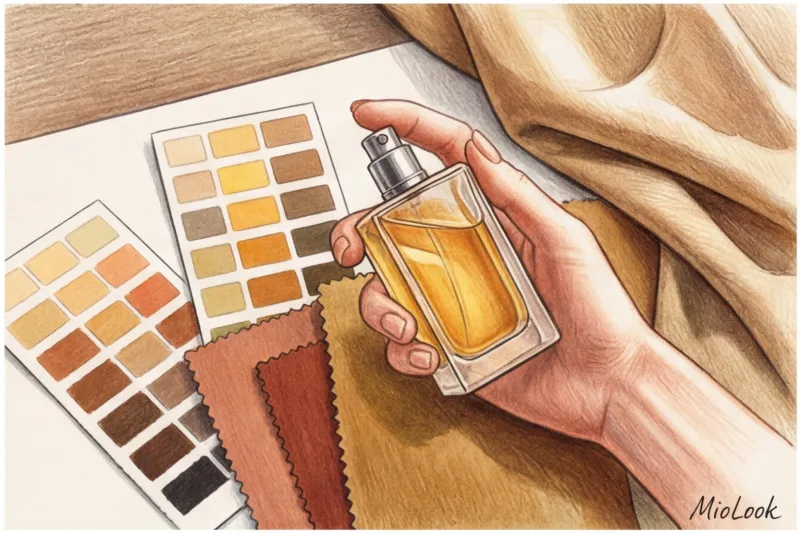
Spring (warm, clean colors). Women of this type are characterized by a natural lightness, tenderness, and inner radiance. Heavy oriental resins on them feel like foreign, overly heavy armor. Ideal choices include crisp fruity accords (juicy pear, peach), moist green notes reminiscent of a broken tulip stem, and light floral compositions. Such fragrances highlight the natural freshness of the spring type without overpowering it. A dense sillage would simply overwhelm the delicate, watercolor-like beauty of spring.
Summer (cold, muted colors). The summer type has an aristocratic, slightly "dusty" aesthetic. See the appendix. MioLook When we create a palette for summer girls, we use complex gray-blue, mint, and dusty pink shades. In perfumery, this perfectly complements powdery notes (dried orris root, violet), cool aquatics, icy rose petals, and sparkling, soapy aldehydes. They create an aura of crystal purity and noble detachment.
Autumn (warm, deep colors). This texture is thick tweed, corduroy, and voluminous chunky knit. The Autumn type is literally made for rich, dense perfumes. On their warm skin, spices (cinnamon, cardamom), viscous resins, amber, tobacco leaf, and heavy woods unfold luxuriously and without distortion. What might seem stifling on a Summer type, on Autumn, sounds cozy, expensive, and organic, merging with their natural golden undertones into a seamless whole.
Winter (cold, contrasting colors). True drama queens. Winter types, with their high natural contrasts, require equally vibrant and uncompromising fragrances. They thrive on sharp, classic chypres, predatory and loud tuberose, mystical incense, and compositions built on contrasting combinations of ice and fire (for example, icy peppermint at the top and a scorchingly hot woody base). Winter is the only type capable of wearing an eccentric niche as if it were their own skin, harmonizing even the most theatrical perfume formulas.
How to properly try on and choose fragrances in the store
Have you ever wondered why 80% of impulse purchases at perfume boutiques end in complete disappointment? You spend €150 or €200 on a bottle that instantly captivated you at the display stand, only to realize the next day it's suffocating you to the point of giving you a headache. It's not that the brand secretly changed the formula. The problem lies solely in the testing process. A well-curated fragrance wardrobe doesn't tolerate fuss at the checkout.
Let's get right to the most common and harmful action I regularly observe at the corner. A customer sprays perfume generously on her wrist and begins vigorously rubbing it with her other hand. The salespeople often widen their eyes and threaten, "Don't do that, you'll break the molecules!" Physicists openly scoff at this assertion: to physically "break" a molecule, you'd need a hadron collider, not just rubbing your skin.
The reality is much more prosaic: Friction causes localized heating of the surface. Due to the sudden temperature change, the delicate top notes (those volatile citrus and light floral accords) evaporate in seconds, rather than the expected 10–15 minutes. You literally "rewind" the composition, depriving yourself of the opening intended by the perfumer. Simply apply the liquid and let it dry naturally.
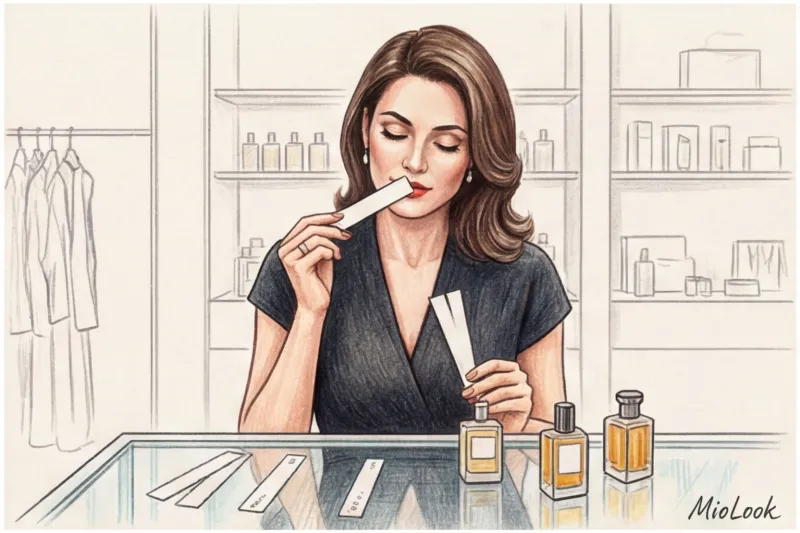
The human brain is not a chromatograph. Our olfactory system's ability to analyze new odors declines critically after just the fifth blotter. This results in what's known as "olfactory blindness" (anosmia). Apply to skin. no more than 3-4 fragrances per trip: on both wrists and on the inner elbows. Your receptor system simply won't be able to absorb more in one day without distortion.
And now, my favorite myth about the jars of coffee beans carefully placed throughout the store. Forget about them forever. Coffee is a powerful, incredibly complex olfactory irritant, consisting of hundreds of volatile compounds. Trying to "cleanse" your nose with coffee is simply giving your tired receptors a coup de grace.
At professional schools like ISIPCA (the International Institute of Perfumery in Versailles), students are given a completely different protocol. To truly nullify perception, a simple sip of pure, still water is all it takes. Water washes away odorant molecules from the back of the throat, which is directly connected to the sense of smell.
If you don't have a water bottle handy, simply bury your nose in your own clean wool or cotton scarf for 30 seconds—the neutral, familiar scent of your clothes will reset your senses to their baseline.
To buy “your” perfume and not throw money down the drain, I make my clients follow a strict "rule of three approaches":
- Step 1: Blotter. First, we listen to the composition on paper. If we like the overall direction, we move on.
- Step 2: Wrist. Spray onto clean skin. Your body chemistry (pH level, temperature, natural lipid layer) will alter the scent beyond recognition. On cardboard, the scent may seem crystalline, but on "hot" skin, it may suddenly develop a heavy, animalic note.
- Step 3: Street. The final, most important step is leaving the store. The abundance of other people's scents and the air-conditioned air in the boutique dramatically distort perception. Only in the fresh air will the perfume begin to reveal its true self.
Take a walk for at least 2-3 hours before returning to the checkout. During this time, I recommend logging into the app. MioLook And in the virtual wardrobe section, make a note of your current look—which fragrance you're currently testing. This way, you can analyze how harmoniously this scent pairs with your everyday style once the base notes unfold.
Perfume Etiquette and Seasonality: Where Do Your Boundaries End?
According to a 2023 survey by an international recruiting agency, approximately 30% of HR directors admitted that a candidate's overly strong perfume negatively impacted the outcome of an interview. Working with senior managers, I constantly remind them of this harsh truth: in a business environment, your scent is not only a form of self-expression but also a potential intruder on someone else's personal space. Modern corporate protocol even has a special term for this: "harassment by smell" (or olfactory harassment).
The basic rule that needs to be learned by heart is called "arm's length rule" In a closed office space, your perfume should be detectable from the exact distance you'd shake a colleague's hand. If you've already left a conference room or elevator, and your thick scent lingers for another fifteen minutes, it's a sure sign of bad manners. For everyday work, always choose fragrances with minimal diffusion that sit close to the skin.

Beyond social appropriateness, physics and seasonality play a huge role. Why does that same luxurious oriental extract with dense notes of oud, resins, and vanilla that so beautifully warmed you in December suddenly begin to mercilessly "suffocate" those around you in July? The answer lies in the temperature difference. On scorching summer skin and in the hot air, heavy molecules evaporate several times faster, crashing onto the receptors like a dense wall. Conversely, trying to wear light, sparkling citruses (bergamot, grapefruit) in freezing temperatures is doomed to failure. At subzero temperatures, their volatile essential compounds simply "collapse" and disappear without a trace within 15 minutes.
To automate this process, I recommend my clients use MioLook By virtually categorizing your bottle collection by season right in the app, you'll never make a stylistic mistake by accidentally choosing a heavy gourmand at 30°C.
Another important, yet often overlooked, factor is humidity. Humidity acts as a powerful magnifying glass for earthy, mossy, and woody notes. That's why a rainy, chilly autumn is a shining example for classic chypres and patchouli-based fragrances. The rain literally brings out their noble depth, softening the initial sharpness that can be so irritating in a dry, heated room.
I'd like to specifically address perfume etiquette for experts before a public appearance. I'm regularly asked, "What status fragrance should I wear before going on stage?" My answer as an image consultant: no Nervousness inevitably alters our body's chemical reactions, raising our temperature and increasing sweat production. The mixture of adrenaline and complex, multi-component perfumes can betray your insecurity or sound distorted. If you absolutely cannot perform without your calming olfactory "anchor," apply just one micro-spray to the back of your neck, just beneath your hairline. The porous structure of your hair will gently trap the scent, and minimal pulsation in this area will prevent it from escaping throughout the entire hall.
Your perfect look starts here
Join thousands of users who look flawless every day with MioLook.
Get access — €0.99 onceChecklist: Reviewing Your Current Fragrance Collection
According to consumer behavior statistics published by the analytical agency Euromonitor in 2023, women regularly use only 20% of the contents of their perfume shelves. The remaining 80% gathers dust for years, turning into an expensive "museum of past memories." As a professional stylist, I approach fragrances as ruthlessly and systematically as I would declutter a closet. If a piece (or scent) no longer reflects your status and doesn't support your current goals, it has no place in your life. It's time to take stock.
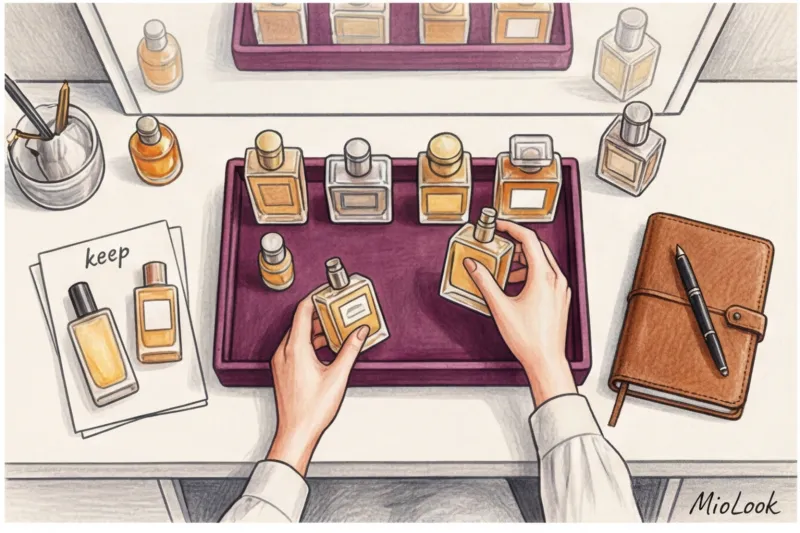
Below I provide a rigorous step-by-step algorithm that I use in my personal consultations. Set aside an hour of your free time for this practice and be prepared to make honest decisions.
Step 1: Complete inventory and categorization
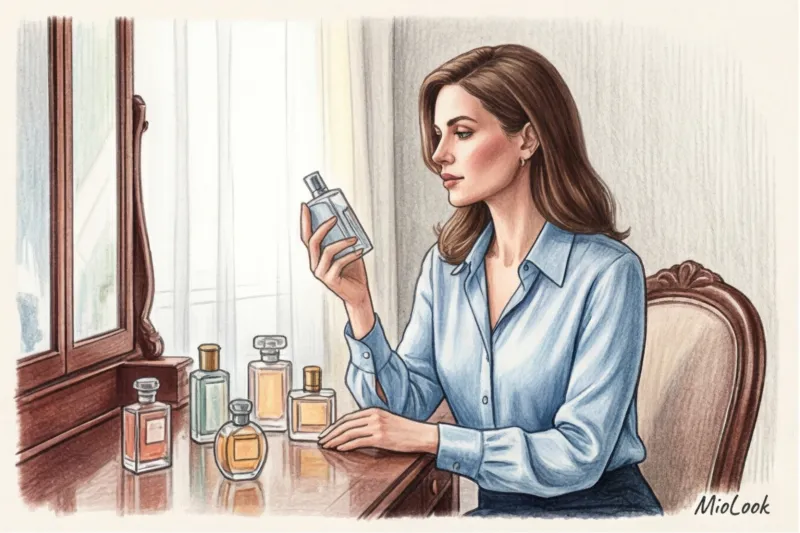
Take out absolutely every bottle, decant, sample, and gift miniature. Remove them from your everyday purses, car glove compartment, desk drawers, and, most critically, your bathroom (more on that later). Lay out all your treasures on your bed or a large table. Now your task is to physically separate them into clear categories by season (cold/warm) and purpose (work, dating, leisure, sports). This simple visual method will instantly reveal where you have an overabundance and where you're seriously deficient.
Step 2: Check for viability and assess shelf life
There's a frequent debate in the perfume community about whether perfumes can last for decades. My answer: yes, but only if the temperature is perfectly maintained. If your bottles have been stored in a bathroom, where humidity and temperature fluctuate constantly, they're likely ruined. How can you tell if a fragrance has "broken"? First, hold the liquid up to the light—if the original color has changed, darkened, or a flake-like sediment has settled at the bottom, this is a sure sign of oxidation. Second, spray a test sample onto a paper towel. If the top notes have disappeared and are replaced by a sharp alcohol scent or the distinct smell of rancid oil (this is how natural floral absolutes decompose), throw the bottle in the trash without regret. Applying such chemical compounds to your skin is simply unsafe—it can lead to severe contact dermatitis.
Step 3: Identifying blind spots and olfactory gaps
After assessing your current arsenal, analyze its balance with your current lifestyle. The most common scenario I encounter during inventory reviews: a client has five heavy, luxurious evening fragrances with killer sillage, but not a single calm, appropriate office fragrance. Ask yourself: where do you spend most of your week? If you spend 70% of your time in business meetings or open-plan offices, then 70% of your fragrance wardrobe should reflect that. Identify any gaps. Perhaps you've been longing for a light, cocooning scent for lazy weekends at home or a crisp, fresh scent for extreme summer heat.
Step 4: Smart Shopping and Test Drive Before You Buy
Spotted a shortage of essential categories? Great. But don't rush to the boutique with your credit card. Modern, high-quality perfumes require a budget—on average, a good bottle will cost you between €150 and €300. To avoid impulsive spending and disappointment, create a wish list for purchases strictly in decants or official travel-size miniatures of 5-10 ml. This is a brilliant tool: you get the opportunity to "wear" the fragrance for a full week. Your skin, stress level, and even body temperature will inevitably change the composition's performance. Buy a full-size bottle only when your travel-size bottle is down to the last drop, and your hand still instinctively reaches for it.
To easily manage your new, conscious fragrance wardrobe, I recommend digitizing it in MioLook app Add photos of your bottles to your virtual closet, categorize them by tags ("office," "theater," "date"), and associate them with specific outfits when planning your looks. This will forever rid you of the "nothing to wear or perfume" problem, creating a cohesive, well-thought-out look.
In conclusion, I want to remind you of the most important thing: a fragrance wardrobe is a living, breathing machine. It should evolve along with your career, style, and outlook. Conduct an inventory at least once a year, ruthlessly shed the clutter, and allow yourself to feel relevant. After all, your scent is the only thing that remains in the room when you leave it. Make sure this invisible message is impeccable.
Guide Chapters
How to properly store perfume at home so it doesn't spoil
Storing perfume in the bathroom or in the sun is a surefire way to ruin an expensive scent. We'll explain how to properly care for your perfume collection.
Niche Perfumery: Where to Start
Tired of mass-market hits and want to find your own unique scent? We'll tell you how to choose the right first niche perfume and save your budget.
Layering Fragrances: How to Mix Perfumes Properly
Fragrance layering is a technique for layering fragrances to create a unique scent trail. Learn how to properly blend your favorite perfumes.
The Best Winter Fragrances for Women: Warming Perfumes
Winter perfume is a functional accessory. Learn how to choose a scent that will warm you in the cold and unfold beautifully indoors.
Spring Fragrances for Women: A Perfume Wardrobe
The change of seasons calls for not only a fresh outfit but also a fresh perfume. Find out why it's important to shed those winter sillages and how to choose the perfect perfume for spring.
Autumn Perfumes for Women: Woody and Spicy Scents
As the cold weather sets in, light fragrances lose their appeal. Discover refined woody and spicy compositions that will become an invisible yet prestigious addition to your wardrobe.
Summer Perfumes for Women: The Best Fresh Scents for the Hot Weather
In extreme heat, your favorite perfume can become overpowering and trigger migraines. Learn how to create the perfect summer capsule of light and fresh scents.
How to Match Perfume to Your Clothing Style: A Guide
Fragrance is an invisible part of your wardrobe, capable of either enhancing your status or completely ruining your look. Let's figure out how to avoid stylistic dissonance.
All Fragrance Families in Perfumery: A Guide by Notes
The wrong perfume can ruin even the most precious image. Learn how to masterfully manipulate impressions with olfactory notes.
How to Choose Perfume for a Date: Secrets of Evening Fragrance
When choosing a fragrance for a date, it's easy to make a mistake and turn off your date with a heavy scent. Let's explore the architecture of a romantic image and the rules for choosing a perfume.
Affordable Women's Perfumes: How to Build a Fragrance Wardrobe
How to create a prestigious perfume capsule without breaking the bank? A stylist's tips for choosing and layering affordable yet long-lasting fragrances.
The Perfect Perfume for the Office: Rules of Perfume Etiquette
The right fragrance is your invisible business suit. We'll tell you how to choose the perfect work perfume and avoid fatal mistakes.
How to Apply Perfume Properly: Secrets to Longevity
Why does luxury perfume fade by lunchtime? We explore the mechanics of fragrance longevity and learn how to prolong the life of your favorite scent.
How to Find Your Fragrance: A Guide to Choosing a Signature Scent
Perfume is your invisible accessory, capable of either enhancing your status or ruining your look. We'll tell you how to choose the perfect signature scent.
Basic Perfume Wardrobe: What Every Woman Should Have
Trying to find a single scent to last a lifetime is a mistake. A personal stylist explains why a fragrance wardrobe is essential and how to build it properly.