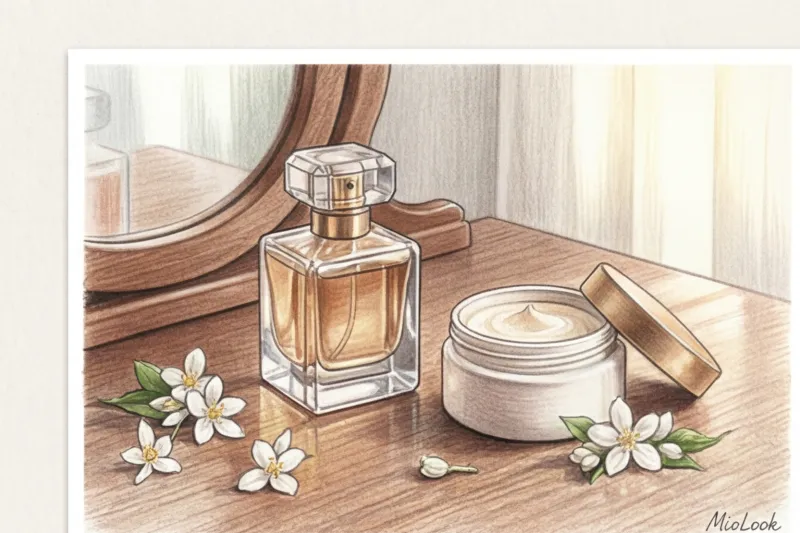
Have you ever noticed how a luxurious bottle of niche fragrance for €250 can completely disappoint by lunchtime? You spray your usual three times before leaving the house, and four hours later, the luxurious sillage is gone. Over 12 years of working as a personal stylist, I've learned one crucial thing: we're accustomed to perceiving perfume as "magic water," when in fact, it's a complex chemical formula. Perfume is your invisible accessory. It's the finishing touch that ties your entire look together or, conversely, ruins it if the scent doesn't feel right.
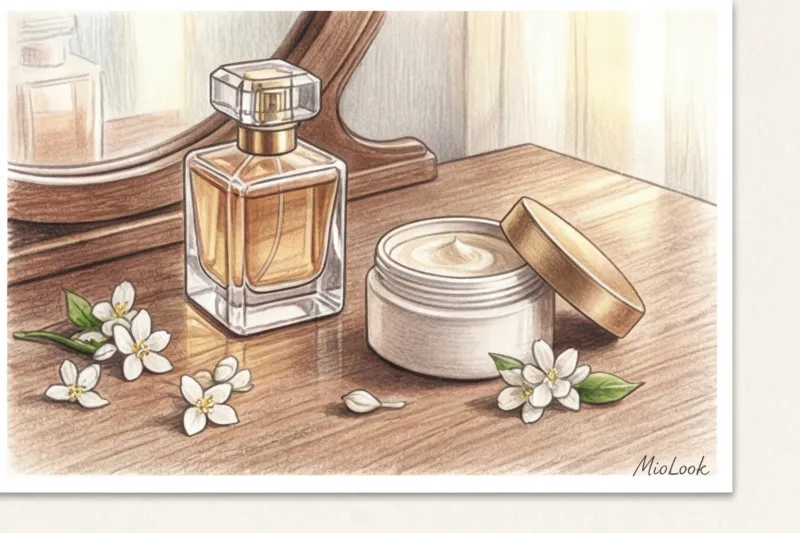
The correct way to apply perfume directly depends on your skin's lipid barrier, the texture of your clothes, and even how many hours you spend on your laptop today. If you're just starting to develop your personal style and want to understand the basics, I highly recommend checking out our The Complete Guide: Perfume Wardrobe: How to Build a Basic Collection Today, we'll explore the pure mechanics of longevity: how to make your fragrance smell expensive and last long without reapplying it every couple of hours.
The Anatomy of Longevity: Why Some Fragrances Disappear While Others Last Until Evening
Let's be honest: no perfume will last long on dehydrated skin. A scent's longevity isn't just a matter of the perfumer's work, it's also a matter of physiology. Essential oil molecules need something to cling to. On dry skin, they have nothing to cling to, so the rate at which perfume evaporates from dry skin is, on average, 40% faster than from properly moisturized skin.
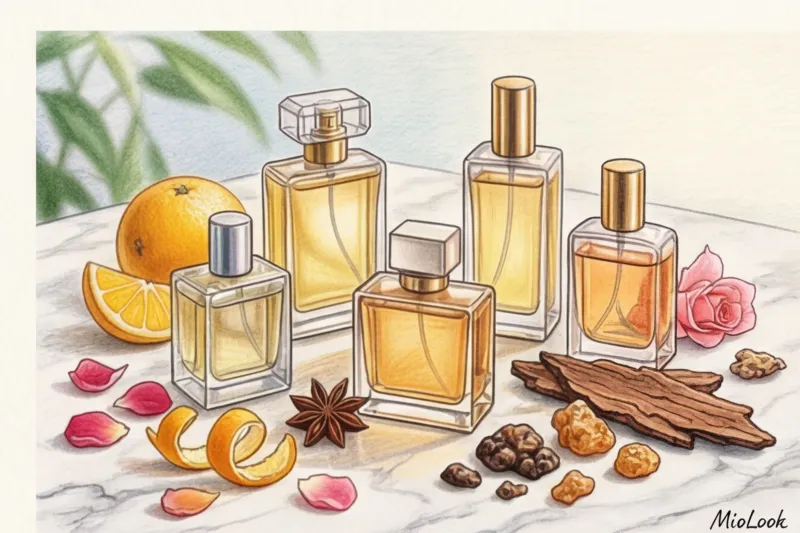
Furthermore, concentration is crucial. According to the international standards of the IFRA (The International Fragrance Association), differences in composition dictate the longevity of a fragrance on the skin. Eau de Cologne contains only 2-5% aromatic substances and is designed to refresh you for a couple of hours. Eau de Toilette contains 5-15% essential oils, while Eau de Parfum contains a hefty 15-20%, capable of lasting a full workday. If you buy a light, citrusy EDC and expect it to last well into the night, you're asking the laws of chemistry to be beyond what's possible.
I often see women accuse brands of "reformulating" or buying counterfeits, when in reality they're simply applying eau de toilette to skin that's tight from a harsh shower gel. Your moisturizing lotion is the best primer for your perfume.
Your perfect look starts here
Join thousands of users who look flawless every day with MioLook. Our smart algorithm will help you choose not only the perfect outfit but also the perfect mood for the day.
Get access — €0.99 onceHow to Apply Perfume Properly: A Stylist's Map of "Secret" Spots
The classic advice is to apply perfume to your pulse points. But have you ever wondered why? The blood in these areas is closest to the epidermis, so the skin temperature there is, on average, 0.5–1°C higher than the rest of the body. This micro-heat acts as a miniature aroma diffuser, constantly warming the oils and causing them to evaporate, creating a trail of sillage.
However, the standard spots (behind the ears and on the collarbones) have one major drawback: they're too close to your nose. After a couple of hours, your receptors adapt, olfactory blindness sets in, and you feel like the perfume has worn off. So you spray three more times, literally ruining your coworkers' sense of smell.
My favorite styling trick, which I recommend to all my clients, is to apply it to the back of the neck, just below the hairline. The hair traps the fragrance, and every time you turn your head or the wind blows, you leave behind a subtle, elegant trail. The scent doesn't overwhelm your nose. Other less obvious but effective areas include the inner elbow and the back of the knee (perfect for summer).
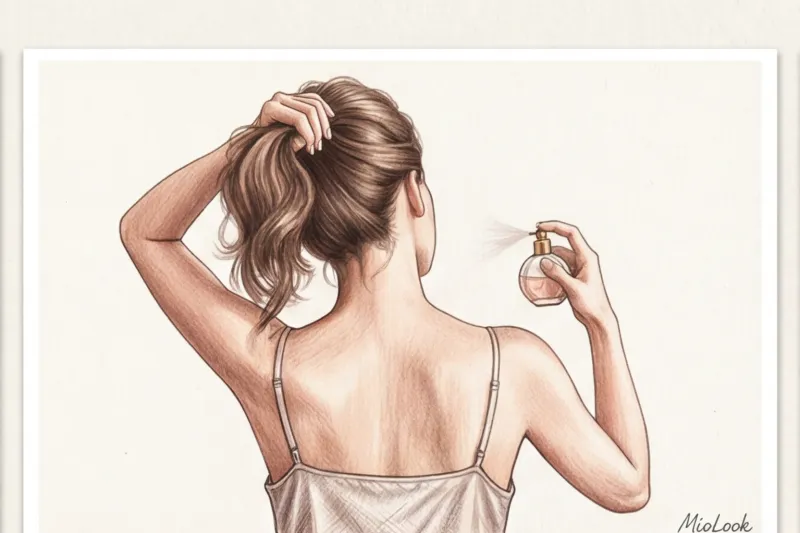
Why Wrists Are the Worst Place to Apply Perfume
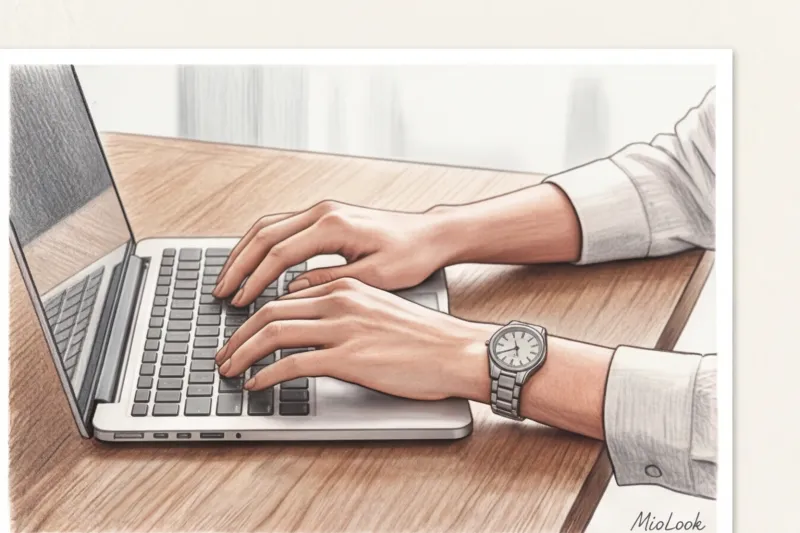
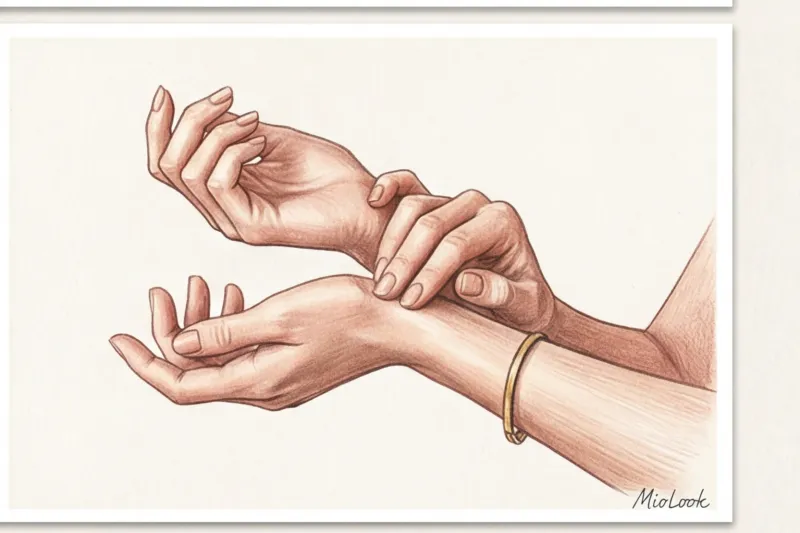
I'm officially stating: spraying perfume on your wrists is a huge mistake for modern women. Yes, it's a classic of the last century, but let's look at your typical day.
You arrive at the office, rest your hands on the desk, and start typing on your laptop. The constant friction against the desk edge and keyboard physically erases your scent. Furthermore, your beautiful perfume inevitably mingles with the scent of heated plastic. And what if you wear a watch? Leather straps absorb scents over the years, distorting any new composition, and metal bracelets can oxidize when exposed to alcohol and oils, producing an unpleasant metallic note.
Perfume and clothing: how to apply fragrance without ruining your look
One of my executive clients once brought me three gorgeous silk Tom Ford blouses (each costing around €800) for a wardrobe review. All three had persistent yellowish stains on the neckline. The reason was simple: she'd sprayed her favorite oily perfume directly over her clothes before going out.
Any perfume is a mixture of alcohol, water, and essential oils. While natural wool, heavy cotton (180 g/m² and above), or cashmere absorb odors like a sponge and can retain them for weeks without damaging the fabric, fine silk, viscose, and light-colored synthetics are not forgiving. Alcohol destroys the silk fibers, and oils leave greasy stains.
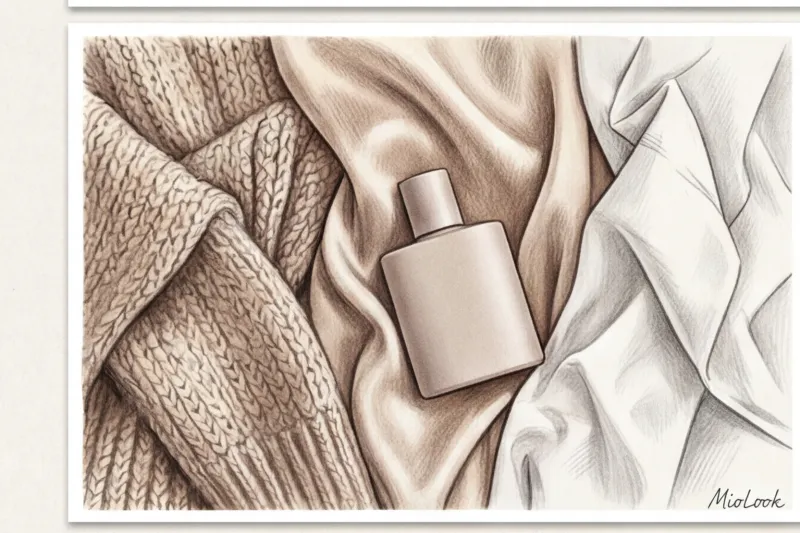
The golden rule of elegance: perfume first, then clothes. Let the alcohol evaporate from your skin for 1-2 minutes before putting on your blouse. The exception is heavy wool jackets and coats—you can safely apply fragrance to their lining to create a lasting seasonal scent. If you're choosing a wardrobe essential, I recommend checking out our article about Women's business suit: how to choose the perfect one , where the texture of the fabric plays a decisive role.
The Art of Layering: The Perfume Cocoon Method
When I prepare my clients for long evening events or red carpet events, I always use the "perfume cocoon" (or layering) method. The idea is simple: you build the scent in layers so it doesn't evaporate all at once.
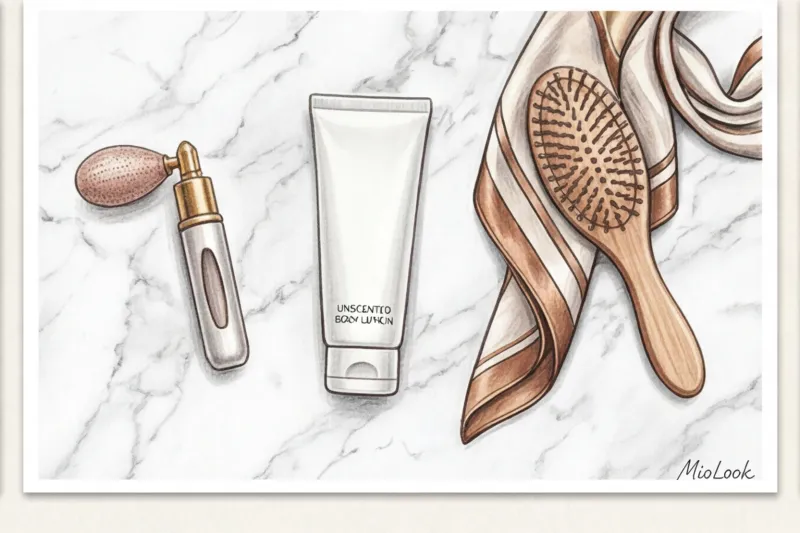
The easiest way is to use shower gel and lotion from the same bath line as your perfume. But buying expensive bath lines to go with each bottle is expensive. My personal professional trick: buy a thick, base body cream or lotion that's completely unscented (even drugstore ones for €10-15 will do). Apply it to your pulse points (neck, elbows, collarbones), and while the cream isn't fully absorbed, spray on your perfume.
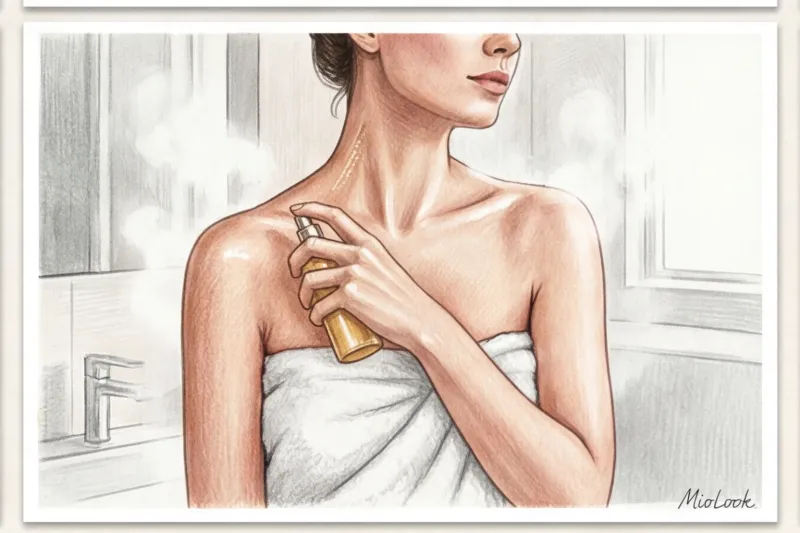
In my experience, this method of sealing the scent in a lipid layer has extended the life of even the most capricious citrus cologne by a good four hours. Important caveat: this method absolutely does NOT work with heavy oud or oriental extracts—you risk creating such a dense cloud that you'll suffocate both yourself and those around you.
Hair deserves a special mention. Regular perfumes dry out the ends of your hair due to their high alcohol content (up to 80%). If you want your hair to smell fresh as you move, invest in a hair mist—it has a lower alcohol content and added conditioning ingredients.
Access to MioLook for €0.99 — one-time payment
A smart AI stylist will create the perfect look for you. Sync your wardrobe with your schedule and mood in just a few clicks.
Get access — €0.99 onceCommon mistakes that kill the cable
Even if you've bought the perfect fragrance and moisturized your skin, a few wrong moves can ruin everything. Here are the main enemies of your sillage:
- Enemy #1: Rubbing perfume between your wrists. The brilliant perfumer Francis Kurkdjian constantly mentions this in interviews: aggressive mechanical friction instantly heats the skin. This literally "breaks" the olfactory pyramid. The fragile top notes (citrus, light florals) burn out in seconds, leaving you with only a dense base. Just apply and let dry.
- Enemy #2: Bathroom Shelf Storage. Moisture and constant temperature changes during showering break down the chemical bonds inside the bottle. Perfume should be stored in a dark place at a stable temperature (a bedroom closet is ideal).
- Enemy #3: The Cloud Method. Spraying perfume into the air and stepping into the cloud might look cinematic, but in reality, it's a waste of 80% of the product. Droplets settle on the floor and furniture, leaving only a pitiful residue on your skin. The only exception is highly concentrated perfumes (Extrait), which are otherwise too difficult to apply.
Choosing an application technique to suit your dress code and occasion
Style is always context. Your fragrance doesn't exist in a vacuum; it must fit the place and time. Business etiquette dictates that perfume shouldn't enter the meeting room before you do or remain there after you leave.
For a business environment, I recommend micro-dosing. Apply perfume only to your lower body (behind the knees) or spray one spray onto the lining of your jacket. Body heat will slowly release the scent without intruding on your coworkers' personal boundaries. If your office has a strict dress code but you want to feel comfortable, we discussed the basic principles in the article. Basic facial skin care: the secret to long-lasting makeup — after all, grooming is evident in the little things.

For evening events, layering works well: apply a drop to your collarbones to activate the scent from the warmth of your skin during conversation, and a little mist to your hair for lingering scent. However, if you're heading outdoors (on a walk, at a restaurant veranda), remember that the wind will quickly blow away light floral notes. Heavier compositions work better here (learn more about woody perfume for women: sandalwood, cedar, vetiver and oud ) - they have sufficient molecular weight to resist gusts of wind.
Checklist: 5 steps to perfect all-day wear
Let's distill all the mechanics into a simple, straightforward algorithm you can use tomorrow morning:
- Preparing the canvas: Apply unscented lotion to slightly damp skin immediately after showering.
- Correct geography: Select 2-3 pulse points (the back of the neck, the inner elbow, the collarbone). Forget about the wrists.
- Timing: Spray the fragrance before putting on clothes (especially if it's silk costing hundreds of euros).
- No violence: Let the perfume dry on its own without rubbing it with your fingers.
- The final touch: Use a hair mist on your comb before styling your hair.
Remember: perfume is the most intimate item in your wardrobe. It speaks volumes about you before you even utter a word. Treat it not as a morning routine, but as a clever styling tool that requires the right base, respect for the laws of chemistry, and the right context.