I still remember that day in 2018 in exquisite detail. My client, a talented top manager, was preparing for a crucial round of negotiations with Japanese investors. We had chosen an impeccable dark blue cold-spun wool suit that exuded confidence and status. But she made one fatal mistake: before leaving, she generously sprayed her favorite evening perfume with its prominent tuberose. In the cramped meeting room, this thick, predatory floral trail literally filled the entire space. One of the partners developed a migraine, the negotiations were disrupted and postponed. The contract was never signed.
This story perfectly illustrates the main rule: the right office perfume isn't just a pleasant scent. It's your invisible business suit, a strategic impression management tool, and, most importantly, a matter of respecting others' personal boundaries. We discussed the architecture of fragrances in more detail in our a complete guide to a perfume wardrobe and building a basic collection , but today I want to talk specifically about the corporate environment.
Perfume Etiquette: Invisible Boundaries in Open Spaces
We're used to carefully choosing our work attire, but we often forget that fragrance is a physical invasion of our colleagues' personal space. In Japan, there's even a special term for this phenomenon: Sumehara (smell harassment, or "smell harassment"). This concept has become so ingrained in corporate culture that some companies have an official ban on the use of perfume in the office.
According to 2022 research in environmental psychology, intense odors in enclosed spaces can reduce employees' cognitive focus by 30%, leading to fatigue and irritability.
Don't forget about the microclimate of a modern open-plan space. Air conditioning (HVAC) systems dry out the air. In these conditions, perfume molecules behave differently than outdoors: top notes evaporate instantly, and heavy base notes (especially ambroxan or synthetic musk) cling to the dry air and linger for hours.
The arm's length rule and the elevator test
Over 12 years of working as a stylist, I've developed a gold standard for office perfume for my clients: the "45-centimeter rule." That's roughly the length of your outstretched arm. Colleagues should only smell your scent when they're handing you documents or leaning toward your monitor. The "let people know I'm here by my sillage" mentality doesn't work in business—it's perceived as aggressive.
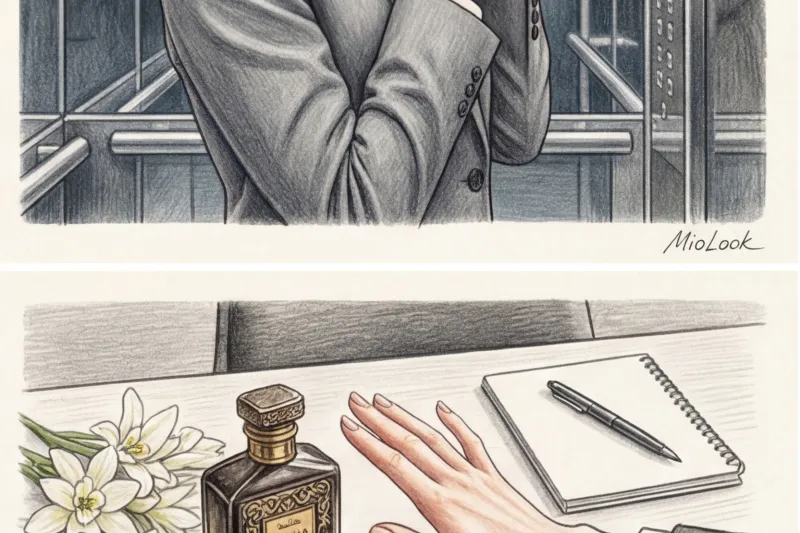
How to test yourself? Use my author's elevator test Apply perfume as usual, wait 15 minutes, then enter an empty elevator in your building. Ride one floor, exit, and immediately re-enter. If a thick, suffocating cloud of your scent lingers in the elevator, you've applied too much, or the perfume is definitely not suitable for the office.
How to Choose the Right Perfume for the Office Based on Your Dress Code
The olfactory profile should complement the texture of your clothing. You wouldn't wear a silk tie with a chunky ski sweater, would you? Likewise, a frivolous fruity "compote" water would ruin the sobriety of an expensive cashmere jacket.
Business Formal: Fragrance as part of a formal suit
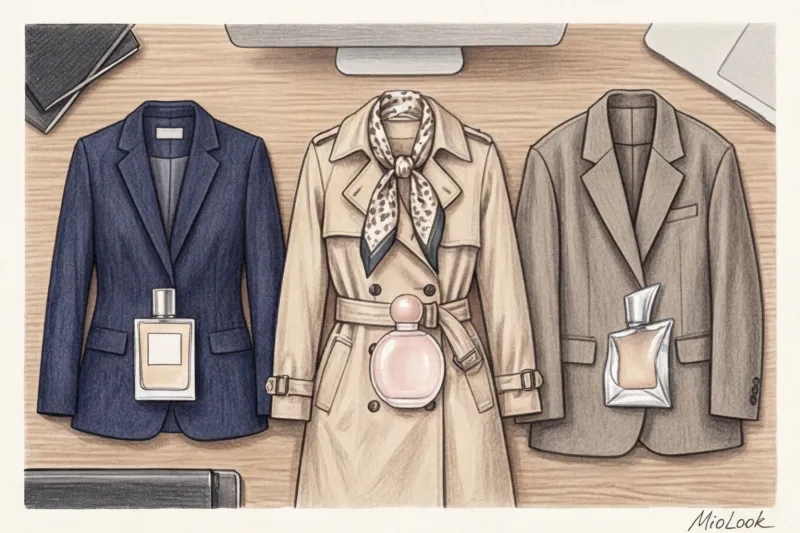
If your work wardrobe consists of structured suits, starched shirts (180 g/m² cotton and above), and pencil skirts, you need fragrances that convey distance and competence. Ideal fragrance families here are dry woody notes (vetiver, cedar) and powdery irises. They create a feeling of cleanliness, collectedness, and impeccable ironing. For example, dry vetiver pairs beautifully with dense cold-spun wool.
Smart Casual and Business Casual: Balancing Comfort and Status
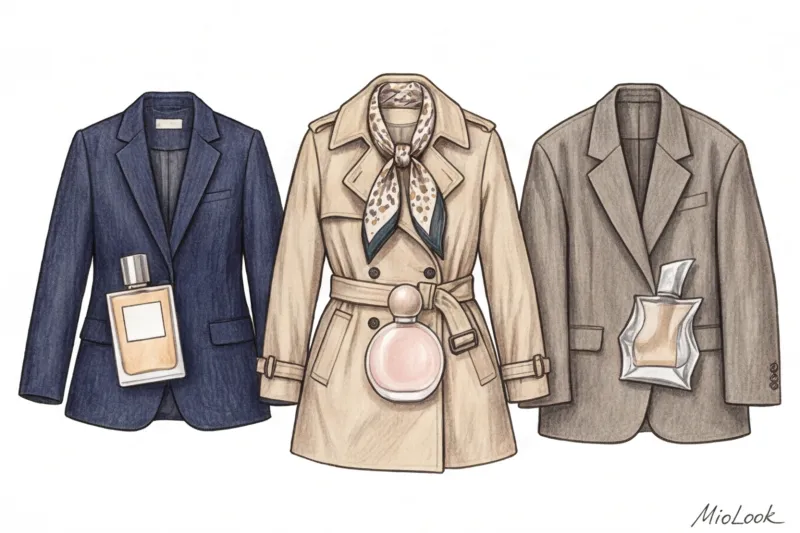
For a Friday dress code or offices where chinos, high-quality denim, and cashmere turtlenecks are appropriate, green scents (galbanum, matcha or oolong tea notes) and light, modern chypres are ideal. They create a sense of dynamism and openness to dialogue, without being overly familiar. This is the scent of someone who is easy to discuss a project with over a cup of coffee, but who strictly respects the chain of command.
Creative Industries: How to Show Your Individuality Without Stifling Your Colleagues
IT professionals, designers, and architects—freedom reigns here, but that doesn't mean you can douse yourself in heavy oud. If you want to highlight your unconventional taste (and your look revolves around asymmetrical cuts or Japanese deconstruction), consider molecular perfumes (bases like Iso E Super or Ambroxan). This creates a "second skin" effect. Also subtly beautiful are notes of unsweetened fig, fine suede, or black pepper.

Your perfect look starts here
Join thousands of users who look flawless every day with MioLook. A smart AI stylist will create a look that matches your dress code.
Get access — €0.99 onceThe Counterintuitive Truth: Why a Little 'Freshness' Can Let You Down
Now let's debunk the most popular myth. If you ask a store associate what scent to bring to the office, they'll immediately suggest something "fresh, citrusy, or marine." But in practice, this is the worst advice for working in an open-plan office.
It's all about chemistry. According to IFRA (International Fragrance Association) standards, citrus oils (such as limonene) are extremely volatile. In dry, air-conditioned air, lemon and bergamot evaporate in 20-30 minutes. What's left on your skin for the remaining seven hours of the workday? The base. In the budget or mid-price range (€30-€80), the base for aquatic fragrances often consists of cheap synthetic fixatives (such as the Calone molecule).
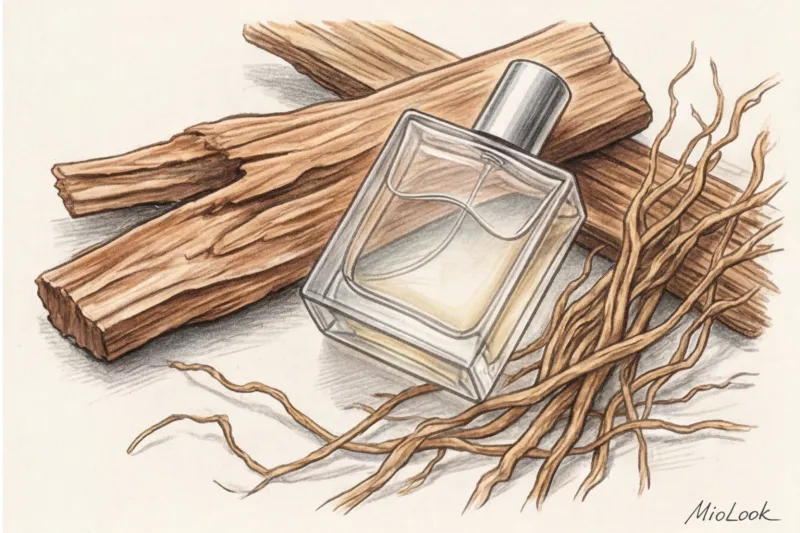
In an artificial climate, this synthetic residue deteriorates and begins to smell like glass cleaner, air freshener, or laundry detergent. Much safer for the office. dry woody aromas or "molecules" - they behave stably, do not break down into vague chemical notes and sound expensive throughout the day.
Perfume Stop List: What You Definitely Shouldn't Wear to Work
There are categories of perfumes that I categorically forbid my clients from wearing to work, regardless of their position.
- Indolic white flowers (tuberose, lily, jasmine). In nature, these flowers emit a scent to attract nocturnal pollinators. In the office, they literally suck the oxygen out of the room and are guaranteed to give coworkers with sensitive olfactory senses a migraine.
- Heavy gourmet (praline, vanilla, caramel, cotton candy). Remember the story from my guide about the IT director who loved sweet scents? People unconsciously associate sweet gourmands with childhood, immaturity, and pastries. You won't be able to rigorously defend a project's budget if you smell like cinnamon rolls—it's a dissonance that cheapens your professional status.
- Aggressive oriental and animalic (powerful oud, civet, dirty musk). These are scents for seduction or to demonstrate dominance. In the workplace, they are perceived as a gross violation of personal boundaries.
Application Technique: How to Wear Perfume to the Office So It Smells Right
Even the most delicate fragrance can be ruined by improper application. The classic advice to "spray on your wrists and rub" is a disaster for office workers. Why? Your wrists constantly rub against the edge of your laptop and keyboard. Firstly, the friction heats up your skin, distorting the development of the notes. Secondly, you wash your hands with soap 4-5 times a day. The mixture of perfume, office dust, and liquid soap fragrances creates an unpredictable and often unpleasant odor on your wrists.
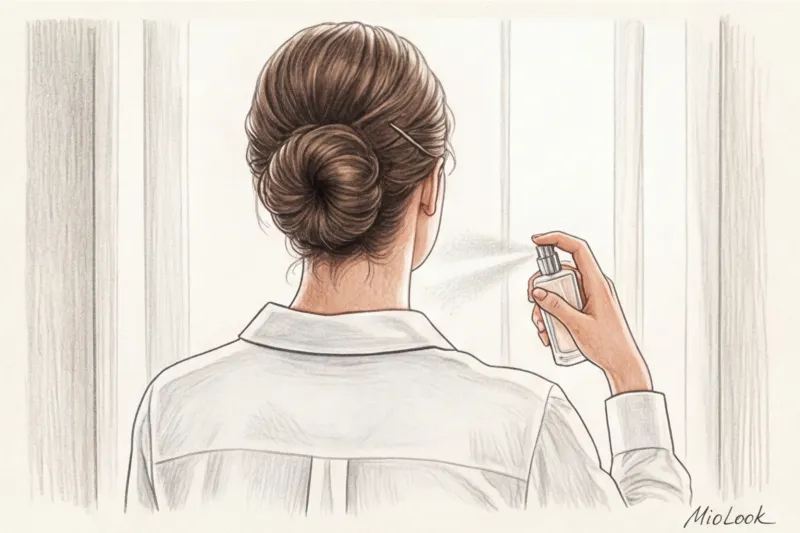
My favorite technique for the office is to apply it under your clothes, at the solar plexus level (one spray before putting on a blouse). The fabric muffles the scent, and it only comes out from the warmth of your body, creating an intimate aura rather than a trail of lingering fragrance.
Another great option is the back of your neck, just below your hairline. The scent will waft lightly as you turn your head or walk down the hallway.
"Important caveat: This advice does NOT work if you're wearing natural silk. The alcohol in perfume will instantly leave an oily stain on a silk blouse (especially in light shades) that no dry cleaner will remove. Silk items require perfume to be applied directly to the skin before wearing."
What about reapplying your perfume after lunch? My advice: don't. By mid-afternoon, your nose adapts to the scent (this is called olfactory fatigue), and you think the perfume has faded. In fact, your coworkers can still smell it just fine. Adding another dose at 2:00 PM risks a gas attack.
Access to MioLook for €0.99 — one-time payment
Start creating perfect looks with artificial intelligence. Manage your wardrobe intelligently and save time in the morning.
Get access — €0.99 oncePre-purchase checklist: how to test office perfume
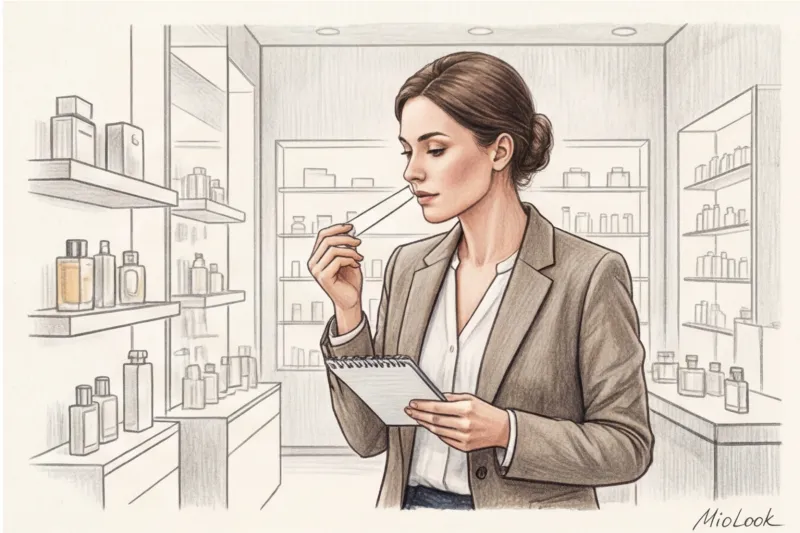
Never buy a fragrance to wear to work during your lunch break based on the first notes on a paper blotter. The paper is cold and won't reveal how the perfume will develop on your hot skin.
- Mandatory skin test. Apply the candidate to the crook of your elbow and leave the store.
- Full day test drive. Evaluate how the fragrance behaves after 8 hours. Has it become sour? Did it give you a headache by evening?
- Checking reactions. Ask your most honest colleague (ideally someone you share an office with): "I'm testing a new fragrance. Does it distract you?"
- The rule of small volume. Don't immediately invest €150-€200 in a full-size 100 ml bottle. Buy a travel-size version (10 ml usually costs around €20-€40) or a branded sample. Wear it for a week. Only if it's stood the test of stress, air conditioning, and meetings should you buy a larger size.
When choosing a perfume for the office, always remember the main purpose of your time at work. You're there to solve problems, build a career, and earn money, not to compete with each other for the loudest scent trail. The ideal work scent is one that makes those you're talking to unconsciously lean a little closer to listen to your words, rather than leaning to the edge of their chairs to escape the overwhelming wave.