The Psychology of Perception: How Clothing Affects First Impressions in 7 Seconds
In my 12 years as a stylist and fashion journalist, I've witnessed the same scene hundreds of times—from the backstage of Paris Fashion Week to the boardrooms of investment funds. Someone walks into the room, and the atmosphere subtly changes before they can even say "hello." Have you ever wondered? How clothes influence first impressions In those crucial moments of dating? It's not just a matter of good taste or following trends; it's rigorous neurobiology, and arguing with it is utterly pointless.
Why are we so quick to judge people by their appearance? Evolutionarily, it's an ancient survival mechanism. Our brains needed to instantly determine whether someone in front of us was friend or foe, leader or follower, whether this person represented a threat or inspired trust. And although today we're rarely threatened by saber-toothed tigers, our neural algorithms remain the same.
According to Alexander Todorov of Princeton University's seminal research, our brain requires just one-tenth of a second (100 milliseconds) to evaluate a stranger's face and visual cues, drawing basic conclusions about their competence, aggressiveness, and trustworthiness. Then those legendary seven seconds come into play: during this time, the brain completes a quick scan of the silhouette, assessing colors, fabric textures, and cut geometry. After this, the "label" is in place, and everything you say next will be perceived by the other person through the filter of their already formed unconscious opinion.
In cognitive psychology this phenomenon is called Halo Effect Its mechanism is simple, yet incredibly powerful: one clearly visible, positive visual trait causes others to automatically attribute other positive qualities to you, qualities they haven't yet had the opportunity to verify. In my experience, this stylistic trick works flawlessly. By wearing an impeccably tailored blazer made of thick fabric (even if it's bought at a high-quality mass-market store for €100-150), you transmit the clearest possible signal to your interlocutor's brain.
Seeing a smooth, structured shoulder line and a perfect fit, people subconsciously assume you're as organized, disciplined, intelligent, and competent in business processes as you are in choosing your wardrobe. Geometric prints work in the same way—for example, traditional patterns convey stability and logic, as we discussed in detail in the article about rules for stylishly combining checkered patterns in clothing When the visual shell is put together correctly, it becomes your invisible advocate, protecting your reputation even before negotiations begin.
Not Just for Others: How Your Image Programs Your Brain
If you think that a conscious approach to wardrobe selection is solely for the purpose of manipulating other people's opinions, you're missing half the picture. Your clothes are a powerful interface that primarily programs your own nervous system.
To substantiate this assertion, let's turn to hard scientific data. In 2012, researchers at Northwestern University published a breakthrough paper, introducing the term Enclothed Cognition Scientists conducted an elegant experiment: they gave subjects identical white cotton coats. But there was a twist: the first group was told they were wearing a doctor's uniform, while the second group was told they were wearing an artist's work coat. The results were astonishing: those wearing the "doctor's coat" demonstrated a sharp, statistically significant increase in concentration, attention, and the ability to solve complex analytical problems.
The subjects were physically wearing the same item of clothing. But the symbolic meaning the brain associated with the clothing literally altered the subjects' cognitive abilities. Clothing changes the way we think.
Beyond symbolism, pure physiology plays a huge role—the way fabric feels on your body directly alters your gait and even the sound of your voice. Heavy tweed or dense, structured cotton make you move more smoothly, deliberately, and grounded. Think of the sensation of a tight skirt constantly riding up, or shoes squeezing your foot—your nervous system spends precious resources every second processing this micro-discomfort, robbing you of focus and creating uncertainty in your gestures.
"The structured collar of a quality shirt or the firm shoulder line of a well-tailored jacket involuntarily straightens your posture. And when you lift your chin and square your chest, your vocal resonator expands. Your voice begins to sound deeper, fuller, and more authoritative."
You're not just "playing the role" of a confident leader—your clothes physically trigger your body to generate confidence signals. That's why I always emphasize: don't save uncomfortable or "difficult" clothes for important meetings in the hopes of impressing. In a critical moment, your wardrobe should act as armor, not cause additional anxiety.
When my clients put together their seasonal capsules in the app MioLook We always consider not only the company's dress code but also the inner state we need to evoke on a particular day. Need maximum focus before a complex presentation? We choose structured lines, high contrast, and dense fabrics. Is there a day of creative brainstorming or mentoring coming up? We soften the silhouette by adding flexible knitwear and freedom of movement. We'll discuss this anatomy of visual communication in detail in the next section.
The Anatomy of a Visual Message: The Hidden Codes of Your Wardrobe
Clothing is more than just covering oneself and protecting oneself from the cold. It's a fully-fledged nonverbal language, with its own grammar, syntax, and vocabulary. In his seminal work, The Fashion System (1967), the French philosopher Roland Barthes brilliantly demonstrated that every detail of our wardrobe functions as a sign. Cut and silhouette are the grammar that defines the structure of the statement, while color, prints, and accessories are the vocabulary. And this language is intuitively understood by others, even those who have never been interested in fashion.
Historically, silhouettes have always conveyed social status and the cultural context of an era. Think back to 1947. Europe was just beginning to recover from World War II. Women were accustomed to angular, practical uniforms made from meager scraps of fabric. And then Christian Dior took to the catwalk with his legendary collection. Corolla , which Carmel Snow of Harper's Bazaar would immediately dub the "New Look." The highlight of the show was the Bar Suit jacket. Sloping shoulders, an extremely narrow waist, a stiff peplum, and a skirt that required up to 40 meters of luxurious fabric.
This wasn't just a new fashion. It was an architectural manifesto: a return to structured, exuberant femininity and a display of status. Dior restored women's right to occupy space and openly declare their privilege through volume. This historical example clearly demonstrates how clothing shape dictates social messages.
Today in styling we actively operate with the concept visual weight (visual weight). This is how your image "anchors" your presence in a room. Dark shades, dense fabrics, layering, and sharp geometric patterns have tremendous visual weight. When my client, the CEO of a fintech startup, was preparing to pitch to the board of directors, we intentionally increased her visual weight. Instead of a light silk blouse, she wore a thick, double-breasted jacket made of heavy wool. This physically changed her gait and the amount of space she visually occupied at the negotiating table. To manage this balance independently, I often recommend clients use the "smart wardrobe" feature in MioLook It allows you to photograph objects and visually analyze the density and geometry of your images on your smartphone screen, assessing their visual weight from the outside.
Lines and Geometry: The Architecture of Trust and Power
Any silhouette, even the most complex, can be broken down into simple lines. And our brain reacts to them in the same way it does to the architectural forms of buildings.
Vertical lines convey dominance, ambition, and dynamism. This applies not only to the classic pinstripe print, but also to creases on trousers, deep V-necklines, long, narrow lapels, or an unbuttoned, straight coat. They draw the viewer's gaze up and down, subconsciously associating it with stature and hierarchy. Horizontal lines (wide, contrasting belts, Breton stripes, boat necklines), on the other hand, convey stability and solidity, grounding the look.
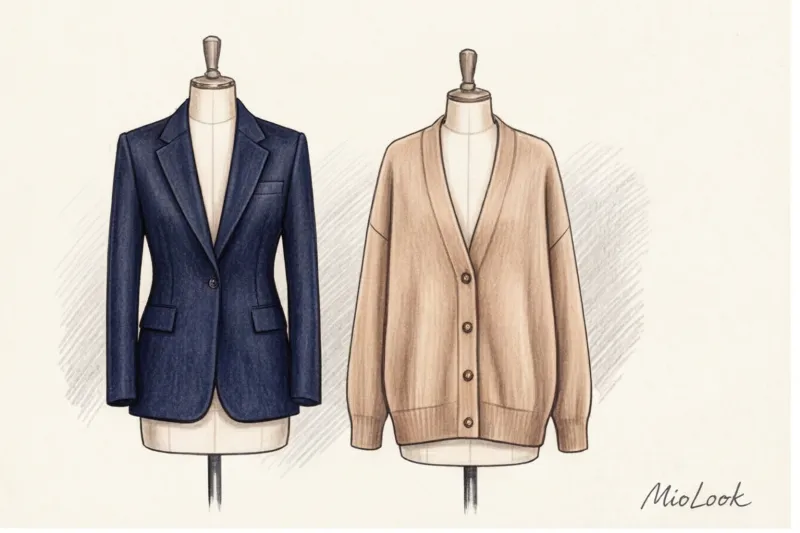
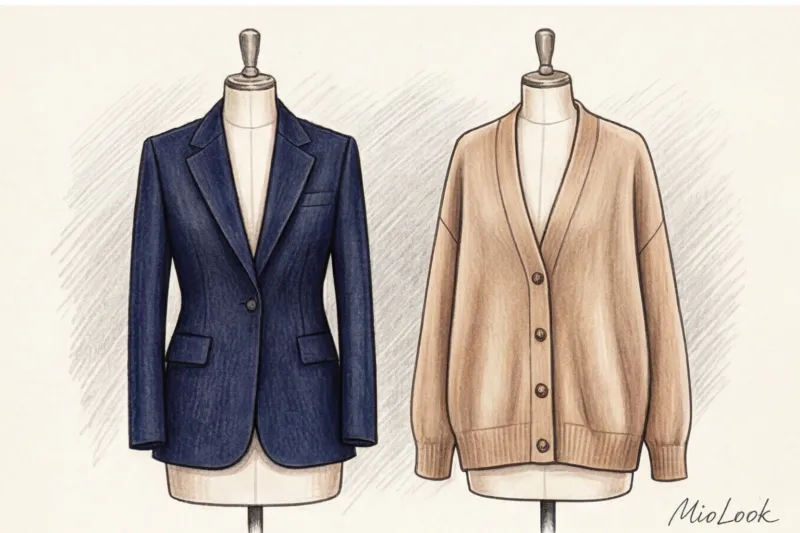
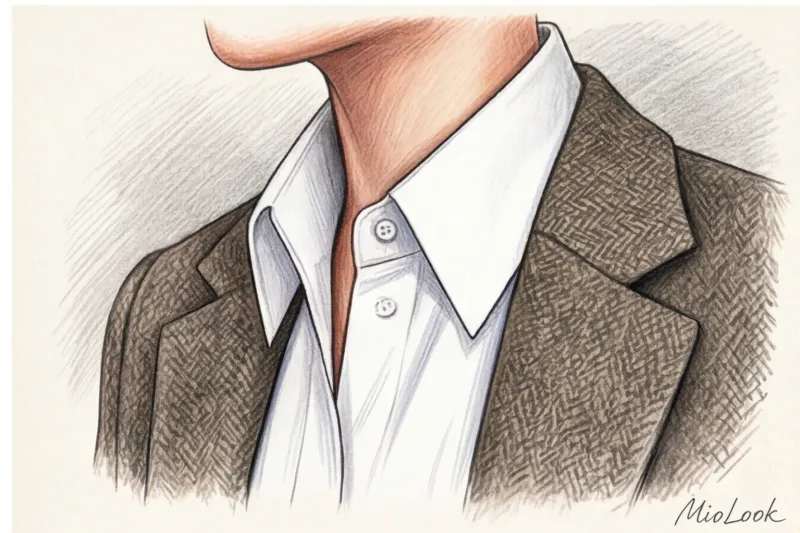
But the main tool for power management is angles. Sharp angles are subconsciously read as boundaries. A pointed shirt collar, a sharp shoulder line with pads, and peaked lapels—all these are nonverbal signals of authority and distance. They say, "I am precise, I demand respect for subordination, do not violate my boundaries." This is the ideal choice for tough negotiations.
Conversely, soft curves convey empathy, flexibility, and approachability. A cowl neck, a drop shoulder, or the rounded edges of a soft cardigan are all examples. If you're facing a difficult conversation with your team, where showing humanity and a willingness to listen is crucial, ditch the stiff jacket. Choose a high-quality knit with a softer fit (a good basic cashmere jumper will cost between €150 and €300, and this investment in trust will pay off handsomely).
Digitize your wardrobe with MioLook
Analyze the visual weight and geometry of your items with an AI stylist. Create capsule wardrobes for any work scenario in just a few clicks.
Get access — €0.99 onceTextures and Fabrics: Kinesthetics at a Distance
We're used to thinking that touch requires physical contact. But in the psychology of style perception, there's a phenomenon called distant kinesthetics: our eyes are capable of "feeling" fabric from a distance. The way light refracts on the surface of your sleeve or collar conveys a wealth of information to your interlocutor even before you shake hands.
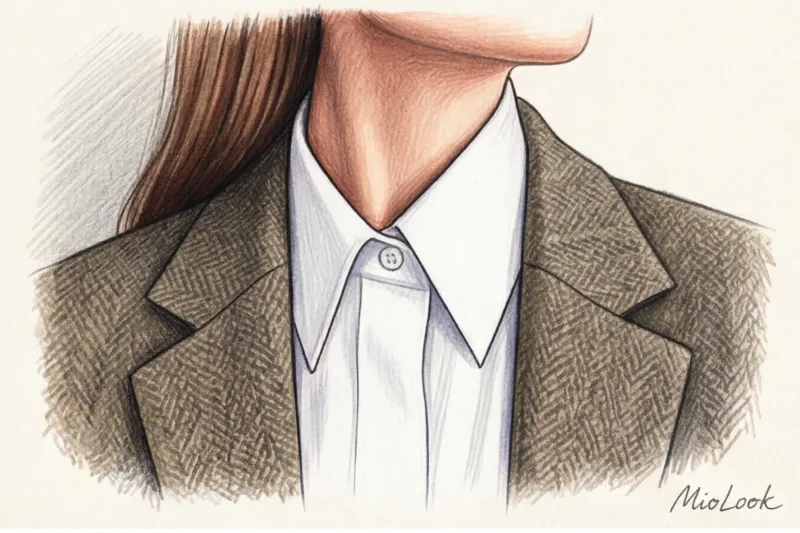
When we consider how clothing influences first impressions, texture often takes an unfair backseat to color and cut.
Dense, matte fabrics—tweed, heavy wool suiting, thick cotton poplin, gabardine—absorb light. They don't reflect light and hold their shape perfectly with every movement. Subconsciously, such materials are associated with reliability, consistency, and gravity. A person in a tweed jacket or heavy cotton shirt seems more solid and predictable. This is your ideal visual "armor" for situations where you need to project unwavering confidence.
At the other end of the spectrum are reflective, flowing, and fluid fabrics: natural silk, satin, viscose, and cupra. They reflect light, creating shimmer and highlights. Such materials convey dynamism, luxury, creative energy, and adaptability. However, they have a dangerous downside: their fluidity and softness can make them feel elusive and less grounded.
"In one of my consultations, we analyzed the wardrobe of a top manager who complained that during strategy sessions, her ideas were often perceived as 'too creative, but out of touch with reality.' We opened her closet and found it dominated by flowing silk blouses with soft bows and fine viscose knits. As soon as we introduced matte structured cotton and thick wool into her workflow, her partners' attitudes changed dramatically—her proposals began to be taken seriously."
Knowing this kinesthetic ABC, you'll never wear a glossy satin blouse to a crisis meeting again. You'll opt for matte cotton or thick wool, because in turbulent times, people need a visual anchor, not glare on the water.
Unobvious details that speak louder than logos
Let's conduct a thought experiment. Imagine two business suits. The first was bought at a mass market for €100, but then taken to a good tailor, who tailored it to fit perfectly. The second is a designer suit for €2,500, worn straight off the rack, with slightly long sleeves and slightly sagging shoulders. Which one conveys higher status? Spoiler: the first, and by a wide margin.
In an era where brand logos have become too accessible, the true marker of status, professionalism and influence has become clothing fit (fit). A perfectly tailored garment conveys a powerful subconscious message to others: this person has the time and resources to provide a personalized approach. They don't settle for average standards.
Working with corporate clients, I often encounter situations where millimeters of fabric literally decide the fate of multi-million dollar projects. One day, a brilliant marketing director of a major FMCG company approached me. She possessed a remarkable analytical mind, but complained that the board of directors repeatedly rejected her innovative strategies. After analyzing her wardrobe, I noticed two critical fit flaws.
First, the sleeves of her favorite jackets were too long, almost completely covering her wrists. From the perspective of evolutionary psychology and nonverbal communication, hidden hands are subconsciously perceived by others as secrecy and a lack of transparency (our brain literally thinks, "She's hiding something"). Second, we discovered a deep "accordion" of fabric above her shoes—an incorrect trouser break (a crease in her trousers), which made her gait visually heavy and her appearance untidy. As soon as we shortened the sleeves, revealing slender wrists (a signal of openness and trust), and adjusted the length of the trousers to a strict, straight line, the dynamic of her meetings changed. Her next pitch was unanimously accepted.
"Seating is your personal architectural design. A perfectly fitting garment frees your mind from the need to adjust your skirt or straighten your collar, allowing you to focus entirely on your conversation partner."
No less important role is played by psychology of scale — how the volume of a garment relates to your body and the context of the situation. Oversized style, so beloved by designers like Demna Gvasalia or the Olsen sisters (The Row), carries a rebellious code. Exaggerated volumes make a statement: "I have the right to occupy a lot of physical space, I don't have to fit into a box." This is a great tool for creative industries, the IT sector, or professions that value out-of-the-box thinking. However, in more conservative fields like investment banking or corporate law, excessive oversize clothing can be a disadvantage. These sectors require tailored fit, which signals discipline, an understanding of boundaries, and a structured mindset.
The third hidden code that our brain reads in a split second is physical state of things You can wear a Loro Piana cashmere sweater, but if it's pilling, the luxury magic evaporates. Sagging toes on shoes, frayed edges on a leather bag, stretched elbows, or a ragged stitching on a hem all transmit a catastrophic microsignal: a lack of attention to detail. A kind of "broken windows theory" comes into play: if someone doesn't notice a torn button or a worn heel before an important meeting, won't they miss a critical mistake in a contract?
Keeping your clothes in perfect condition requires consistency. To avoid unpleasant surprises five minutes before leaving, I recommend that clients regularly digitize their capsule wardrobes. After uploading a basic wardrobe to MioLook , you can plan your looks for the week in advance and mark items that need to be dry cleaned, machine-depilled, or taken to a tailor.
The Perfection Trap: Why “Trying Too Hard” Is a Turn-Off
If fit and grooming are so important, does that mean we should strive for absolute, sterile perfection? Paradoxically, no. There's a counterintuitive rule in styling: a look that's meticulously crafted down to the last micron evokes a subconscious sense of unease in the viewer.
When a bag perfectly matches the color of your shoes and belt, when every hair is perfectly aligned, and the jewelry is carefully arranged, it looks like a costume for a theatrical production. Such a rigid design conveys tension. It screams: "I spent three hours in front of the mirror; I'm so afraid of making a mistake." Perfection deprives one of a way of life and creates distance, preventing the emergence of empathy.
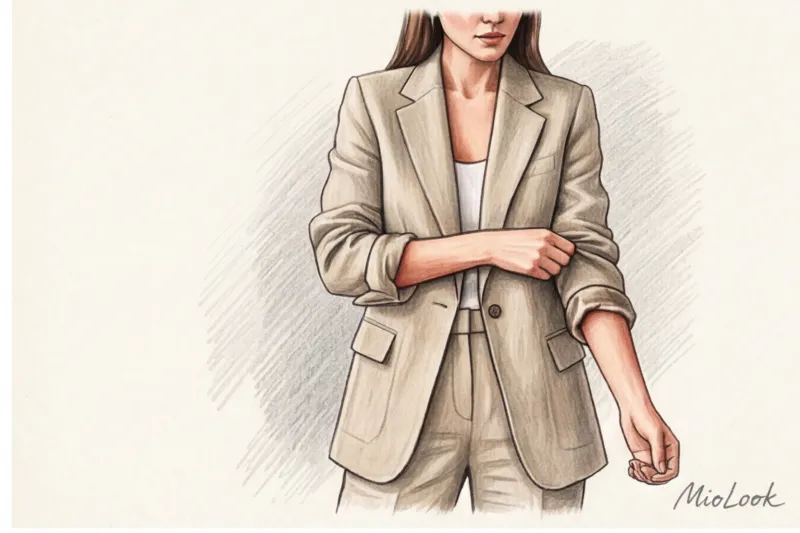
In contrast to this, there is the great Italian concept Sprezzatura (sprezzatura). The term, coined as early as 1528 in Baldassare Castiglione's treatise "The Courtier," refers to the art of concealing art. It's a planned, elegant casualness that makes others think you look stunning without the slightest effort.
How does it work in practice? It's a shirt tucked into trousers asymmetrically (famous French tuck ), which instantly takes the edge off a formal suit. It's the casually rolled-up jacket sleeves, exposing the forearms—a gesture that historically symbolized a willingness to roll up one's sleeves and get down to business. It's a slightly tousled, lively hairstyle paired with a formal dress.
Strategic imperfection is the ultimate marker of self-confidence. When you add a touch of chaos to your image, you send a powerful nonverbal message: "My status and my competence are so unshakable that I don't need to hide behind the armor of a perfect suit." It's this balance between strictness and relaxedness that makes you not just a professional, but a vibrant, engaging leader people want to follow.
Impression Management in Real-World Scenarios
Imagine a sound engineer's console. Your wardrobe is the same mixing console, where the sliders for contrast, geometry, and texture can be cranked up or down depending on the tone you want your communication to take. Understanding How clothes influence first impressions , lies not in blindly following trends, but in the ability to adjust these visual parameters situationally. This is the skill that distinguishes a simply well-dressed woman from a competent strategist.
In my styling practice, my clients and I don't create looks based on the "pretty or ugly" principle. We create them for specific purposes, as functional tools. Let's explore the mechanics of three of the most common professional scenarios.
Scenario 1. Asserting Authority: Hard Boundary Architecture
Context: the first meeting with investors, taking over as the head of a new team, tough negotiations about increasing the budget.
Visual code: High contrast, structured shoulder lines, thick matte fabrics, minimalist yet weighty embellishments.
When your goal is to establish boundaries and demonstrate power, your silhouette must be monumental. High color contrast (for example, a graphite-gray suit and a crisp white shirt) physiologically forces your interlocutor's eyes to focus on the edges of your silhouette. This is interpreted by the brain as uncompromisingness and clarity of position. A structured shoulder, reminiscent of iconic Saint Laurent jackets, visually widens the upper body, conveying dominance.
Pay special attention to fabrics. A matte finish (wool gabardine, heavy cotton) absorbs light, creating a sense of visual weight and stability. Investing in the perfect heavy wool jacket (excellent basic options range from €200–€400) pays off in the very first negotiations. Jewelry in this scenario should be discreet. No small scatterings or bracelets that jingle when you gesture. One large geometric element—for example, a sculptural ring or a steel-cased watch—nonverbally declares, "My time is precious."
Scenario 2. Building Empathy: The Kinesthetics of Trust
Context: conflict resolution in a team, mentoring, therapy sessions, difficult conversations with stakeholders.
Visual code: Low contrast, soft knitwear, smooth lines, warm muted tones.
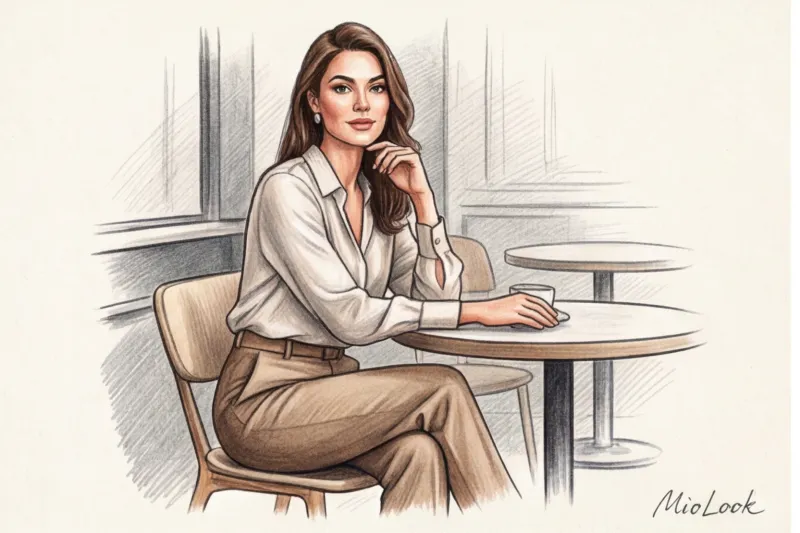
In this scenario, we need to eliminate visual "angles" that might distract a stressed person's gaze. The lack of sharp contrast between your top and bottom reduces visual aggression. If you're dressed entirely in a monochrome beige, olive, or dusty pink, your conversation partner will relax physiologically.
The brain perceives soft, fluid textures—cashmere, thick silk, viscose—as an invitation to safe dialogue. Shoulders should be dropped or softened, and the collar should be soft (for example, a cowl or U-neck instead of a stiff stand-up shirt).
To avoid wasting morning hours choosing the right monochrome on the day of difficult negotiations, my clients save capsules “for building trust” in advance, using intelligent image selection in MioLook The app helps you instantly filter items with the desired texture and color temperature, eliminating unnecessary cognitive load before an important meeting.
Scenario 3. Creative Leadership: The 80/20 Formula
Context: Pitching an innovative project, presenting a creative concept, speaking at a specialized conference.
Visual code: a classic, understandable base plus one unexpected, avant-garde element (asymmetrical cut, complex deconstruction, unusual color combination).
This is the most complex and intellectually challenging styling technique. If you show up to a pitch to investors dressed in total avant-garde (for example, deconstructed Maison Margiela pieces from head to toe), they'll subconsciously assume you're a brilliant visionary but too out of touch with reality to trust you with a budget. If you dress in a predictable navy suit, they'll doubt your ability to generate fresh ideas.
The secret lies in balance: 80% conservatism and 20% rebellion. Wardrobe basics (for example, perfectly tailored straight-leg trousers with a crease and high-quality, classic shoes) say, "I'm reliable, systematic, and able to manage processes." But an asymmetrical blouse, a jacket with a single contrasting lapel, or a neon accent color add, "But I think outside the box and see what others don't." This visual paradox holds the audience's attention the longest, as the brain needs time to decipher the double message.
Access to MioLook for €0.99 — one-time payment
Start creating perfect images using artificial intelligence for any communication task and scenario.
Get access — €0.99 onceHow Clothing Affects First Impressions in the Online Age
According to Stanford University's Virtual Interaction Lab (2022), video conferencing has radically changed the mechanics of reading status. In real life, we assess a person as a whole, but through a webcam lens, 70% of our nonverbal arsenal simply disappears. How clothes influence first impressions in the digital environment, it is subject to completely different laws, borrowed more from television journalism than from classical styling.
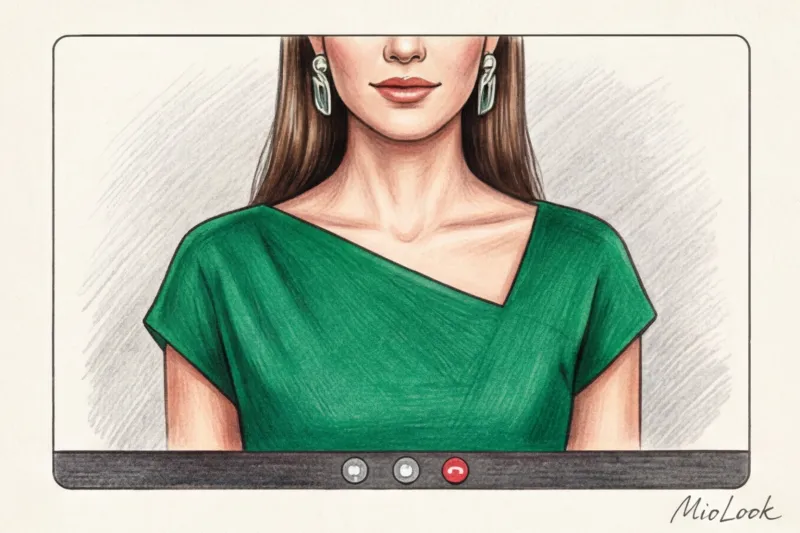
This is where the "waist-up styling" rule comes into play. Since we no longer have the opportunity to showcase perfectly creased trousers or classy shoes, all the visual impact is concentrated on the upper third of the body. One of my clients, a communications director, complained that her authority within the team had begun to wane while working remotely. We analyzed recordings of her calls: she wore soft, shapeless cashmere sweaters. In a real conference room, they would have looked appropriate due to the overall dynamic of her body, but in the static space of Zoom, she looked too homey and relaxed.
Color and Optics: Why Cameras Hate Prints
A laptop camera is a merciless filter. By choosing patterns like pinstripes, ribbed fabric, or classic pied-de-poule, you risk creating a moiré effect. The camera's sensor can't handle the rapid rhythm of the pattern, and on your interlocutor's screen, your shirt begins to visually "shake" and strobe, causing subconscious irritation and distracting from the conversation.
"Solid colors work well in the frame, especially jewel tones like deep sapphire, emerald, and ruby. They create the necessary contrast and don't blend into the background, unlike pastel tones, which webcams often wash out to a dull gray," notes Tom Ford in his guide to video calling aesthetics (2020).
New Focus: Cutout Architecture and Texture
When the silhouette is cropped, the neckline becomes the main architectural element. The collar acts as a "frame" for the face and conveys a level of formality. A stiff turn-down collar on a shirt or a crisp V-neck with a tight hem create strict diagonals, connoting composure and control. Conversely, a soft boat neck or a shapeless round collar on a basic T-shirt instantly diminishes the air of authority. To be fair, this advice isn't universal. If you have a naturally short neck, a stand-up collar will only weigh down the portrait area—in that case, a deep V-neck, which visually elongates the vertical line, is better.
The interaction between fabric and lighting is equally important. Popular ring lights mercilessly highlight even the slightest sheen on synthetic materials. Even a €200 blouse made of shiny viscose will produce cheap reflections under direct, cool light. Matte, dense textures—cotton, crepe, fine wool—absorb light and look elegant in the frame.
To avoid guessing how a particular top will look on screen before every important call, I recommend digitizing your "winning" belt looks. Upload your successful top options to MioLook and put them together in a capsule tagged "Zoom-ready." This will save you 15 minutes of morning preparation and ensure your virtual presence is as impactful as your physical one.
Finally, always consider your digital or real-life background. If you're sitting against a light wall in a white shirt, you risk looking like a "talking head" with no shoulders (the floating head effect). Your image should contrast with the background so the camera lens can clearly focus on the contours of your figure.
Checklist: Auditing Your Visual Message Before an Important Meeting
In aviation, there's an unbreakable rule: no pilot will fly a commercial airliner without passing a rigorous pre-flight checklist. In professional styling and political image-making, we use exactly the same approach. When major contracts, important personnel decisions, or your professional reputation are at stake, then... How clothes influence first impressions , ceases to be a matter of personal taste and becomes a matter of cold calculation.
Before any significant public appearance, I always require my clients to run their finished image through this five-step filter. It takes exactly two minutes, but it protects against fatal nonverbal errors.
Step 1: Goal Formulation (Objective)
Ask yourself: "What specific reaction do I want to provoke?" Do you need unquestionable authority for a meeting with crisis managers? Responsive empathy for a difficult conversation with a burned-out team? Explosive creativity to champion an innovative concept? Or perhaps your tactical goal today is to blend in to become a discreet but attentive observer? All further visual assembly depends on this fundamental decision.
Step 2: Checking the silhouette and structure
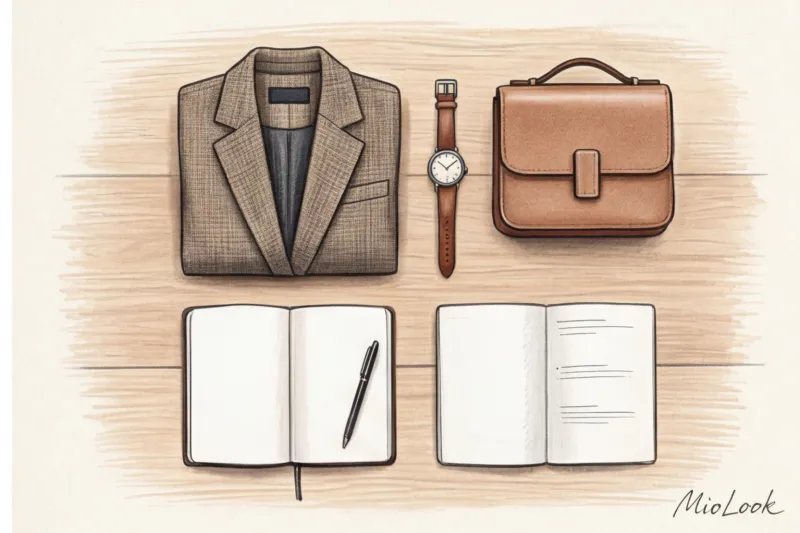
Does the geometry of your clothes align with your purpose? If you've chosen the role of a supportive leader but wear a stiff, armored jacket with sharp, exaggerated shoulders, you'll experience severe cognitive dissonance. Your words will convey "I'm open to dialogue," while your body lines will convey "keep your distance." Remember how Giorgio Armani removed the stiff padding from jackets in the 1980s: this deconstructed silhouette instantly made businessmen appear more flexible and negotiable.
Step 3: Color Contrast Analysis
Consider the contrast between light and dark tones in your look. A stark black and white combination always suggests maximum distance, uncompromisingness, and hierarchy. It can appear too aggressive in situations where consensus is required. If your goal is intimacy, intentionally reduce contrast. Use soft monochrome palettes or analogous color schemes (for example, deep graphite with muted blue).
Step 4: The Comfort Crash Test
I never tire of repeating this rule: even if you're wearing impeccably tailored €1,000 Jil Sander trousers, if they dig into your waist when you sit, you'll fail your presentation. Any physical discomfort triggers micro-tensions in your body, which your audience subconsciously interprets as a lack of confidence in your own words. Try this: sit on a low chair, lean forward, and actively gesture with your hands. Your breathing should be free, and your clothes shouldn't require constant tugging.
Step 5: Checking the focal point
The human eye is lazy—it always seeks the point of maximum visual tension. Where do you direct your interlocutor's gaze? If you're wearing a contrasting belt with a chunky buckle, your interlocutor will unconsciously look at your stomach. To ensure your audience is paying attention to you, shift the focal point to your face. This could be an architectural shirt collar, a silk scarf, a statement eyeglass frame, or a prominent earring.
To avoid wasting cognitive resources on this audit at seven in the morning before leaving for the office, I recommend digitizing your most successful images once. Save them in MioLook app and assign them functional tags: "for the board of directors," "for brainstorming," or "empathetic casual." This is your personal impression management database.
Your ideal image begins Here
Join thousands of users who look flawless every day with MioLook.
Get access — €0.99 onceSummary: From Manipulation to True Authenticity
There's a popular myth that consciously cultivating one's image is a form of hypocrisy. We often think that if we deliberately adjust the width of our jacket lapels or the shade of our silk to appear more powerful or empathetic, we're trying to manipulate and deceive others. But let's look at this through the lens of social psychology.
Let's recall sociologist Erving Goffman's classic work, "Presentation in Everyday Life" (1959). Goffman brilliantly demonstrated that we play out social roles, transmitting nonverbal cues every second. The only question is whether we let this process unfold or take conscious control over it. Effective impression management isn't an attempt to pretend to be someone you're categorically not. At its core, it's a process of eliminating visual friction.
What is visual friction in practice? It's a cognitive dissonance that occurs in your interlocutor when their appearance conflicts with your words and context. Let's say you're talking about strict financial discipline and crisis management, but you're wearing a relaxed, wrinkled linen suit (even though it was bought from Loro Piana for €2,500). The listener's brain is forced to expend precious energy reconciling these two conflicting signals: the soft kinesthetic of the fabric and the harsh rhetoric of the numbers. The way clothing influences first impressions works like a traffic light: by removing the dissonance, you turn on the green light for your interlocutor's brain. You're effectively declaring, "Everything here is logical, there are no hidden traps, I can be trusted." Their freed attention is finally spent on the essence of your ideas, rather than on solving the riddle of your appearance.
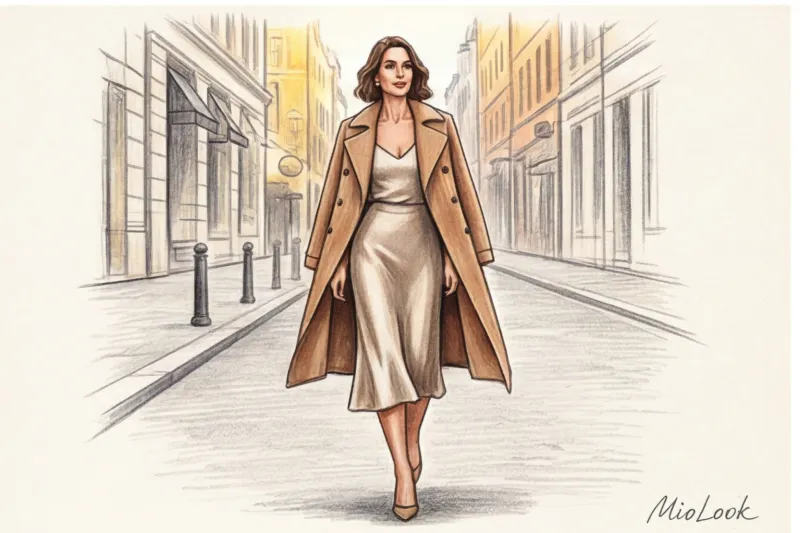
When your internal competence perfectly aligns with your external visual message, professional communication becomes completely seamless. I often recall a case from my practice with a brilliant urban architect. She stubbornly tried to wear stiff, tailored classic suits to meetings with contractors because "that's how it's done in a conservative environment." But inside, she was an innovator, a fan of deconstruction and parametric design. She felt physically uncomfortable in these tight suits, and this stiffness was unconsciously interpreted by her partners as a lack of confidence.
As soon as we shifted gears—switching to minimalist, loose-fitting Jil Sander pantsuits, thick, architectural cotton, and asymmetrical elements—something amazing happened. She no longer had to "play the strict boss." Her clothes became a literal extension of her professional vision: complex, modern, yet structured. Contractors began to listen to her more attentively simply because that same visual friction disappeared.
Finding that delicate intersection between “I need it for work” and “this is who I am” can be difficult. To track which things you feel most congruent with, I strongly recommend digitizing your successful images. By uploading them to MioLook Over time, you'll begin to notice objective patterns: which silhouettes, lengths, and textures not only fit the dress code but also give you that feeling of inner support. The app will act as an analytical mirror of your true authenticity.
The perfect outfit isn't the one that garners the most compliments, like "What a stunning dress!" From a professional styling perspective, such comments often mean the outfit is overpowering you. The ultimate statement is when someone says, "How wonderful you look today, what incredible energy and presence you have."
Your wardrobe should act as a flawless museum setting for a masterpiece. The best clothes are those that allow your true personality, your brilliant intellect, and your unique skills to shine brightly, without stealing the spotlight. Ultimately, your personal style isn't armor or a mask behind which you hide from the world. It's a microphone that makes your true voice clearer, louder, and more compelling.
Guide Chapters
How Details Change Everything: The Importance of Accessories in Your Look
Your basic wardrobe may consist of mass-market pieces, but it's the details that reveal your true status. Learn how accessories influence first impressions.
The ideal clothing style for a creative profession
We're busting the myth that the creative class must dress flamboyantly. Learn how to use minimalist cuts and colors to highlight your expertise and build trust.
How to choose the right look for the occasion: MioLook neural network
Your wardrobe is a powerful tool for impression management. Discover how MioLook's artificial intelligence helps you flawlessly choose a style for any occasion.
Clothing as Protection: The Psychology of Personal Boundaries
How does your wardrobe help you establish personal boundaries and manage the behavior of others? We explore the neurobiology of style and transform clothing into your armor.
What clothes make a woman look older: how to look younger
Youth trends don't always make you look younger; sometimes they mercilessly accentuate them. Discover the key style secrets and mistakes that make you look older.
How to Dress for a Networking Event: Dressing for Confidence
Why do expensive formal suits turn people off at events? Learn how to use the right textures and silhouettes to create a look that intrigues your audience.
How to Dress for a First Date: Stylist Tips
According to statistics, 8 out of 10 girls fail on dates because of uncomfortable new clothes. We'll tell you how to choose the perfect outfit without stress.
How to dress as a female executive: a status wardrobe
A leader's attire isn't about trends, but rather a tool for nonverbal dominance. Learn how to create a status-defying silhouette and command attention.
What cheapens an image: 7 details that ruin the impression
The secret to impeccable style isn't in the receipts from boutiques. Discover the 7 biggest micro-mistakes that instantly cheapen even the most expensive outfit.
The Psychology of Color in Clothing: How to Manage Your Emotions
Color is a powerful tool for nonverbal communication. Learn which shades in your wardrobe inspire trust and which can provoke aggression.
How to Look Expensive: Secrets of a Status Image
Why does one outfit look like a million bucks, while another looks cheap? Discover the secrets of a high-status wardrobe and learn how to create luxury looks in mass-market clothing.
How to Dress for an Interview: Secrets for an Offer
Choosing clothes for an interview has long gone beyond the rule of "looking neat." We explore the psychology of style to help you land that coveted offer.