Over the past three years, I've reviewed the wardrobes of over 50 clients who've transitioned to full-time remote work. Do you know what 90% of them complained about during their first consultation? It wasn't the lack of an ergonomic chair or noisy neighbors. Their main problem was constant, background fatigue, an inability to focus, and a completely blurred line between "me at work" and "me at home." As we dug deeper, one common detail emerged: the vast majority of them worked in pajamas or stretched-out fleece suits.
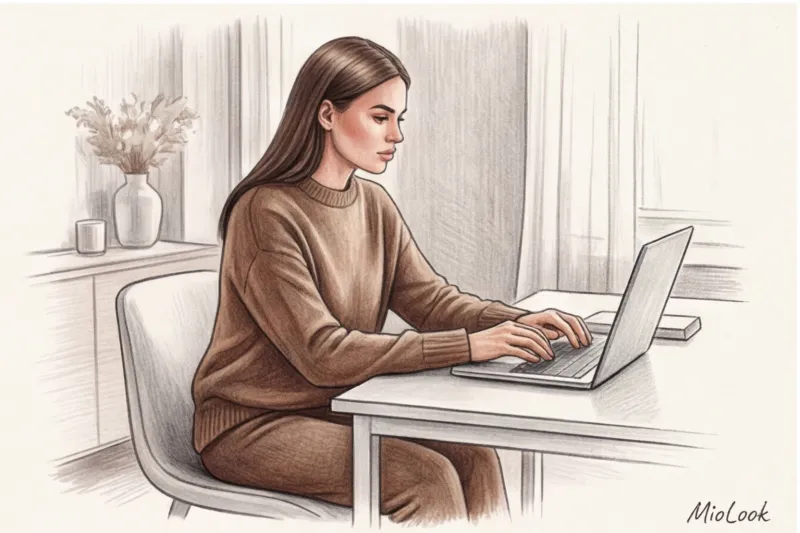
It seems like we've been dreaming about this for years—answering work emails right from our beds. But in practice, The impact of home clothes on productivity It turned out to be colossal, and not at all positive. Your body reads signals from the soft elastic of your pants just as quickly as from the stiff collar of your jacket. Let's explore why popular remote work "life hacks" are actually sabotaging your career and how the concept Smart Loungewear is able to give you back your energy.
The Biochemistry of Relaxation: The Impact of Loungewear on Productivity
To understand the scale of the problem, we need to look at how our brain processes tactile information. Pajamas aren't just a piece of fabric. Over the years, they've become a powerful trigger for your nervous system. When the familiar soft fleece, flannel, or silk you usually sleep in touches your skin, your brain receives a clear chemical signal: "Time to slow down, reduce cortisol, and get ready for sleep."
According to a study published in Medical Journal of Australia (2020), people who work in pajamas are 59% more likely to experience sleep problems and complain of daytime sleepiness. Why is this? We ourselves are breaking the associative connections.
In 2012, Northwestern University researchers Hayo Adam and Adam Galinsky coined the term "enclothed cognition." They demonstrated that the symbolic meaning of clothing directly influences our cognitive abilities. In their famous experiment, people in white coats who were told they were wearing a doctor's coat made half as many errors in attention tests as those who thought they were wearing an artist's coat. I discussed this phenomenon in more detail in our basic article. a guide to the psychology of style and the "dressed cognition" effect.
The Micro-Association Trap: How the Brain Confuses Rest and Work
Our brains love anchors. Bed and sleepwear are sacred ground for restoration. When you open a spreadsheet with your financial statements while sitting in your pajama bottoms, you're committing a crime against your own rest.
By working in sleepwear, you force your nervous system into a state of stress (work tasks) in a context designed for relaxation (pajamas). As a result, your brain loses the ability to respond to these things in the evening. You go to bed in the same fabric you wore during the day while arguing with contractors, and wonder why sleep doesn't come. The architecture of rest is destroyed.
Your perfect look starts here
Join thousands of users who look flawless every day and manage their wardrobe with MioLook.
Get access — €0.99 onceThe Zoom Shirt Myth: Why Business Tops and Pajama Bottoms Are a Bad Idea
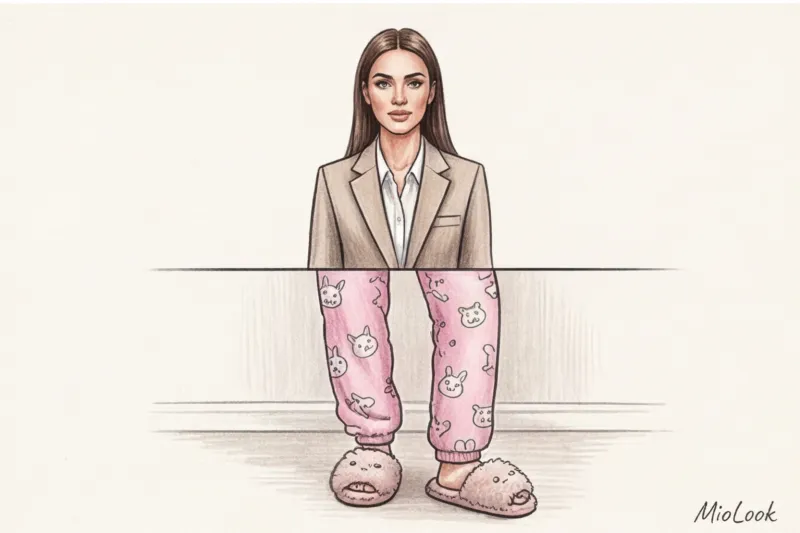
During the pandemic, the "Zoom-mullet" style was born: strict business blouse Or a jacket for the webcam and baggy shorts or sweatpants under the table. The internet is full of memes about how convenient this is. As a stylist, I consider this the main pitfall for remote workers.
The half-office, half-bed style evokes what I call wardrobe cognitive dissonance You are sending your body two conflicting signals at once.
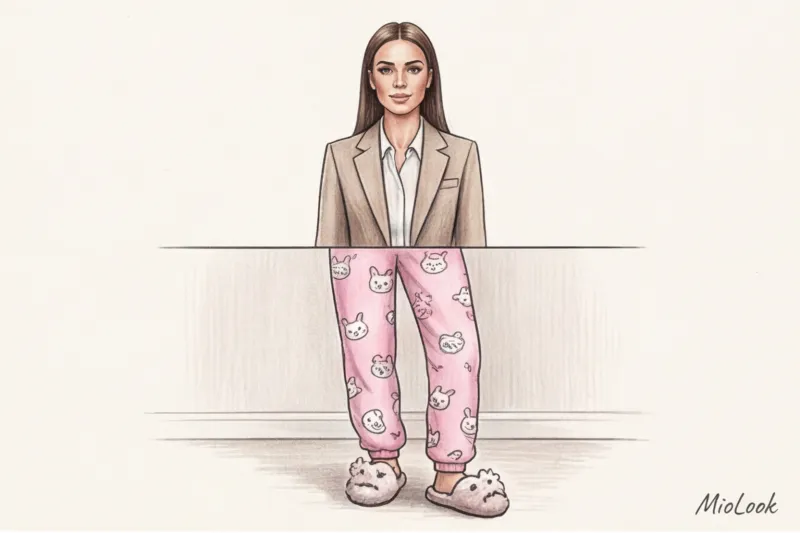
One of my clients, a top manager at an IT company, constantly complained of severe burnout and loss of concentration by midday. We tried an experiment: she swapped her soft joggers for structured, thick cotton pants—the kind that weren't even visible on camera. A week later, she texted me: "I stopped sliding under my desk at the end of calls."
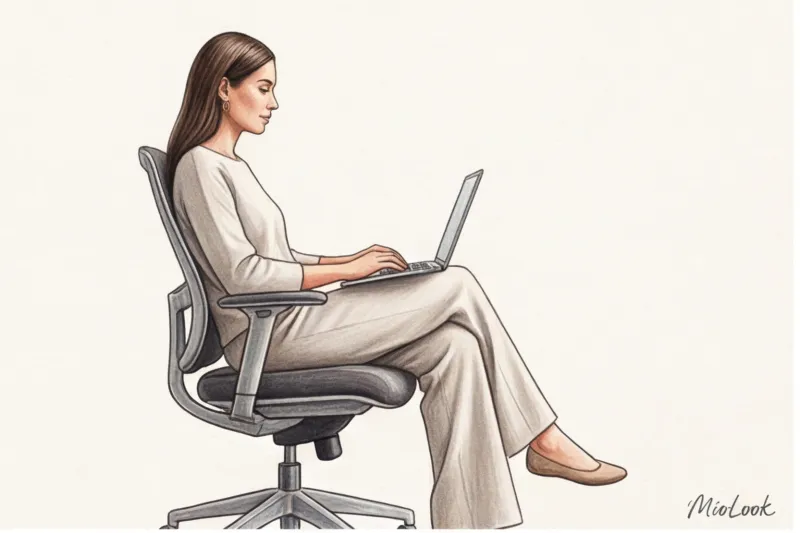
"Your posture is directly affected by the cut of your clothing. A soft, shapeless waistband on your elastic pajama bottoms causes your core muscles to relax. You slouch, your diaphragm tightens, your brain gets less oxygen, and you tire quickly."
Of course, this advice doesn't work for everyone. If you're experiencing gastrointestinal issues or severe pain, body comfort is paramount, and a soft elastic band is a must. But for healthy everyday life, a structured bottom is the foundation for your productivity.
Three-Mode Theory: Setting Wardrobe Boundaries
To regain control of my state, I implement the "three modes" system with my clients. It's a practical framework that permanently solves the problem of "nothing to wear at home."
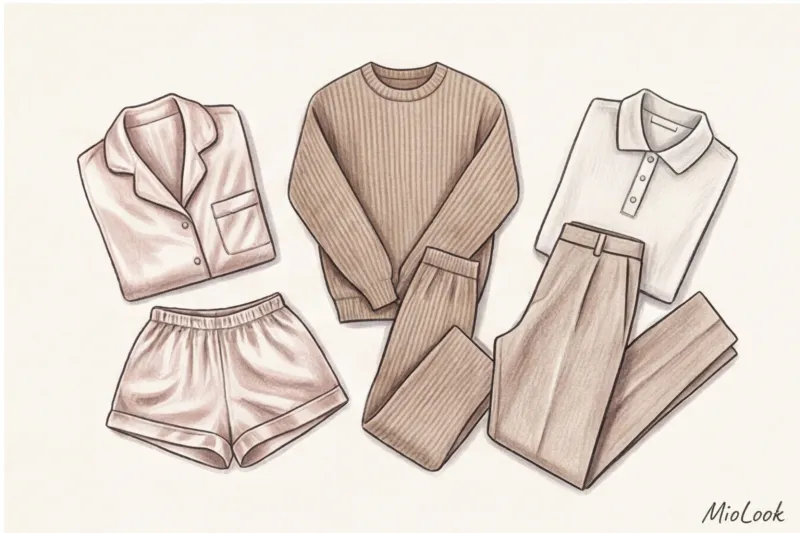
- Sleep mode (for bed only): Fine silk, cambric, soft viscose. No tight elastic, buttons, or tight seams. These are the clothes you put on 10 minutes before bed and take off immediately after waking up.
- Home Relaxation Mode (for evenings and weekends): Soft knitwear (two-piece sweatshirt), oversized hoodies, and loose joggers. These are clothes for watching Netflix, cooking dinner, or reading on the couch.
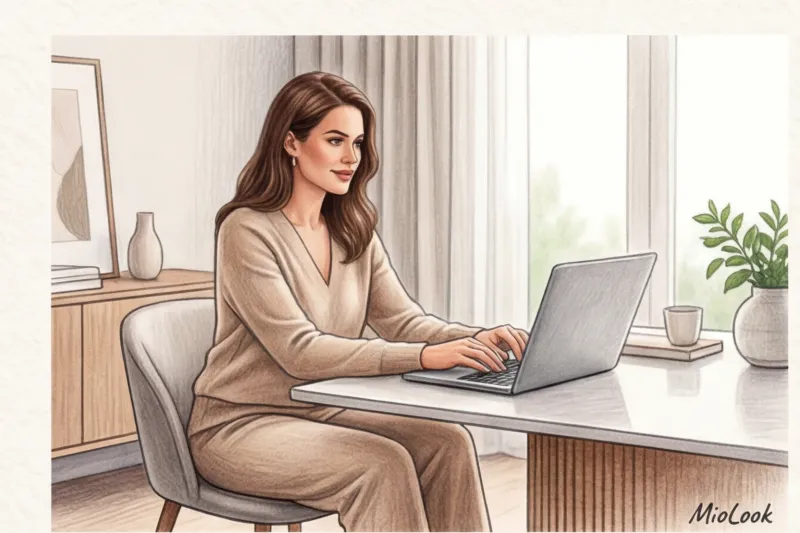
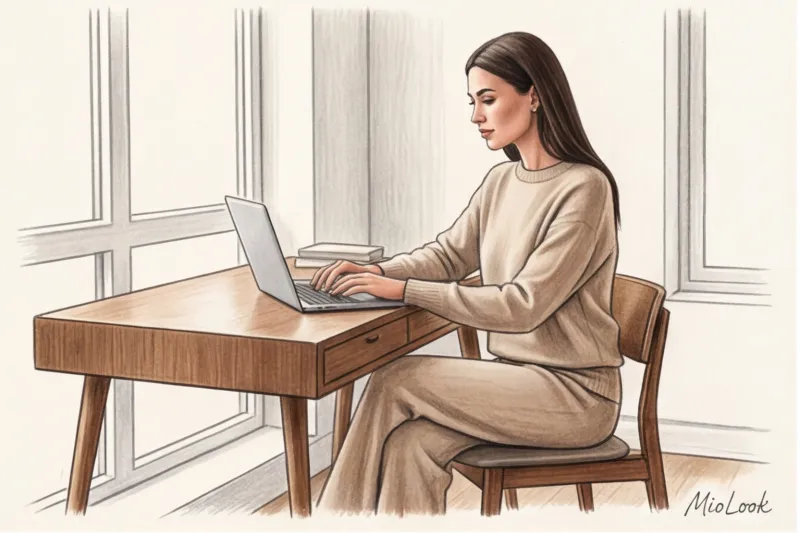
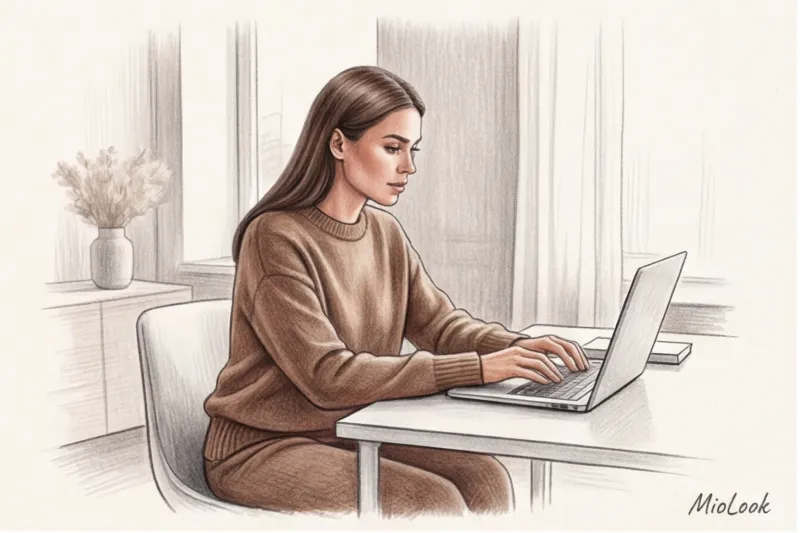
- Remote Work Mode (Smart Loungewear): Soft yet structured suits, thick knits, flannel shirts, chunky knit cardigans—in these clothes, you shouldn't be embarrassed to open the door for a delivery person or suddenly turn on a camera.
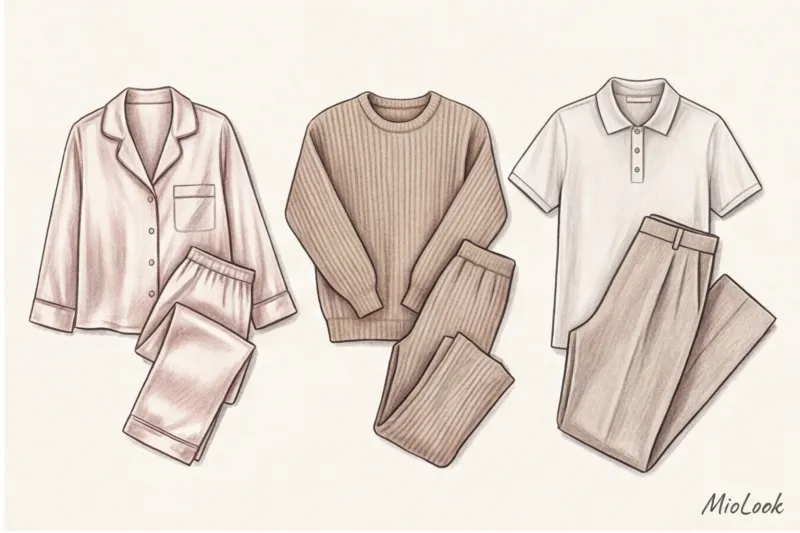
Physically changing clothes from one category to another replaces that very commute to the office that used to help the brain switch context.
Checklist: Putting together a WFH (Work-From-Home) capsule
What's the secret to a great home workspace? It's the balance between tactile comfort and visual clarity. Here are three rules I follow. smart casual kits for their clients.
1. The "tight edge" rule
Replace shapeless necklines and elongated sleeves with pieces with clean lines. Polo collars, V-necks with tightly ribbed binding, and cuffs that hold their shape are ideal. This visually brings together the portrait area and conveys professionalism, even through a poor webcam.
2. Fabrics that "support the back"
Forget about thin jersey that's see-through and wrinkles with the slightest movement. Choose:
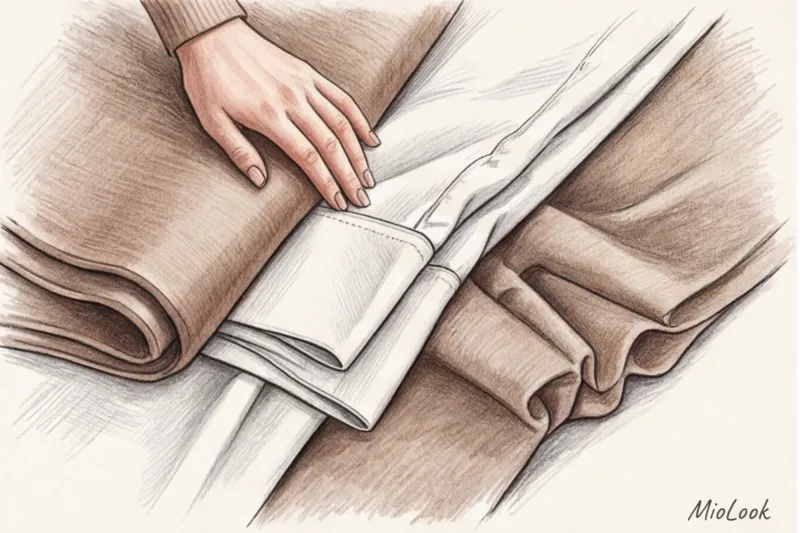
- Ponte Roma - double dense knitwear that stretches like leggings, but looks like trouser fabric.
- Thick cotton (from 180 g/m²) - perfectly holds the shape of loose-fitting shirts.
- Merino wool - thin, does not itch, regulates temperature and looks expensive.
3. Neutral palette versus childish prints
Ditch the Snoopy or Mickey Mouse pajamas from your work wardrobe. Opt for elegant monochrome combinations: camel, graphite, deep blue, ecru. According to internal analysis our MioLook app , users who plan monochrome home looks in advance report reduced morning anxiety and decision fatigue.
Access to MioLook for €0.99 — one-time payment
A smart AI stylist will select the perfect work-from-home capsule from your items in just a couple of clicks.
Get access — €0.99 onceThe Shoe Factor: Why You Should Ditch Slippers for Loafers or Mules
Fluffy house slippers are another enemy of composure. In body psychology, there's the concept of proprioception (the body's sense of space). When your foot is in a soft, shapeless cloud, the body receives a signal for maximum relaxation.
A stiff sole psychologically "pulls" a person together. Swap slippers for anatomically shaped clogs (like classic Birkenstocks), soft suede loafers, or leather mules that you only wear at home. Firm arch support dramatically changes your gait and energy level.
Dressing as a Ritual of Passage: Protecting Against Burnout
The main problem with remote work is the "eternal workday." You close your laptop, but you continue to sit in the same clothes on the same chair. Your mind doesn't register the end of work.
The "work suit removal" ritual is a powerful stress management tool. Create a rule: at exactly 6:00 PM (or when your shift ends), you get up, go to your closet, take off your Smart Loungewear, and put on a soft hoodie from the "Loungewear" category.
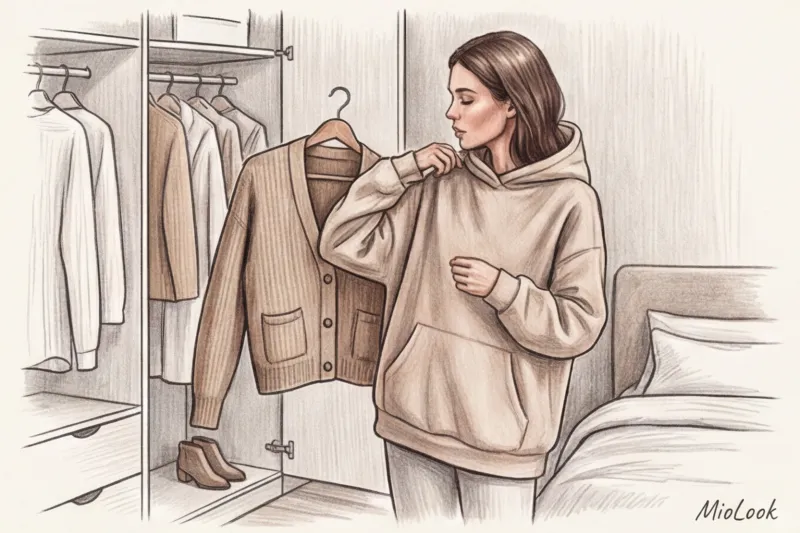
In my practice, clients who suffered from evening anxiety over unfinished tasks were able to reduce their anxiety within two weeks simply by adding this five-minute physical act. Releasing this "armor" is much more effective for the brain than simply closing the laptop lid because it engages muscle memory and associations.
Action Plan: Your Smart Home Wardrobe Starting Tomorrow
Reading articles doesn't change your life, taking action does. If you're reading this right now wearing the same T-shirt you slept in, here's your plan for the weekend.
Step 1: Conduct a rigorous audit.
Gather all your sleepwear and put it away in your bedroom drawers. Pajamas are not allowed in the office or kitchen during work hours.
Step 2: Assemble your WFH capsule.
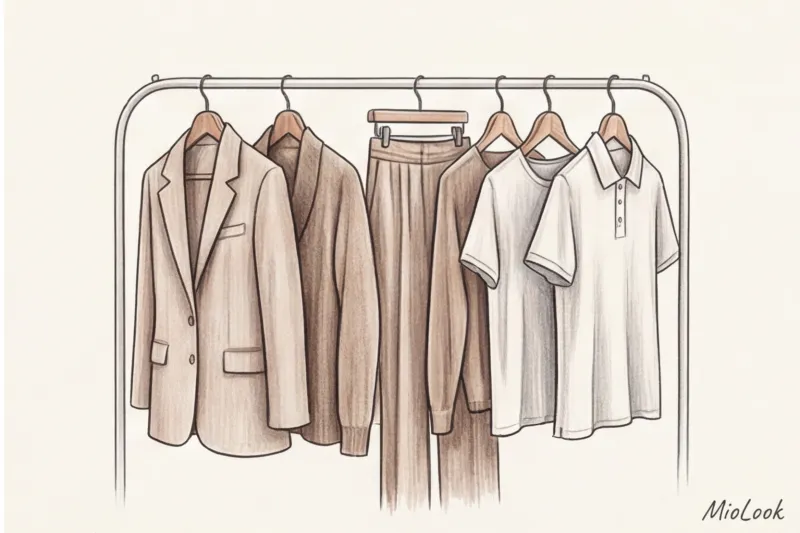
Set aside 3-4 sets specifically for working from home. Consider these: heavy knit pants, a pair of basic high-quality cotton t-shirts, and a structured cardigan. Hang them on a separate rack.
Step 3: Digitize and track.
Upload these items to a smart wardrobe, such as an app MioLook Try planning your at-home outfits for a week as carefully as you would for your commute to the office, and track the correlation between what you wear and the number of tasks you complete.
Your clothes are the control panel for your well-being. Stop giving up this control to random, stretched-out items, and you'll be surprised how much more energy you'll have left by the end of the work week.