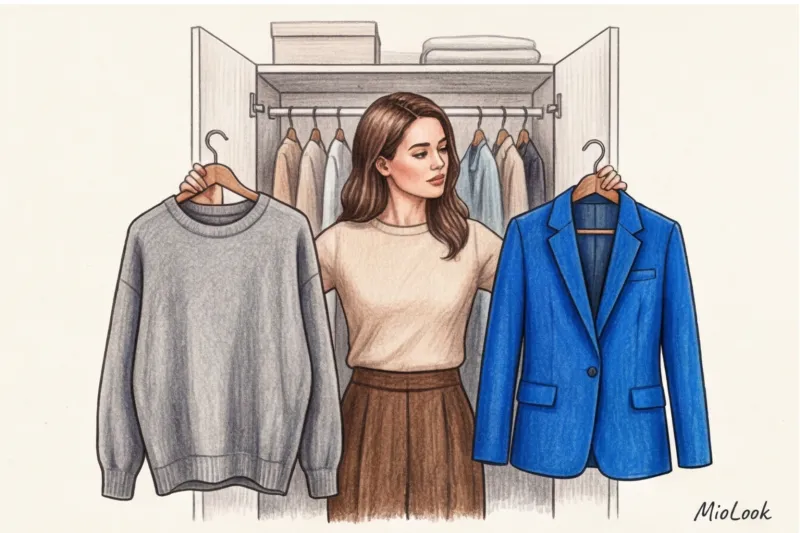
Did you know that 78% of women come to my first consultation with the same request? They say, "Emily, help me hide this." And only the remaining 22% actually ask the right question—how to highlight their best features. We spend years masterfully learning how to hide hips, drape stomachs, and camouflage shoulders, turning our closets into a warehouse of camouflage uniforms. But what if I told you that this camouflage strategy works exactly the opposite?
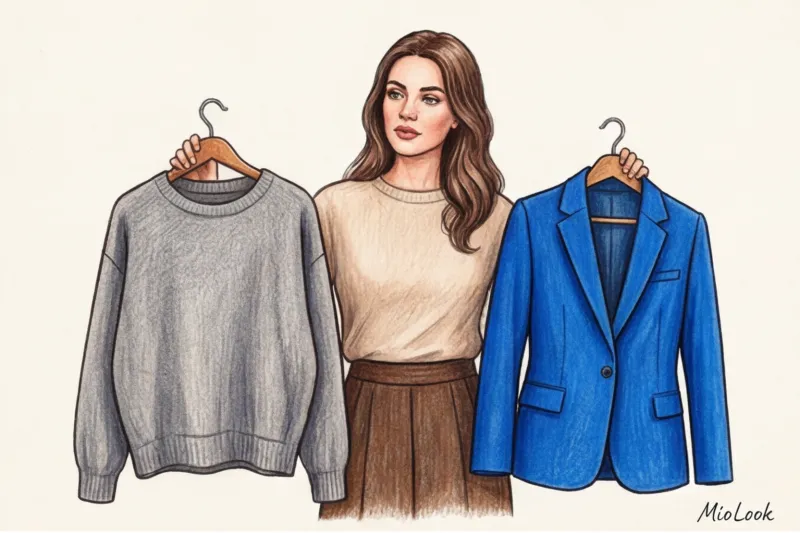
Over 12 years of working as a stylist, I've realized a simple truth: as long as you focus on your flaws, your entire look screams them. Let's forever forget the outdated classification of women's bodies into "fruit" shapes (no more "apples" and "pears"!). Today, we'll talk about how to shift the focus from insecurities to strategically accentuating your strengths using cut architecture, color, and modern technology.
The Psychology of Disguise: Why We Hide in Our Closets
The process of accepting your body always begins with hangers. We've already discussed this phenomenon in more detail in our a complete guide to the psychology of style and wardrobe Choosing clothes isn't just an aesthetic decision; it's a daily attunement of your psyche to a specific wave.
In 2012, Northwestern University researchers Hajo Adam and Adam Galinsky coined a startling term: enclothed cognition (embodied cognition). Their experiments proved that clothing directly influences the wearer's cognitive processes. By wearing shapeless loose-fitting clothes or buying jeans a size too small "to motivate yourself to lose weight," you create daily microstress. These items act as a silent form of self-harm.
"A wardrobe built out of fear of showing too much robs you of your individuality. You're not buying style, you're buying the illusion of security."
I had a classic case in my practice: while sorting through a client's wardrobe, I discovered that 80% of her items were black and dark gray oversized hoodies. A whole shelf of "punishment items" designed to hide wide hips. The irony was that this arsenal visually made her look two sizes bigger.
The Elephant in the Room Effect: How Camouflage Draws Attention to a Risk Area
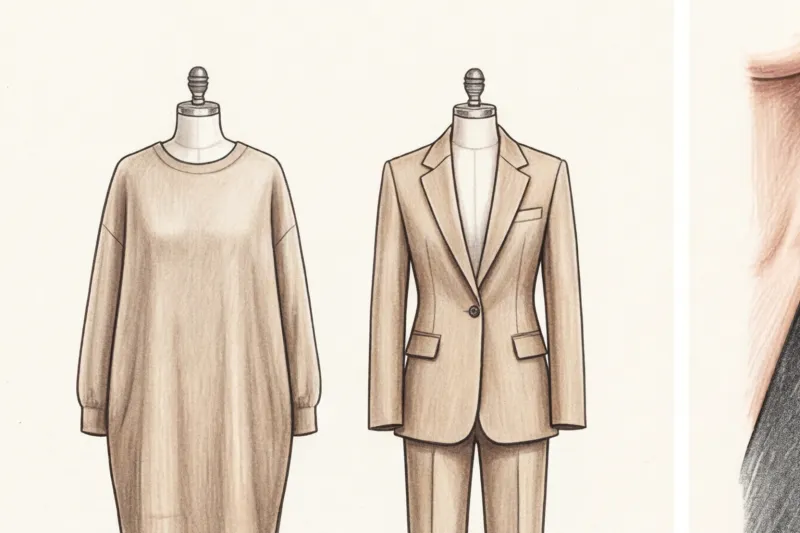
There's a myth that refuses to die: "oversized clothes and black are slimming." I have to disappoint you. This rule only works in glossy photo shoots with proper studio lighting. In real life, shapeless clothes designed to conceal imperfections actually work against you.
How does this happen physically? The fabric falls downwards from the widest point of your body. If you have a full bust, the robe will draw a straight line from your chest to your knees, visually extending your body's dimensions to that width. You become a monolithic block. Instead of showing off your narrow waist or graceful legs, you hide them behind a "tent" of fabric.
Access to MioLook for €0.99 — one-time payment
A smart AI stylist will select the perfect look based on your strengths.
Get access — €0.99 onceAttention management: how to highlight your figure's advantages without stereotypes
Modern styling has long abandoned attempts to force women into rigid "body types." We no longer reshape ourselves to fit standards; we manage the gaze of others. This approach is based on lines, proportions, and pure physiology.
Research in fashion retail using eye-tracking technology reveals astonishing data. Where does a person's gaze fall in the first three seconds? Toward contrast. Toward a geometric inflection. Toward a bright splash of color. The human eye is lazy—it focuses on whatever you highlight.
This is where strategy comes into play. Focal Point (focal point). We don't want to hide our hips. We want to draw the other person's gaze to your graceful wrists, your beautiful décolleté, or your profile.
Three Basic Rules for Optical Illusions in Clothing
Back in 1889, Franz Müller-Lyer described the optical illusion, which today is the main weapon of cutters and stylists. In the context of clothing design, this boils down to three laws:
- Light and shiny brings you closer, dark and matte makes you move away. Want to visually enlarge your bust? Wear a light silk top under a dark matte jacket.
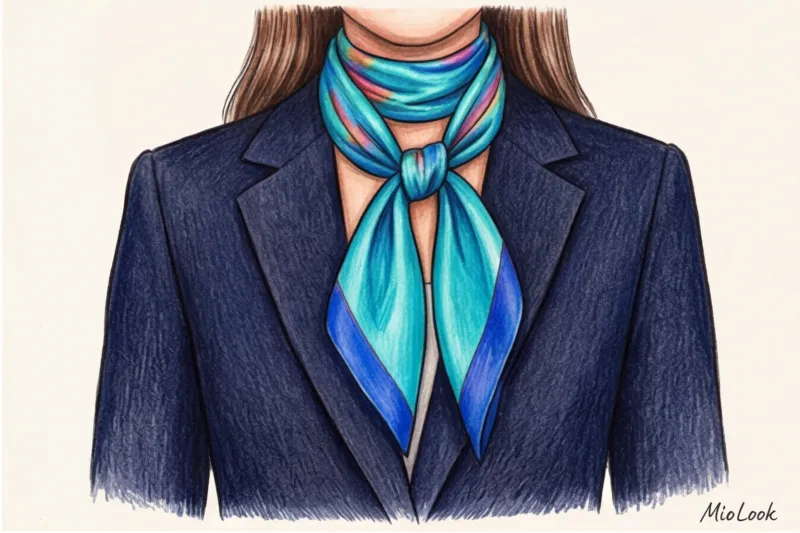
- Verticals and diagonals stretch. An open cardigan, a long scarf with loose ends, or a V-neck create vertical vectors, forcing the eye to move up and down, which slims the silhouette.
- The scale of the print is equal to the scale of the appearance. If a petite woman 155 cm tall wears a dress with enormous tropical flowers, the print will overwhelm her. Conversely, a fine ribbed pattern on a larger figure will only accentuate her curves.
Styling tools: color, print, and cut architecture
How can you highlight your figure's best features in practice? You don't need complicated designer pieces. Simply master three tools that can be found in stores of any segment—from COS to local premium brands.
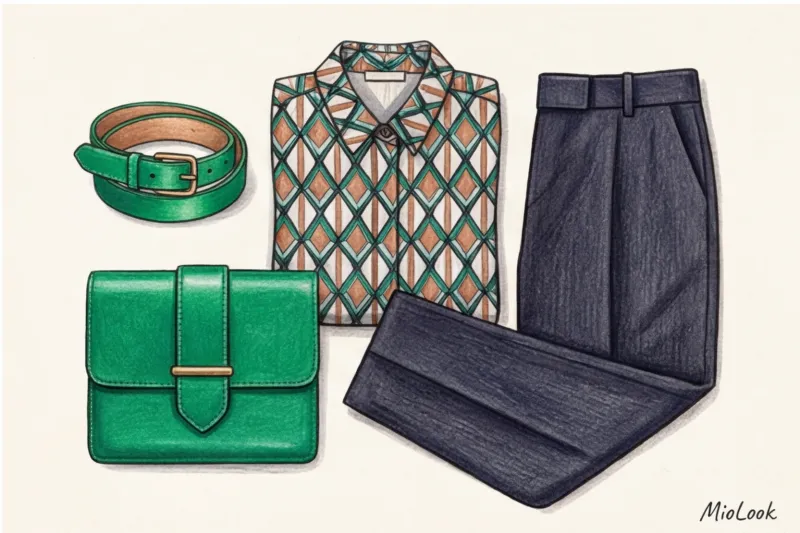
The first tool is - color blocking (Color blocking). Using contrasting shades, you can literally "draw" a new silhouette for yourself. For example, trousers with dark side panels visually shave a couple of centimeters off each hip. It's pure geometry.
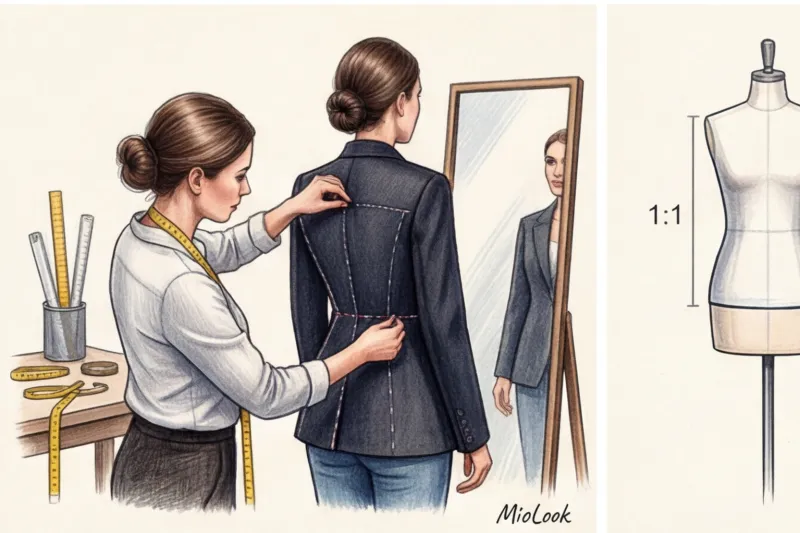
The second tool is cut architecture. Here I'll share my favorite professional secret. Do you know why 3/4-length sleeves are so popular with experienced stylists? The line where the sleeve ends automatically draws a horizontal line. With a 3/4-length sleeve, this line runs exactly at waist level. You get an accent on your slender wrist and a visually cinched waist at the same time.
The third point is fabric texture. This is where many people make mistakes. Thin, flimsy knits (especially low-density viscose) will cling to every fold, revealing even nuances you don't have. Choose dense, structured fabrics: cotton with a weight of at least 180 g/m², denim without elastane, or suit wool. Structured clothing sculpts your silhouette and holds its shape for you.
Your perfect look starts here
Join thousands of users who look flawless every day with MioLook.
Get access — €0.99 onceFrom Theory to Practice: Finding Our "Trump Cards"
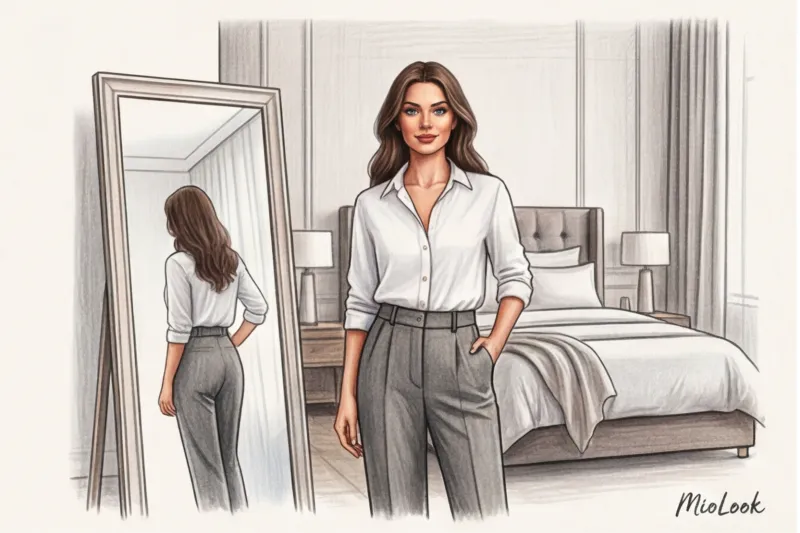
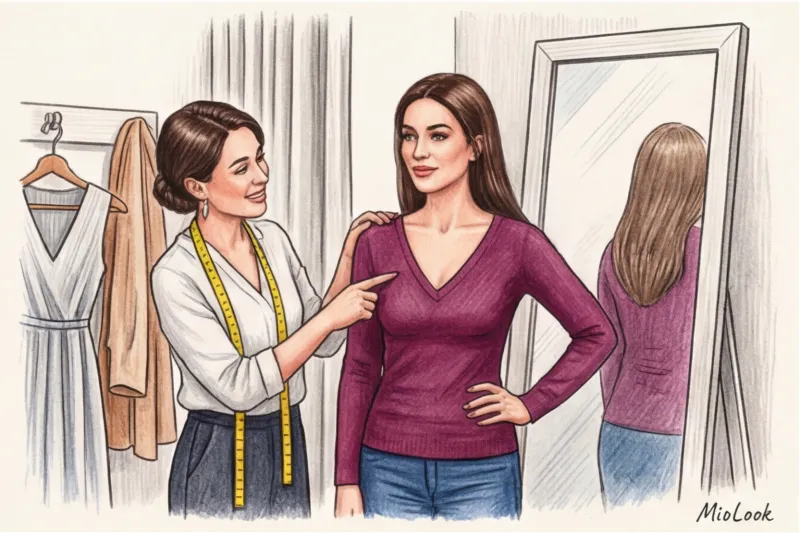
Stop criticizing yourself. Stand in front of a large mirror and conduct an honest audit of your appearance. We need to find your focal points.
I give my clients a mandatory homework assignment: name three things about their body that they truly love. This often leaves them stunned. We're so used to looking for flaws that we don't notice a beautiful collarbone, a long neck, graceful ankles, or thick hair.
Once you've identified your strong points, choose a statement piece to complement each one. Love your collarbones? A boat neckline or a deep V-neck is your choice. Proud of your slender ankles? Cropped chinos and elegant loafers will accentuate them.
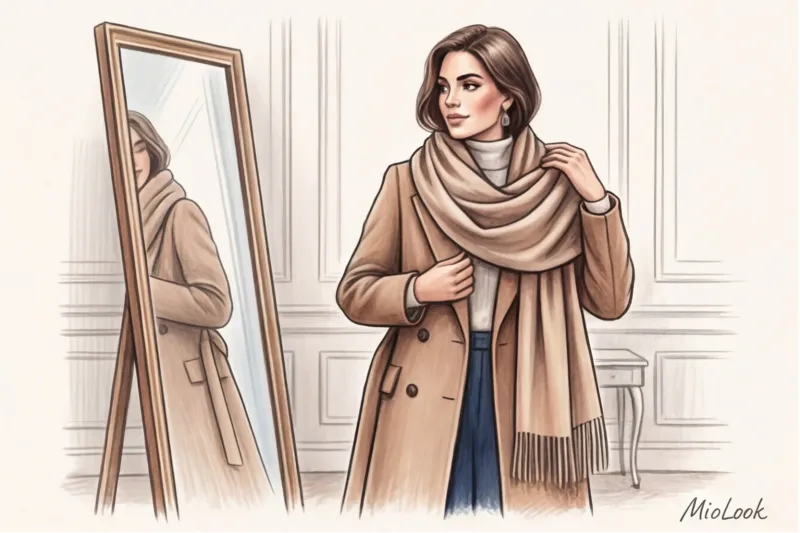
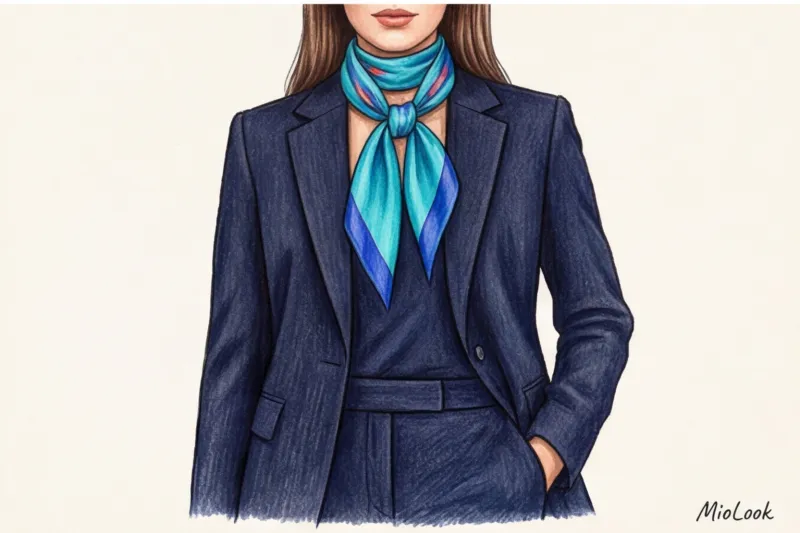
Pay special attention to your portrait area. In the era of remote work and Zoom calls, a top, jewelry near the face, and the right collar have become far more important than a perfectly fitted pair of trousers. A light silk scarf near the face acts as a reflector, erasing signs of fatigue and highlighting the skin.
The biggest mistake beginners make is focusing on everything at once.
I must issue a fair warning here. This advice doesn't work for everyone, and the transformation process is fraught with a pitfall. The transition from a "gray mouse" to a confident woman often involves a pendulum effect.
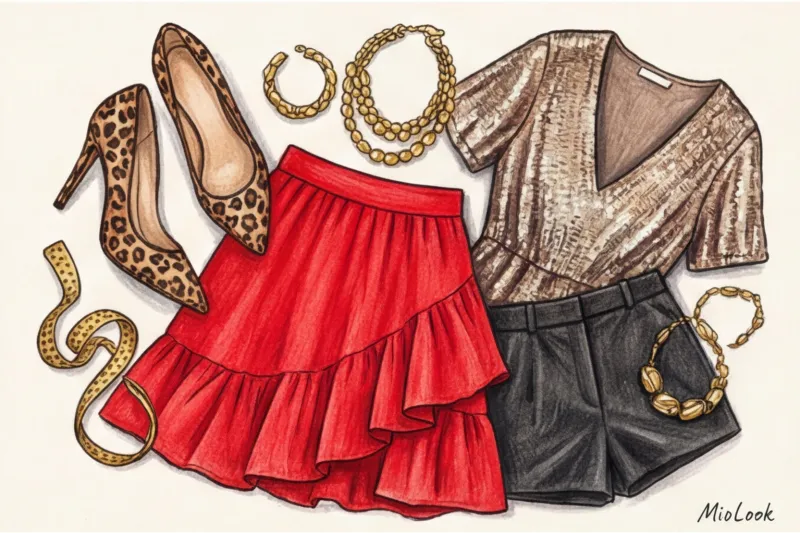
When my clients ditch the black hoodies, they embrace color and texture. They wear fuchsia pants, leopard-print blouses, chunky gold chains, and red lipstick all at once. The "I'll wear all my best at once" look unbearably cheapens the look and creates visual noise.
Remember the one-lead-hero rule. A good look, like a good movie, can't have five main roles. If we're going for a luxurious neckline, the bottoms should be as subdued as possible (for example, formal palazzo heels). If you're wearing statement shoes, keep the base monochrome. The ideal wardrobe formula is 70% simple basics and 30% statement pieces.
Style Tech: How Digitizing Your Wardrobe Reveals Your Strengths
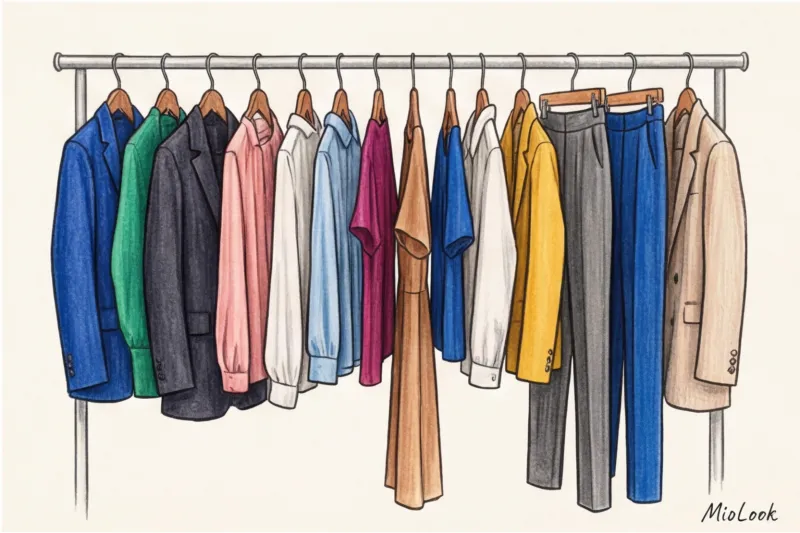
Looking into a closet full of clothes and trying to analyze your style is no easy task. Our brains are subjective. We often think we wear formal suits, but in reality, we spend 80% of our time in our favorite jeans and sweater.
This is where technology comes in. My testing experience MioLook showed that digitizing your wardrobe can do wonders for your self-perception. When you upload your items to the app, you start seeing wearability statistics. The numbers are unbiased.
Remember the Pareto principle: we wear 20% of our clothes 80% of the time. Why? Because it's these 20% of our clothes that contain the right lines and cut architecture that intuitively make us feel beautiful. Analyzing your favorite looks through an app will reveal patterns: you'll suddenly realize that you wear structured jackets more often than soft cardigans because the former hold your shoulders in place and make you look more put-together.
Ready to get started?
Try the MioLook plan for free—no commitments required—and start building your perfect wardrobe today.
Get access — €0.99 onceChecklist: 5 Steps to a Wardrobe That Works for You
To make sure your knowledge doesn't just remain text on a screen, here's a concrete action plan you can put into action this evening:
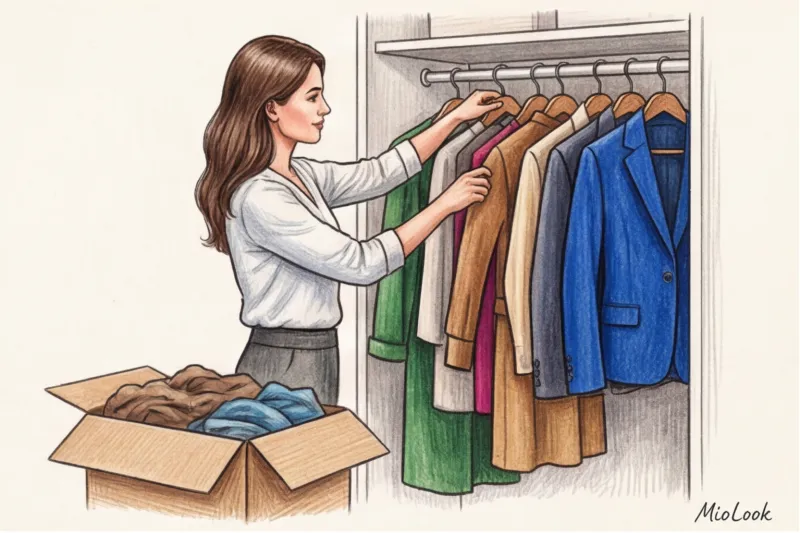
- Perform a hard cleanup. Get rid of all your "punishment items"—things that are too small, things you bought to cover up, and things that make you feel insecure. If something doesn't bring you joy, it has no place in your life.
- Find 2-3 focal points. Study yourself in the mirror and choose areas that you are proud of (wrists, waist, neck, ankles).
- Check the density of the base. Take stock of your basic T-shirts and trousers. Replace thin, see-through knits with thick cotton.
- Add 3 smart accents. Invest in some essential pieces: a bold, structured belt, a quality V-neck top, and a jacket with a crisp shoulder.
- Digitize the result. Take photos of your best outfits in the app so you can get ready in the morning in 2 minutes, relying on ready-made formulas rather than emotions.
Stop apologizing to your closet for your figure. Clothes are simply a tool, and only you can decide whether they hide you from the world or highlight your unique beauty.