The Anatomy of Quality: Why We've Lost the Ability to Distinguish Good Clothes from Bad
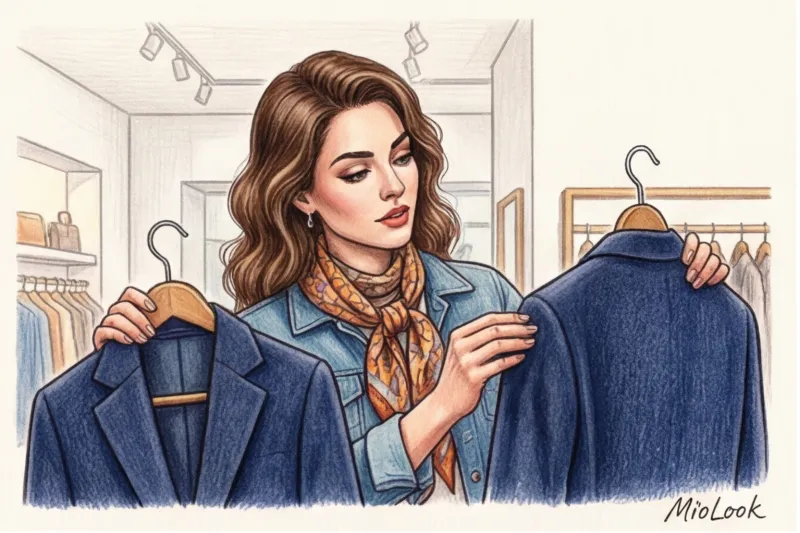
A revealing incident occurred at a closed presentation during Paris Fashion Week. My colleague, a seasoned fashion editor with a decade's worth of experience, was admiringly stroking a thick, architectural coat from a young brand. "What a luxurious, expensive piece," she declared. But as soon as I turned the coat inside out, the magic instantly vanished: the cheap, static-prone polyester lining and the cinched armholes revealed the real deal. The heft and shape of the garment were provided not by high-quality wool, but by a layer of stiff, bonded interlining. If even industry professionals fall for this bait, it naturally raises the question: how can someone who doesn't work in fashion choose quality clothing?
How to Choose Quality Clothing: A Comprehensive Guide to Fabrics, Seams, and Materials - 9
The answer lies in numbers and consumer psychology. According to a major McKinsey report (2020), over the past 20 years, the average lifespan of our clothes has been cut in half. This is no coincidence. The modern fashion industry has spent billions of euros training us to look at the logo on the chest rather than the quality of the shoulder seam.
Today, there's a huge gap between "perceived quality" and actual quality. The former is created by marketing: a heavy cardboard tag, carefully crafted lighting in a boutique, the scent of expensive perfume in a fitting room. The latter is a matter of pure physics and geometry: the twist density of the yarn, the grain direction, and seam allowances.
To stop wasting your budget on one-day things, I suggest mastering the concept forensic shopping — "detective shopping." This is the ability to look at clothes with the eyes of an experienced tailor. You stop reading the promises on the price tag and start examining the inside, where the brand can't hide its savings. By the way, to assess the true longevity of your wardrobe, I often advise my clients to use MioLook — The app's analysis of wear frequency and condition quickly reveals which brands are truly worth the money and which ones lose their shape after the third wash.
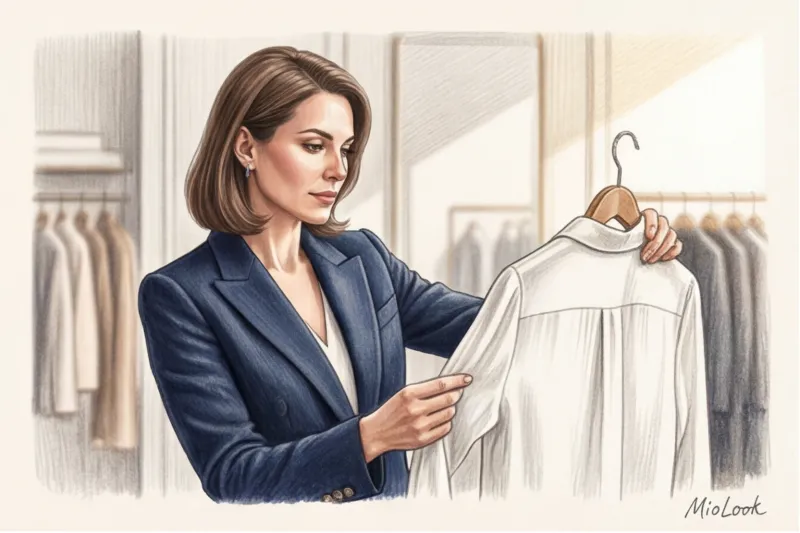
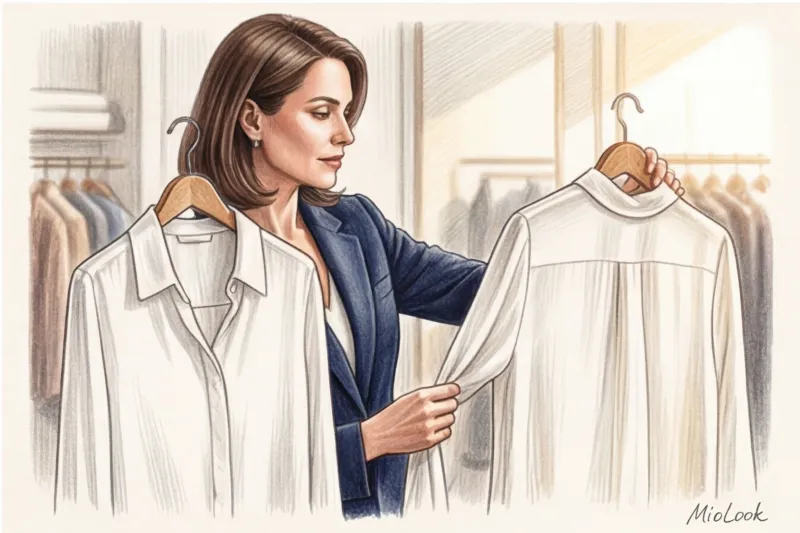
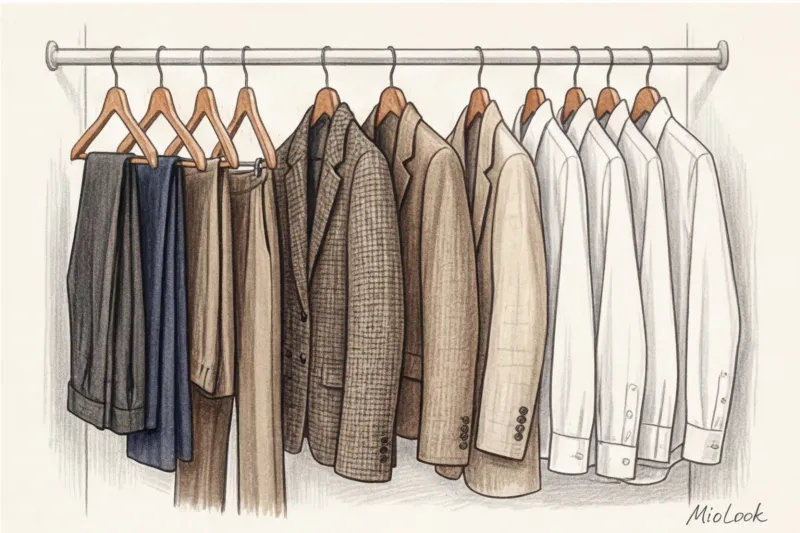
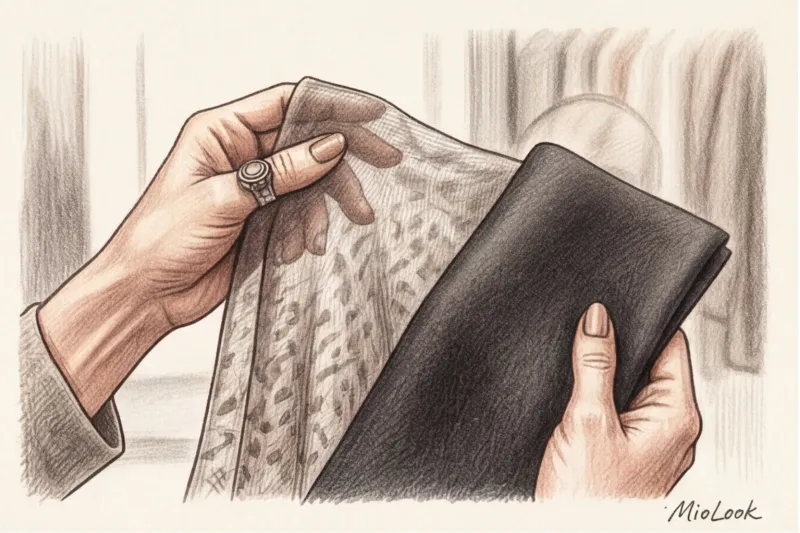
The illusion of luxury: visually identical items can differ dramatically in the quality of cut and fabric.
The fast fashion effect and the illusion of luxury
Fast fashion has revolutionized fashion, but its main focus is stealing silhouettes. Mass-market fashion has mastered the art of copying runway contours while completely ignoring the garment's internal architecture. A jacket from a popular chain store might resemble a Saint Laurent silhouette from a distance, but underneath, it lacks the proper padding or the complex system of darts that shape posture.
Unfortunately, this virus of simplification has also infected higher-end segments. Today, high price tags—even in the €300–€500 range for mid-market brands or diffusion lines—no longer guarantee top-notch craftsmanship. You're paying for the name and the rent for a high-street store, but you're still getting the same unlined viscose and crookedly sewn buttons. We've covered more about how to visually evaluate materials in our guide. Fabrics that look expensive: stylist secrets.
But the most serious crime in modern commercial fashion is the wholesale abandonment of structured tailoring in favor of stretch fabrics. Creating perfect 100% wool trousers that gracefully curve around the hips and hold a crease is incredibly difficult. It requires the work of highly skilled designers and a precise fit. It's much easier and cheaper to sew a shapeless tube, adding 5% elastane to the mix and claiming "the fabric will adjust itself." The problem is that elastane degrades over time. Such a garment quickly stretches out at the knees, loses its original proportions, and ends up in the trash, forcing you to return to the store.
The biggest myth about fabrics: why 100% natural composition isn't always a sign of quality
Have you ever noticed how proudly the consultant at the boutique says, "Note, this is 100% cotton"? Over 12 years of experience and reviewing hundreds of wardrobes, I've constantly encountered the same assumption: natural means expensive and high-quality, while synthetics are cheap and evil. Spoiler alert: in the realities of modern clothing design, this is a dangerous misconception.
Of course, a 100% natural composition is ideal for bedding or lightweight summer shirts. But when it comes to a functional, everyday wardrobe, the obsessive pursuit of the "100%" label often spells doom for a garment. Here, the architecture of modern fabrics comes to the fore.
Let me give you an example from my styling practice. When I put together business capsules for clients, I specifically look for suit trousers with added 2–5% elastane (elastane/spandex) Why? The mechanics of the fabric are such that pure 100% wool suiting (especially fine Super 100s) without a synthetic backing inevitably deforms under body weight. Just three hours at a desk or a couple of taxi rides can leave you with unsightly "bubble" knees and a stretched-out seat area. A microdose of elastane acts as a hidden spring, instantly returning the thread to its original position.
From a textile engineering perspective, a high-quality blended fabric isn't a brand's attempt to save money, but rather the creation of a smart material where the disadvantages of one fiber are offset by the advantages of another.
It's crucial to understand the fundamental difference between cheap petrochemicals and high-tech synthetic fibers. Cheap polyester in the lining of a dress or jacket acts like a plastic bag—it's impermeable and makes you sweat instantly. But high-tech cupro (cupro/bemberg) — a premium synthetic fiber made from cotton fluff — breathes better than natural silk, wicks away moisture, cools the skin, and is completely static-free.
When synthetics save things: useful and harmful additives
In the clothing design industry, there is a concept called the "golden ratio" for blended fabrics. The ideal basic coat, which won't show scuffs from a bag strap after a month of wear, should ideally have a blend of 75–80% wool and 20–25% polyamide (nylon) In this clever combination, wool provides thermal insulation and a refined appearance, while polyamide creates a reinforcing frame, protecting the fabric from tearing and thinning.
A small percentage of elastic fibers in the wool helps the garment retain its shape and prevent stretching at the knees and elbows.
But there are also downright harmful additives that should be avoided at all costs. The absolute anti-leader in knitwear is 100% acrylic Mass-market brands adore it because it disguises itself as soft, voluminous wool on the hanger. However, the physics of the fiber is unforgiving: acrylic threads lack sufficient elasticity. A sweater made of 100% acrylic is guaranteed to become covered in stiff pills (pilling) after just three wears, and will be completely insufficiently warm.
Another red flag is a thin polyester lining in an expensive winter coat. Even if the outer layer is premium alpaca or cashmere for €800, a cheap lining will completely block heat transfer. You'll sweat unbearably on the subway and instantly freeze in the cold wind.
Access to MioLook for €0.99 — one-time payment
Create thoughtful capsule collections of quality pieces, analyze your style, and receive daily outfit recommendations.
How to Test Fabric Right in the Store: 3 Buyer Secrets
In buyers' jargon, manually checking fabric is called a "field test." To avoid relying solely on the numbers on the label (which, according to European textile labs, may have some margin of error), I teach my clients three quick tests right in the fitting room. Items that pass this test are usually immediately uploaded to our virtual wardrobe via MioLook so that in the future it will be easy to create sets with them.
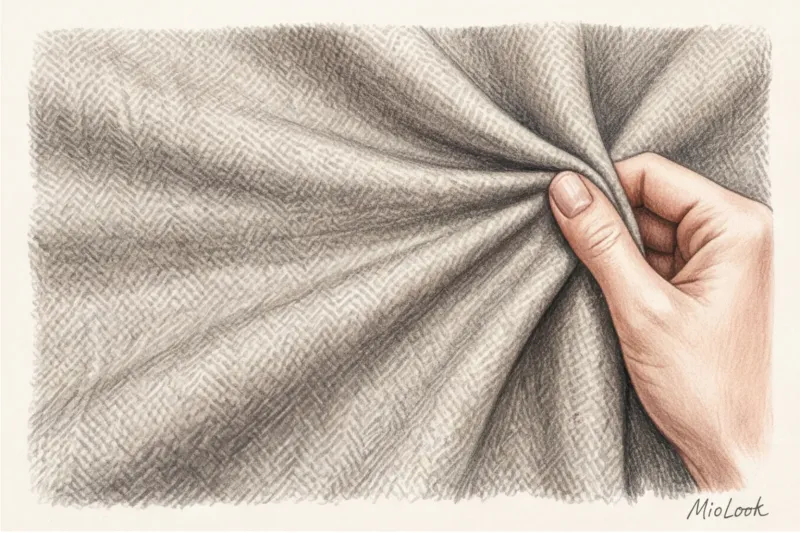
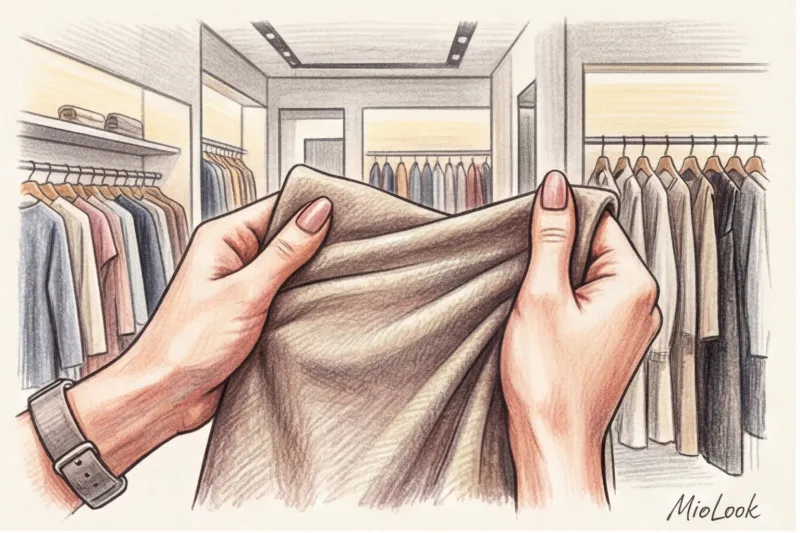
The Crush Test. Firmly squeeze the edge of the fabric in your fist for 10 seconds, then release. If the item is chewed up like paper, it's a low-twist fabric that will look unkempt on your way to work. If the wrinkles disappear within a few seconds (thanks in part to the right percentage of synthetics), the item is worth investing in.
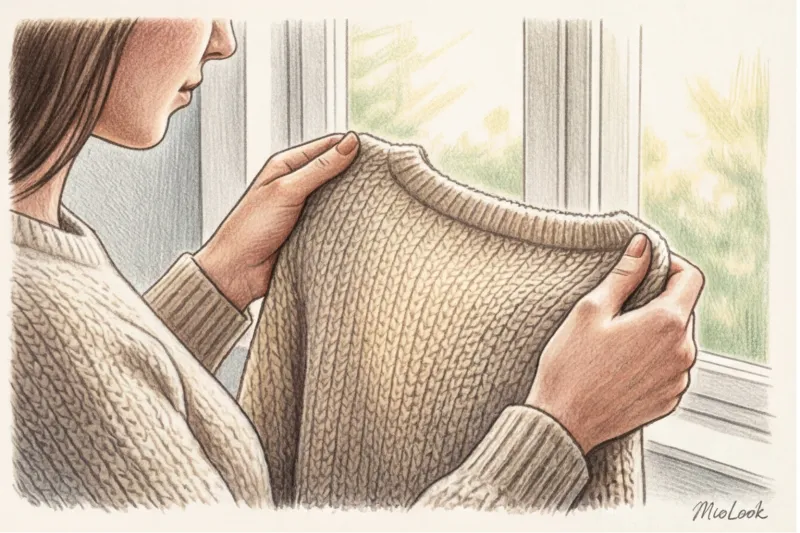
The Light Test. Hold one layer of fabric (especially T-shirts, shirts, and summer pants) up to a bright light from a store lamp. You're not looking for density per se, but uniformity of weaving In cheap fabrics, you'll see "clouds" and patches of transparency—this means the threads are of different thicknesses, and the material will quickly wear through in areas of tension.
Stretch and Snap (Stretch and Snap Test). This step is critical for knitwear, jersey, and denim. Stretch the edge of the garment (for example, the cuff of a sweater or the waistband of jeans) and release it quickly. The fabric should act like a tight elastic band (snapback) and instantly return to its original shape. If the edge ripples and remains stretched, the garment will lose its shape permanently after the first wash.
The inside tells the truth: how to choose quality clothing based on seams and cut
Making my way backstage at haute couture shows—from the couture debuts of young Parisian designers to the shows of century-old fashion houses—I've developed a peculiar habit. While fashion influencers photograph the glitter of sequins and intricate avant-garde tailoring, I unabashedly peer under the hem of dresses and turn back the lapels of jackets. The inside is where a designer can't lie. That's why the golden rule of any professional stylist is: always turn a garment inside out before approaching the checkout.
The internal architecture of a garment—how the pieces are assembled, whether the collar is reinforced, how the armholes are finished—determines how the fabric will drape on your body and how it will age over a couple of seasons. Historical tailoring techniques, originating from London's Savile Row, require the creation of a precise framework. Modern mass-market garments, however, often simply sell us a flat piece of fabric, hastily stitched. Compare the sloppy, loose seam of a basic overlocker from a fast fashion store with the meticulously finished, closed edges of heritage brands, where not a single thread is visible. A cheap overlocker quickly unravels and creates excess volume under the fabric, distorting the silhouette.
To catch a manufacturer cutting corners, all you need is your eyesight. Remember the tailor's rule of thumb: Stitches Per Inch (SPI). This is the most accurate indicator of a manufacturer's production budget.
Budget brands typically use 6-8 stitches per inch: the sewing machine runs at maximum speed, using less thread, making the process significantly cheaper, but the stitching is weak and vulnerable. For high-quality clothing, 12-14 stitches per inch is considered the gold standard. The tighter the needle pitch, the stronger the stitching and the less likely the garment is to unravel after the first wash. Next time you're in the fitting room, simply place your thumb on the seam on your thigh and count the number of stitches.
French and lapped seams: premium markers
In production lines, 90% of inseams are simply trimmed and overcast with a zigzag or serger stitch. But if you're investing in a silk blouse or slip dress (especially in the €150 to €300 price range), be sure to look for French seam (French seam). This elegant technique involves folding the edge of the fabric twice inward and stitching it. The result is a perfectly smooth, "packed" strip of fabric that adheres to the body without chafing or unraveling delicate silk or chiffon where tension is applied.
For heavy fabrics such as denim, heavy cotton or linen, the main indicator of durability is lapped seam (flat-felled seam). You've probably seen it on classic men's shirts and high-quality jeans—it's a completely flat seam with two parallel stitches on the outside, where the layers of fabric are securely interlocked. It's virtually impossible to tear during everyday wear.
But the absolute indicator of tailoring skill is bias binding (bias-bound seams). If you pick up an unlined summer linen blazer and see that each inner edge is neatly wrapped with a contrasting or tone-on-tone strip of smooth fabric, you're looking at a piece of superior quality. The manufacturer spent three times as much time on finishing to ensure the backing looks as beautiful as the outside.
The inside is the product's identity. High-quality seam binding and a proper lining say more about a garment than a brand logo.
Lining as an indicator of the item's status
Imagine a gorgeous double-breasted coat made of 100% pure wool costing €450. You put it on, ride the subway, or get into a hot car, and within ten minutes you're profusely sweating. The reason lies within: the brand saved a few euros and installed a 100% polyester lining. The opaque polyester layer acts like a plastic bag, completely blocking the heat-regulating properties of the expensive wool.
The lining is the layer closest to your body, and it's what truly reveals a brand's commitment to customer comfort. Always check the label: look for cupro (bemberg), viscose, acetate, or natural silk. These materials are breathable, glide smoothly over the base layer (you won't get caught in the sleeves of your sweater), and don't accumulate static electricity.
Another secret that only experts know is freedom of movement fold (ease pleat). Look at the back of a good suit jacket from the inside. Right down the center, from the collar down to the shoulder blades, the lining fabric shouldn't lie completely flat—there's a small vertical fold intentionally placed there. This isn't a fault with ironing, but a rigorous engineering calculation. When you hug someone, reach for a bag, or sit at your desk, your back widens. This fold gives the fabric the necessary slack to prevent the non-elastic lining from bursting along the center seam under tension.
If you start recording the details of your best purchases, analyzing their fit in MioLook app , you'll quickly notice a clear pattern. More often than not, your hand naturally gravitates toward those items whose design and backing are impeccably executed. It's pure physics—they seamlessly follow the contours of the body, don't restrict movement, and retain their original shape for years.
Fittings and components: where manufacturers (even expensive ones) cut corners
Students at my styling lectures often ask, How to choose quality clothing Without relying on a big name on the tag. My answer remains the same: ignore logos and carefully examine the hardware. According to the Fashion Institute of Technology (FIT, 2022) study guides, it's on the details that brands cut costs first, as customers make purchasing decisions based on the color and texture of the base material. Hardware is a ruthless indicator of the actual production budget.
Last season, I consulted with a local brand launching a line of jackets. During the planning stage, it became clear that replacing regular plastic buttons with natural corozo increased the production cost by 8%, and properly finishing the buttonholes by another 12%. To keep the final price of the product within €100–€120, many manufacturers choose to save precisely this 20%.
This creates a monstrous dissonance: the magnificent Italian wool is ruined by cheap, hollow, shiny buttons. The brand invests the lion's share of its budget in fabric to create a wow effect on the hanger, but the hardware immediately reveals the garment's true value. Moreover, the quality of the stitching around the buttons is the first place where the garment begins to deteriorate. Punching buttonholes requires expensive equipment and proper thread tension. If the conveyor belt is running at maximum speed, the machine inevitably skips stitches.
I'll give you a specific visual marker for detective shopping: right in the fitting room, gently bend the edge of the buttonhole and look inside the opening. If you see any loose threads, an unevenly cut fabric edge, or a loose, translucent overlock, it means the production was ruthlessly rushed. A quality item will have a tight, smooth buttonhole that holds its shape like a jewelry setting.
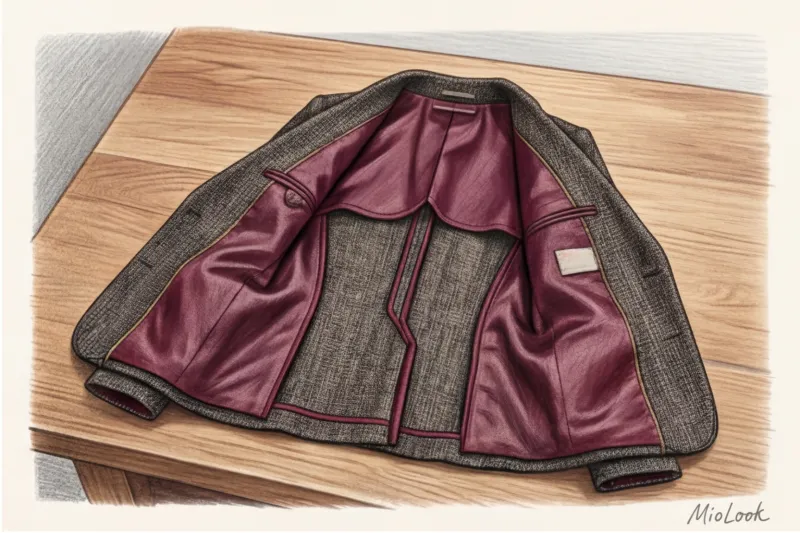
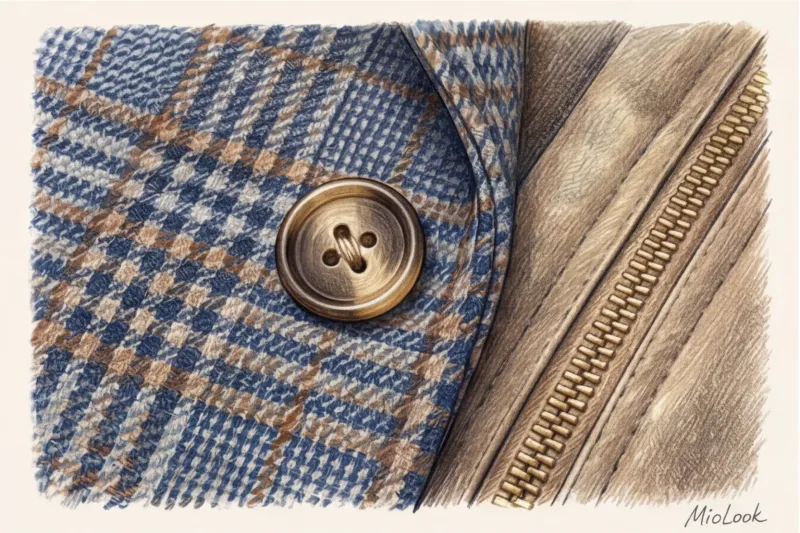
High-quality hardware: a horn button on a tweed jacket. The combination of a printed seam and a button made of natural materials are clear signs that the manufacturer didn't skimp on production.
Buttons, zippers, and buttonholes: a stylist's checklist
To quickly assess the quality of a product, pay attention to the materials. The luxury segment and self-respecting mid-market use natural materials: horn (ideal for coats and formal suits), mother-of-pearl (for silk and cotton blouses), or corozo. The latter is a dense walnut that takes dye beautifully and has a unique microstructure. Unlike stamped plastic, each natural button has a slightly uneven pattern and always remains cool to the touch.
The most important detail lies in the so-called "shank." On a quality coat, the button is never sewn flush to the material. A small column of tightly wrapped threads forms between the button and the fabric—the shank that allows the thick lapel to button freely without constricting the fabric. Without a shank, the button is guaranteed to fall off after a couple of months of heavy wear, tearing the threads from the base.
Be sure to look for spare hardware. If a spare button is securely sewn onto the inside label with the composition, the manufacturer expects you to wear the item for years to come. Regarding zippers: plastic coils are only acceptable for sportswear and lightweight knitwear. Classic trousers, skirts, and leather jackets priced over €150 must have a heavy metal zipper (from trusted brands like Riri or YKK Excella). Check for smooth operation and the presence of strong stops—the slider shouldn't "chew" the fabric at the start.
Print Matching: A Brand Greed Test
If buttons reveal a garment's budget, then working with a print is the ultimate test of greed. The perfect combination of checks, stripes, or large floral patterns on seams costs brands colossal sums. This isn't just an aesthetic whim: creating a continuous pattern requires 15-30% more fabric, which inevitably goes to waste. Furthermore, cutting such garments requires highly skilled craftsmen working by hand, which rules out cheap automated stamping.
One of my favorite techniques when assessing a trench coat or a checked shirt is to look at three critical points: the shoulder seam, the side seams, and the patch pockets. If the lines of a Scottish tartan or Breton stripe break at the junction, creating a chaotic optical shift, you're looking at mass-market fabrication at its worst. A patch pocket on a quality garment should be cut to literally disappear into the background, mathematically precisely continuing the geometric pattern.
Clothes with irregular prints intuitively seem "wrong" to us; they visually distort the proportions of the figure and cheapen the entire look. During wardrobe reviews with clients, we mercilessly discard such items. However, we immediately photograph and file away items with impeccable cuts and the right fittings. MioLook The app's artificial intelligence easily recognizes high-quality textures and allows you to create truly expensive, high-status everyday looks around these investment pieces.
Access to MioLook for €0.99 — one-time payment
Start creating perfect looks with the help of artificial intelligence and assemble a capsule in which every detail works for you.
Sweaters and knitwear: How to predict pilling before buying
Have you ever seen a luxurious €500 cashmere sweater covered in unsightly pilling after just a week of wear, while a basic €100 sheepskin model looks flawless for years? The secret lies not in the magic of pricing, but in the strict physics of textiles. When choosing quality clothing for the cold season, remember: the anatomy of any sweater begins with the length of the fiber.
In professional environments this parameter is called staple (staple). The difference between long-staple and short-staple yarn is fundamental. The shorter the fiber, the more loose ends protrude to the surface of the thread. At the slightest friction—against a bag strap or a coat lining—they cling to each other, creating that dreaded pilling. The second critical factor is yarn twist. According to research by the Institute of Textile Technologies (2022), tightly twisted yarn pills 70% less. If the yarn is loose and easily peels apart under your fingers right in the store, the item is doomed.
Next, we evaluate the product architecture. Low-cost mass-market products use the method cut-and-sew (cut knitwear): the pieces are simply cut from a huge roll of knitted fabric and sewn together with an overlocker, much like regular T-shirts. High-quality knitwear is created using a regular knitting method ( fully fashioned ) — each piece is machine-knitted precisely along the contours of the future garment. To spot this premium quality marker, look at the armhole line (where the sleeve attaches to the shoulder seam). You should see the characteristic "decreases"—a series of stitches that change direction and form a neat herringbone or diagonal pattern. This technical guarantees that the sweater will not warp after the first wash.
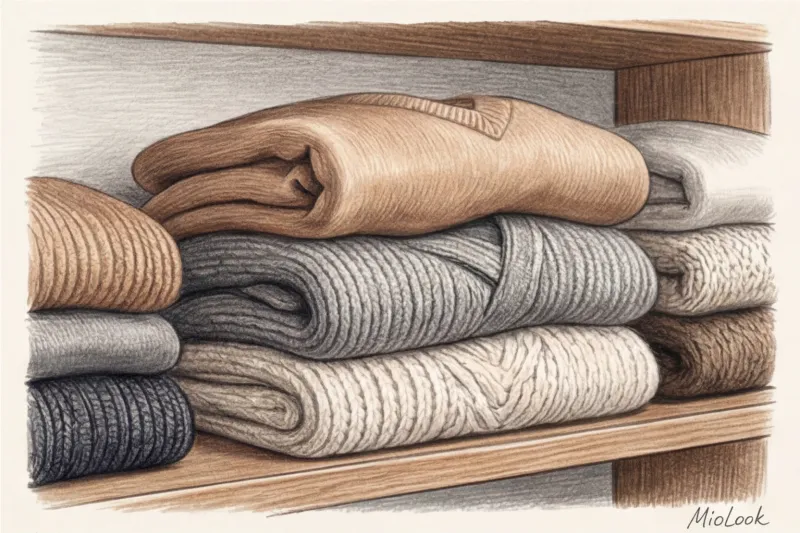
Knitting density is more important than initial softness: a new sweater that is too fluffy will pill faster.
The Density Rule: Why Cashmere That's Too Soft Is a Bad Sign
Here lies the main marketing trap of brands - the so-called showroom feel (window display effect). We subconsciously want to buy something that feels like a weightless cloud from the first second of trying it on. But I always categorically warn my clients: overly fluffy and hyper-soft to the touch new The sweater is a warning sign.
To achieve this instant tactile appeal, manufacturers intensively wash knitwear with industrial conditioners at the factory, intentionally fluffing the already short fibers. As a result, the garment becomes thinner and loses structural strength even before you bring it home. High-quality cashmere and dense merino should initially feel slightly dry. They reveal their true softness gradually, with each gentle wash, year after year.
Be sure to perform a tension test: gently tug the elastic on the cuffs and hem. It should instantly and elastically return to its original position. If the edge remains stretched and wavy, you have a loose knit. Also, look for the mark on the inside label. 2-ply (double thread). This means that two threads are tightly twisted into one, doubling the density of the product and preventing deformation.
When you invest in long-lasting pieces like these, it's important to incorporate them into your wardrobe wisely. I recommend digitizing high-quality knitwear right away and adding it to your wardrobe. MioLook With density markings (for example, "2-ply cashmere"). This will make it much easier to create multi-layered fall/winter looks when you need a reliable, shape-resistant base.
Quality vs. Price: How to Calculate a Item's Cost Per Wear
Wardrobe math can be ruthless: often, it's the very things that seem like incredible bargains at the checkout that end up putting the biggest dent in your budget in the long run. It's not for nothing that the legendary Vivienne Westwood repeated the mantra: "Buy less, choose better, and make it last." It's time we stopped experiencing initial price tag shock (the so-called sticker shock ) and move on to the only true metric for a conscious consumer – the Cost Per Wear (CPW) formula, or the cost of one wear.
The formula is crystal clear: the initial price of the item plus all maintenance costs, divided by the number of days you wear it. Let's take a classic example. Why does an impeccably tailored blazer for €300 ultimately turn out to be cheaper than a poorly tailored one for €50? A mass-market jacket maintains its shape solely due to the manufacturing glue and stiff synthetic threads. After the first professional cleaning, this illusion is shattered, and you wear the item a maximum of five times. The result: €10 per wear. A high-quality, well-designed blazer, on the other hand, can easily be worn twice a week for three years (around 300 wears), reducing its real cost to €1 per day of wear.
When calculating the CPW, it's important to consider hidden costs. Dry cleaning, repairs, hardware replacement, and tailoring costs should always be factored into the true cost of an item. If you already know how to choose quality clothing, you understand: good fabric is designed to withstand steam, washing, and professional work, whereas loose, cheap fabric will simply fall apart under the needle when a tailor tries to shorten the sleeves.
The numbers speak for themselves. One of my clients, a finance director, had been buying fast-fashion suits for years for around €100. The fabric quickly became shiny, requiring a wardrobe refresh every season. Over five years, she spent exactly €1,000 (two suits per year). We radically changed our strategy: we invested in one gorgeous mid-premium wool suit for €450, added €50 for a custom fit, and budgeted €100 for regular eco-friendly dry cleaning. After the same five years, the suit still retained its perfect shape, and the total cost was €600. The conclusion is clear: investing in an "expensive" suit turned out to be 40% cheaper in the long run.
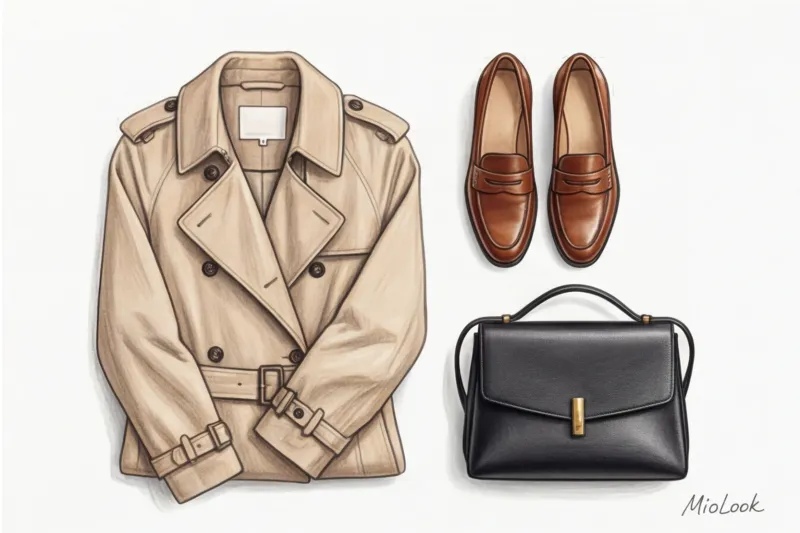
Cost Per Wear Rule: An expensive but high-quality trench coat that you wear for 5 years will ultimately cost less than a mass-market one.
Investing in quality is the foundation of an eco-friendly, sustainable wardrobe and the main principle of building a capsule wardrobe. When each item lasts for years, the need to impulsively buy seasonal trends disappears. To clearly track which investments are paying off the best, I recommend digitizing your key basics and adding them to MioLook The app makes it easy to mix and match images and analyze the frequency of use of each unit, helping you create a truly effective, long-lasting capsule where every coin spent is worth its weight in gold.
Your ideal image it begins Here
Join thousands of users who look flawless every day with MioLook and invest wisely in their style.
Checklist: 7 steps to audit an item before buying it
Imagine a typical situation: you have exactly 15 minutes in a cramped fitting room to decide whether this €180 blazer is worth the money or whether it will hopelessly lose its shape after the first dry cleaning. To avoid acting blindly and being swayed by a beautiful color, I always use a strict audit protocol. Save this checklist on your phone and use it whenever you doubt the quality. In professional stylist parlance, we call this the "60-second method."
Step 1. Checking the “passport” (Composition and care). Start with the inside side tag. Look not only for the fiber percentages but also for the care symbols. If, for example, a basic cotton shirt requires professional dry cleaning only, this is a clear sign of a manufacturing defect or the use of low-grade fabric that will shrink when exposed to water.
Step 2. Translucency test (Fabric density). Hold the item up to the fitting room's harsh lighting. High-quality fabric should block most of the light. If the weave is loose and shimmers like gauze, you're looking at a fabric that will stretch out at the elbows and knees after just a month of wear.
Step 3. Crash test (Crumple resistance). Squeeze the edge of the fabric tightly in your fist for 10 seconds, then release. If the creases remain deep and sharp, the garment will look untidy on the way to the meeting. Properly blended materials quickly return to their original shape.
Step 4. Inspection of the reverse side (Seams, lining and allowances). Turn the garment inside out. Examine the hem: quality trousers or skirts have a hem allowance of at least 3–4 centimeters, allowing for adjustment to suit your height. A narrow butt-stitched hem is a sign of extreme economy.
Step 5. Hardware audit (Buttons, zippers and spare parts). Check the metal zippers for smooth operation—they shouldn't snag. Be sure to find a spare button or hook sewn into the tag: this is a sign of a brand that takes responsibility for the durability of its products.
Step 6. Tension test (Thread strength). Stretch the fabric slightly with both hands where the pieces are sewn together. Before purchasing, always gently tug the fabric in the seam area: if threads or gaps are visible, the item will quickly come apart along the seam. If a “ladder” of threads forms between the pieces or wide gaps are visible, the stitching is highly likely to break at the first sharp movement.
Step 7. Landing architecture (Balance on the hanger). Hang the item on a hanger, fasten it, and step back. A quality cut won't sag: the side seams hang straight and the lapels lie flat.
European garment technologists confirm that over 40% of clothing fit issues stem from imbalances in the design during the cutting stage. If a garment "falls" forward or backward on a hanger, it will never fit properly.
This quick audit takes literally a minute, but it saves you from disappointment. Items that pass such a rigorous check become a reliable foundation for your look. I recommend adding these long-term investments right away. MioLook — this way you will create a base of truly high-quality, architecturally correct products that can be easily combined with each other without having to look in the closet every time.
Wardrobe Investments: What Items Must Be of Impeccable Quality
The paradox of professional styling is that a truly luxurious look never consists entirely of premium pieces. When clients first approach me to create a "status wardrobe," they often mentally brace themselves for astronomical expenses, believing they'll have to replace absolutely everything. This is a colossal misconception.
The main secret of that, How to choose quality clothing The key to staying stylish and not going broke is to manage your budget wisely. You don't need perfect quality down to the last detail. A basic white cotton T-shirt for €15-€20 from, say, COS or Uniqlo will do the trick. Basic tank tops, long sleeves, thin cotton, and trendy seasonal trends are fashionable "consumables." They have a short lifespan, and spending hundreds of euros on them is pointless.
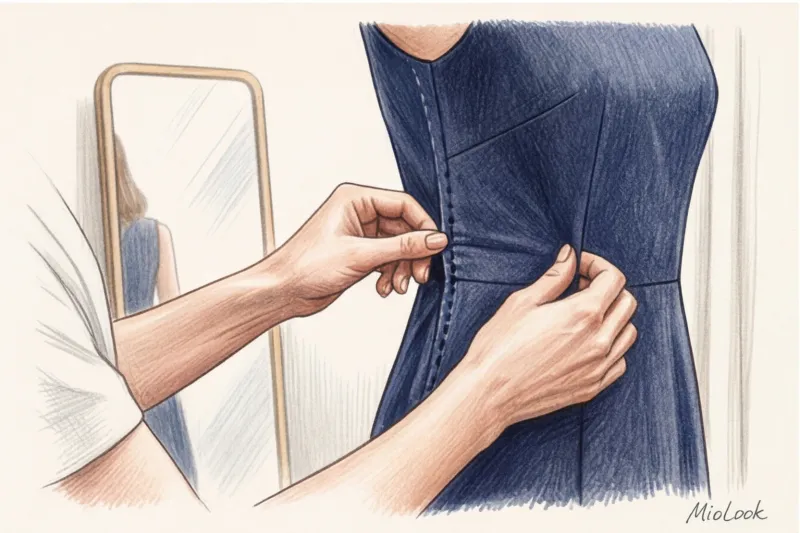
Invest in quality "architectural" pieces: jackets, trousers, and coats. They create the framework for your status image.
Instead, focus your attention (and the bulk of your budget) on so-called "architectural pieces." These are wardrobe items that define the geometry of your silhouette and serve as the foundation of your style:
Suit group (blazers and formal trousers): A properly cut jacket requires a complex internal structure—padding, high-quality shoulder pads, and proper fabric interlining. This architecture cannot be recreated in a factory setting for €40.
Outerwear: A wool coat or a heavy cotton trench coat is the façade of your appearance. It's how others perceive your status on the street or when entering a building.
Shoes: The last, leather quality, and fittings are elements where compromises result not only in a cheap appearance, but also in foot health problems.
This is where an optical illusion I call the "fashion halo effect" comes into play. High-quality, structured pieces have a magical ability to visually elevate an entire outfit. If you wear an impeccably tailored wool blazer over that budget-friendly white T-shirt and simple jeans, others will subconsciously judge your entire look as expensive and well-thought-out. The blazer becomes a shield that conceals the skimping on your base layers.
Creating a status-defying wardrobe isn't about chasing logos, but about self-respect and building a personal brand. Your clothes speak for you even before you utter a single word. By investing in impeccable tailoring and high-quality materials, you convey competence, reliability, and attention to detail.
Over the years of working with top managers, I've developed a strict formula: 70% of your budget should go toward 30% of the items in your closet—those architectural investments. To manage this asset effectively, I recommend digitizing your most important status items. By uploading them to MioLook virtual wardrobe , you can visually create dozens of new outfits, mixing expensive jackets with simpler casual pieces, avoiding impulse purchases.
Ultimately, understanding fabrics, seams, and cuts leads us to our ultimate goal: conscious consumption. The famous philosophy of designer Vivienne Westwood: Buy less, choose better, make it last. "Today, it sounds less like a fashion slogan and more like the only true strategy for intelligent shopping. You may have fewer items in your closet, but each one will be worthy of wearing for years to come, reflecting your confidence and impeccable taste.
To choose quality clothing, you need to master "detective shopping" and evaluate the physical characteristics of the garment rather than the brand. Pay attention to the density of the thread, the quality of the seams, and the inside of the garment. It's the internal architecture, hidden from view, that reveals the manufacturer's true savings.
No, today's high price tags often reflect only marketing and boutique rental costs, not the quality of the tailoring. Many mid-range brands sell items made from cheap materials and without lining for 300–500 euros. Therefore, it's important to look at the actual quality of the garment's construction, not just the logo and a pretty cardboard tag.
Mass-market clothing brilliantly imitates external silhouettes while completely ignoring the garment's internal structure. In a cheap jacket, you won't find the proper paneling or complex darts that create a beautiful posture. Such garments often hold their shape only due to cheap fusible interlining, not a precise cut.
When choosing quality clothing, be sure to turn the garment inside out and examine the lining. Cheap, static-prone polyester, tight armholes, and minimal seam allowances indicate poor quality tailoring. It's also worth assessing the grain direction and the reliability of the hardware.
To objectively assess the durability of items, it's helpful to track statistics using the MioLook app. It helps analyze how often you wear them and track their condition over time. This data will quickly reveal which brands are truly worth the money, and which ones are losing their shape after just three washes.
Over the past 20 years, the lifespan of clothing has been halved due to the impact of fast fashion and the widespread reduction in production costs. To buy something that will last for years, you need to ignore "perceived quality"—perfect lighting in the store or the scent of perfume. Assess the garment through the eyes of a tailor, relying solely on the physics of the fabric and the geometry of the cut.
How much do you know about fashion?
Test your knowledge of fashion, style, and the history of the fashion industry.
Loading...
Загрузка quiz...
Almost done!
Enter your email to see results and get personalized recommendations
Share
About the author
C
Camille Durand
Fashion journalist with 10+ years covering Fashion Week. Analyzes trends and translates runway fashion into everyday looks. Knows the industry inside out — from backstage to brand strategies.
Unlock MioLook for €0.99
Start creating perfect outfits with artificial intelligence