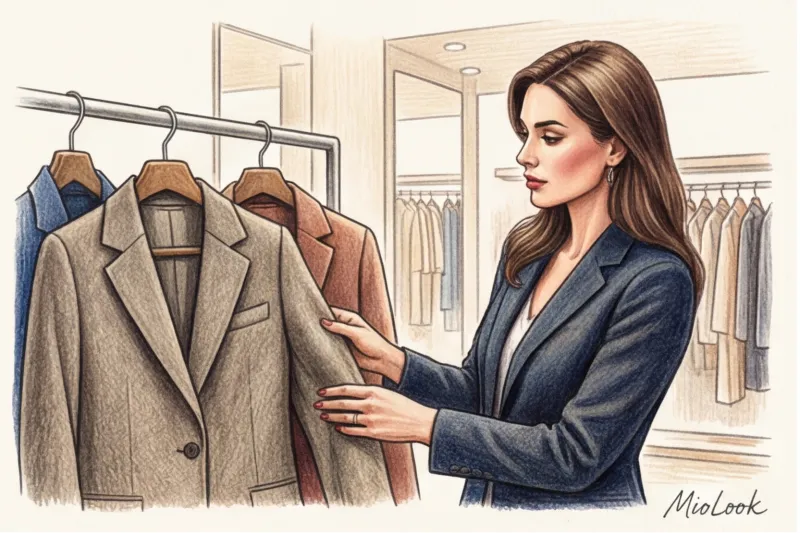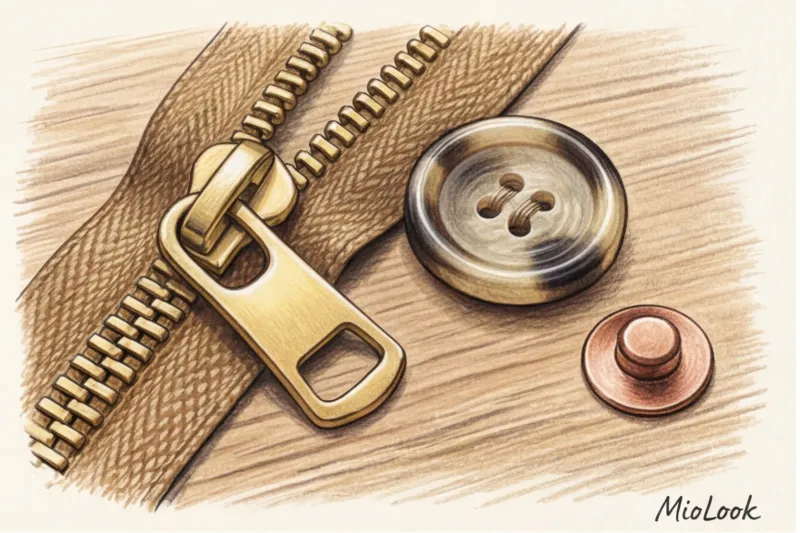
September 2019, a showroom in the Marais district during Paris Fashion Week. I'm watching the head buyer of a major London department store. A collection by a promising young designer hangs in front of her—luxurious silk blouses, thick wool coats, impeccable tailoring. But do you know what she does first? She doesn't look at the seams or read the ingredients. She closes her eyes and quickly unzips and zips her leather jacket several times. She listens to the sound. Then she runs her fingernail across the button.
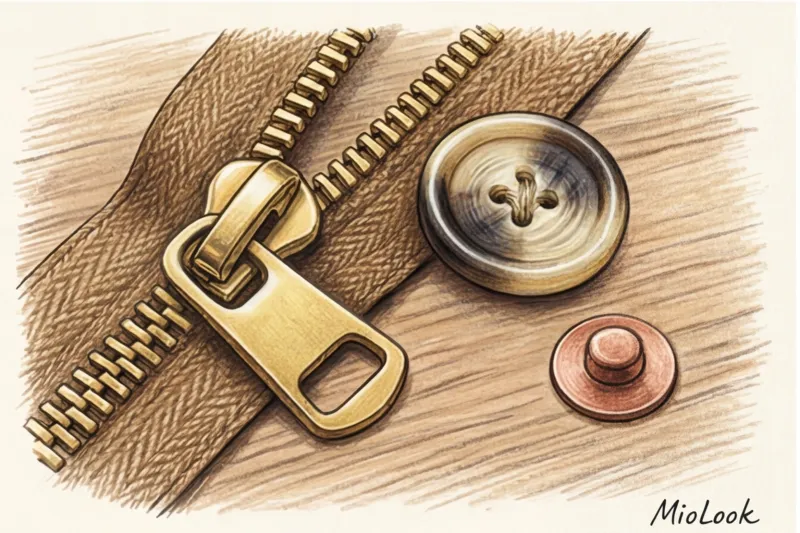
"A brand can buy cheap cotton and impregnate it with silicone to make it feel silky," she told me over coffee. "But no one would ever put a Riri Swiss zipper or real horn on a poor-quality product. It's not cost-effective."
This is the main secret of the modern fashion industry. While we are learning to read ingredient labels (which I discussed in detail in our the complete guide to fabrics ), manufacturers have masterfully disguised polyester as silk and viscose as cashmere. But fittings remain the main "lie detector." If you know, How to check the fittings on clothing , you will never again buy something that falls apart after the third wash.
Furniture as a lie detector: why brands can't hide their savings
The mathematics of mass production are ruthless. Mass-market brands fight for every cent of their product's cost. A no-name plastic zipper from a Guangzhou factory costs about 10 cents. Basic metal YKK hardware will cost €1-2. But a heavy luxury zipper from the Swiss brand Riri or the Italian brand Lampo can cost €10-15 per piece.
The price difference is colossal. That's why you'll never find truly expensive hardware in the budget segment (€30–€80). Conversely, a premium brand won't risk the reputation of a €600 jacket by sewing buttons made from recycled polyester.
According to WGSN analytical agency data from 2024, more than 60% of outerwear returns are due to broken zippers, snaps, and loose fasteners. Consumers forgive pilling on a sweater, but a stuck zipper on a down jacket is a death sentence.
A new term has appeared in the professional stylist community. forensic shopping (Detective Shopping). We teach our clients to be a bit of a forensic expert in the fitting room: looking not at the front (color and cut), but at the back and small details. This is the only way to find a gem in the mass market and avoid overpaying for blatantly cheap mid-range items.
Your ideal image begins Here
Join thousands of users who look flawless every day with MioLook. Digitize your wardrobe and create looks in just a few clicks.
Get access — €0.99 onceThe Anatomy of a Zipper: How to Check the Hardware on Your Clothes and Avoid Buying a Fault
A zipper is the most complex engineering component of any garment. It contains dozens of microscopic parts that must fit together perfectly. A single misalignment of a tooth by a fraction of a millimeter, and the zipper will begin to snag the fabric.
There's a common myth that almost every fashion blog promotes: "Look for the letters YKK on the zipper pull; it's a sign of luxury." Let's set the record straight. The Japanese company Yoshida Kogyo Kabushikikaisha (YKK) produces approximately 90% of all high-quality zippers in the world. The presence of this abbreviation isn't a sign of luxury. It's just... basic standard of adequate quality This is the Toyota of hardware: reliable, durable, but not exclusive. True heavy-duty luxury is Riri, Lampo, or the YKK Excella line with hand-polished teeth.
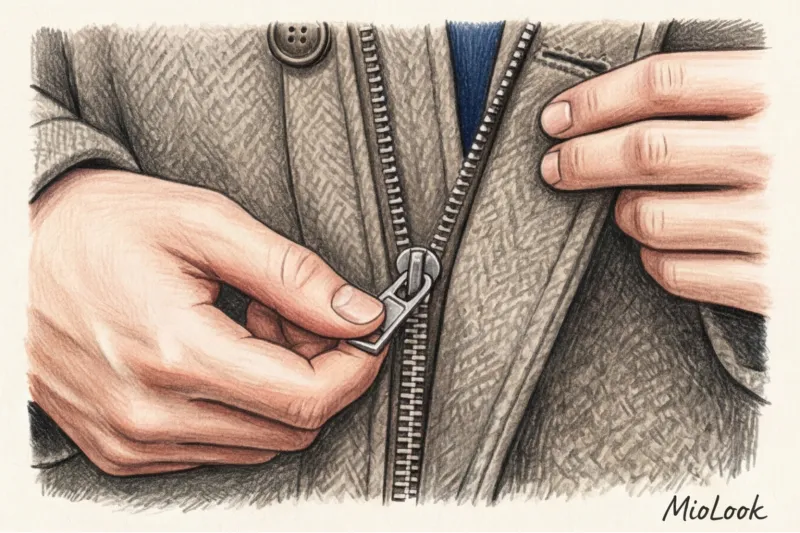
How can you check quality right in the store? Forget about carefully fastening it with two fingers on a hanger. Put the item on. Perform the "smoothness test": zip and unzip the zipper three times at different speeds. It should slide smoothly.
Then do the "stop test." Zip the zipper halfway and gently tug the fabric sideways, simulating tension on your body. A high-quality zipper will lock the teeth securely. A cheap plastic one will begin to slide apart under your hands.
Metal, plastic, or tractor: what's appropriate where
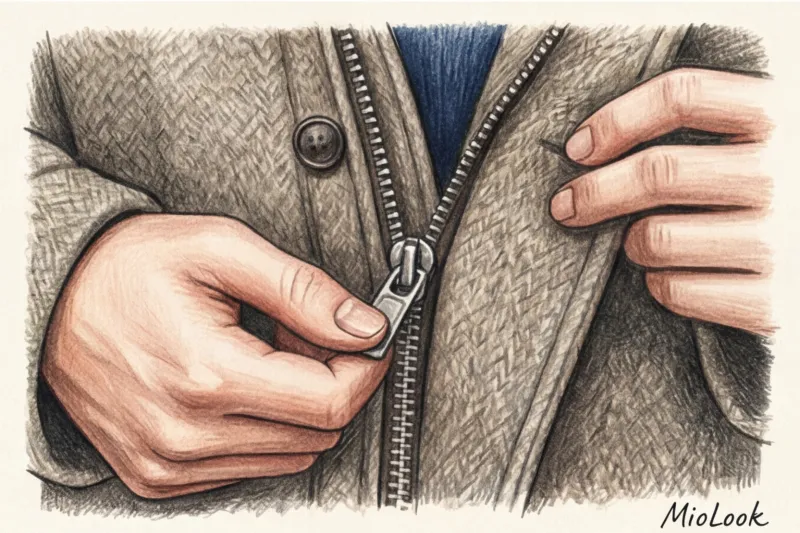
The most common mistake made by mid-tier brands is using the wrong type of zipper. Heavy brass hardware is unacceptable on a thin silk dress (it will simply pull the fabric and distort the cut). And a thin, twisted plastic zipper is a disaster for a winter down jacket, where the tension in the fabric is at its greatest when moving.
Counterintuitive fact: A tight, slightly snagging metal zipper on a new leather jacket or raw denim isn't a defect. It's a sign of superior quality. Heavy metal without silicone lubrication needs time to "break in." Like expensive leather shoes, a high-quality brass zipper adapts to you within the first few weeks of wear, after which it will last for decades.
But a hidden zipper on dense fabrics (tweed, thick wool) is always a red flag. The teeth of a hidden zipper are too small to withstand the pressure of dense materials. Where seams intersect (for example, at the waist), it will inevitably break.
Buttons: How to distinguish noble horn and mother-of-pearl from cheap imitation
Have you ever noticed that a seemingly perfect double-breasted coat from a mass-market store often looks... cheap? Something about the fit catches your eye, even though it's perfectly tailored. Nine times out of 10, it's the buttons. Flat, shiny, perfectly uniform plastic instantly ruins the garment's magic.
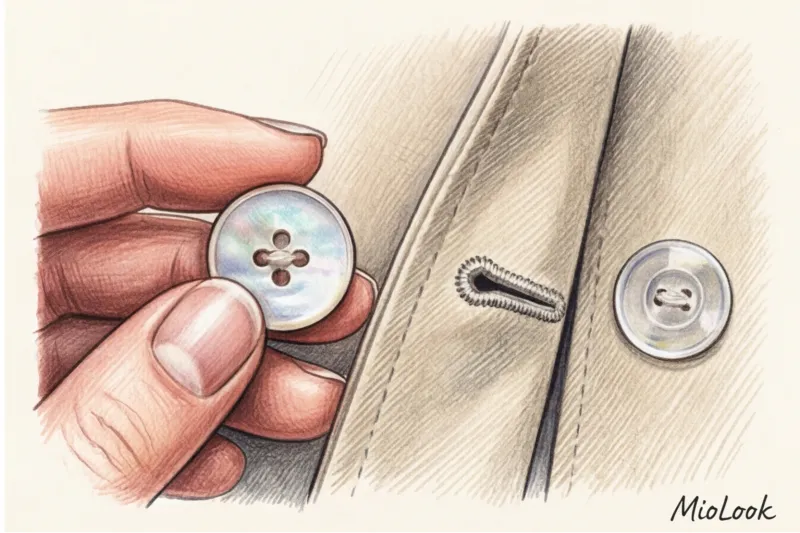
Over 12 years of working as a stylist, I've developed a simple habit. When I pick up a jacket, I press the button to my cheek or the back of my hand. Natural horn, mother-of-pearl, corozo walnut, or metal Always will feel cold. The plastic instantly adapts to the room temperature and feels warm.
The second thing to look at is the fastening. A quality button is never sewn flush to the fabric. It always has a "shank" of thread wrapped around its axis. This allows the button room to maneuver when the buttonhole is placed under the fabric.
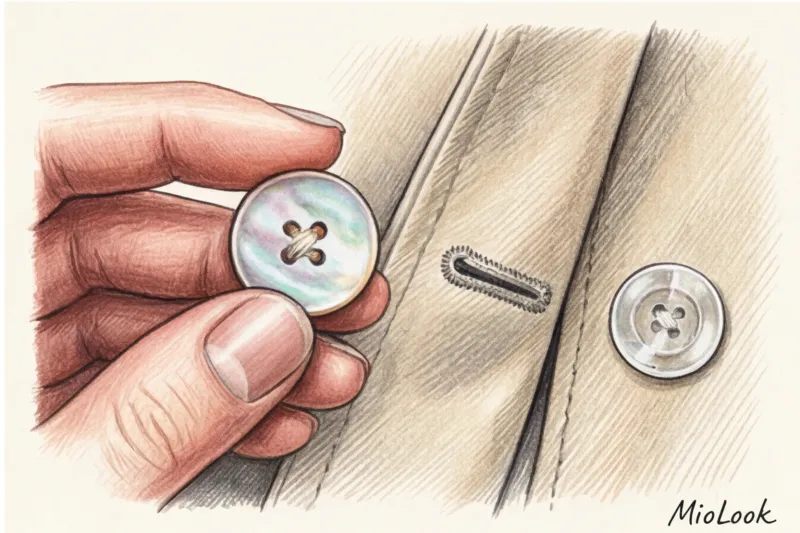
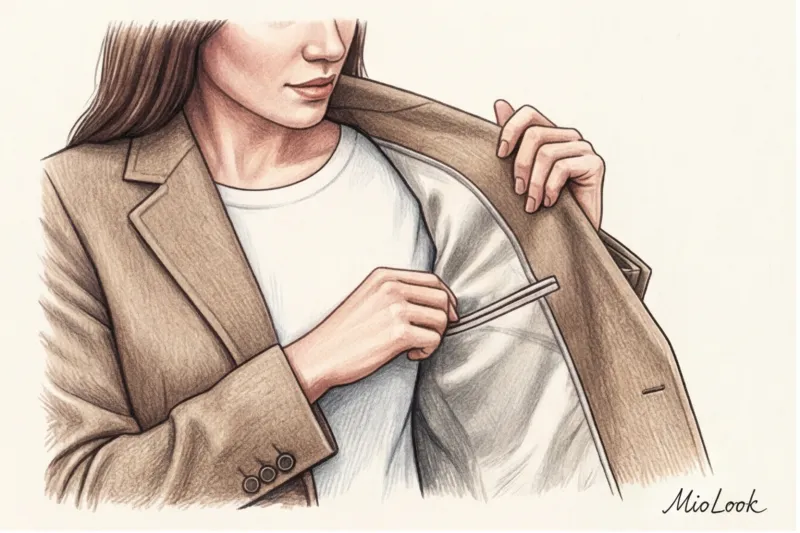
- Sub-button: Outerwear and expensive jackets must have a small flat button on the inside. This is a French tailoring standard. It absorbs the tension of the thread and prevents the main button from tearing the fabric "with the flesh."
- Loop: Inspect the opening. A quality buttonhole (especially a "eyelet" buttonhole with a rounded end) is sewn with a tight, raised seam without a single loose thread.
Access to MioLook for €0.99 — one-time payment
A smart AI stylist will select the perfect look based on your wardrobe. Analyze your clothes like a pro.
Get access — €0.99 onceButtons, rivets, and hooks: hidden threats to fabric
Metal rivets on jeans weren't invented by a designer, but by tailor Jacob Davis in 1873 for lumberjacks and gold miners. They were placed on the corners of pockets not for aesthetics, but to prevent the fabric from tearing under the weight of tools. On high-quality denim, the rivets are always copper and permanently pierced.
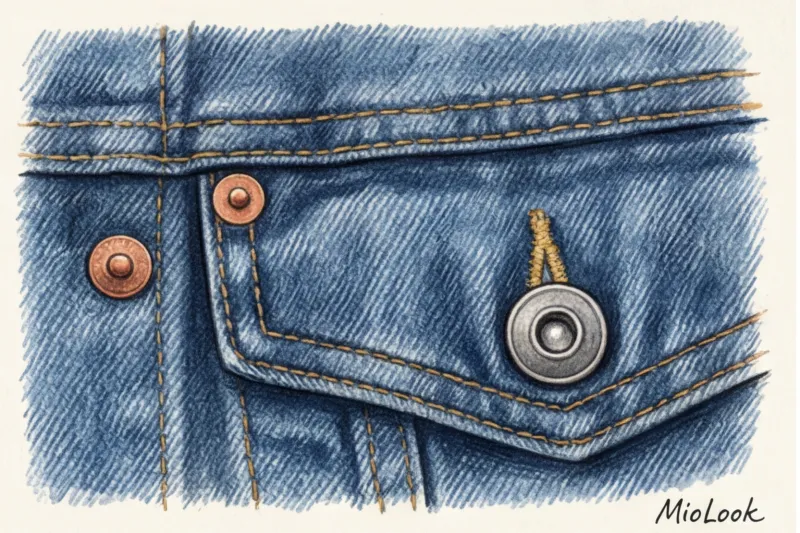
But the biggest hidden danger in modern stores is metal snaps on delicate fabrics. Last season, a customer came to me in tears: she'd ripped a stunning (and expensive!) cotton shirt on the very first day. The problem was with the construction.
The brand installed tight metal buttons but didn't use interlining (a special reinforcing material) on the inside of the fabric. When she tried to unbutton the shirt, the button proved too strong for the thin cotton. Rule: If you see a thick button on thin fabric, turn the item inside out. You should see an additional layer of thick fabric or adhesive backing underneath the button. If there isn't, leave the item in the store.
The same goes for trouser hooks. On office trousers, the hook should be attached not just to the lining, but to a rigid inner waistband, otherwise the waistband will quickly become misshapen. Investing in a Basic Wardrobe , pay attention to these invisible to the eye frames.
Stylist Hack: Upcycling Mass-Market Clothing with Accessories
I'll share my favorite styling trick. It's the cheapest and most effective way to add visual value to your wardrobe.
You buy a well-tailored basic jacket at Zara or Mango for €50-€70. You bring it home and mercilessly cut off all the plastic buttons. Then you go to a vintage market, flea market (or a good tailoring supply store) and buy a set of brass buttons, vintage enamel ones, or real mother-of-pearl ones. This will set you back another €15-€20.
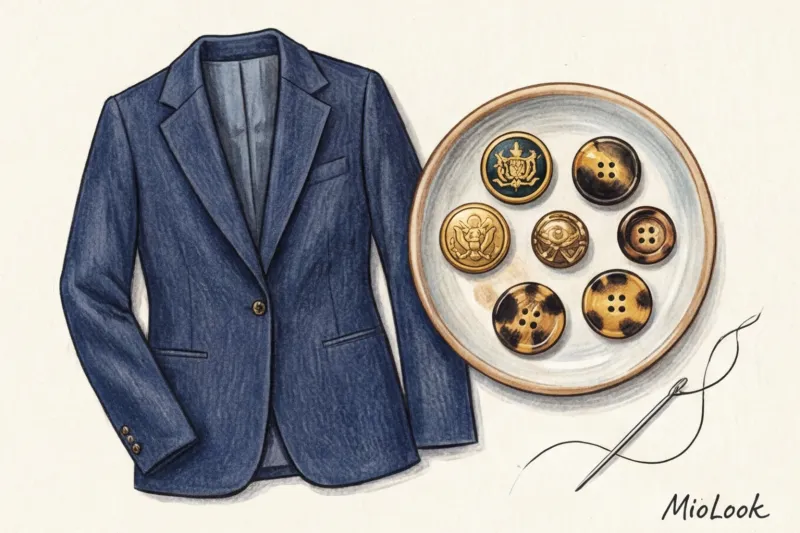
Take the jacket to a tailor (or sew it yourself, remembering to add a thread "foot"). The result? Your €70 jacket now looks like a €500 piece from a Parisian boutique. Plastic always gives away mass-market goods, while heavy metal and horn are associated with custom tailoring.
By the way, the return on investment for such customized items is skyrocketing. In the app MioLook I advise my clients to add these updated pieces to their smart wardrobe to track their Cost Per Wear metrics. You'll wear a jacket with the right hardware five times more often than a cheap plastic piece that subconsciously irritates you.
Forensic Shopper Checklist: 5 Steps to Check Fitting Room Hardware
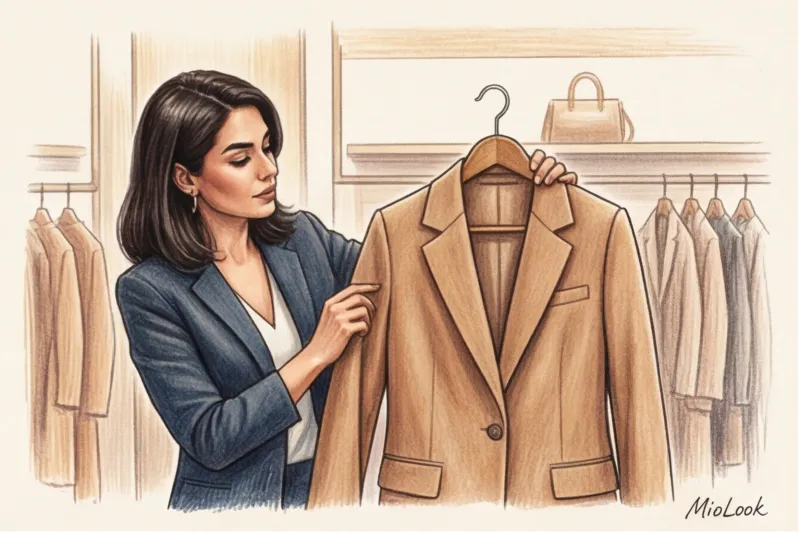
Next time you pick up something from the rail, don't immediately look at the price tag. Pretend you're a fashion forensic expert. Follow this checklist:
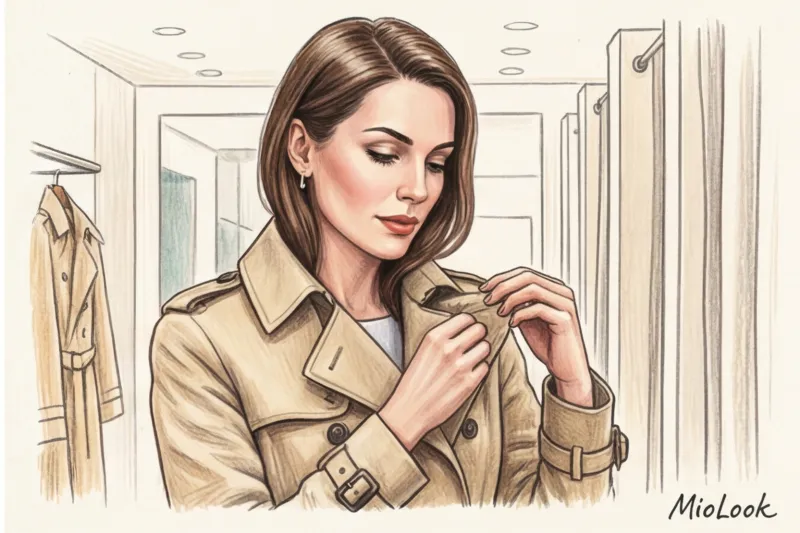
- Lightning test: Zip and unzip the zipper three times at different speeds. If it's a jacket, pull the fabric apart while the zipper is closed. Does it come undone? Return it to the hanger.
- Temperature test of buttons: Place the button against your cheek. If it's cold, take it. If it's immediately warm, it's plastic (which is acceptable for items under €50, but critical for expensive ones).
- Search for a sub-button: Take a look at the inside of your coat or jacket. Is there a small, transparent button holding the main button in place? If so, the brand didn't skimp on technology.
- Testing the buttons: Inspect the backing around the buttons. The fabric should be reinforced with interlining.
- Inspection of hinges: Run your finger along the buttonhole. It should be firm, textured, and free of any loose threads.
We're used to thinking that style is about combining colors and styles. But true elegance is always hidden in the details, the ones that aren't visible in Instagram photos. Hardware is the soul of a piece. And now you can read it as easily as the ingredients on the label.