The Illusion of Luxury: Why Our Fingers Have Lost the Sense of Fabric
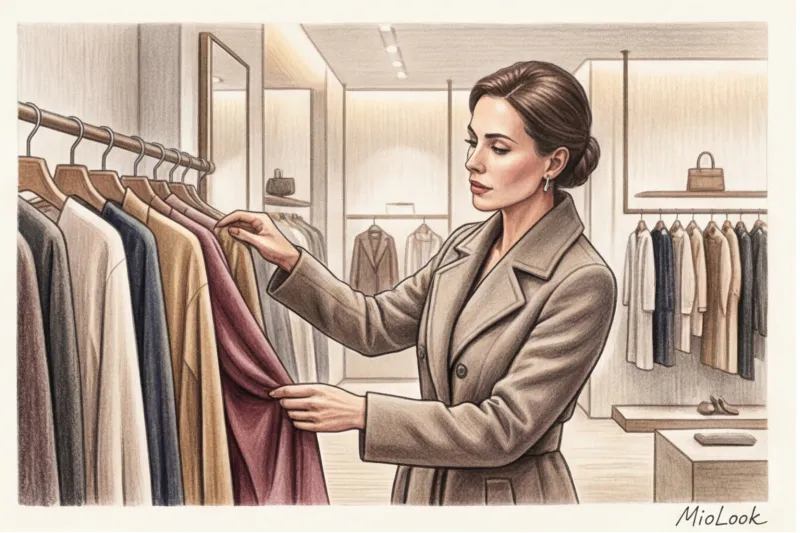
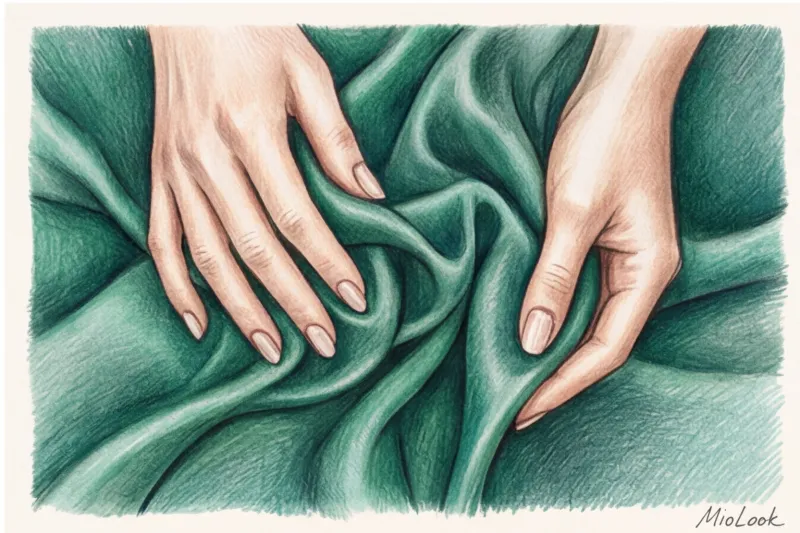
Several years ago, at a private show in Milan, I held a luxurious dress in a deep emerald shade. The fabric was flowing, heavy, and pleasantly cool in my hand. A representative of a premium brand proudly told guests about a "new interpretation of evening silk." But my fingers, accustomed to the archives of vintage houses during my ten years as a stylist, immediately sensed a catch. It was impeccable, masterfully woven, but still cupro. If even industry insiders sometimes fall for this trick, what about ordinary consumers?
The chemical industry has long since learned to imitate natural luxury. The journey from the first Chaldone viscose to today's high-tech micropolyester has derailed our tactile sensors. According to McKinsey's 2024 State of the Fashion Industry report, brands are switching en masse to cheaper blended materials, hiding them behind aggressive marketing. We've already discussed the global decline in mass-market standards in our a complete guide to choosing quality clothing and fabrics.
That is why the request is for that, How to distinguish natural silk Separating clothes from synthetics has become the number one concern for my clients. The internet is full of advice like "just light a thread on fire." But let's be realistic: no one will let you pull out a lighter in the middle of a boutique. We need a method called "forensic shopping"—a non-destructive analysis of the item right on the hanger.
Access to MioLook for €0.99 — one-time payment
A smart AI stylist will select the perfect look.
Get access — €0.99 onceHow to identify natural silk right in the store: a touch detector
During a trip to Como, Italy—the historic capital of European silk weaving—one of the local master weavers gave me the best advice. He said, "Camilla, silk speaks to the body, while plastic just hangs on it." To expose the producers, we need to tap into our tactile memory and a little high-school physics.
Temperature and kinesthetic test
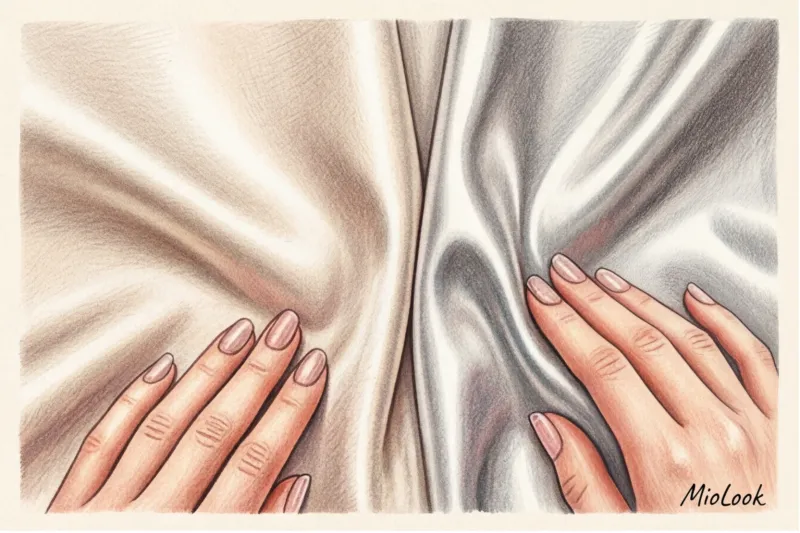
The first thing that gives away a fake is its thermal conductivity. Natural silk is a protein fiber similar to human hair. Place the fabric on the inside of your wrist or cheek. Real silk will feel cool at first, but after a few moments, it will match your body temperature and feel like your own. Polyester, on the other hand, will remain lifelessly cold or, conversely, create a greenhouse effect.
According to the Textile Institute, silk can absorb up to 11% of its own weight in moisture while remaining dry to the touch. By comparison, standard polyester absorbs only 0.4%. That's why you'll start sweating even while trying on a cheap synthetic blouse.
Do a slip test: rub two layers of fabric together. Synthetics will slide perfectly smoothly, like plastic on glass. Silkworm threads, however, offer a slight, barely noticeable resistance when rubbed—they cling to the surface with microscopic scales.
Fabric Acoustics: What is "Silk Crunch" (Scroop)?
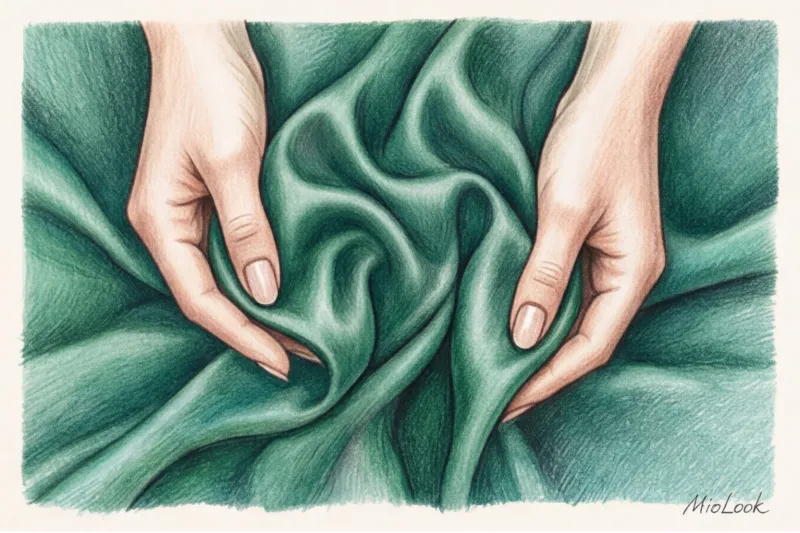
Silk has its own unique voice. In textile terminology, this phenomenon is called scroop Squeeze the hem of your dress in your fist near your ear. Real silk will make a dull, soft crunch, very similar to the sound of footsteps on freshly fallen snow on a frosty day. If you hear a high-pitched squeak, reminiscent of a balloon rubbing, you're holding synthetic fabric.
"The luster of silk cannot be imitated with chemicals. Mulberry silk thread is shaped like a triangular prism. It refracts light, creating a deep, multidimensional, pearlescent glow. Polyester thread is round—it reflects light flatly, producing a cheap, glassy sheen."
Your perfect look starts here
Join thousands of users who look flawless every day with MioLook.
Get access — €0.99 onceReading the Label Like a Technologist: Hidden Signs of Counterfeiting
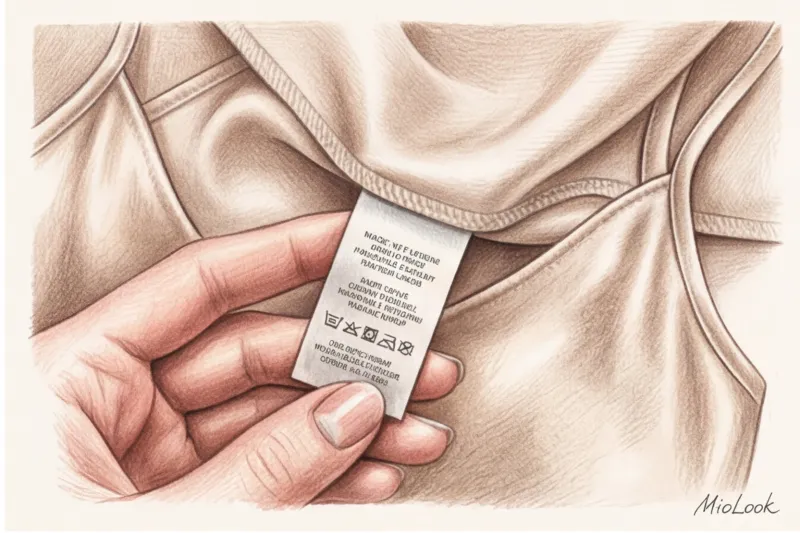
Clothing manufacturers are masters of legal acrobatics. According to the International Silk Association, only a 100% natural product can be called silk. So brands come up with catchphrases. See the labels? Silk touch , Silky , Art silk (artificial silk) or mysterious Washable silk For next to nothing? You can hang it back up with confidence. It's 100% polyester or viscose.
If you have genuine premium silk in front of you, the brand will definitely indicate two characteristics:
- Raw material class: Look for Grade 6A marking - this is the highest quality long-staple silk.
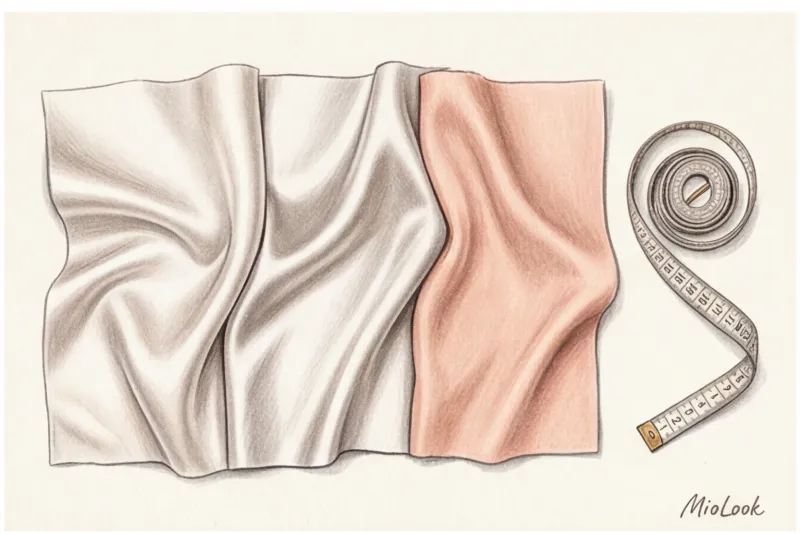
- Density in momme (mm): This is a key indicator of silk weight. For a comfortable and durable blouse, the weight should be 16–19 mm. For a slip dress, it should be strictly 19–22 mm.
One of my clients once happily brought me a "silk" blouse from a mass-market store, bought on sale for €45. I had to disappoint her. Let's figure it out: high-quality raw silk is expensive on the exchange, plus the complex dyeing process, sewing, logistics, and store markup. A genuine silk blouse of basic weight physically cannot cost less than €120-150. Anything below that is either cellulose or tissue-paper-thin silk (about 10 mm).
Crash test at home: when fire and chemicals are safe to use
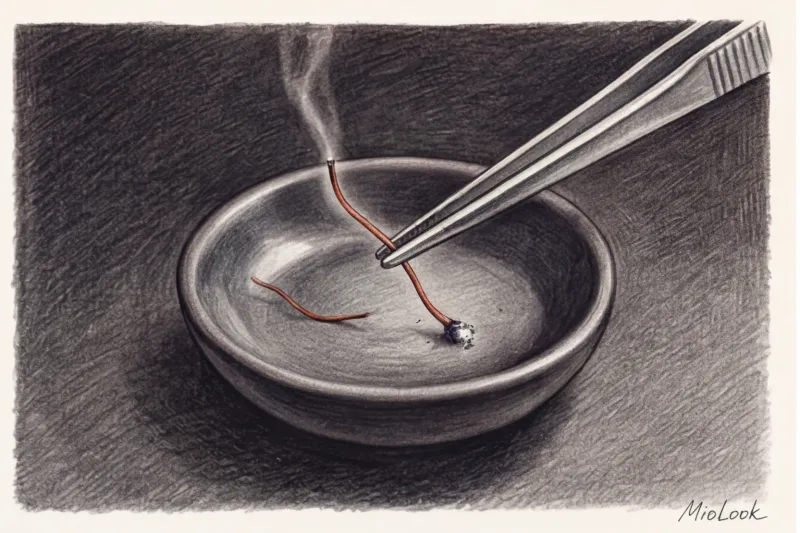
Let's say you bought a vintage item without tags or ordered a dress from a local designer and want to verify its authenticity at home. A classic method, the burn test, comes to the rescue. Simply snip off one or two threads from the inside seam allowances. Grab them with tweezers and hold a match to them.
How does natural silk behave? It doesn't burn, but smolders and curls into a black ball. It will have a pungent odor—like burnt hair or wool (which is also a protein). If you rub the cooled ball between your fingers, it will easily crumble into a fine dust.
Viscose (cellulose silk) will burn brightly and quickly, leaving a light gray ash and the smell of burnt paper. Polyester will melt, drip black resin, and smell like acrid plastic, while the cooled drop will turn into a hard, unbreakable stone.
A caution from practice: This test does NOT work reliably with blended fabrics. If the fabric is 70% silk and 30% polyester, the thread will give a mixed result, which will only confuse you. In this case, a chemical test will help: dip the thread in regular chlorine bleach. Natural silk will completely dissolve in 5-10 minutes, while synthetic silk will remain unharmed.
Is artificial silk always bad? Debunking the main myth
Here I'll say something that fashion purists often criticize me for: Rayon (not to be confused with synthetic polyester!) isn't always a bad thing. In fact, in certain situations, high-quality cellulose is superior to the original.
I regularly see women invest their last money in a cheap slip dress made of 100% pure silk, 12-mommie count. What happens next? The delicate fabric gives way under the strain. One awkward car ride, and the seams at the hips unravel, leaving ugly holes ("thread separation"). This dress can't be salvaged at a tailor's.
In such scenarios, I strongly recommend choosing premium cupro or lyocell (Tensel). Cupro is a breathable synthetic fiber made from cotton fluff. Brands like COS and Massimo Dutti often use dense cupro for trousers and dresses with complex cuts. This fabric will flow just as well as silk, allow the skin to breathe, and resist static, while also holding up to daily wear without coming apart at the seams. Learn more about... What fabrics look expensive and last a long time? , read in a separate article.
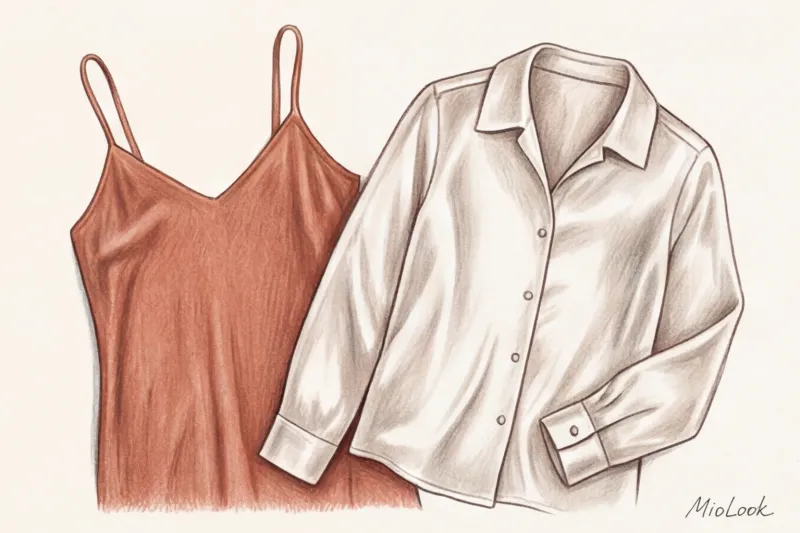
Checklist: 5 steps to check your silk item before checkout
As you stand in the fitting room with the silk blouse you plan to wear to an important interview, do this one-minute audit:
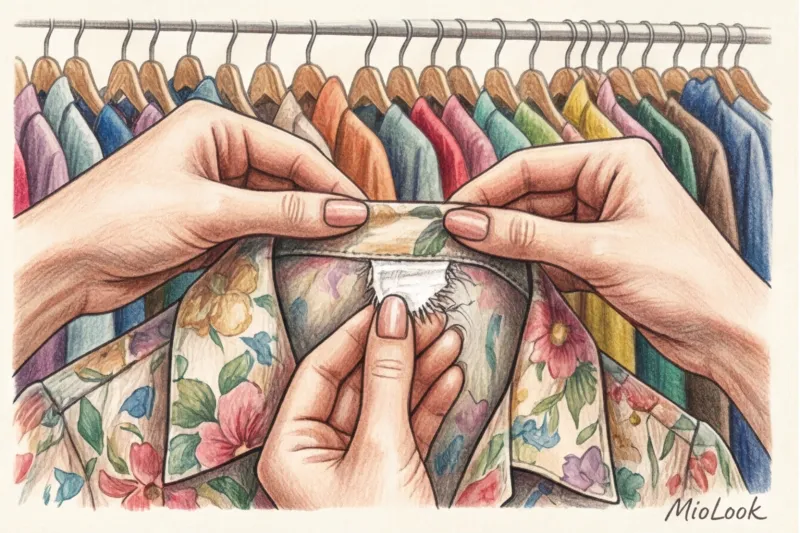
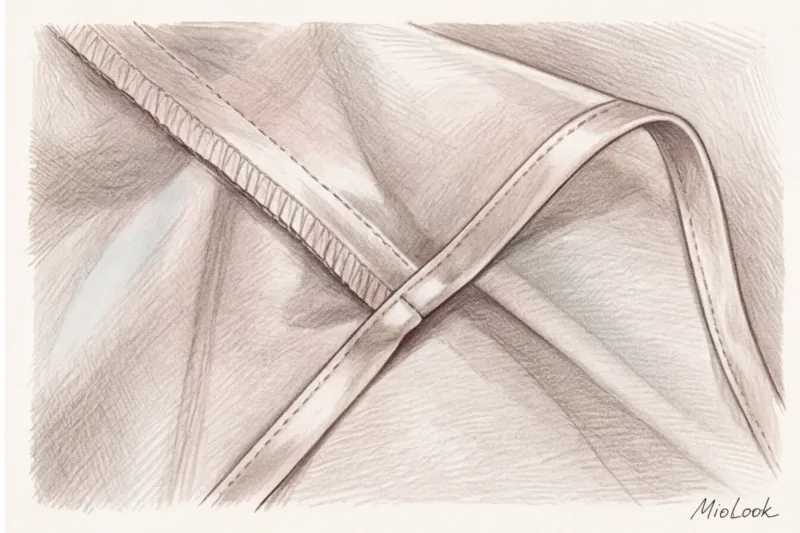
- Analysis of internal seams. Natural silk absolutely does not tolerate carelessness. Reputable brands never use a regular overlocker on silk. Look for a closed "French" (or lingerie) seam, where all the edges are hidden inside.
- Crease test. Crumple the hem in your fist for five seconds. Natural silk will wrinkle (it's not perfectly wrinkle-resistant), but the creases will be soft, rounded, and will quickly begin to straighten out. Viscose will leave sharp, deep creases, like paper.
- Temperature test. Place the cloth on your cheek. Wait 3 seconds. If the chill disappears and the cloth becomes warm, give it a plus.
- Checking the tension. Gently pull the fabric in the armhole area in different directions. If the threads easily separate, revealing gaps, the garment will unravel after the first wash.
- Studying the tag. We are looking for 100% silk (soie, seta) and the density indicator in mm.
MioLook: Silk Care and Cost Per Waste (CPW) Calculation
High-quality silk is a serious financial investment. To avoid the high price tag, I always teach my clients to use the Cost Per Wear formula. If a blouse costs €200 but you wear it 50 times over three years, the actual cost per wear is only €4. A cheap polyester copy for €40 will be thrown in the trash after the third wash, costing you €13 per wear. The savings are obvious.
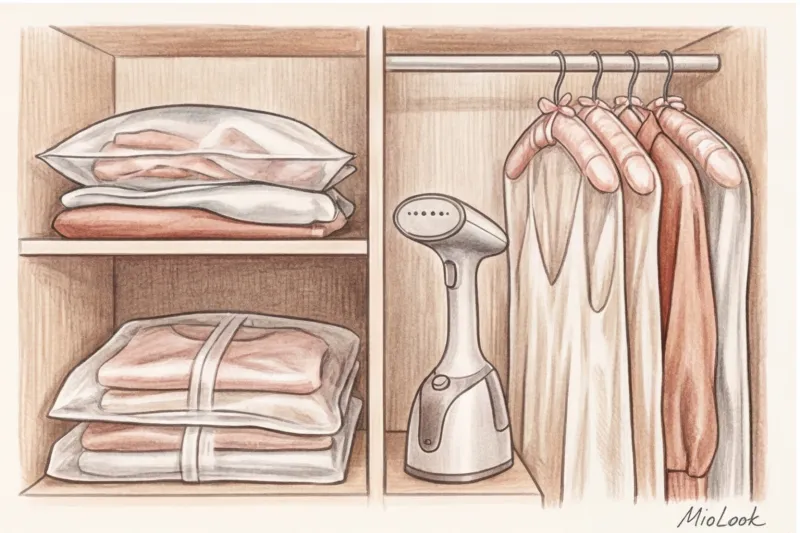
But for the investment to work, the protein fibers need rest. Silk can't be worn two days in a row—the threads need to restore their structure and shed absorbed moisture. This is where modern technology comes in.
In the appendix MioLook The smart wardrobe feature allows you to digitize your premium items. Artificial intelligence not only creates stylish combinations but also tracks the frequency of wear of specific items. The algorithm simply won't suggest you wear the same silk skirt two days in a row, giving the delicate fabric the necessary time to "rest" on the hanger. Learn more about what is really worth investing in When putting together a capsule wardrobe, you can check out our basic wardrobe reviews.
A conscious approach to style begins not with chasing trends, but with a deep understanding of the materials that touch your skin. Develop a keen eye, trust your fingers more than advertising banners, and remember: a truly luxurious piece doesn't have to shout—it should whisper. And with natural silk, that whisper will sound like a soft, incomparable crunch.