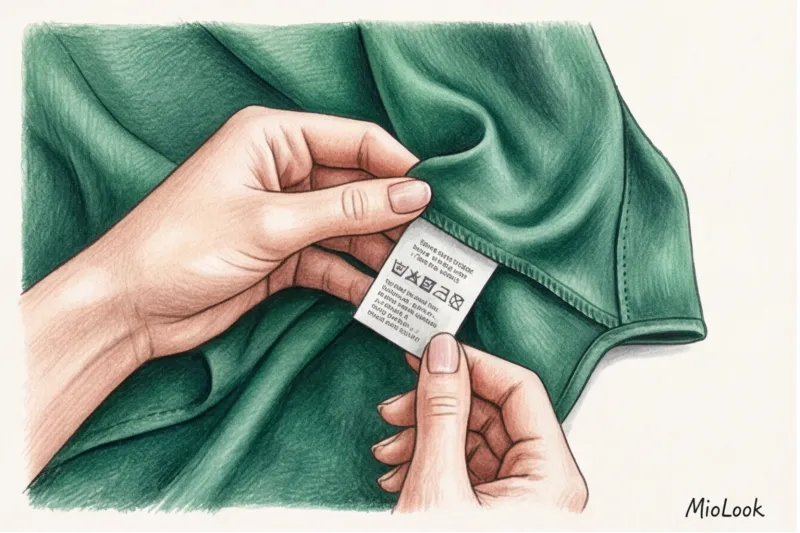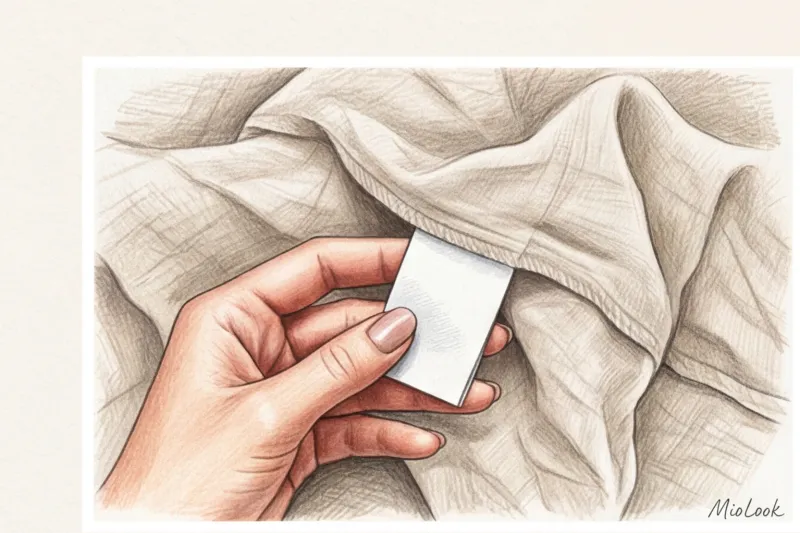
Do you know what the most expensive wardrobe mistake is? A poor investment due to carelessness. A couple of years ago, a client came to me upset. She'd bought a luxurious emerald blouse for €450, believing it to be thick, matte silk. She'd hand-washed it, and the fabric had shrunk two sizes and lost its luster. It turned out she'd trusted the pretty cardboard price tag labeled "Premium Collection" without checking the side seam. And there, on a tiny white scrap of fabric, was the honest declaration: 100% viscose.
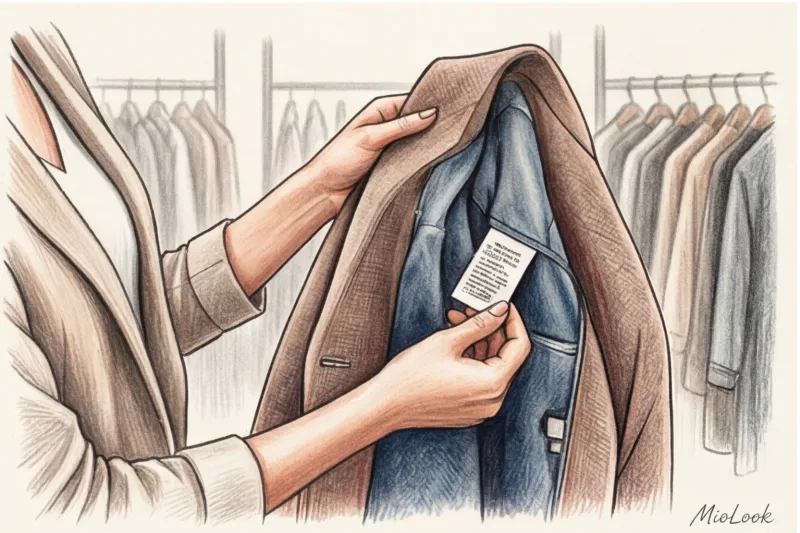
This case perfectly illustrates the main rule of a smart wardrobe: if you don’t know, How to read clothing labels , you'll constantly be overpaying for marketing rather than quality. We've covered more about how to evaluate materials before purchasing in our a complete guide to quality clothing and fabrics But today I want to teach you how to read tags not just as boring washing instructions, but as a real financial document.
Why is a label a product's passport, and a price tag just advertising?
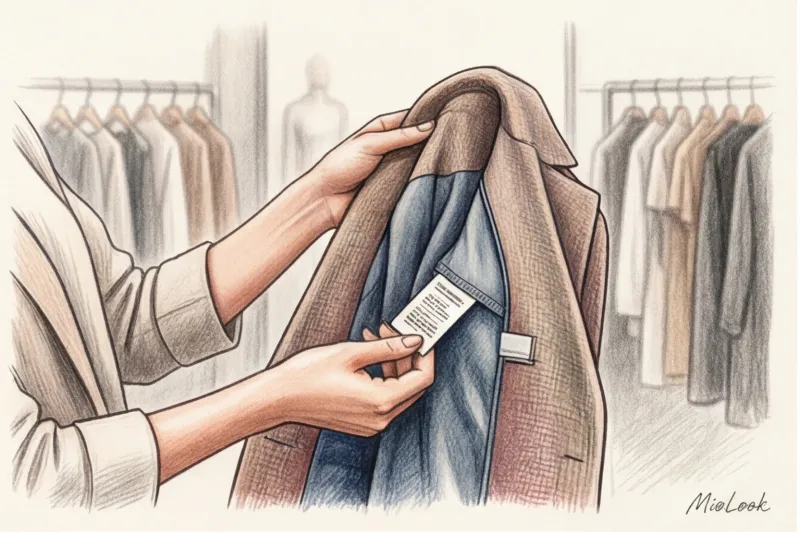
Over 12 years of working as a stylist, I've developed a strict ritual I call "forensic shopping." When I enter a boutique—whether it's Zara, COS, or a premium brand—I never look at the front of a garment or the price tag. My hand automatically reaches for the left side seam. Why there?
The difference between "perceived quality" (what marketing sells us) and actual quality is enormous. Under international consumer protection laws, manufacturers are obligated to state the absolute truth. only On a sewn-in textile tag. The cardboard label on the neck may be emblazoned with the words "Eco," "Luxury Feel," or "Natural Yarn," but only that scratchy tag has legal force.
How do you read clothing tags before buying? Make it a rule: until you've examined the inside tag, the item doesn't exist for you. The cardboard tag is advertising, the inside tag is the identity document.
Access to MioLook for €0.99 — one-time payment
A smart AI stylist will select the perfect look and help you organize your wardrobe based on fabric composition.
Get access — €0.99 onceAnatomy of a composition: what are we really paying for?
Reading fabric composition is like reading the label on a packet of cookies: ingredients are always listed in descending order. The material with the most amount in the item is listed first. If you see a sweater for €120 that says "45% acrylic, 35% polyamide, 20% wool," you're buying plastic at the price of natural yarn.
Blended fabrics are a particular pain for stylists. According to the Textile Exchange 2023 report, blends like "50% cotton, 50% polyester" (polycotton) wear the worst. Why? Let's consider physics: cotton is a relatively soft fiber and prone to abrasion, while polyester is incredibly durable. Cotton microfibers tear during wear, but instead of simply falling off, they are held tightly by strong polyester threads, twisting into stiff pilling. This is the perfect breeding ground for a scruffy appearance after just three washes.
The Illusion of "Naturalness": Marketing vs. Facts
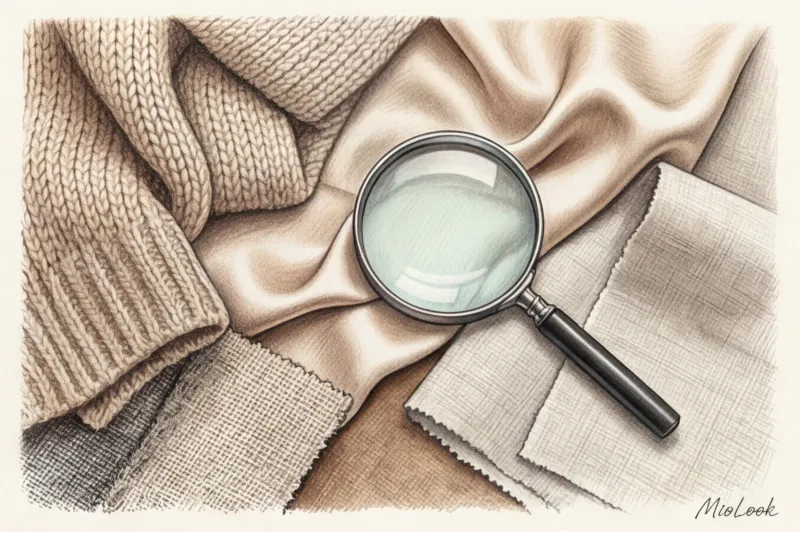
In the mass market and mid-price segments (€40–€150), a classic cashmere ploy is common. You see a large "Wool & Cashmere blend" label. It feels soft. But look at the ingredients and the illusion is shattered: 95% cotton or viscose, and only 5% cashmere. The brand adds just enough premium fiber to legally claim this word on the label. The 5% cashmere has no practical benefit—it won't make the garment warmer.
Another common guest is acrylic disguised as wool. About 30% of mass-market items labeled "wool sweaters" contain only 5-10% wool. Acrylic is easy to recognize even without a tag: it makes a distinctive squeak between your fingers when lightly rubbed, and while it offers no warmth in cold weather, it makes you sweat indoors.
When synthetics are a plus, not a minus
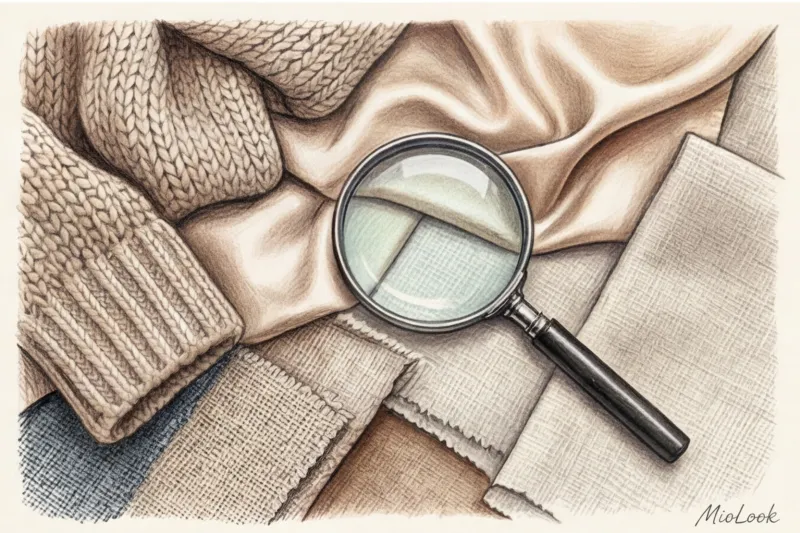
To avoid extremes, let's debunk the myth: "100% natural is always better." This isn't true. In some situations, synthetics are vital.
- 2-5% elastane (spandex) Including it in your perfect pair of jeans or business trousers is a guarantee that your knees won't get blisters after a day at your desk.
- 10-20% nylon (polyamide) In a thin wool sweater or hosiery, it's the reinforcement. Nylon makes fragile natural yarn tear-resistant. Without it, a thin merino turtleneck would wear out at the elbows within a month.
Your perfect look starts here
Join thousands of users who look flawless every day with MioLook. Digitize your items and their tags!
Get access — €0.99 onceThe secret language of care: deciphering the icons on clothing labels
There's no need to memorize boring tables with dozens of symbols. The international standard ISO 3758, which regulates textile labeling codes, is based on strict, almost mathematical logic. Simply understand the principle.
Basic shapes: basin (washing), triangle (bleaching), square (drying), iron (ironing), and circle (professional cleaning). Then the dot-and-line game begins.
- The dots are temperature. The more dots in the basin or iron, the more heat the fabric can withstand. One dot in the basin means 30°C, two means 40°C. Three dots in the iron means you can iron cotton and linen at maximum heat, while one dot means a lukewarm iron for silk.
- The underlining lines are delicate. This is the most important marker! If there is no line under the basin, wash on a normal cycle. One horizontal line at the bottom means a reduced spin speed (delicate cycle). Two lines mean minimal mechanical action (hand wash or wool cycle in the machine).
Dry Cleaning Myth: When the Circle with the Letter P Lies to You
And now for a counterintuitive insight that will save you hundreds of euros. The "Dry Clean Only" symbol (a circle with a P or F, often accompanied by the words "Dry Clean Only") is placed on 40% of items by brands not because of the fragility of the fabric.
"Brands often play it safe by putting a dry-cleaning symbol on regular cotton, viscose, or silk blends. This is done to absolve themselves of legal liability for the deformation of cheap hardware, buttons, or low-quality adhesive interlinings (dublerin) during regular washing in water."
How can you tell if an item can be washed at home? Do the water test: dip a cotton swab in warm water with a drop of mild shampoo and gently rub the inside seam (where the fabric is not visible). If there's any paint on the swab, take it to the dry cleaner. If the swab is clean and the fabric isn't wrinkled, there's a 99% chance the item can be gently hand washed in cool water. Important caveat: this tip does NOT work for structured jackets, coats, or items with complex pleats—water will permanently ruin their shape.
Eco-labels and greenwashing: how to avoid being fooled
Today, every other basic €15 T-shirt screams eco-friendliness. As a stylist, I see how the sustainability trend has become a powerful tool for greenwashing.
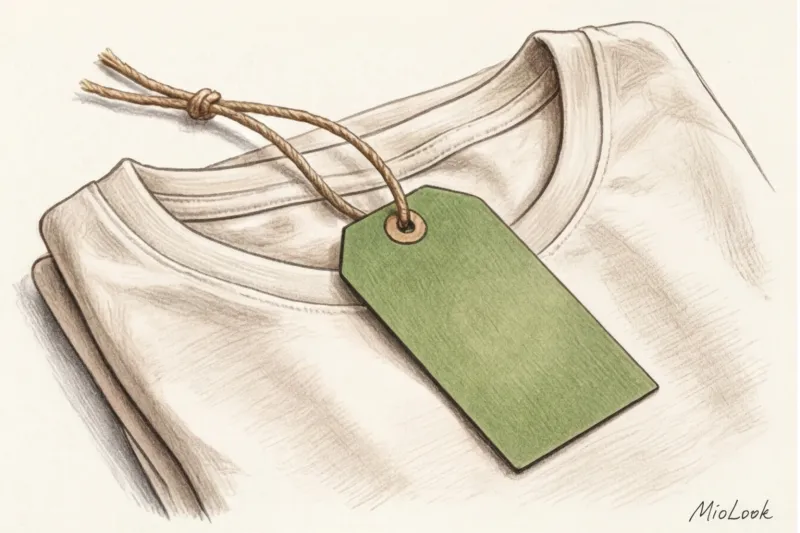
Labels like "Eco-friendly," "Conscious," or a green cardboard tag mean absolutely nothing unless they're backed by international certifications. Look for abbreviations on labels. GOTS (Global Organic Textile Standard) or OEKO-TEX Standard 100 The latter, for example, guarantees that no toxic dyes, heavy metals, or formaldehyde were used at any stage of production—from thread to button.
And my favorite is "recycled polyester." Brands tout it as saving the planet. Yes, it's made from plastic bottles, which reduces the carbon footprint of production. But according to research by the United Nations Environment Programme (UNEP, 2023), recycled polyester releases exactly the same amount of microplastics into wastewater when washed as regular polyester. Furthermore, bottle fibers are often more fragile, causing items to deteriorate faster.
It's a similar story with "vegan leather." It sounds noble, but in 90% of cases, it's just polyurethane (plastic) on a fabric backing. It doesn't breathe, cracks after a couple of seasons, and takes centuries to decompose. Don't overpay for a fancy term.
Ready to get started?
Try a free plan—no commitments required. Save care instructions for every item in your digital wardrobe.
Get access — €0.99 onceDetective Shopping Checklist: 3 Steps in the Fitting Room
Next time you go shopping or order things online, use this three-step process:
- Step 1: Look for the tag before trying it on. Don't waste time removing makeup and changing clothes if a €100 dress is listed as 100% polyester. Evaluate the fabric on the beach.
- Step 2: Assess profitability. Ask yourself: does the price match the material? Paying €200 for a wool jacket is a great investment. Paying the same amount for an acrylic jacket because of a logo on the lining is a questionable idea.
- Step 3: Reality Test. Match the care label's instructions to your lifestyle. Does the tag on your linen pants say hand wash and a crossed-out square (flat dry)? Ask yourself honestly: are you willing to spend 20 minutes washing and steaming these pants every summer morning? If not, they'll stay in the closet.
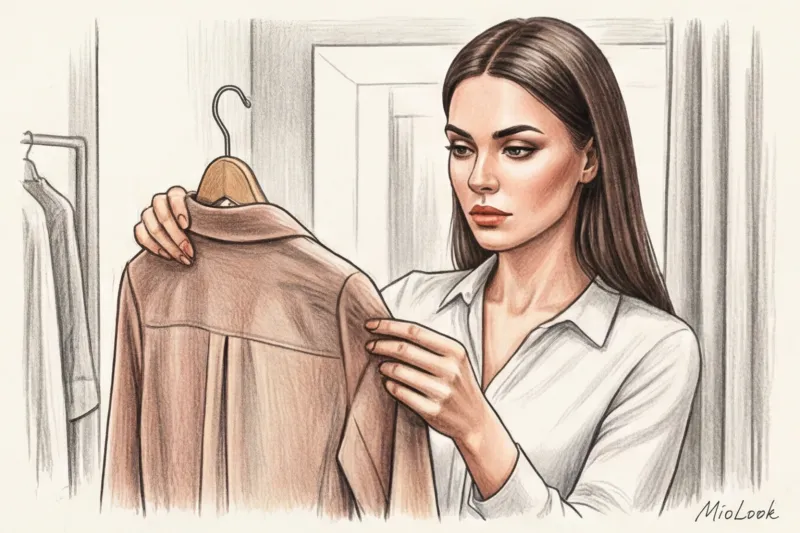
To help you remember how to care for the item you bought, I recommend using the “smart wardrobe” function in MioLook Take a photo of the item, add it to your virtual closet, and note its composition and washing instructions in the notes. This way, you'll be sure to avoid ruining your favorite silk top by forgetting not to wring it.
What to do if the label is cut off? (And why I don't recommend it)
Many people cut off labels on the day of purchase simply out of habit. As someone who works closely with clients' wardrobes, I strongly advise against this. Firstly, you (or the dry cleaner) are guaranteed to forget the ingredients within six months. Secondly, if you decide to sell an item on a resale platform, the absence of a sewn-in label automatically reduces the item's value by 20-30%, as authenticators cannot verify the originality and materials.
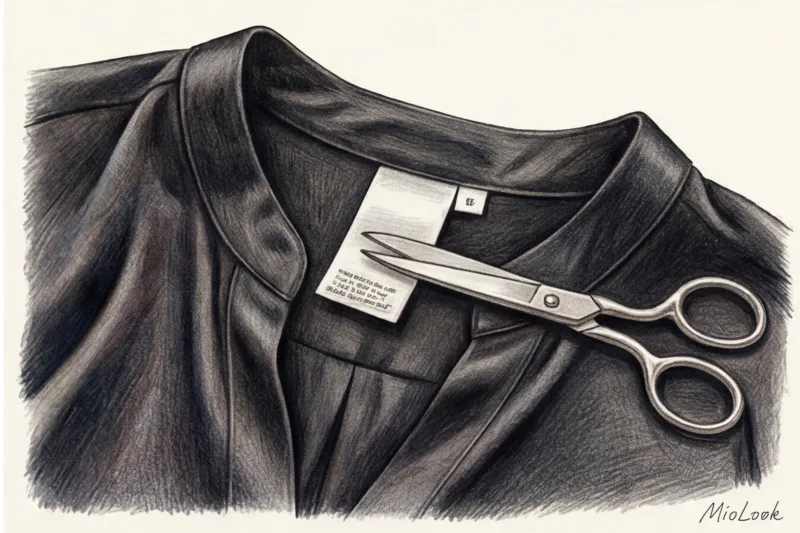
If the tag is made of hard nylon and is unbearably itchy, do not cut it with scissors close to the fabric The remaining hard "stump" will scratch the leather even more. Use nail scissors or a seam ripper and carefully pick up the threads of the seam where the tag is sewn (it's often sewn on with a separate stitch). Pull the tag out completely, without damaging the seam of the garment itself.
What should you do if you bought a vintage or second-hand item and the tag was already cut off? In such cases, I resort to extreme measures: combustion test Carefully pull a couple of threads from the inside seam of the garment and light them with a lighter on a heat-resistant saucer.
- Natural wool and silk burn slowly, smell like burnt hair and crumble into black ash.
- Cotton and linen burn quickly, smelling like burnt paper and leaving a light gray ash.
- Polyester and nylon do not burn, but melt, emitting a strong chemical odor, and harden into a hard plastic ball that cannot be crushed with your fingers.
Knowing how to read labels isn't just a housekeeping skill; it's your defense against marketing manipulation. The sewn-in label is your only guarantee of the quality of your clothes. By learning to decipher it, you'll buy less but better, and your clothes will last for years, maintaining their original appearance.