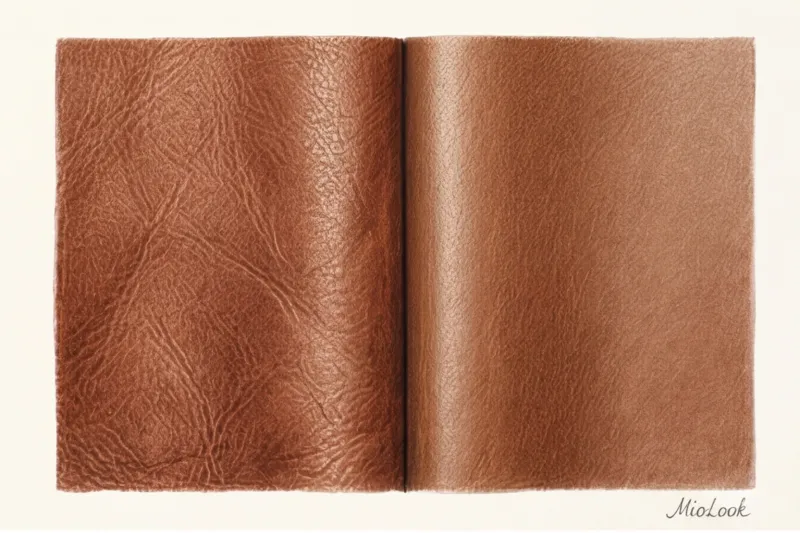
One day, a client came to me in tears. She'd bought a stunning pair of "premium vegan leather" trousers from a fashionable eco-friendly brand for €600, but four months later, after just one gentle dry cleaning, they were literally falling apart in her hands. Only bare mesh remained at the knees and thighs. She'd thought she was investing in ecology and durability, but in reality, she'd purchased single-use plastic at a luxury price.
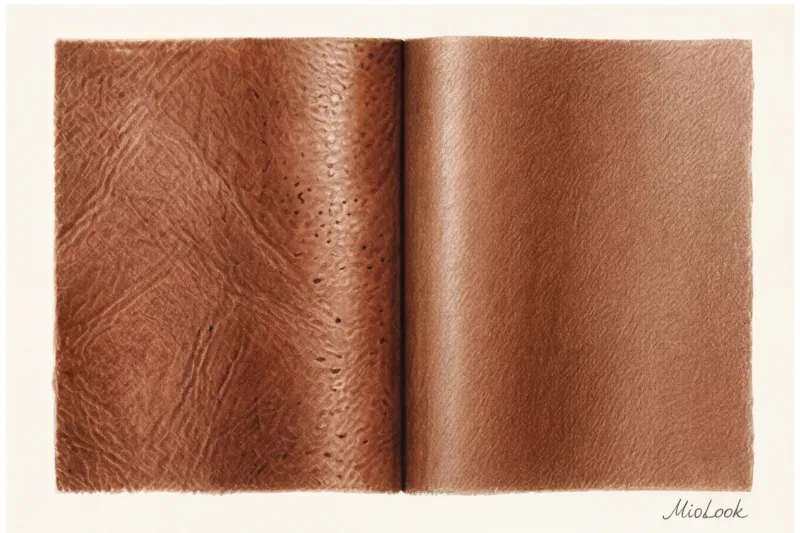
This story perfectly illustrates the main problem with modern shopping: we too often buy beautiful marketing legends, forgetting to look at the physics of materials. We discussed the basic principles of compositional analysis in more detail in our the complete guide to fabrics , but today I want to look at the most controversial category.
If you don't know, How to choose eco-leather clothing or are you unsure whether it's worth spending money on substitutes at all, this material is for you. We'll apply methods forensic shopping (detective shopping) and find out when artificial material is paradoxically better than natural, and when the only right choice is a classic leather jacket.
Genuine leather vs. eco-leather: shedding the marketing hype
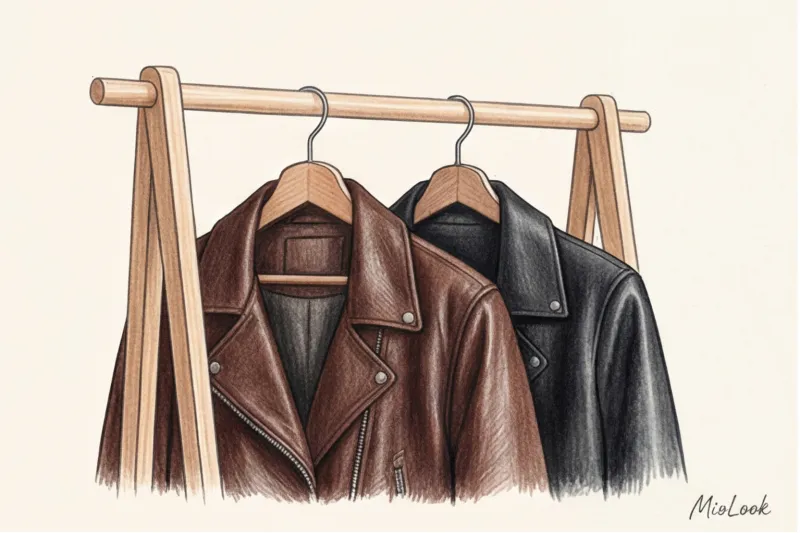
A leather jacket and well-cut, tailored trousers are the absolute core of a functional capsule wardrobe. They instantly pull together an outfit, tone down the formality of tailored shirts, and make simple knitwear look luxurious.
But when it comes to purchasing, we fall into a terminology trap. Brands are rapidly adopting terms like "vegan leather," "eco-material," or "cruelty-free leather." Sounds noble, right? According to a 2024 McKinsey report on conscious consumption, over 60% of millennials are willing to pay a premium for items labeled "eco." And the fast fashion industry is shamelessly exploiting this.
In 90% of cases, the proud label "vegan leather" conceals a common petrochemical product—polyurethane or, even worse, polyvinyl chloride. Brands sell cheap plastic at premium prices, masquerading as environmentalists.
Does this mean we should completely abandon artificial materials? Absolutely not. My main principle as a stylist: there are no bad materials, only improper use and unfair pricing.
Your perfect look starts here
Join thousands of users who look flawless every day with MioLook. Digitize your wardrobe and discover new combinations.
Get access — €0.99 onceAnatomy of Materials: How to Choose Eco-Leather Clothing That Won't Crack
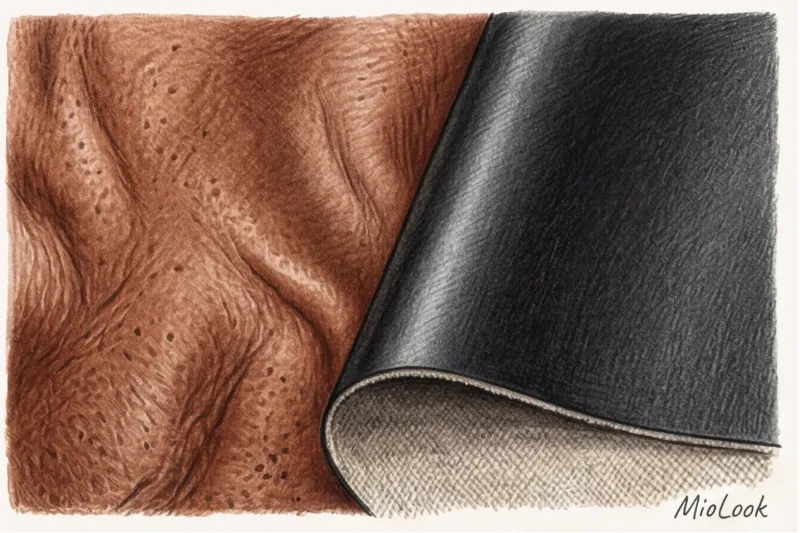
To understand why one mass-market jacket lasts for years, while another cracks after a month, you need to look at the material through the eyes of a tailor. Faux leather is always a layered product: a woven or non-woven base coated with a polymer layer.
Material breakdown (that dreaded peeling) occurs due to layer conflict. In areas of constant bending—elbows, knees, and underarms—the top layer becomes stretched. If the fabric backing is rigid and the polymer is not elastic, the top layer will crack.
Read the composition: PU (polyurethane) vs. PVC (polyvinyl chloride)
The fate of your garment is decided at the factory, when the polymer's chemical composition is selected. Look carefully for these abbreviations on the inner tag.
- PVC (polyvinyl chloride): A stiff, completely non-breathable material. It's literally linoleum, but for some reason they decided to make it into a jacket. It stiffens in the cold and cracks instantly. If you see PVC on the tag, don't hesitate to leave it on the hanger.
- PU (polyurethane): This is high-quality modern eco-leather. Polyurethane has a microporous structure, is breathable (though not as breathable as genuine leather), and has excellent elasticity.
What about innovative materials made from apples, mushrooms, and cacti? According to the latest analytical reports from WGSN, this is more marketing than revolution. To ensure "apple leather" holds its shape and doesn't fall apart in the rain, it still contains up to 40% of the same polyurethane. Paying €400–€500 for this is simply irrational in today's marketplace.
Quality testing right in the fitting room: 4 steps
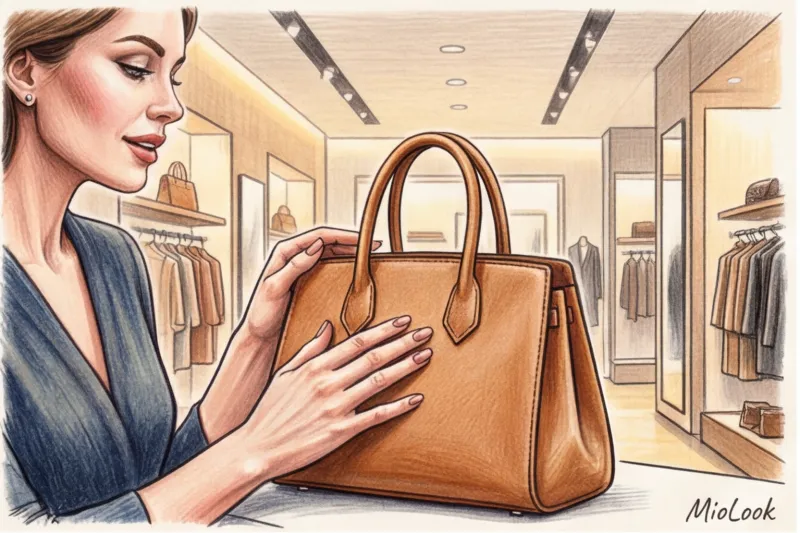
Tags often lie or conceal details. As a practitioner, I recommend physically testing the item directly in the store:
- Heat test. Press your palm firmly against the material for 10 seconds. High-quality PU will warm up slightly and soften, absorbing body heat. Cheap PVC will remain cold.
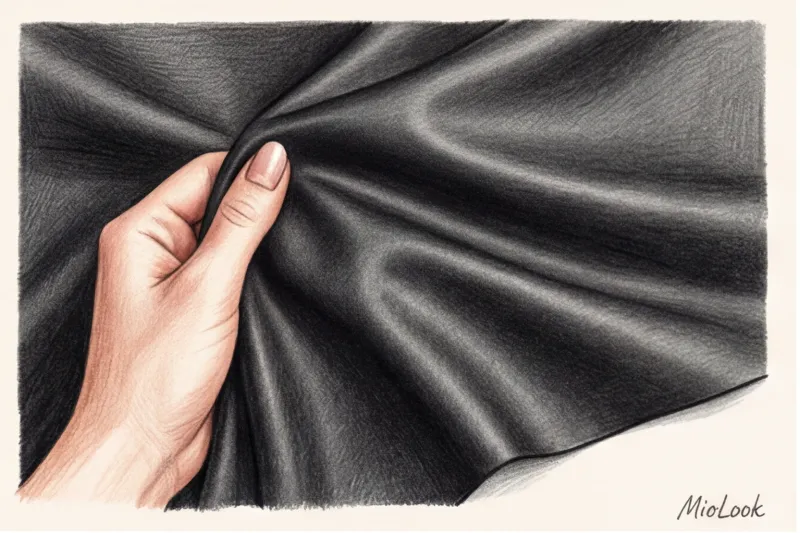
- Fold test. Squeeze the fabric into a fist as hard as you can, then release. Good polyurethane will straighten out in seconds without any sharp creases.
- Tensile test. Gently tug the material. It should give and spring back. If the fabric is "wooden," it will tear at the knees or elbows.
- Odor assessment. A sharp fishy or toxic chemical scent indicates the use of cheap solvents. This smell won't go away after washing or after using the balcony.
Trousers and skirts: why eco-leather often beats genuine leather here
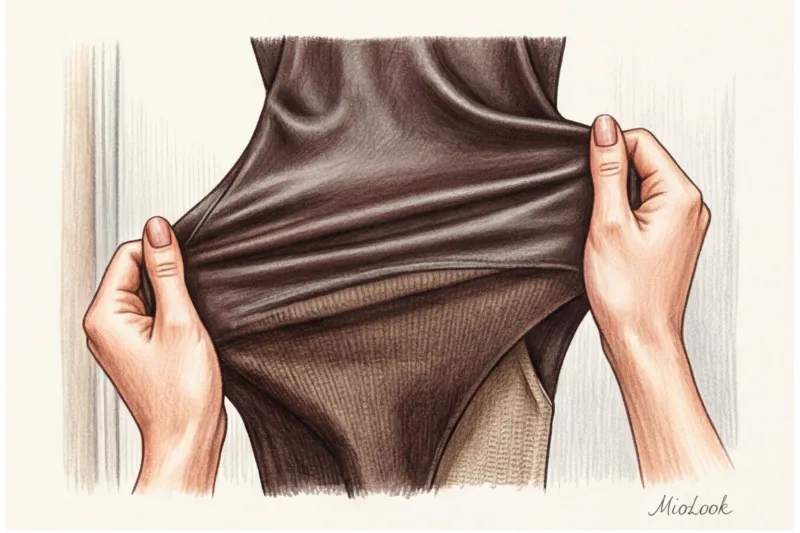
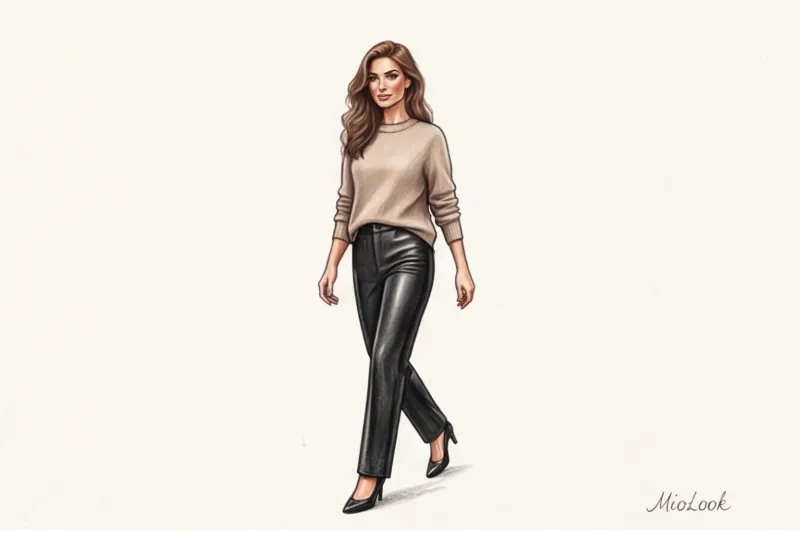
And now a counterintuitive fact that many initially argue with: for tight-fitting bottoms (trousers, pencil skirts), modern PU leather on a high-quality knitted base more practical genuine leather.
Why does this happen? Genuine leather is a living material that can deform plastically. If you sit at your desk for 8 hours in tight leather pants, the leather will stretch at the knees and back. And it will already never It won't return to its original state. You'll get a "bubble knees" effect, which instantly cheapens the look.
Polyurethane with an elastic backing, on the other hand, has structural memory. It stretches when you sit and returns to its original shape when you stand up. We include faux leather trousers in 80% of my clients' capsule wardrobes. We especially often use this technique when they need a classy alternative to traditional denim (by the way, if you have a casual office, check out our guide). about the rules for wearing jeans to work ).
The second less obvious advantage is care. Good PU leather pants can be turned inside out, placed in a special bag, and machine washed on a delicate cycle (30 degrees Celsius, no spin). Genuine leather pants require specialized dry cleaning, which often costs a third of the pants themselves.
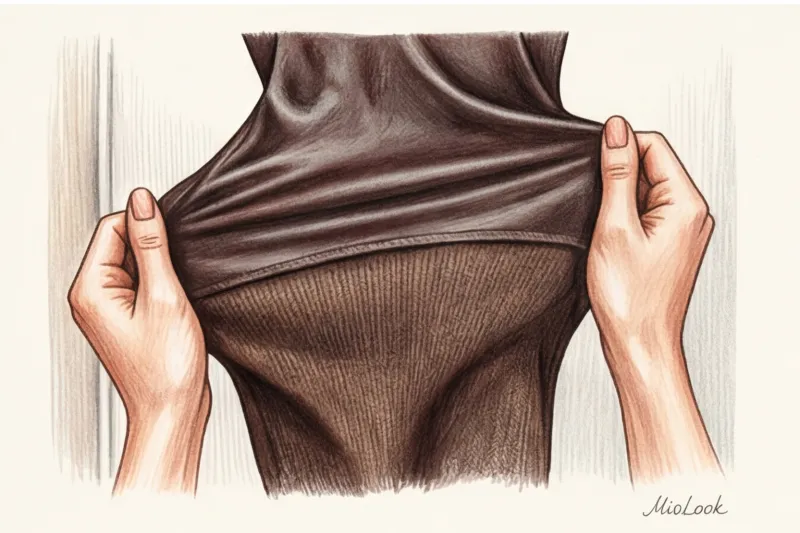
The only limitation: Faux leather won't keep you warm at -15 degrees. This option isn't suitable for harsh winter walks.
Access to MioLook for €0.99 — one-time payment
A smart AI stylist will find the perfect look for your new leather pants or jacket based on your current wardrobe.
Get access — €0.99 onceAn Investment in Eternity: A Checklist for Choosing the Perfect Genuine Leather Jacket
While trousers are best made of PU, a jacket (especially a biker jacket or bomber) is one category where I categorically insist on genuine leather. A jacket doesn't put as much strain on the joints as trousers, so durability and texture come first.
But not all leather is the same. Here's what we look for when buying:
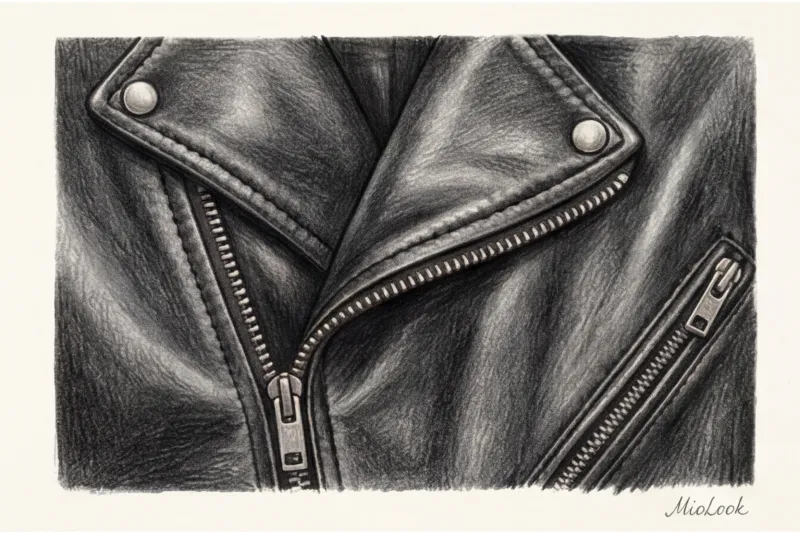
- Full-grain vs. Split. Full-grain is the top cut of the hide with a natural pore pattern (mereya). It breathes, ages beautifully, and develops a noble patina over time. Split leather is the inner, loose layer, which is generously coated with dye and polymer to simulate smoothness. Essentially, split leather behaves like cheap faux leather—it doesn't breathe and cracks.
- Weight and thickness. A proper sheepskin or calfskin biker jacket shouldn't be as lightweight as a windbreaker. A good biker jacket weighs between 1.5 and 2 kg. Thin leather in mass-market jackets (less than 0.8 mm thick) will quickly become scratched and lose its shape.
- Tanning standards. Look for the Leather Working Group (LWG) certification on labels—the gold standard in the leather industry. This guarantees that toxic chromium compounds were not used in hazardous concentrations during tanning.
Forensic Shopping: Checking the Backside and Hardware
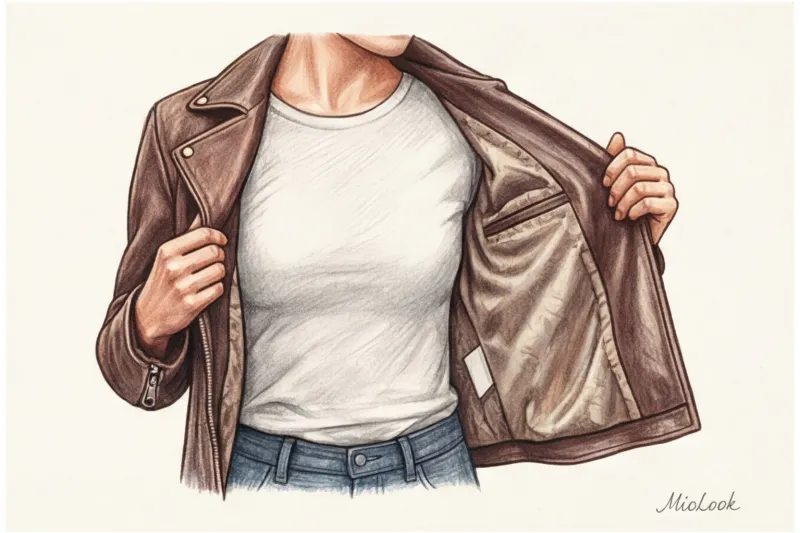
The cardinal rule of detective shopping is: a brand always cuts corners where the buyer isn't looking. Turn the jacket inside out before checking the price tag.
A common scenario: a brand charges €400 for a jacket made of excellent genuine leather, but then installs a 100% cheap polyester lining. This is a disaster. Leather itself retains heat, but polyester creates a greenhouse effect. You'll sweat in such a jacket even at 15 degrees Celsius. Look for viscose, cupro, or heavy cotton in the lining.
The second indicator of quality is the hardware. Leather is a heavy, dense material. A cheap plastic zipper (even one painted to look like metal) will come apart within a season. Check the zipper pull—quality items usually have Japanese YKK or Swiss Riri zippers. They move smoothly, like a knife through butter, without snagging.
Wardrobe Math: Calculating Cost Per Wear (CPW) for Leather
In 12 years of working as a stylist, I've learned one thing: people misjudge the cost of things. I love relying on data and always suggest clients calculate Cost Per Wear.
The formula is simple: divide the price of the item by the number of days you wore it.
Let's compare two scenarios from my personal tracker. I bought a vintage leather biker jacket for €500 made of thick calfskin. I wore it at least 500 times over five years. My CPW was 1 € per exit At the same time, a friend of mine bought a trendy jacket made of thin PVC for €80. The jacket cracked at the sleeves in the first season, after 20 wears. Her CPW— 4 € per exit A cheap thing turned out to be four times more expensive in real use!
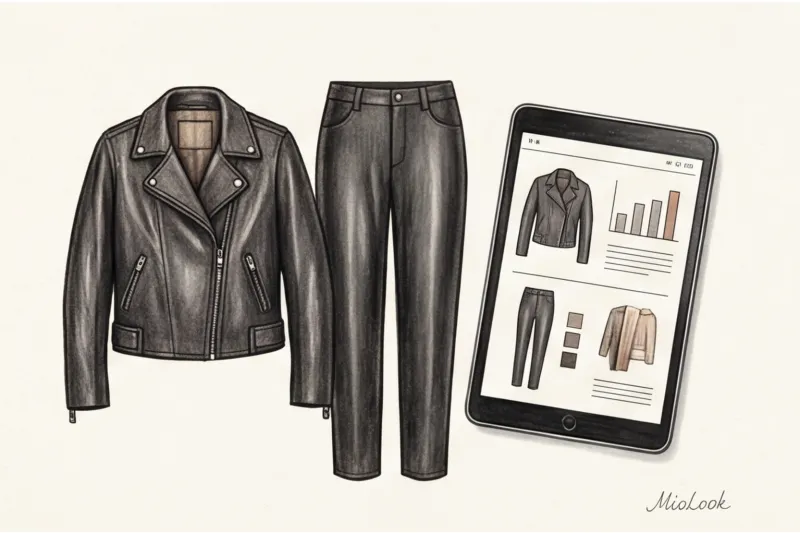
To avoid having to keep these numbers in your head, use technology. When I started analyzing my wardrobe through MioLook app Statistics clearly show that basic leather items have the highest return on investment, so you shouldn't skimp on them.
Ready to get started?
Try a free plan—no commitments required. Upload your items to MioLook and start calculating the true value of your wardrobe.
Get access — €0.99 onceExtending Life: Honest Rules of Care
Buying the right item is only 50% of the success. The rest depends on care. And this is where people make the biggest mistake: trying to care for leather clothing the same way they would care for shoes.
Never use shoe polish on jackets! It contains waxes and pigments that will clog the pores of your clothes and stain anything you touch.
The main enemies of eco-leather:
- Friction against rough surfaces (bag straps).
- Direct sunlight (polyurethane fades and loses elasticity).
- Alcohol-containing perfumes (spray the perfume on yourself before putting on a PU jacket - alcohol corrodes the polymer).
The main enemies of genuine leather:
- Dryness (the skin requires moisturizing, otherwise it will crack).
- Long-term contact with water.
- Store in plastic covers (leather needs air).
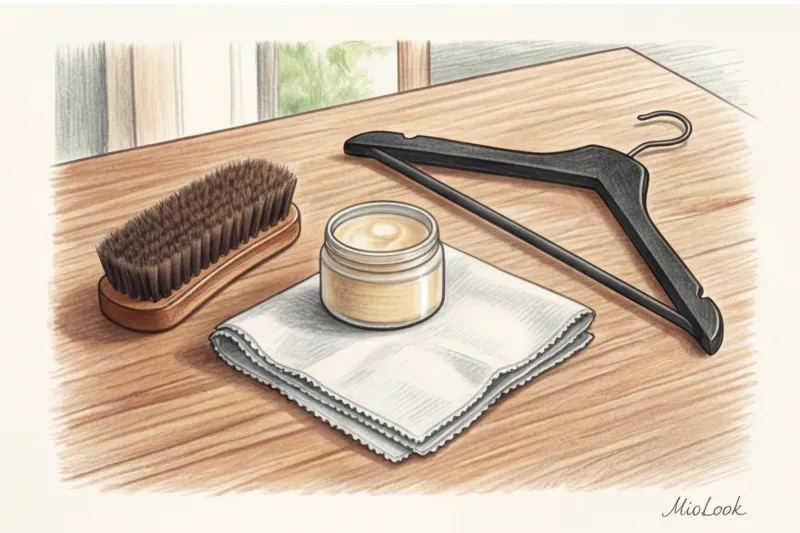
Your basic care kit should consist of three things: a soft natural bristle brush, a microfiber cloth for dusting, and a special leather conditioner lotion.
Choosing between genuine leather and modern eco-friendly materials is no longer a matter of ethics versus aesthetics. It's a matter of physics, the garment's intended purpose, and brand integrity. For fitted styles, confidently choose stretchy, high-quality polyurethane, and for outerwear that will shape your silhouette for years to come, invest in dense, full-grain leather. Don't buy marketing hype—buy technology and quality.