One of my clients bought ten cheap white T-shirts every summer. Do you know why? After the first wash, the side seam would treacherously sag down onto her stomach, and the collar would stretch out as if a dog had chewed it. It's a typical mass-market pitfall: the item looks passable on the hanger, but falls apart when exposed to water. Today we'll talk about... How to choose a quality basic T-shirt , which will last more than one season, retain its shape and work off every cent invested in it.
As a practicing stylist and buyer, I no longer read advertising labels. In the fitting room, I look at the thread count, seam geometry, and the composition of the collar binding. We discussed the basic principles of material analysis in more detail in our the complete guide to fabrics , and here I'll share a highly focused, yet incredibly practical, algorithm for choosing the perfect knitwear.
The Anatomy of Knitwear: Why Mass-Market Fabric Loses Its Shape After the First Wash
Fast fashion manufacturers are brilliant at cutting corners on invisible details. You see the "100% cotton" label and rejoice in your purchase. But cotton comes in different varieties. The industry measures knitwear quality in grams per square meter (GSM). According to WGSN's Material Sourcing Report (2024), the optimal weight for a quality basic T-shirt ranges from 160 to 220 g/m². Anything thinner than 130 g/m² will become a rag after three washes.
Brands rarely list the weight of the cotton on tags. Instead, pay attention to the yarn type. Cheap T-shirts are made from carded cotton (the fibers are short, making the fabric fluffy and easily pilling). We need combed cotton (also known as "combed")—its long fibers are tightly twisted, creating a smooth, almost silky surface. If you see "mercerized cotton," go for it: this thread has undergone a special treatment, has a light, elegant sheen, and is virtually shrink-free.
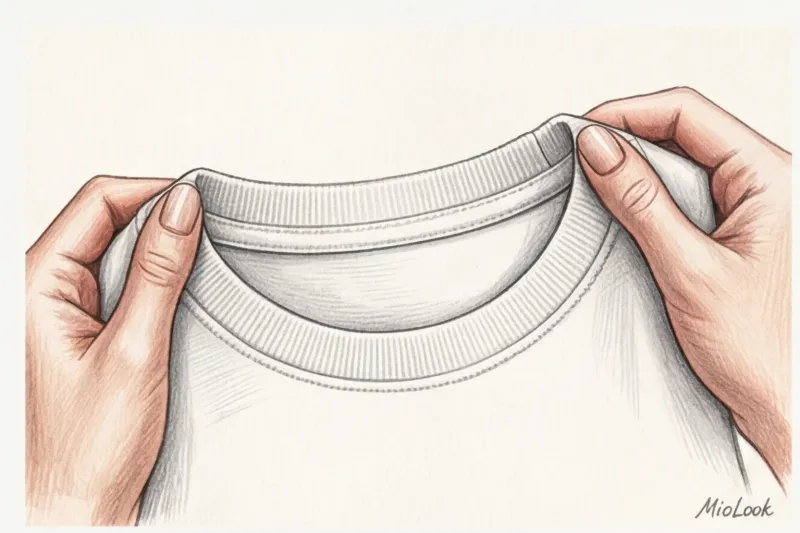
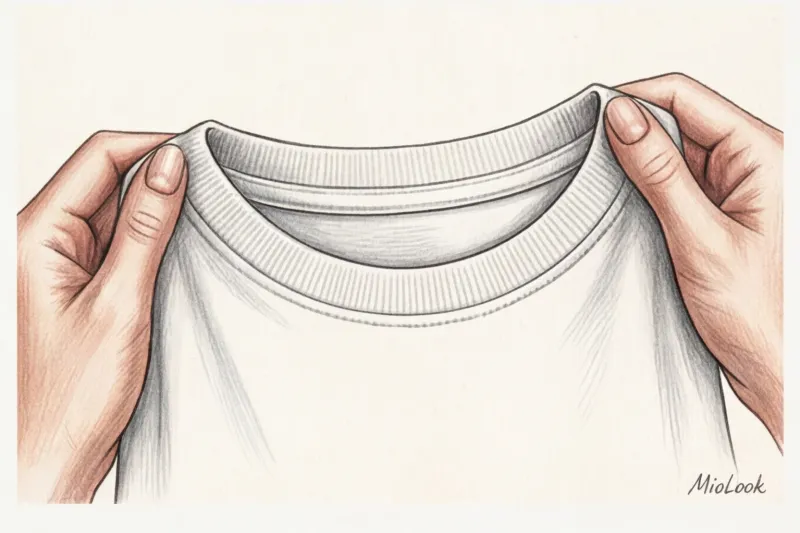
"The biggest mistake when buying a T-shirt is looking only at the main fabric. The secret to a T-shirt's durability lies in the collar. If the ribbing is made of pure cotton, it will inevitably stretch."
How to Choose a Quality Basic T-Shirt: Test Drive in the Fitting Room
Over the years of working with clients, I've developed my signature "30 Seconds in the Fitting Room" method. You don't need to be a technologist to weed out defective items right in the store. Here's what I do first.
1. Transmission test. Hold the fabric close to your smartphone's flashlight. If you can clearly see the light source and the loose weave of the threads, the T-shirt won't last even a month. A tightly twisted thread (that same 180 g/m²) will only let in diffused light.
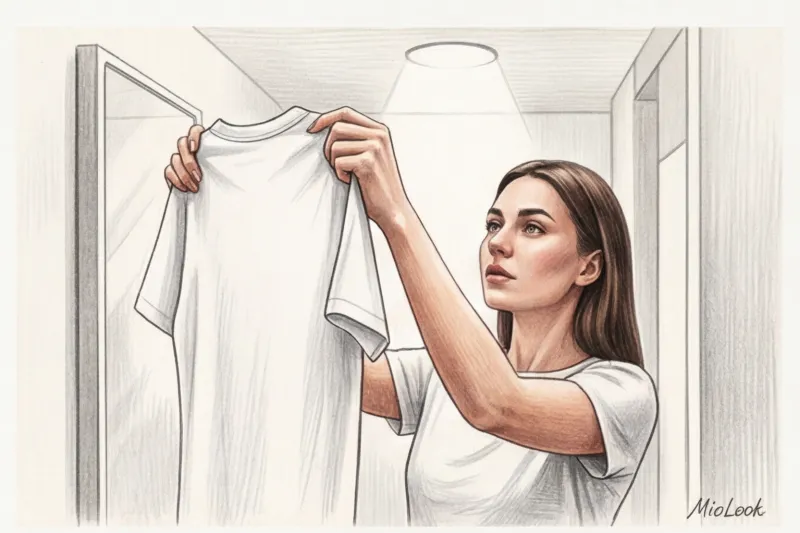
2. Geometry of the side seam. Remember the story about the belly seam that slipped? This happens when the grain line isn't aligned correctly during cutting. Brands are trying to save fabric by cutting crookedly. How can you check? Fold the T-shirt in half, matching the shoulder seams. The side seams should line up perfectly. If they're even a centimeter off the hanger, return the item to the shelf.
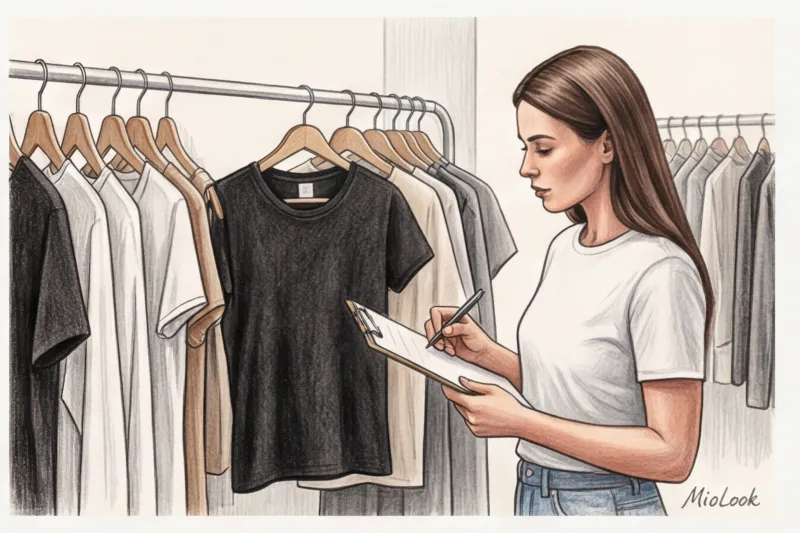
3. Tensile test. Gently (without overdoing it!) tug on the sleeve edge or hem of the garment. Proper knitwear has a reflex—it instantly returns to its original shape. If the fabric ripples, it has zero elasticity.
Access to MioLook for €0.99 — one-time payment
A smart AI stylist will select the perfect look and help you integrate new T-shirts into your wardrobe.
Get access — €0.99 onceChoosing the perfect cut: from office smart-casual to relaxed weekend wear
There's no one-size-fits-all T-shirt. How do you choose a quality basic T-shirt for a specific look? It all depends on the geometry you're trying to achieve.
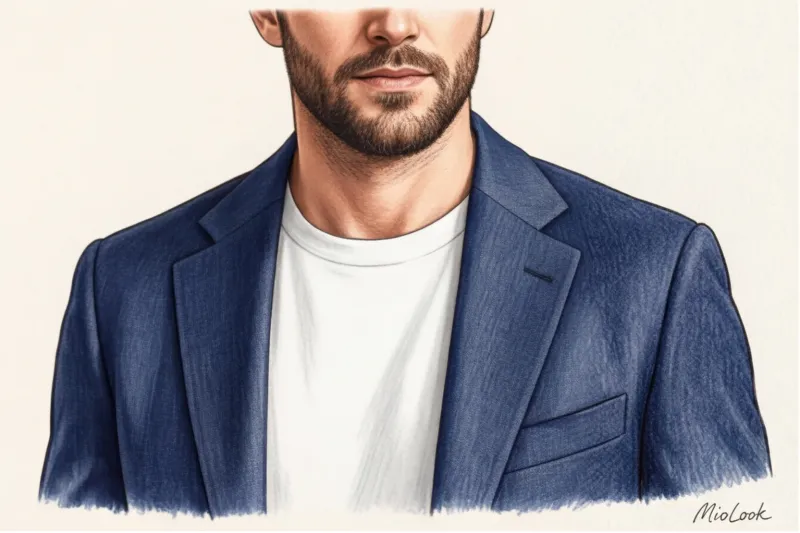
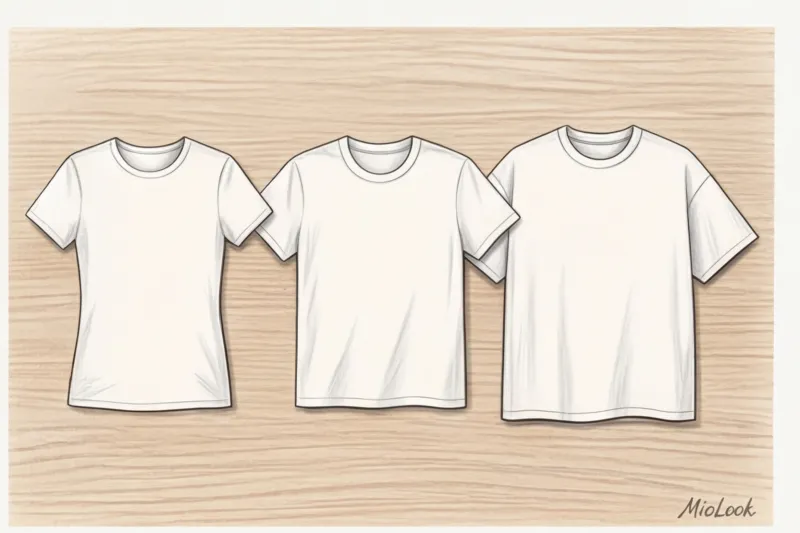
- Slim fit (semi-fitted): The golden rule is to leave about 2-3 cm of air between your body and the fabric. This is the ideal base layer for structured jackets. It prevents unnecessary folds at the waist and chest.
- Regular straight: A staple of basics. A straight silhouette, mid-bicep sleeves, and a shoulder seam that sits squarely at the knuckle. It flatters everyone and works perfectly as a standalone piece with jeans or palazzo pants.
- Oversized: Here's the catch. A proper oversized shirt should have a dropped shoulder (an extended shoulder line) so the fabric flows downwards. If the shoulder seam is in place but the shirt itself is simply too wide, you'll end up looking like a massive box.
Fair limitation: Thick, stiff cotton T-shirts (like classic men's styles) are absolutely unflattering for women with prominent busts. The dense fabric will form a "tent" from the highest point of the bust, visually adding a few extra sizes. In this case, look for flowy, blended fabrics.
The Collar Decides Everything: Crew-neck vs. V-neck
The neckline dictates the mood of the entire look. A crew neck is a modern, classy classic. It visually broadens the shoulders and makes the look more put-together. A V-neck elongates the silhouette and neck perfectly, but requires impeccable corner finishing (double topstitching is essential). A deep U-neck, however, cheapens the look and makes it appear dated in 90% of cases—avoid it in your basic wardrobe.
The 100% Cotton Myth: Which Blends Benefit a T-Shirt?
It's time to dispel one of the biggest myths in fashion retail. We tend to demonize synthetics, but 100% cotton isn't always the best choice for a T-shirt. A 2023 study by the Textile Institute confirms that adding polyurethane yarns (elastane or spandex) significantly extends the lifespan of knitwear.
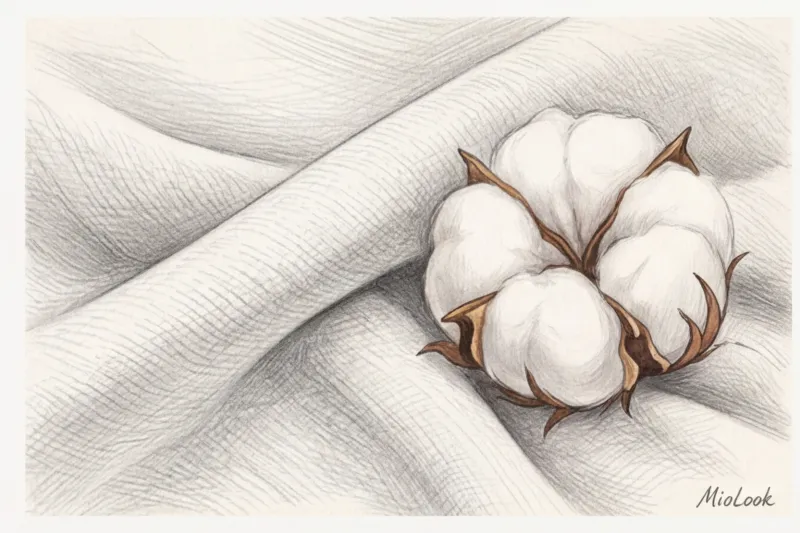
If the collar binding doesn't contain 2-5% elastane, the T-shirt is guaranteed to stretch around the neck, creating an unsightly "bacon effect." The same applies to fitted styles: 3-5% elastane in the main fabric isn't a cost-cutting measure, but a technological necessity to maintain shape.
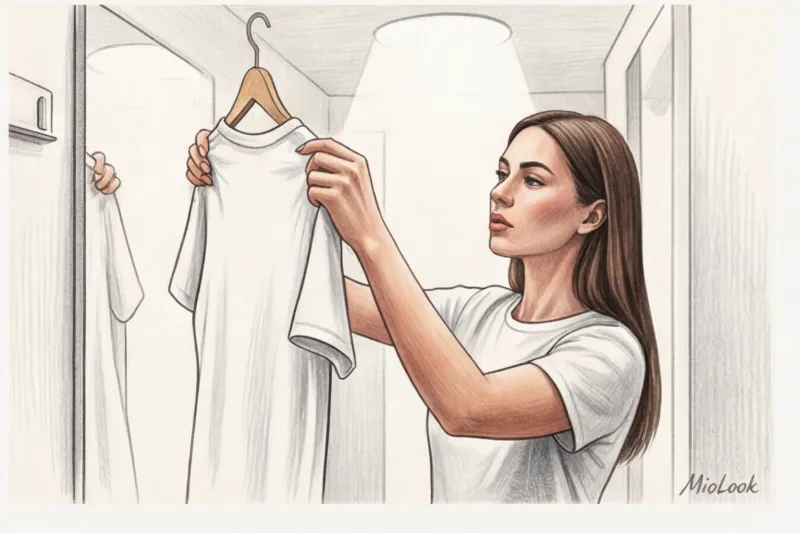
Blends with viscose, modal, or lyocell are excellent alternatives to basic cotton. They provide that flowing, cool texture that drapes perfectly under jackets. The only absolute red flag is polyester in a basic everyday T-shirt (we're not talking about technical sportswear). It's not breathable, quickly absorbs odors, and becomes pilled.
Your perfect look starts here
Join thousands of users who look flawless every day with MioLook. Upload your finds and plan your capsules.
Get access — €0.99 onceBrand Analysis: Where to Find the Best Essentials (COS, Zara, Uniqlo, Massimo Dutti)
Let's be honest: where should I buy essentials these days? I regularly review European mass-market products, and here's my current ranking based on value for money.
- Uniqlo U (Christophe Lemaire line): The standard density (around 250 g/m²). They're practically indestructible, but have a distinctive box-shaped cut and are quite stiff. An excellent option for ~15–20 €.
- COS: My personal favorite for smart casual. The cut is perfectly architectural, and they often use mercerized cotton. The price, ranging from €30–€45, is completely justified, as they look luxurious.
- Massimo Dutti: Here, it's worth looking not for pure cotton, but for chic, semi-fitted options made from a lyocell or linen blend. Ideal for formal suits (from €35).
- Zara and H&M (Premium lines): Buying T-shirts in the basic departments of these brands is a waste of money. But if you visit the Premium Selection section (H&M) or Origins (Zara), you'll find excellent heavy cotton styles for €20-€30.
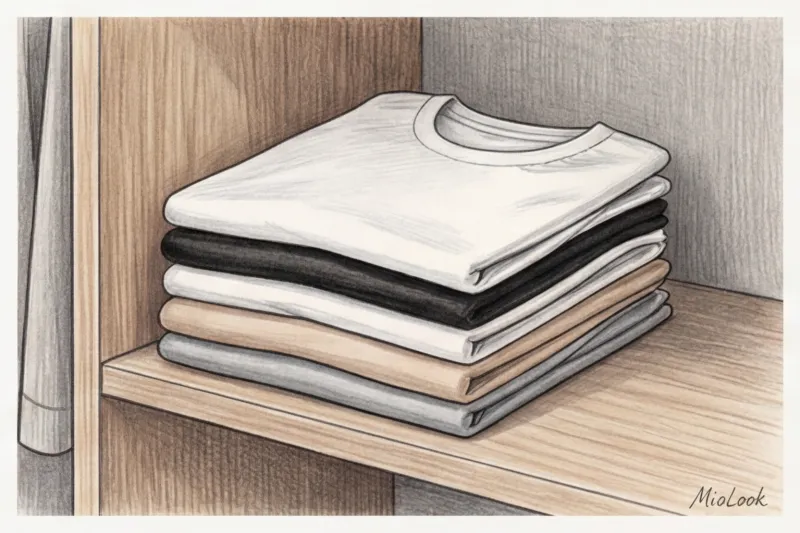
Consider the cost per wear. A €15 T-shirt that will fade after 5 washes will cost you €3 per wear. A €40 COS T-shirt that will last 50 washes costs only €0.80 per wear. Wardrobe math doesn't tolerate imaginary savings.
Stylist Checklist: 5 Steps to Buying the Perfect T-Shirt
Save this checklist for your next shopping trip. A T-shirt is acceptable to checkout if it meets five criteria:
- Doesn't show through underwear or body contours (unless this is the intended design of the translucent fabric).
- The side seams run strictly perpendicular to the floor, without distortions.
- The neckline is dense, contains elastane and springs back when stretched.
- The sleeve doesn't feel stiff or cling to the biceps like a second skin (air is the secret to an expensive silhouette).
- The length allows you to tuck the T-shirt securely into your trousers or wear it loose without distorting the proportions of your legs.
Once you find your perfect style, don't forget to add it to your Smart Wardrobe section. MioLook app This way, you can track what you pair it with most often, and the algorithm will automatically suggest dozens of new looks with this basic item.
How to care for high-quality knitwear so it lasts for years
Even the best premium cotton T-shirt can be ruined by one improper wash. The main rule for knitwear: 30 degrees Celsius and avoid aggressive spinning (maximum 600 rpm). The acceptable shrinkage rate, even for expensive cotton, is 3-5%, but washing at 60 degrees Celsius will shrink the garment by a full size.
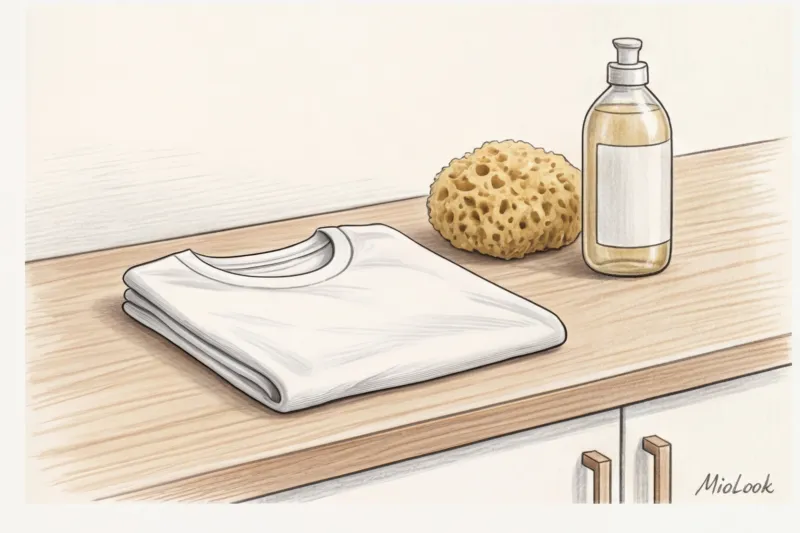
In my experience, 80% of white T-shirts end up in the trash not because of holes, but because of yellow stains in the armpit area. This is a reaction between aluminum salts (from deodorant) and sweat and laundry detergent. My personal advice: never use chlorine bleach, as it makes the fibers brittle and sets the yellowing. Use enzyme stain removers or oxygen bleach before the main wash.
It's best to dry heavy knitwear flat on a towel—this will prevent the side seams and shoulders from warping. And most importantly, store t-shirts folded on a shelf. Hangers (especially thin metal ones) will inevitably stretch the shoulder seams, creating unsightly "loopbacks."
A quality basic T-shirt isn't just a backdrop for the rest of your outfit. It's a frame for your face and the foundation upon which the geometry of your entire silhouette is built. Choose it with the same care you would a wool jacket, and your everyday wardrobe will reach a whole new level of aesthetics.