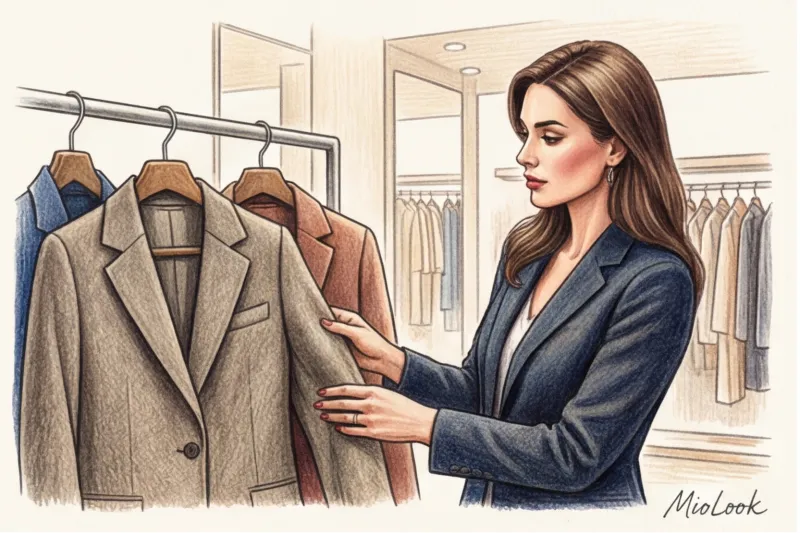
I recently read a report McKinsey State of Fashion By 2024, one figure literally made me choke on my morning coffee: over the past 20 years, the average lifespan of mass-market clothing has been cut in half. Brands have masterfully imitated luxury while skimping on hidden details. As a result, we buy visually beautiful items that turn into shapeless rags after the first wash.
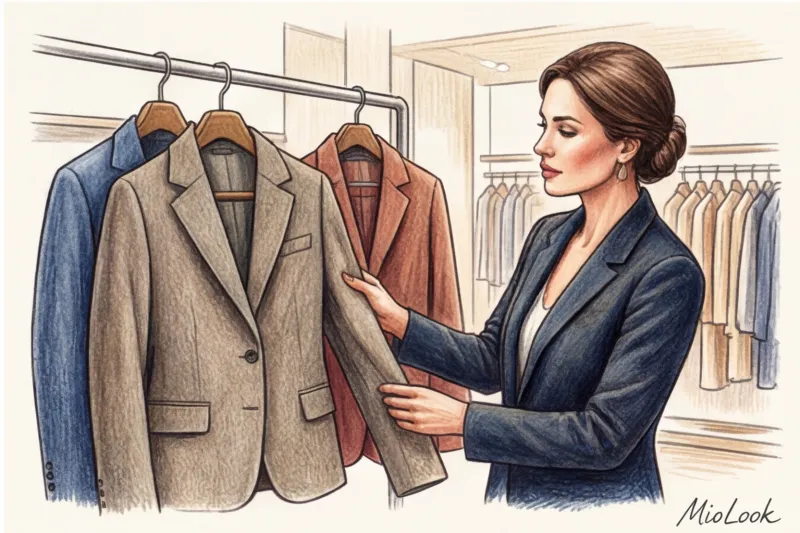
We have written in more detail about how modern industry and materials architecture work in our a complete guide to choosing quality clothing But today, I invite you to switch from being a regular shopper to being a fashion detective. Forget blindly trusting a price tag or logo.
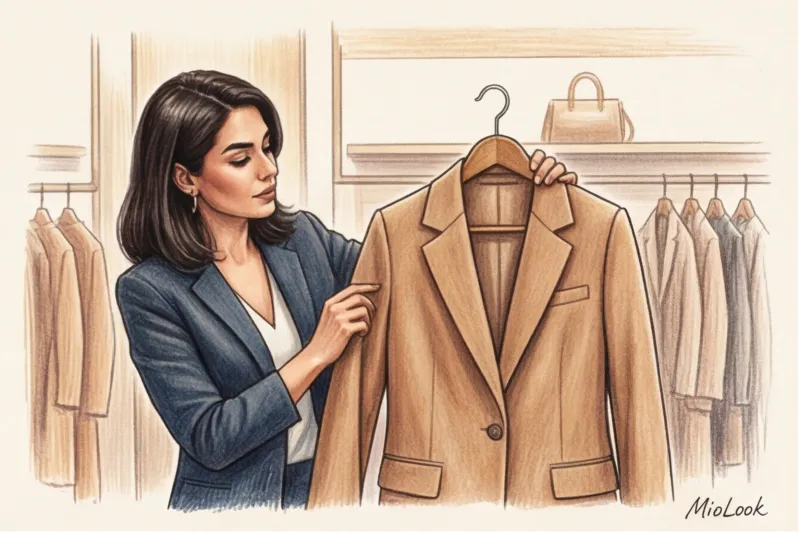
If you are wondering, How to determine the quality of clothing in a store , the answer lies not in reading advertising tags, but in physical testing. As an image consultant, I constantly use the concept forensic shopping (Detective Shopping). These are 7 quick checks right in the fitting room that will reveal the true cost of an item in 60 seconds and save you from bad investments.
Why the price tag is no longer a guarantee: how to determine the quality of clothing in a store
We live in an era of so-called "perceived quality." Marketers know that if you hang a cheap polyester jacket in a beautiful boutique with the right lighting and attach a €200 price tag, our brains automatically perceive it as high-quality. Conversely, we often ignore truly high-quality items from basic brands like Uniqlo or COS simply because they're hung in a dense row of similar items.
My goal is to teach your hands to "see" what marketers try to hide. True tailoring always leaves physical traces. And we will learn to find them.
Test #1. Tactile testing: holding the fabric up to the light and the fist test
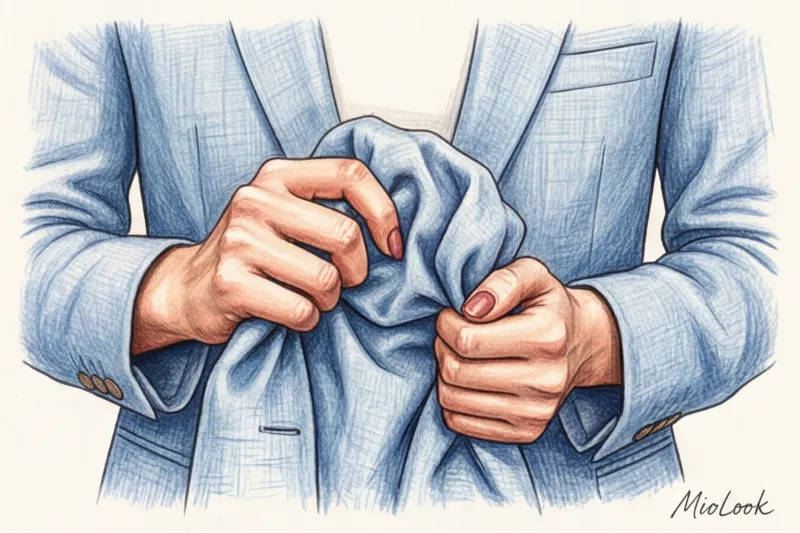
Let's start with a simple yet illustrative experiment. Take the edge of a garment (preferably the hem or sleeve) and squeeze it tightly in your fist for 5 seconds. Release.
If the fabric is heavily wrinkled or has hard creases, it will look unkempt within an hour of wearing it. High-quality fabric, whether cotton with a weight of 180 g/m² or good suit wool, has a springy quality. It should spring back visibly.
"This test has one important exception: it doesn't work on fabrics with a deliberate crush effect, pleats, or the finest summer linen without any additives, where the elegant creasing is part of the texture. But even expensive linen should have soft, smooth folds, not break like cheap paper."
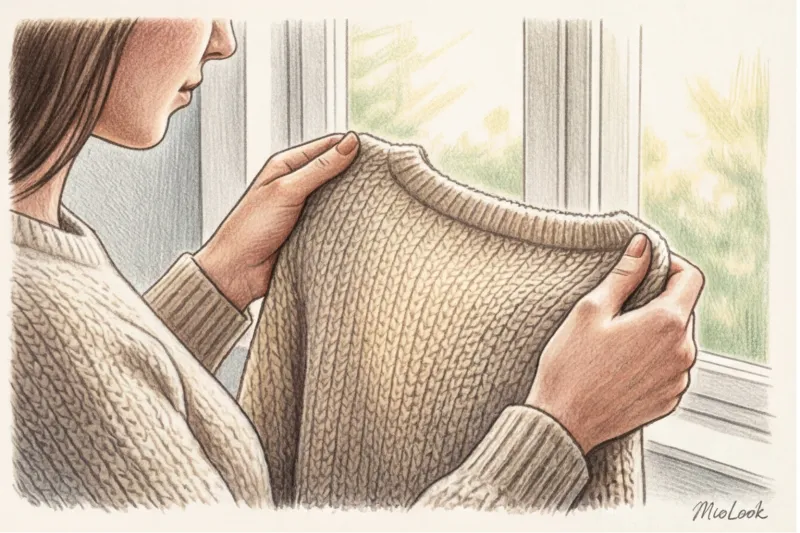
Next, do the light test. Hold the back of a shirt or dress up to a bright light in the fitting room. Pay attention to the weave of the threads. If you see uneven gaps, thickening (knots) in the cotton, or suspiciously thin areas, the manufacturer cut corners by using cheap, short-fibered fabric. Such an item will quickly become pilled and worn through.
Access to MioLook for €0.99 — one-time payment
A smart AI stylist will select the perfect look based on your preferences and wardrobe.
Get access — €0.99 onceTest #2. Suture Anatomy: Pull to Find Out the Truth
I once saved a client from buying a stunning silk blouse at a luxury boutique for €500. The color was perfect (a deep emerald that perfectly complemented her complexion), but when we entered the fitting room, I made one simple move: I gently pulled the fabric in different directions from the side seam.
The seam immediately "smiled"—the threads tightened, creating a gaping, millimeter-wide space between the pieces. If the client had bought this blouse, it would have come apart at the seams the first time she made an awkward movement while driving or tried to reach the overhead compartment.
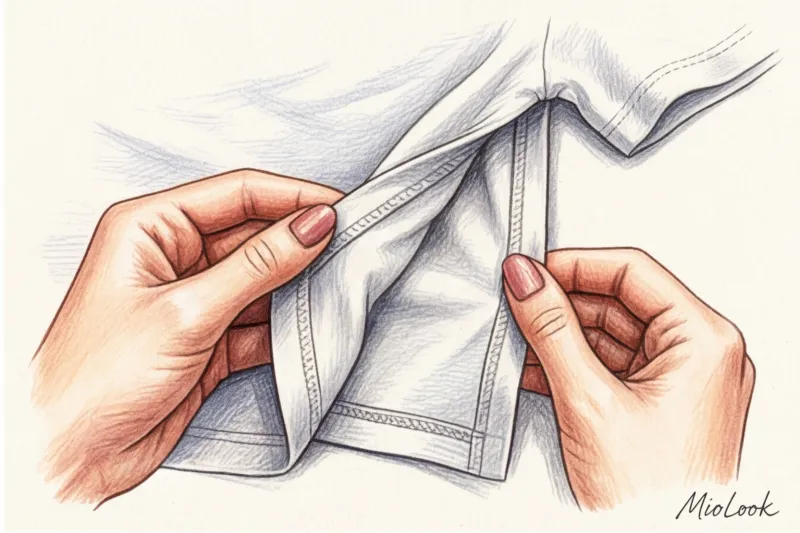
The golden rule of tailors is the SPI (stitches per inch) standard. The more frequent the stitches, the stronger the garment and the more time the seamstress spent creating it. A quality garment should have 4-5 stitches per centimeter. If you see only 2-3 sprawling stitches per centimeter, you're looking at a severely undercut production.
Also, take a closer look at the threads themselves. If you see shiny, fishing-line-thin synthetic threads on an expensive wool coat or matte cotton, the manufacturer has skimped on basic consumables. Such threads will eventually cut through the natural fabric.
Test #3. Print Matching: Where Mass Market Always Cuts Costs
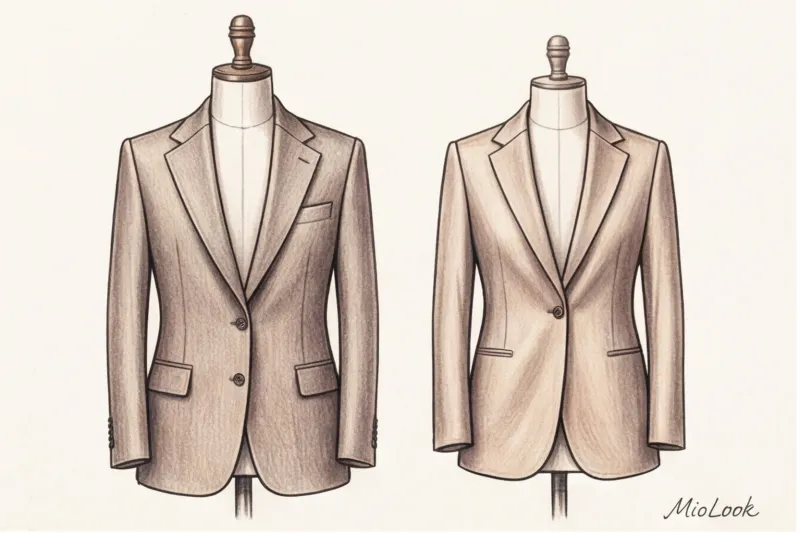
If you want to instantly assess a brand's quality without reading labels, look at checked or striped clothing. Pay attention to the side seams, jacket lapels, the junction of the sleeve and shoulder, and patch pockets.
The lines of the design must perfectly align, flowing from one piece to the next. Why does mass-market fashion almost never do this? Matching geometric patterns requires a huge amount of fabric (15% to 30% is wasted) and painstaking handwork by the tailor. Fast fashion can't afford this.
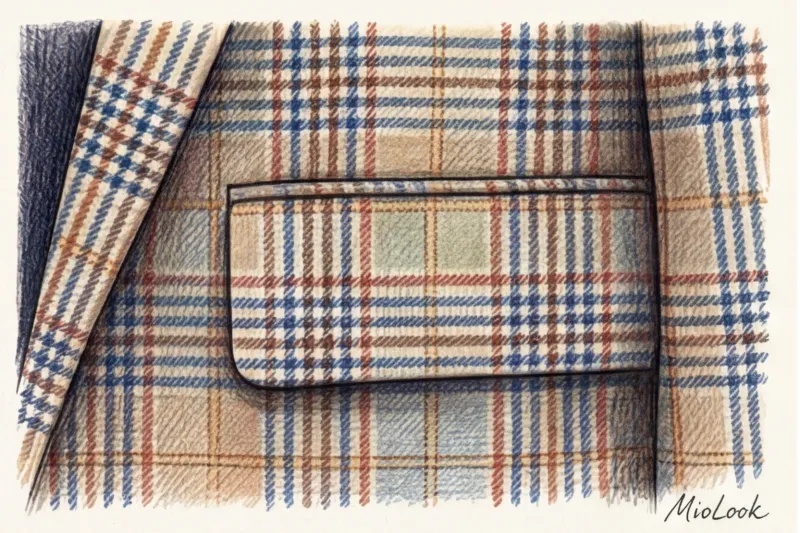
A different rule applies to floral and abstract prints. Make sure large elements of the design aren't upside down on different halves of the dress or, worse, that a large flower isn't positioned in awkward positions (for example, right down the center of the chest or on the seat seam of pants).
Your perfect look starts here
Join thousands of users who look flawless every day with MioLook. See how items fit together before you buy.
Get access — €0.99 onceTest #4: Fittings as the Main Cost Indicator
The hardware clearly reveals the true value of an item. Ninety percent of buyers only look at the outer button, but professional stylists also check the inside.
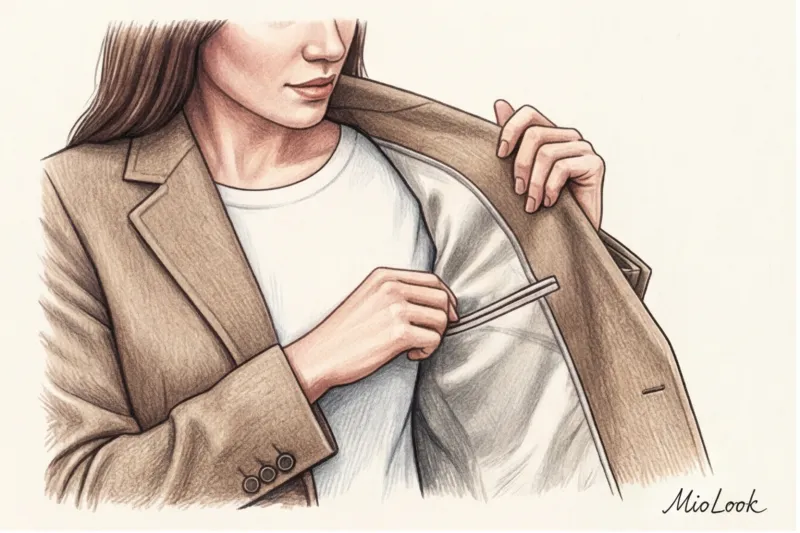
On high-quality outerwear (coats, trench coats, thick jackets) it is always sewn on the inside button — a small, flat button. It bears the entire load when the thread is pulled tight and protects the expensive underlying fabric from tearing. If there's no backup button, and the heavy button dangles on a "shank" of a couple of flimsy threads, the brand has skimped on your comfort.
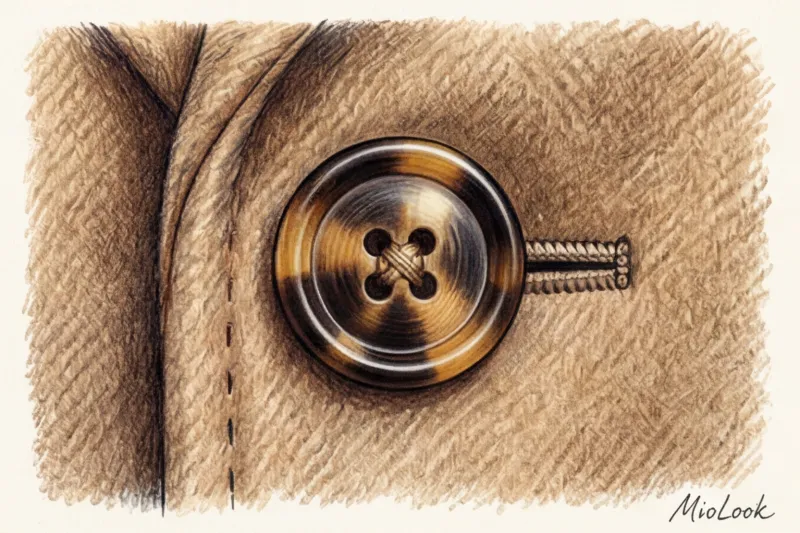
Pay attention to the buttonholes. The edges should be tightly and firmly overcast, without a single loose thread. In the premium segment, buttonholes are often overcast by hand or on specialized expensive machines, creating a beautiful raised ridge.
Regarding zippers, their movement must be absolutely smooth. If a metal zipper is sewn into a thin knit or viscose fabric and "waves" (faldits), the tension was improperly adjusted during sewing. This deformation cannot be corrected by steaming or dry cleaning. The garment will always bulge at the stomach or back.
Test #5: Hidden Clues: Examining the Lining and Backing
The inside is the soul of a thing. If a manufacturer has invested in what no one sees, then they've taken a responsible approach to the visible part as well.
The worst fashion crime I regularly encounter in the €150-€300 price range is a luxurious 100% wool jacket lined with 100% cheap, crisp polyester. Wool breathes, polyester does not. You'll sweat in such a jacket like you're in a plastic greenhouse, and the garment itself will quickly develop an unpleasant odor. Look for viscose, cupro (an ideal breathable material), or acetate in the lining.
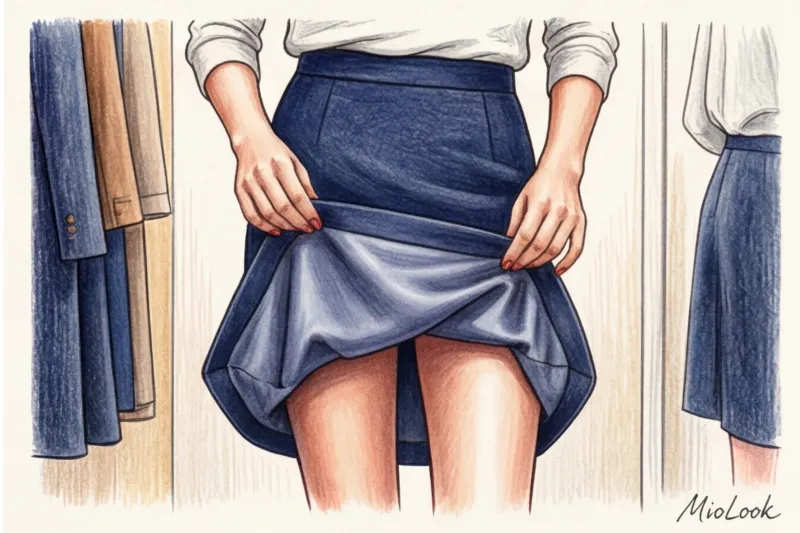
Also check seam allowances High-quality trousers, skirts, and jackets always have 1–1.5 cm of extra fabric. Why? So the garment can be adjusted at the tailor's if you gain a little weight or have an unusual waist-to-hip difference. Cheap brands cut the fabric right down to the root with an overlocker—this makes it impossible to adjust the garment.
If you see that the inside seams aren't simply finished with an overlocker, but are neatly bound with fabric (bias binding), this is a sure sign of expensive, luxury tailoring. For more information on how to visually evaluate textures, read our article about fabrics that look expensive.
Ready to get started?
Try the MioLook free plan—no commitments required. Digitize your wardrobe and start calculating your Cost Per Wear.
Get access — €0.99 onceTest #6. Ingredients on the Label: Debunking the Myth of 100% Natural Ingredients
It's time to debunk one of the biggest myths in the world of shopping. Many believe that the "100% natural" label is an absolute seal of quality. As a colorist and fabric researcher, I can assure you that this isn't always the case.
If you buy a basic office suit made of 100% wool without any blends, after two weeks of active wear, your knees will stretch out on your trousers and your elbows on your jacket. Wool is incredibly warm, but it doesn't hold its shape well when constantly stretched.
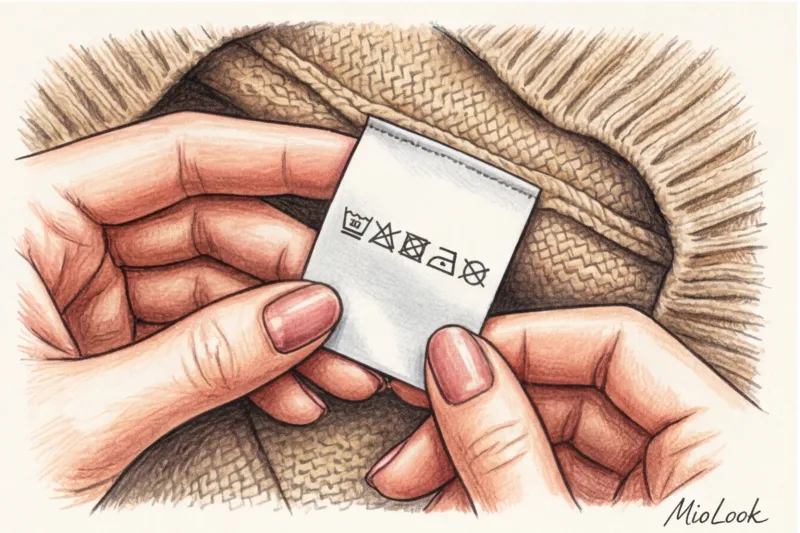
The golden ratio rule states that adding 2–5% elastane, spandex, or polyamide to a natural fabric only improves its durability. These threads act as an invisible scaffold, causing the fabric to return to its original state.
- Flax: 100% linen wrinkles mercilessly. But a blend of 70% linen and 30% viscose will flow more easily, wrinkle less, and hold its color better after washing.
- Cashmere: Pure Mongolian goat hair is incredibly soft but tends to pill quickly. Adding 5-10% silk makes the thread smoother and stronger, dramatically reducing pilling.
- Socks and thin knitwear: without 15-20% polyamide, the heels and elbows will wear out within a month.
Smart Shopper Checklist: 60 Seconds in the Fitting Room
So, you're in the fitting room. You have exactly one minute to make a decision. Use this algorithm:
- Compress (crumple): Crumple the edge of the fabric. Does it spring back or break?
- Enlighten (density): Hold it up to the light. Are there any bald spots in the weave?
- Pull (strength): Spread the side seam slightly. No threads should be visible.
- Compare (picture): Do the stripes/checks on the pockets and seams match?
- Turn inside out: Is the lining breathable? Is there any fabric slack in the seams?
- Pull (hardware): Check the presence of the button and the smoothness of the zipper.
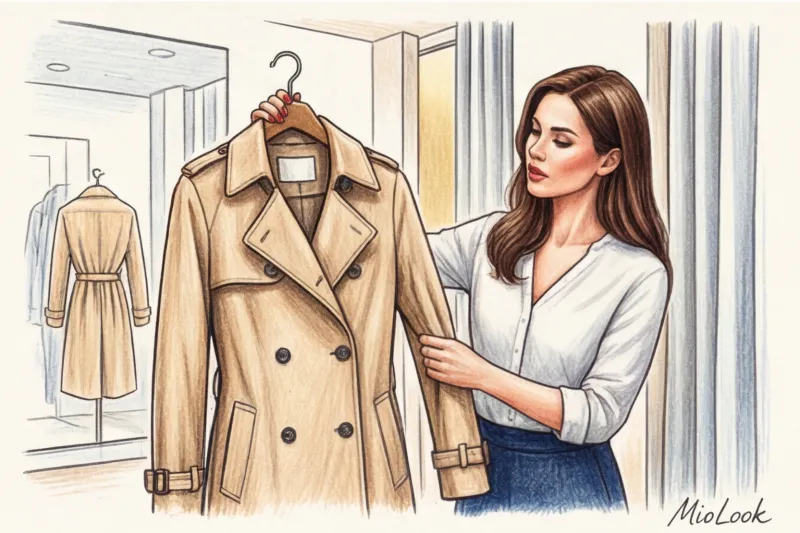
Every item that passes this filter becomes not just a purchase, but an investment. In my app MioLook At , where we conduct wardrobe analysis with our clients, the statistics are relentless: items with the "correct" backing and high-quality seams last 4-5 times longer and have a minimal Cost Per Wear (Cost Per Wear).
Next time you're in a store, don't look at the price tag first. Touch it, pull it, turn it inside out. Let the fabric tell you its worth.