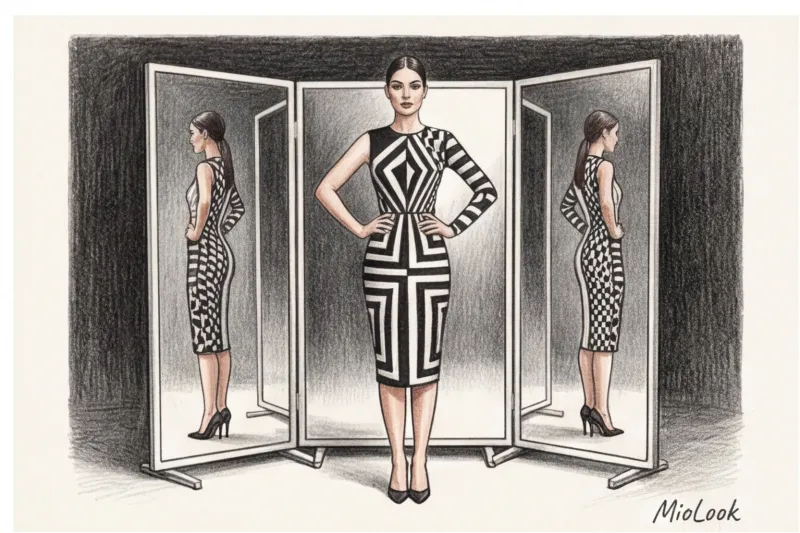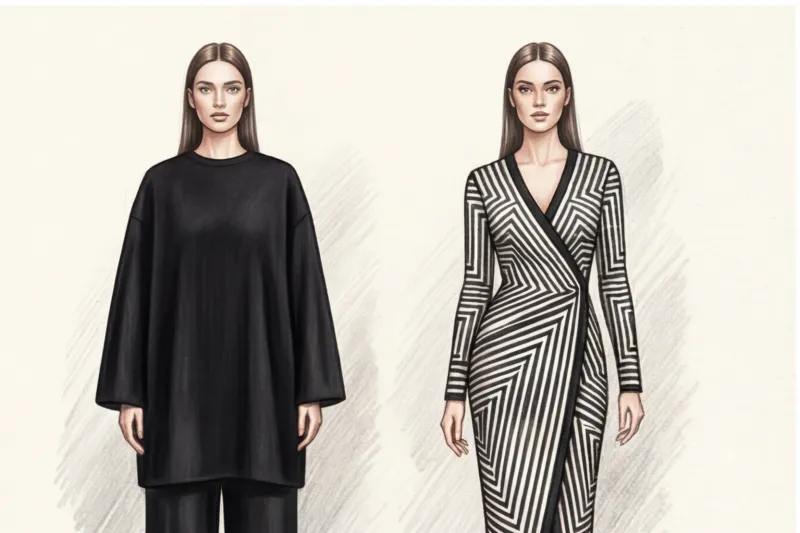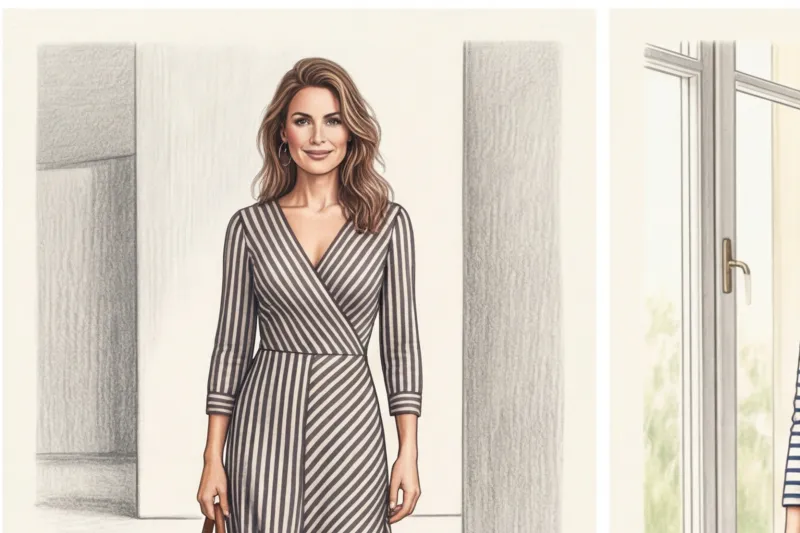
In my practice, nine out of ten clients categorically declare at the first meeting: "Anyway, not a Breton top—horizontal stripes make you look fat!" One of them, a top manager from Berlin, avoided any prints for ten years, hiding behind what she thought was a safe, black monochrome. But when I put the perfect COS top with its dense Breton stripes on her in the fitting room, she couldn't believe the mirror—her shoulders looked slimmer and her posture more composed.
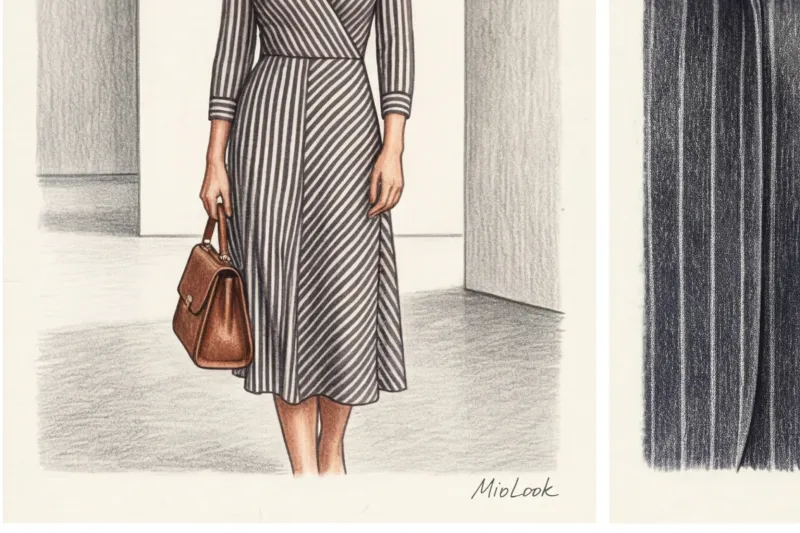
Let's be honest: most of the advice from the glossy magazines of the 2000s is hopelessly outdated. Prints aren't just decoration; they're a powerful optical mesh that physically alters the perception of body proportions. We discussed the fundamental laws of silhouette geometry in more detail in our a complete guide to visual body shaping Today, we'll explore a specific tool. I'll show you prints that are slimming and explain how scale, contrast, and—critically—the quality of seam alignment in European mass-market clothing can determine whether you'll look great or visually add a few pounds.
The Top Slimming Prints: How Clothing Controls the Eyes
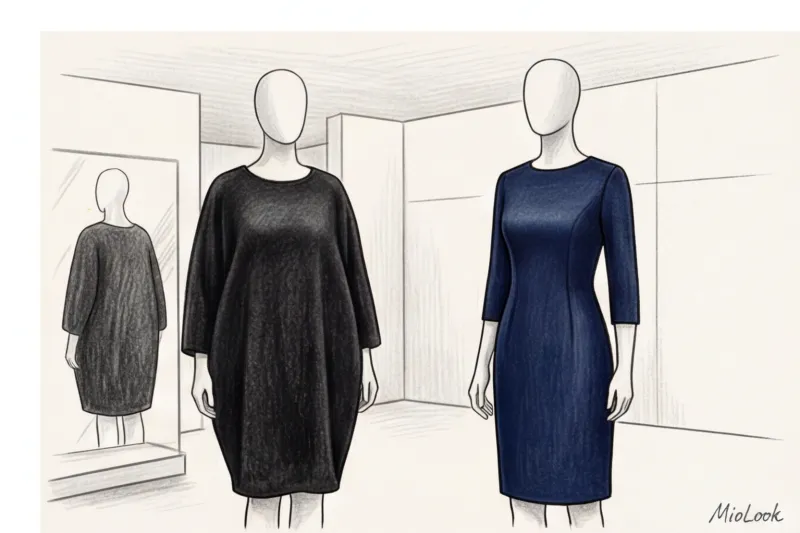
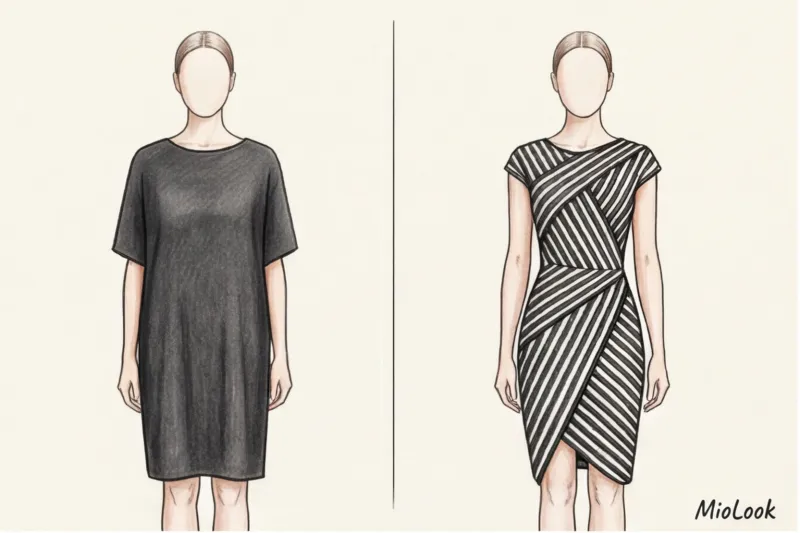
Forget the rule that "black is slimming, prints are fattening." Have you ever noticed how a sleek black dress made of thin viscose treacherously highlights the contours of an unfortunate mound on your stomach or hips? Black defines the silhouette, creating a sharp line. The right print, however, works like camouflage—it distracts the eye and hides unevenness.
Any fabric pattern is governed by three principles of optics: scale (proportion to your facial features and figure), rhythm (the distance between elements), and contrast. Contrast is often a stumbling block.
"Prints with a tonal difference of less than 30% (for example, beige stripes on white or graphite polka dots on black) create a subtle blurring effect. They conceal volumes much better than harsh black-and-white contrast, which fragments the figure."
The human eye always gravitates toward the most contrasting area and follows the leading lines. Our task is to arrange these lines so that they elongate the silhouette rather than widen it.
Your perfect look starts here
Join thousands of users who look flawless every day. Upload your items to your smart wardrobe.
Get access — €0.99 onceStripes: Debunking the myths and finding prints that make you look slimmer
If you still believe that vertical is always good and horizontal is always bad, you're depriving your wardrobe of its most stylish essentials. Wide vertical stripes (wider than 4-5 cm) don't make you look slimmer. They turn you into a "fence." The human eye is lazy: it doesn't skim a long vertical line from top to bottom; it starts measuring distance. between horizontal stripes. As a result, the silhouette widens.
The Helmholtz Illusion: When the Horizontal Works for You
Back in 1867, the German physicist Hermann von Helmholtz demonstrated a paradoxical optical effect: a square filled with dense horizontal stripes appears taller and narrower than the same square with vertical lines. This law of physics also applies to fashion.
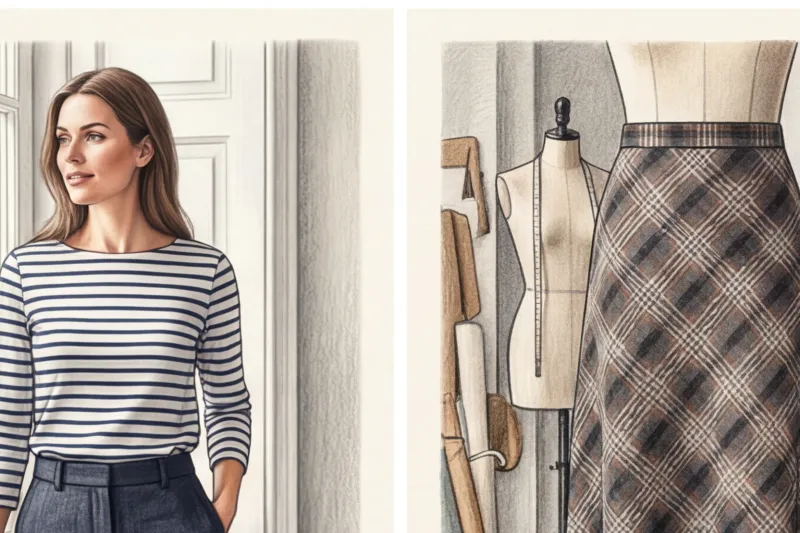
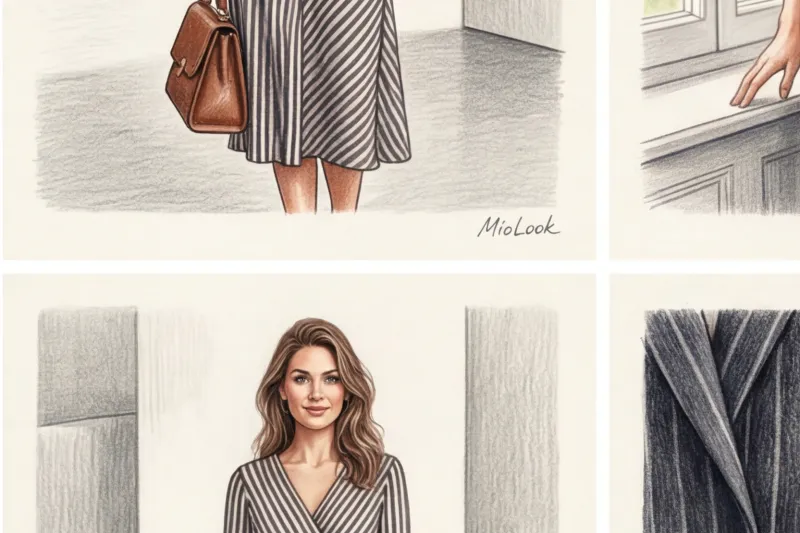
A dense horizontal stripe (like on a classic French sailor shirt) forces the eye to quickly scan numerous small elements, merging them into a single, elongated column. But if you're looking for a vertical look, choose a thin pinstripe on a suit. This pattern, borrowed from the menswear of Wall Street bankers, is the absolute epitome of elongated silhouettes.
Choosing the perfect striped shirt in the mass market
Why does one striped T-shirt make you look like a Parisian, while another makes you look like a tired housewife? It's all about the fabric. Thin, flimsy viscose from H&M's basics clings to your body, causing straight horizontal lines to become distorted at the chest and waist. As soon as a straight line becomes curved, your brain interprets it as excess bulk.
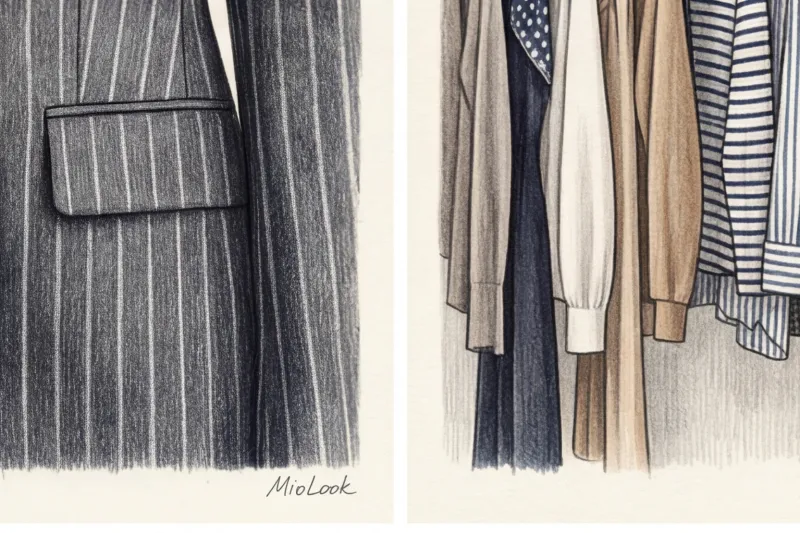
- Density: The ideal sailor shirt is made of heavy cotton (180-200 g/m²). Try COS or Arket—their basic long sleeves for €45-€55 hold their shape well and create a rigid frame that makes the body feel more fragile.
- Neck clearance: The most flattering prints for a slimming neckline have a solid, light-colored space (3-5 cm) at the collar. This visually lengthens the neck and brightens the face.
Cage: silhouette architecture without excess volume
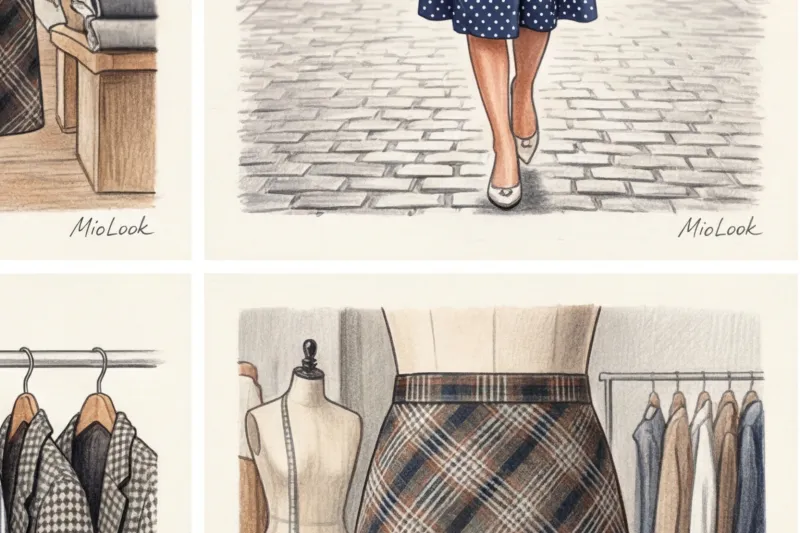
Plaid is the most difficult and tricky print for figure contouring. By nature, it's square, and a square is a static, grounding, and expanding figure. Wearing a straight skirt with a chunky plaid pattern is guaranteed to widen your hips.
The Magic of the Diagonal: Bias Cut
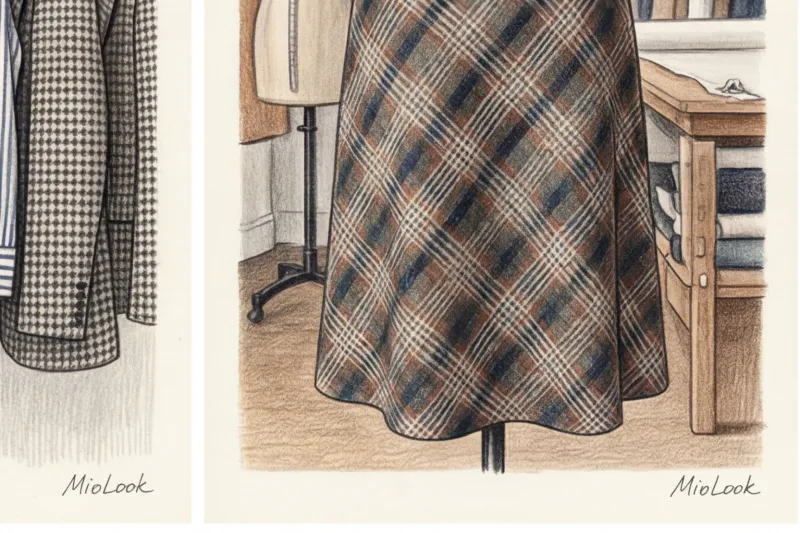
A tailoring secret popularized by the brilliant Madeleine Vionnet in the 1920s is the bias cut. If you take a checked fabric and cut it at a 45-degree angle, the squares become elongated diamonds.
A bias-cut midi skirt or slip dress in plaid is a phenomenal piece. The diamond pattern creates powerful diagonals that converge toward the center, visually narrowing the waist and hips, creating an hourglass silhouette without the need for a constricting corset.
The Goosefoot and the Prince of Wales (Glencheck)
What to do with classic jackets? Opt for micro-scale. A fine Prince of Wales print or micro houndstooth blends into a sophisticated gray or beige monochrome from a distance. But up close, this optical ripple conceals the slightest imperfections in the fit.
But the large contrasting buffalo check is your tool for spotting additions Volume. If you have narrow shoulders and wide hips (a pear shape), wear a thick, large-checkered shirt over a basic top—this will balance out your proportions.
Access to MioLook for €0.99 — one-time payment
A smart AI stylist will analyze your figure and select the perfect print combinations from your closet.
Get started with your wardrobePolka Dot: How the Scale of a Design Changes Proportions
Polka dots are circles. And circles always add softness, femininity, and... volume. How to wear this print without looking like a "teapot"?
The key here is proportionality. Polka dots larger than 3-4 cm in diameter act as a magnifying glass. According to visual perception research (WGSN, 2023), large circular patterns visually expand the area they occupy by 15-20%. If you wear a blouse with huge polka dots (the size of an apple), your chest and shoulders will appear larger.
Small polka dots (up to 1 cm), on the other hand, work as a background. But density is key here. Sparse polka dots on a large, empty background force the eye to jump from dot to dot, assessing the width of your body. Dense, dense polka dots create a rippled effect and create a compact line.
A stylist's inversion lifehack
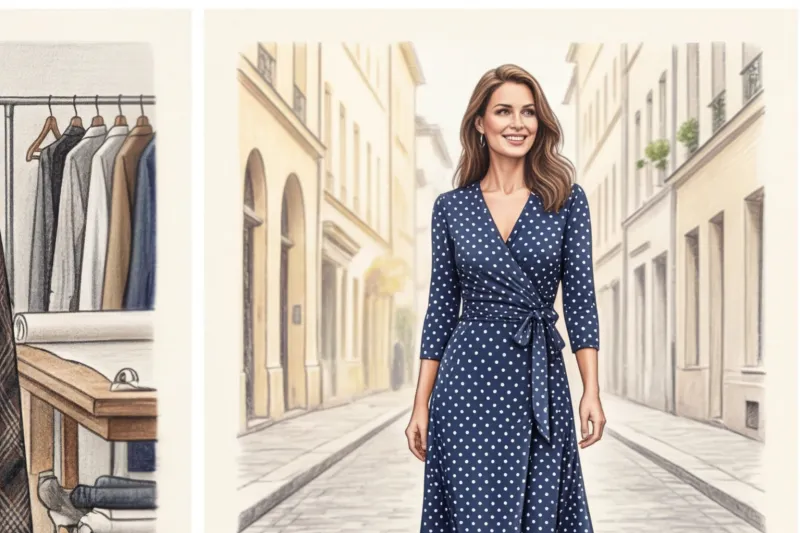
The classic black polka dots on a white background look fresh, but white always makes you look a bit fatter. Opt for an inverted look. Light polka dots on a dark blue, emerald, or burgundy background are impeccably slimming. Check out the summer collections from &Other Stories: year after year, they release wrap dresses with dark polka dots. The dark background minimizes bulk, while the small light dots create movement. Paired with a diagonal wrap, this is one of the best solutions for shaping your figure.
The Hidden Threat: How Cheap Tailoring Ruins the Slimming Effect of Prints
Even if you've mastered all the rules of optics and chosen the perfect slimming prints, there's one detail that can ruin everything: the quality of the garment's assembly at the factory.
I categorically forbid my clients from buying printed items in the budget segment (€30–€60) unless they pass the "seam test." Fast fashion brands skimp on fabric. To cut the cuts cheaper, they don't pay attention to how the pattern will line up at the seams.
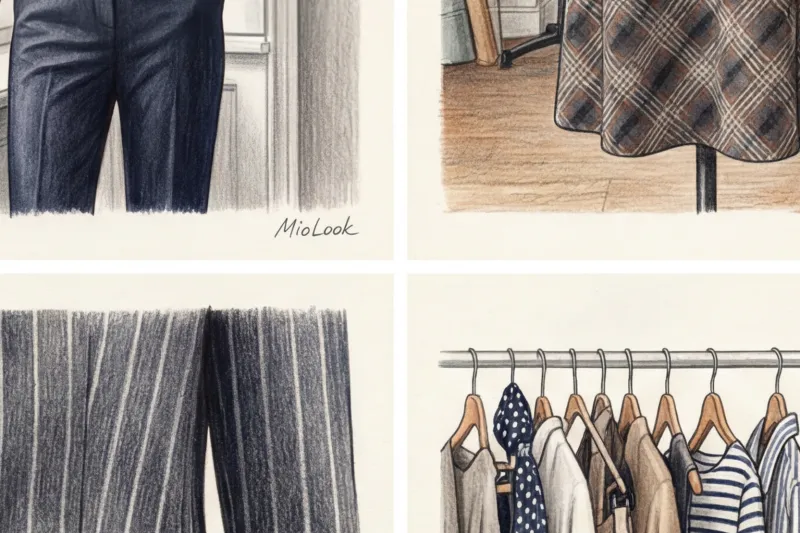
Imagine a €50 striped jacket from Zara. The lines are straight on the front, but at the side seam or bust dart, the stripes break at an angle and don't line up with the back. What's going on? This broken line immediately draws the eye. If the misalignment is at the waist, it will visually create a fold there that you don't have. The warped geometry of the fabric distorts your body.
Compare this to a €150 Massimo Dutti jacket. Yes, it's more expensive, but the tailors there use more fabric to perfectly match the checkered pattern on the pockets, lapels, and center back seam. The garment looks cohesive, expensive, and frames the figure neatly.
A Stylist's Checklist: How to Wear Slimming Prints Every Day
Let's move from theory to practice. If you're standing in front of the mirror and unsure whether something works for you, check this checklist:
- Manage your attention. Use the print only where you want to draw the eye. Wide hips? Wear sleek dark trousers and a top with a tight Breton stripe. The attention will be drawn upward.
- Reduce contrast. For delicate correction, choose low-contrast combinations: dark blue with light blue, caramel with white, graphite with black.
- Diagonal is your everything. If you're unsure what to choose, try a bias-cut dress (diamond check) or a wrap dress. The diagonal cut never fails.
- Watch the tension. This rule does not work if the fabric is too small for you. If the perfect little polka dots on the chest stretch and turn into ovals, the garment is too small. The print will always reveal the fabric's tightness, highlighting excess volume. Choose your actual size or a semi-fitted silhouette.
Ready to redesign your style?
Try the MioLook plan for free—no commitments required. Digitize your wardrobe and discover which prints flatter your figure.
Get access — €0.99 oncePrints aren't scary. They're math and physics translated into fabric. Once you learn to use geometric lines and optical illusions, you'll never again hide in black robes. Your style will become more complex, more interesting, and your silhouette will be exactly how you want it to be.