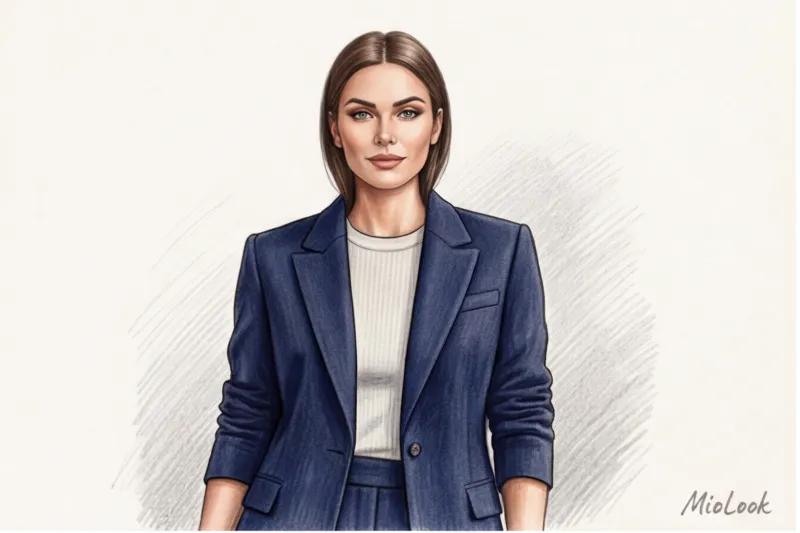
Every other client of mine, a size D or above, comes to me with the same request: "Camilla, help me hide it." For decades, glossy magazines have been urging curvy women to wrap themselves in dark colors and wear shapeless clothes. Let's be honest: this is the worst advice you could ever receive. In 12 years of working as a stylist at fashion weeks from Paris to New York, I've learned one rule: to understand How to visually reduce breast size with clothing , we need to stop hiding it and start working with it as an architectural object.
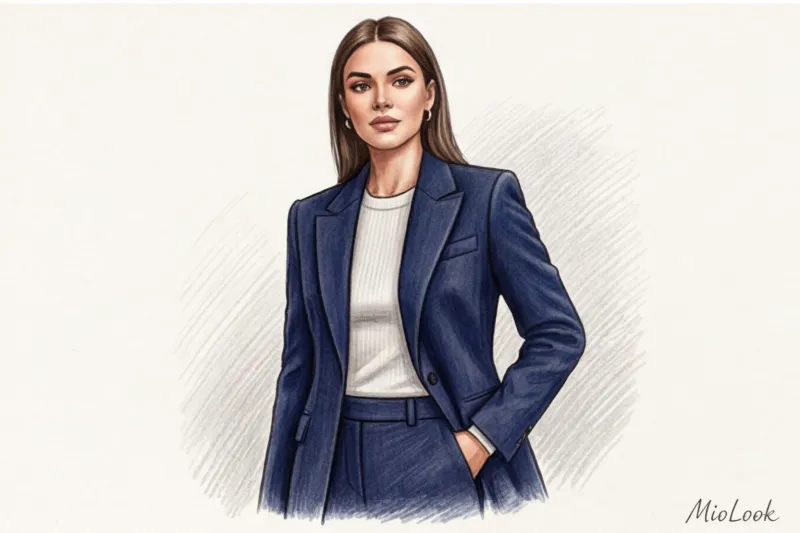
We have already discussed the basic laws of proportions in more detail in our a complete guide to visual body shaping , but today I want to talk about a specific area. We'll abandon outdated stereotypes and apply an architectural approach: directing attention through vertical fragmentation, fabric density, and proper fit.
Silhouette architecture: how to visually reduce your bust with clothing
The first thing we need to do is change the paradigm itself. Large breasts aren't a flaw. They're volume that requires careful balance. Your body is a landscape on which we build the correct geometry, not try to level mountains to the ground.
Think back to 1947 and Christian Dior's legendary New Look collection. Dior didn't remove volume from women; he created a rigid framework with darts and structured shoulders, forcing the fabric to work with the figure rather than sag. This principle remains relevant today.
This is where the Müller-Lyer law of optical illusion, or the "vertical fragmentation" rule, comes into play. Our goal is to break up a solid patch of color or fabric in the chest area into pieces. A solid monolith always appears larger than the same volume divided into two or three vertical sections.
Access to MioLook for €0.99 — one-time payment
A smart AI stylist will select the perfect look based on your proportions and suggest the right silhouettes.
Get access — €0.99 onceThe Biggest Mistake: Why Oversized Clothes and Loose-Looking Pants Make You Look Bigger
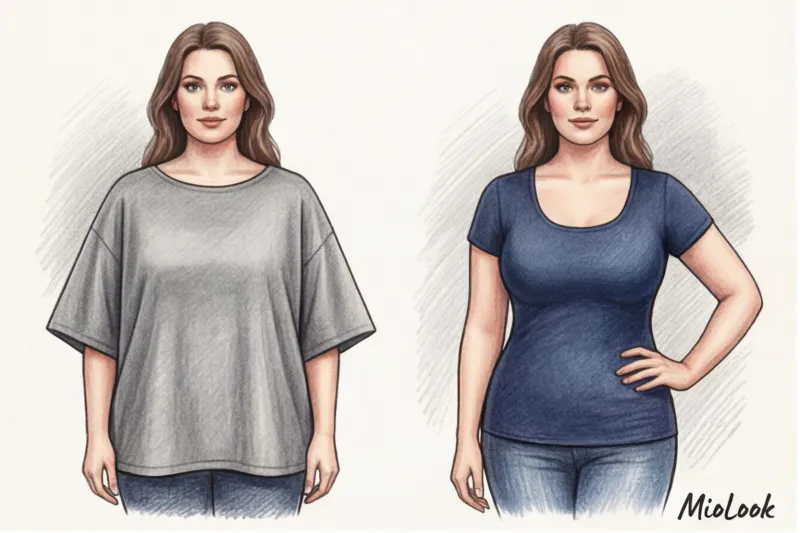
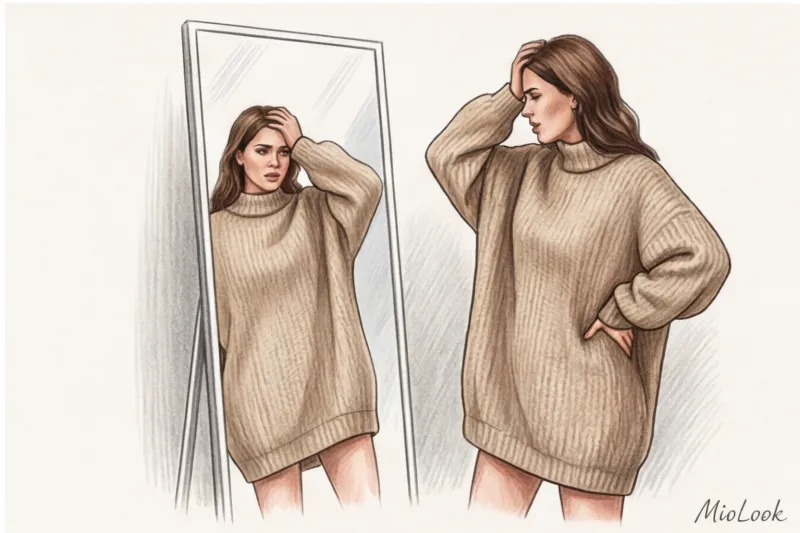
The most paradoxical and counterintuitive insight that shocks my clients is that oversized clothes make you look fat. The desire to hide under an oversized hoodie from Zara or H&M has the exact opposite effect.
How does this work from a physics perspective? When you wear a loose garment, the fabric falls vertically from the most prominent point of your chest. I call this the "tent effect." At this point, your silhouette visually expands, and the brains of others perceive that your entire torso is equal in circumference to your bust. Your waist disappears, and a massive "monoblock" appears.
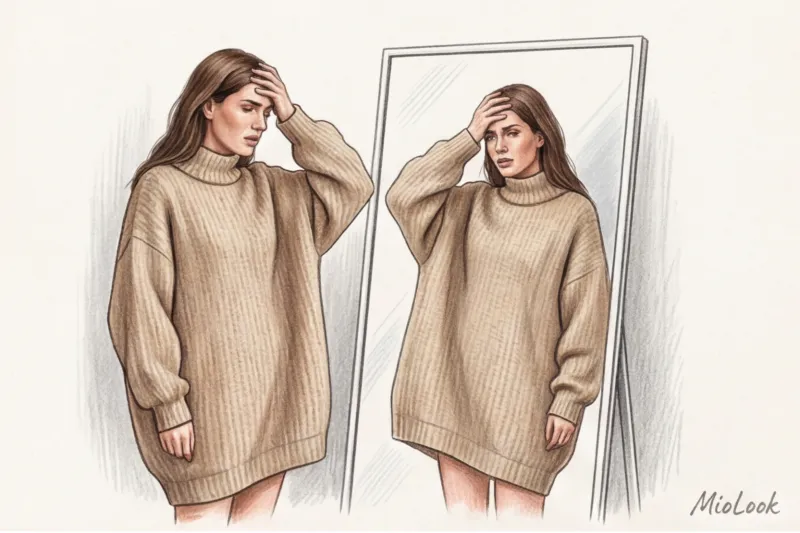
According to the application statistics MioLook 68% of women with a D+ bust size intuitively, but mistakenly, choose clothes with dropped shoulder seams. They think this creates a relaxed look, but in reality, the seam sits directly above the bust, creating a horizontal line that visually adds up to 10 cm to the chest width.
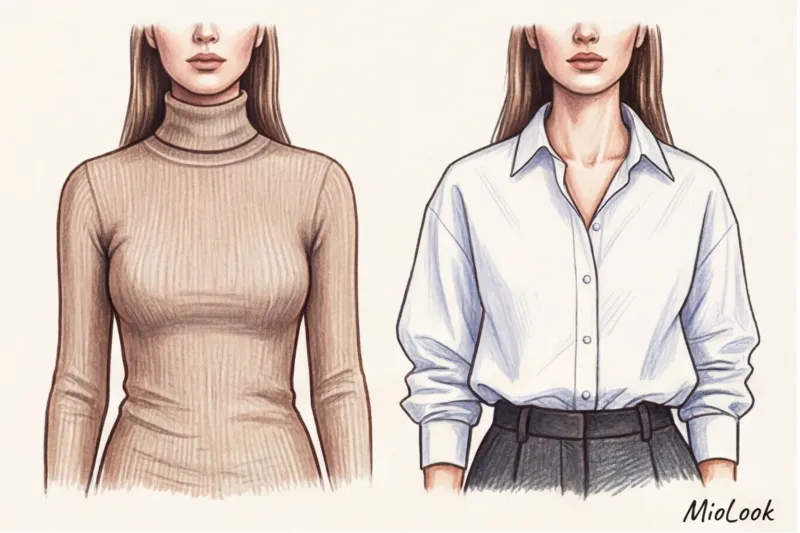
The same goes for turtlenecks. They create the effect of an endless "mono-bust," starting from the chin and completely engulfing the neck. Want to look slimmer? You need structure, not a tank top.
Lingerie Essentials: The Bitter Truth About Minimizer Bras
It's time to reveal some insider information from lingerie stylists. If you're wearing compression minimizers to make yourself look smaller, throw them away immediately. I absolutely forbid them for my clients.
Why? A minimizer severely flattens the breasts from the front. But the volume doesn't magically disappear—the breast tissue is simply pushed into the armpits. Yes, in profile you appear slightly flatter, but from the front, your figure becomes wider and squarer. You literally add dimension to your shoulders.
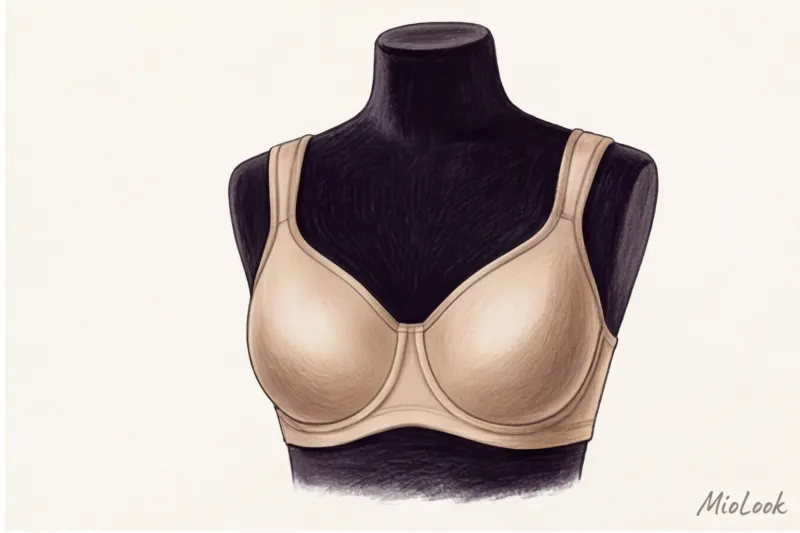
The secret lies in the rule "air above the waist" A properly fitted structured bra (high-quality models with a wide band typically range from €70 to €150) should lift the bust 3-5 cm higher than it naturally is. When there's a gap between the bustline and the waist, your torso appears longer and your waist appears a full size smaller. Changing your bra alone can solve 50% of blouse fit issues.
Your perfect look starts here
Join thousands of users who look flawless every day with MioLook. Upload your wardrobe to the app and get ready-made combinations.
Get access — €0.99 onceNeckline Geometry: What Works Better Than the Classic V-Neck?
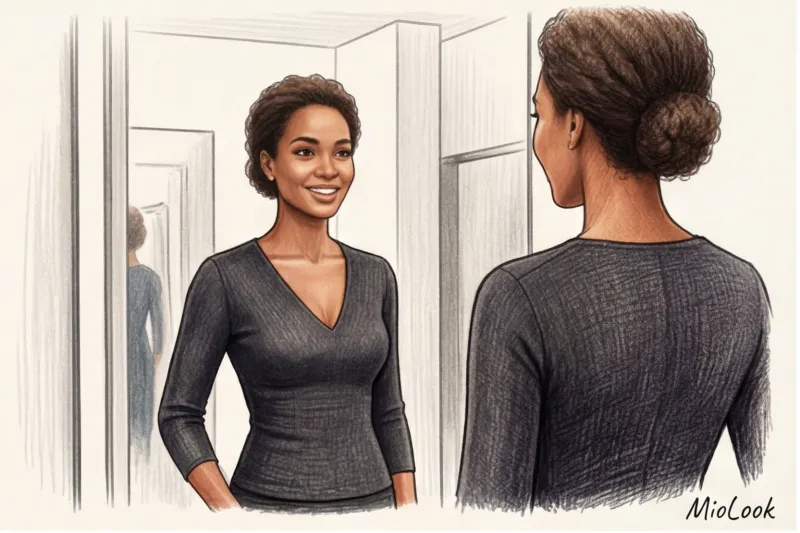
Every article online says, "Wear a V-neck." But the devil is in the details. A wide V-neck will stretch your shoulders. You need narrow and deep neckline. It creates a perfect vertical line that draws the eye downwards, breaking up the width of the chest.
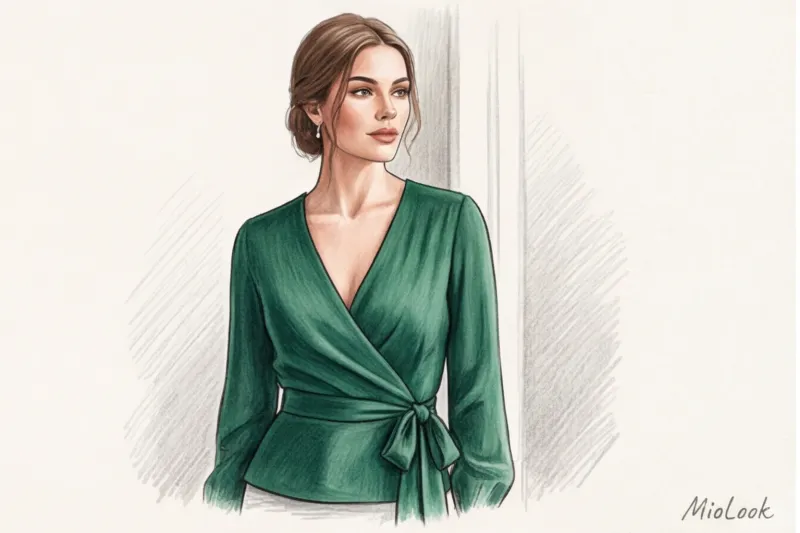
An even more powerful tool is the wrap effect. Remember the famous wrap dress invented by Diane von Furstenberg in 1974? It's a brilliant mathematical trick: diagonal lines cut the bust in half and create artificial emphasis on the waist, creating an hourglass silhouette.
Asymmetrical necklines (such as one-shoulder) also work well for evening wear. They break the symmetry, throwing off the viewer's eye: the viewer simply can't accurately assess the true volume.
Cutting details to avoid
Even the right neckline won't save you if you've got the details wrong. I recommend permanently eliminating the following from your wardrobe:
- Patch pockets on the chest (especially on safari style shirts) - they create a 3D effect where you don't want it.
- Ruffles, frills and bows at the neck - this is the focal point that will draw all eyes to the décolleté area.
- Boat neckline (bateau) - it draws a rigid horizontal line from shoulder to shoulder, visually stretching the chest in width.
Fabrics and textures: how material density controls volume
Have you ever wondered why you look pulled together in one shirt, but slouched in another of the same style? The answer lies in the physics of materials.
Thin knits and shiny fabrics (satin, cheap silk, lurex) are your worst enemies. A glossy surface reflects light so that every bulge and crease in your underwear is illuminated like a spotlight. Thin viscose knits hug the contours of your underwear, highlighting that "monoblock" shape.
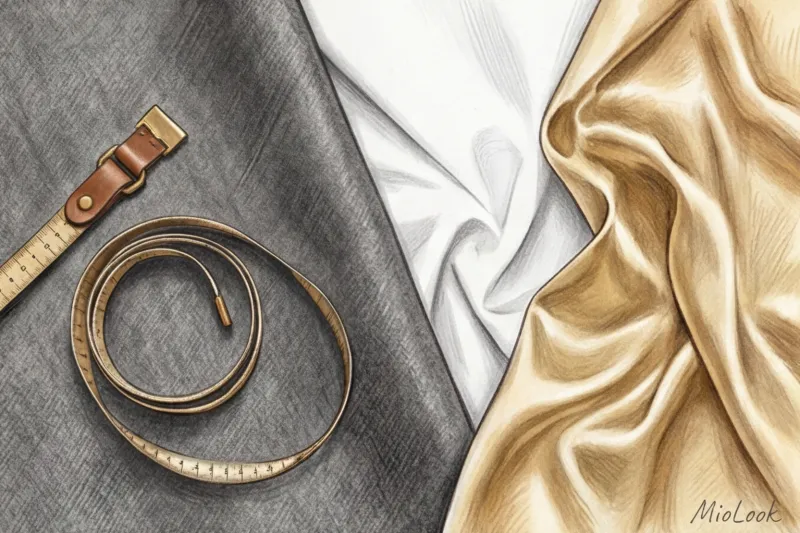
Choose matte, dense, structured fabrics. Excellent choices include heavyweight cotton (from 180 g/m²), suiting wool, tweed, or denim. These fabrics don't conform to your body's curves, but rather create their own rigid frame. The garment should retain its shape even when hung on a hanger.
Layering Strategy: Breaking Up the Monolithic Volume
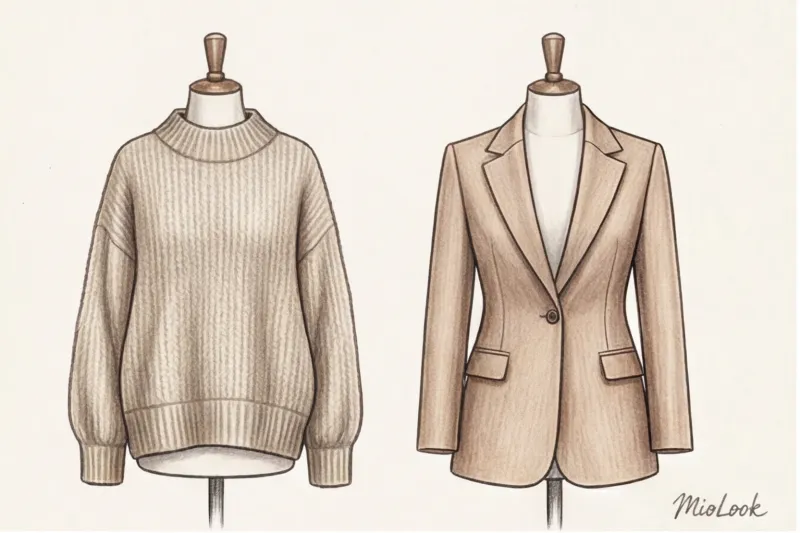
I had a revealing case in my practice. I was preparing a client, a top manager at a large IT company, for an important presentation. She arrived wearing a soft, cozy cardigan, which made her figure (a full size E) look bulky. We replaced the cardigan with a crisp, single-breasted, straight-cut jacket from Massimo Dutti, leaving it unbuttoned over a basic top.
The result was stunning: the unbuttoned jacket flaps created two powerful parallel vertical lines. They literally "cut off" the volume at the sides, leaving only a narrow, light strip of top down the center visible. The viewer's brain calculated the width of the torso precisely by this narrow strip. It's a perfect optical illusion of slimness.
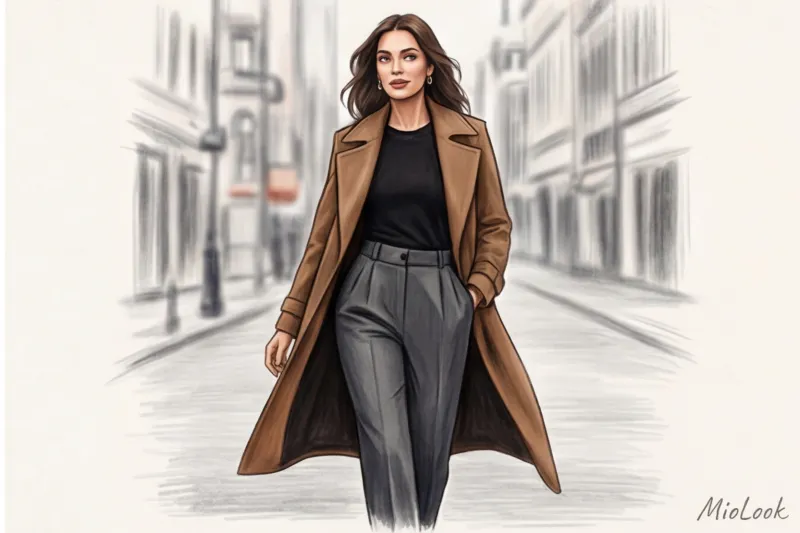
But there is an important limitation here: This technique does NOT work if the top layer is made of thin, loose material. A jacket, long vest, or trench coat should have a defined shoulder line.
Stylist checklist: creating a harmonious look
So, let's put all this knowledge together into a single system. Next time you're standing in front of your open closet, check your look using these four steps:
- Volume fixation: Are you wearing a sleek bra that lifts your breasts and creates "air" above your waist?
- Structure: Does the fabric hold its shape? Avoid fine knits in favor of heavy cotton or suiting wool. Set-in sleeves are always better than dropped shoulders.
- Verticalization: Is your bust too full? Try an unbuttoned jacket, a long necklace (without a pendant that falls into your cleavage), or a wrap blouse.
- Shift of emphasis: If the top is basic and calm, add some movement underneath by wearing striking shoes in a bright color, an interestingly cut skirt, or palazzo pants.
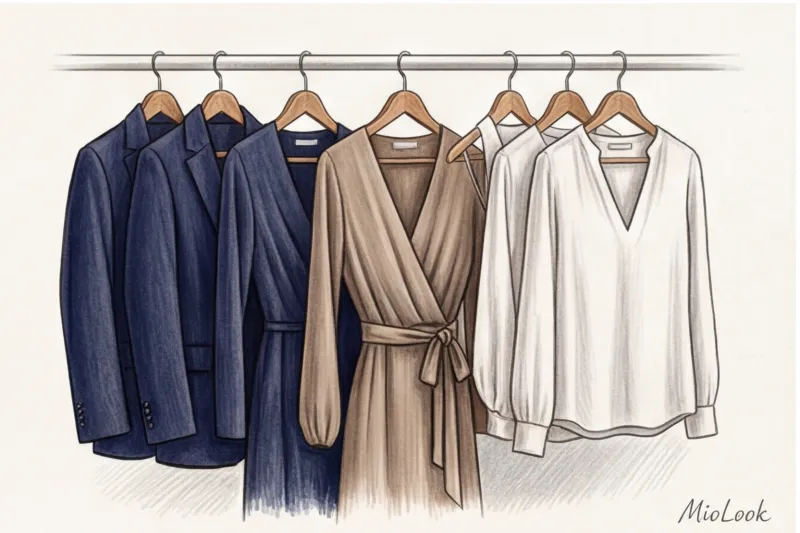
The main takeaway for you today: to look stylish and elegant with a full bust, you need to stop wrapping yourself in shapeless cocoons. The key to success is clean lines, crisp textures, and architectural cuts. Manage your attention, and your clothes will work for you, not against you.