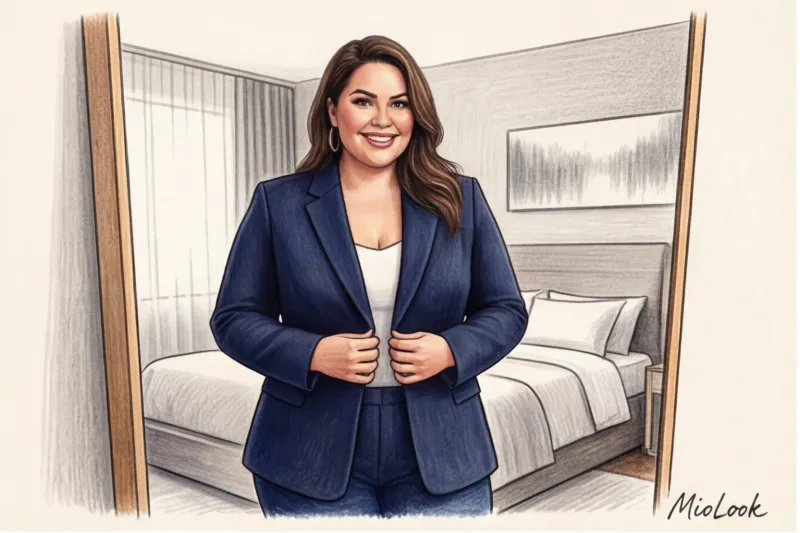
How many times have you turned down a stunning summer dress simply because it was sleeveless? In my 14 years as a personal stylist, I've seen hundreds of women stubbornly bundle up in thick cardigans in 30°C weather, trying to hide their arms. And you know what's most annoying? These cardigans made them look bigger.
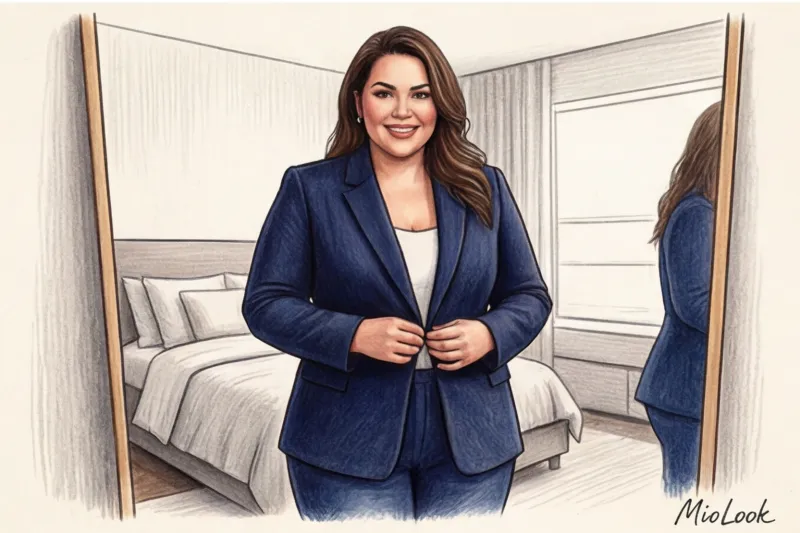
When we think about how to hide full arms with clothing, our instinct is to throw on something voluminous and shapeless. We think that if we wrap the problem area in a meter of fabric, it will magically disappear. Spoiler: it won't. We discussed the silhouette architecture in more detail in our a complete guide to visually correcting your figure with clothing Today, we'll focus exclusively on the arms and shoulder girdle. No hoodies—just pure geometry that works.
Geometry instead of robes: how visual arm correction works
Let's agree right away: we're not hiding the body, we're creating the right lines. There's a golden rule of architectural design in styling. The human eye doesn't perceive actual body measurements in centimeters, but the geometry of the outer contours created by the garment.
A 2022 study by the London College of Fashion confirmed what fashion designers have known for decades. Scientists have proven that the perception of proportions is governed by the classic Müller-Lyer illusion. If you put on a shapeless cover, the observer's brain automatically constructs a massive body beneath the fabric. Fabric should structure the silhouette, not simply hang loosely.
Have you ever noticed how perfectly men's jackets fit larger men? The secret lies in a strong shoulder girdle. The same principle applies to women's wardrobes. We need a framework.
Access to MioLook for €0.99 — one-time payment
A smart AI stylist will select the perfect look based on your proportions.
Get access — €0.99 onceThe Biggest Mistake: Why Batwing Sleeves Make You Look Bigger
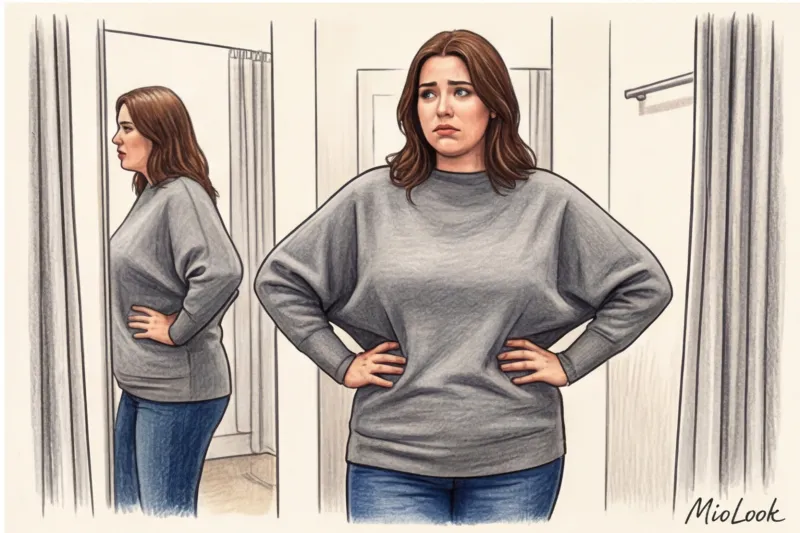
Perhaps the most widespread and most damaging myth in the world of plus-size fashion is the belief in the dolman sleeve as a lifesaver. Sales associates love to suggest it, claiming, "You'll be very comfortable, with no tightness."
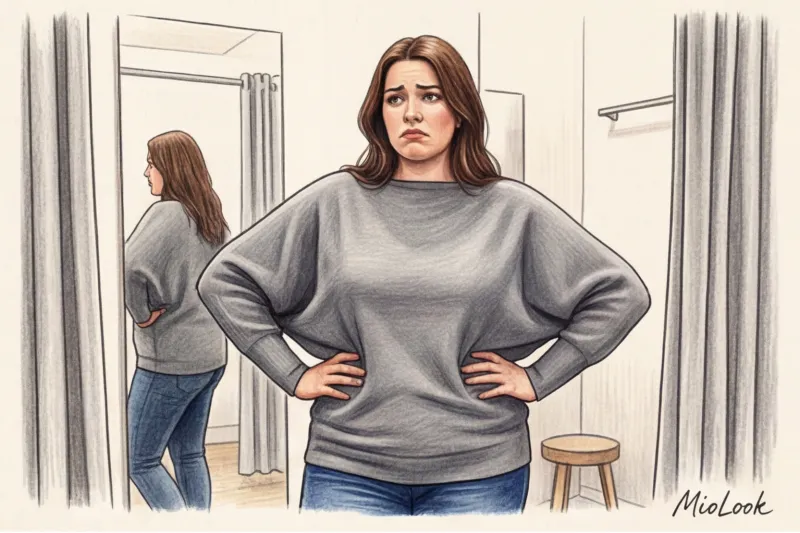
One of my clients, a top manager at an IT company, had been buying these sweaters for years. She thought the abundance of flowing fabric effectively camouflaged the bulk of her forearms. When we first took a full-length "before" photo, she gasped. What had happened? The solid fabric between her arm and waist had erased her natural curves. It had visually expanded her chest to the dimensions of a heavyweight wrestler. You lose your waist, you lose your bust, and you become a monolithic square.
The second fatal mistake is the dropped shoulder seam on basic oversized t-shirts. Where does this seam end? That's right, right at the widest part of your biceps. It creates a hard horizontal line there, acting like a neon sign: "Look, this is the widest part!" Never buy t-shirts with dropped shoulders if your goal is to reduce the size of your arms.
And finally, there's the "caterpillar effect." This occurs when you wear thin, tight-fitting knitwear. The fabric clings to your body, highlighting even the slightest contours. Clothing should be snug, but not tight. There should always be about 1-2 centimeters of air between the fabric and your skin.
How to hide full arms with clothing: the life-saving set-in sleeve
So what should I wear? Write down two key words: set-in sleeve And definitely with a high armhole.
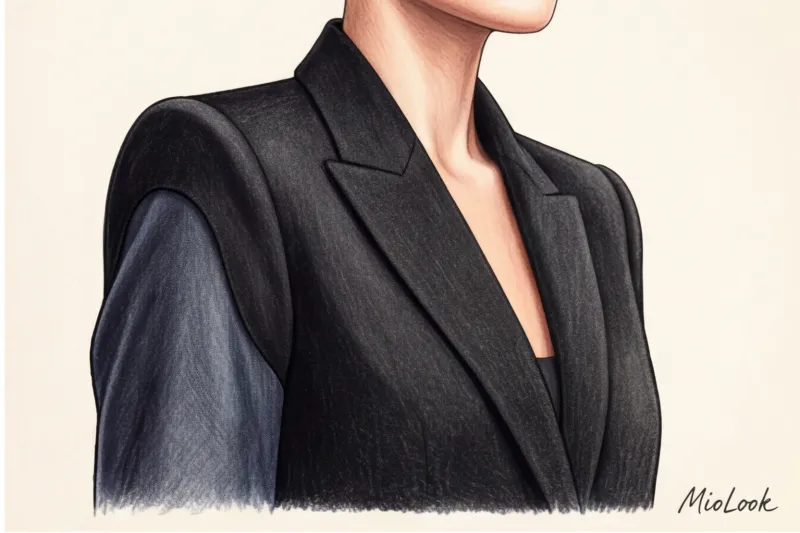
A high armhole means the underarm seam sits high, close to the body. This allows for freedom of movement (the sleeve doesn't pull the entire bodice when you raise your arm) and visually separates the arm from the torso. The shoulder seam should sit directly on the bodice—where the shoulder ends and the arm begins.
A great life hack is using shoulder pads. Modern jackets with small, neat shoulder pads create a crisp, right-angled silhouette. This instantly balances the volume of the forearms. In the mid-price range (around €100–€180), brands like COS or Massimo Dutti always have stunning architectural blazers with the right fit.
Your perfect look starts here
Join thousands of users who look flawless every day with MioLook.
Get access — €0.99 onceThe perfect length: from summer dresses to formal jackets
The mathematics of style is ruthless but fair: length is everything. The most flattering sleeve length for any body type is 3/4 or 7/8. Why does this work so well?
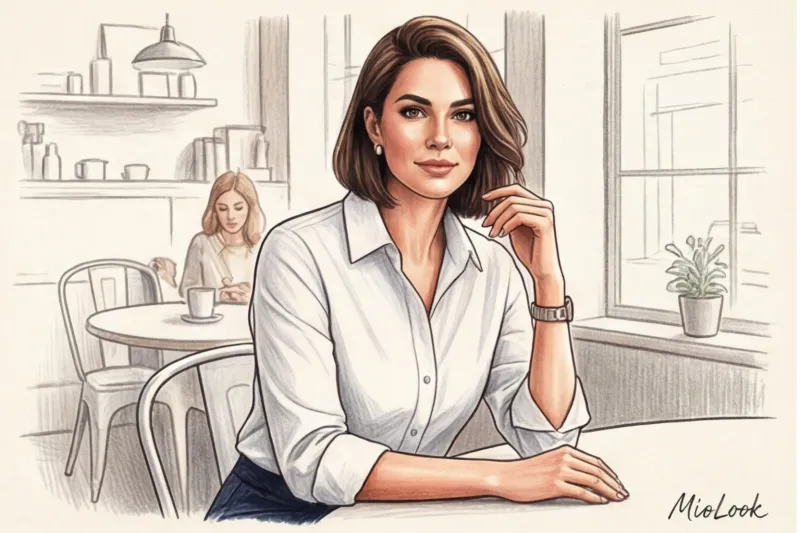
The wrist and ankle are the most delicate parts of a woman's body. When you cover the bulky part of the hand but leave the slender wrist exposed, the viewer's brain automatically transfers this fragility to the entire silhouette. The app's internal analytics MioLook shows astonishing figures: users who choose clothes with 3/4 sleeves are 40% more likely to say that they are satisfied with their photos, compared to those who wear full long sleeves.
How do you calculate the ideal short sleeve length? Take a measuring tape and find the widest part of your forearm. Your ideal short sleeve should end 3-5 centimeters (1.2-2 inches) wider. below this line. If the sleeve cuts the widest part in half, the arm will appear twice as big.
In terms of shape, a flutter sleeve always beats a tight puff sleeve. A flutter sleeve falls freely, creating diagonal lines that create a slimming effect. A puff sleeve with elastic clings to the arm, gathering the fabric into a bubble.
"Important: This tip does NOT work for women with an inverted triangle body shape (broad shoulders, narrow hips). Wearing a cap sleeve will make your shoulders appear even broader. In this case, a classic straight set-in sleeve without flare is your best choice."
Summer Wardrobe: How to Avoid Dying from the Heat While Trying to Hide Your Arms
A heat wave of +35°C isn't a reason to hide in synthetic hoodies. Your solution is to choose the right breathable fabrics that hold their shape: heavy linen and viscose. Avoid thin cotton, which wrinkles and sags easily.
If you want to wear revealing tank tops and sundresses, pay attention to the width of the straps. Forget thin spaghetti straps. A thin strap will make a voluminous arm appear even larger due to the contrast. Choose wide straps (4 to 7 cm) with a square or V-neckline.
Another luxurious summer trick is layering without insulation. Wear a top with wide straps and layer an unbuttoned shirt made of translucent organza or the finest matte chiffon over it. You get the illusion of lightness, with your arms covered, but you're completely cool.
Texture and color: fabrics that make you look slimmer
Even a perfect cut can be ruined by the wrong fabric. According to the WGSN report on garment design (2023), the texture of a material influences the perception of volume as much as color.
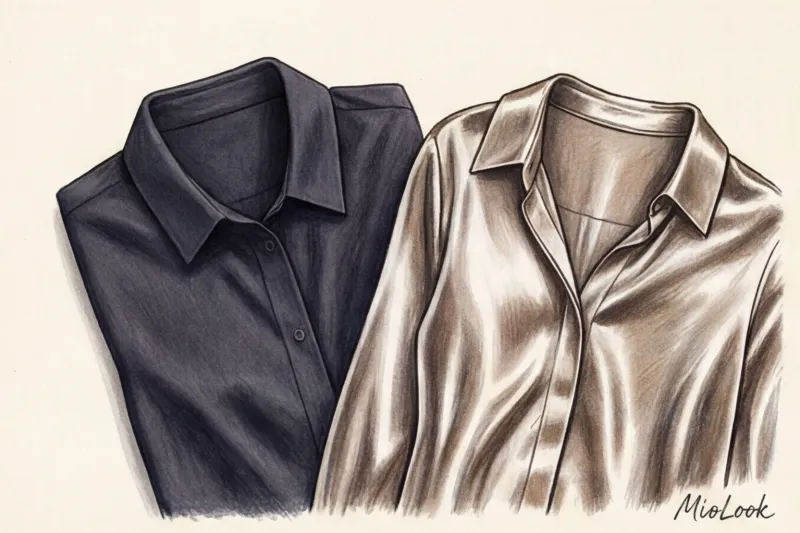
Remember the basic rule of physics: matte fabrics absorb light and visually reduce volume. Shiny fabrics (satin, shiny silk, lurex) reflect light and act like a magnifying glass, highlighting every unevenness and adding a few centimeters.
Instead of a shiny blouse, choose a shirt made of thick cotton poplin (the optimal weight is 130–150 g/m²). High-quality cotton shirts that hold their shape well can be found in the €50–€90 price range.
The contrast principle known as color blocking also works well. If you wear a light or bright top (or dress) and layer a dark jacket with sleeves over it, the arm area will literally fall into shadow against the lighter torso. Your silhouette will instantly become slimmer.
Distraction: Shifting Focus
If you don't want people looking at your hands, give their eyes something else to focus on. This is the law of visual balance, which I use every time I prepare clients for important public speaking engagements. You can't just tell people "don't look there"; you have to show them where to look.
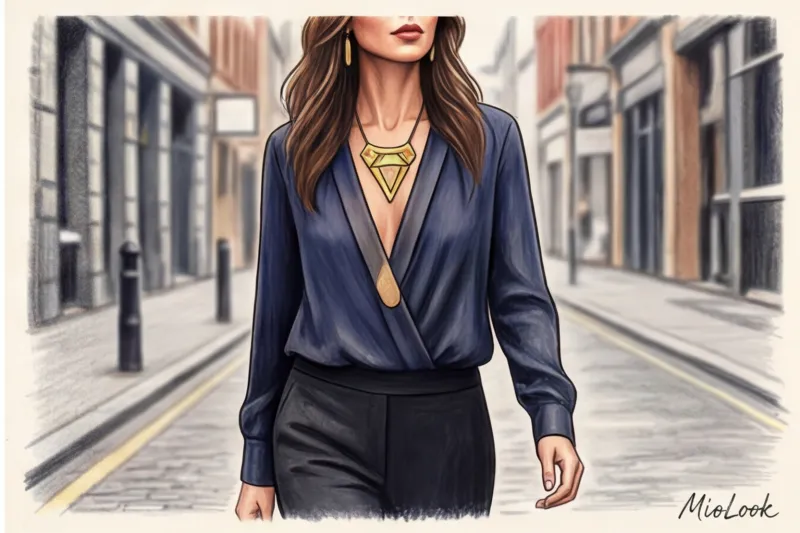
A V-neckline is a portrait's best friend. It elongates the neck, highlights the collarbones, and directs the viewer's eye to the center of your figure, away from the periphery (shoulders and arms).
Enhance the effect with accents. A chunky geometric necklace (no thin chains, they'll get lost), a bright accent lipstick, or an interesting brooch on your jacket lapel—all of this forces your conversation partner to look at your face rather than examine the size of your forearms.
Another option is to shift the focus downwards. Wear a neutral black, navy, or graphite top with a stylish set-in 3/4 sleeve, and layer it with a stunning pleated skirt in a bright color or trousers with a bold print. No one will even notice your arms, because everyone will be admiring your legs and sense of style.
MioLook's Checklist: Go Shopping Smart
Theory only works when you put it into practice. Open your closet right now. If you've been studying Larson types , you already know how important proportions are. Let's do a quick review.
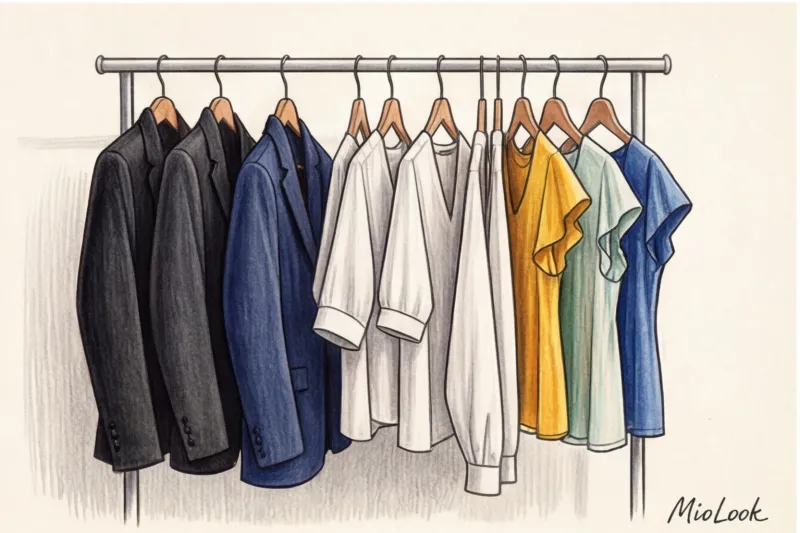
5 things you should get rid of (or put off until better times):
- Turtlenecks made of fine ribbed knitwear.
- Oversized T-shirts with dropped shoulder seams.
- Dresses with tight puff sleeves and elastic bands.
- Shiny satin blouses with fitted sleeves.
- Batwing jumpers and cardigans.
5 things to add to your capsule:
- A straight-cut jacket with shoulder pads (structure is everything).
- Blouse with 3/4 sleeves made of matte silk or thick viscose.
- Dress with a V-neck and loose cap sleeves.
- A classic shirt made of thick cotton (so that the sleeves can be rolled up to graceful wrists).
- Summer top with wide straps and a square neckline.
Your hands are a beautiful part of your body, allowing you to embrace loved ones, work, create, and live life to the fullest. Our stylistic goal isn't to hide you from the world under meters of shapeless fabric, but rather to create a dignified, architecturally precise frame. Don't hide. Develop your silhouette consciously, and you'll see how not only your reflection but also your posture will change.