After 12 years of covering Paris and Milan Fashion Weeks, I've uncovered a curious optical illusion. When you look at street style reports, influencers like Miroslava Duma or Zoë Kravitz appear tall, statuesque, and have seemingly endless legs. But meet them at the entrance to a Chanel show and you'll discover they're barely 155–157 cm tall. Magic? No, pure mathematics and silhouette architecture.
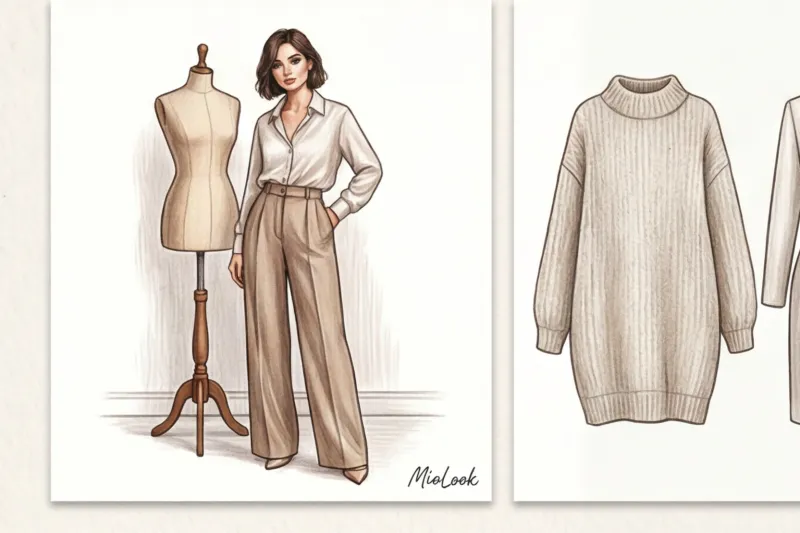
For a long time, the fashion industry tailored patterns for the average 175 cm height, offering petite women only one piece of advice: "Wear higher heels." Analytics from our MioLook app confirms this pain: 68% of users under 160 cm tall admit, upon first signing up, to buying uncomfortable wedge shoes, completely ignoring the proportions of the clothes themselves. But we can't physically lengthen our bones. What we can do, however, is control the way our interlocutors' gaze glides.
We talked about the basic laws of body geometry in more detail in our a complete guide to visual body shaping , and today we'll talk about micro-proportions. If you're looking for an answer to the question, How to look taller with clothes Forget those painful 12-centimeter heels. True height is measured in millimeters of fabric.
The Anatomy of an Illusion: How to Look Taller with Flats
Our brains are lazy. They read the silhouette as a whole, focusing on horizontal lines: the hem of a jacket, a contrasting belt, the line of shoes. If the eye stumbles over horizontal lines, the figure is visually "cut" into blocks, appearing shorter and wider. If the eye moves unimpeded from top to bottom, you appear taller.
The Rule of Thirds: The Golden Ratio in Wardrobe
Leonardo da Vinci developed the golden ratio, and modern clothing designers (especially in the premium segment) use Fibonacci numbers to create perfect patterns. The secret to ideal height lies in the 1/3 to 2/3 ratio.
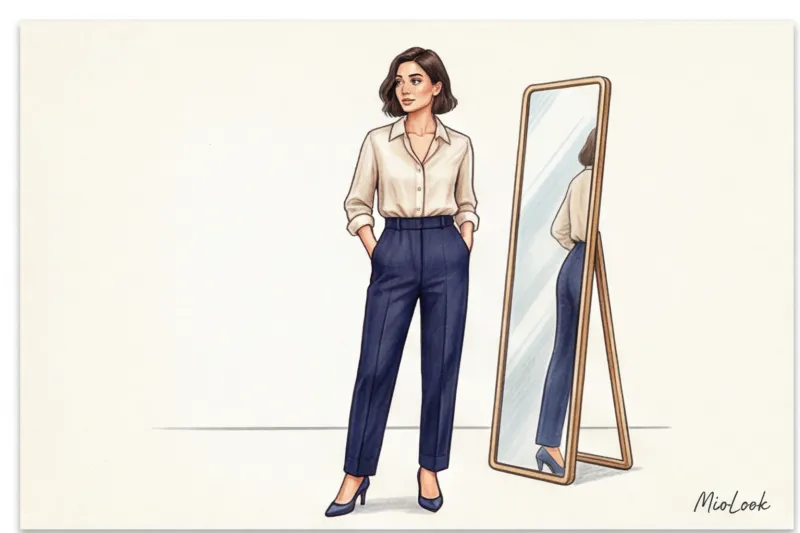
If you wear mid-rise jeans and an untucked sweater that ends at your hips, you'll divide your body exactly in half (1/2 to 1/2). This ratio visually shortens your legs. But if you choose high-waisted pants and tuck your top in, your upper body will take up 1/3 of your silhouette, and your lower body will take up 2/3.
"A 1:3 ratio of top to bottom visually adds 3 to 5 centimeters of height to the viewer, even if you are standing in flat loafers," confirm researchers from the PANTONE Color Institute, analyzing the perception of color blocks (2023).
And yes, this rule works even if you have a slight belly. Tuck your shirt in only at the front (the French tuck) or choose a thicker fabric for your pants—this will conceal any imperfections while maintaining your figure's shapely proportions.
The Biggest Style Mistakes: What's Stealing Your Inches
I had a client, Elena (155 cm tall), who complained that she looked "like a nightstand," even though she wore a size S. While reviewing her wardrobe, it became clear that she loved wearing white shirts worn untucked, paired with black trousers and ankle boots that contrasted with her skin tone.
Here are three things that instantly steal your growth:
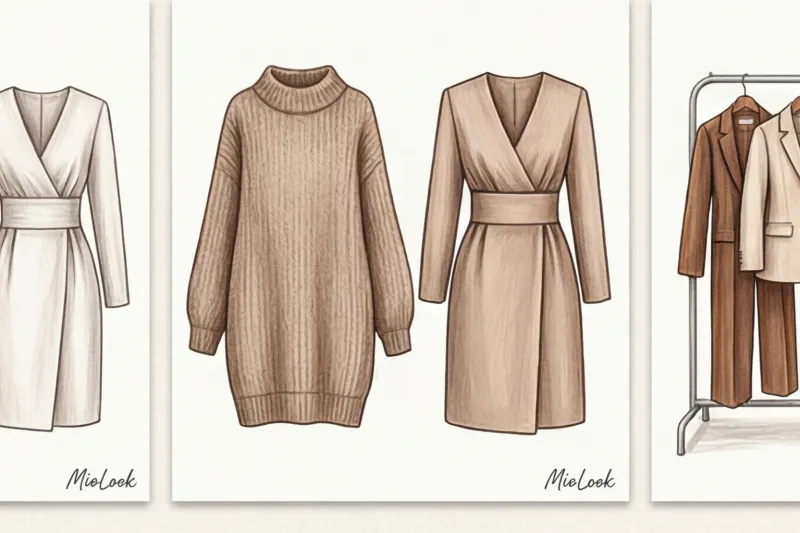
- Contrasting color block in equal parts: The white top and black bottom divide the figure like an axe.
- Shoes with an ankle strap: The contrasting strap literally “cuts off” the foot from the leg.
- Incorrect midi length: If the skirt hem ends at the widest part of the calf, the legs appear heavy and short. The hem should end where the leg begins to taper (below the knee or closer to the ankle).
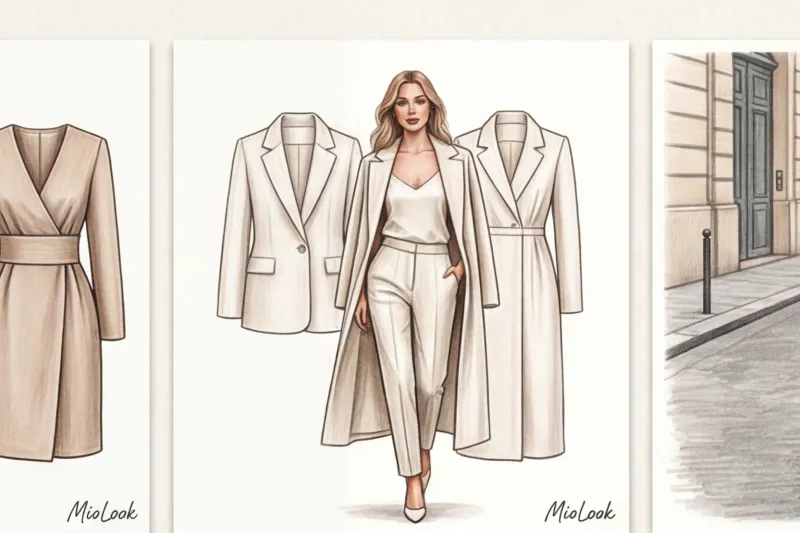
Also, many petite girls make the classic mistake of trying to hide their hips under long tunics. These are one of those clothing styles that make you look older and make the figure squat, shortening the legs by a good ten centimeters.
The myth of vertical stripes and total oversize
Ready for a counterintuitive fact? Vertical stripe far from always slimming and stretching.
The female body isn't a flat sheet of paper; it's a complex topography with curves. If you wear a bodycon dress with contrasting vertical stripes, the lines will inevitably curve and widen at the chest and hips. The brain interprets this widening as additional volume. The best vertical line isn't a print on the fabric, but an unbuttoned coat or jacket over a contrasting top.
Access to MioLook for €0.99 — one-time payment
A smart AI stylist will analyze your proportions and select the perfect looks that will visually elongate your silhouette.
Get access — €0.99 onceSilhouette Architecture: 5 Tips to Elongate Your Figure and Become Slimmer
The sartorial traditions of London's Savile Row dictate that a silhouette rests on the shoulders. For petite women, a perfectly positioned shoulder seam is crucial. The popular "drop shoulder" style pulls the figure down, creating a slouched effect. Choose a set-in sleeve, where the seam runs exactly along the knuckle.
How else to create the illusion of growth:
- V-neck: The ultimate neck-lengthening tool. It opens the collarbones and directs the gaze down the central axis.
- Open wrists and ankles: If you wear oversized clothing, be sure to roll up the sleeves to the narrowest part of your arm. This reveals the true (fragile) dimensions of your body beneath the fabric.
- Long scarves: The freely hanging ends of the scarf create two powerful artificial verticals.
Monochrome 2.0: A play of textures instead of boring color
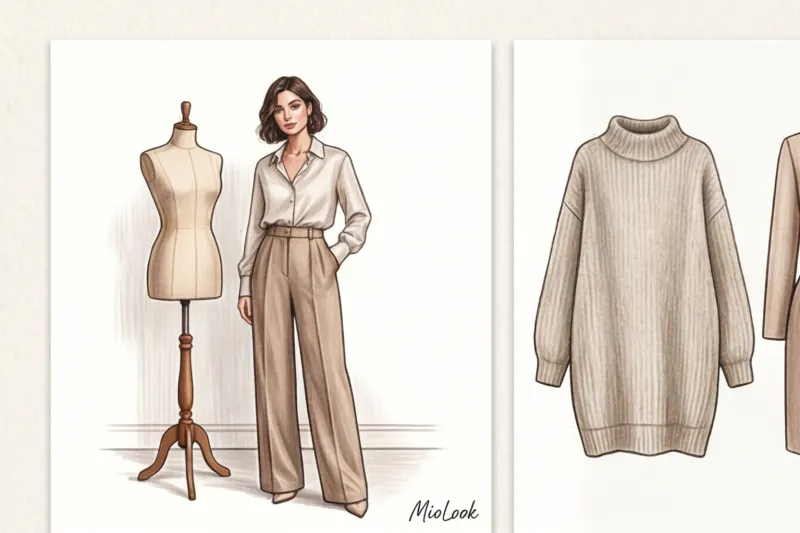
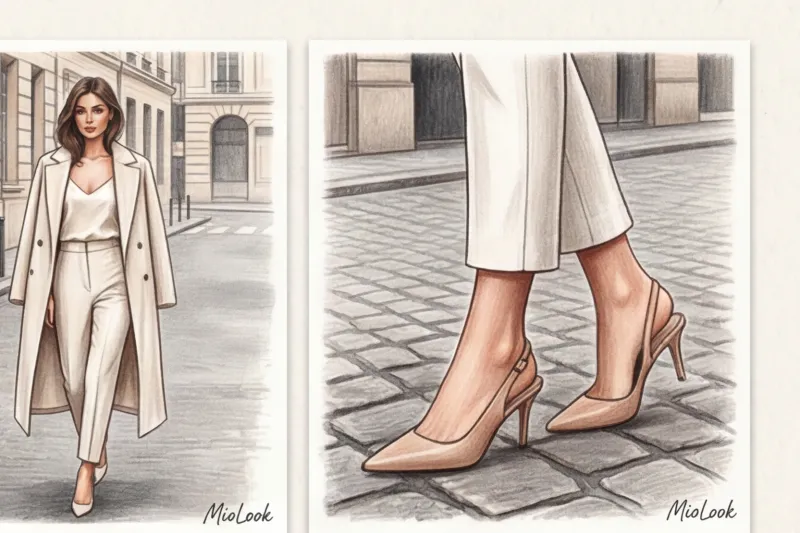
A monochrome look creates a single column of color. The eye has nothing to focus on and slides down, visually elongating the body. MioLook user analytics for people under 160 cm (5'6") show that those who switched to the "monochromatic layering" algorithm report a 45% increase in self-confidence.
But to avoid looking like a cleaning service employee in uniform, mix textures. Combine smooth with rough, shiny with matte. For example: a basic cashmere sweater from Massimo Dutti (approximately €120) paired with a flowing satin skirt in the same shade and leather boots. The difference in textures within a single color adds depth and luxury to the look.
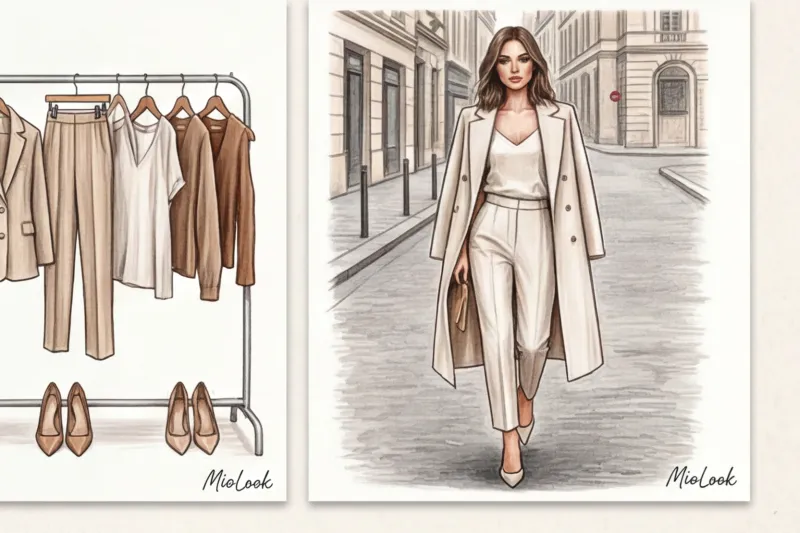
Trends vs. Proportions: How to Adapt Runway Fashion to Women Under 160cm
At Fashion Week, I often see stylists adapting runway pieces designed for 180cm models for normal-height front-row clients.
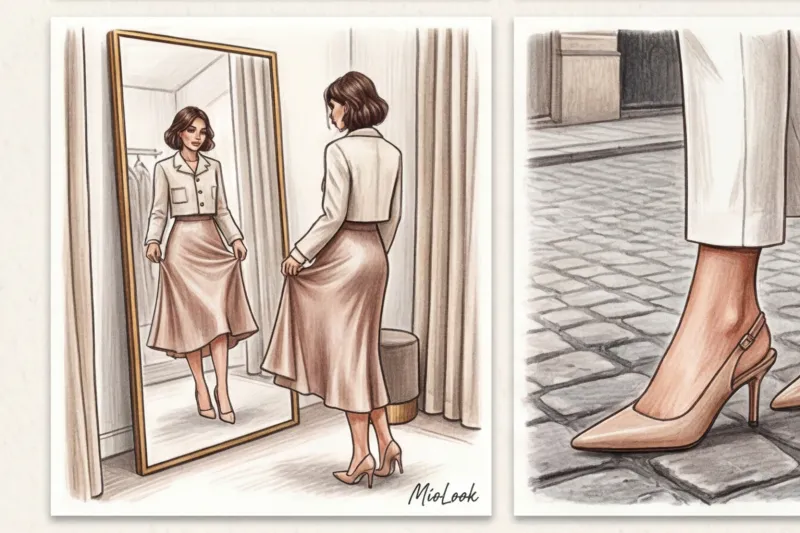
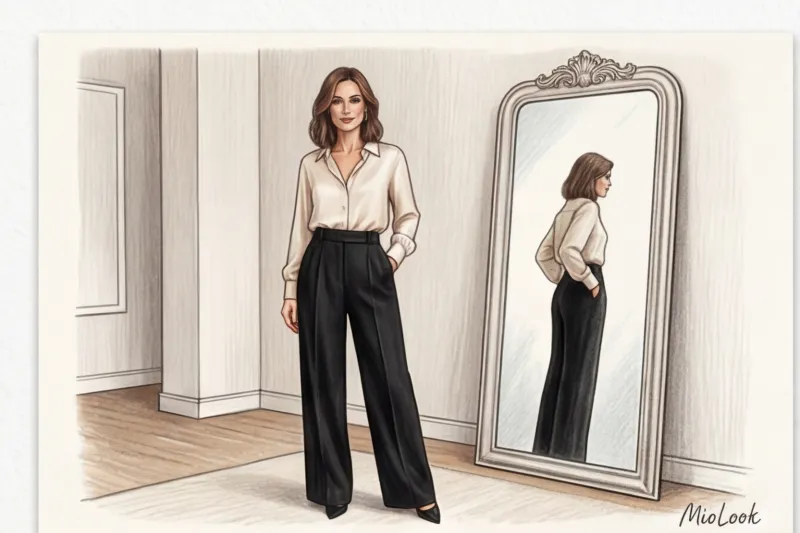
Take, for example, the trend for wide-leg palazzo pants. If worn incorrectly, a petite woman will simply drown in them. The key to getting the right fit is this: the pants should sit firmly at the high waist, and their length should leave just 1-2 centimeters of the toe of your shoe exposed. The fabric should be flowing (viscose with 5% elastane, fine wool), not stiff and stiff (like heavyweight denim over 14 oz).
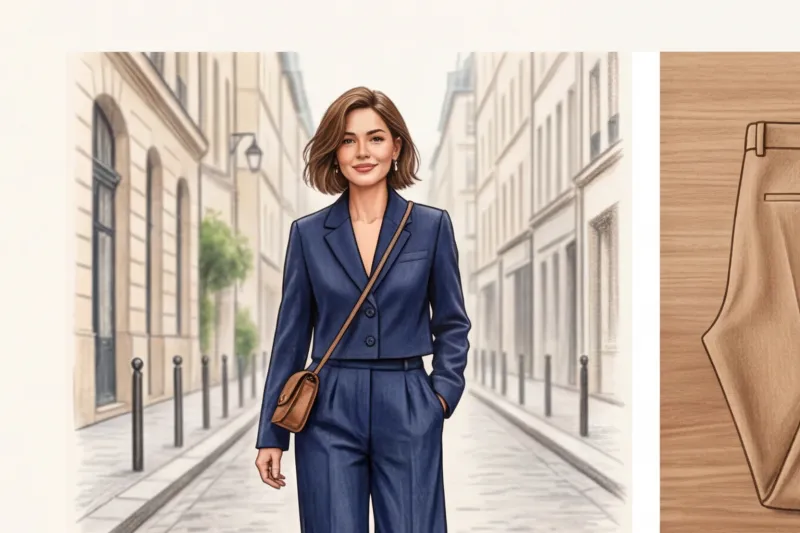
A cropped blazer is an absolute must-have for petite figures. Unlike a classic mid-thigh jacket, which shortens the legs, a cropped blazer ends right at the waist, automatically creating that perfect 1/3 ratio.
Your perfect look starts here
Join thousands of users who look flawless every day with the MioLook virtual fitting room.
Get access — €0.99 onceShoes and accessories: the finishing touches that set the vertical
Let's get back to my client Elena, whom I mentioned above. Do you know what happened when we swapped her black ankle boots for nude pumps and beige pointed-toe loafers? Her colleagues started asking her what diet she was on. The illusion of a continuous line worked flawlessly.
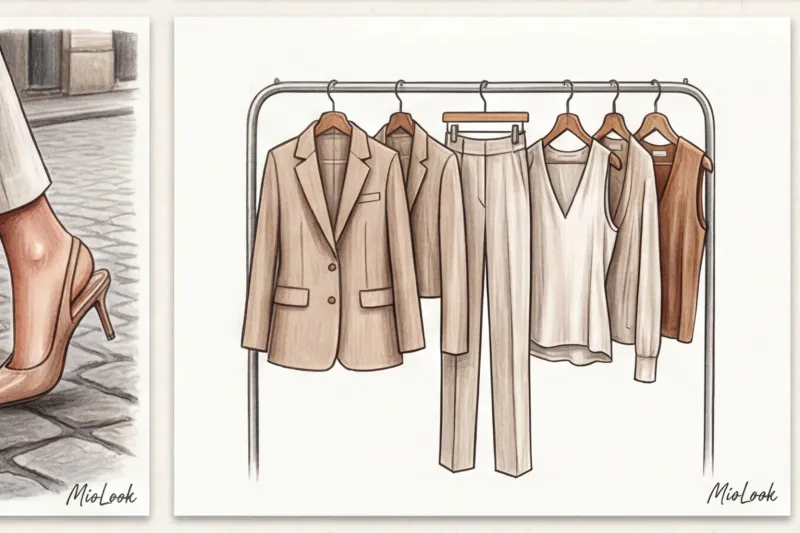
You don't need stilettos to appear taller. The magic lies in the geometry of the toe. Pointed toe continues the line of the leg, narrowing and creating a direction vector. The round toe interrupts this line.
Choosing women's casual shoes Opt for loafers or derbies with a moderate, slightly raised sole and an almond-shaped or pointed toe. If you're wearing skirts, your shoes should match your skin tone (or tights). If you're wearing trousers, match the color of your trousers.
Don't forget the law of proportionality in accessories. Enormous tote bags look like duffel bags against a height of 155 cm, making you look even smaller. Opt for structured bags in medium and small sizes. The same goes for belts: a wide, contrasting band at the waist (wider than 4 cm) visually cuts off your height and takes up to 5 cm off your height. Choose thin, elegant straps 1.5–2.5 cm wide to match your trousers or dress.
MioLook Stylist Checklist: Putting Together the Perfect Capsule Wardrobe for Petites
Building a wardrobe is a process that requires a system. To avoid spending hours in front of the mirror every morning, you need the right foundation.
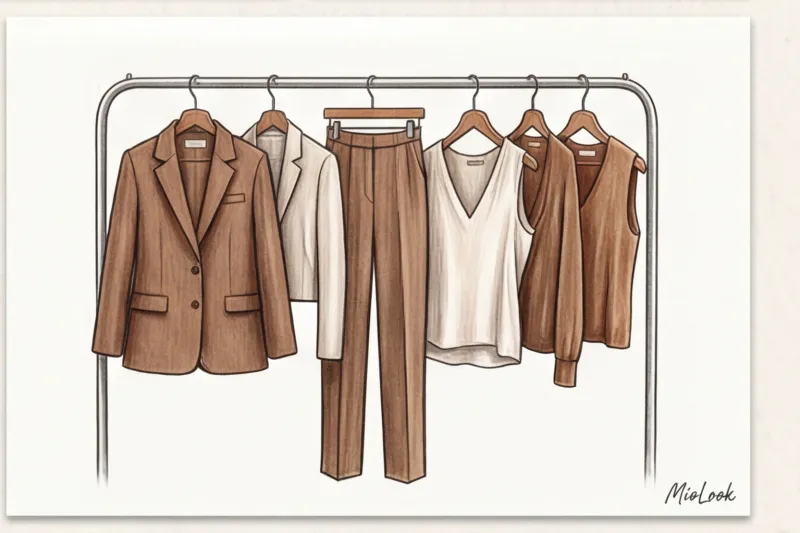
Check your closet for these functional, height-stealing pieces:
- Trousers with a straight or moderately wide cut and a high waist (avoid low rise).
- V-neck tops and pullovers (a great investment in the €30–€80 range from brands like COS or Uniqlo).
- A cropped, structured jacket with a perfect fit through the shoulders.
- A sleek, basic shoe with a pointed or almond-shaped toe.
- A monochrome three-piece suit (trousers, vest, jacket) that can be broken down into different looks.
Of course, this list isn't a hard and fast rule—for example, it doesn't work if you have a pronounced apple-shaped figure and high-waisted pants cause physical discomfort (in that case, we shift the emphasis to the chest and bust area, leaving the pants semi-fitted).
But for most petite girls, the golden ratio rule works flawlessly. You can upload your items to MioLook wardrobe , and artificial intelligence will help you create sets with the correct proportion of 1/3 to 2/3.
Your next step? Open your closet today. Find those long, contrasting tunics and ankle-grazing shoes with straps. Put them away for a month and try dressing according to the rule of thirds. I guarantee you'll be getting compliments on your slimmer figure.