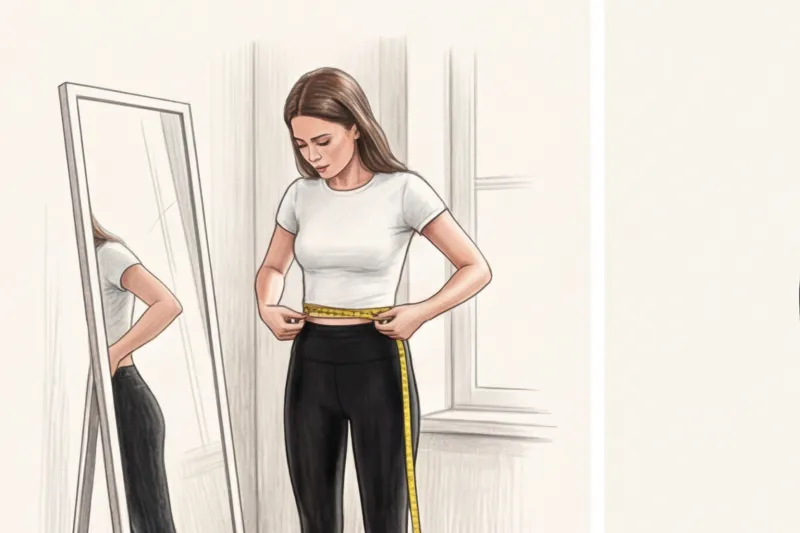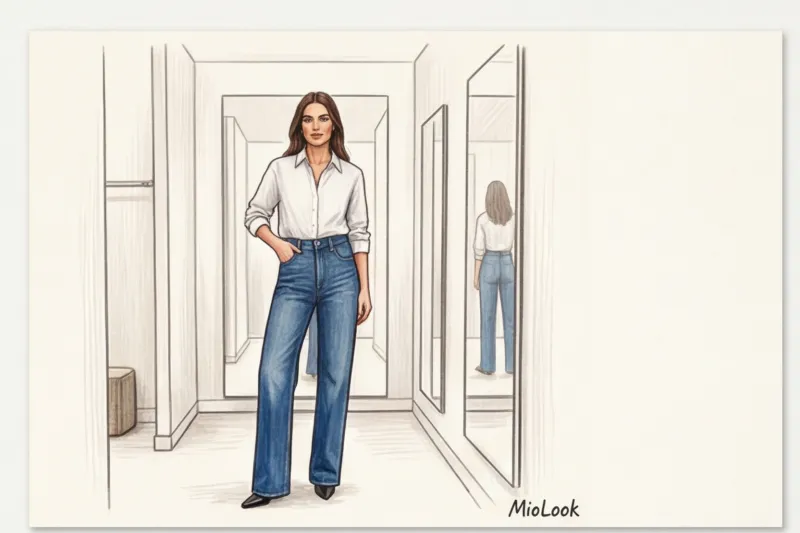
You know what style advice I hate the most? "Just wear long, wide clothes." Over 12 years of working as a personal shopper in Europe, I've seen dozens of women hide behind shapeless robes because of insecurities. My client Anna spent years swaddled in flowing maxi skirts and baggy viscose trousers, fervently believing she was solving her problem. Spoiler alert: she only made it worse.
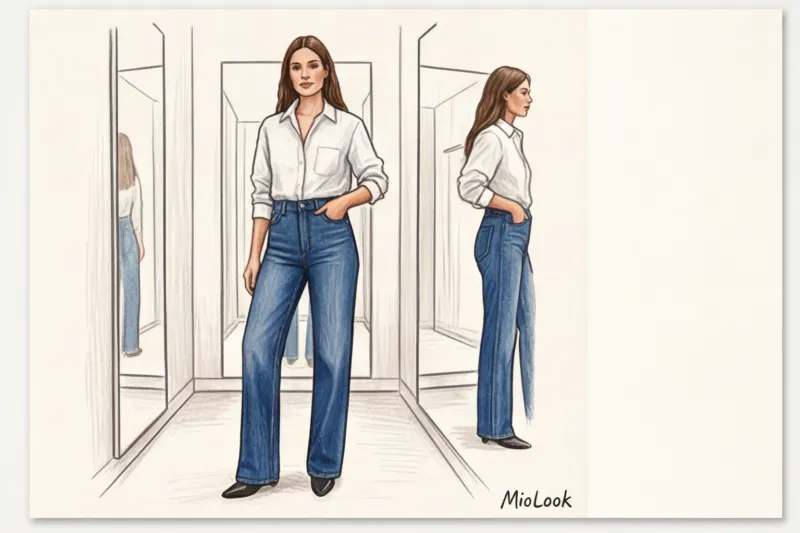
When we try to drape the figure's nuances with meters of soft fabric, we don't hide them, but create a shapeless, heavy volume. If you're looking for an answer to the question, How to hide crooked legs with clothing Forget about width. Your main tools are the density of the material and the rigid geometry of the cut. We've covered the basic principles of working with proportions in more detail in our a complete guide to visually correcting your figure with clothing Today, we'll talk exclusively about legs: how to build the perfect vertical without becoming a "case."
Optical illusion: how to hide curvature by building a new "facade"
There's a golden rule in clothing design based on the Müller-Lyer law of optical illusions: the human eye always follows a continuous line. If the line breaks or bends, the gaze stumbles at that break. Our goal is to force the gaze to move from top to bottom, without ever lingering on the contours of the body.
"We don't change your body. We build the right architectural framework around it, which dictates what the eye should see"—that's what I tell every client at my first consultation.
According to the application's internal analytics MioLook , users who swapped soft, draped fabrics for architectural, shape-defying cuts were 40% more likely to report satisfaction with their looks in their style tracker. Why? Because the stiff fabric forms its own straight line from hip to ankle, leaving air between the material and the leg. This air is your best secret.
The Biggest Styling Mistake: Why Oversized and Thin Fabrics Are Your Enemies
A popular myth holds that wide-legged palazzo pants made of viscose or thin silk are a savior for uneven legs. In reality, they're a disaster. I always make my clients take a brutal but sobering test in the fitting room: put on the pants and simply walk quickly from corner to corner.
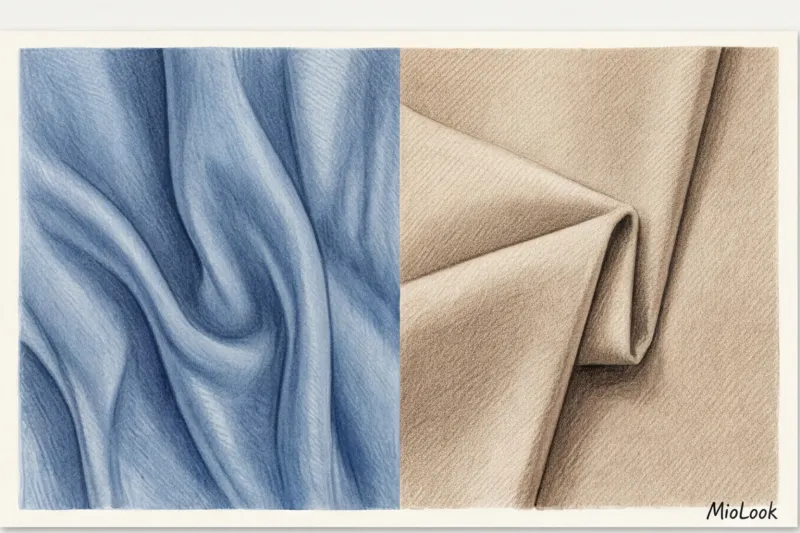
What's happening? When you move, or even with the slightest breeze, the soft, flowing fabric stretches. It acts like tracing paper or wet paper, instantly clinging to the leg and treacherously outlining every curve (especially those with a "knee" or "o-shaped" curve). The same applies to tight skinny jeans with a high elastane content (more than 2-3%). Even if you wear a long tunic over them, the calf will still reveal the true silhouette.
Your ideal image begins Here
Join thousands of users who look flawless every day with a smart AI stylist.
Get access — €0.99 onceTrouser Question: 3 Ideal Silhouettes (and 2 Strictly Off-Limited)
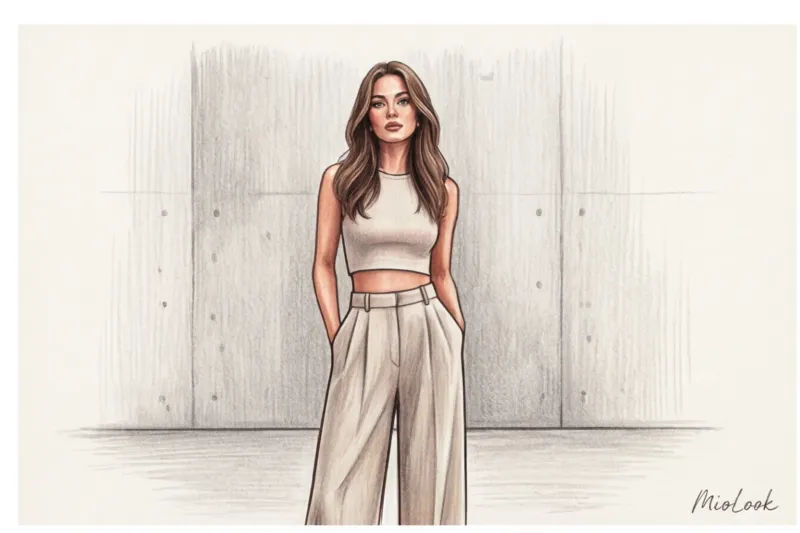
According to Savile Row's classic tailoring standards, the correct fit of trousers is determined by one detail: a plumb crease or side seam. If the crease wanders left or right around the knee or calf, the trousers are incorrectly sized. To achieve a straight crease, we need the right fabric and one of three tried-and-true silhouettes.
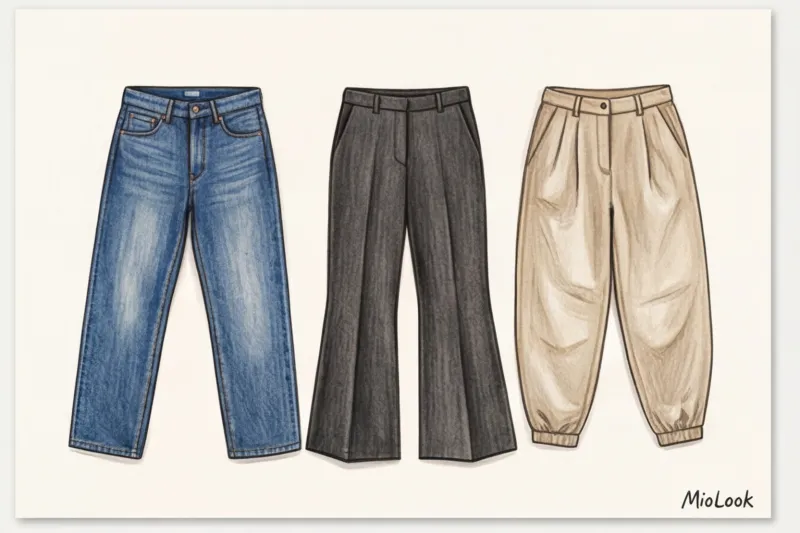
Straight-leg trousers made of thick fabric: a basic recipe
Your best friends are 100% cotton, raw denim (12-14 oz), heavy-duty lined wool suiting, or corduroy. This is where the paradoxical pricing rule comes into play.
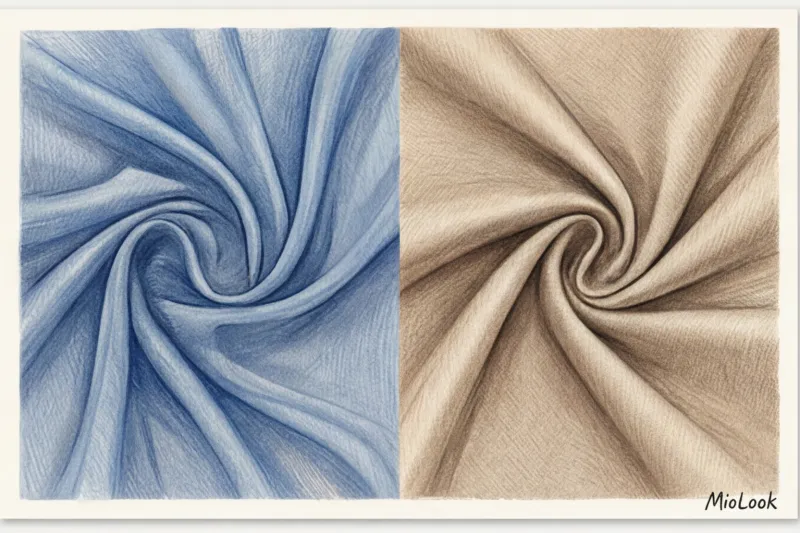
In my experience, a pair of straight-leg jeans from Zara's youth TRF line for €40 flatters the figure ten times better than luxurious trousers made of the finest summer wool from Massimo Dutti for €120. Price doesn't matter if the fabric doesn't hold its shape. Straight-leg trousers should fall from the widest part of the hip in a straight line.
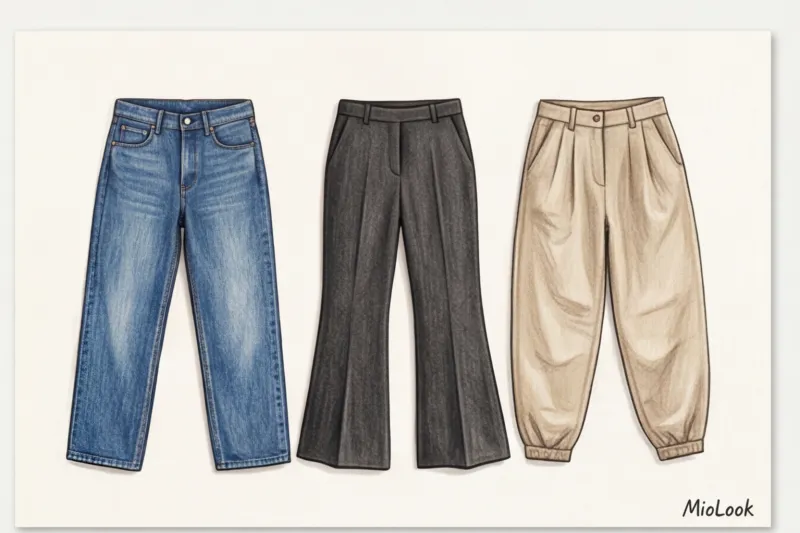
Flared and bootcut trousers: salvation for an O-shaped curve
If you have O-shaped legs (a gap between your calves), flared trousers from the knee down create the perfect balance. The flare at the bottom visually compensates for the gap between your legs, creating a harmonious hourglass figure.
Fair Limit: This technique is incredibly effective, but it has its drawbacks. In rainy autumn weather, long flares are impractical unless you're wearing chunky platform shoes. The correct length for these trousers is exactly 1-1.5 cm from the floor, taking into account the shoes you'll be wearing them with.
Slouchy and mom jeans: camouflaging the curve of the buttocks
For an X-shaped silhouette (where the knees come together and the calves spread out), slouchy, banana, and classic mom jeans work great. They create artificial volume in the hip area and taper gently towards the bottom, completely eliminating the break at the knee. This cut, incidentally, fits beautifully. romantic-straights according to Larson , whose figure requires slightly more relaxed, but not shapeless lines.
Skirts and dresses: the geometry of the hem decides everything
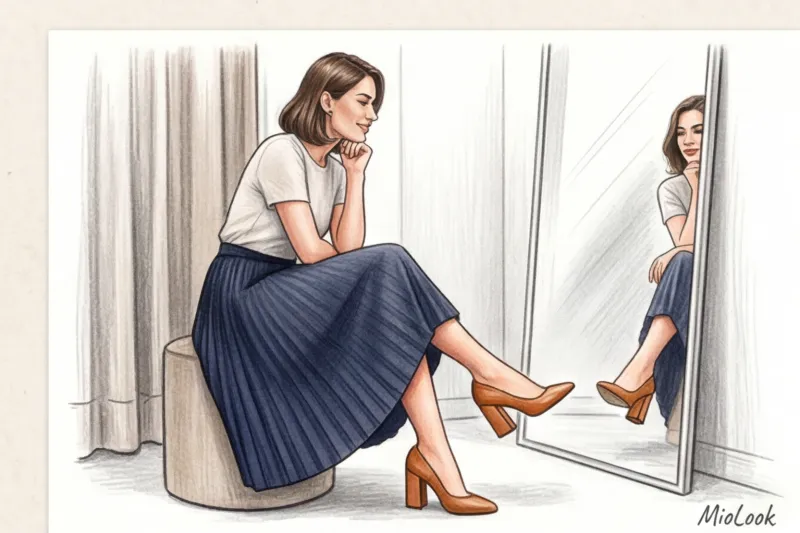
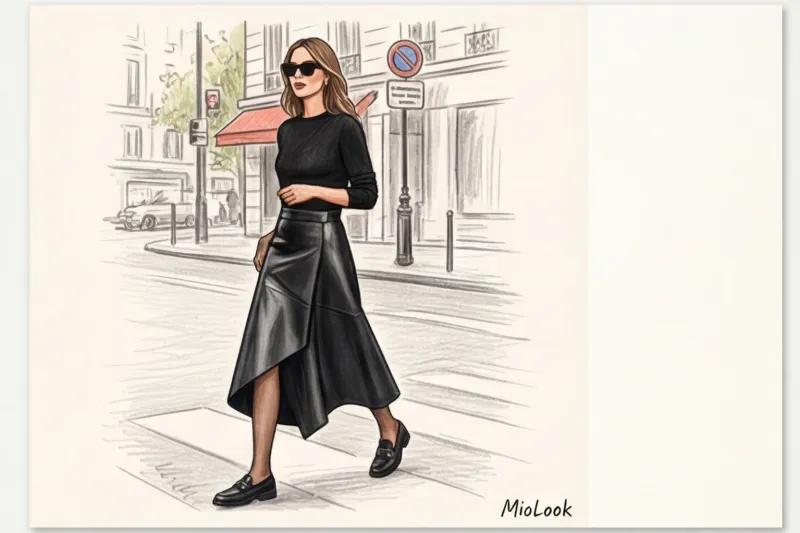
The most dangerous skirt length for uneven legs is one that hits just below the knee, or just below the kneecap, where the narrowing begins. A horizontal hemline acts as a highlighter, forcing the viewer to focus on the exact point where the skirt ends.
How do we treat this?
- A-line silhouette made of rigid textures: My absolute favorite for my clients are A-line midi skirts made of thick matte leather, heavy denim, or tweed. They create a strict triangle, making your legs appear slim and even.
- Asymmetry and cuts: Broken hemlines (for example, on diagonally cut wrap skirts) disrupt visual focus. The eye can't perceive a clear horizontal line, so the brain stops analyzing the symmetry of the legs.
- Shift of emphasis: Show off your slender ankles if you have graceful ones.
Access to MioLook for €0.99 — one-time payment
A smart AI stylist will choose the perfect look for you and help you implement new style rules.
Get access — €0.99 onceFootwear and Tights: Foot and Leg Architecture
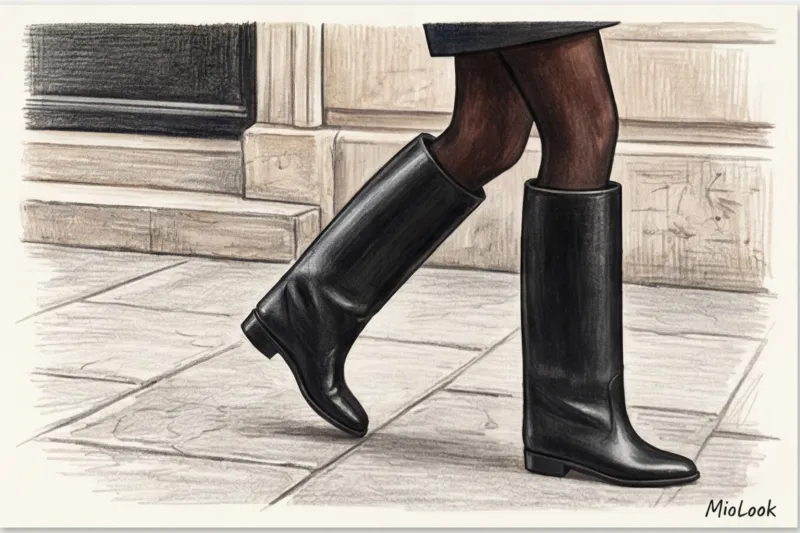
According to WGSN's 2024 analysis report, wide-shaft boots remain the hottest footwear trend in Europe, not only due to their 2000s aesthetic but also due to their phenomenal corrective properties.
Tube boots have a rigid straight shaft, which does not fit to the calf. They create the illusion of a perfectly straight leg inside this leather cylinder. The main rule: two toes should fit comfortably between the boot and your foot.
Another important nuance is contrast. If you wear black ankle boots that cut off the ankle with light-colored tights, you'll shorten your height and emphasize your curvature. Create a monochrome vertical line: black suede boots with thick black matte tights. Read more about how denier affects the perception of volume in our article about rules for choosing tights.
Stylist Checklist: Heading to the Fitting Room with New Rules
Next time you go shopping or do a wardrobe audit with MioLook , use this practical three-step algorithm:
- Test in motion: Never judge pants or a skirt simply by standing in front of the mirror like a soldier. Take a wide step, squat down, turn your back, and look over your shoulder. The fabric shouldn't be bunched up between your legs or cling to the back of your calves.
- Pinch test: Put on your pants. Try pinching the fabric at your thigh and calf with your fingers. If you can gather less than 2 cm of material, the garment is too tight and will reveal all your figure secrets. Leave some air!
- Checking the vertical: Look at the side seam. It should fall perpendicular to the floor. If the seam is snaking, take it off immediately—it's a poor fit or the fabric isn't thick enough.
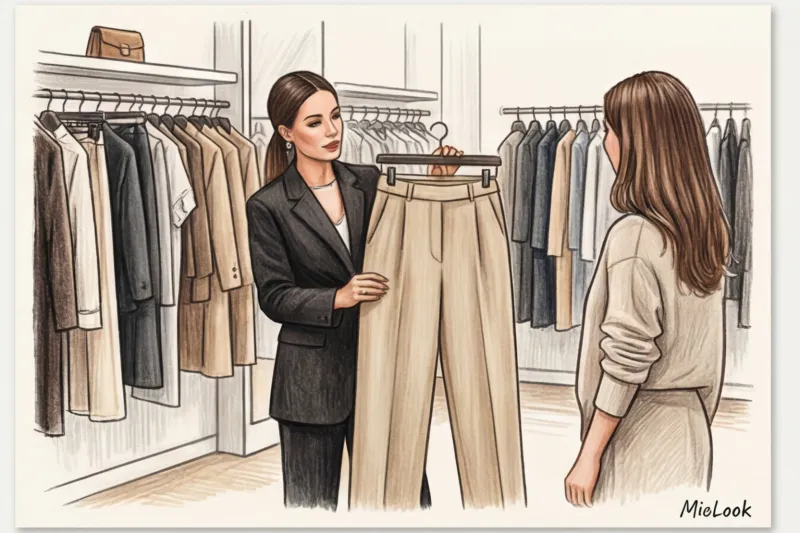
Remember the most important thing: clothes shouldn't be your second skin, obediently following every curve of your body. Clothing is an architectural form in its own right. Choose dense materials, respect the straight lines of your cut, and you'll forever forget about the need to hide anything.