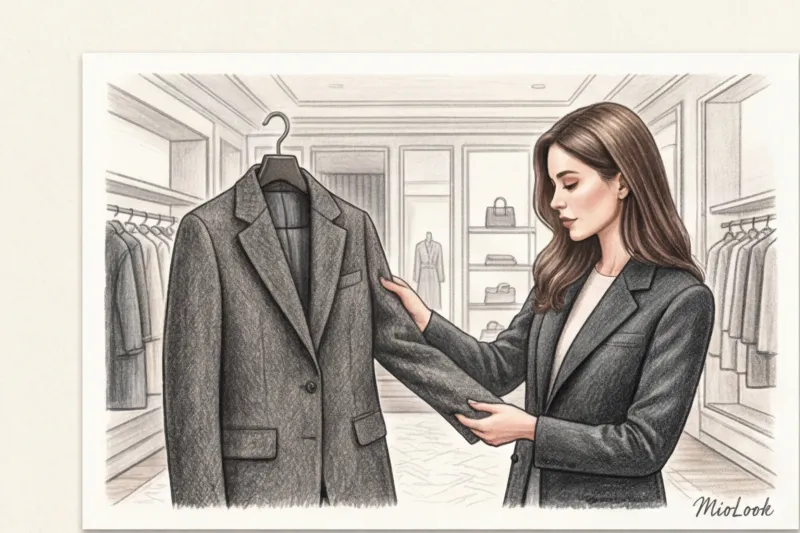
The Illusion of the "Basics": What is a Real Wardrobe Investment?
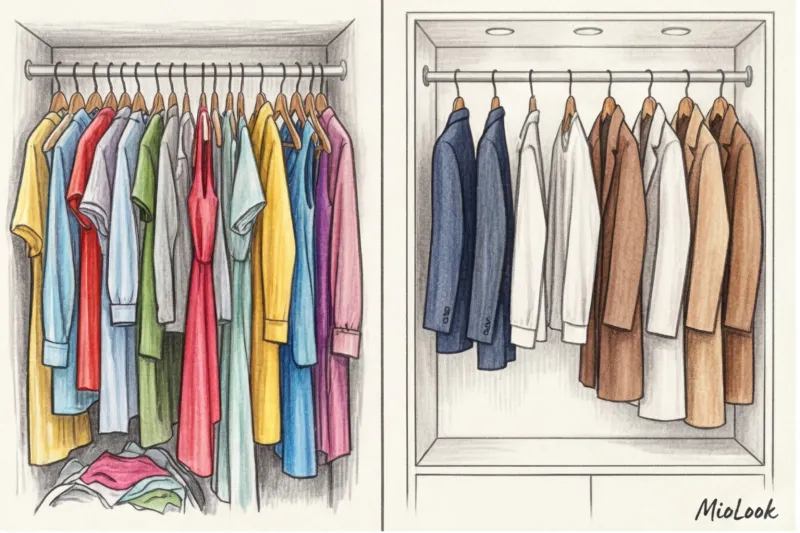
How many times have you opened an article titled "10 Things Every Self-Respecting Woman Must Have in Her Closet"? Over 12 years as a fashion journalist and stylist, I've seen hundreds of such lists. Year after year, the industry dictates the same template: a beige trench coat, black pumps, a pencil skirt. But let's be honest. Blindly following these universal lists is a surefire way to end up with a closet overflowing with clothes with the tags still attached. Smart wardrobe investments begin with the understanding of one fundamental truth: there is simply no universal basis.
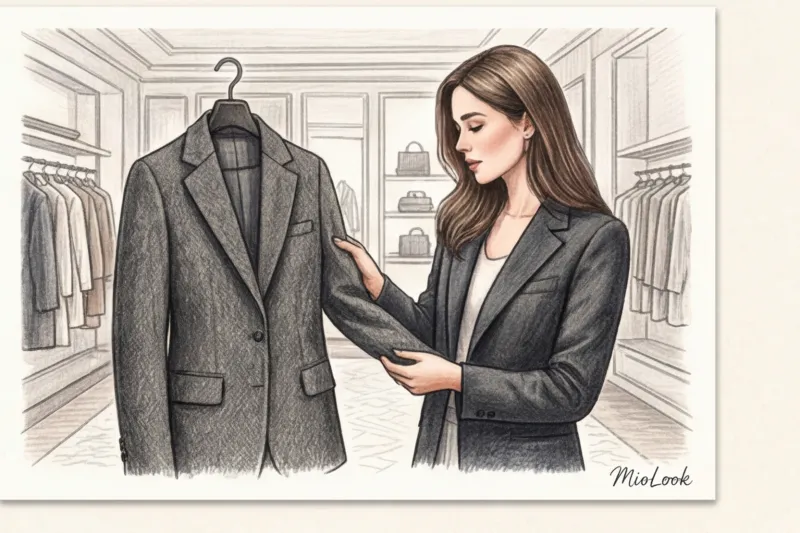
The concept of a standardized set of must-haves is hopelessly outdated (I discussed in detail why we should let go of these stereotypes in the article about outdated style rules ). The most striking example of this pernicious illusion is the classic white men's shirt. For decades, fashion magazines have been telling us it's the foundation of absolutely any look. But in my experience, eight out of ten clients who bought a stiff cotton shirt "because the stylists told them to" wore it exactly once. Rigid stylistic dogmas no longer work. If you're a creative director working in an informal environment or a freelancer, starched poplin will only restrict your movement and irritate your skin. In your personal reality, the role of a "white shirt" could be played by a high-quality long-sleeve made of thick lyocell or a cashmere polo.
"The most expensive item in your closet is the one you never wear, no matter how attractive the discount on the price tag."
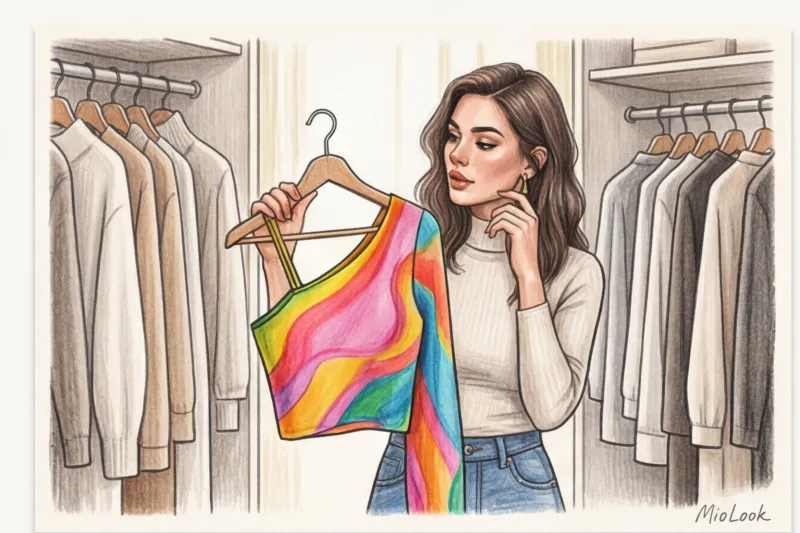
This leads to the main rule: a real investment always serves your current life, not a fantasy one. Women tend to buy silk slip dresses for imaginary social events or $1,000 formal suits for abstract "important negotiations," completely ignoring the clothes they spend 80% of their time in. Before making a major purchase, ask yourself honestly: where will I wear this next Tuesday? To avoid costly mistakes, I always recommend digitizing your looks. [Image credit: sss] is a great help with this. MioLook app — visualizing your current capsule instantly shows you which real areas of your life you lack quality clothing for.
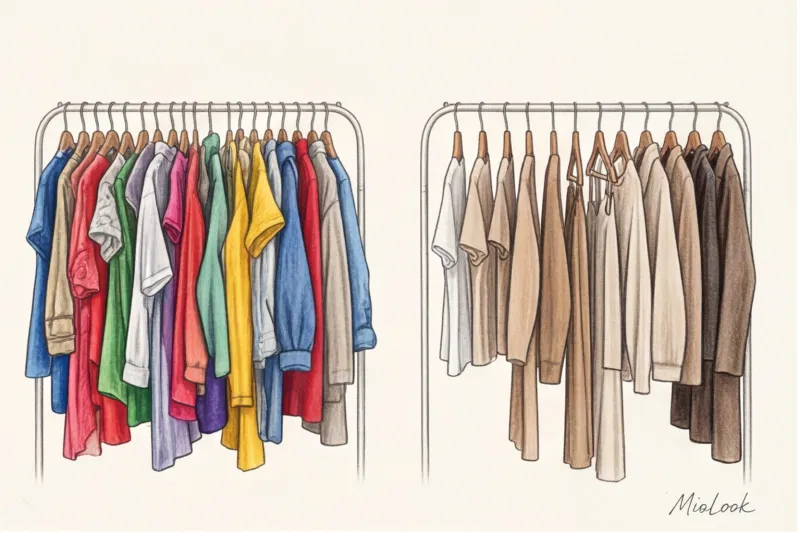
Another dangerous stereotype is that an "investment" piece must be as neutral as possible. A sleek gray sweater, straight black trousers, a bland coat. This is profoundly misleading. Investment isn't synonymous with boring design. It's synonymous with impeccable fit, precise proportions, and phenomenal durability of materials.
Take a look at Phoebe Philo's archives from the Old Celine era or The Row's contemporary collections. Their pieces are utilitarian in nature, yet they're never boring. A deconstructed jacket with a complex shoulder line or an asymmetrical skirt made of thick Italian wool could be the best investment of your life. As long as they're perfectly tailored to your figure and made using techniques that won't let the seams unravel after just one season. Invest in the garment's architecture and the quality of the fabric, not its visual "safety."
The Mathematics of Style: How to Calculate Cost Per Wear (CPW)
Professional buyers at major department stores like Le Bon Marché or Net-a-Porter never purchase collections based solely on the price tag. Their primary analytical criterion is the garment's profitability. In personal styling, this principle is transformed into the concept Cost Per Wear (CPW) , or the price per wear. This isn't just a formula; it's a powerful psychological tool that permanently cures impulsive shopping and shifts the focus from the consumer category of "expensive/cheap" to the investment category of "profitable/lossless."
Basic math is incredibly simple: divide the cost of an item by the expected number of wears. Let's compare two typical winter purchases. On one end, there's a classic double-breasted coat made of a dense wool blend for €800. You'll wear it for at least five seasons, approximately 60 days a year. That's 300 wears. Your CPW is just €2.60 per day. On the other end, there's an ultra-trendy neon-colored puffer jacket from a mass-market retailer for €120. It will lose its shape after the first wash or simply become unfashionable by next winter. You'll wear it maybe 20 times. Its CPW is €6.
The paradox of the stylish economy is that the "cheap" down jacket cost you almost two and a half times more than the "expensive" premium coat.
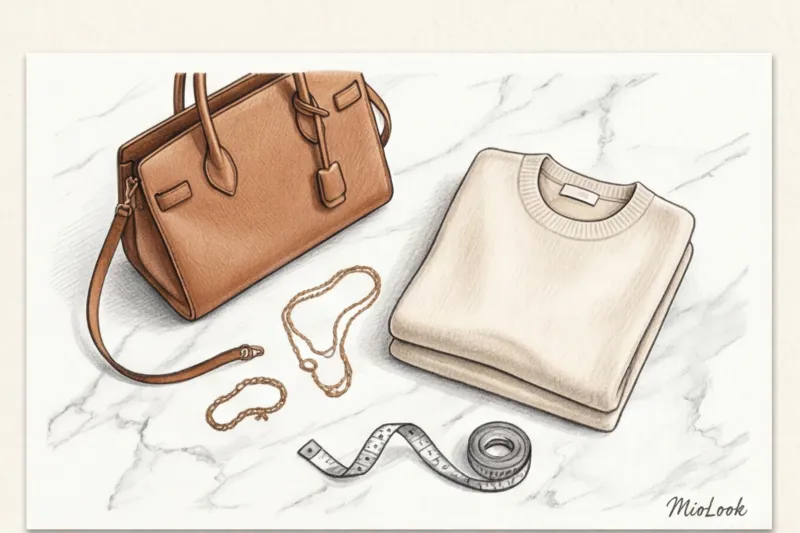
However, the real CPW formula, which we use in professional wardrobe audits, includes another crucial variable: hidden costs. The full formula looks like this: (Price of the item + Cost of care and repair) / Number of wears.
When buying a skirt with intricate asymmetrical pleating or a jacket made of delicate light crepe for €200, you should understand that they will require specialized dry cleaning. Three dry cleaning visits per season (an average of €25 each) will quietly add €75 to the cost of your item in the first year alone. An investment in your wardrobe should always be based on your willingness to maintain it. If an item requires complex ironing, and you hate ironing, its dry cleaning value will tend to infinity because it's just sitting in the closet.
It's precisely because of physical wear and tear that the cost-effectiveness rule applies most harshly to accessories. Cheap shoes and bags always cost the most in the long run because they constantly perform functional tasks.
- Bags: A €50 faux leather model with fragile hardware will start to crack at the handles and peel at the corners after three months of daily wear. A structured leather tote bag for €600 will last you 5-7 years, reducing the cost of each outing to mere cents.
- Shoes: Cheap polyurethane ankle boots are basically beyond repair—a worn-out sole or a broken arch support sends them straight to the trash. Meanwhile, classic leather Chelsea boots for €400, with timely, quality maintenance (around €30), will last for years, aging gracefully and acquiring a noble patina.
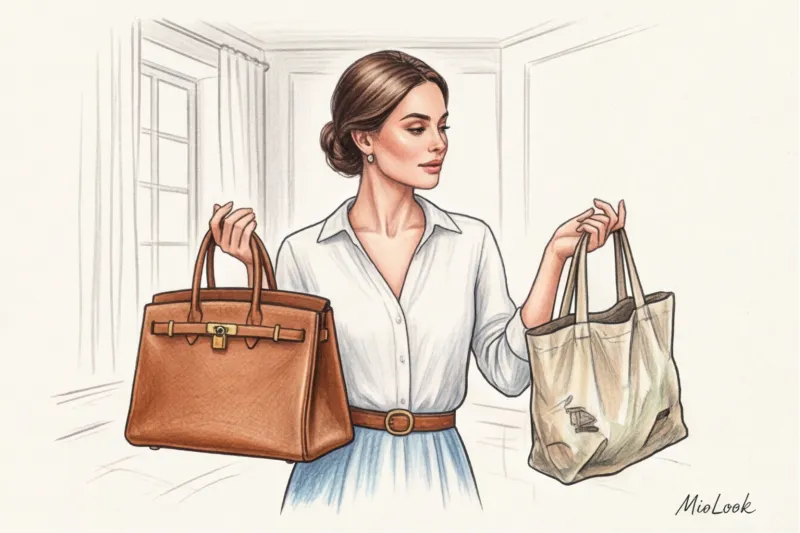
The main rule for buyers that I always apply when working with clients: the highest budgets should be allocated to what separates you from the ground (shoes) and what you touch hundreds of times a day (bags).
Access to MioLook for €0.99 — one-time payment
A smart AI stylist will select the perfect look, evaluate your wardrobe, and help you calculate the return on your purchases.
Get access — €0.99 onceThe Anatomy of Quality: How to Distinguish a Timeless Item from a One-Season One
A few years ago, during Paris Fashion Week, the head cutter of a historic French house taught me a lesson that completely revolutionized my approach to shopping. He took an impeccably tailored jacket, turned it inside out, and declared, "The outside of a garment is the marketing. The inside is the truth." Real investment in your wardrobe begins in places most shoppers don't even think to look.
Modern manufacturing technologies have masterfully imitated the appearance of luxury, but the mathematics of quality cannot be faked. To avoid wasting money on a beautiful illusion, I recommend analyzing every potential purchase like an engineer.
Fabric composition: why 100% doesn't always mean quality
The "100% cashmere" tag has long been a staple of marketing. Cashmere comes in a wide variety of grades. Luxury brands use long fibers (Grade A), which become softer over time and are virtually pilling-free. Budget brands, striving to offer a $100 sweater, purchase short fibers (Grade C), which will pill after just three washes. To check the quality right in the boutique, gently tug the cuff: long fibers will instantly return the garment to its original shape, while cheap knitwear will remain misshapen.
But the figure "100%" isn't always the standard. When it comes to classic wool trousers, I Always I look for 2–5% elastane or high-tech polyamide. This tiny amount of synthetic material isn't a cost-cutting measure by the manufacturer, but a functional necessity. It ensures that your trousers won't stretch out at the knees after eight hours in the office and will maintain a crisp crease.
Seam architecture and fittings
Technical quality standards are merciless when it comes to fast fashion. The first indicator stylists look for is stitch density. For premium garments, the standard is 18 to 22 stitches per inch (approximately 2.5 cm). The denser the stitching, the stronger the seam and the better the garment holds its shape. How can you check this without a ruler? Take a closer look at the collar: high-quality stitching flows into a single, almost continuous line, rather than a sparse dotted line.
"If you see loose threads on buttonholes or a crooked overlock on silk, leave the garment on a hanger. Those who rushed the final stage also slacked off on the pattern making"—this golden rule of tailoring works without fail.
On silk blouses and dresses, look exclusively French seam — a technique in which the raw edges of the fabric are hidden within the seam itself. A regular overlock on delicate fabrics will unravel after the first dry cleaning. The hardware also reveals the origin of the garment. Buttons made of natural horn or mother-of-pearl are always cool to the touch and have a unique pattern. Moreover, in prestigious items, buttons are sewn onto a special thread "shank"—this provides space for the fabric to prevent it from wrinkling when fastened.
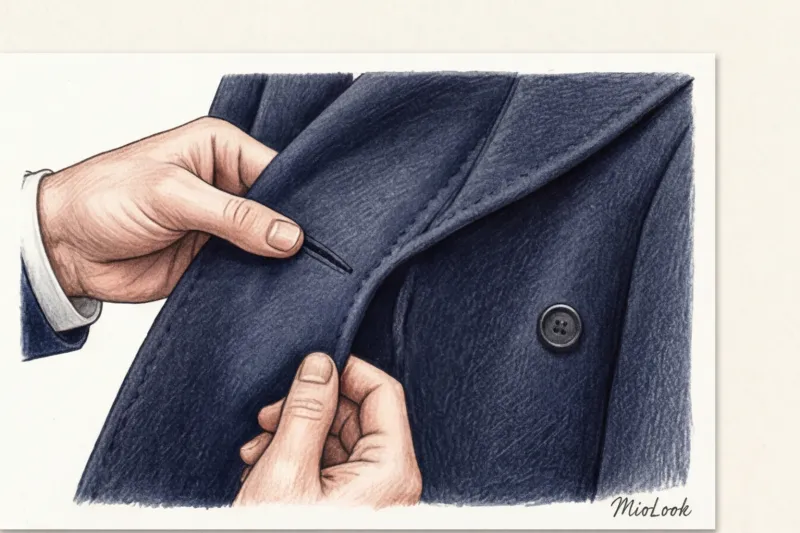
Seam allowances as a hidden luxury marker
Another invisible detail is generous seam allowances. Mass-market factories cut garments tightly, saving every millimeter of fabric in millions of copies. Premium brands always leave 2–3 centimeters of allowance at the side seams, center back seam, and hem.
Why is this critically important for investing? Our bodies change—it's a natural process. A true investment piece should be able to be re-tailored in a tailor's shop five or even ten years later. This trick won't work with mass-market clothing: there's simply no material to create volume.
The Lining Rule: Invisible Comfort
I'm genuinely amazed when I see a luxurious pure alpaca coat for €900 lined with 100% polyester. Polyester is plastic. Would you wear a plastic bag over a cashmere sweater? That's exactly what happens when a manufacturer skimps on the backing. Polyester doesn't breathe, creates a greenhouse effect, and negates all the thermoregulating properties of expensive wool.
The right investment outerwear, whether a trench coat or overcoat, always has a lining made of natural or artificial (but not synthetic!) breathable materials. Look for cupro (often labeled as Bemberg) or dense viscose. They wick away moisture, are completely static-resistant, and glide smoothly over your base layer without disrupting your silhouette.
Get into the habit of checking these four parameters before every major purchase. And to make the process more visual, I recommend conducting a technical audit of what's already hanging in your closet. When adding items to MioLook app , you can mark items with the right composition, French seams, and cupro lining. By analyzing your smart wardrobe statistics after a couple of seasons, you'll receive mathematical confirmation: these are the items that are worn most often, last longer, and fully recoup their initial cost.
Gold Fund: 4 Categories for a Flawless Wardrobe Investment
Every season, analyzing the front-row collections at Milan and Paris Fashion Weeks, I observe a fascinating paradox. Entire eras may change on the runways—from hyperbolic grunge and deconstruction to the sterile minimalism of the '90s—but the fundamental architectural principles of cut remain immutable. Beyond the visual noise, theatrical proportions, and fleeting hype, the bottom line of wardrobe investment always boils down to rigorous engineering. We don't pay for a flashy brand name on the tag; we pay for the precise mathematical calculations that assemble and shape our silhouette. Let's take a closer look at those four fundamental categories, investments in which are guaranteed to pay off for decades.
Outerwear: A Triumph of Architecture over Color
There's a persistent and dangerous misconception in the styling community: it's believed that a coat must be black or gray to be durable. In reality, color is deeply secondary. What matters most is volume, cut lines, and how the heavy fabric interacts with gravity. A poorly tailored black coat will visually transform you into a shapeless rectangle, while a brilliantly crafted camel or deep emerald coat will create a monumental and stately appearance.
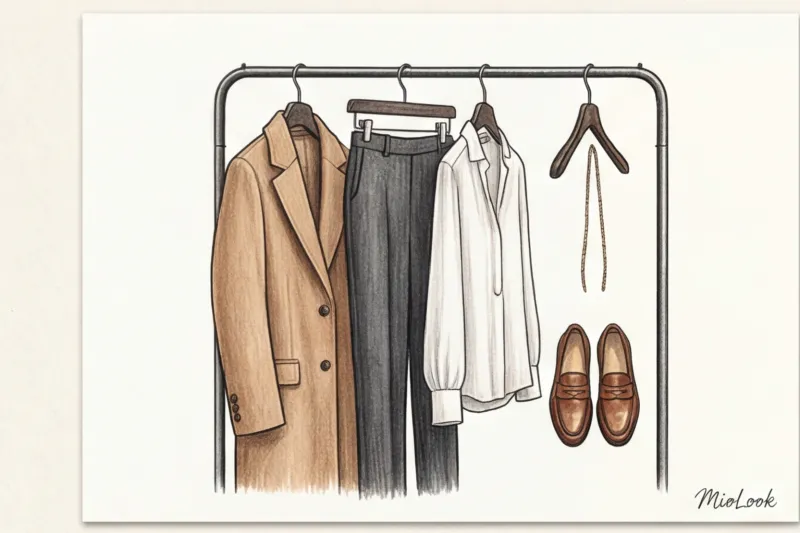
A textbook example of a flawless investment is the legendary double-breasted Max Mara coat 101801, created by French designer Anne-Marie Beretta in 1981. Its enduring value lies in its one-piece kimono sleeves, perfect 120-centimeter length, and precise proportions. This cut allows it to be worn with equal grace over a sheer silk slip dress or a voluminous chunky-knit men's sweater. This isn't just a piece of expensive wool; it's a functional, architectural cocoon.
A historical excursion brilliantly confirms the rule: function always creates perfect form. Consider the creation of gabardine by Thomas Burberry in 1879. Before his invention, outerwear for London's inclement weather was heavy, rubberized, and impermeable. Burberry created a tightly woven cotton fabric that naturally repelled water. The classic trench coat was conceived not as a fashion accessory, but as utilitarian military gear. Epaulets held the shoulder straps, the back yoke acted as an umbrella to shed rainwater, and deep pockets protected documents. Today, when you spend $1,500 or €2,000 on a premium trench coat, you're investing in this historically proven utilitarian cut, which automatically makes any look, even the most relaxed, look put-together and formal.
Structured Jackets and Suits: Shoulder Geometry
If outerwear is the façade of your personal style, then your suit is its supporting structure. And here, shoulder design is absolutely crucial.
"A jacket always starts with the shoulder. If the shoulder line is improperly constructed, if the garment is out of balance, even the most expensive Italian silk or dense English wool won't save the fit." This golden rule was repeated to me time and again by the bespoke tailors on the famous Savile Row.
The colossal difference between a mass-market jacket and a premium investment piece is hidden within the lining. In the budget segment, cheap fusible interlining holds its shape. After several inevitable dry-cleaning cycles, the adhesive breaks down, and the fabric on the lapels begins to bubble unsightly. Expensive jackets use a "floating interlining" (full or half canvas) made of horsehair and cotton. Under the influence of your body's natural heat, this construction literally "remembers" you over time, adapting to your individual anatomical contours.
Invest in a shape that complements your figure and lifestyle. Whether it's a sharp, accentuated shoulder in the spirit of early Yves Saint Laurent, which creates an aggressive dynamic, or a soft, rounded Neapolitan shoulder (the so-called spalla camicia), which conveys relaxed, intellectual chic, the right cut shapes your posture and how confidently you occupy the space.
Access to MioLook for €0.99 — one-time payment
Start creating your perfect looks with AI and digitize your wardrobe for easy investment capsule planning.
Get access — €0.99 onceShoes and bags: the foundation of status
Accessories are the finishing touches, paradoxically boasting the highest Cost Per Wear ratio, as they are the items we wear the most and most frequently. The quality of your bags and shoes determines whether your look will look expensive or fall apart.
The "visual weight" rule and logo-free forms
When it comes to bags, the number one rule for long-term investment is a categorical rejection of flashy logos and overly accentuated hardware, which any insider can instantly use to determine the year of a collection. The era of logomania is cyclical and fleeting, while the concept of quiet luxury is timeless. Invest in clean geometric shapes: trapezoids, crisp rectangles, and saddle-shaped models with minimalist trim.
The design of the bag itself is critical here. Why does a rigid, framed bag last so much longer than a soft one? Soft leather (like delicate nappa) without a rigid internal frame quickly deforms under the weight of everyday contents, its corners wear against outerwear, and its silhouette sag irreversibly. A framed bag—think of the classic Hermès Kelly or the austere Celine Classic Box—retains its original geometry for decades, requiring only light edge repair every few years.
When creating an outfit, it's also crucial to consider the principle of "visual weight." A heavy, voluminous tweed coat will visually "crush" an elegant small bag made of fine suede. Dense, textured fabrics require structured accessories made of thick, smooth or grained leather. This creates the right visual balance, which we discussed in detail in our the complete guide to capsule wardrobe.
Status footwear: engineering comfort and durability
Why do classic penny loafers, tailored Oxfords, or simple 85mm stiletto pumps always seem to be on everyone's must-have lists? The answer lies in a single professional term: the shoe last. A shoe last is a wooden or plastic mold used to create shoes. Heritage brands like JM Weston, Church's, and Manolo Blahnik have been perfecting their lasts for decades.
The high price of luxury shoes (which currently range from €600 to €1,200) is justified not only by the brand name but also by the quality of the raw materials. Investment shoes are made from full-grain calfskin (with the top layer intact). It is naturally porous and absorbs skin care products, acquiring a refined vintage patina over time. Mass-market shoes often use split leather (the bottom layer of the hide), generously coated with a layer of polyurethane. Such shoes are completely impermeable, and deep cracks quickly form at the natural folds, exposing the synthetic lining. Such defects are essentially irreparable.
Leather soles deserve special attention in the premium segment. In boutiques, consultants often say, "They breathe and adapt perfectly to the anatomy of the foot." This is absolutely true; a leather sole is an unmistakable sign of an expensive classic shoe. However, in the harsh realities of the city, with its harsh asphalt, winter chemicals, and autumn rains, this is an extremely vulnerable spot.
My personal style hack that's guaranteed to prolong the life of your shoe investment: after buying an expensive pair with leather soles, wear them 2-3 times exclusively in dry weather. The soles should be lightly scratched on the pavement to remove the slippery factory shine. Afterward, immediately take the pair to a reputable shoe repair shop and have them fitted with thin rubber protectors (such as Vibram). This simple step will reliably protect the welt threads from fraying and save the expensive leather from damaging moisture, turning your shoes into a truly timeless investment, ready for any challenge.
Your Style DNA: Adapting Your Timeless Wardrobe to Your Lifestyle
One of my clients, a successful freelance UX designer, once proudly showed me her biggest fashion purchase of the year—a tailored, structured Saint Laurent jacket for €2,400. “Everyone says it’s the perfect basic,” she explained. The problem was, her typical week consisted of hours of coding in her home office, relaxed meetings in a coworking space, and brunches. For two years, she hadn’t worn this sartorial masterpiece even once: it was uncomfortable for sitting at her laptop, and it looked too pretentious for her usual environment. This story is a classic illustration of how blind people wardrobe investments crash into harsh reality.
To understand the reason for such costly mistakes, I often turn to the psychological concept of style archetypes. The basic wardrobe of a corporate lawyer in the financial sector and a creative director at a digital agency simply cannot overlap. For the former, a status uniform is built around hard lines, dense fabrics, and closed shoes—this is the visual embodiment of the archetype. Ruler. For the second (where the archetype dominates) Creator ) A deconstructed Maison Margiela trench coat, premium Japanese Kuroki denim, or a voluminous, intricately knit cardigan are more likely to be an investment piece. A classic business suit on a creative professional will look like a rented uniform.
Before spending a significant amount of money, I make my clients conduct a brutal but sobering lifestyle audit—create a busyness chart. Take the last 14 days of your life and honestly divide them into sectors: office, remote work, evening outings, walks, sports. If the office with a strict dress code accounts for only 15% of your time, then the budget for a strict business capsule should not exceed this 15%. To automate this mathematical calculation, I recommend using analytics function in the MioLook app By digitizing your belongings, you'll get precise statistics: which categories truly shape your everyday style, and which are purchased for a fictitious version of yourself.
Another dangerous stereotype concerns color palette. For years, glossy magazines have been telling us that a universal base must be black. However, in practice, black is far from always the best base color. Firstly, it's harsh on the complexion: for most European skin types, it highlights fatigue, skin texture, and under-eye shadows. Secondly, black instantly collects lint on textured wool or cashmere, requiring obsessive lint roller cleaning. Much more "expensive" and versatile alternatives for a wardrobe foundation include dark chocolate, deep graphite, rich navy, or cool taupe. A dark blue jacket looks less formal, but still pairs effortlessly and elegantly with both distressed blue jeans and tailored pleated trousers.
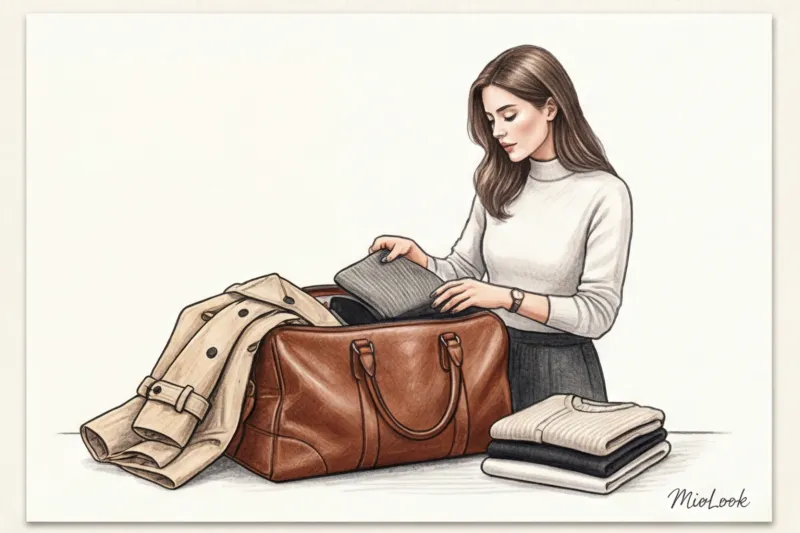
Finally, your long-term purchases should carefully consider geography and mobility. The choice of textures directly depends on the climate and frequency of travel. If you spend half the month on planes and trains, it's worth investing in wrinkle-resistant fabrics: high-twist wool (often used in premium brands' travel collections), dense viscose, or technical silk with added elastane. Buying a luxurious but heavy 100% camel wool coat is pointless if freezing rain falls in your region most of the winter. In such a climate, it's smarter to invest in a minimalist parka with a Gore-Tex membrane from technical brands like Herno. Remember the main rule: a timeless item is one that enhances your comfort, not one that requires you to change your habits.
Micro Trends vs. Macro Trends: Which Are Safe to Invest in?
The most damaging misconception about investment wardrobes is the belief that they are completely static. Analytical report McKinsey State of Fashion Year after year, the trend confirms a crucial principle: the fashion market is driven not only by fleeting hype, but also by long-term macro trends. The difference between the two is colossal. A micro trend (for example, micro bags, neon colors, or viral low-rise jeans) fades within six months. A macro trend is a tectonic shift in global silhouettes that shapes new "classics" for five to ten years to come. Recognizing such shifts is a key skill when building a luxury wardrobe.
A prime example of how a macro trend can forever change the rules of the game is the evolution of oversized fashion. In my practice, clients often ask for a "classic fitted jacket," citing looks from decades ago. But the paradox is that the very concept of a "classic fit" has irreversibly changed. The global demand for comfort and relaxed geometry has shifted basic proportions. The modern "timeless" jacket now implies slightly dropped shoulders, a straight cut, and air between the fabric and the body. If you buy a slim, stiff blazer today in the name of "timeless style," it won't look classic—it will only betray an outdated approach to silhouette.

When it comes to patterns, many stylists advise avoiding them for the sake of maximum versatility. I'm categorically against such sterility. Investing in prints is absolutely safe if you choose historical geometric patterns. Breton stripes, Prince of Wales checks, and traditional houndstooth are timeless. Why? Their DNA is rooted in classic menswear tailoring, making them visual neutralizers. A houndstooth jacket has a strict optical balance that easily pairs with basic jeans and evening silks.
This historical continuity leads us to the most reliable form of fashion investment: investing in vintage and the archives of famous brands. Today, buying archival items is like acquiring genuine wearable assets. Finding a well-preserved Burberry trench coat from the '90s or a minimalist Celine coat from the Phoebe Philo era on resale platforms will cost you around €600–€1,500. Unlike modern mass-market fashion, these items have already stood the rigorous test of time. They have proven their relevance to the global macro-cycle, and their value on the secondary market only increases over time.
Before investing heavily in an archival find or a new macro silhouette, you need to make sure it will fit seamlessly into your capsule wardrobe. To avoid having to think about dozens of possible combinations, I recommend uploading your current pieces to MioLook smart wardrobe — a visual digitization of your closet will instantly show whether this purchase will be your best investment of the decade or another mistake.
Your ideal image
it begins Here
Join thousands of users who look flawless every day with MioLook.
Get access — €0.99 onceStylist Checklist: 5 Questions to Ask Before Making a Major Wardrobe Investment
The fitting room is a high-risk area for your budget. Soft lighting, the euphoria of shopping, and clever merchandising often lead us to make purely emotional decisions. To regain my composure, I've introduced a strict filter into my practice—a five-question protocol. My clients are required to run it through their heads before approaching the cash register with a hefty check.
1. Can I create at least 5 different looks with this item from what I already have?
A luxury item shouldn't be a capricious lead singer who needs a new backup dancer. If you have to buy shoes, an architectural shirt, and the right belt to go with your luxurious €400 palazzo, it's no longer an investment, but a financial black hole. The ideal scenario is when you instantly visualize five ready-made combinations with your current basics. If your imagination falters right in the store, upload a photo of your potential purchase to MioLook smart wardrobe function and check how it aligns with your real assets.
2. Am I willing to pay for dry cleaning and special care for this fabric?
A perfectly tailored silk blouse might cost a reasonable $150, but if it requires professional dry cleaning after every two wears (an average of $20 per session), its real cost will increase exponentially over the course of a year. Be realistic about your household resources: if you hate steaming or regularly visiting a dry cleaner, invest in heavyweight cotton, high-tech wool blends, or premium denim.
3. Does this item suit my figure NOW, and not when I lose/gain weight?
Buying clothes "for motivation" is the most common source of frustration, which I address in my personal consultations. I call it "aspirational sizing"—a psychological trap that forces us to buy clothes for an imaginary version of ourselves. Clothes should beautifully flatter your body as it is, not act as a tool of pressure. If your belt digs into your waist today, you won't wear those pants tomorrow or next month.
4. Am I comfortable moving in it (arm raising and squatting test)?
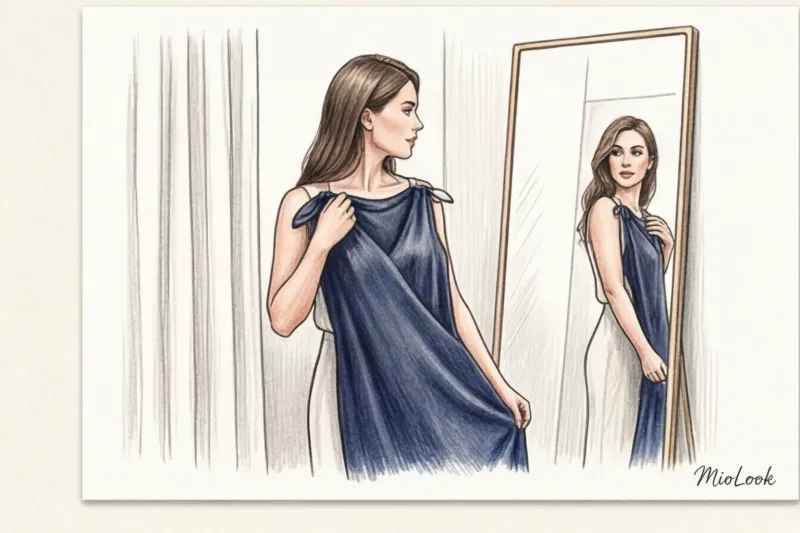
An expensive item must be functional. Conduct a crash test right in the fitting room: raise your arms as if you were reaching for a folder from the top shelf. Sit on a ottoman, cross your legs, and mimic a long stride. If the armhole of your jacket is treacherously tight, your skirt is slipping to a critical point, and your trousers are restricting your stride, the cut isn't designed for your anatomy. A prestigious wardrobe shouldn't turn you into a beautiful but rigid display mannequin.
5. Does the quality of the fittings correspond to the stated price?
The devil in the premium segment lies in the utilitarian details. Carefully examine zippers, buttons, and interior fasteners. A metal zipper (such as the benchmark Riri or YKK Excella) on an €800 jacket shouldn't snag or scratch your hands. Buttons made of cheap, shiny plastic can visually ruin even a perfectly tailored garment. Brands that truly create pieces that last for decades use horn, natural mother-of-pearl, corozo walnut, or heavy matte metal for their hardware.
If you answered "no" to any of these questions, feel free to return the item to the rail. Your perfect investment is still waiting for you, and there's no room for compromise.
Investment Care: How to Extend the Life of Luxury Items
According to a confidential report from the Institute of Textile Care (2023), 70% of wear and tear on luxury items occurs not on the streets, but in the washing machine drum. Harsh enzymes in modern detergents literally "eat" the protein fibers of silk and cashmere, and mechanical friction during the spin cycle destroys the twist of the threads. Behind the scenes at London's Savile Row tailors, they'll tell you bluntly: the best wash for an expensive wool suit is no wash at all.
Literate wardrobe investments require a paradigm shift: we should not wash clothes after each wear, but refresh Her. Theatrical costume designers, rescuing couture outfits after hours-long performances, use a tried-and-true trick: a spray bottle with a one-to-one mixture of distilled water and high-quality vodka. The alcohol evaporates instantly, taking with it any body odors or perfume, without damaging the fabric's structure. Ironing is another silent killer of premium wool. Hot metal flattens the threads, leaving glazes (treacherously shiny marks) on dark wool. Professional workshops use only powerful vertical steam: it relaxes the fibers, allowing them to assume their natural shape without harsh physical pressure.
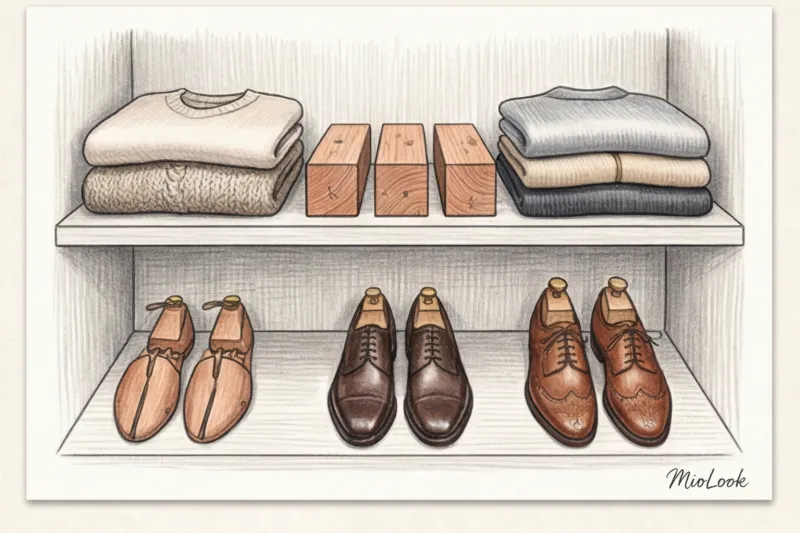
Storage architecture determines the longevity of your clothes. A luxurious blazer with a perfect shoulder line, for which you paid €800, will lose its shape in a month if hung on thin wire hangers brought home from the dry cleaner. For structured silhouettes, wide wooden hangers (at least 4-5 cm at the ends) are essential, as they physically follow the natural curves of the human body.
The same rule applies to high-end footwear. Leather loafers or Oxfords are full of moisture after twelve hours on your feet. If you don't insert cedar shoe trees immediately after taking them off, the leather will dry out, creating deep creases, and the stitching will begin to fray from the inside. Be sure to use unvarnished cedar shoe trees, not cheap plastic shoe trees. Cedar draws out moisture, naturally disinfects the interior, and, thanks to its spring mechanism, returns the shoe to its original factory shape.
When it comes to premium knitwear, the main enemy isn't pilling, but clothes moths. Behind the scenes at boutiques specializing in fine fleece, customers are always warned: moths don't feed on the cashmere itself. They're attracted to the microscopic particles of skin, sebum, and drops of perfume that remain on the fibers. The golden rule for protecting cashmere is this: never put a sweater away for the season if you've worn it even once. Only delicate wash (by hand, with an enzyme-free liquid detergent) or dry clean immediately before vacuum packing. Dry such items strictly horizontally on a terry towel to prevent the weight of wet water from stretching the neckline. Forget toxic mothballs—modern stylists are saving archives with safe pheromone traps and sachets of Florentine sandalwood.
A true indicator of status and the culture of a sustainable wardrobe is timely repairs. For decades, the European bourgeoisie has been passing on the contacts of trusted restorers by word of mouth. Worn heels, the protection of leather soles with thin rubber pads (to prevent slipping and abrasion of the original leather on the pavement), and the micro-mending of an accidental snag on wool trousers are not signs of austerity. They are a sign of deep respect for the work of tailors and high-quality materials. Instead of throwing away $600 shoes because of an annoying scratch on the heel or a worn toe, a professional restorer will restore them for $40, visually returning them to like-new condition.
A truly smart wardrobe isn't a bottomless pit of new purchases, but a living ecosystem where every item has its place and a schedule for careful maintenance. To avoid having to remember which coat needs to be dry-cleaned and which boots need new heels, I recommend keeping track of your belongings electronically in an app. MioLook By digitizing your capsule, you can assign statuses to each item and intelligently plan seasonal storage without unnecessary stress. In closing our conversation about timeless style, I want to remind you: a true investment isn't a number on a receipt. It's the years of impeccable service, absolute comfort, and self-confidence that a piece will give you in return for proper care.
Guide Chapters
Basic Jewelry for Women: What's Always in Style
The standard jewelry essentials list is hopelessly outdated. Learn how to build a jewelry wardrobe that will highlight your individuality, not your age.
Classic Women's Wristwatches: What to Invest in
The right accessories can instantly elevate any look. Find out which watches are truly worth investing in.
Classic Basic Jeans: How to Find Your Fit
There's no such thing as a one-size-fits-all pair of jeans. We'll show you how to look at denim through the eyes of an engineer and find your perfect pair beyond the latest trends.
Quiet Luxury Style: A Wardrobe That Looks Expensive
Quiet luxury isn't about avoiding color, but rather about architectural cuts and perfect fabrics. Learn how to build a wardrobe that looks like a million bucks.
The Classic Beige Trench Coat: How to Find a Burberry Alternative
How to find the perfect mid-range raincoat that looks and wears like luxury? We'll explore the anatomy of a trench coat and learn how to identify quality.
How to Determine the Quality of Clothing Before Buying: Stylists' Tips
A price tag and a big brand name no longer guarantee durability. A personal stylist shares secrets on how to recognize a truly high-quality item at first glance.
A Basic White Shirt for Women: A Guide to Choosing
Forget the myth that oversized men's clothing suits everyone. Let's figure out how to choose the perfect white shirt based on your body shape and fabric thickness.
How to choose a cashmere sweater that won't pill
Why is overly soft mass-market cashmere a bad sign? Learn the secrets to choosing the perfect sweater that will last for years to come.
Cost per wear formula: calculating the real cost of an item
The most expensive items in your closet are often cheap, one-time purchases. Learn how to calculate the true cost of your clothes and stop wasting your budget.
How to Choose a Basic Jacket: Cut and Fabric Guidelines
Discomfort in a jacket isn't a size issue, but a pattern error. We'll tell you what to look for when buying one to ensure you feel confident and comfortable.
Basic Women's Shoes: 5 Pairs You Shouldn't Skimp On
Tired of beautiful but uncomfortable shoes? Discover 5 pairs of shoes that will become the perfect, stylish foundation for your wardrobe.
The Perfect Basic Women's Coat: How to Choose the Right One for You
Forget the harmful myths about the versatile beige coat. Let's break down outerwear down to its molecule: from the weight of the cloth to the geometry of the cut.
The Perfect Everyday Basic Bag: How to Choose One
The "Genuine Leather" label isn't always a guarantee of quality. Learn the secrets of choosing the perfect everyday bag from a professional stylist.