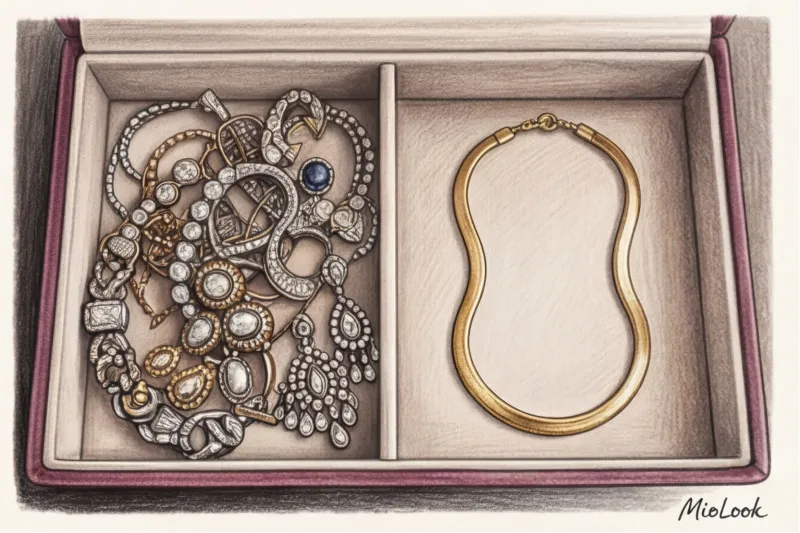
You know what item I most often relegate to the back of my closet when I'm sorting through my wardrobe? A classic short strand of round, perfectly even pearls. For decades, glossy magazines have been telling us they're an absolute must-have that will save any look. But the harsh reality is this: in today's world, classic pearls make 80% of women look older, adding a decade to their age, unless you style them with ripped grunge T-shirts or sharp, masculine jackets.
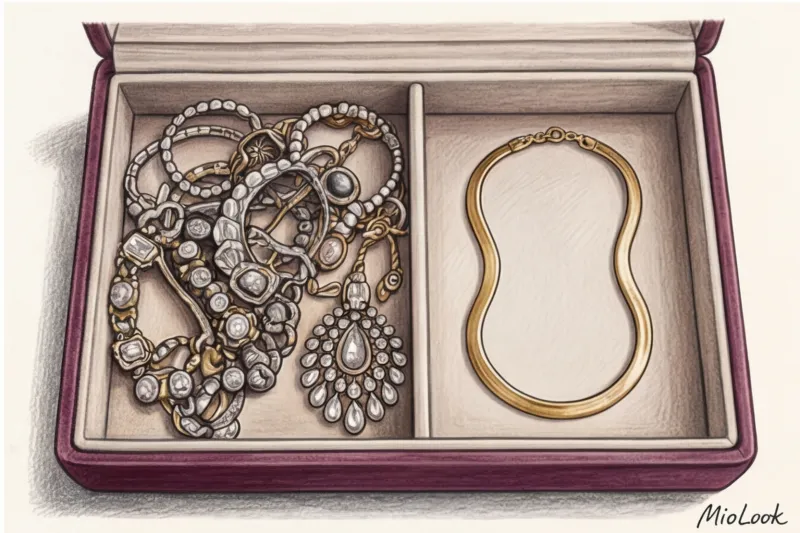
We discussed in more detail why the concept of a standardized list of things is hopelessly outdated in our The Complete Guide to Wardrobe Investments The jewelry base operates according to the same laws. Correct basic jewelry for women — This isn't a cookie-cutter checklist of diamond studs and a gold chain. It's an engineered approach to your appearance, bone structure, and, most importantly, your lifestyle.
The "One-size-fits-all" Illusion: Why Standard Jewelry Lists Don't Work
Over 12 years of working as a stylist and regularly attending jewelry presentations during Paris Fashion Week, I've learned one rule: jewelry only lives when it's functional. In my experience, eight out of ten expensive sets given as gifts (especially those with a necklace, earrings, and ring all in the same design) end up as dead weight in clients' homes. Why? Because they were bought for a fantasy life that modern women simply don't have.
A jewelry essential is a set of functions. You should have a piece that pulls your face together on a makeup-free morning Zoom call. You should have a ring that doesn't snag your nylon tights when you're putting them on in a hurry. And you should have a chain that doesn't get caught in the collar of your favorite cashmere sweater. If a piece doesn't pass the utility test, it's not an essential; it's a situational accessory.
Jewelry Wardrobe Architecture: Basic Jewelry for Women of Different Body Types
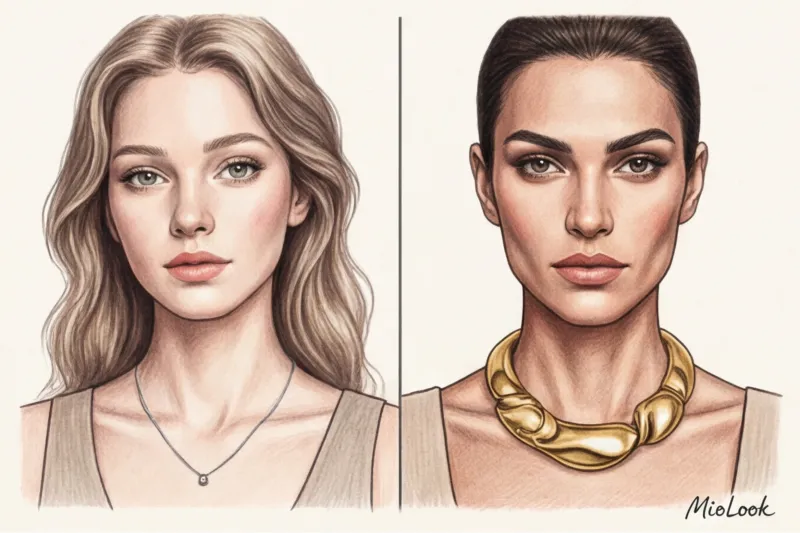
Before buying the first necklace you see, we need to evaluate your physical characteristics. In professional styling, there's a critical concept: the scale of your appearance. This determines whether a piece of jewelry will look expensive on you or will make you look ridiculous.
Scale and bone structure: the rule jewelers keep quiet about
If you have thin bones, narrow wrists, delicate collarbones, and small facial features, a massive gold choker 3 cm wide will visually overwhelm you. Your base is delicate shapes: thin chains (up to 2-3 mm), elegant choker rings, and small hoops. Conversely, on a woman with a large bone structure, tall stature, and expressive facial features, a minimalist spider chain will simply disappear, creating a "string" effect. Large links, puffy hoops, and voluminous earrings are essential. I discussed this principle in more detail in the article about Choosing accessories based on Kibbe body types.
Warm or Cold? Debunking Myths About Color Types and Metals
Forget the "gold for warm skin tones, silver for cool skin tones" rule. It's hopelessly outdated. Today, the contrast in your appearance and the overall palette of your wardrobe are far more important. If you have high contrast (for example, dark hair and fair skin), white gold or platinum with bright accent stones is ideal. If your contrast is low, consider matte yellow or rose gold. Rose gold (an alloy with added copper) is generally the most complementary metal for skin with mild redness or rosacea—it visually evens out the tone.
The Anatomy of the Perfect Base: Building a Personal Collection
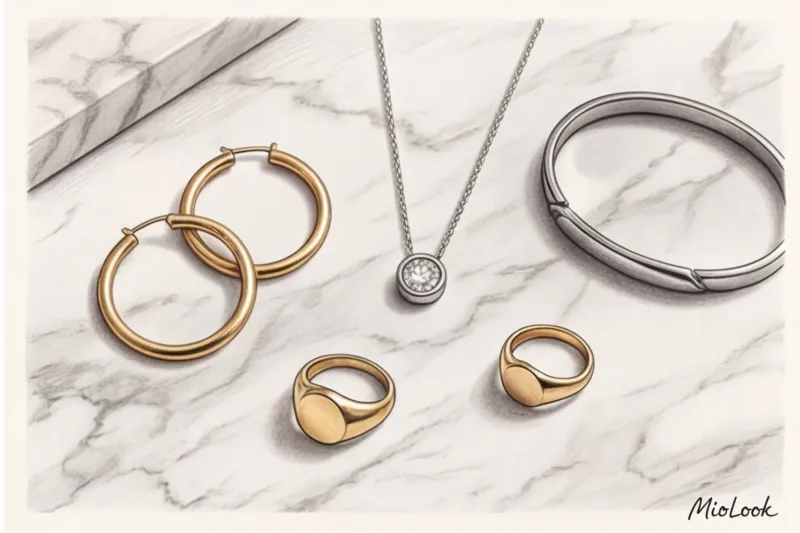
The great designer Elsa Peretti, creating her iconic collections for Tiffany & Co., was guided by one principle: jewelry should feel like a second skin, blending seamlessly with the body. Ergonomics is the secret to luxurious, essential jewelry for women.
Stud Earrings and Hoop Earrings: How to Find Your Perfect Shape
Diamond studs are beautiful, but let's be honest: they often look boring. If you're looking for a modern staple, consider small hoops (rings) with a diameter of 1.5 to 2.5 cm. For thin lobes, choose hollow hoops—they add volume without weighing down the ear. If you're going for studs, choose a unique stone cut: baguette or emerald cuts look significantly more prestigious than the usual round diamond, and metal with a "crinkled foil" texture adds a dynamic touch.
Your ideal image begins Here
Join thousands of users who look flawless every day with MioLook. Our smart algorithm will help you choose the perfect jewelry to match any outfit.
Get access — €0.99 onceChains and pendants: the focal point of the portrait area
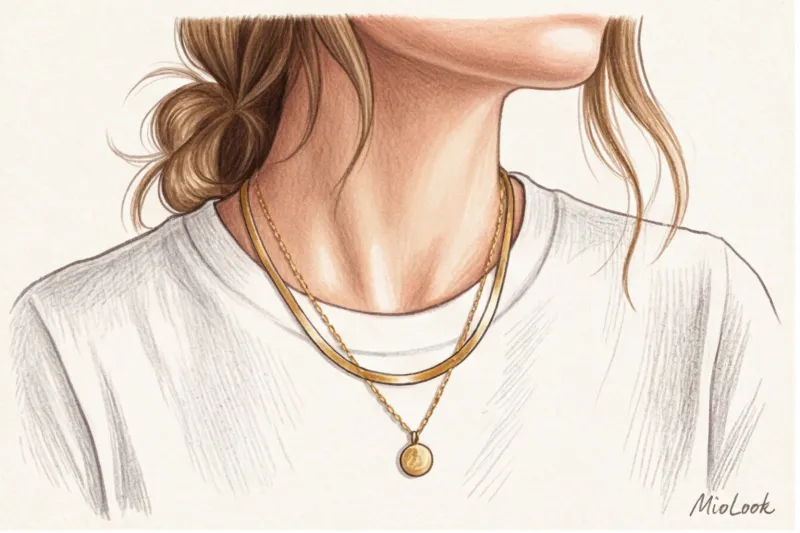
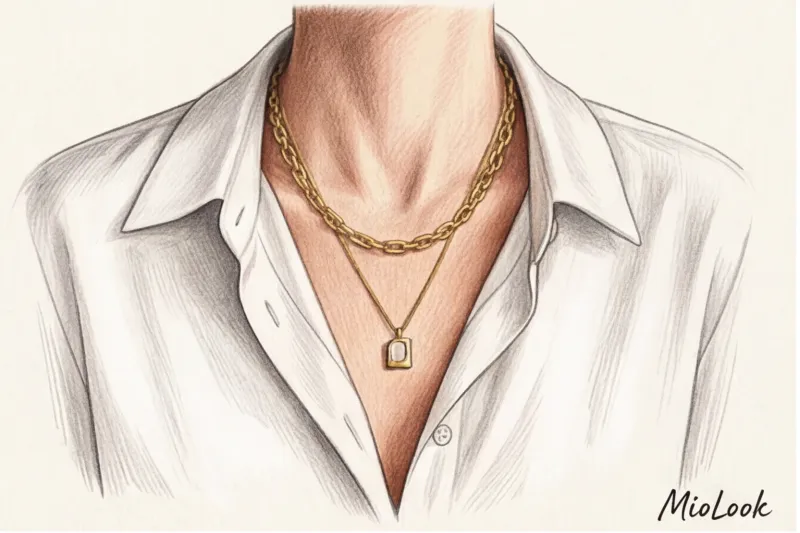
The ideal base chain should end where the neckline of your most frequently worn garment begins. Shirts and V-necks require a length of 40-45 cm. The type of weave is critical: anchor or curb weave are the most reliable and won't kink. However, the popular flat snake chain requires perfect posture and careful storage, otherwise it will develop irreparable creases. The pendant should have personal touch — whether it’s a vintage medallion or a minimalist geometric symbol that’s uniquely you.
Rings and bracelets: a practical choice for keyboardists
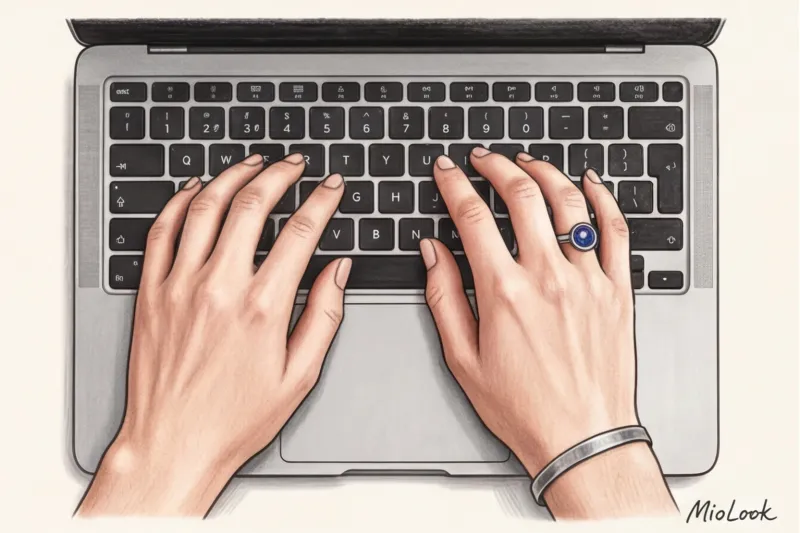
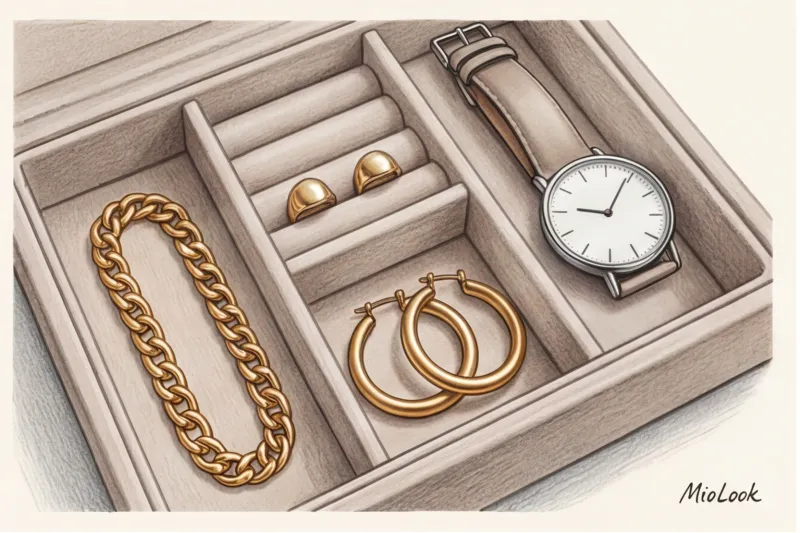
One of my clients, a top manager at an IT company, bought a stunning, rigid bangle bracelet from a well-known brand. At the very first presentation, it became clear that the bracelet was loudly banging against the MacBook case with every movement, distracting the entire board of directors. If you work at a computer, your go-to wristwear is a soft chain bracelet or a watch with a leather strap.
It's the same story with rings. Choose a bezel setting, where the stone is pressed around the perimeter with metal rather than held in place by protruding prongs. This type of ring will never snag on a silk blouse or cashmere, which is especially important if you're shaping stylish office wardrobe.
Investments vs. Trends: What's Worth Paying for?
There is a rule for calculating profitability in the jewelry market: Cost-per-wear (price per wear). Let's say you bought a trendy pair of large earrings made of costume jewelry for $50. You wore them five times, after which they oxidized or went out of style. The price per wear is $10. Now, take a smooth ring made of solid 14-karat gold for $500. You wear it every day for three years (1095 days). The price per wear is only $0.45. You should only invest in items that come into contact with your body every day.
The Mohs Scale: Which Stones Will Survive Everyday Wear?
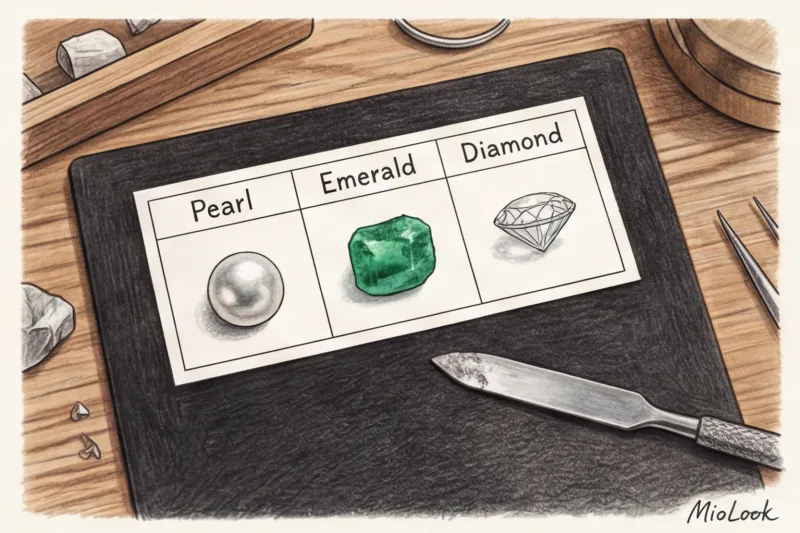
According to the Gemological Institute of America (GIA) standards, not every gemstone is suitable for a base. The Mohs scale measures mineral hardness on a scale of 1 to 10. If you're choosing a base ring for everyday wear, the stone should have a hardness rating of at least 7.5, otherwise it will become micro-scratched, dull, or chip if accidentally hit by a doorknob.
- Absolute NO for base rings: Pearl (hardness 2.5 - becomes cloudy from hand cream), Opal (5.5-6.5 - cracks from temperature changes outside), Emerald (7.5-8, but has natural microcracks, which makes it very fragile).
- Absolute "YES": Diamonds (10), Sapphires and Rubies (9), Topazes (8).
Important limitation: This rule applies specifically to rings and bracelets. In earrings and pendants (the portrait zone), where the risk of physical impact is minimal, you can safely wear both emeralds and pearls.
The Art of Combination: How to Wear Basic Jewelry Without Looking Boring
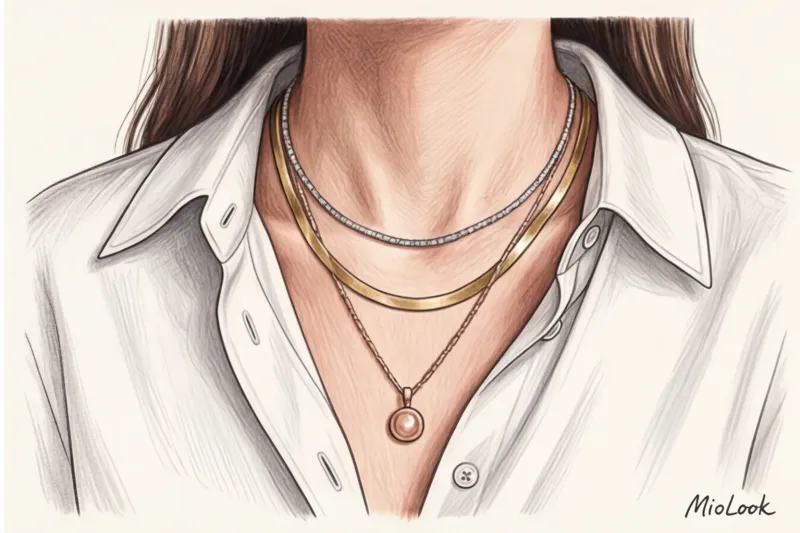
Observing street style at Fashion Week, I've long noticed: Vogue editors never wear full sets (matchy-matchy style). This is considered a sign of a lack of imagination. True chic is a clever mix.
The "don't mix gold and silver" rule is officially dead. Louis Cartier legitimized this mix in 1924 with the creation of the iconic Cartier Trinity ring (an intertwining of white, yellow, and rose gold). To ensure a harmonious blend of metals, use the 80/20 rule. Keep 80% of the metals in your look one shade (for example, yellow gold), and 20% a contrasting shade (silver or white gold). Or use a "bridge"—a single piece of jewelry that already blends two metals, such as a two-tone watch.
When the mix does NOT work: If the metals have different, clashing textures, for example, matte, roughly aged blackened silver paired with polished, glossy rose gold will look like an accidental mistake rather than a stylistic choice.
Checklist: An Audit of Your Current Jewelry Wardrobe
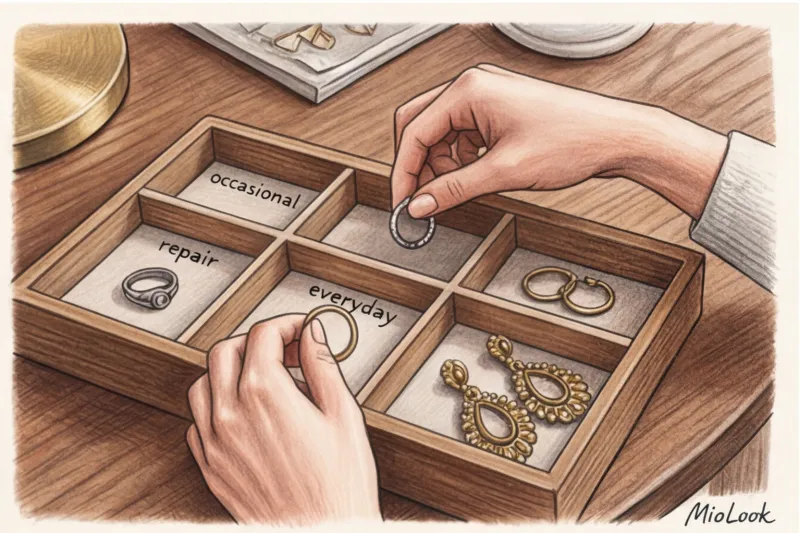
Before heading to a jewelry boutique, do a thorough inventory. I always make my clients empty their jewelry boxes onto the table and go through three steps:
- Inventory. Divide everything into three piles: 1) I wear it every week; 2) I wear it once every six months to events; 3) I haven’t worn it for more than a year (or ever).
- Analysis of "lost and found" items. Look at the first pile. What are you physically missing when you're getting ready for work? Perhaps your only earrings are too dressy for a strict dress code? (By the way, we wrote about dress code balance in the article about smart-casual style ).
- Shopping list. Make a wishlist not based on emotions (“I want a beautiful ring”), but on needs: “a smooth ring without stones, 4 mm wide, made of yellow gold.”
Access to MioLook for €0.99 — one-time payment
Take a photo of your favorite jewelry, upload it to your MioLook virtual wardrobe, and an AI stylist will show you which items they pair best with.
Get access — €0.99 onceSummary: Jewelry that works for you
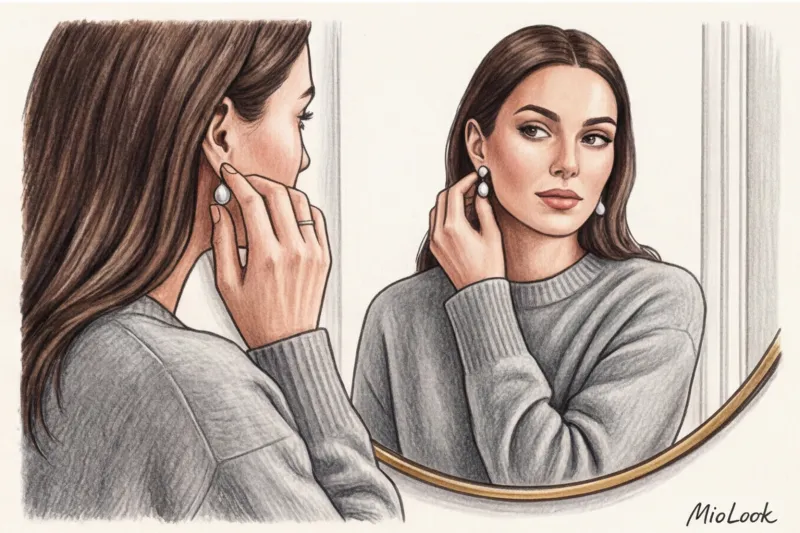
Essential jewelry for women isn't an abstract shopping list from a fashion blog. It's your personal style architecture, built on an understanding of your own bone structure, lifestyle, and the basic laws of gemology. The perfect jewelry essential is invisible to you, but obvious to others: it doesn't jingle during meetings, doesn't tear cashmere, and doesn't lose its shine with a drop of perfume.
Invest in quality, not quantity. Three flawless, ergonomic pieces made of solid gold or platinum that you'll wear every day for the next 10 years will do far more for your style and confidence than an overflowing box of disposable trends. Choose something that becomes an extension of you.