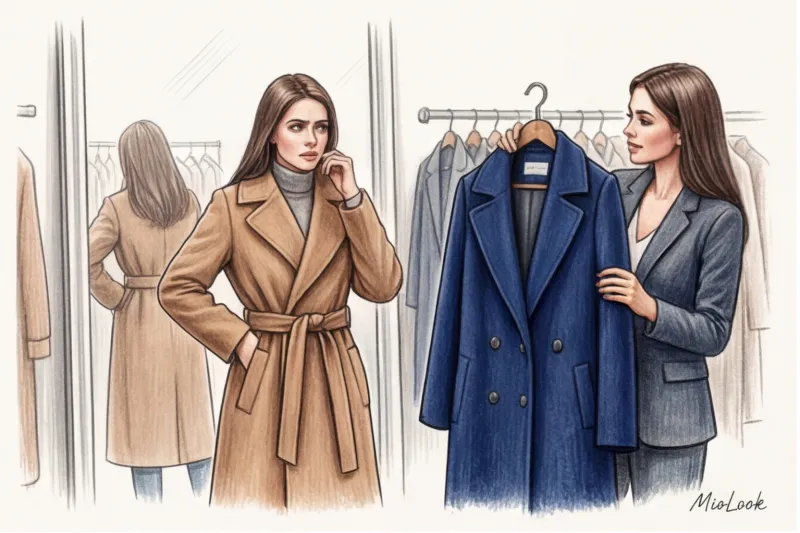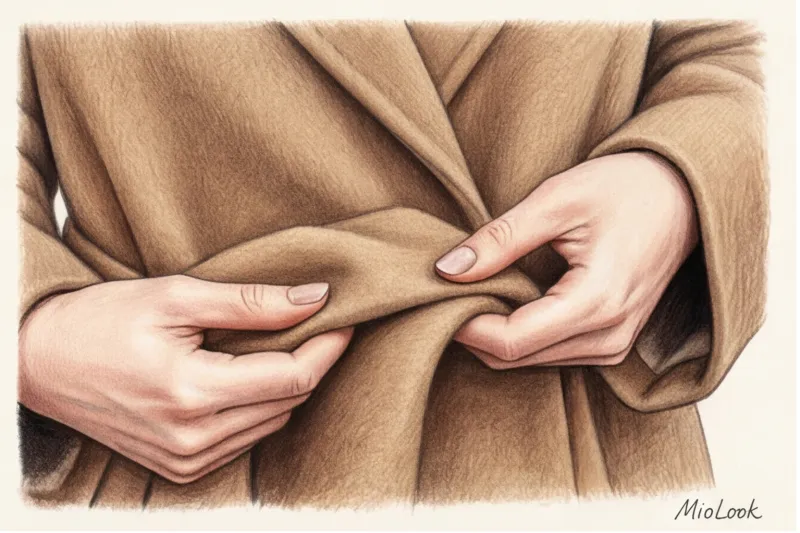
In 2018, in a private showroom during Paris Fashion Week, I watched buyers from top department stores select outerwear. They didn't look at logos and paid little attention to color. The first thing they did was turn the garment inside out, crumple the sleeve in their fist, and tug hard at the armhole seam. That's when I finally realized: the perfect women's basic coat It's not a matter of fashion. It's a matter of textile engineering and cutting geometry.
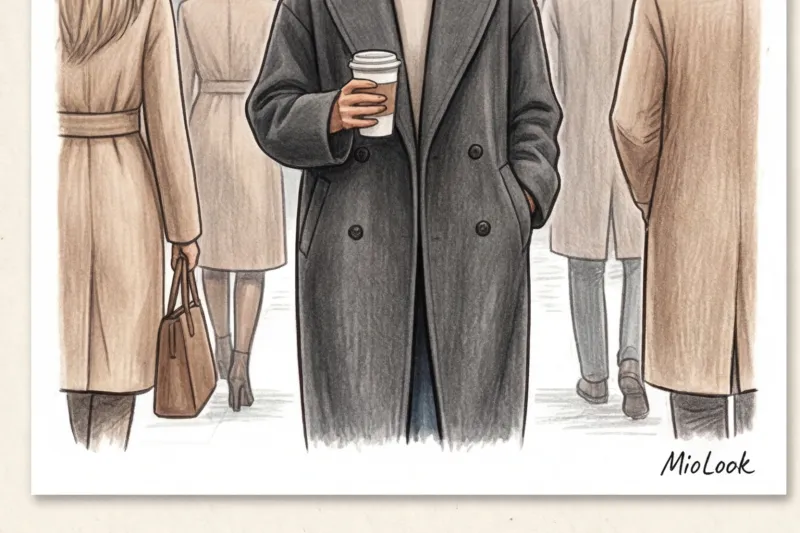
Every fall, the internet is flooded with articles urging you to buy "that one" beige robe coat because it supposedly flatters everyone and goes with everything. As a stylist with twelve years of experience, I can tell you this is one of the most damaging fashion myths. We've covered why "universal must-have" lists often do more harm than good in our complete guide to investing in your wardrobe and creating the perfect base Today, we'll break down coats down to their molecule-by-molecule dimensions: from the weight of the cloth to the armhole width, so your next purchase will last for years, not just until the first dry cleaning.
A Basic Women's Coat: Why Stylists' Standard Lists Are Misleading You
The concept of "basics" has long been distorted by marketers. We're sold the illusion that a basic item must be neutral, boring, and always camel-colored. But a basic isn't a color. It's a function.
One of my clients, the CEO of a large IT company, once complained to me about her "lucrative investment." She'd bought a gorgeous fitted cashmere coat for $2,500, from the classic "must-have" list. The result? She wore it three times in two years. It turned out the narrow armholes made it difficult to drive comfortably, and it was impossible to wear her favorite structured jackets underneath—the sleeves bunched up, restricting her movement.
Your choice of silhouette shouldn't be dictated by trends, but by your route. If you spend 80% of your time driving, you don't need a maxi-length coat—it will get tangled in the pedals and collect dirt from the door sills (your choice is a cropped cocoon or a pea coat). If your main transportation is the subway and walking, a midi or maxi length will be your salvation from the piercing wind. The difference between a true wardrobe investment and a "just for show" purchase is how well the item adapts to your reality.
Access to MioLook for €0.99 — one-time payment
A smart AI stylist will select the perfect look for every day, taking into account your lifestyle and existing wardrobe.
Get access — €0.99 onceAnatomy of an Investment: How to Read Fabric Composition to Avoid Buying "Cardboard"
Let's be realistic: we buy outerwear to keep warm. This is where the thermal conductivity of fabrics comes into play. Sheep's wool retains heat extremely well, alpaca is seven times warmer than sheepskin yet lighter, and camel wool has unique thermoregulatory properties (you won't be too hot on the subway or too cold outside).
But the composition on the label only tells half the truth. In textile engineering, there's a key metric: GSM (grams per square meter), or weight in grams per square meter. Mass-market brands often cheat: they'll list "100% wool" but use loose, thin wool with a low GSM (around 300 g/m²). Such a coat will be completely opaque. High-quality winter or mid-season wool should have a density of at least 500-600 g/m². How can you test this without a laboratory scale? The fabric should be tactilely dense, slightly springy when compressed, and not translucent when held up to a lamp.
The Myth of 100% Cashmere and the Benefits of Synthetics
There's a common misconception that 100% cashmere or 100% virgin wool is the pinnacle of creation and the best investment. I'm about to say something that might make luxury retailers hate me: 100% cashmere is the worst choice for a coat. for every day.
"Cashmere is the soft undercoat of the mountain goat. It's designed to keep you warm, not to withstand the daily friction of a heavy leather shopping bag strap or hard seats on public transportation."
An everyday workhorse requires structural strength. This is where the 80/20 rule comes into play. If high-quality wool contains 10-20% polyamide (nylon), don't rush to hang it back on the rail. According to textile lab research, adding 15% polyamide increases the wear resistance of wool fabric by 40%. This prevents pilling in high-friction areas: underarms, sides, and cuffs. However, acrylic and polyester in the composition basic Fabrics should be avoided at all costs - they don't keep you warm, quickly lose their appearance and cheapen the look.
Lining: invisible indicator of the item's status
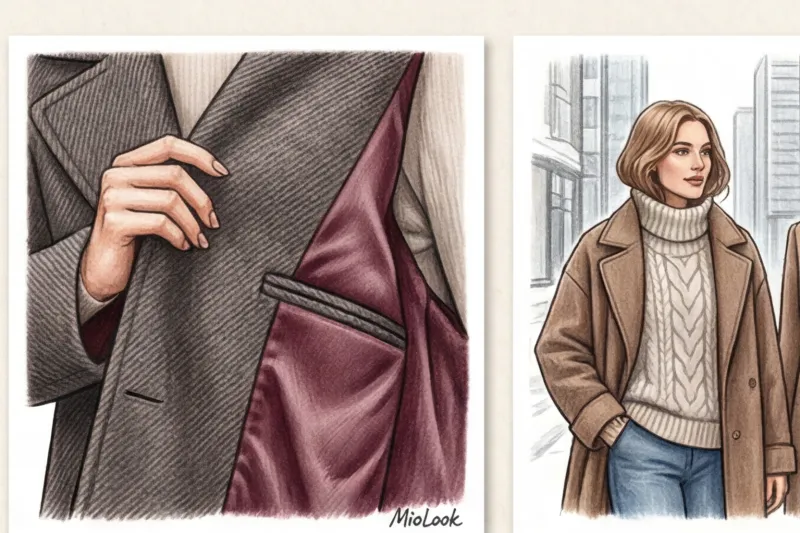
Brands love to skimp on lining because customers rarely notice it. You can buy beautiful wool for a lot of money, but if it's 100% polyester, you've bought a beautiful greenhouse. Polyester creates a greenhouse effect, negating all the breathability and temperature-regulating properties of expensive wool.
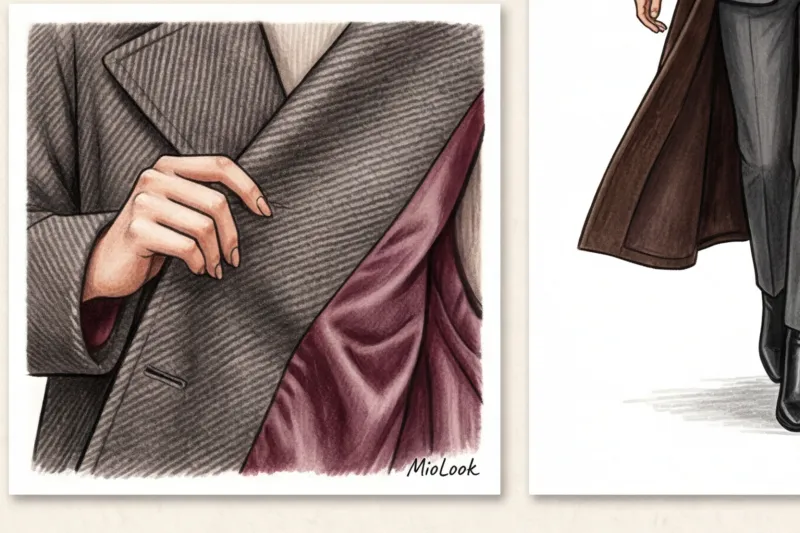
A high-quality coat is always identified by a lining made of cupro (a fabric made from wood pulp with a silky feel), viscose, or silk. They're slippery, don't generate static, and allow the skin to breathe. If a brand saved $20 per meter of cupro, you can be sure they also skimped on the inner lining (the glued lining), meaning the coat will lose its shape after the first rain.
Style and cut: an engineered approach to silhouette for years to come
Fashion is cyclical, but the evolution of outerwear volume is moving in one direction—toward comfort. The tight, skinny silhouettes of 2012 now look hopelessly outdated. This isn't just a designer's whim; it's a response to our desire for layering. Today, we want to wear hoodies, voluminous cardigans, and oversized jackets under our outerwear.
A straight cut (Chesterfield), a cozy cocoon in the style of Cristóbal Balenciaga, or a relaxed robe—choose your basics based on your temperature. And pay special attention to the length. Perhaps the most tricky length is right at the knee. It visually cuts the leg in half, throws off proportions, and turns choosing skirts into a nightmare (the hem will always be unflattering). Safe lengths: either a cropped, mid-thigh coat, or a confident midi (to mid-calf) or maxi.
Armhole and sleeve: a fatal mistake when trying on
The most common mistake I see when accompanying customers on a shopping trip is trying on outerwear over a thin T-shirt. This way, you'll never check the technical construction of the sleeve.
There are three main types of shoulder cut:
- Set-in sleeve A classic that creates a clean silhouette. It needs to perfectly match your shoulder line.
- Raglan Invented for Lord Raglan to conceal his missing arm after the Battle of Waterloo, it has no shoulder seam, visually softening broad shoulders and allowing freedom of movement.
- Dropped shoulder: The modern standard for layering.
Always do the "jacket test": a basic coat should easily accommodate your heaviest sweater or business jacket without straining the underarm area. A narrow armhole is the enemy of a modern wardrobe. However, I'll be honest with you (and here's the exception to the rule): a severely oversized, dropped-shoulder coat is absolutely unflattering for figures with pronouncedly sloping shoulders—it will make the silhouette look shapeless and bulky. In this case, a structured raglan with small shoulder pads is your choice.
Your perfect look starts here
Join thousands of users who look flawless every day with MioLook. Create your own virtual capsule in just a few clicks.
Get access — €0.99 onceColor palette: moving beyond the beige stereotype
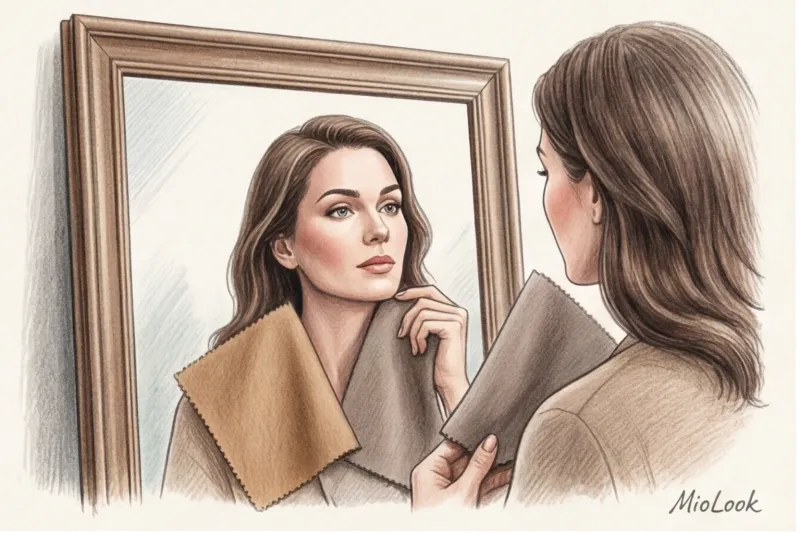
Let's return to the infamous camel color. Did you know that the classic warm beige shade blends mercilessly with Slavic skin, highlighting under-eye circles and fatigue?
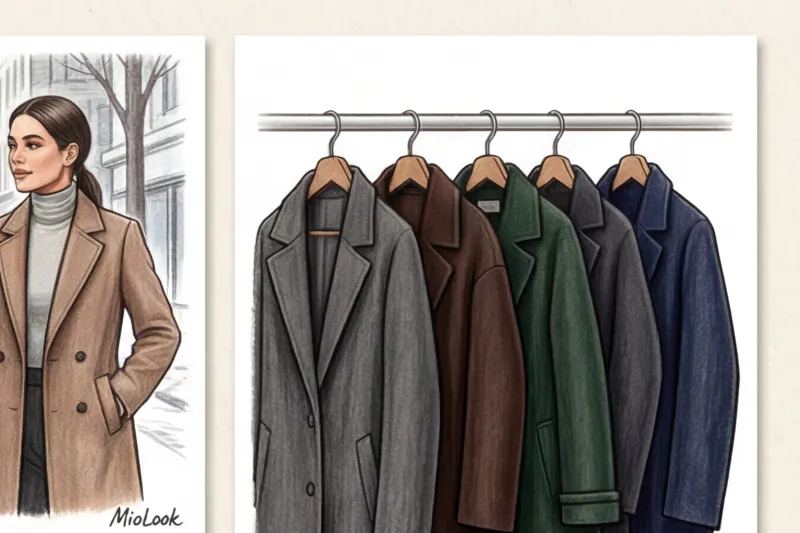
Pantone Color Institute analysis and WGSN trend bureau reports (2024) document a confident shift away from classic beige toward a "quiet luxury" aesthetic based on complex, deep tones. Alternative, visually much more expensive bases include deep graphite, dark chocolate, classic navy blue, and muted dark olive.
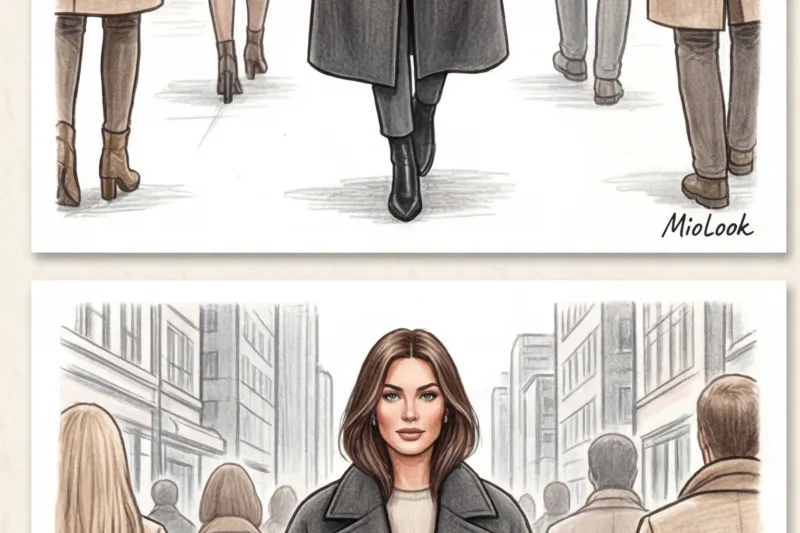
When choosing a color, consider the shoes and bags you already have in your closet. If 80% of your shoes are black, a navy or graphite coat will tie the look together better than a light one. Chocolate shades work phenomenally with burgundy and red leather.
Stylist Checklist: 5 Strict Coat Tests in the Fitting Room
Once you've found a style you like visually, don't rush to the checkout. Over 12 years of experience, I've developed five essential tests that I conduct with clients in the fitting room:
- Crease test. Squeeze the sleeve in your fist for 10 seconds and release. If the creases remain and don't straighten out, the garment will look wrinkled after just one taxi ride.
- Light test. Examine the fabric in bright light. The weave should be uniform, without any lumps or bald spots.
- Hands up test. Raise both arms. If the coat rises more than 5 centimeters with you and the collar presses against the back of your head, the balance of the garment is off and the cut is faulty.
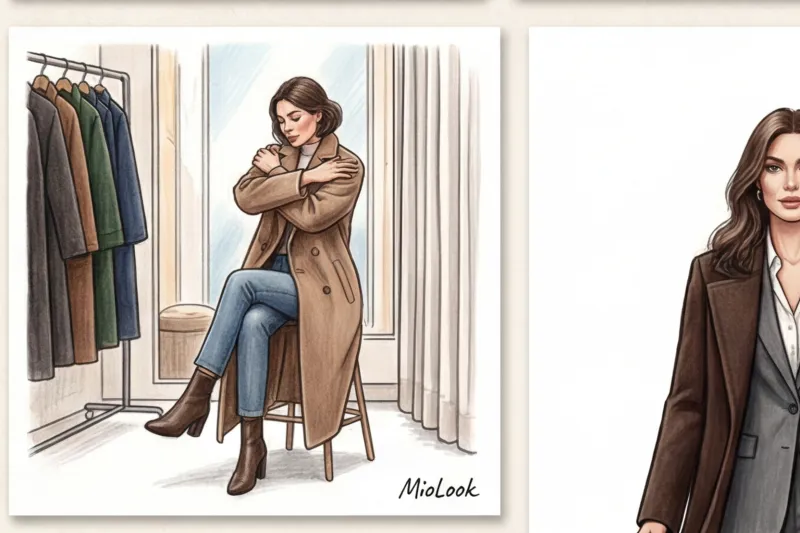
- Sitting test. Button up and sit down on the ottoman. The back vent shouldn't be too wide, and the buttons on your stomach shouldn't pull at the fabric.
- Checking the direction of the pile. Run your palm over the fabric from top to bottom. It should be smooth. If it's smooth from bottom to top, the pile is cut incorrectly, and when it rains, water will be trapped in the fabric instead of rolling off.
Capsule Integration: What to Wear with Your Perfect Coat
One well-designed basic women's coat replaces three compromises in your closet. It becomes a blank canvas that brings together completely different looks.
For a business capsule wardrobe, use a formula of volume contrast: a wide, relaxed cocoon coat thrown over a tailored two-piece suit or sheath dress tones down the formality, creating a modern look. And if you're interested in office wardrobe essentials, check out our article. Smart Casual for Women: A Style Guide for the Office.
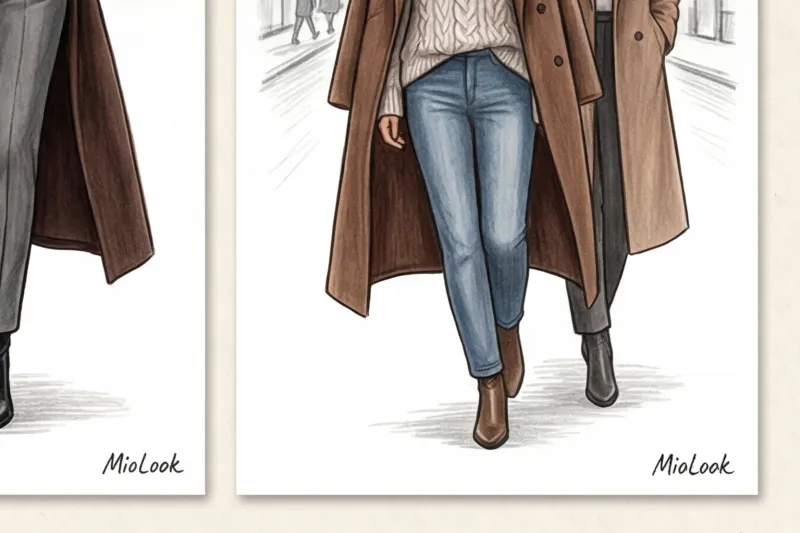
On weekends, this same outerwear instantly adapts to a relaxed rhythm. Pair it with straight-leg jeans, an oversized hoodie (with the hood tucked over the collar), and chunky sneakers. The deep color of the cloth will elevate even the simplest tracksuit. And if you're unsure how to integrate your new purchase into your wardrobe, try digitizing your items. Upload photos of your clothes to the app. MioLook , you will receive dozens of ready-made combinations with your new coat, generated by artificial intelligence.
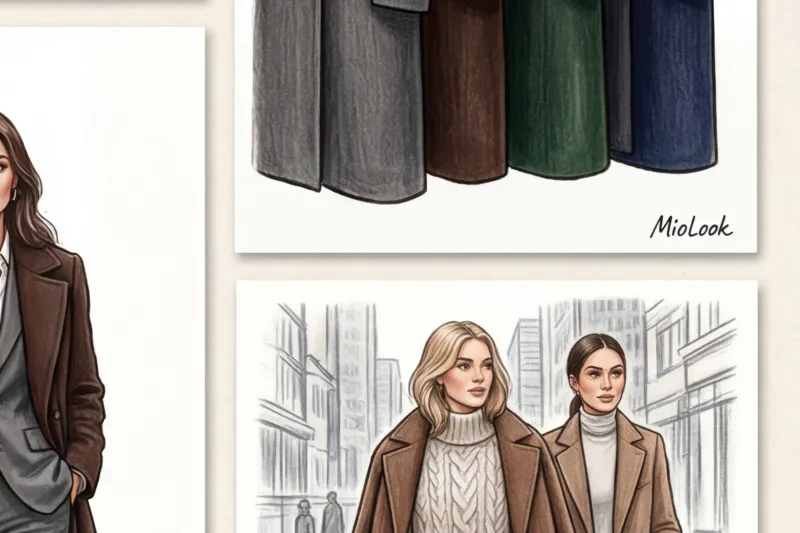
Stop looking for the "one-size-fits-all" look you see in glossy magazines from decades ago. Investing in outerwear isn't about choosing a color; it's about choosing the right style that will give you freedom of movement, warmth, and confidence every day, whether you're wearing a tailored jacket or your favorite oversized sweater.