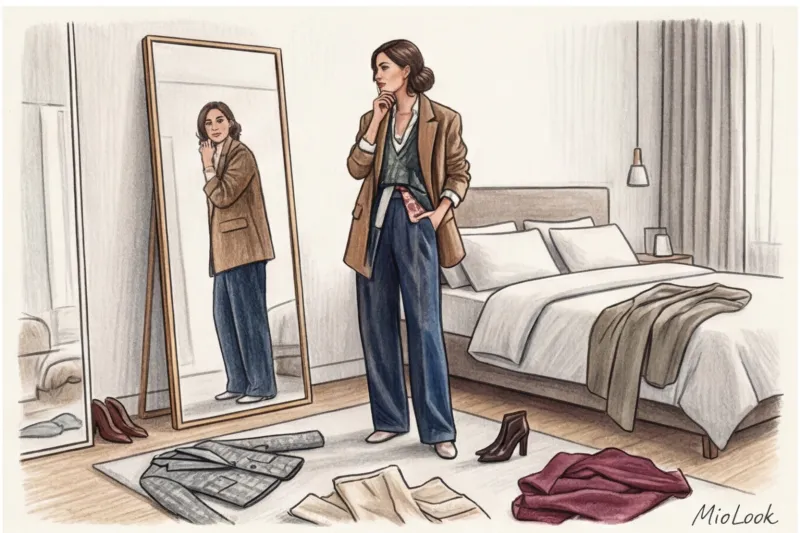
A couple of years ago, before the Miu Miu show in Milan, I observed a curious scene. Street style photographers—the ultimate arbiters of contemporary street fashion—pointedly lowered their cameras as women walked by in perfectly coordinated, "correct" looks: shoes matching their handbags, impeccable symmetry, not a single superfluous detail. But they literally pounced on those whose outfits exhibited a slight stylistic clash. It was then that it became clear: outdated style rules They don't work anymore. They don't just make the image boring—they reveal your fear of making mistakes.
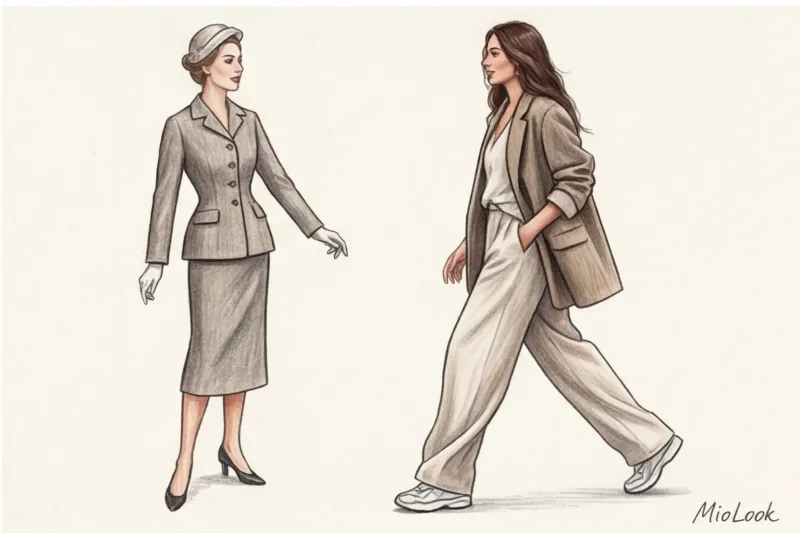
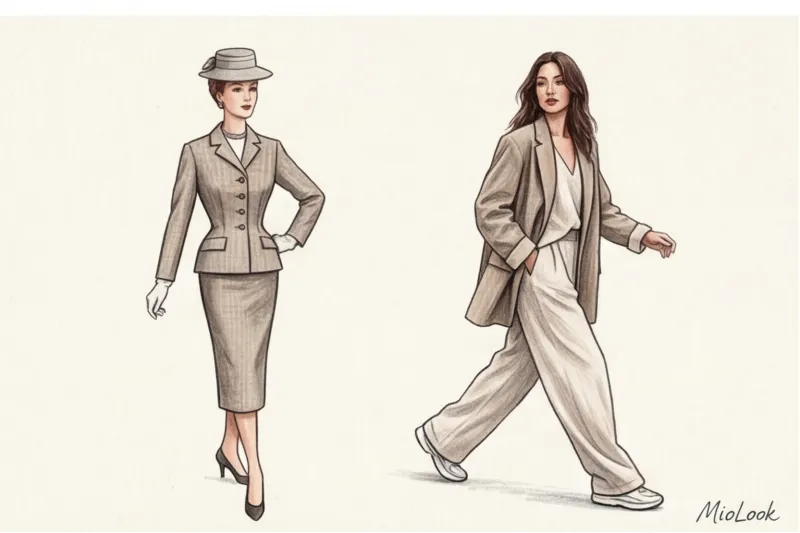
As a fashion journalist, I often see women voluntarily confining themselves to rules that were outdated 30 years ago. Most of these dogmas—from bans on mixing metals to taboos on certain colors—arose in a completely different historical era. We've covered the evolution of wardrobe norms in more detail in our a complete guide to anti-trends in clothing , and today we'll dissect the anatomy of the most persistent fashion myths and consign them to the dustbin of history forever.
The Anatomy of Style: Why Outdated Style Rules Are Ruining Your Look
The line between timeless classics and a mindset stuck in the past is a fine one. Classics are the perfectly tailored Burberry trench coat or the impeccable fit of straight-leg jeans. But obsessively choosing textures and shades is a throwback to the industrial era of the 20th century.
Remember history: strict rules were dictated by fabric shortages, strict divisions into social classes, and later by factories' desire to simplify mass production. Today, according to a report by the analytical agency WGSN (2024), precise minimalism has been replaced by a macro trend toward individualization and chaotic styling (chaotic styling). Perfect combinations (so-called matchy-matchy) are perceived by others as a lack of imagination.
"Perfection today seems artificial. Modern luxury is the concept of sprezzatura, the Italian art of effortless, thoughtful nonchalance," industry insiders note.
If your outfit looks like you spent two hours in front of the mirror trying to fit every detail to an invisible GOST, the look instantly loses momentum.
Access to MioLook for €0.99 — one-time payment
A smart AI stylist will select the perfect look.
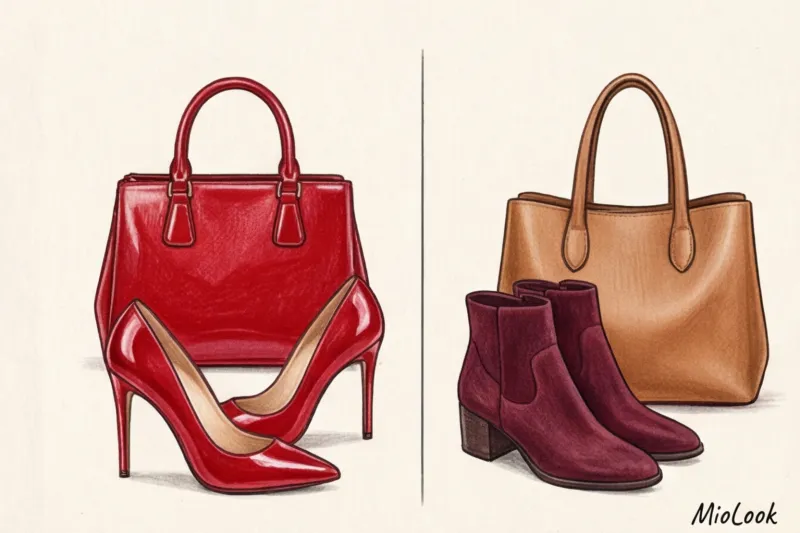
Get access — €0.99 onceMyth 1: Shoes and bag must be the same color
One of my clients, a 45-year-old top manager at a major bank, complained that she looked older than her age at work. When we opened her closet, I saw neat rows of two-piece suits: black pumps stood neatly next to a black leather bag, beige ones next to a beige one. Fearing the appearance of unprofessionalism, she strictly followed this rule, which mercilessly added 15 years to her age.
Where did this myth come from? It's a brilliant marketing ploy from the 1950s. American department stores began selling matching sets of accessories for housewives to boost the average purchase. While convenient, it undermined individuality. According to statistics from The Business of Fashion, sales of matching sets have fallen by 40% over the past five years.
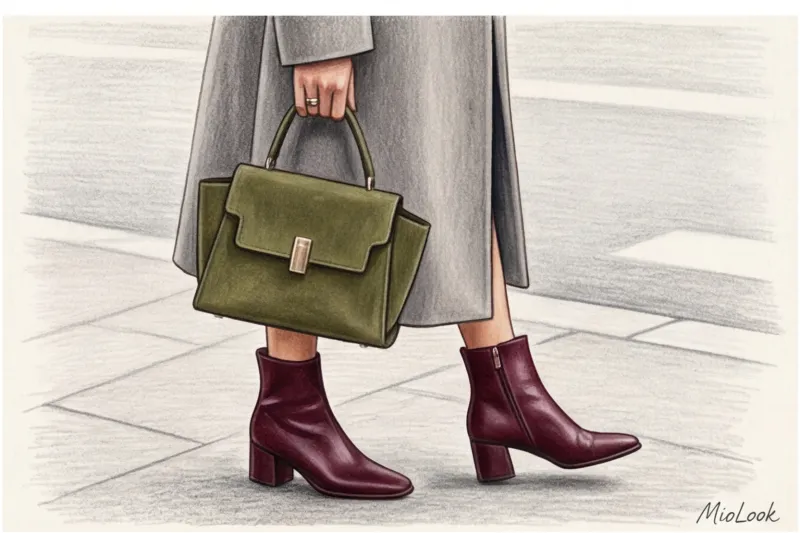
What to do today? Replace color matching with textures and temperature balance. If you're wearing black smooth leather shoes, opt for a soft suede slouchy bag in a deep olive, chocolate, or burgundy shade. The contrasting textures will add dimension to the look. When we swapped my client's formal black bag for an asymmetrical cherry-red tote (keeping the black shoes), her work wardrobe instantly took on a new look.
Myth 2: Metals don't mix - it's either gold or silver
Have you ever noticed how often we instinctively remove a gold ring if we plan to wear silver earrings? This prohibition has its roots in the strict etiquette of the early 20th century, when silver was considered a modest "daytime" metal, and gold a statutory "evening" metal. Wearing them together was considered poor manners and a lack of understanding of appropriateness.
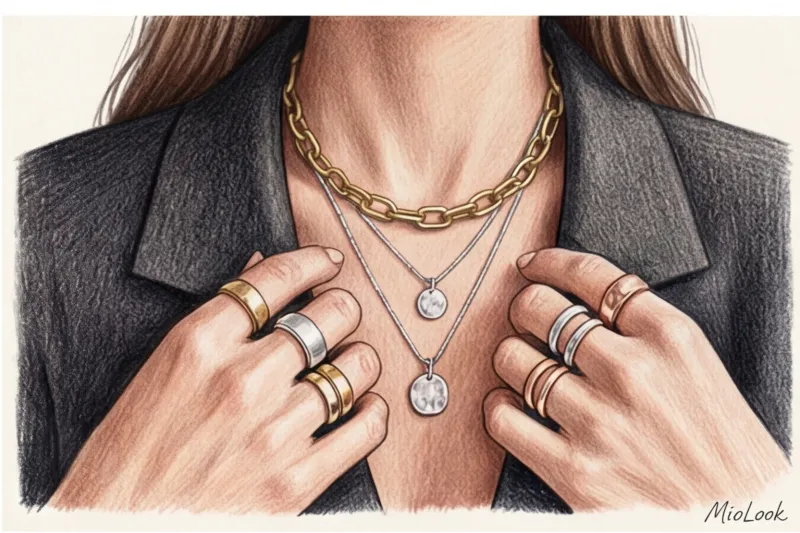
Officially, this rule was abolished back in 1924, when Louis Cartier created the iconic Trinity ring in yellow, white, and rose gold. However, the myth persisted in the public consciousness for decades. Today, we see the triumph of this on the catwalks of Schiaparelli and Paco Rabanne. messy layering - a casual layering where warm and cold radiance are deliberately pushed together.
Practical Tip: How to Create a Transitional Bridge Between Metals
To avoid the look of a mix-and-match ensemble, use the rule of dominant metal: 70% of one metal and 30% of another. A great styling trick is to use a "bridge." This is a single piece of jewelry (for example, a bimetal watch or pendant) that fuses gold and silver. It legitimizes all the other mismatched accessories in your look.
Access to MioLook for €0.99 — one-time payment
Start creating perfect images with the help of artificial intelligence
Get access — €0.99 onceMyth 3: Black and navy blue are taboo in the same look
"She looks like she got dressed in the dark" is what they used to say about those who mixed navy blue and black. The fear was that the colors were too similar, and people would think you'd simply mixed things up in your sleep.
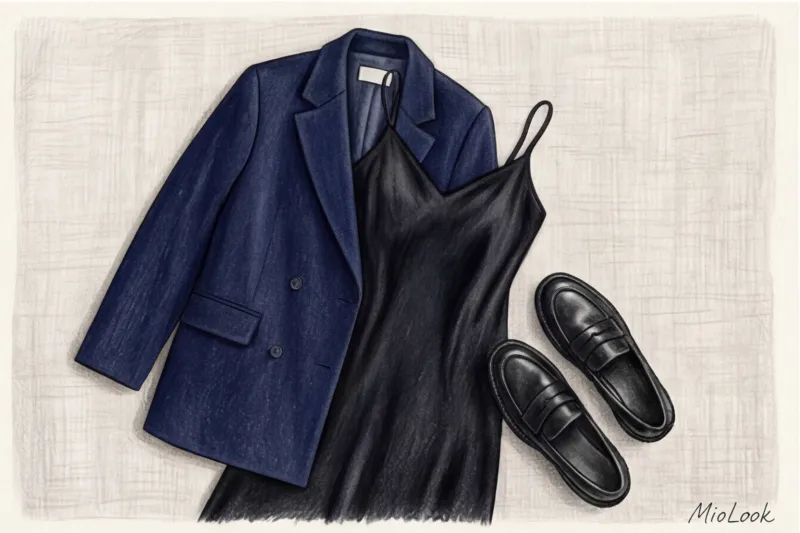
Yves Saint Laurent revolutionized the look when he first sent models down the runway in dark blue jackets with black lapels, making this combination an absolute symbol of Parisian chic. From a color perspective, the combination of two basic dark shades is far more prestigious and sophisticated than the aggressive, eye-catching contrast of black and white. The viewer's eye perceives the subtle optical difference, adding depth to the silhouette.
But there is a fair limitation here (when it DOESN'T work): The colors should be clearly distinct from each other. If your blue is so dark that it blends into black in artificial light, it really looks wrong. Choose a blue with a pronounced cobalt or sapphire undertone, and keep the black matte (for example, a blue viscose jacket and black trousers made of heavy cotton).
Myth 4: You should dress "age appropriately"
This is perhaps the most harmful and limiting stereotype of all. The rule "after 40, cover your knees and eschew trends" is a sexist construct from the last century, invented by department stores to sell conservative clothing lines (so-called missy departments).
A global survey found that 78% of Zoomers and millennials don't understand the concept of "dressing inappropriately." Just look at style icons like Grace Ghanem or Carmen Dell'Orefice. They wear leather pants, neon sweaters, and chunky sneakers, and look dazzling.
The modern style paradigm dictates that you dress not according to your passport, but according to your body type, the contrasts in your appearance, and your lifestyle. A leather miniskirt with thick matte tights and a voluminous cashmere sweater looks appropriate at 20 and 55. Integrate youth trends through tailoring: replace a fitted, cropped jacket with a nice oversized fit, and skinny jeans with straight or wide-leg styles made of high-quality denim (for example, 12 oz or more).

Your perfect look starts here
Join thousands of users who look flawless every day with MioLook.
Get access — €0.99 onceMyth 5: Horizontal stripes always make you look fat
Have you heard that striped shirts are contraindicated for curvy girls? Forget it. This myth has been debunked by science. Back in 1867, German physicist Hermann von Helmholtz discovered an optical illusion, proving that a square filled with horizontal lines appears visually narrower and higher , than exactly the same square with vertical lines.
The problem isn't the direction of the stripe itself, but its architecture. Wide, sparse, high-contrast stripes (like those on a rugby uniform) placed across the widest part of the hips will indeed add volume. But the classic Breton stripe—thin, dense, with a light background dominating the dark line—works as the perfect camouflage. It creates a visual rhythm that draws the eye upward, elongating the silhouette.

Checklist: How to Check Your Wardrobe for Outdated Style Rules
How do you know if your look needs a refresh? Over 12 years of working in the fashion industry, I've developed a simple dissonance method. Stand in front of a mirror five minutes before you go out and do a quick audit:
- Degree of diligence: Is everything too perfect? If so, let your hair down, roll up your jacket sleeves, or wear chunky boots instead of your neat ballet flats.
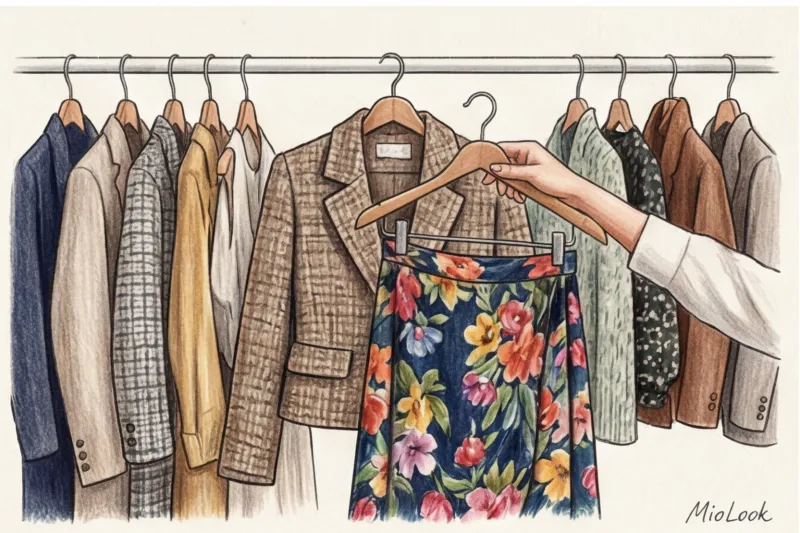
- Mix of prints: Still only pairing strict geometric patterns with geometric ones? Try a modern approach: combine a crisp tartan check with a romantic floral pattern.
- Wrong Shoe Theory: This genius stylist trick from Allison Bornstein is to choose the shoes that seem the least appropriate to the outfit. For a romantic lingerie-style dress, pair chunky sneakers or loafers with socks instead of delicate sandals.
Freedom of Expression: How to Forget Fashion Myths with AI
Breaking rules is harder than following them. It requires a certain amount of courage and foresight. The brain resists: "What if I look stupid if I wear this voluminous jacket with a silk skirt?"
This is where technology comes to the rescue. Virtual fitting room algorithms MioLook They analyze not just color matching according to Itten's color wheel, but the overall look's architecture, proportions, and the relevance of silhouettes. You can safely, without spending a penny on new items, test the most "forbidden" combinations right in the app.
Shifting from outdated "right/wrong" thinking to a modern "hot/off" one is the first step to finding your own visual voice. Style is a living language, evolving every day, and outdated style rules are its dead grammar. Allow yourself a little fashionable mischief, and you'll see how your reflection in the mirror changes.