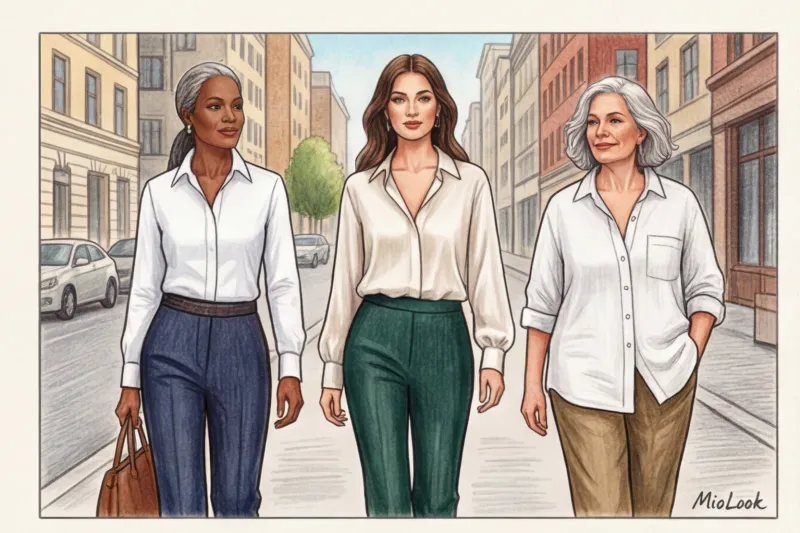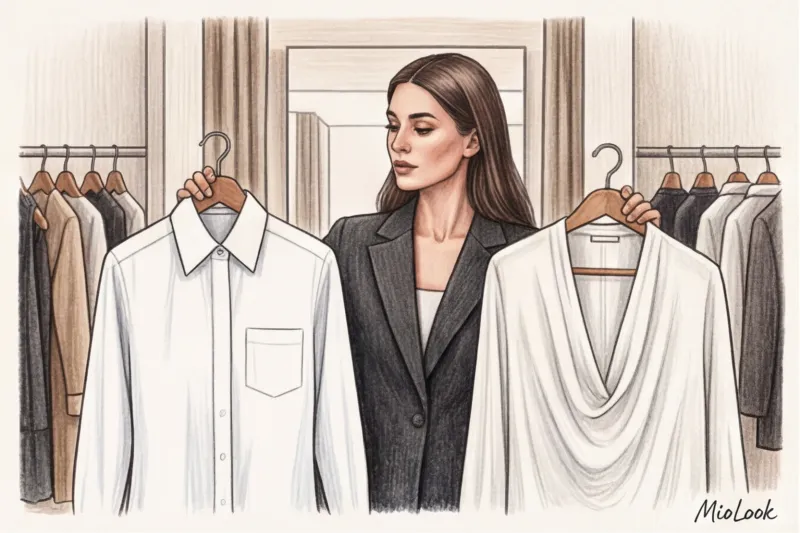
How many times have you bought something inspired by a flawless Pinterest photo, only to feel like a lab technician in a medical clinic in the fitting room? When it comes to shirts, I hear this story every week. For decades, glossy magazines have convinced us that masculine cuts, crisp cotton, and slightly oversized fits are the cure-all. But let's be honest. For 70% of women, a stiff, man-made cotton shirt is the worst investment, hiding the waist, visually broadening the shoulders, and making the figure look boxy.
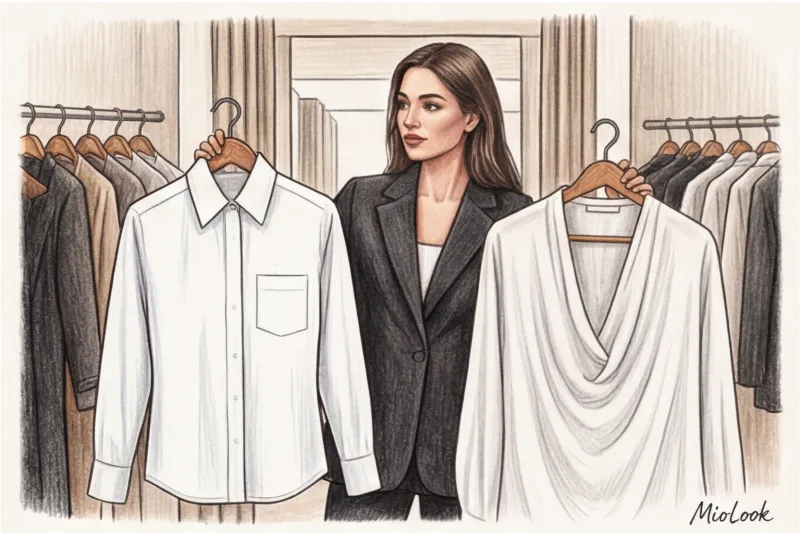
My name is Camille Durand and after 12 years of working as a stylist at fashion weeks and with private clients, I have realized one thing: the perfect women's basic white shirt It's not a matter of luck. It's pure engineering. It involves calculating the fabric density (GSM), collar architecture, and understanding your body geometry. We've already discussed the concept of a smart approach to clothing in more detail in our The Complete Guide to Wardrobe Investments , and today we will apply this method to the main element of the base.
The "That One" Shirt Illusion: Why Pinterest Images Don't Work in Real Life
One of my clients, a top manager at an IT company, once brought in an $800 Jil Sander shirt for a wardrobe review. It was a famous brand, impeccably minimalist, and made of thick, stand-up poplin. Yet she never wore it. Why? With a D-cup bust, the stiff fabric stretched in front, hung at a right angle, and formed a huge bubble in her back. Visually, the garment added 10 kilograms to her weight.
The myth that there's a universal, basic white shirt that suits everyone is beneficial to the mass market, but destructive to your style. What looks luxurious on a rectangle-shaped figure (like Jane Birkin or Carolyn Bessette-Kennedy) will turn an hourglass figure into a massive, rectangular block. The key isn't to blindly buy the latest oversized trend, but to find a texture that works well with gravity and your silhouette.
Fabric Architecture: How Weight (GSM) and Weave Change Silhouette
When professional tailors evaluate fabric, they rarely use the word "quality." They talk about density, measured in grams per square meter (GPS) and thread count (threads per inch). This is the physics that determines whether a garment will "stand up" around you or flow smoothly around your body.
According to textile industry standards, the ideal basic cotton shirt should have a weight of 120 to 150 g/m². Anything lower (for example, 110 g/m²), and the fabric will wrinkle drastically. You'll see a creased back when you step out of the washing machine. Anything above 160 g/m² will cause the fabric to stiffen.
"Right in the store, squeeze the edge of a shirt in your fist for 10 seconds. If the fabric has straightened out and only slight, elegant creases remain, buy it. If a firm network of fine wrinkles has formed, leave the item on a hanger. No steamer will save you during the day."
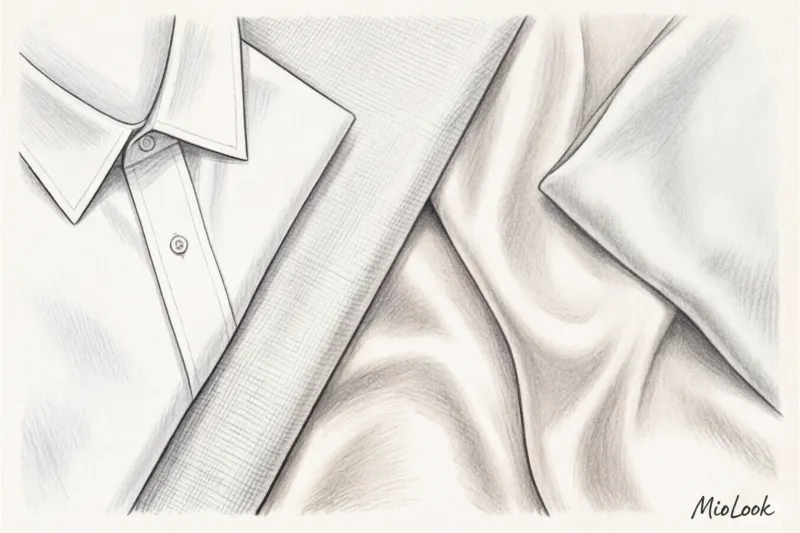
Structural fabrics: poplin and oxford
These fabrics have a distinct rigidity. They are designed to hold their shape, create straight lines, and add architectural rigor to the look. If your goal is to create a prestigious business casual for women , Oxford will be perfect.
- For whom: Figures with clear geometry (rectangle, inverted triangle), women with small breasts.
- Restrictions: I definitely don't recommend poplin for women with curvy figures - it will create a "box" effect.
Drapery fabrics: silk, viscose and lyocell
Heavyweight silk (22 momme count and up) or high-quality, dense lyocell are a lifesaver for 70% of women. Unlike cotton, these fabrics yield to gravity. They fall flat, contouring curves without clinging. About How to choose clothes for your body type without stereotypes , I often speak about this in my master classes, and replacing cotton with lyocell is always step number one.
- For whom: Figures with pronounced curves (hourglass, pear), plus-size.
- Advantage: They look expensive and prestigious even when relaxed.
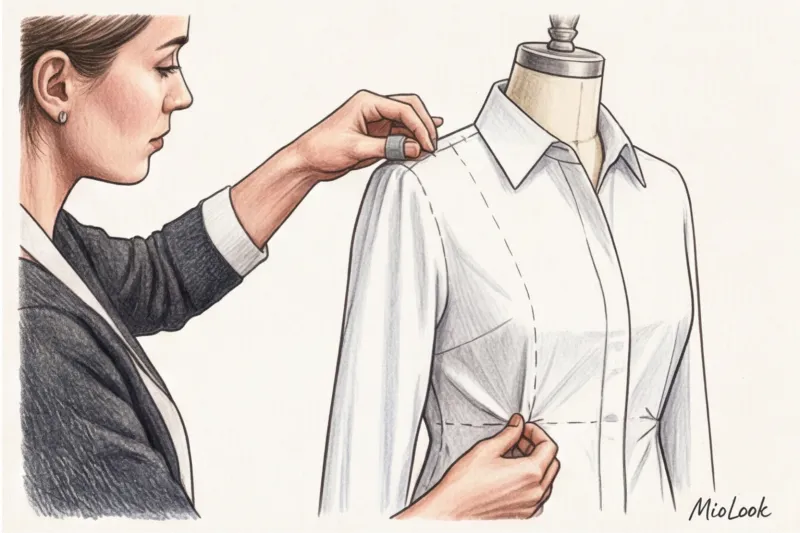
Anatomy of the cut: from the collar to the bust darts
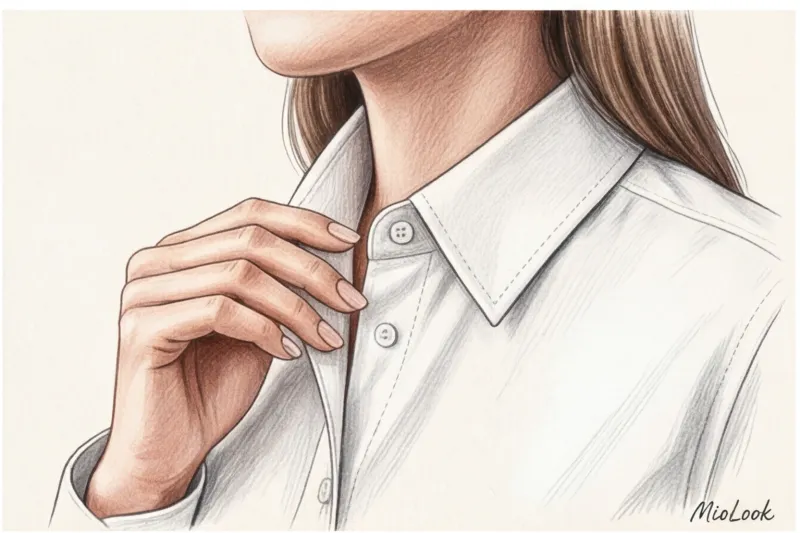
The principles of men's tailoring (recall the famous Savile Row street) state that the fit is determined by the shoulder seam and collar. In women's fashion, we often see dropped sleeves. Supposedly, this is for a relaxed look. But if you have a broad back or full arms, a dropped seam will visually make your shoulders appear even wider. A set-in sleeve (a seam right at the shoulder bone) always gathers the silhouette and creates a slimmer look.
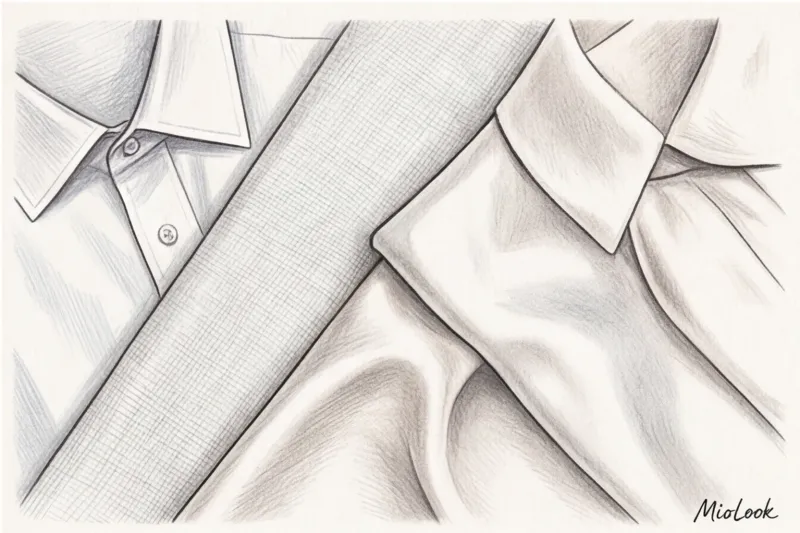
Length is another pitfall. The most dangerous area for a shirt to end is mid-thigh (the widest part). This visually cuts off the legs and makes the bottom heavier. A shirt should either end just below the waist (for easy tucking) or completely cover the buttocks.
And the golden rule of tailoring: the larger the chest circumference, the smaller the breast pocket should be. Ideally, it should be absent entirely. Two patch pockets on a size D chest are a visual disaster.
The Boob Gap
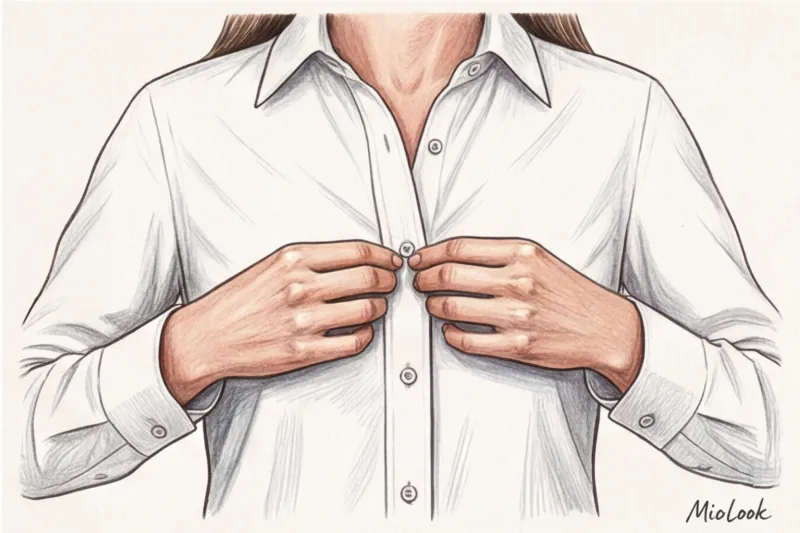
It's a familiar sight: you put on a shirt, stand up straight—everything's fine. But sit down or cross your arms—and a telltale hole appears in your chest. The standard factory distance between buttons is 8–9 cm. This is mathematically calculated for a flat male chest or a woman's A-B cup.
For a C cup and larger, this standard doesn't work. The solution? Look for brands that use a hidden button placket or shirts with an additional internal button in the chest area. If the shirt fits perfectly but the buttons are coming apart, I always advise my clients to take the shirt to a tailor and simply sew the button placket shut (while pulling it over their head) or install a hidden micro-button.
Your perfect look starts here
Tired of wondering which shirt will flatter your figure? Join thousands of users who look flawless every day with an AI assistant.
Get access — €0.99 onceFifty Shades: How to Find Your White
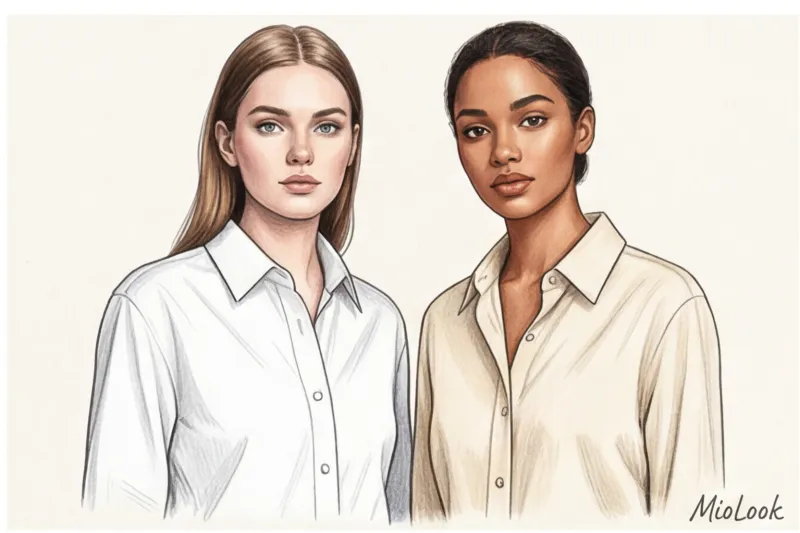
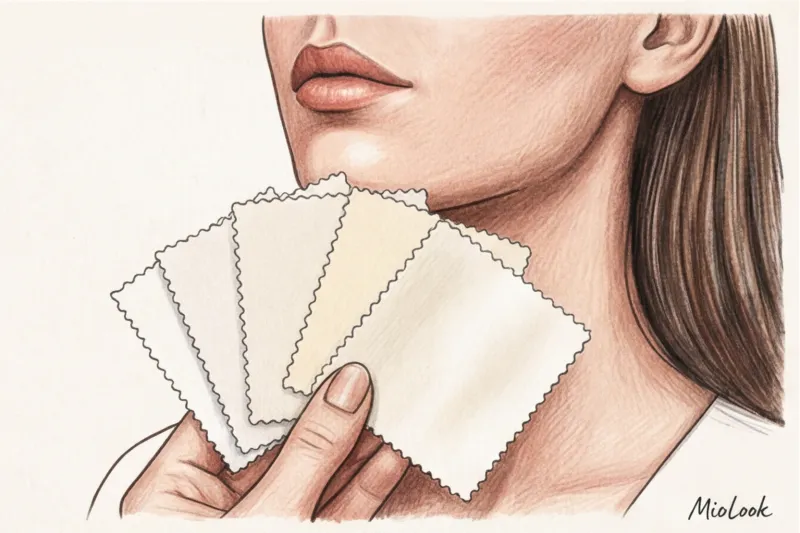
Off-white (optical white with a blue undertone) is the trickiest color in your wardrobe. According to Pantone and WGSN color studies (2024), cool white light reflects blue light directly onto your face. The result? It accentuates under-eye circles and redness, and makes you look five years older.
Backstage at Paris fashion shows, makeup artists often use pieces of fabric in the desired shade, placing them on the model's face to highlight the skin. Try this trick at home. In 90% of cases, warm alternatives—ivory, ecru, undyed linen, or eggshell—work like Photoshop. The key rule of contrast: the shade of the shirt shouldn't be whiter than the whites of your eyes or the enamel of your teeth. You can read more about this in our guide. 12 Color Types of Appearance: A Guide to Choosing a Palette.
Lifestyle Matrix: Which Basic White Women's Shirt Is Right for You?
We often buy things for a fantasy life. It's time to take a pragmatic approach. Your ideal shirt depends on where you spend 80% of your time.
- Corporate environment (Strict Dress Code): If you work in a bank or law firm, you need a proper semi-fitted cut made of heavy cotton with elastane (2-5%). This will allow for freedom of movement but maintain a formal look. Bulky oversized clothing is inappropriate. Explore business dress code for women , to understand the nuances.
- Remote work and creative class (Smart Casual): A basic white women's shirt made of thick, flowing lyocell reigns supreme here. It looks put-together enough for a Zoom call, but is also comfortable enough for lounging on the couch with a laptop.
- Evening outing: A heavy silk blouse with accented, elongated cuffs and a deep V-neck. Pairs perfectly with palazzo pants.

Stylist Checklist: 5 Fitting Room Tests
When I'm shopping with VIP clients, I never just let them twirl in front of the mirror. We always crash-test the item right there in the booth.
- The Hug Test: Put on the shirt, raise your arms, and cross them in front of you (as if hugging yourself). If the fabric cuts into your armpits or is ripped at the back, the armhole is cut incorrectly. Return it to the hanger.
- Refueling test: Tuck your shirt into your pants. If a huge bubble forms under your waistband, making you look like a life preserver, you have too much volume.
- Transparency test: The most important rule that many forget: when wearing a white shirt, wear nude underwear that matches your skin tone, NOT white. If your body contours are visible even through a smooth nude bra, the fabric is too cheap and thin.
- Inspection of seams: A sign of a premium item (even if it's from a mass-market brand like COS or Massimo Dutti) is stitch density. A good shirt should have at least six stitches per centimeter of seam. Any less, and the garment will unravel after the tenth wash.
Access to MioLook for €0.99 — one-time payment
A smart AI stylist will analyze your wardrobe and select the perfect combinations to complement your new white shirt.
Get access — €0.99 onceSummary: When a shirt becomes a second skin
Stop searching for the mythical "perfect white shirt" recommended by glossy magazines. It doesn't exist. What does exist is a shirt made from the right fabric (structured or flowy), the right shade of white (complementary to your skin), and tailored to your anatomy.
Next time, before you take that crisp cotton item to the checkout that will choke you all day, remember the wrinkle test, check the spacing between the buttons, and ask yourself, "Does this item flatter my figure, or am I trying to fit into someone else's trend?" I recommend doing a closet audit before shopping. MioLook — perhaps you don't need a fifth cotton shirt, but one, but the perfect silk blouse that will solve the problem of "nothing to wear" once and for all.