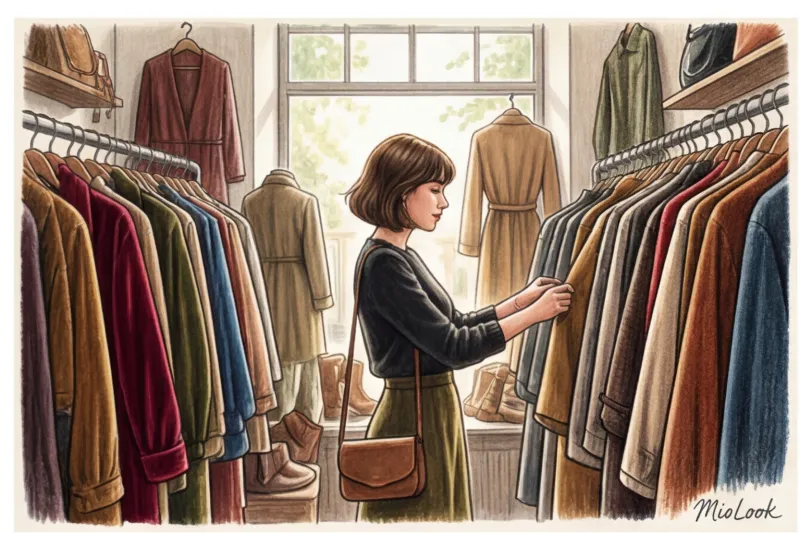
Why the skill of second-hand shopping is more important today than shopping in boutiques
Have you ever wondered why that €60 sweater from the mass market loses its shape after just three washes, while your mom's vintage cardigan from the '90s still looks flawless? It's not because you're using the wrong fabric softener. The problem lies in the very design of modern clothing.
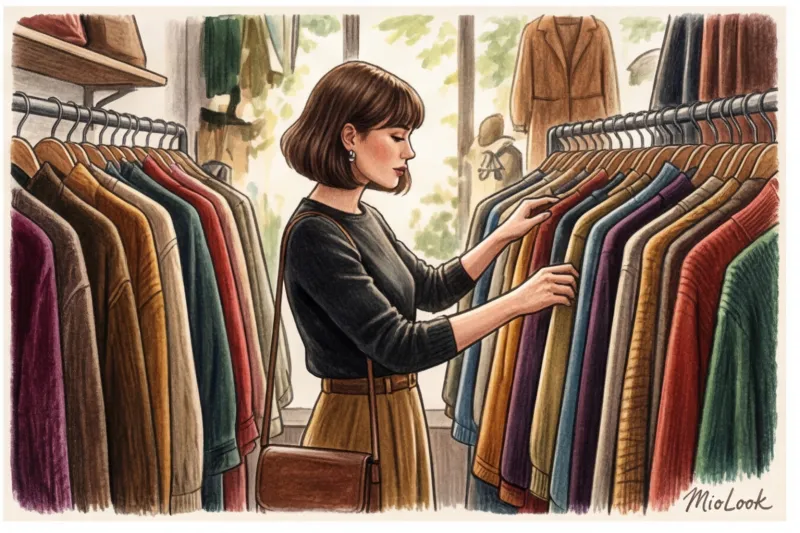
That is why understanding that, How to shop at a second-hand store Resale has ceased to be simply a way to save money. Today, it's a critical skill for anyone who wants to dress stylishly, well, and intelligently. Over the past ten years, I've witnessed a radical transformation in perception: resale has gone from being labeled as "clothing out of desperation" to a conscious choice for the intellectual elite. In my practice as a personal stylist, top managers, gallery owners, and IT directors increasingly ask me to put together a capsule collection consisting of 70% vintage finds. This is no longer about a lack of money—it's about access to quality that's simply no longer available in traditional retail.
Modern mass-market clothing (and even the mid-market segment) is losing out to vintage clothing due to the catastrophic decline in textile industry standards. While in the early 2000s, brands like Zara and H&M still used dense cotton, 100% wool, and viscose on a massive scale, today total optimization reigns supreme. The share of synthetics in mass-market clothing exceeds 65%. To reduce production costs, factories use short-fiber materials—it's precisely because of these short fibers that your new jumper will pill where your bag rubs within the first week of wear.
An old item will objectively last longer than a new one. Thirty years ago, the standards for thread twist, weave density, and seam finishing were fundamentally different. If an item has survived to this day in excellent condition, it has already stood the test of time. I discussed in detail how the texture and density of a fabric influence the overall perception of an image in the article How to Look Expensive: Secrets of a Status Wardrobe.
But there's also a global, ethical dimension to the issue. Circular fashion has become the only mathematically sound answer to the crisis of overproduction. According to a seminal study by the Ellen MacArthur Foundation (2020), every second, the world burns or landfills a volume of textiles equivalent to one garbage truck. By shopping secondhand, you're literally voting with your wallet against this destructive machine, removing a quality item from the linear "make-buy-throw away" cycle.
Economics and ecology: the language of numbers
The hidden cost of fast fashion to the planet is enormous: producing one cotton T-shirt requires approximately 2,700 liters of water—the equivalent of what a person drinks in two and a half years. But let's translate this environmental abstraction into understandable math for your personal budget.
In styling, there is a golden rule for calculating the profitability of a wardrobe: cost-per-wear (cost per wear). The formula is simple: the price of an item is divided by the number of days you wear it. And this is where modern retail suffers a crushing failure.
Imagine you bought a trendy acrylic sweater at the mall for $60. Due to the greenhouse effect (acrylic doesn't breathe) and rapid loss of shape, you'll wear it a maximum of six times per season, after which it'll be thrown away or thrown in the trash. Your cost-per-wear will be $10 for each wear.
Now, here's an alternative scenario: you find 100% Scottish cashmere or dense merino wool at a vintage store for the same $60. Thanks to the material's natural durability, you'll wear this sweater at least 30 times a year for five years. That's 150 wears. Your cost-per-wear is only $0.40. The difference is colossal.
To see this math in action and stop buying things that don't last forever, I recommend my clients digitize their closets. By uploading their looks to MioLook , you can track your wear statistics. The app will quickly reveal the harsh truth: a quality vintage jacket pays for itself dozens of times faster than an impulse buy from a mass-market sale. Savings should be realized not at the time of purchase, but over the long-term use of the item.
The stylist's main secret: how to find things with your hands, not your eyes.
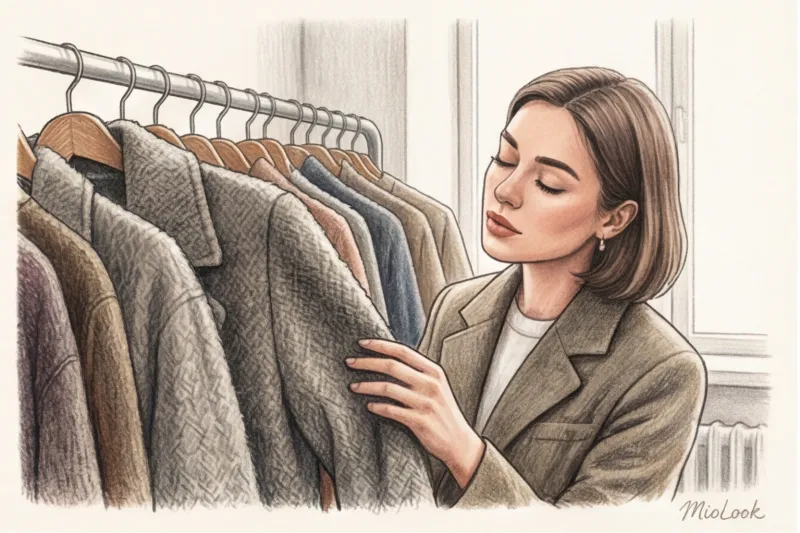
There's one essential exercise in my personal shopping sessions. When we enter a vintage store, I ask the client to close her eyes, extend her arm, and simply walk along a long rail of clothes, letting the fabrics flow through her fingers. It's a bit of a laugh at first, but after two minutes, magic happens: her hand automatically lands on thick cashmere, flowing silk, or heavy denim. That's exactly how we recently snagged the perfect 100% camel wool blazer for 18 euros from an unremarkable corner. This is the basic skill of how to shop secondhand with maximum efficiency—trust your tactile senses more than your sight.
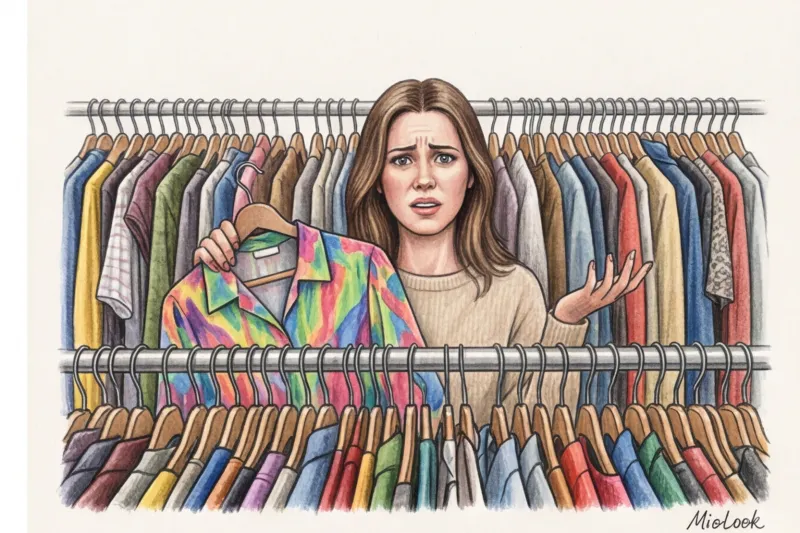
Why does this approach work so well? In stores with dense displays, our eyes become our worst enemies. A bright, trendy print or a trendy neon hue instantly captures our attention, tricking our brain into ignoring the fact that the item is made of "glass" polyester. The illusion of color skillfully tricks the optic nerve. For years, fast fashion has trained us to buy visual images rather than the real thing. But tactile receptors, unlike the eyes, are impossible to deceive.
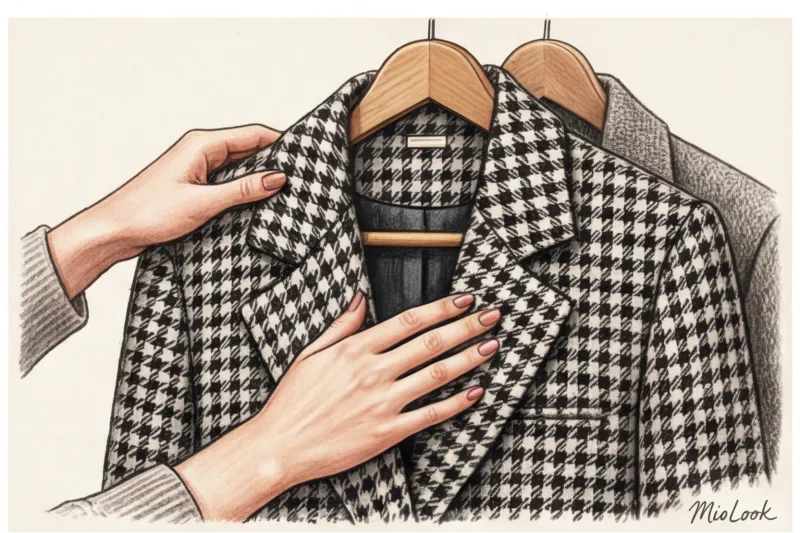
My "blind" search algorithm saves a colossal amount of time and prevents impulse purchases that will then sit on the shelves as dead weight. You don't spend hours rummaging through each hanger. Instead, you scan the aisles by touch, pinching the edge of a garment between your thumb and forefinger. Your task is to look for specific physical triggers:
- Pleasant coolness and sliding: a sure sign of natural silk or premium heavy viscose.
- Springy, soft comfort: This is how good merino wool or cashmere responds, the threads of which easily regain their shape after pressing.
- Dry, grainy texture: typical for natural linen or dense organic cotton.
If the fabric creaks suspiciously under your fingers, feels uncomfortably itchy, or leaves a feeling of damp plastic film, feel free to let go of the hanger and move on, without even looking at the style, brand, or price tag.
When working with vintage items, it's crucial to understand the difference between graceful aging and simple wear and tear. As researchers at the Textile Institute (2023) point out, high-quality natural fibers undergo a natural enzymatic process over time. With proper care, they become softer and more pliable, adapting to the body's anatomy. Take linen, for example. High-quality long-staple linen creases amazingly beautifully over the years: its creases look like soft, voluminous waves, lending the relaxed chic of old Italian films. But cheap short-staple linen, especially if it's been blended with 30% synthetics to reduce costs, simply becomes stiff after washing. It develops stiff, sharp, and untidy folds that are impossible to iron out completely.
Access to MioLook for €0.99 — one-time payment
A smart AI stylist will curate the perfect look based on your best finds and help you seamlessly integrate vintage into your everyday wardrobe.
Get access — €0.99 onceClass indicators: fittings, seams and lining
Once you've found a worthy fabric, the technical audit begins. The first thing that reveals the true quality of a garment is the weight and sound of the hardware. Low-cost manufacturers skimp on details first and foremost, as high-quality hardware can account for up to 30% of a garment's cost. Conduct a simple test right at the rail: lightly flick a button with your fingernail. Plastic will produce a dull, hollow, and cheap sound. Meanwhile, metal, genuine mother-of-pearl, or natural horn buttons (a common feature of classic English trench coats) will produce a clear, solid response. A heavy brass zipper that moves smoothly without snagging is a sure sign that the garment cost at least 150-200 euros when it was made.
Another unmistakable indicator of high-end production is stitch count. In professional tailoring, there's a term called SPI (stitches per inch). On premium shirts, jackets, and dresses, you'll count 10-14 small, perfectly even stitches per inch. On mass-market items, there will only be 6-8—factories intentionally increase the stitch length to allow the sewing machine to sew the seam faster. Be sure to turn your potential purchase inside out. Closed seams (so-called French seams) and bias binding on the inside edges, rather than a sloppy, shaggy overlock, scream of the highest quality.
And finally, the anatomy of a garment from the inside—its lining. Over many years of working with clients, I've developed a strict rule that I teach everyone: a magnificent wool coat or impeccably tailored jacket is completely meaningless if it's lined with slippery polyester. Such a lining is completely non-breathable, attracts static electricity, and creates a greenhouse effect where you'll constantly sweat. In vintage finds, look for only natural or high-quality synthetic (but always cellulose, breathable!) linings. Flowing viscose, silk, or cupro (bemberg) are ideal options. Cupro was often used in expensive mid-century suits, and this luxurious material feels like pleasant, cool water on the skin.
Preparing for a Hunt: What You Need to Know Before You Step Into the Wild
Let's start with the hard truth. According to the Fashion Institute of Technology's 2023 Consumer Behavior Report, nearly 40% of clothes purchased on resale platforms and thrift stores remain hanging in closets with the tags still attached. The reason lies in our psychology. Spontaneous secondhand shopping is a surefire way to clutter.
The thrill of a treasure hunt and the euphoria of a low price often override logic. When you find a silk blouse from Dries Van Noten for just 25 euros, your brain reacts with a surge of dopamine. You buy it, even if it's frankly small in the shoulders and its complex mustard hue makes your face look tired. Ultimately, we save the item from the landfill, but we end up turning our own closet into a landfill.
To avoid this trap, I make my clients use "blank slate" rule Before learning secondhand shopping techniques, you need to create a strict checklist of items you need. Your goal is to align your shopping list with your personal capsule wardrobe.
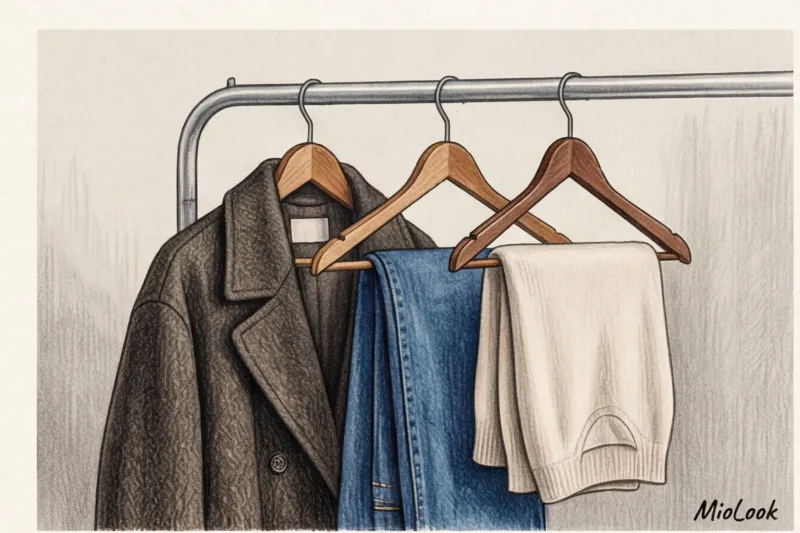
The architecture of a smart wardrobe is based on mathematics: each new item should form at least three complete outfits with what you already own. You're not just looking for a "pretty skirt"; you're looking for a tool to solve a specific styling problem.
What does this look like in practice? You open your closet and assess the proportions. For example, you have an abundance of straight jeans and wide-leg trousers, but you're desperately short on a thick, form-fitting top. This means any flowy blouses (no matter how cheap!) are on your stop list, while structured jackets and chunky knit cardigans are your focus. To visualize these gaps, I recommend using MioLook — By digitizing your database, you'll understand in just a couple of minutes what piece of the puzzle is missing from your personal collection.
Equally important is the right mental attitude. Vintage shopping requires incredible patience and a willingness to leave empty-handed. I leave the store empty-handed 80% of the time. Give yourself permission to buy nothing. Your goal is to find that one piece that will last a decade, not just leave money at the checkout for a consolation prize.
The perfect uniform to try on
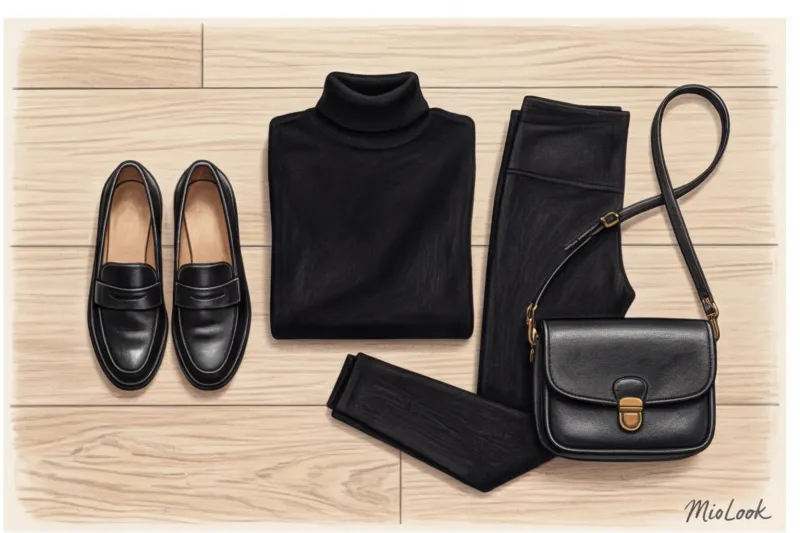
An experienced "hunter" can easily be spotted in a crowd by their attire. Fitting rooms in vintage boutiques are often tiny and poorly lit, and on arrival days or sales, there's a line to find them. Your own clothes should save you time, stress, and energy.
The ideal base is tight-fitting layer Wear thick leggings (or cycling shorts in warmer weather) with a smooth top, turtleneck, or bodysuit. This trick allows you to try on oversized sweaters, blazers, trench coats, and men's shirts right in front of a large mirror in the showroom. What's more, the smooth texture of microfiber or viscose won't catch on the linings of the items you're trying on, allowing them to fit properly.
Avoid layers, belts, and complicated fastenings. Shoes should be strictly slip-on: classic loafers, Chelsea boots, or slip-ons that can be easily removed with a flick of the wrist. And perhaps most importantly, you need freedom of movement. Leave the bulky tote bags at home and opt for a compact crossbody bag. You simply won't be able to properly feel the rails and check the seams if you have a heavy carry-on dangling from your elbow.
Rail Navigation: A Step-by-Step Strategy for Finding Pearls
According to a 2022 study of consumer behavior in the Journal of Retailing, in stores with high merchandise density, so-called "decision fatigue" sets in after just 17 to 20 minutes. Large vintage hangars, where tens of thousands of unsorted items hang across thousands of square meters, are the perfect catalyst for this state. The main secret to shopping secondhand without leaving with a heavy head is strict time management and the wise allocation of cognitive resources.
Zoning the space is your first step. Most shoppers make a fatal mistake: they start leisurely examining lightweight blouses right at the entrance, wasting their peak concentration. My strategy is different. In the first 15 minutes, while your eyes are still fresh and your analytical skills are at their peak, head to the outerwear, denim, and suiting departments. This is where you'll need to pay close attention to the cut, hardware, and hidden defects. Save lightweight knitwear, T-shirts, and scarves for the last half hour, when you only have enough energy for a quick browse.
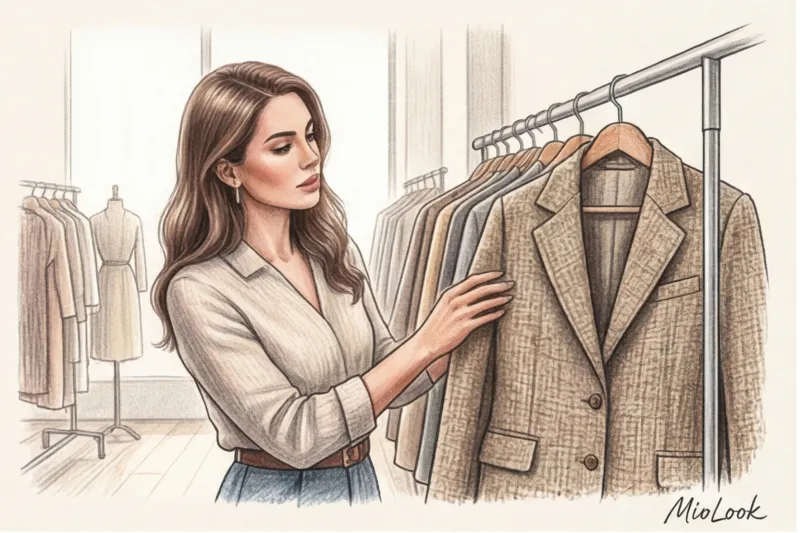
Once you've reached the desired aisle, don't just sift through the hangers one by one—that'll waste hours. Use color and texture scanning. Stand at the beginning of a long rail, focus your gaze on the shoulder lines, and slowly walk down the aisle. Look for visual anomalies: the elegant matte sheen of silk among polyester, the loose, complex texture of tweed, the density of real cotton. At the same time, eliminate shades that don't complement your color type. If you're looking for a quality base, scan the rail exclusively for caramel, deep blue, milky, or graphite blocks.
This is where the most important rule of vintage shopping comes into play: "try on everything that catches your eye." A standard plastic hanger has nothing to do with the anatomy of the human body; it catastrophically distorts the cut of a garment.
A bias-cut dress looks like a shapeless, sad piece of fabric on the hanger, but on the body it comes alive, flowing and delicately accentuating every curve. Never judge the potential of a complex cut by its weight.
Take an armful of 10-15 items to the fitting room. Even if the shoulder seam seems a little loose and the darts look odd, wear them. Often, it's the subtle geometry of a garment's free-fall that creates that luxurious, casual fit that's so prized in high-end vintage.
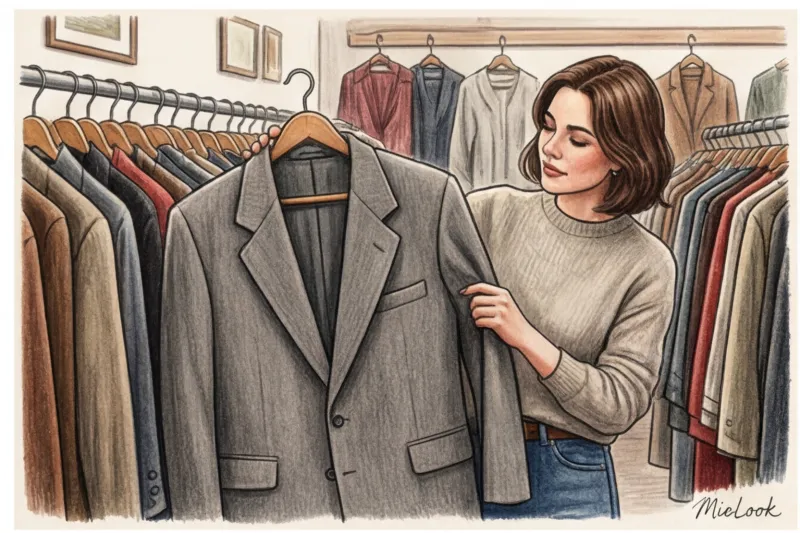
The men's department is a hidden treasure trove of wardrobe essentials.
One of my clients' most frequent requests is to find "that one" perfect jacket in the style of The Row or Khaite: voluminous, relaxed, yet impeccably shaped. Over 12 years of practice, I've developed a firm rule: for such essentials, you should go exclusively to the men's department. Historically, the quality standards of men's clothing have always been significantly higher. The mass-market textile industry produces women's clothing with an eye toward quickly changing trends and saving fabric, while men's fashion is conservative and focused on durability.
In the men's section, the density of the fabric, the quality of the lapels, and the reliability of the hardware often equate to the premium segment, even if you're looking at a piece from a little-known brand from the 90s. What exactly should you look for here? First, structured jackets made of dense 100% wool. Second, classic Oxford cotton shirts—they're not see-through and hold the collar perfectly, unlike flimsy women's blouses. And finally, cashmere crewneck sweaters, where the knitting density (gauge) is traditionally higher, preventing deformation and pilling.
The secrets to styling a masculine cut in a feminine look are built on the architecture of contrasts. To prevent a vintage, mannish jacket from looking like you simply wore the wrong size, pair it with decidedly feminine pieces: a flowing silk slip dress, delicate lace, or a form-fitting bodysuit. A men's shirt is best worn three buttons open, with the sleeves casually rolled up to the elbow (to show off graceful wrists) and a "French tuck"—tucking just the front into jeans or high-waisted trousers, defining the waistline.
Access to MioLook for €0.99 — one-time payment
Start creating perfect looks with AI and easily integrate voluminous vintage finds into your capsule wardrobe.
Get access — €0.99 onceThe Vintage Size Trap: How to Avoid Getting the Fit Wrong
In 1958, the standardized women's size 12 in the US was based on a waist circumference of approximately 63 centimeters (25 inches). If we look at modern mass-market sizing charts, these same 63 centimeters correspond to a US size 0 or 2 (between XXS and XS). This historical discrepancy in sizes is the main reason why unprepared shoppers leave vintage stores in utter disappointment, struggling in vain to fasten their familiar "M"-style trousers.
What we are facing today is called in the industry vanity sizing (Size vanity). Over the past 40 years, brands have systematically changed their size standards, artificially lowering the numbers on tags. According to a study published in the International Journal of Fashion Design (2016), the waist circumference of a standard size M has increased by an average of 10-12 centimeters since the 1980s. Manufacturers benefit from making customers feel slimmer—this directly drives sales. Furthermore, body types themselves have changed: modern lifestyles and diets have made the average human body larger and posture different. Vintage clothes from the 70s and 80s were cut with completely different ease allowances, implying a narrower ribcage and a more defined waist.
That's why the golden rule of buying vintage secondhand is to completely ignore the tags. If you find a gorgeous wool trench coat from 1985 marked "M," be prepared for the fact that it's actually a modern-day, uncompromising XS. The numbers and letters on the yellowed tags are purely decorative and historical.
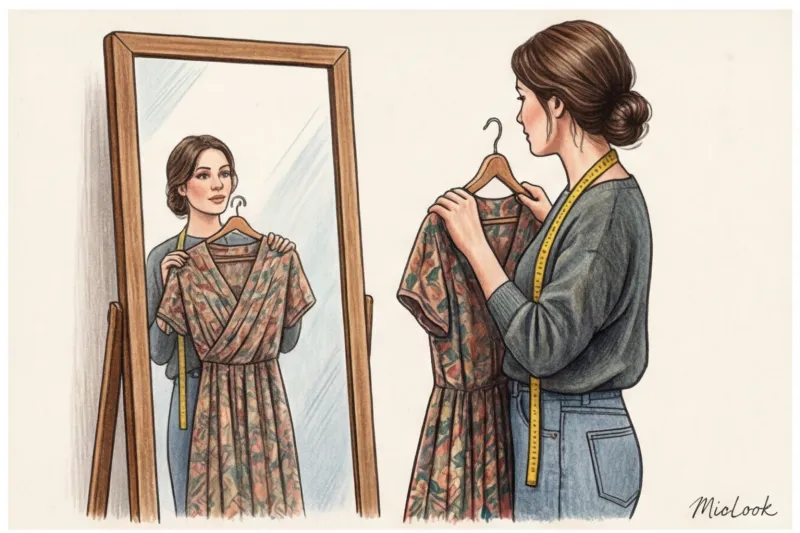
The only objective criteria are the actual fit and a measuring tape. I never go shopping without a tape measure in my bag. Before carrying an item to the fitting room, I measure the half-chest and waist directly on the hanger. To make this process quicker, I recommend keeping the exact measurements of your favorite, perfectly fitting garment on hand. Record these measurements in your app profile. MioLook , you create a personal standard. You apply the measuring tape to a vintage find, compare it with the numbers on your phone, and immediately understand whether it's worth the time to try it on.
What's easy to fix and what's best left in the store
Finding a piece with a perfect composition that fits flawlessly in every way is a rare stroke of luck. Vintage clothing often requires adaptation. But herein lies the main pitfall: not every item can be tailored to fit the figure without losing its visual value.
High-quality clothing has a strict cut architecture, the foundation of which is the shoulder girdle and armhole. People often ask me, "This coat is stunning, but it's too big in the shoulders—let's just take it in." As a textile expert, I'm always categorical on this issue: you can't just "take it in at the shoulders." To change the shoulder width or armhole height, a tailor will have to completely rip out the sleeve, reshape the cap, and sometimes even reshape the collar. This is a highly complex engineering task that disrupts the original balance of the garment and often costs twice as much as the garment itself. The same applies to crotch depth in classic trousers. If the garment doesn't fit in the shoulders or crotch, leave it on the rail.
But simple alterations are your best tool for creating an exclusive wardrobe. Safe and inexpensive options include:
- Shortening the length: Hemming straight trousers, a skirt or sleeves without complicated cuffs costs pennies.
- Waist tapering: If a jacket or dress has darts on the back, removing excess volume at the waist is a 15-minute task for an experienced seamstress.
- Replacement of fittings: My favorite trick: By cutting off cheap plastic and installing horn, metal, or mother-of-pearl buttons (which can be bought for 10-15 euros), you visually increase the price of an item by hundreds.
"You need to calculate a tailor's profitability at the checkout. Add the cost of alterations to the price tag—that's the real cost of your purchase."
The math here is crystal clear. Let's say you found a gorgeous vintage blazer made of 100% dense wool for €25. But it requires shortening the sleeves and tapering the side seams, which would cost an additional €50 at a tailor. Total price: €75. Is a perfectly fitting, custom-fitted wool jacket worth €75? Absolutely, considering a polyester equivalent in Zara's current collections would cost €90. But if it's a €10 synthetic blouse that requires €30 worth of alterations, the investment is completely pointless.
Pre-purchase checklist: the three "Yes" rule
According to a 2023 report by the Sustainable Fashion Institute, approximately 30% of items purchased at resale stores are never worn by their new owners. The reason is simple: the thrill of the hunt overshadows common sense. To ensure that the science of secondhand shopping yields real dividends rather than cluttering the shelves, I employ a strict filter. Not a single item of clothing goes to the checkout until it passes a technical and style audit following the three "Yes" rule.
Yes #1: Flawless composition. Buying secondhand polyester is a dubious investment. But what if the information tag has faded to a white flag? Use a trick with your smartphone's flashlight: shine it at an acute angle, and the indented marks from old thermal printing often become legible. Pay attention to markings: vintage American items carried a WPL number until the late 1950s, later replaced by an RN number. If the text is irretrievable, trust a tactile examination. Natural silk quickly absorbs body heat when rubbed between your fingers, while synthetics remain cool. High-quality wool feels slightly springy in your hand, while nylon blends reveal themselves with a characteristic "glassy" sheen at the folds.
Yes #2: Structural integrity. There are defects that even the most brilliant tailor can't fix. A fatal diagnosis is a frayed warp thread on delicate fabrics, thinning of the material at the seam joints, and "bubbles" in the interlining on jacket lapels (when the fusible interlining has permanently peeled off after harsh dry cleaning). Perform a simple test: gently tug the fabric near the inseam. If the threads begin to fray, leaving micro-holes, leave the item in the store. The fabric is irreversibly "tired."
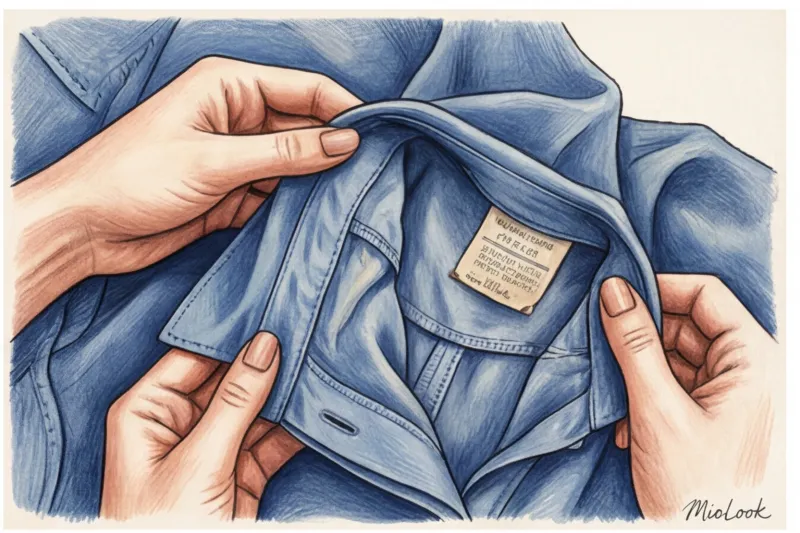
Yes #3: 100% integration into your current wardrobe. A piece can be a true archival masterpiece from Maison Margiela for a paltry 40 euros, but if you need to buy new trousers, shoes, and a bag to go with it, it's a liability, not an asset. Ask yourself: "Can I create at least three different looks with this item from what's already in my closet?" To avoid guessing in the mirror, I always consult my digital capsule. After uploading the database to MioLook , you can virtually combine a potential purchase with your existing items right in the fitting room and see if it will truly fill a gap in your wardrobe.
Checking for hidden defects: where to look
The average person looks at the front: are there any noticeable stains on the chest or missing buttons? But the devil is in the blind spots. Over the years, I've compiled a checklist of the places where clothes die first.
- Collars and cuffs: Turn your shirt or trench coat inside out. The inner collar stand and creases in the cuffs reveal real wear. Whitish creases on thick cotton aren't dirt, but pigment loss that can't be removed.
- Armpits: Silk and viscose in this area should be checked against the light. Antiperspirants of past decades literally burned away natural fibers. If the fabric appears thinner in the light or has a yellow ring, the item will tear with the first sharp movement of the hand.
- Pleats and elastics: On wool sweaters, look for moth infestations not on the back, but in hidden places—under the collar, inside pockets, and along the hem. On vintage '80s and '90s sweaters, be sure to tighten the elastic waistbands. Over time, the elastane dries out and crumbles inside the drawstring, making a distinctive crunching sound (replacing the complex elastic will cost you an additional $20-$30 at a tailor).
The sweet, powdery smell of old perfume or the lingering odor of basement dampness are red flags. Unlike industrial sanitizing gas, mold molecules are permanently embedded in the protein structure of fabric.
An olfactory test is the final stage of the audit. The distinctive, pungent odor of second-hand clothing (a consequence of treatment with methyl bromide) is normal and will disappear after the first wash with vinegar or airing in frosty air. However, no dry cleaner can remove heavy aldehydes or a musty smell from a wool coat.
Your ideal image begins Here
Join thousands of users who look flawless every day with MioLook. Digitize your wardrobe and make smart purchases.
Get access — €0.99 onceVintage Care: How to Restore Your Items' Status and Life
After buying a luxurious cashmere cardigan from the 1990s for 15 euros, many people make a fatal mistake: throwing it in the washing machine with harsh detergent. Even if you've mastered the art of secondhand shopping, without proper fabric regeneration, all your efforts are wasted. As a textile expert, I always emphasize: true vintage has proven its resilience, surviving decades, but improper household cleaning can destroy it in a single cycle.
The first step after bringing your treasure home is proper cleaning, depending on the fabric's composition. There are no one-size-fits-all solutions. Silk and viscose require gentle hand washing in cool water—I often use mild baby shampoo, which removes stains better than harsh enzyme gels. Wool and cashmere require strictly pH-neutral detergents to prevent the fiber scales from opening and shrinking. If you're unsure about the composition because the tag has faded, test the garment with detergent on an inconspicuous area of the inseam.
The main fear of newcomers is that lingering smell of second-hand clothing. It's important to understand that this isn't the smell of age, but rather the result of treatment with sanitary gas (usually methyl bromide), which is mandatory for international transport of used textiles. Never soak such an item in hot water—the high temperature will literally "bake" the chemicals into the fibers. To neutralize this odor, soak the garment in a cool solution of white table vinegar (one cup per basin of water) for 40 minutes. The acid effectively breaks down the gas molecules. Afterwards, simply air the item outside in the shade.
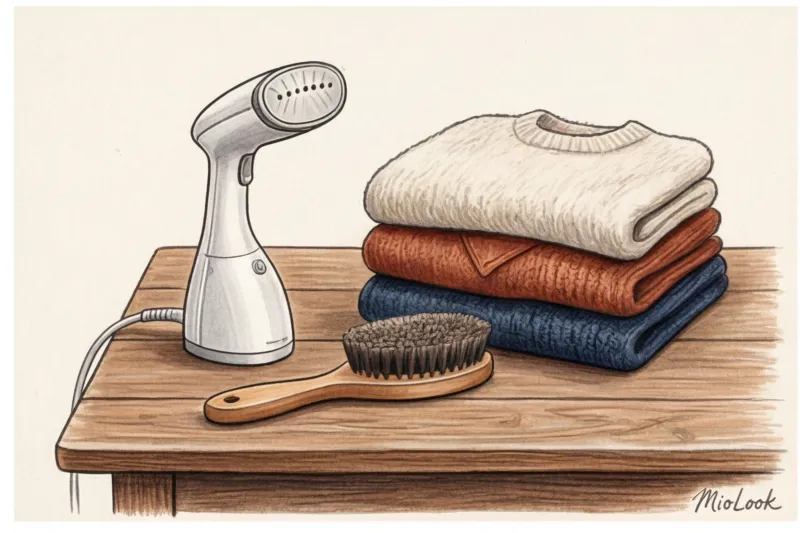
After cleaning, comes the mechanical restoration stage, which can visually increase the purchase price tenfold. Here are my three main rules for home care of delicate materials:
- Lint remover (trimmer): Never pull out pilling with your hands. This will pull on adjacent threads, causing new pilling. Carefully shave the pilling off with a clipper, laying the sweater flat on a hard surface. This will instantly restore the smoothness and factory-like appearance of the knitwear.
- Steaming instead of ironing: Forget about ironing. Hot, pressurized steam not only disinfects but also plumps up the fibers of fabrics (especially wool, velvet, and heavy cotton) that have been flattened over time. The garment regains its structure and softness.
- Skin hydration: Vintage leather jackets, belts, and bags are often critically dry. Before active wear, they need to be "watered." I use professional conditioners based on lanolin or beeswax. Apply the conditioner with a soft flannel cloth and leave it overnight—this will restore the pliability of the oak leather, preventing cracks at the folds.
These simple steps will extend the life of your find for at least another decade. Once the item is in perfect condition, I immediately add a photo of it to MioLook This digital inventory helps you instantly integrate a new item into your wardrobe and clearly see that the time spent on restoration will pay off with dozens of stylish looks.
Thrift Store Myths It's Time to Forget
According to ThredUp's 2024 analytical report, the global resale market is growing three times faster than traditional retail. The era when buying secondhand clothes was considered a sign of financial hardship is gone forever. Today, it's the choice of the intellectual elite, eco-activists, and fashion insiders. However, stereotypes persist, and they are what often prevent newcomers from putting together a unique capsule collection.
Myth 1: "They only sell old and unfashionable things there."
This argument breaks down against the fundamental law of the fashion industry—the twenty-year trend cycle. What's being shown on the Miu Miu or Saint Laurent runways today is a direct citation of the aesthetics of the 1990s and 2000s. The real art of How to shop at a second-hand store , lies in the ability to spot current silhouettes in the aisles of vintage clothing. Bulky shoulders, fitted jackets, low-rise jeans, or flowing slip dresses—all these "hot" trends are already hanging on the secondary market, and in their original, authentic versions.
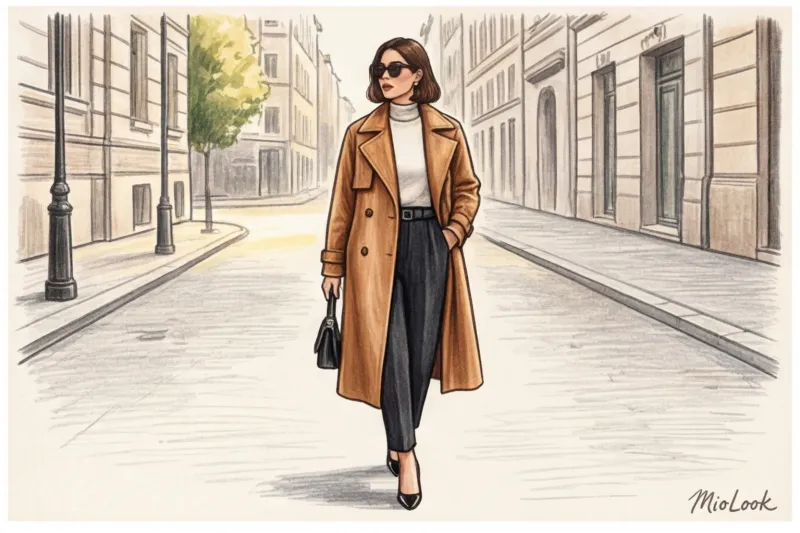
Myth 2: “It’s unhygienic.”
Many people are squeamish, believing that wearing used clothing is dangerous to their health. The irony is that "new" items from mass-market stores often pose far greater risks. Before they even hit the racks in a regular store, the fabric is treated with formaldehyde resins (to protect against mold during transportation), and the item itself may have been worn by dozens of sweaty people in the fitting room before you.
In contrast, legal industrial secondhand undergoes the strictest sanitization procedures. At sorting factories, clothes are placed in special chambers where they are treated with formalin steam and high-temperature gas at 110°C. This procedure kills 99.9% of bacteria, fungi, and insects. Yes, it leaves that distinctive odor, but it's easily removed with proper washing, whereas the toxic dyes of cheap fast fashion will linger on your skin for months.
Myth 3: “You should only look for well-known brands there.”
Here I'll allow myself to express a highly unpopular opinion. A huge number of articles advise: "Look for luxury at thrift stores!" My professional verdict: deliberately chasing Dior, Gucci, or Chanel tags at flea markets is a sure path to disappointment and a waste of money.
Firstly, the risk of stumbling upon a high-quality counterfeit from the 2000s is virtually zero. Secondly, even if you find an original luxury item for 20 euros, it'll likely be in poor condition. My strategy is the complete opposite: look for unnamed masterpieces.
"The true class of a garment is determined not by the logo on the collar, but by how the fabric behaves in movement. A no-name Italian brand from the 1980s, creating a coat made of 100% virgin wool with a thick cupro lining, will always outshine a modern polyester jacket with a big name."
The best gems I've found for my clients are pieces from long-defunct manufacturers. They don't have recognizable logos, but they boast impeccable cuts, hand-stitched buttonholes, and compositions that would cost thousands of euros today. Learn to read composition tags rather than brand names.
Vintage shopping isn't a lottery, but a curating skill. Every item you bring home should work for you. To prevent new finds from becoming dead weight, I strongly recommend integrating them into your system right away. Add a photo of a newly purchased cashmere sweater or the perfect blazer to the app. MioLook — this way, you can virtually try on a new item with your basics and create dozens of fresh, smart looks without taking anything out of your closet.
Guide Chapters
The Difference Between Vintage and Second-Hand: A Stylist's Guide
Many people are afraid of the secondary market due to confusing terminology. Learn the difference between vintage, retro, and thrift to make smart wardrobe investments.
How to repurpose secondhand clothing: premium upcycling
Upcycling isn't just a way to save money, it's a high-fashion tool. Learn how to transform vintage finds into exclusive, custom-made pieces.
Vintage Clothing Sizes: How to Choose the Right Fit
Modern sizes M often don't match the measurements of vintage clothing. We'll explain how to navigate old tags and take accurate flat measurements.
What clothes are best to buy at a second-hand store: a stylist's guide
Mass-market quality is declining, making vintage the best wardrobe investment. We'll explain how to find the perfect coat, jeans, and cashmere.
Where to buy vintage clothing online safely
Learn the buyer's strict protocol for safe shopping on resale platforms. We'll explain how to verify the authenticity and fit of brand-name used items using photos.
How to check second-hand items: hidden defects
Learn to spot hidden defects in vintage clothing like a professional authenticator. Discover which minor issues can be fixed and which ones are worth avoiding.
How to remove the second-hand smell from clothes: stylist tips
Have you bought a stunning vintage item, but are repulsed by the distinctive chemical scent? We reveal professional stylist methods for saving your clothes.
How to Style Vintage Clothes Without Looking Old
Vintage pieces can add a unique touch to your look if you know how to pair them. We'll show you how to use contrast without slipping into retro-retro styling.
What to avoid buying at a second-hand store: expert advice
Why is buying basics at vintage stores the worst strategy? We explore which items from resale rails are already physically "dead."
How to find designer items at thrift stores: looking for the original
True luxury is recognized not by a logo, but by the quality of the fabric and stitching. Learn to think like a professional buyer and find original brands.