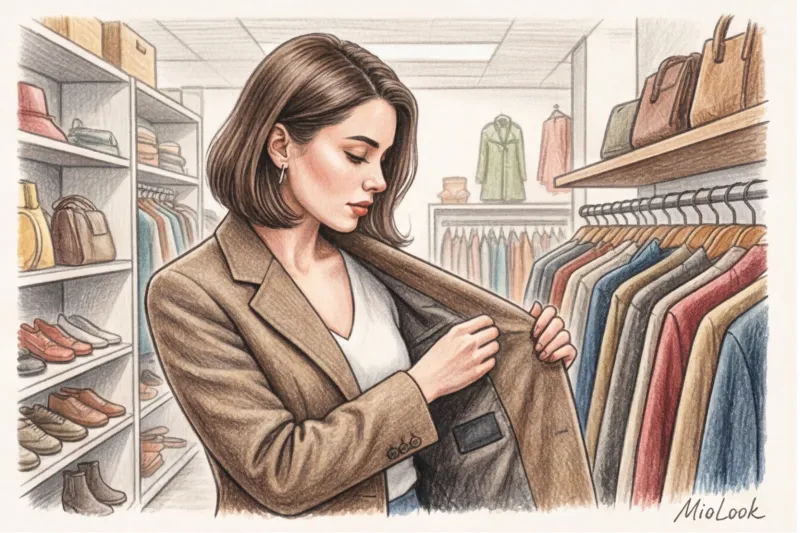
Contrary to popular myth, small stains or missing buttons on a vintage item are a great find. Yes, you heard right. These small visual tweaks can halve the price, and the problem can be fixed for next to nothing at your local tailor. The real red flag that you should run away from is "fabric fatigue," which is impossible to wash or mend.
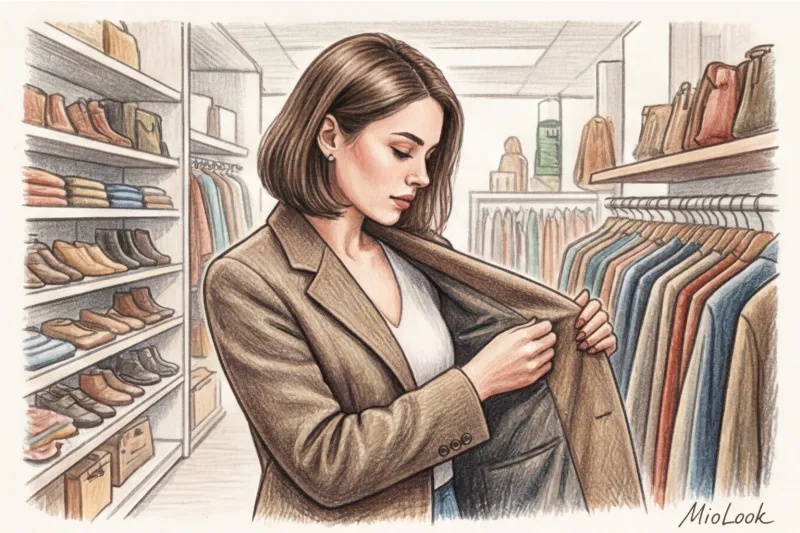
A month ago, I was putting together a vintage capsule collection for an IT director and categorically rejected a seemingly perfect Max Mara coat. The reason? An invisible imbalance in the shoulder seam. Due to improper storage on a thin hanger by the previous owner, the fabric had become so distorted that the coat was permanently out of shape. If you want to know, How to check items at a second-hand store Just like professional authenticators do, forget about trivial advice like "smell the thing."
We have already talked in more detail about the strategy of searching for real treasures in our The Complete Guide to Resale Shopping Today, we'll talk about the purely technical side of the matter. Clothing is an architectural structure, and we'll learn how to test its foundation.
The Anatomy of Quality: Why How to Check Items at a Second-Hand Store Is More Important Than the Brand Itself
According to a 2024 McKinsey analytical report, the share of synthetics and short-fiber materials in today's mass-market products has exceeded 65%. Brands intentionally design their products to have short life cycles. That's why a heavy cardigan from the '90s has a 99% chance of outliving a new sweater from a given mass-market brand.
But there's a catch. When buying vintage, we're often blinded by the big name on the tag, forgetting the laws of physics. The difference between a cosmetic defect and a structural failure is enormous. A coffee stain on silk is a cosmetic issue. A warp thread that's skewed diagonally on a cotton shirt is a structural failure.
I propose a paradigm shift: approach resale shopping not as a bargain hunt or brand hunting, but as a technical assessment. Your task is to evaluate the durability of materials.
The Three-Zone Rule: Where Irreparable Damage Hides
The average buyer looks at a garment from the front, assessing its silhouette and color. This provides a maximum of 30% of information about its actual condition. In my styling practice, I use the concept of a "heat map" of clothing wear. Every item has its points of greatest wear, which reveal the truth about how many times it's been worn and how it's been washed.
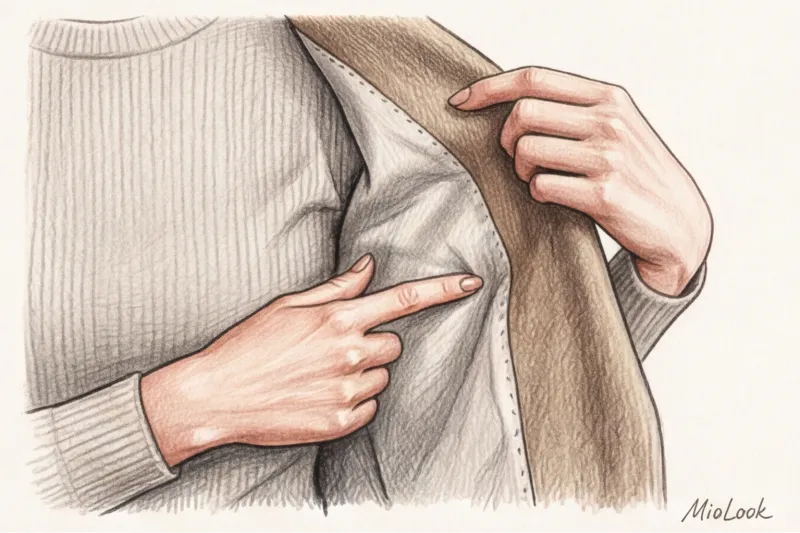
Friction areas: armpits, collars and inner thighs
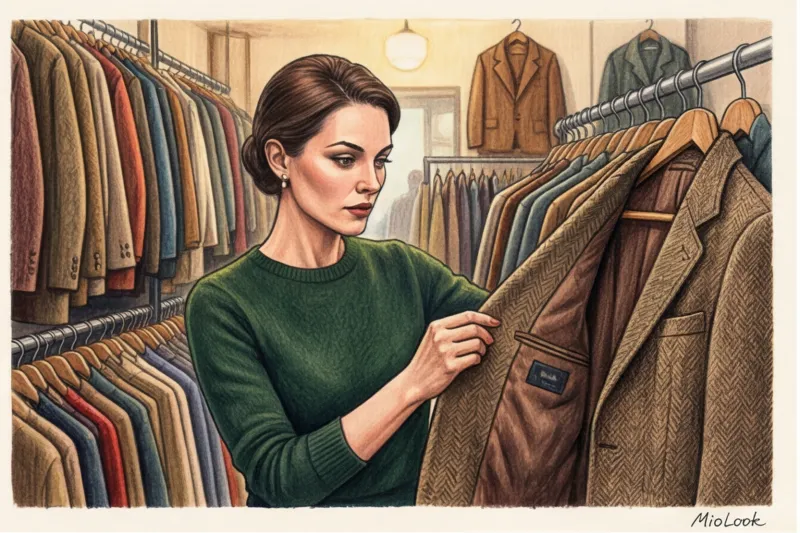
Never buy an item without turning it inside out. Start with the armholes. This is where the lining fabric tends to fray first. If you see micro-pilling or thinning threads in the jacket's lining, it's a sign the item has been worn extensively, even if the outside appears new.
The collar requires special inspection. Light halos of sebum on the inside collar stand of shirts and trench coats that have been on the fabric for more than a year crystallize. The fibers literally "burn" under the influence of acids. Removing such a stain without damaging fabrics weighing less than 180 g/m² is virtually impossible.
Fittings and cutting area: seams, zippers, buttonholes
The next step is the tension test. Gently tug the fabric along the center back seam or hip seam. If you see loose seams (where the threads pull the fabric apart, creating small holes), this indicates that the garment has been subjected to constant excessive tension. The fabric in this area will tear after 2-3 wears.
Pay attention to the buttonholes. A stretched, misshapen buttonhole (the "fishmouth effect") is a sure sign that the overall fabric structure has been compromised. The buttonhole itself can be re-sewn, but the deformed fabric around it cannot be restored.
Your perfect wardrobe starts here.
Found the perfect vintage item? Add it to your digital wardrobe and create hundreds of new looks with the help of artificial intelligence.
Get access — €0.99 onceFabric Fatigue Syndrome: A Major Red Flag in Resale
My own six-month experiment testing the durability of vintage wool against its modern counterparts has proven one thing: fiber degradation is the one defect no dry cleaner can fix.
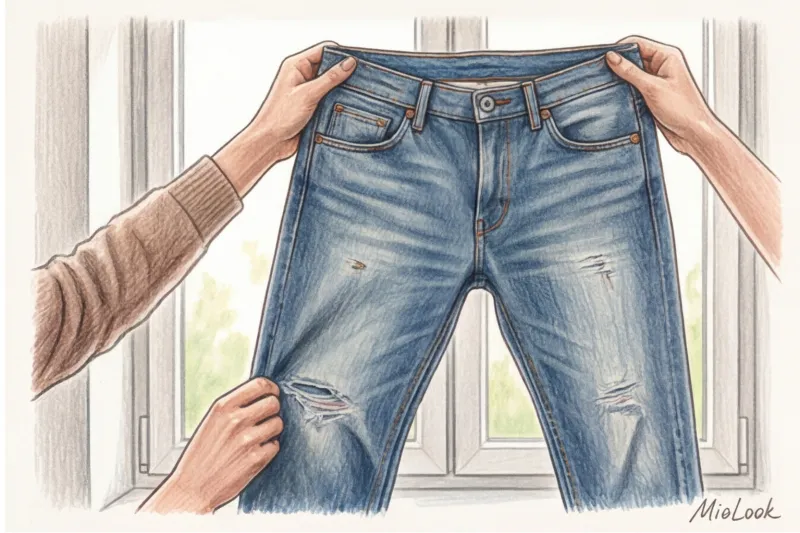
How can you recognize elastane breakdown? If you're picking up jeans or spandex-blend knits, squeeze the fabric in your fist near the knee or elbow and release it quickly. Then, tug gently. Do you hear a soft, barely perceptible dry crack? This is the dried-out elastane fibers breaking. The characteristic "bubbles" on the knees of such pants won't disappear even after washing in boiling water—they'll stay with you forever.
Another critical issue is bias stitching. Look at the side seams of a T-shirt or dress. If they're sagging forward or curled, it means the previous owner washed the item at the wrong temperature. The fibers are distorted, and no matter how much you steam the garment, it will never fit symmetrically again. I readily buy thick silk with slight stains if I know a good dyer, but I categorically reject "tired," bias-stitched knitwear without a single spot.
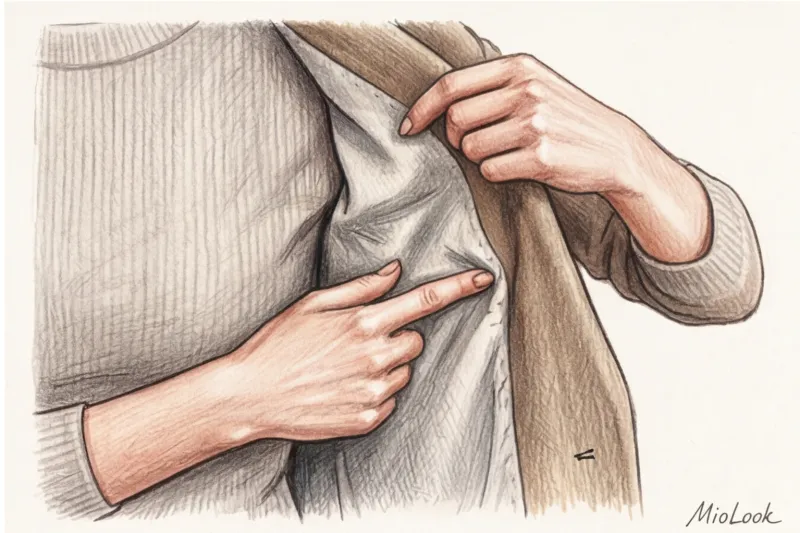
Someone Else's Figure: How to Identify Hidden Alterations and Fittings
It's a common occurrence: you find the jacket of your dreams, put it on, and it fits... oddly. The shoulders are in place, the length is perfect, but the garment seems to resist your body. Chances are, you're dealing with a custom fit.
One of my clients once bought a luxurious Jil Sander jacket secondhand. Visually, it was flawless. But upon closer inspection of the inside, it turned out that the previous owner had moved the bust darts 3 centimeters higher due to irregular proportions, and the fabric allowances had been ruthlessly trimmed at the tailor's. Restoring the jacket to its original factory fit was physically impossible.
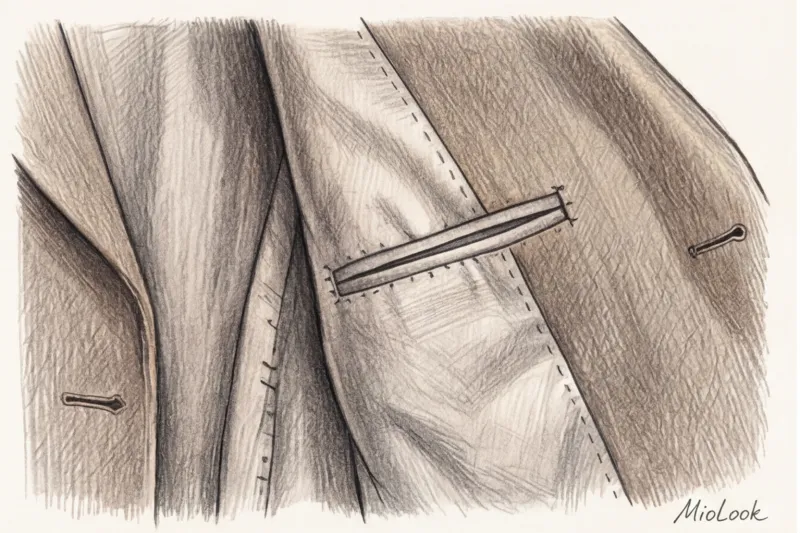
How can you check this? Look at the back. Look for traces of old seams (small pinholes in the fabric next to the current seam), non-standard threads with a different sheen than factory-made ones, and seam allowances cut off almost to the root (less than 1 cm). Pay particular attention to the symmetry of the shoulder seams—if one is even 5 millimeters shorter than the other, the balance of the garment is off.
Organize your finds
Integrate vintage purchases into your everyday looks. MioLook will help you create a capsule wardrobe where old and new pieces work together.
Get access — €0.99 onceTesting specifics: from cashmere to heavy denim
That, How to check items at a second-hand store , directly depends on the composition. The tools and focus of attention should change depending on what you have in your hands.
Wool and cashmere: light test
The most insidious enemy of expensive knitwear is moth. The larvae eat away microscopic areas of the fibers that aren't visible when the item is simply sitting on a shelf. Lift the sweater and look at it through a bright light source (a window or a lamp). The micro-holes will immediately begin to glow.
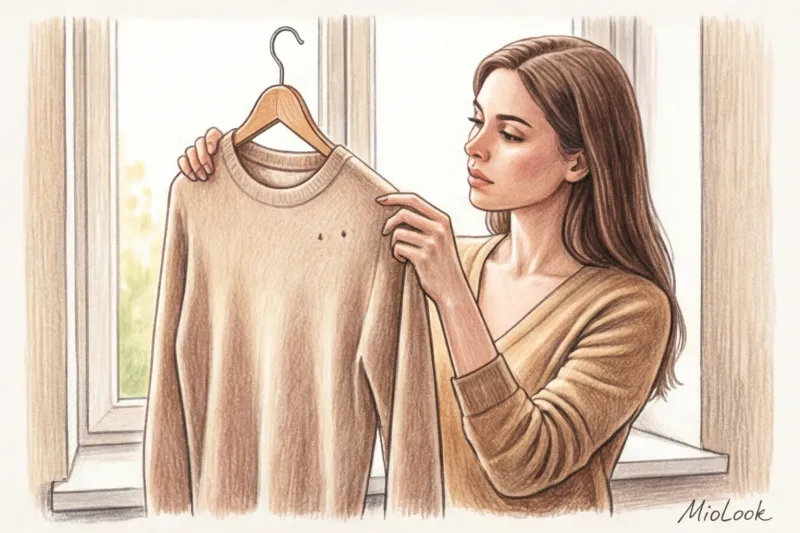
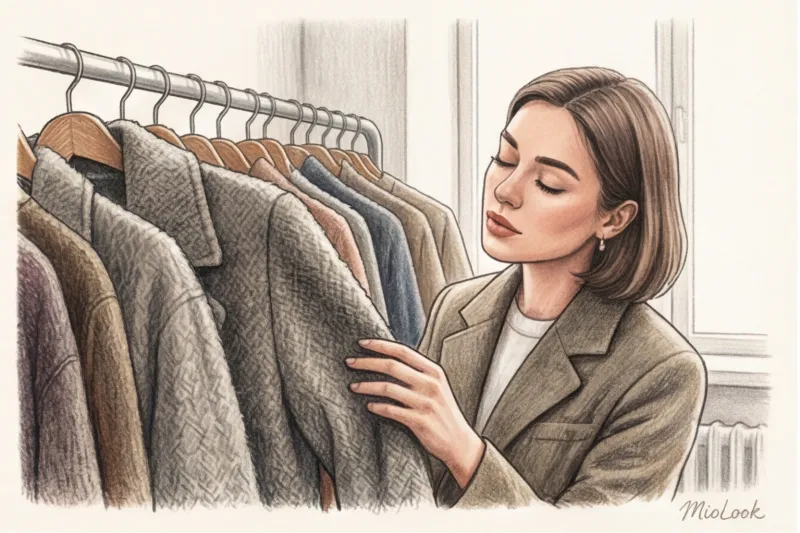
The second test for wool is felting. Run your hand over the surface of the cashmere. If it feels too dense, stiff, and felt-like, and the knit stitches are impossible to spread with your fingers, the item has been washed in hot water. It has lost its elasticity and temperature-regulating properties and has likely shrunk a couple of sizes. This is an irreversible process.
Genuine leather and suede: dryness test
Vintage leather is beautiful, but only if it's been cared for. Press the edge of a leather item into a tight fold for a few seconds and release. The noble patina will quickly smooth out, leaving a soft crease. Overdried leather, having lost its natural oils, will develop a network of microcracks reminiscent of parchment. Creams won't be able to save such a jacket—it will simply crack when worn in freezing temperatures.
Also, be sure to check the bottom of your pockets. This is where dirt accumulates, which can ruin the leather from the inside.
Express Audit: How to Check Items at a Second-Hand Store in 60 Seconds
Over the years as a stylist, I've developed a clear checklist. Save this checklist for use right in the fitting room:
- Weight and density assessment (10 sec). A quality item is always heavier than a cheap fake due to the density of the weave and good fittings.
- Tension and clearance test (15 sec). We pull the seams and hold the fabric up to the light. We look for micro-holes and thread distortions.
- Inspection of the reverse side (15 sec). Turn inside out. Check the armpits, collar, and inseam on the trousers.
- Checking fittings (10 sec). The work of the zippers, the symmetry of the buttons, the quality of the welt loops.
- Balance (10 sec). Fold the garment exactly in half along the vertical axis. The shoulder seams, darts, and sleeve lengths should match millimeter for millimeter.
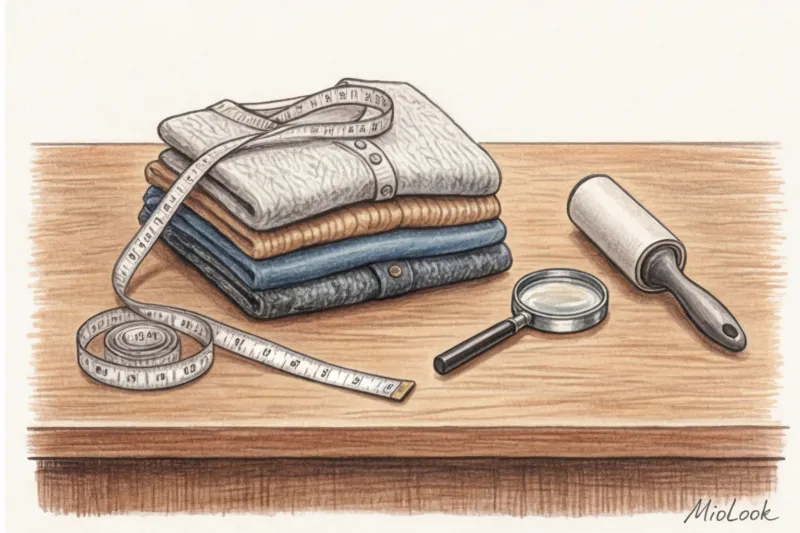
The golden rule: never inspect an item in dim store lighting. Artificial yellow light hides 50% of stains and color imperfections. Move to a window or turn on a bright flashlight on your smartphone. My professional bag always contains a portable jeweler's loupe (for assessing the weave) and a soft mini tape measure (for measuring the actual shrinkage of an item, without relying on tags).
Not sure what to wear it with?
Upload a photo of your vintage find into the app, and a smart stylist will find the perfect combination with items from your closet.
Download the appInvestment Approach: What Flaws Are Worth Living With?
Smart shopping is all about math. I use a simple profitability calculator. If the cost of a vintage item plus the atelier's fees is still less than the actual value of the item (its cut, fabric quality, and status), it's worth buying. Read more about how an outfit's status is determined in our article. about the secrets of an "expensive" wardrobe.
Easily fixable defects are your best friends when negotiating the price. A loose hem, a missing button, a superficial foundation stain on the collar (not to be confused with old sebum!), or sleeves that are too long—all these are reasons to ask for a discount and take the item to a reputable tailor.
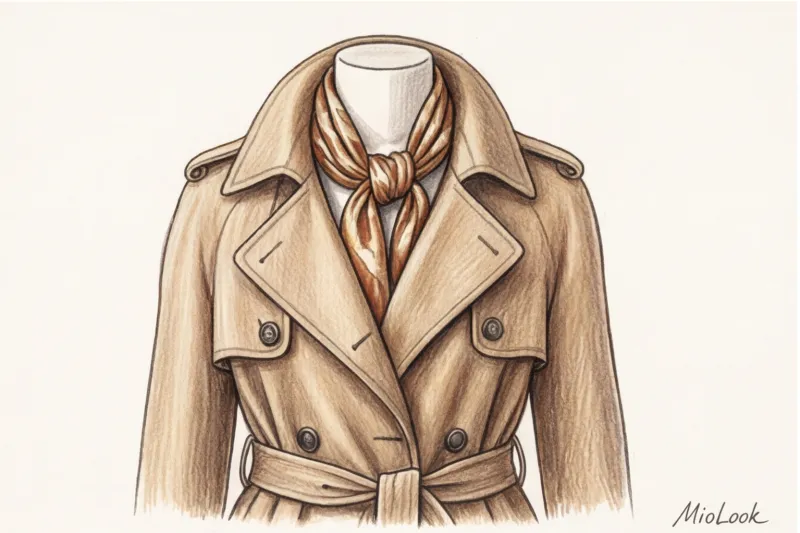
Vintage doesn't have to be sterilely new. The art of style is about recognizing potential. A men's jacket with frayed cuffs can be played up by rolling up the sleeves and revealing the luxurious silk lining, creating a slightly casual look. The key is for this jacket to have a strong, architectural frame that won't fall apart after the first dry cleaning.