Wardrobe Psychology: Why Classic Advice on Finding Your Style No Longer Works
Over twelve years of working as a stylist, I've heard the same phrase hundreds of times: "I'm a soft autumn and a dramatic classic according to Kibbe, but I have absolutely nothing to wear." One of my clients, a top manager at an international IT company, stubbornly filled her closet with mustard, olive, and terracotta for five years. She frankly hated these shades. They made her feel tired and dull, but she firmly believed the consultant's verdict, categorizing her as "autumn." Within these rigid boundaries, she completely lost her individuality, and getting ready in the morning became a torture. And it is at this point that the main question arises: How to find your own clothing style , if memorized formulas no longer bring joy?
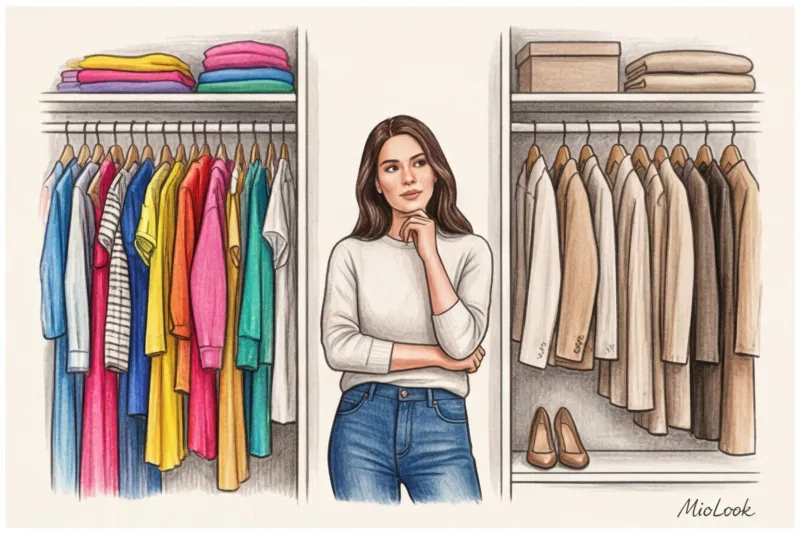
Let's be honest with ourselves. Theories of 12 color types and geometric body types are hopelessly outdated. They reduce the female body to a set of fruits ("pear," "apple") and force us to focus on camouflaging so-called "flaws." But who said your shoulders or hips need to be hidden? True style isn't born from dry, formulaic pairing charts. It lies at the intersection of your unique personality, career ambitions, and your actual lifestyle, not strict academic rules. I discussed how to work with proportions effectively in more detail in the article about ideal accessories for your body type , where we finally break these stereotypes.
The second global trap that silences our inner voice is the toxic fast-fashion culture. The fast fashion industry creates the illusion of incredible choice by bombarding us with micro-trends weekly. Today, algorithms dictate aesthetics. mob wife , Tomorrow - office siren This glut of trends acts like visual fast food. When you buy another €50 polyester top just because it popped up on an influencer's feed, you're not solving your wardrobe problem. You're merely postponing your encounter with your true self, drowning your individuality in throwaway items that will be out of style in a month.
As a premium segment expert, I offer my clients a completely different approach - Investment Dressing (investment wardrobe). Start treating your closet not as a bottomless pit of random purchases, but as a curated collection and personal investment portfolio.
Every item in such a wardrobe undergoes a rigorous selection process. It's much more cost-effective to purchase one impeccably tailored blazer made of thick Italian wool for €300-€400 than eight mediocre jackets that will lose their shape after the first dry cleaning. High-quality cuts, fine fabrics, and hand-finished seams speak louder than any flashy logo. If you strive for intelligent elegance, consider evening wardrobe in a minimalist style , where the concept of conscious luxury is revealed in its fullest form.
Practical step: Today, open your closet and find three items you bought purely because of a passing trend or because "it suits your color type," but never truly loved. Consider them a bad investment and put them out of sight—this will make room for your true style.
Audit Your Life, Not Your Closet: The Perfect Day Formula
The most common mistake I see when sorting through wardrobes is buying clothes for a fantasy life. We stubbornly invest in outfits for the red carpet, bohemian parties, or formal corporate meetings, even though our real-life day consists of entirely different tasks. It's completely impossible to understand how to find your personal style if you don't know, down to the last detail, where and how you spend your days.
To shatter this illusion, I make every new client keep a strict "wardrobe diary" for seven days. The rule is uncompromising: photograph absolutely everything you actually put on in the morning, without any attempt to embellish the reality. No "I just popped out for coffee in old sweatpants, that doesn't count." Everything counts.
The results of this practice always confirm the famous Pareto principle (a principle discovered back in 1897, but perfectly describing modern closets): we wear 20% of our clothes 80% of the time. The remaining 80% of our wardrobe is expensive ballast from unfulfilled ambitions.
Today, you can track these statistics not only in a notebook - to automate the process, I recommend using analytics function in the MioLook app , which visualizes which things you actually wear and which ones just take up space.
For deep analysis, I use the "Time Pie" exercise. Take a piece of paper, draw a circle, and divide it into sections strictly proportional to your actual schedule over the past month: office with a relaxed dress code, remote work from home, outings with the kids, business dinners, sports. If social events only take up 5% of your time, why do luxurious sequined dresses take up half the railing? Your closet should be an exact mirror of your schedule, not a storehouse of theatrical props.
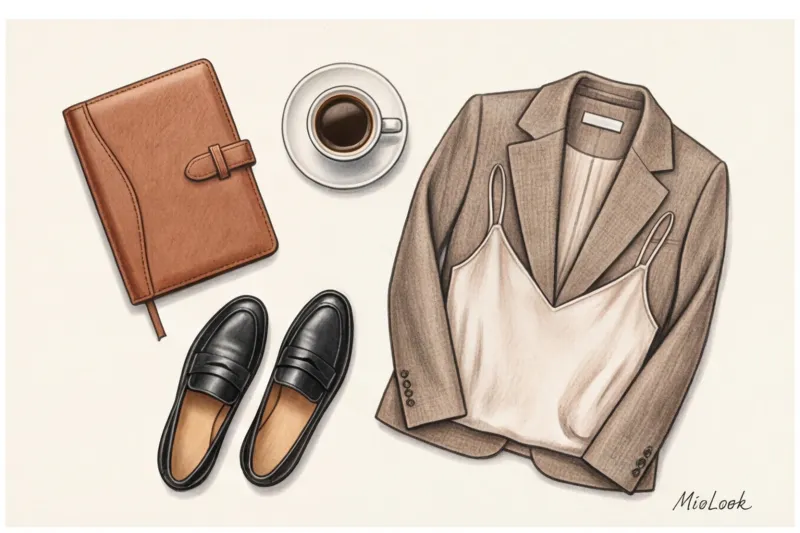
Understanding your "Time Pie" fundamentally changes your approach to shopping. It begins by adapting luxury to reality—a principle I teach all my clients. Imagine: you've purchased a flawless, fine, hand-made silk blouse for €450. The item is objectively beautiful. But if your day involves driving, intensive paperwork, and evening family chores, this blouse will be wrinkled by midday. You'll feel unkempt, and the item will end up in your closet, requiring a complex dry cleaning. It's simply inappropriate for your hectic schedule.
A luxurious, chunky cashmere cardigan with a tight knit from a reputable Italian brand will be a true lifesaver. You get the same premium feel and prestigious texture, but this piece works for you, providing absolute comfort from morning until late at night.
The highest level of mindfulness is developing the concept of a personal "Uniform." Many avoid this term, associating it with boredom or school rules. But in the life of a successful, busy woman, a uniform is a powerful productivity tool. Its main goal is to completely eliminate the fatigue of making decisions in the morning (in cognitive psychology, this phenomenon is known as decision fatigue).
When you have three or four well-established style formulas that 100% cover the sections of your "Time Pie," you stop wasting valuable willpower in front of your closet. My personal work uniform: straight-leg wool trousers with a crease, a sleek cashmere turtleneck, and a structured blazer. It's predictable, it's flawless, and it frees my mind for the things that really matter.
Access to MioLook for €0.99 — one-time payment
A smart AI stylist will select the perfect look based on your real-life rhythm.
Get access — €0.99 onceThe Style Signature Concept: How to Express Your Individuality Without the Words
At the Istituto Marangoni in Milan, where I delved into the philosophy of luxury styling, the professors always emphasized one fundamental idea. The difference between "being fashionable" and "having style" is colossal. Being fashionable simply means having enough budget to buy a total look from the latest Prada or Bottega Veneta collection. Having style means developing your own Style Signature (style signature) that will make you recognizable even from the back, no matter what logo is sewn on the inside of your jacket.
What is a style signature? It's your visual signature, an unwavering constant in a changing world of trends. Think of Anna Wintour: her flawless bob and chunky Chanel sunglasses became a brand in themselves. Or Jane Birkin with her wicker basket, which she wore even in winter, and her flared denim. When clients ask me how to find their own style, I suggest they stop chasing seasonal must-haves and start crafting their own DNA.
The DNA of personal style is always based on three pillars:
- Silhouette. These are proportions that make you feel physically comfortable and that flatter your figure. Your signature silhouette can be architectural and oversized, it can reference the defined waist in the spirit of the Dior New Look, or it can feature a strict, masculine cut.
- Texture. In the premium segment, tactile sensations shape perceptions of status. Thick, flowing silk, grained Saffiano leather, scratchy Scottish tweed, or weightless Mongolian cashmere—your uniqueness often resides in your favorite materials.
- Detail. A cut feature or an indispensable stylistic trick. A slightly upturned shirt collar, casually rolled-up jacket sleeves revealing slender wrists, or a French chic look with an asymmetrically tucked-in sweater hem (French tuck).
To understand which silhouettes and textures really work for you, I highly recommend digitizing your most flattering looks. This is easily done through Smart wardrobe in the MioLook app When you upload your looks, the algorithm clearly shows you which proportions and details you return to most often—that's where your true signature lies.
The Role of Status Accessories in Personal Branding
The Italian school of styling teaches the golden rule: the basics of an outfit can be simple, but the accents must be impeccable. You can wear a simple white T-shirt made of thick cotton and straight-leg vintage jeans, but it's the accessories that will elevate this ensemble from "everyday essentials" to "quiet luxury."
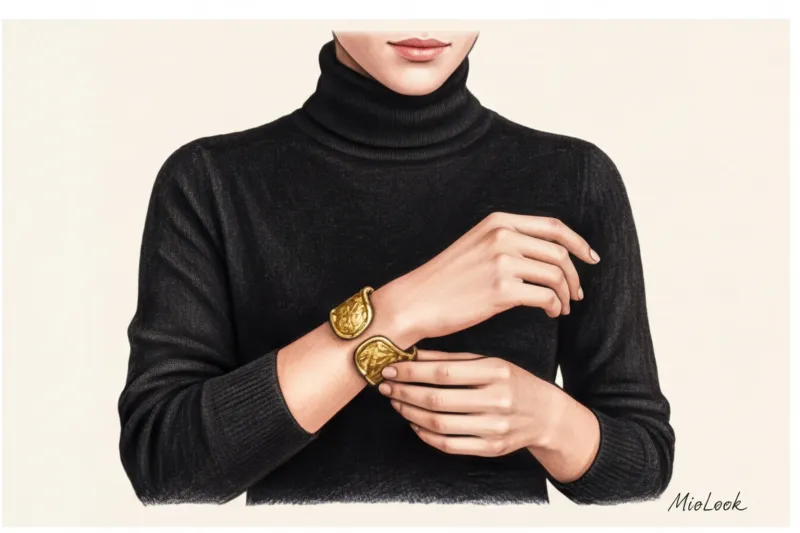
A high-quality bag made of structured leather with fine hardware, a Swiss watch (like a simple Cartier Tank with a sapphire cabochon), or a statement vintage ring are more than just jewelry. They're markers of your taste, telling a story about you even before you speak. At Investment Dressing, we believe it's far wiser to invest €1,500–€2,500 in a single iconic bag, which will develop a refined patina over the years, than to spend the same amount on a dozen trendy polyester day dresses.
Choosing the right accent piece should be a natural extension of your anatomy and lifestyle. If you work a lot on a laptop and type constantly, chunky, jingling bracelets will only irritate you. In that case, opt for statement earrings or a textured silk scarf.
Find one signature accessory that makes you feel underdressed, and make it your signature accessory. Let others subconsciously know: if you see that specific leather cardholder on your desk or hear the gentle jingle of that pendant in the hallway, you've entered the building.
The Mathematics of a Luxury Wardrobe: The Art of Conscious Consumption
The most expensive item in your closet isn't the classic €1,500 trench coat, but that impulse-buy €30 blouse you wore exactly once before it settled on the back shelf forever. When women ask me, How to find your own clothing style and at the same time not go broke in endless experiments, I always suggest putting emotions aside and engaging in merciless mathematics.
Conscious consumption in the premium segment is based on the rule Cost-Per-Wear (CPW – cost per wear). This figure is immediately sobering and proves that high-status, truly high-quality items actually save you money. Let's do the math. Let's say you buy a trendy jacket from a mass-market store for €80. Due to the mediocre cut and thin blended fabric, it loses its shape after the first dry cleaning. Ultimately, you wear it maybe four times. The actual cost per wear is €20.
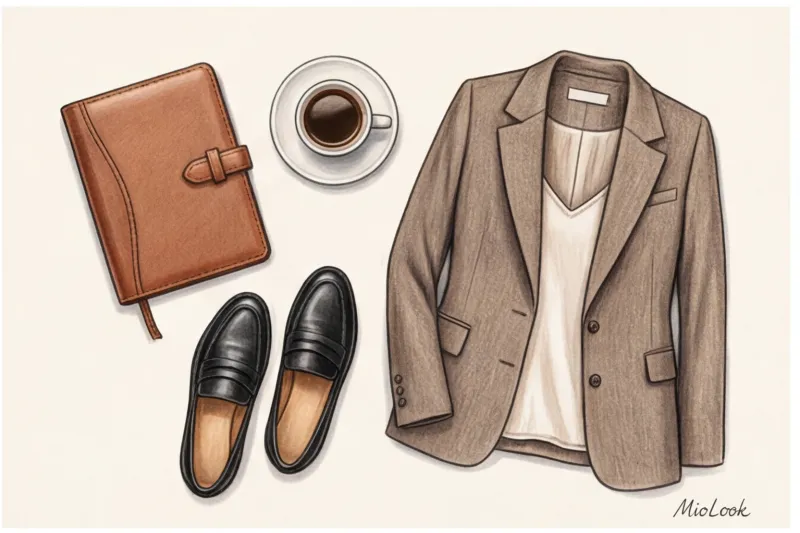
Now let's take a perfectly tailored blazer made of dense merino wool for €600. You make it part of your style uniform and wear it at least twice a week for nine months of the year. Over three years, that's 216 times. The cost per wear drops to €2.77. This luxurious, impeccably fitting item cost you almost 10 times less than the "budget" alternative, yet you looked classy every day.
Developing a personal style isn't about buying everything and hoping the puzzle will fall into place. It's about managing your budget wisely, where you act as a curator: you know exactly which assets will enhance your image for years to come, and which will only bring losses.
What you absolutely must not skimp on
The DNA of a truly expensive look is always hidden in the architecture of the item. First and foremost, it is correct patterns Premium clothing is designed with the complex dynamics of the human body in mind. High, narrow armholes allow you to raise your arms freely without pulling the entire jacket along with you; darts are perfectly positioned, and proper shoulder balance literally maintains your posture. Cheap tailoring, on the other hand, always makes the figure look flat and shapeless.
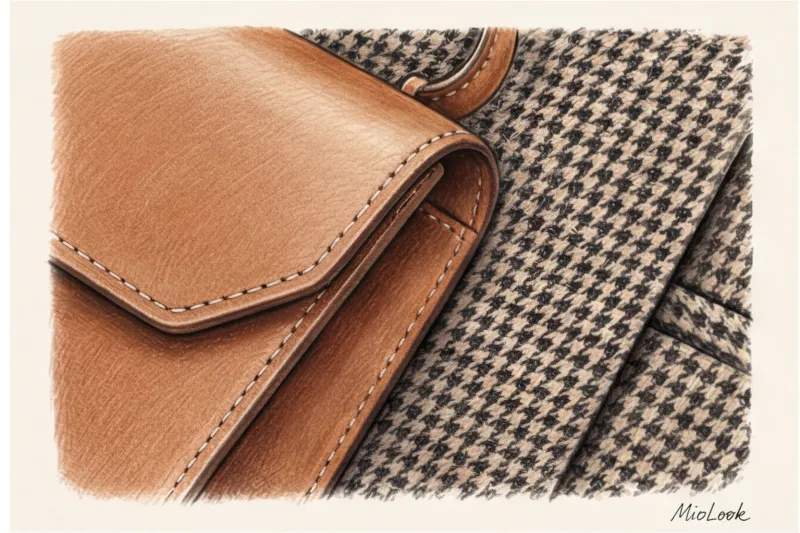
The second unshakable pillar is Italian leather, seams and fittings I regularly see how a perfectly respectable suit's silhouette is completely ruined by flimsy plastic buttons or crooked stitching. True class is revealed by seemingly unnoticeable details: dense, elastic stitching (in the premium segment, this is at least 4-5 stitches per centimeter) and heavy, cast hardware. For example, Swiss zippers. Riri or premium line YKK (Excella) Knives with polished teeth move smoothly, like butter, don't scratch your hands, and last for decades. Meanwhile, cheap metal quickly seizes and oxidizes. The same goes for bags: high-quality leather only develops a noble patina over time, telling your story, while budget faux leather simply cracks and ends up in the trash.
What can you save on?
The ability to mix luxury with affordable brands (the so-called method high-low ) is a sign of the highest level of stylistic mastery. Investing huge sums in every basic T-shirt is pointless. White cotton jersey is essentially a disposable item. A €350 T-shirt from a renowned designer house and a heavyweight equivalent from COS or Uniqlo for €20–25 are equally vulnerable to the occasional coffee stain or foundation mark. Feel free to save on simple tank tops, basic long sleeves, and socks.
The second category for strict savings is trendy one-day items If you're looking to incorporate a trendy neon hue, a complex asymmetrical top, or extremely low-rise trousers into your wardrobe this season, don't buy them from expensive boutiques. Pick up an inexpensive version for €40-€50, play with the new aesthetic for a couple of months, and then recycle it with peace of mind. Your personal style is always based on a fundamental, investment-grade foundation, and micro-trends are only there to add a touch of relevance to that foundation.
Access to MioLook for €0.99 — one-time payment
Start creating perfect looks with AI and easily track the cost per piece (CPW) for every item in your closet.
Get access — €0.99 onceThe Anchor Method: How to Integrate Trends While Maintaining Uniqueness
Have you ever noticed that women who proudly proclaim, "I'm above fashion, I only wear classics," often look a good ten years older than their passport says? This is one of the most insidious pitfalls of personal styling. Completely ignoring current trends is just as dangerous as blindly buying every new seasonal item. In the first case, you risk looking out of date and becoming stuck in the era of your youth; in the second, you completely erase your own individuality. True mastery of... How to find your own clothing style , lies in the filigree ability to balance between the eternal and the momentary.
Let's turn to the analytics. According to the fundamental report McKinsey State of Fashion (2024) , the global vector of consumption in the premium segment has completely shifted. Long-lasting macro-trends like the Quiet Luxury aesthetic and 90s minimalism are now overwhelmingly outsold by fleeting micro-trends from TikTok, whose lifespans have shrunk to a disastrous two to three weeks. Analysts are clearly pointing out that investing in eccentric, one-time-only items isn't just unsustainable; it's a grave financial mistake.
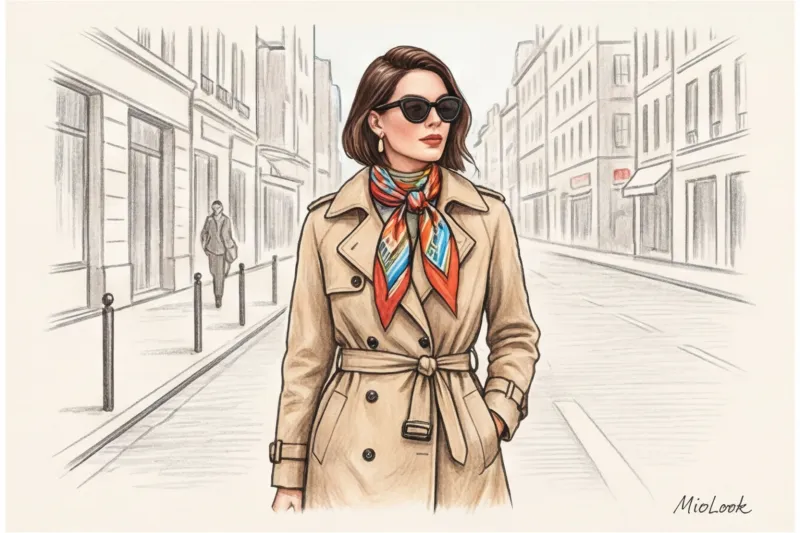
So how do you refresh your wardrobe without breaking the bank? I incorporate a concept I call the "Anchor Method" into my clients' wardrobes. The architecture of this approach is built on strict proportions: 80% of your closet consists of a consistent signature staple (your personal stylistic anchors—a perfectly fitting jacket, the perfect denim, the right weight cashmere), and the remaining 20% is left to seasonal trends. It's this 20% that prevents your look from becoming stale and shows others that you're in tune with the times.
The most elegant way to test new stylistic trends is through accessories and beauty details. You don't necessarily need to buy a deconstructed €900 down jacket to embrace the season's avant-garde spirit. Simply integrate the trend in microdoses: through a complex manicure, an unusual leather belt texture, or a trendy sunglasses shape. These details are placed in the portrait area or at key points of articulation; they're instantly noticeable without disrupting your established style.
If you're worried about disturbing the harmony of proportions, try putting together complex looks virtually. After uploading your basic pieces, MioLook smart wardrobe , you can visually layer trendy accessories before shopping. This will prevent you from making impulse purchases that then sit on the shelf for years with the tags still attached.
The key rule of integration: a trendy, one-off piece should always be paired with your most expensive or high-quality basics. Trendy plastic glasses or a statement belt instantly gain status when paired with a perfect silk top, not a polyester T-shirt.
Next fashion season, before you give in to the urge to buy a suit in a trendy but unusual shade, simply buy nail polish or a scarf in that color. If this micro-trend starts to irritate you after two weeks, congratulations – you've just saved yourself a significant amount of money and protected your style DNA from foreign interference.
A Digital Approach to Style: How AI and Clothing Tracking Help You Find Yourself
Sociologists from Yale University recently published a fascinating study: the average woman regularly uses only 15 to 20 percent of her closet's contents. This confirms a key problem with modern consumerism: we often think we're wearing one thing, but in reality, we're wearing something completely different. This leads to the so-called "wardrobe blind spot" problem.
You might be absolutely certain you're constantly rocking those stunning wool palazzo pants. But the reality is this: you only wore them three times all fall, while you wore that basic cashmere jumper forty times. Our memory is biased. We remember the vivid emotions of a prestigious purchase or a special occasion, not the boring routine of choosing clothes every day.
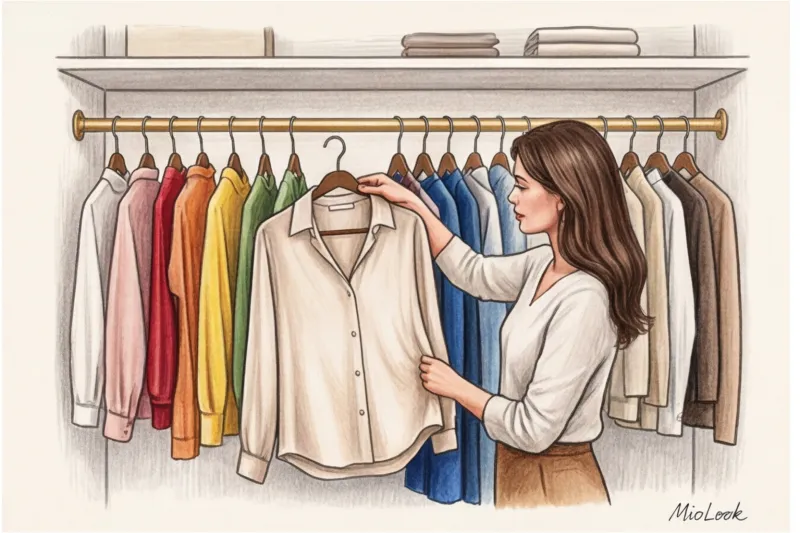
That is why the answer to the question of whether How to find your own clothing style Today, the key to success lies not in fashion magazines, but in precise data. Digitizing your wardrobe is a process of removing illusions. When you see the raw math—how many times a particular item has been worn—you begin to understand your true style DNA. If a €450 designer jacket leaves your closet twice a year, it's a failed investment. But if a €120 silk scarf complements every third outfit, it truly is your style signature. Understanding your true wear statistics helps you hone your personal style, ruthlessly cutting out anything imposed by fleeting trends.
"Your real style isn't what you save on Pinterest boards. It's what you wear on a rainy Tuesday morning when you have exactly five minutes to get ready."
I had a very revealing case with a client who was a top manager. She was absolutely convinced that her style was strict. corporate chic (corporate chic). We agreed to conduct an experiment and use MioLook smart wardrobe manager to track the most frequently worn items for two months. My experience using the app once again served as a clear confirmation of the Pareto principle in real women's wardrobes. Analytics showed that 80% of the time she wore relaxed smart casual — loose merino knit two-piece suits and suede loafers. Her perfectly tailored jackets simply hung like dead weight, creating that very same blind spot.
This digital audit allowed us to completely rethink her shopping strategy. We stopped buying structured suits and redirected our budget toward premium knitwear and high-quality shoes. Moreover, algorithms make capsule collections effortless: the AI itself suggests combinations of items that have already proven their effectiveness and comfort in practice.
Tracking your clothes transforms your closet from a chaotic mess of emotions into a manageable investment portfolio. You stop wondering what you're missing because the numbers provide a clear and uncompromising answer.
Your ideal image
it begins Here
Join thousands of users who look flawless every day with MioLook.
Get access — €0.99 onceStep-by-step plan: how to find your clothing style in 30 days
In the exclusive styling agencies of Paris and Milan, there's a strict rule: before taking a premium client on their first shopping trip, we take a break for exactly one month. Theory without practice is dead. You can thoroughly study the architecture of cuts, color theory, and the concept of the "Perfect Day," but until you physically declutter your visual and everyday space, this new knowledge won't work. The habit of impulsive clothing buying is formed over years, and it takes time for the brain to break this neural pattern.
Below is my professional algorithm—the very protocol I use with clients before making a major investment in their new wardrobe.
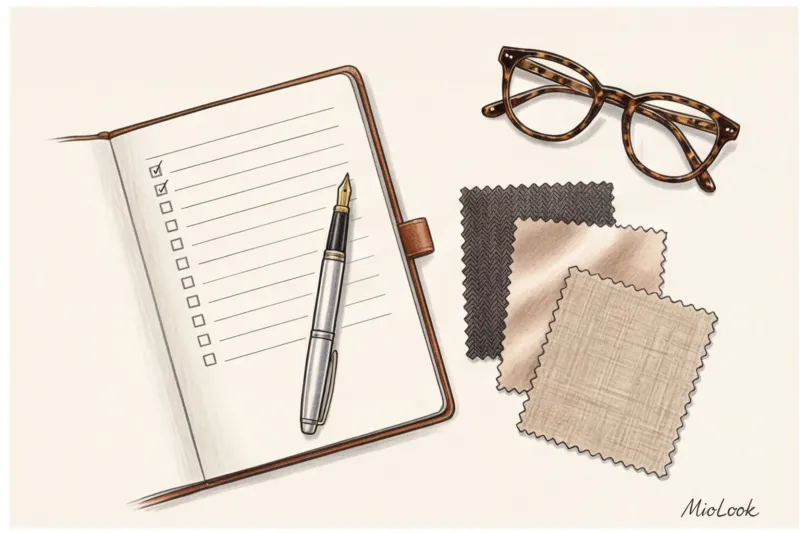
Step 1: Digital Detox (Days 1–3)
The first thing I ask you to do is open your social media subscriptions and ruthlessly unfollow influencers whose style is completely incompatible with your lifestyle. If you're the head of a conservative business, it won't help to be constantly exposed to street style bloggers' looks from Fashion Week, complete with feathers, deconstruction, and micro-shorts. Foreign contexts confuse your inner focus. Once you eliminate this visual noise, you'll stop craving a neon micro-bag just because it flashed across your feed ten times this morning. Follow only those whose aesthetic resonates with your reality.
Step 2: Moodboard of Feelings, Not Things (Days 4–7)
A common mistake when trying to figure out how to find your personal style is collecting pictures of specific items (a beige trench coat, straight-leg jeans, a white shirt). I suggest creating a mood board. sensations Ask yourself: "What impression do I want to make when I walk into the room?" Conjure up associations: the texture of coarse linen, stills from old French films, strict architectural lines, the color palette of a twilight sky or morning espresso. Your future style should convey a state of mind—be it relaxed chic, intellectual sexiness, or dynamic austerity.
Step 3: A Hard Closet Overhaul (Days 8–14)
There are no half measures here. We remove from sight anything that raises the slightest doubt: items that are "waiting to lose weight," itchy sweaters and dresses bought in a fit of passion on sale and never worn. Keep only what makes you feel flawless today. To prevent this process from turning into chaos, I always advise clients to simultaneously upload the remaining "golden base" into MioLook smart wardrobe manager Seeing your actual, decluttered asset on your smartphone screen, you instantly calculate which DNA elements you're missing to complete your images.
Step 4: Forming a “Trial Uniform” (Days 15–21)
Choose one stylistic formula from the remaining pieces that feels most comfortable and reflects your new mood board. For example: wide-leg wool trousers + smooth knit turtleneck + statement belt. Wear this formula (changing only colors or micro-details) for a whole week to work and meetings. Your goal is to track how viable this silhouette is in practice. Does it allow you freedom of movement? Does it relieve morning decision fatigue? This step is a rigorous test of your stylistic hypothesis.
Step 5: Buying Your First Investment Item (Days 22–30)
Only after three weeks of analysis do we move on to purchasing. Your goal is to acquire exactly one An investment piece that will become the foundation supporting your new style DNA. It could be an impeccably tailored €500 jacket made of a dense wool blend that immediately gathers the shoulders, or a pair of state-of-the-art, handcrafted loafers for €350. The key requirement is that the item be of the highest quality (within your budget) and 100% in line with your mood board. This single purchase will set a new standard for your entire wardrobe—you'll never want to wear that luxurious jacket with a cheap polyester T-shirt.
“Style is a way of saying who you are without saying a word,” is a phrase often attributed to Rachel Zoe, and it’s incredibly accurate in the context of an investment approach.
Building a personal brand through your wardrobe is a curated process, not a trend-following one. Stop seeking salvation in universal lists of "10 essential items every woman should have." They don't exist. Only you, your ambitions, your rhythm of life, and your unique anatomy exist. Once you allow yourself to rely on these constants, the question of "what should I wear" will disappear from your morning routine forever, giving way to confidence and impeccable taste.
Guide Chapters
How to Find a Style Icon: Analysis Without Blind Copying
We're learning to analyze celebrity looks without looking like a costume. Stylists' tips on how to adopt the vibe and style cues of your favorite stars.
How to Mix Styles: Stylists' Advice
Perfectly matched tone-on-tone pieces only make your look look older. Learn proven formulas from a stylist that will help you easily combine seemingly incompatible items.
The Psychology of Clothing Style: Why We Wear What We Wear
A wardrobe isn't just a collection of clothes, but a complex interface with the subconscious. Find out why we feel like we have nothing to wear and how clothes change our state of mind.
Style crisis: what to do if you don't like your wardrobe
Is your closet bursting with clothes, but none of them make you happy? We explore the psychological causes of a style crisis and share the right course of action.
Fashion Aesthetics: A Complete Guide to Microtrends
Clean Girl, Old Money—modern styles are changing at an alarming rate. We'll figure out how to adapt microtrends without losing your touch.
How to Make a Basic Wardrobe Fun: Stylist Tips
Forget the "just add a bright bag" rule. We'll explore how to add personality to minimalism with the right cut and play with textures.
How to Create a Style Mood Board: Pinterest for Your Wardrobe
Why aren't saved Pinterest pins helping you dress better? We'll explore how to bridge the gap between your fashion fantasies and your actual closet.
How to choose a clothing style based on your lifestyle every day
Is your closet overflowing with clothes? Learn how to stop buying clothes for a fantasy life and adapt your wardrobe to your real-life routine.
How to Create Your Own Style: Stylist Secrets
A signature style isn't about flashy accessories, but rather about your organic micro-habits. Learn how to find the detail that will become your calling card.
12 Clothing Style Archetypes: How Your Wardrobe Dictates Your Personality
Why does archetype theory work better than classic color and body types? Discover how your inner values dictate your ideal wardrobe choices.
Fashion Style Formula: Creating Your Own Uniform
Tired of wondering what to wear every morning? Learn how an engineering approach can help you put together a basic outfit and solve the problem of a full closet once and for all.
How to Change Your Style in Your 30s: Stylist Tips
Turning 30 isn't a reason to settle for boring classics. Learn how to find your unique style and avoid the most common wardrobe mistakes.
A neural network will help you choose a clothing style better than a stylist
Is your closet overflowing with clothes, but you still have nothing to wear? Find out how artificial intelligence is changing the rules of fashion and helping you create the perfect wardrobe.
Clothing Style Quiz: How to Find Your Aesthetic
Most online style quizzes force you into a box and force you to buy things that won't last. Learn how to define your true aesthetic without the clichés.